Jun 27. 2020Deputy Prime Minister Somkid Jatusripitak, left and Finance Minister Uttama Savanayana.
By The Nation
In a meeting with the public-private partnership (PPP) committee on Friday (June 26), Deputy Prime Minister Somkid Jatusripitak called on state enterprises to take action after PPP projects worth a combined Bt1.09 trillion have stalled due to the Covid-19 outbreak.
He said a little delay is acceptable, but projects should not be postponed by a year. Several PPP investment projects have not been able to get off the ground for six to 10 months.
Somkid also said he had met with executives of PTT and the Electricity Generating Authority of Thailand on Thursday and asked them to speed up their investment by bringing next year’s projects forward. The investment should also focus on creating more jobs, he said.
His statement reflects concerns about rising unemployment due virus-induced business shutdowns and sharp economic contraction. The Bank of Thailand recently predicted that the Thai economy this year will shrink 8.1 per cent, the worst ever recorded in history.
He said that PPP investments should not just concentrate on infrastructure projects, but should also cover social projects, services, medical services, education, public health, tourism and agricultural projects. He also asked the Board of Investment (BOI) to offer more incentives so these projects can lure private investors.
Meanwhile, Finance Minister Uttama Savanayana said the Covid-19 pandemic was the main cause for the delays, adding that the plan was to always push for domestic investment in order to boost the economy amid export contraction.
Prapas Kong-led, director general of the State Enterprise Policy Office, said up to 90 PPP projects are in the pipeline worth Bt1.09 trillion.
He said 18 of these projects worth a combined Bt472 billion were on the priority list, and of them, 10 had been delayed by the impact of Covid-19.
Separately, the PPP committee on Friday approved rules and regulations for PPP projects worth less than Bt5 billion, which is expected to facilitate more investment cooperation between the public and private sectors.
Positive sentiments pushed the Stock Exchange of Thailand (SET) Index up by 4.46 points or 0.34 per cent today (June 26), closing at 1,330.34, while total transactions amounted to Bt47.193 billion with an index high of 1,344.04 and a low of 1,328.49.
During the morning session, a Krungsri Securities stock analyst said he expected the index to fluctuate between 1,315 and 1,340.
“The market won positive sentiment after the European Central Bank gave central banks the go-ahead in lending cash to mitigate the Covid-19 impact and the mass buy-offs of stocks,” the analyst said.
“Meanwhile, Larry Kudlow, director of the US National Economic Council, has said that the US will not impose lockdown measures again even though the number of new Covid-19 cases is rising sharply.”
However, the analyst warned of uncertainty from economic recession after the International Monetary Fund revised the global GDP this year from 3 per cent contraction to 4.9 per cent contraction.
“The index will also be under pressure from foreign investors’ move to reduce capital flow into the country.”
The top 10 stocks with the highest trade values today were GULF, CPALL, ADVANC, KBANK, AOT, PTT, SCC, GPSC, CPF and INTUCH.
As of 4.30pm, crude oil price rose by US$0.57 or 1.47 per cent to $39.29 per barrel, while gold price dropped by $3.60 or 0.20 per cent to $1,774.20 per ounce.
Asian indices, meanwhile, were mixed:
Japan’s Nikkei Index closed at 22,512.08, up 252.29 points, or 1.13 per cent.
Hong Kong’s Hang Seng Index closed at 24,549.99, down 231.59 points, or 0.93 per cent.
South Korea’s KOSPI Index closed at 2,134.65, up 22.28 points, or 1.05 per cent.
Stock markets in China and Taiwan were closed due to the Dragon Boat festival.
The Stock Exchange of Thailand (SET) has extended uptick rules on short-selling and the ceiling and floor prices of stocks to September 30 from June 30 this year to mitigate the impact from market volatility.
Meanwhile, the Thailand Futures Exchanges also has extended the rule on daily price limit of SET50 Index Futures, SET50 Index Options, Sector Futures, and Single Stock Futures to September 30 from June 30.
SET officials said that the move had been approved by the Securities and Exchange Commission after hearing comments from related parties.
“The SET had announced these rules since the middle of March to mitigate the impact from market volatility due to the Covid-19 outbreak,” the officials said.
“However, the market is still facing high volatility due to Covid-19 and uncertainties for the global economy.”
The price of gold was unchanged in morning trade on Friday (June 26), the Gold Traders Association reported.
As of 9.29am, buying price of a gold bar was Bt25,700 per baht weight and selling price Bt25,800, while gold ornaments were priced at Bt25,421.40 and Bt26,300, respectively.
The Gold Spot Index price this morning moved to around US$1,762 (Bt54,423) per ounce after the price dropped by $4.5 to $1,770.6 per ounce at Thursday’s close (June 25) due to the strengthening dollar.
However, the price of gold dropped slightly after the US revealed weak economic data.
The Stock Exchange of Thailand (SET) Index opened at 1,337.65, up 11.77 points, or 0.89 per cent, on Friday morning (June 26).
A stock analyst at Krungsri Securities expected the index to fluctuate between 1,315 and 1,340.
“The market gained positive sentiment from the European Central Bank allowing central banks outside the euro-zone to lend cash to mitigate the Covid-19 impact and mass buy-offs in stocks as window dressing,” the analyst said
“Meanwhile, Larry Kudlow, director of the US National Economic Council, revealed that the US government will not impose lockdown measures again although the number of new Covid-19 cases in the country were increasing sharply.”
The analyst, however, said that uncertainty following the economic recession after the International Monetary Fund cut the global gross domestic product this year from contracting 3 per cent to contracting 4.9 per cent would plunge the index.
“In addition, the index would be under pressure from foreign investors’ move to reduce capital flows into the country.”
He recommended the following stocks:
▪ Defensive stocks, such as INTUCH,TTW, and DIF.
▪ Stocks that were added to the SET50 and SET100 calculations — BPP, TTW, ACE, BFIT, DOHOME, RBF, SIRI, SISB, SPCG, TVO, and WHAUP.
The SET Index fell by 7.55 points on Thursday (June 25), closing at 1,326. Total transactions amounted to Bt60 billion.
Foreign investors made net sales of Bt740 million in stocks, but made net buys of Bt1.754 billion in bonds. There were 5,141 net long TFEX SET50 contracts.
By The Washington Post · Renae Merle, Rachel Siegel · NATIONAL, BUSINESS, HEALTH
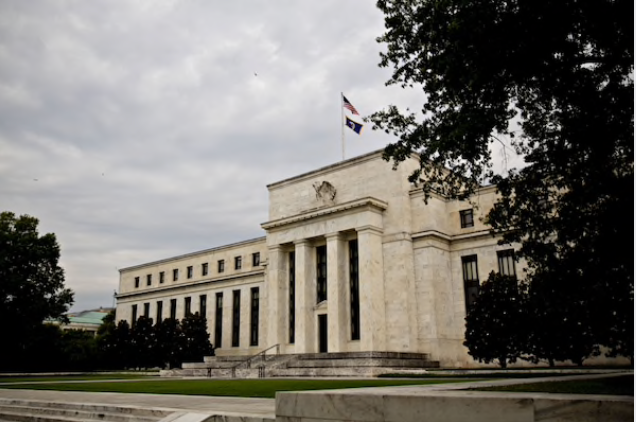
WASHINGTON – For the first time since the aftermath of the global financial crisis, the Federal Reserve is putting new restrictions on how the country’s biggest banks spend capital with an eye toward protecting the financial system from risks to the economy posed by coronavirus pandemic.
The Federal Reserve ordered the country’s 34 biggest banks, including JPMorgan Chase, Wells Fargo and Bank of America, to suspend their stock buyback programs and to limit dividend payments to shareholders. The banks must also submit new plans for maintaining enough of the they capital needed to survive a downturn.
Most banks are in good shape now, the Fed’s Vice Chair Randal Quarles said in a statement. “The banking system remains well capitalized under even the harshest of these downside scenarios-which are very harsh indeed,” Quarles said.
However, if there is slower U-shaped recovery or a W-shaped scenario where a brief recovery is followed by a harsh second drop later this year, “several (financial firms) would approach minimum capital levels,” according to a Fed statement. The banks reviewed could incur loan losses of $560 billion to $700 billion under some scenarios, the Fed found.
The hopeful outlook was not shared by all Federal Reserve Board members. Federal Reserve Gov. Lael Brainard wrote a separate statement calling on the Fed to block dividend payouts to shareholders during the third quarter, not just limit them.
“I do not support giving the green light for large banks to deplete capital, which raises the risk they will need to tighten credit or rebuild capital during the recovery. This policy fails to learn a key lesson of the financial crisis, and I cannot support it,” wrote Brainard, who was appointed by President Obama.
The Fed’s decision adds to the already-bleak reality gripping the American economy during the worst recession since the Great Depression.
More than 30 million Americans have claimed unemployment benefits as of last week, and more major companies keep filing for bankruptcy each week. Despite trillions of dollars in government stimulus and unprecedented intervention from the Fed, many say an economic recovery hinges most on more federal assistance and a vaccine or cure to end to the coronavirus pandemic.
This recession marks the first big test of banking industry reforms put in place after the financial crisis. The banking industry has emphasized that it has significantly more capital to weather a downturn and has not stopped lending to corporations or retail investors.
But some regulators have warned that after years of record profits, the banking industry could be hit hard depending on how long this downturn persists.
“If this goes on long enough, it could produce strains in the banking sector. And then the Fed and Congress and Treasury would have to step in to make sure that the banks are sound,” Neel Kashkari, the head of the Federal Reserve Bank of Minneapolis, said on “Face the Nation” in April.
The Fed typically conducts a “stress test” to assess whether the largest banks could survive a hypothetical economic crisis without needing a taxpayer bailout or being forced to stop lending. The hypothetical scenario for this year’s traditional stress was published in February, just as the coronavirus pandemic and its economic devastation began to take hold.
The Fed quickly realized that the extreme scenario it had dreamed up paled in comparison to the escalating crisis. The typical test looks at how the banks would perform, for example, if unemployment spiked to 10 percent. Now, the official unemployment rate is 13.3 percent, and the real rate is likely 3 percentage points higher.
The Fed then developed a coronavirus-specific test it used to shape its policy on payouts of shareholder dividends.
The Fed’s approach has been met with its share of criticism. For example, the traditional test typically include data specific to large banks, with a spotlight on specific banks that need work. But this new test aggregated data comparing how the banking system would fare as a whole.
Three Democratic senators said it was “highly disconcerting” that the test would not include bank-by-bank results. In a Tuesday letter to Fed Chair Jerome H. Powell and Quarles, Sens. Brian Schatz, Sherrod Brown and Elizabeth Warren said “transparency surrounding the results of the tests is a bedrock principle of the stress testing framework.”
“This decision could undermine confidence in the banking system,” the senators wrote.
The letter also raised concerns about bank capital requirements being tied to the results of the traditional stress test from earlier this year. Not basing those requirements off the coronavirus-specific sensitivity analysis, the senators wrote, could lead to “lower than appropriate” guidelines that don’t match the current reality.
Failing to disclose the individual results of each bank could also mask weaker financial institutions from needed scrutiny, said Gregg Gelzinis, a senior policy analyst for the Center for American Progress, who called the decision a “critical weakness.”
“This is going to undermine the usefulness of the results,” Gelzinis said.
Eight of the country’s biggest banks, including JPMorgan Chase and Bank of America, had already suspended buybacks earlier this year as the economy slowed down due to the coronavirus. But bank CEOs have defended their need to continue dividends.
“From our perspective, our dividend is sound, and we plan on continuing to pay it,” Citigroup CEO Michael Corbat told CNBC this week.
Among America’s biggest banks, JPMorgan Chase and Wells Fargo have paid out the most in dividends to shareholders since 2008, about $80 billion each, according to S&P Global Market Intelligence data. Bank of America and Citigroup paid out about $52 billion and $30 billion, respectively, during that period.
Wells Fargo CEO Charles Scharf said in April that dividends were important to shareholders: “If they [companies] have ability to pay, it’s the right thing to do,” he said.
Still, given such extreme uncertainty about the economy’s future, advocates say the Fed should be more stringent. Dennis Kelleher, chief executive of Better Markets, which advocates stronger market regulation, said the Fed shouldn’t allow any capital distributions by banks for at least a year.
“These aren’t just stress tests for Wall Street banks. These are credibility tests for the Fed,” Kelleher said.
Some Democrats and advocacy groups have also called on federal regulators to halt regulatory rollbacks launched under the Trump administration, warning that they could weaken banks during a deep economic downturn. Separately on Thursday, the FDIC finalized a rollback of a key post-financial crisis restrictions on risky trading, known as the Volcker rule.
“Trump’s financial regulators are not letting the pandemic and the economic catastrophe get in the way of their deregulatory agenda,” Kelleher said.
The banking industry had complained for years that the rule was too cumbersome. The changes adopted by the FDIC “will allow banks to further support the economy at this challenging time for the nation,” Rob Nichols, president of the American Bankers Association, said in a statement.
By Syndication Washington Post, Bloomberg · Claire Ballentine, Amena Saad · BUSINESS
U.S. stocks climbed the most in more than a week as investors weighed the prospects for additional stimulus against the spike in American virus cases. Crude oil snapped a two-day slide and the dollar strengthened.
The S&P 500 jumped in the last hour of trading after fluctuating for most of the session to finish up 1.1%. The index is clinging to a monthly gain after one of the highest-ever increases in U.S. cases prompted Texas and Florida to halt the next phases of the reopening of their economies. Banks surging 2.7% after regulators eased rules that will free up capital. Investors also grappled with a mixed batch of economic data, after initial jobless claims topped estimates at almost 1.5 million.
“The market is trying to digest what the timeline is, and also measuring monetary stimulus and future fiscal stimulus as well,” said Chad Morganlander, senior money manager at Washington Crossing Advisors. “There are a lot of unknowns but yet, we have to believe that the monetary backdrop as well as fiscal backdrop will support the market, so we’re a little bit more optimistic over the next 18-24 months.”
In Europe, stocks swung from a loss to close higher, with Deutsche Lufthansa AG rallying as its biggest shareholder backed a government rescue package. Shares in German fintech Wirecard AG collapsed after it filed for insolvency. Core European bonds gained.
Worries over lockdowns being reimposed and economies reopening more slowly has hurt sentiment, as investors weigh reports of new daily records for infections. Meanwhile, health leaders called on the U.K. to prepare for a possible second wave, and Australia recorded its largest spike in cases since April.
“The market really got the shivers over the prospect of a big increase in covid and maybe starting to see places that were opening up have to close up,” Margie Patel, portfolio manager at Wells Fargo Asset Management, said on Bloomberg TV. “We’ve had such a great run from the end of March it’s only inevitable that we should get at least a little step back.”
Elsewhere, stocks in Asia fell the most in almost two weeks. China and Hong Kong were shut for holidays. West Texas crude oil rose, while gold reversed an earlier gain.
These are some of the main moves in markets:
Stocks
The S&P 500 Index advanced 1.1% to 3,083.76 as of 4:04 p.m. EDT, the largest gain in more than a week.
The Dow Jones industrial average advanced 1.2% to 25,745.60, the biggest gain in more than a week.
The Nasdaq Composite Index gained 1.1% to 10,017.
Currencies
The Bloomberg Dollar Spot Index advanced 0.1% to 1,218.48.
The euro decreased 0.2% to $1.1226.
The Japanese yen depreciated 0.1% to 107.12 per dollar, the weakest in more than a week.
Bonds
The yield on two-year Treasurys fell less than one basis point to 0.18%, the lowest in two weeks.
The yield on 10-year Treasurys gained less than one basis point to 0.68%.
Britain’s 10-year yield decreased four basis points to 0.154%, the lowest on record.
Commodities
West Texas Intermediate crude advanced 2.7% to $39.05 a barrel, the biggest gain in more than a week.
Jun 26. 2020Deputy Prime Minister Somkid Jatusripitak called on state enterprises to make smart investments that make money and can help the economy.
By The Nation
At a meeting held to discuss economic stimulus measures with the Energy Ministry, Deputy Prime Minister Somkid Jatusripitak came up with an “energy to create Thailand” policy for state enterprises such as PTT and the Electricity Generating Authority of Thailand (Egat) to follow.
Somkid said that since there is a global slowdown due to Covid-19, PTT should adjust its approach and accelerate investment this year and the next, as well as make sure it does not miss the target. PTT should also find new sources to boost employment through options like connecting agriculture and tourism.
Meanwhile, he said, Egat is a strong organisation and has made sacrifices this year by reducing the cost of power. However, Somkid said, Egat needs to come up with ways of looking after the unemployed and further reducing the cost of electricity, natural gas, NGV and LPG. He also said that the Energy Ministry should work with the Transport Ministry to make public buses cheaper.
Meanwhile, Energy Minister Sonti Sontijirawong said his plans focus on reducing the cost of living and creating revenue for people amid the Covid-19 fallout.
Energy Minister Sontirat Sontijirawong has come up with a plan to boost grassroots economy as well as create new jobs.
The ministry has divided its stimulus measures as follows:
• Spending more than Bt40.5 billion to ease people’s burden by reducing household electricity bills, keep household gas (LPG) affordable until September (extending this subsidy to December is being considered) and providing NGV support for public vehicles until the end of July among others.
• Expediting the investment of more than Bt200 billion this year to create more than 10,000 jobs. The ministry will also launch a new round of exploration and production this year, as well as invest in modernising the grid to help Thailand become an LNG hub and study the possibility of connecting the grid to neighbouring countries.
• Spending more than Bt30 billion to stimulate the economy in post-Covid era by generating revenue for companies and creating more than 8,000 jobs. Egat will stimulate trade through online markets, communities, power plants and trips to dams and reservoirs nationwide. PTT, meanwhile, will create a Living Community Marketplace, promote domestic travel by launching a “Blue Card” and stimulate the economy through funds to promote energy conservation. There are also plans to expand power transmission lines to divert the river to the Bhumibol Dam, which should also help ease drought conditions.
Sonthirat said his ministry is planning to invest in a 700-megawatt community-based project to boost grassroots economy and expects a Cabinet approval on June 30. The ministry will then open bid for a “Quick Win” programme for 100MW from July 1, announce winners by mid-August, and start construction at the beginning of next year.
As for the 600MW general community-based power plant, it should be open for registration between October and December. This power plant is expected to create more than 10,000 jobs.
Jun 26. 2020Samy Chaar, chief economist at Lombard Odier & CIE SA, says the bank prefers not to invest in emerging markets, especially in bank shares, energy or business sectors of the old economy.
By The Nation
Foreign equities are becoming more attractive to Thai investors because the Thai economy is unlikely to recover from the Covid-19 crisis any time soon, according to the Kasikornbank Private Banking Group.
Jirawat Supornpaibul, chief of the Kasikornbank Private Banking Group, said on Thursday (June 25) that the economy may start to pick up as the government relaxes lockdown restrictions, but it will take a long time before it fully recovers or returns to where it was in the pre-Covid-19 period.
Against this backdrop, KBank Private Banking has been diversifying its investment overseas. On shore investments do not look bright due to limited options, which is why the group is shifting investments abroad, he said at a webinar on “Tracking the Recovery and the World after Covid-19”.
He predicted that the Stock Exchange of Thailand index may rise about 5 to 10 per cent from the current level, but it will be subject to high volatility. Since the economy will recover slowly, the annual returns for Thai equity investment will be between 3 and 4 per cent or a little higher, he said, while returns from bank deposits will be even lower.
Siriporn Suwannagarn, financial advisory head for the group, said as Covid-19 subsides, the group has cash in hand for about 5 to 11 per cent of its total portfolio and has started using it to invest in global equities and investment funds in both Asia and Europe. The group has also been investing in property funds and gold for use as hedging instruments against risks.
Meanwhile, Samy Chaar, chief economist at Swiss Private Bank Lombard Odier & CIE SA, said global recovery will look like the Nike swoosh – initial recovery being V-shaped during the reopening of cities before the rate decelerates. He also said that it will take two to three years before the economy can return to pre-Covid levels. Inflation, meanwhile, will be low, interest rates may fall into the negative territory, and the gap between the rich and poor will become wider.
If there is a second wave of infections, then the economy will be in an L-shaped slump for a long time, he warned.
Risks could also come from trade tensions between China and the US. Also, if many countries bring their fiscal and monetary expansions to an end too soon, then the global economy will go into recession, he said.
With slow recovery, Lombard Odier reckons that equities and debentures will be more attractive than bank deposits and short-term debt instruments, he said.
Equities must be related to technology, especially digital industry, senior citizens and environment to name a few.
He also advised investment in gold and government bonds until the end of the year as an insurance against market volatility.
‘We like equities in US and Asia, especially growth stock associating with new technology, we do not like emerging market’s stocks in particularly bank shares, energy or business sectors in the old economy. We are also interested in debentures and government bonds due to increasing yields,” he said.
For currencies, he said the Japanese yen was attractive, while US dollar may become weaker as US rates may no longer rise.
Jun 26. 2020A person rides a bicycle along a nearly empty Houston Street Viaduct in Dallas, Texas, on April 15, 2020. MUST CREDIT: Bloomberg photo by Rebecca Smeyne.
By Syndication Washington Post, Bloomberg · Rich Miller · NATIONAL, BUSINESS, US-GLOBAL-MARKETS The U.S. economic recovery is showing incipient signs of weakening in some states where coronavirus cases are mounting.
The ebbing is evident in such high-frequency data as OpenTable restaurant reservations and follows a big bounce in activity as businesses reopened from lockdowns meant to check the spread of Covid-19.
“We’re now starting to see very early evidence that things are leveling off” in some of the states that reopened first and are now suffering rising virus cases, said Michelle Meyer, head of U.S. economics at Bank of America.
The result, she said, is likely to be an uneven recovery, even as gross domestic product rapidly rebounds next quarter from what will probably be the steepest nosedive since the Great Depression. “It’s going to be fits and starts,” she said. “It’s not going to be a smooth path.”
Jobs data on Thursday reflected that. Applications for unemployment benefits were higher than forecast for a second week, clocking in at 1.48 million after an upwardly revised 1.54 million in the prior period. The median forecast called for 1.32 million. Continuing claims, however, declined more than estimated — to 19.5 million in the week ended June 13.
“The stickiness that we see in claims is a reason to be concerned,” Meyer said even before the latest report. “It tells you there’s still some firing going on” even as the economy reopens.
Among America’s most-populous states, Texas, Florida and California are experiencing a surge in coronavirus outbreaks even while others, including New York, see declines. Overall, counties accounting for between one-third and one-half of U.S. GDP are suffering from worsening trends in new cases or Covid-19-related deaths, according to research by Deutsche Bank economists.
The S&P 500 Index slumped 2.6% and Treasury yields fell on Wednesday as investors grew anxious about the economy’s prospects.
“We’re playing mediocre Whac-A-Mole” in controlling the disease, former Treasury Secretary Lawrence Summers said.
He told the Economic Club of New York on Wednesday that 30% of the economy will need to be shut back down — either by government decree or by people and companies acting on their own — to prevent the pandemic from getting out of control.
The fading economic momentum already evident in states with more virus cases is occurring even though the authorities there have not re-imposed shutdowns, though they may eventually do so. Instead, the shift appears to reflect increased caution by consumers and businesses in the face of the contagion.
“The public is not psychologically immune to Covid-19 and will retrench if the virus starts spreading again, regardless of government restrictions (or lack thereof),” Jefferies economists Aneta Markowska and Thomas Simons wrote Wednesday in a note to clients.
That’s particularly the case for older Americans, who are in greater danger of dying from the virus if they contract it.
“The baby boomers account for something like 30% to 35% of consumer spending in this country,” Peter Hooper, global head of economic research for Deutsche Bank, said Wednesday on Bloomberg Television. “If this virus continues to get worse, consumer spending is not going anywhere down the road.”
This, in turn, would create “real problems” for many U.S. businesses with low profit margins because they would still have to operate well below capacity due to limited consumer demand, according to JPMorgan Chase Chief U.S. Economist Michael Feroli.
Recurring coronavirus outbreaks could mean restrained economic expansion and elevated unemployment for years, according to Federal Reserve Bank of Chicago President Charles Evans.
“My forecast assumes growth is held back by the response to intermittent localized outbreaks — which might be made worse by the faster-than-expected reopenings,” Evans said Wednesday in remarks at a virtual event.
What seems to have happened, some economists say, is that a number of states restarted their economies prematurely, paying little heed to guidelines from the Centers for Disease Control and Prevention.
That led to the earlier and stronger recovery in economic activity seen in recent national statistics. But it also raised the risk of a relapse in parts of the country as the virus flares anew.
“The bounce-back in the economy has happened,” said Summers, a Bloomberg contributor and professor at Harvard University. “We’re not going to see a lot more bouncing back until we get a vaccine.”

 Deputy Prime Minister Somkid Jatusripitak, left and Finance Minister Uttama Savanayana.

 Deputy Prime Minister Somkid Jatusripitak called on state enterprises to make smart investments that make money and can help the economy.
 Samy Chaar, chief economist at Lombard Odier & CIE SA, says the bank prefers not to invest in emerging markets, especially in bank shares, energy or business sectors of the old economy.
 A person rides a bicycle along a nearly empty Houston Street Viaduct in Dallas, Texas, on April 15, 2020. MUST CREDIT: Bloomberg photo by Rebecca Smeyne.
