Fed carries funding markets over quarter with rocky path ahead #ศาสตร์เกษตรดินปุ๋ย

#ศาสตร์เกษตรดินปุ๋ย : ขอบคุณแหล่งข้อมูล : หนังสือพิมพ์ The Nation.

Fed carries funding markets over quarter with rocky path ahead

Econ

Jun 25. 2020The Marriner S. Eccles Federal Reserve building in Washington on Aug. 13, 2019. MUST CREDIT: Bloomberg photo by Andrew Harrer.The Marriner S. Eccles Federal Reserve building in Washington on Aug. 13, 2019. MUST CREDIT: Bloomberg photo by Andrew Harrer.

By Syndication Washington Post, Bloomberg · Emily Barrett · BUSINESS, US-GLOBAL-MARKETS 

U.S. funding markets are approaching quarter-end on a remarkably sure footing, given the Treasury is still borrowing in near-record amounts, its cash pile has barely ever been larger, and the pandemic appears to be seeing a resurgence.

Even as Libor jumped the most in three months Thursday, indicators of stress in this crucial corner of financial markets — such as the spread between three-month Libor and the risk-free rate — are hovering where they were before the March upheaval. In secured funding markets, the benchmark repurchase rate remains in check, and the Federal Reserve’s overnight liquidity facilities have hardly been touched this week.

That all adds up to a big win for the Fed, though maybe not exactly mission accomplished. It’s a testament to officials’ swift and aggressive actions over the past three months that this key market is calm at what would typically be a volatile time, with banks wrapping up their books at mid-year.

The threat of a relapse heading into the second half of 2020 is reduced with ample cash in the system. The biggest risk to this hard-won equilibrium is if demand is unable to keep up with the Treasury’s borrowing needs, with more government stimulus potentially on the way.

“The really big unknown right now is that we’re at this fork in the road as far as stimulus goes,” said Blake Gwinn, a rates strategist at NatWest. “That will have a massive impact on bill supply and funding needs.”

There are signs that buyers might be starting to drift out of the safety of bills, even as supply may need to ramp up again. In particular, strategists have been eyeing outflows from government money-market funds.

While the Treasury’s cash hoard, at a near-record $1.61 trillion, has allowed it to trim bill supply, Gwinn doesn’t see major cuts on the way. Spending needs may surge again soon enough, as the administration is reportedly considering a $1 trillion infrastructure package.

There were concerns in recent weeks that the Treasury’s cash stockpile could complicate matters for the Fed at quarter-end, because of the potential for increased volatility in reserves at a time when short-term funding needs are typically more acute.

That hasn’t turned out to be the case. For one thing, the Treasury’s cash pile has dropped from last week’s historic level. Also, unlike September, when large flows tied to corporate tax payments and Treasury auction settlements crashed a system that was running close to scarcity, reserves are now abundant. That’s thanks to asset purchases and a plethora of liquidity facilities that have expanded the Fed’s balance sheet beyond $7 trillion.

“When the Fed started blowing out its balance sheet, reserves really ceased to matter,” Gwinn said. “We’re so far past that, we’re so far into reserve abundance.”

Stress indicators in the U.S. are muted so far. Three-month Libor did fix higher Thursday, in the biggest increase since March, but it’s coming off a five-year low and returning to last week’s level. The spread to overnight index swaps, the risk-free rate, rose only a fraction.

To Jon Hill, U.S. rates strategist at BMO Capital Markets, that suggests upward pressure on the benchmark “will not be durable absent a sharp correction in risk assets.”

As for secured funding markets, “heading into quarter-end, additional repo pressure could mount, but their spillover into other areas of funding markets is unlikely,” according to a report from Steven Zeng and Craig Nicol, strategists at Deutsche Bank.

The markets are “functioning well without any major dislocations” in Treasury, mortgage-backed and municipal bond markets, they said in a report dated June 18. Treasuries are maintaining a stable spread to swaps across different maturities, “suggesting stable investor demand despite increased issuance.”

Though that spread measure has jumped around somewhat in the past week, the gap between three-month T-bills and the overnight index swaps rate is still below its peak this month, and well short of the stresses seen in March and April.

Overseas, some stresses remain. The European Central Bank announced plans for a precautionary facility to provide euros to central banks outside the currency area to help ease any liquidity crunches that remain in the wake of the pandemic. And liquidity in foreign-exchange markets is still below norms, according to Guy Debelle, deputy governor of the Reserve Bank of Australia and head of the Global Foreign Exchange Committee.

NatWest’s Gwinn says that even if the course of the pandemic takes a more critical turn, exerting renewed pressure on the economy, the financial system is far better placed now to handle the risks.

“There’s a fuller understanding now of the Fed’s tolerance for funding rates to widen out,” he said. “When we went into this in March nobody had any clue that the Fed would act as quickly and as strongly as they did — now we know what their playbook is.”

Another 1.48 million workers are newly unemployed #ศาสตร์เกษตรดินปุ๋ย

#ศาสตร์เกษตรดินปุ๋ย : ขอบคุณแหล่งข้อมูล : หนังสือพิมพ์ The Nation.

Another 1.48 million workers are newly unemployed

Econ

Jun 25. 2020A person sits at a bus stop next to closed businesses in the New York borough of Brooklyn on June 17, 2020. MUST CREDIT: Bloomberg photo by David Dee Delgado.A person sits at a bus stop next to closed businesses in the New York borough of Brooklyn on June 17, 2020. MUST CREDIT: Bloomberg photo by David Dee Delgado.

By The Washington Post · Eli Rosenberg · NATIONAL, BUSINESS, US-GLOBAL-MARKETS 
Another 1.48 million people applied for unemployment for the first time last week, a slight decrease from the week before and the 14th straight week that more than one million people have filed for unemployment.

Workers continue to file for jobless claims at record numbers, due to the economic shutdown to stem the spread of the coronavirus. By contrast, in February the weekly claims were roughly 200,000 a week. The previous record was 695,000 jobless claims in 1982.

Another 730,000 people applied for the supplemental pandemic unemployment assistance program created by Congress for self-employed and gig workers for the first time last week, bringing the total number of first-time claims to 2.2 million.

The numbers were higher than analysts’ predictions, adding to a raft of bad news as the country struggles to rebound from the economic and public health crises from the coronavirus.

“It is just deeply disturbing,” said Heidi Shierholz, chief economist at the Department of Labor during the Obama administration. “I do think that people are getting hired back, but we are continuing to see an absolute hemorrhaging of jobs. Just record levels of people.”

The total number of people claiming unemployment last week shrank to 19.5 million, a drop of more than 750,000 from the week before. When including benefits for gig workers, 30.5 million people claimed unemployment insurance of some type last week. 

There are signs that some states are still dealing with the backlogs that plagued unemployment systems early in the crisis – making the numbers an imperfect snapshot of the current picture.

In Wisconsin, state officials have warned a backlog of unemployment claims could last until October. Kentucky’s state capitol has been flooded with laid off workers who said they had not been paid since the beginning of the pandemic.

The initial weekly unemployment claims have steadily declined from a weekly peak of 6.9 million at the end of March, which gave some economists hope that the worst of the pandemic’s toll on the economy was over. But rising coronavirus cases in many parts of the country have begun to raise fears of continued shutdowns. 

There are concerns about more issues when the supplemental $600 unemployment bonus runs out at the end of July. While some lawmakers have expressed concerns that the payments pose an incentive for some to remain unemployed, a study released looking at data from 2013 to 2019 this month by the Federal Reserve Bank of Chicago showed the opposite: That those collecting jobless benefits search for jobs more than twice as intensely as those who have exhausted their benefits.

Joseph Brusuelas, chief economist at RSM, likened the situation to a classic war film, “Tora, Tora, Tora,” which depicts a Navy captain refusing to act in defense of Pearl Harbor until he received confirmation of an attack was coming from, as ships exploded around him.

“I think that’s a pretty good allegory for where we’re at right now,” he said. “We have 30 million people on unemployment insurance, yet major decision-makers are asking for more confirmation that more aid is necessary. It’s sitting out in plain site – they just don’t want to look at it.”

Policy measures may ease Covid-19 effects, but not offset recession: Moody’s #ศาสตร์เกษตรดินปุ๋ย

#ศาสตร์เกษตรดินปุ๋ย : ขอบคุณแหล่งข้อมูล : หนังสือพิมพ์ The Nation.

Policy measures may ease Covid-19 effects, but not offset recession: Moody’s

Econ

Jun 25. 2020

By THE NATION

The latest report from Moody’s Investors Service says that policy measures taken by the Asean-5 economies – Malaysia (A3 stable), the Philippines (Baa2 stable), Indonesia (Baa2 stable), Vietnam (Ba3 negative) and Thailand (Baa1 stable) – may reduce some of the negative effects of the Covid-19 outbreak, but will not offset the rising recession or credit risks for most sectors.

“The various policy measures will mitigate credit-negative pressure on companies, banks and the broader economy, but weakness in trade, commodity prices and general sentiment will weigh on growth for all five economies,” said Deborah Tan, a Moody’s assistant vice president.

The five economies are highly integrated in regional manufacturing supply chains and are experiencing sharp declines in external trade flows, while ongoing travel restrictions are weighing on tourism-related revenue and export earnings.

At the same time, sluggish commodity prices are pressuring fiscal revenues for commodity exporters.

Financial market volatility triggered capital outflows in March and April, although lower dependence on foreign-currency denominated debt for most governments will to some extent shield them from currency depreciation risk

“Fiscal costs of the support measures will be significant, with debt burdens only stabilising from 2021 for most economies, although the Asean-5 countries had adequate buffers prior to the pandemic that provide them with the fiscal space to respond to the crisis,” Tan added.

Policy measures for the financial sector have mostly focused on providing liquidity to banks to support new lending and through credit restructuring such as debt moratoriums. As moratoriums are lifted, banks’ problem loans will likely increase.

Few corporate sectors will benefit directly from government support, with strategically important state-owned enterprises likely to take priority in receiving direct financial support. Still, privately owned companies will receive some support from broader policy measures such as temporary tax relief and lower interest rates.

The infrastructure sector will also get limited support, as with the exception of Indonesia, few countries in the region have taken steps to support these companies. Governments have also shifted some of the burden related to policy support to utilities and other infrastructure providers. Nevertheless, the essential nature of these companies’ services may help shore up demand for some.

Second Covid wave, US import tariffs pull down SET #ศาสตร์เกษตรดินปุ๋ย

#ศาสตร์เกษตรดินปุ๋ย : ขอบคุณแหล่งข้อมูล : หนังสือพิมพ์ The Nation.

Second Covid wave, US import tariffs pull down SET

Econ

Jun 25. 2020

By The Nation

The Stock Exchange of Thailand (SET) Index dropped 7.55 points or 0.57 per cent today (June 25), closing at 1,325.88, while total transactions were worth Bt60.823 billion with an index high of 1,325.88 and a low of 1,306.67.

During the morning session, a Krungsri Securities stock analyst said he expected the index to fall between 1,310 and 1,320 points due to several negative sentiments.

“Investors are not just concerned about a second wave of Covid-19 infections, as the number of new cases in the US is still rising, which may force the country to issue lockdown measures again. They are also worried about Washington’s threat to impose tariff on goods worth $3.1 billion imported from Britain, France, Spain and Germany,” he said.

The analyst also added that the International Monetary Fund (IMF) had brought its prediction for global gross domestic product down from a 3 per cent contraction to 4.9 per cent.

“Plus the price of crude oil dropped sharply by more than 5 per cent because United States’ stored crude oil increased, prompting uncertainty following a drop in demand if a second wave of Covid-19 emerges,” the analyst said.

The top 10 stocks with the highest trade value today were CPALL, KBANK, AOT, PTT, MINT, BAM, SCB, ADVANC, PTTEP, and KCE.

As of 4.30pm, the price of crude oil remained unchanged at $38.01 per barrel, while gold dropped by $1.40 or 0.08 per cent, to $1,773.70 per ounce.

Changes in Asian indices were as follows:

Japan’s Nikkei Index closed at 22,259.79, down 274.53 points, or 1.22 per cent.

South Korea’s KOSPI Index closed at 2,112.37, down 49.14 points, or 2.27 per cent.

Stock markets in China, Hong Kong and Taiwan were closed due to the Dragon Boat festival.

Deadline to apply for central bank governor’s job extended #ศาสตร์เกษตรดินปุ๋ย

#ศาสตร์เกษตรดินปุ๋ย : ขอบคุณแหล่งข้อมูล : หนังสือพิมพ์ The Nation.

Deadline to apply for central bank governor’s job extended

Econ

Jun 25. 2020

By THE NATION

The committee in charge of selecting the governor of the Bank of Thailand on Thursday (June 25) resolved to extend the date for receiving applications for the top job to July 10 from the previous June 16, selection committee chairman Rangsan Sriworasart said.

He added that the committee wanted to give more time for potential candidates to apply. The extension will also give a chance to potential applicants, who were hampered because of the Covid-19 pandemic. He added that looking at more applicants would be in the interest of the country.

Currently there are four candidates in contention, of whom two are the central bank veterans.

Current BOT Governor Veerathai Santiprabhob completes his five-year term in September.

The committee will consider the qualifications of all candidates on July 17 and allow them to present their vision on July 21. Two names will eventually be sent to the Finance Minister to pick one of them as BOT governor.

Rangsan added that he expected more applications due to the extension of deadline, but added that there would be no further extension after July 10.

ADB Ventures funds LocalFarm app to help tourism sector endure downturn #ศาสตร์เกษตรดินปุ๋ย

#ศาสตร์เกษตรดินปุ๋ย : ขอบคุณแหล่งข้อมูล : หนังสือพิมพ์ The Nation.

ADB Ventures funds LocalFarm app to help tourism sector endure downturn

Econ

Jun 25. 2020LocalFarm will help farmers who had relied on tourism for their income to market seasonal fruit and vegetables directly to consumers, says ADB.LocalFarm will help farmers who had relied on tourism for their income to market seasonal fruit and vegetables directly to consumers, says ADB.

By The Nation

The Asian Development Bank (ADB)’s impact investment platform, ADB Ventures, teamed up with the Tourism Authority of Thailand (TAT) to support the creation of LocalFarm, an online application that will help mitigate the impact Covid-19 has had on Thailand’s tourism sector.

LocalFarm will help farmers who had relied on tourism for their income to market seasonal fruit and vegetables directly to consumers. The app features agricultural produce from more than 50 sellers across Thailand. The creator, TakeMeTour, does not charge any fees or commissions from sellers. 

“We are thrilled to launch LocalFarm, which will give our local guides and farmers the opportunity to earn and to connect with new customers,” TakeMeTour’s co-founder Taro Amornched said. “It ialso opens a great opportunity for farmers once tourism is revived. We’re looking forward to working with ADB Ventures and TAT to scale this platform across the country.

“In this unprecedented crisis, it is impressive to see how quickly and efficiently TakeMeTour has developed an innovative platform to help frontline tourism workers earn via alternative income streams,” ADB Venture’s senior investment specialist Dominic Mellor said.  

TakeMeTour is an online marketplace that for the past five years has been matching tourists with independent local guides. It developed LocalFarm after learning that Thai local guides, many of whom operate farms and gardens, will lose income during the pandemic. 

ADB Ventures provides venture capital and technical assistance to highly-scalable technology businesses in Asia and the Pacific, supporting their expansion into emerging markets and helping countries achieve Sustainable Development Goals. Investors in ADB Ventures include Finland’s Foreign Ministry, the Clean Technology Fund, the Nordic Development Fund and South Korea’s Economy and Finance Ministry. 

ADB and TAT have supported TakeMeTour since 2017, and now it has become the Greater Mekong subregion’s largest peer-to-peer tourism platform, featuring tours and activities hosted by more than 25,000 local experts, more than 60 per cent of whom are women. 

ADB Ventures gave TakeMeTour US$150,000 (Bt4.6 million) in seed grant funding for the development of LocalFarm as well as regional market validation. ADB Ventures seed grants are reimbursable and give ADB Ventures the option to make future equity investments. 

Established in 1966, it is owned by 68 members — 49 from the region

SCB subsidiary advises investors to pick stocks of banks with strong financial base #ศาสตร์เกษตรดินปุ๋ย

#ศาสตร์เกษตรดินปุ๋ย : ขอบคุณแหล่งข้อมูล : หนังสือพิมพ์ The Nation.

SCB subsidiary advises investors to pick stocks of banks with strong financial base

Econ

Jun 25. 2020

By The Nation

SCB Asset Management (SCBAM) advised investors to buy bank stocks that have a strong financial base as it can generate profits and pay dividends in the long term amid various negative factors.

Nunmanus Piamthipmanus, chief investment officer at SCBAM, said that investors must consider bad debt reserve, capital funding, and customer base whether it can take risks or not.

“Banks with a strong financial base can generate profits and pay dividends in the long term because they can cope with the impact from crises and asset quality deterioration,” she said.

She said that bank stocks are still under pressure from various negative factors, such as a decline in profitability, change in business structure, and asset quality deterioration, leading to increase in bad debts.

“These negative factors would cause an impact on bank stocks in the long term because debtors both household and business sectors still suffered from the decline in income due to restrictions in economic activities,” she said.

“Meanwhile, fund managers had reduced investment in bank stocks before the Covid-19 outbreak.”

She added that the Bank of Thailand’s move ordering banks to hold off paying interim dividend and buying back shares would enable banks to cope with the crisis although investors expecting dividends were disappointed.

“When the economy recovers, banks would be able to grant more loans,” she added.

Separately, she said that investment in funds that focus on dividend stocks is still a good choice when the stock market is still facing volatility, but dividends may drop lower than in previous years.

“The Covid-19 outbreak caused an impact on every business sector, which can be seen from the decline in gross domestic product and listed companies’ profit forecasts,” she said.

“Meanwhile, many experts expected the Stock Exchange of Thailand’s earnings per share this year to drop over 20 per cent year on year.”

She advised investors to opt for SCB Dividend Stock Open-End Fund (SCBDV) as the returns since establishment was 8.96 per cent.

“Recently, this fund was awarded the best equity fund 2020 in the category of equity large-cap by Morningstar Research [Thailand],” she added.

Emerging East Asian bonds feel the impact of Covid-19 #ศาสตร์เกษตรดินปุ๋ย

#ศาสตร์เกษตรดินปุ๋ย : ขอบคุณแหล่งข้อมูล : หนังสือพิมพ์ The Nation.

Emerging East Asian bonds feel the impact of Covid-19

Econ

Jun 25. 2020

By The Nation

The coronavirus disease (Covid-19) pandemic continues to drag on local currency bond markets in emerging East Asia as investment sentiment globally and in the region wane and containment measures limit economic activity, says the latest issue of the Asian Development Bank’s (ADB) Asia Bond Monitor.

“Governments and central banks in the region have taken significant measures to mitigate the impact of Covid-19 through fiscal stimulus packages and eased monetary policies. But more needs to be done to strengthen the region’s economies and financial markets,” said ADB chief economist Yasuyuki Sawada. “While overall investment sentiment is still down, there are signs of recovery in some economies as quarantine measures are strategically relaxed.”

Emerging East Asia is comprised of: China, Hong Kong, Indonesia, South Korea, Malaysia, the Philippines, Singapore, Thailand and Vietnam.

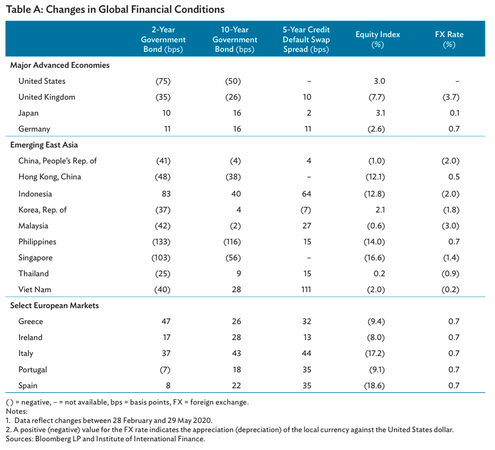
Government bond yields trended downwards in most regional markets between February 28 and May 29 this year, while equity markets in emerging East Asia suffered losses and local currencies depreciated against the US dollar.

Credit spreads have widened for nearly all markets in the region as investors took a risk-averse approach, with the share of foreign holdings in most of emerging East Asia’s local currency bond markets also declining.

Risks to the global outlook remain heavily tilted to the downside, mainly due to the uncertainty brought about by the Covid-19 pandemic, including the prospect of longer periods of minimal economic activity and further waves of outbreaks. Other risk factors include trade tensions between the China and the US, as well as financial volatility due to capital outflows from emerging markets.

Local currency bonds outstanding in emerging East Asia totalled $16.3 trillion at the end of March, up 4.2 per cent from December 2019 and 14 per cent higher than in March 2019. Bond issuance in the region reached $1.7 trillion in the first quarter of 2020, up 19.7 per cent from the fourth quarter of 2019. Emerging East Asia’s local currency bonds outstanding as a share of gross domestic product rose to 87.8 per cent at the end of March.

Government bonds outstanding rose to $9.9 trillion at the end of March, while corporate bonds reached $6.4 trillion. China remains the largest bond market in emerging East Asia, accounting for 76.6 per cent of the total bond stock at the end of the first quarter of 2020.

The second issue of Asia Bond Monitor this year explores the impact of Covid-19 on capital markets; the possibility of issuing pandemic bonds as an option to fight Covid-19; the rising attention to social bonds in response to the pandemic; using fintech to promote inclusive growth and pandemic resilience; and the infrastructure and policies needed for firms to obtain financing during the Covid-19 pandemic.

The report also includes a theme chapter on the link between financial architecture and innovation. It highlights the importance of a sound and efficient financial system in fostering a viable innovation environment.

Stronger dollar, mass gold sell-offs pressure precious metal #ศาสตร์เกษตรดินปุ๋ย

#ศาสตร์เกษตรดินปุ๋ย : ขอบคุณแหล่งข้อมูล : หนังสือพิมพ์ The Nation.

Stronger dollar, mass gold sell-offs pressure precious metal

Econ

Jun 25. 2020

By The Nation

The price of gold dropped sharply by Bt150 per baht weight in morning trade on Thursday (June 25), the Gold Traders Association reported.

As of 9.27am, buying price of a gold bar was Bt25,650 per baht weight and selling price Bt25,750, while gold ornaments were priced at Bt25,180.76 and Bt26,250, respectively.

At close on Wednesday (June 24), buying price of a gold bar was Bt25,800 per baht weight and selling price Bt25,900, while gold ornaments were priced at Bt25,332.36 and Bt26,400, respectively.

The Gold Spot Index price on Thursday morning moved to around US$1,761 (Bt54,447) per ounce after the price dropped by $6.9 to $1,775.1 per ounce at close on Wednesday.

Gold was pressured by the stronger dollar and mass sell-offs after the price skyrocketed. However, some investors are still buying gold as a safe haven asset after the US stock index fell sharply.

Worries of a second Covid-19 wave cast shadow over SET #ศาสตร์เกษตรดินปุ๋ย

#ศาสตร์เกษตรดินปุ๋ย : ขอบคุณแหล่งข้อมูล : หนังสือพิมพ์ The Nation.

Worries of a second Covid-19 wave cast shadow over SET

Econ

Jun 25. 2020

By The Nation

The Stock Exchange of Thailand Index opened at 1,319.38, down 14.05 points, or 1.05 per cent, on Thursday morning (June 25).

A stock analyst at Krungsri Securities expected the index to fall between 1,310 and 1,320 due to various negative sentiments.

“Investors were concerned about the second Covid-19 wave as the number of new cases in the US is still rising, which may force the country to issue lockdown measures again,” the analyst said

“Meanwhile, the US may impose tariffs on goods worth US$3.1 billion imported from

Britain, France, Spain and Germany.”

The analyst said that the International Monetary Fund (IMF) had cut global gross domestic product forecast from contracting 3 per cent to contracting 4.9 per cent.

“Separately, the price of crude oil dropped sharply by over 5 per cent due to increasing US crude oil storage and uncertainty following the decline in demand if the second Covid-19 wave emerges,” the analyst said.

He recommended the following stocks:

▪ Defensive stocks, such as INTUCH,TTW, and DIF.

▪ Stocks that were added to the SET50 and SET100 calculations — BPP, TTW, ACE, BFIT, DOHOME, RBF, SIRI, SISB, SPCG, TVO, and WHAUP.

The SET Index fell sharply by 23 points on Wednesday (June 24), or 1.70 per cent, closing at 1,333 due to uncertainty following the Bank of Thailand and the IMF cutting previous GDP forecasts and worries of a second Covid-19 wave.

Total transactions amounted to Bt60 billion. Foreign investors made net sales of Bt3.589 billion in stocks and Bt432 million in bonds. There were 9,004 net long TFEX SET50 contracts.