IMF says global economic collapse caused by coronavirus will be even worse than feared #ศาสตร์เกษตรดินปุ๋ย

#ศาสตร์เกษตรดินปุ๋ย : ขอบคุณแหล่งข้อมูล : หนังสือพิมพ์ The Nation.

IMF says global economic collapse caused by coronavirus will be even worse than feared

Econ

Jun 25. 2020

Graphic Credit : IMF

Graphic Credit : IMF

By The Washington Post · David J. Lynch · BUSINESS, WORLD, US-GLOBAL-MARKETS 
The International Monetary Fund on Wednesday painted a bleak portrait of the global economy, saying the coronavirus pandemic has caused more widespread damage than expected and will be followed by a sluggish recovery.

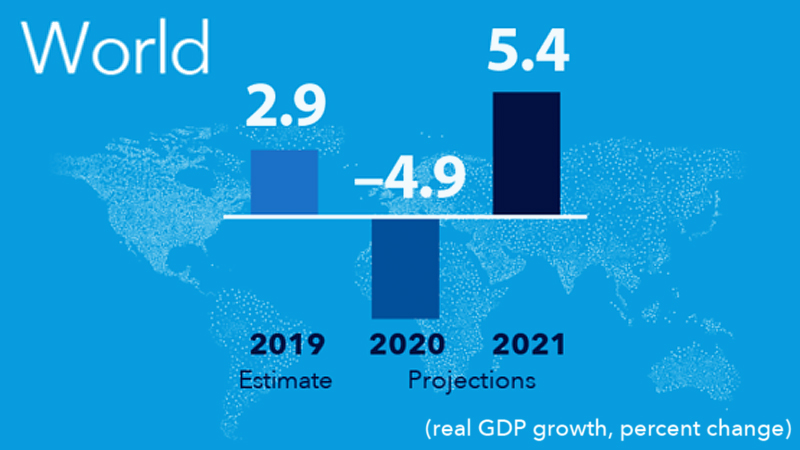
The global economy will shrink this year by 4.9%, worse than the 3% decline predicted in April, the IMF said.
Graphic Credit:IMF

Graphic Credit:IMF

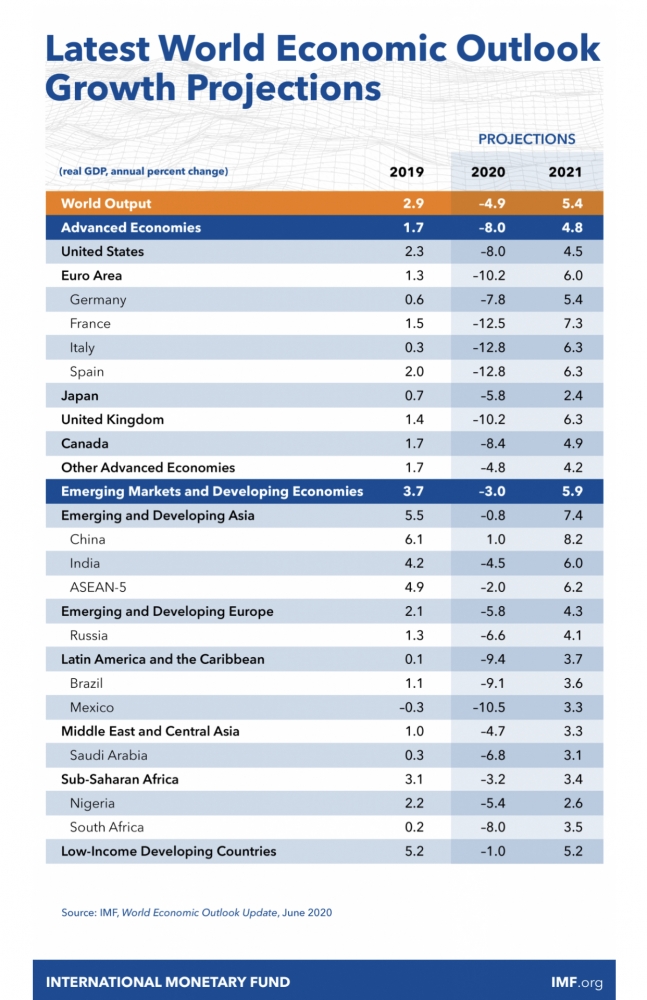
No major economy is escaping the pandemic. The U.S. economy, the world’s largest, is expected to shrink this year by 8%. Countries that use the single European currency are headed for a decline of more than 10% while Japanese output will fall by 5.8%, theIMF said.

The Chinese economy, suffering the twin ravages of the pandemic and the trade war with the U.S, is projected to eke out just a 1% gain – its worst performance in several decades.

“Maybe we can say the world has bottomed out, for now, and we’re in a recovery phase,” said Gita Gopinath, the IMF’s chief economist. “But still, the strength of the recovery is highly uncertain because there is no solution yet to the health crisis.”

By the end of next year, the pandemic will have cost the global economy $12.5 trillion in lost output, she added.

Current conditions are considerably more dire than the “unprecedented decline in global activity” that the fund projected two months ago. Since mid-April, economic data suggest “even deeper downturns than previously projected,” the fund said.

Fund officials blamed the darker forecast on the effects of social distancing; scarring to global production capacity from the lockdown of activity; and the productivity cost of new safety and hygiene rules. Some economies also are still struggling to control the coronavirus, the fund added without naming specific governments.

The forecast assumes countries will not reimpose comprehensive lockdowns even if the pandemic flares up again.

Government crisis-fighting efforts – including $11 trillion in spending and tax cuts – have kept the economic collapse from worsening, the fund said.

“Today’s IMF report is a warning to the world about what will happen if policymakers take their foot off the gas,” said John Lipsky, a former IMF senior adviser who is now with the Atlantic Council. “. . . The uncertain spread of the virus, risk of rising trade tensions, and debt vulnerabilities in emerging economies all lead to the same conclusion – we have not done enough.”

Along with backing continued central bank support for low interest rates, the IMF is calling for wealthy nations to grant substantial debt relief to the world’s poorest countries. Earlier this month, the fund approved its 70th request for emergency financial aid, a $148 million loan for Guinea.

The funds are intended to help Guinean officials pay for urgently needed medical programs to deal with a worsening local coronavirus outbreak.

The fund’s economic forecast is more downbeat than some major investment firms. Goldman Sachs, for example, earlier this month raised its U.S. forecast to -4.2% from -5.2%.

The fund’s forecast also carried a stark warning for investors, who have been buoyed by a stock market recovery from the lows of late March.

“The extent of the recent rebound in financial market sentiment appears disconnected from shifts in underlying economic prospects,” the fund said.

If investors subsequently decide they have been overly optimistic, financial conditions could tighten and further hobble the recovery, the fund warned.

That’s not the only question clouding the forecast. Uncertainty over the pandemic’s future course, including prospects for a vaccine, weigh on assessments of economic growth. A medical breakthrough could render obsolete forecasts of a decline.

“Downside risks, however, remain significant,” the fund cautioned.

Low-income countries also are likely to be especially hard hit, with inequality set to worsen, the fund said. Progress in recent years on reducing the share of the world’s population living in extreme poverty – less than $1.90 per day – could reverse amid the global economic hurricane.

Earlier this month, Kristalina Georgieva, the fund’s managing director, called the pandemic recession “a crisis like no other” and said that by the end of this year, an unprecedented 170 countries would see average individual incomes fall.
Dow tumbles more than 700 points as surge in coronavirus cases rattles investors #ศาสตร์เกษตรดินปุ๋ย

#ศาสตร์เกษตรดินปุ๋ย : ขอบคุณแหล่งข้อมูล : หนังสือพิมพ์ The Nation.

Dow tumbles more than 700 points as surge in coronavirus cases rattles investors

Econ

Jun 25. 2020

By The Washington Post · Thomas Heath, Hamza Shaban · BUSINESS, US-GLOBAL-MARKETS
Coronavirus infections sweeping across the southern United States on Wednesday reawakened investor alarm that the stubborn disease might derail an economic recovery and slammed the breaks on stock market momentum.

The Dow Jones industrial average fell 709 points, or 2.7 percent, settling at 25,447 on the day after falling as low as 859. The blue-chip index is still poised to post one of its best quarters in history, but remains down around 10 percent for 2020.

“Wishful thinking has given way to practical reality when it comes to Covid-19,” said Daniel Wiener, chairman of Adviser Investments. “Warm weather and a reduction in the rate of deaths does not give people the right to go out and party. They partied, the market partied and the hangover begins.” 

The Standard & Poor’s 500 index fell 81 points, or 2.6 percent, to close at 3,050. The broad index, like the Dow and Nasdaq composite, is on track for one of its best quarters in decades. The S&P is down 5 percent in 2020.

The Nasdaq, whose technology stocks have powered markets out of their spring depths, snapped an eight-day winning streak on Wednesday, falling from its all-time high. The Nasdaq slid 222 points, or 2.2 percent., to close at 9,909.

The sell-off was wide and deep, marking the steepest drop since June 11. Crude oil fell 6 percent. European indexes closed down 3 percent. Even highflying mega-tech stocks like Microsoft, Apple and Alphabet finished negative.

Energy, industrials, real estate and financials – industries tied to a reviving economy – led all 11 stock market sectors into the red as Florida, Texas and Arizona reported spikes in virus outbreaks. Airline stocks dove after officials in New York, Connecticut and New Jersey announced 14-day quarantines on incoming travelers from virus hot spots.

“Markets have been looking past the negative headlines on the economy for many weeks,” said Wayne Wicker, chief investment officer at Vantagepont Investment Advisers. “However, the health crisis risk that appears to be accelerating in many states with the reopening process has started to give investor’s pause.” 

Shareholders may also have to reevaluate their expectations for next year’s corporate profits, he said, which are projected to recover sharply but may change if shutdown measures are reinstated by government leaders, he said. 

“Just when it looks like the markets are shaking themselves free of coronavirus another bout of worry returns to put them on their back,” Russ Mould, investment director at AJ Bell, wrote in a note to investors.

Wall Street also digested news of new travel restrictions in the northeast. New York Gov. Andrew Cuomo, a Democrat, announced Wednesday that New York, along with New Jersey and Connecticut, will require some nonresidents entering any of the three states to self-isolate for two weeks after they arrive. The quarantine mandate would apply to visitors from states that are suffering elevated levels of coronavirus infections.

While such regional measures may not hinder the economy as much as a nationwide shutdown, the mixed signals and stutter-step nature of the recovery could drag down the stock market, Mould said.

As central bankers and grim economic data point to a slow, years-long recovery, investors have nonetheless been buoyed in recent weeks by government relief measures and a commitment from the Federal Reserve to keep interest rates near zero for at least several more years.

But optimism that businesses will climb out of the recession has also been checked by a resurgence in confirmed cases. More than 30 states and U.S. territories have reported a higher rolling average of infections compared to last week. In recent days and weeks, some states and businesses that had scheduled to reopen have since reversed course and delayed their plans, fearing that the coronavirus will spread further.

BBS group revs up engines for Thailand’s third major airport #ศาสตร์เกษตรดินปุ๋ย

#ศาสตร์เกษตรดินปุ๋ย : ขอบคุณแหล่งข้อมูล : หนังสือพิมพ์ The Nation.

BBS group revs up engines for Thailand’s third major airport

Econ

Jun 25. 2020

Photo credit: facebook Thailand Infrastructure

Photo credit: facebook Thailand Infrastructure

By The Nation

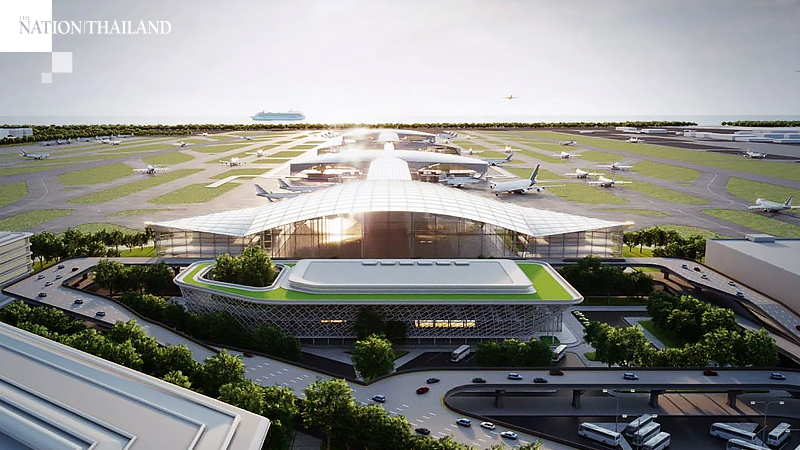
The BBS consortium is confident in its ability to develop the Bt290 billion U-Tapao Airport and Eastern Aviation City mega-project, and expects more than 200 million passengers in 2030.

Prasert Prasarttong-Osoth, a billionaire businessman and adviser to consortium member Bangkok Airways, told a press conference on Wednesday that U-Tapao International Aviation Co Ltd (BBS Joint Venture Group) is ready to construct the Rayong-based project as part of national infrastructure development in the Eastern Economic Corridor (EEC).

He said that Bangkok Airways joined the consortium due to the strategic importance of U-Tapao Airport and the aviation city as a hub for rail, road and air travel. Airlines in Bangkok Airways’ alliance would be invited to operate from the new airport development, he added. Bangkok Airways has over 100 airline partners worldwide.

Keeree Kanjanapas, chairman of fellow consortium member BTS Group Holdings, said the project will become Thailand’s third major international commercial airport, marking a significant step in the country’s economic development.

“Previously, we had never thought of joining an airport project, but we met with Bangkok Airways, who told us what was needed. So we decided to move forward and today we are 100-per-cent confident that we will continue to invest in the development of this ultra-modern airport system. ” said Keeree.

BTS Group Holdings group has been tasked with constructing the project’s travel connection system to link with external transportation systems, including the APM (Automated People Mover) to link with the separate high-speed rail line which will connect U-Tapao with Bangkok’s Suvarnabhumi and Don Mueang airports.

Keree revealed that both domestic and international partners were interested in investing in the aviation city, which should bring an influx of expertise to the project.

A study would likely be conducted before developing the duty-free shopping area, though no problems were predicted here since a budget of Bt30 billion had been earmarked, he said.

Anawat Leelawatwatana, Bangkok Airways senior vice-president, added its study had revealed three main factors, which lured the airline into bidding for the contract to build a third national airport:

The first was that Suvarnabhumi and Don Mueang airports do not have enough capacity to support the 200 million annual arrivals expected by 2030.

The second was that travel in Asia-Pacific will account for an estimated 43 per cent of all global travel in 20 years’ time, up from 30 per cent now.

Thirdly, investments in the government’s EEC project would boost employment and future investments, creating an opportunity to build a large city. Other capital cities, such as London with its four airports, were using airports in their development plans. Likewise, U-Tapao airport was expected to speed up development in the area and in Bangkok.

Anawat revealed Bangkok Airways’ Bt186-billion investment plan was split over four phases of development.

Phase 1 will use a budget of Bt31.290 million to construct 157,000 square metres of passenger terminals, a commercial activity area, parking building, ground transportation centre and 60 aircraft parking slots. Scheduled for completion in 2024, phase 1 is designed to accommodate up to 15.9 million passengers per year

Phase 2 will use Bt2.852 billion to develop a 107,000sqm passenger terminal with APM and automatic walkway systems, adding 16 aircraft slots. Scheduled for completion in 2030, it will accommodate up to 30 million passengers per year.

Phase 3 will use Bt31.377 billion to extend phase 2’s passenger terminal by more than 107,000 sqm, increasing the number of APM and adding 34 aircraft slots.

Scheduled for completion in 2042, it will accommodate up to 45 million passengers per year.

Phase 4 will use Bt38.198 million to build a second, 82,000sqm passenger terminal area in the aviation city, with automatic check-in system and 14 more aircraft slots. This should bring the airport’s capacity to 60 million passengers per year by 2055.

BTS Group Holdings has divided the development area into three parts:

The Commercial Gateway will stretch for 269 rai (430,000sqm) and encompass a lifestyle shopping area, hotel and luxury outlets.

The Airport City will cover 654 rai (1 million sqm) and feature an Innovation Park, exhibition area, medical hub, and office space.

The Cargo Zone and FTZ (Free Trade Zone) covering 262 rai (419,000sqm) will be a distribution centre to support product transportation.

The government is scheduled to deliver the project area to BBS at least 18 months before construction begins.

Pakpoom Srichamni, president and executive director at the third consortium partner, Sino-Thai Engineering & Construction, revealed that the government will issue a notice to proceed (NTP) within 180 days of the June 19 contract signing. He added that the government was preparing to open bidding to build the second runway at U-Tapao airport, with a budget of Bt13 billion-Bt14 billion. BBS Group will join the bidding he said, which is expected to open before the NTP for the Aviation City Project is issued.

BOT sees dark cloud of 8% contraction looming over economy #ศาสตร์เกษตรดินปุ๋ย

#ศาสตร์เกษตรดินปุ๋ย : ขอบคุณแหล่งข้อมูล : หนังสือพิมพ์ The Nation.

BOT sees dark cloud of 8% contraction looming over economy

Econ

Jun 25. 2020 Titanun Malikamas, secretary to BOT’s Monetary Policy Committee (MPC)Titanun Malikamas, secretary to BOT’s Monetary Policy Committee (MPC)
By The Nation

Thailand’s economy this year will contract 8.1 per cent, its worst point ever, because the Covid-19 crisis has had a greater impact on both the Kingdom’s and global economy, says the Bank of Thailand (BOT).

The central bank on Wednesday (June 24) revised downward its economic growth forecast to 8.1 per cent contraction from minus 5.3 per cent it previously forecast due to the Covid-19 fallout having a greater impact that expected, said Titanun Malikamas, secretary to BOT’s Monetary Policy Committee (MPC).

In a meeting on Wednesday, the MPC decided to leave the key policy rate unchanged at 0.5 per cent as expected. 

Titanun said that Thailand’s exports and tourism in particular will be hit harder than previously estimated. 

The MPC also revised downward its GDP projection for 2021 to 3 per cent from 5 per cent growth it forecast earlier. 

This year, exports are expected to contract 10.3 per cent compared to a previous estimate of an 8.8 per cent shrinkage as the global economyhas also been hit hard by the crisis, he said. Imports, meanwhile, are expected to fall 16.2 per cent from 15 per cent. 

Private consumption will contract 3.6 per cent from 1.5 per cent, private investment will plunge 13 per cent from 4.3 per cent, while headline inflation will fall to minus 1.7 per cent from minus 1 per cent forecast earlier. The price of crude oil is currently averaging at $35.1 a barrel. 

Thailand this year will only see 8 million foreign tourists from the previously estimated 15 million, compared to 40 million last year. More tourists are expected to arrive in the latter half of 2021, on the assumption that Covid-19 vaccine is widely available. 

“The central bank has not yet taken into account the possibility of a second wave of Covid-19. If that happens, there is a high risk of further downward projection,” he said, adding that a loosening of the monetary policy since early this year and the government’s fiscal expansion should help the economy to some extent. 

Don Nakornthab, a senior director at BOT, said the 8.1 per cent contraction this year is the deepest in history. Even during the 1997 financial crisis, the economy contracted 7.6 per cent. 

“Economic contraction in the second quarter may hit double digits, before the economy starts to recover slowly,” Don said. 

As for financial stability, it has become more fragile in line with the falling economy. Banks are leading more to big businesses, as they are switching from issuing debentures to taking loans. However, loans to small- and medium-sized businesses and individuals has slowed down. Hence, he said, the MPC has to make sure affected businesses and households have access to loans. 

The baht, which usually has the tendency to be weaker than major foreign currencies, is strengthening because the US dollar is weakening. Meanwhile central banks across the world have implemented quantitative easing (QE) measures, which are bound to encourage large and volatile flows of capital, especially in Thailand. The central bank will closely monitor this and take necessary action where the exchange rate is concerned, as a strong baht will further hurt the export market, he said. 

SET down as trade chilled by Covid second wave #ศาสตร์เกษตรดินปุ๋ย

#ศาสตร์เกษตรดินปุ๋ย : ขอบคุณแหล่งข้อมูล : หนังสือพิมพ์ The Nation.

SET down as trade chilled by Covid second wave

Econ

Jun 24. 2020

By The Nation

The Stock Exchange of Thailand (SET) Index closed at 1,333.43 today (June 24), down 23.00 points or 1.70 per cent. Total transaction volume was Bt60.885 billion with an index high of 1,365.46 and a low of 1,333.32.

In the morning session, a stock analyst at Krungsri Securities expected the index to fluctuate between 1,350 and 1,365 due to uncertainty following the second wave of Covid-19.

“The market gained positive sentiment from hopes of an economic recovery after the US and European manufacturing and service Purchasing Managers’ indices for June rose to their highest in four months, at 46.8 and 4.75 respectively in response to lockdown easing,” he said.

“However, uncertainty over a second wave of Covid-19 as the number of new cases in the US continues to rise will drag down the index.”

The analyst advised investors to follow the central bank’s Monetary Policy Committee meeting today, which maintained the interest rate at 0.50 per cent.

The 10 stocks with the highest trade value today were KCE, KBANK, MINT, SCB, BBL, CPALL, ADVANC, PTT, BAM, and AOT.

As of 4.30pm, the price of crude oil dropped by US$0.81 or 2.01 per cent to $39.56 per barrel, while the gold price rose by $11.00 or 0.62 per cent, to $1,793.00 per ounce.

Changes in other Asian indices were as follows:

Japan’s Nikkei Index closed at 22,534.32, down 14.73 points, or 0.065 per cent.

China’s Shanghai SE Composite Index closed at 2,979.55, up 8.93 points, or 0.30 per cent, while the Shenzhen SE Component Index closed at 11,813.53, up 19.52 points, or 0.17 per cent.

Hong Kong’s Hang Seng Index closed at 24,781.58, down 125.76 points, or 0.50 per cent.

South Korea’s KOSPI Index closed at 2,161.51, up 30.27 points, or 1.42 per cent.

Taiwan’s TAIEX Index closed at 11,660.67, up 48.31 points, or 0.42 per cent.

No change to key interest rate #ศาสตร์เกษตรดินปุ๋ย

#ศาสตร์เกษตรดินปุ๋ย : ขอบคุณแหล่งข้อมูล : หนังสือพิมพ์ The Nation.

No change to key interest rate

Econ

Jun 24. 2020

By THE NATION

The Monetary Policy Committee on Wednesday (June 24) voted unanimously to maintain the policy rate at 0.50 per cent, the Bank of Thailand said.

The move was in line with theexpectations of many analysts.

The MPC has cut the key policy rates three times this year, from 1.25 per cent to the current 0.5 per cent.

Surge in demand pushes up gold price #ศาสตร์เกษตรดินปุ๋ย : ขอบคุณแหล่งข้อมูล

#ศาสตร์เกษตรดินปุ๋ย : ขอบคุณแหล่งข้อมูล : หนังสือพิมพ์ The Nation.

Surge in demand pushes up gold price

Econ

Jun 24. 2020

By The Nation

The price of gold rose by Bt100 per baht weight in morning trade on Wednesday (June 24), the Gold Traders Association reported.

As of 9.26am, the buying price of a gold bar was Bt25,750 per baht weight and selling price Bt25,850, while gold ornaments were priced at Bt25,286.88 and Bt26,350, respectively.

At close on Tuesday (June 23), buying price of a gold bar was Bt25,650 per baht weight and selling price Bt25,750, while gold ornaments were priced at Bt25,180.76 and Bt26,250, respectively.

The Gold Spot Index price on Wednesday morning moved to around US$1,769 (Bt53,538) per ounce after the price rose by $15.60 to $1,782 per ounce at Tuesday’s close, the highest in seven years.

Gold gained from the surge in demand due to uncertainties following the weakening dollar and the tensions between US and China.

SET rises, but worries of second Covid-19 wave remain #ศาสตร์เกษตรดินปุ๋ย

#ศาสตร์เกษตรดินปุ๋ย : ขอบคุณแหล่งข้อมูล : หนังสือพิมพ์ The Nation.

SET rises, but worries of second Covid-19 wave remain

Econ

Jun 24. 2020

By The Nation

The Stock Exchange of Thailand Index opened at 1,364.62, up 8.19 points, or 0.60 per cent, on Wednesday morning (June 23).

A stock analyst at Krungsri Securities expected the index to fluctuate between 1,350 and 1,365 due to uncertainty following the second Covid-19 wave.

“The market gained positive sentiment from hopes of an economic recovery after the US and Europe manufacturing and service Purchasing Managers’ Index in June rose to the highest in four months at 46.8 and 4.75, respectively in response to the lockdown easing,” he said.

“However uncertainty over a second wave of Covid-19 after the number of new cases in the US continues to rise would plunge the index.”

The analyst advised investors to follow the Thai Monetary Policy Committee (MPC) meeting, adding that investors expected the MPC to maintain interest rate at 0.50 per cent.

He recommended the following stocks to investors:

▪ Energy stocks that benefit from the rising crude oil price, such as PTT, PTTEP, Top, PTTGC, IRPC, SPRC and IVL.

▪ Food stocks that benefit from rising pork and chicken prices, such as CPF, GFPT and TFG.

▪ Stocks whose second-quarter performance will improve, such as CKP, Tasco, STA and RS.

The SET Index rebounded by 4.25 points on Tuesday (June 23), or 0.31 per cent, closing at 1,356 as fears of a US-China trade war among investors has eased.

Total transactions amounted to Bt49 billion. Foreign investors made net sales of Bt773 million in stocks, while net bond purchases amounted to Bt20 million. There were 6,848 net long TFEX SET50 contracts.

Hong Kong economy gets boost from staycations, dining deals #ศาสตร์เกษตรดินปุ๋ย

#ศาสตร์เกษตรดินปุ๋ย : ขอบคุณแหล่งข้อมูล : หนังสือพิมพ์ The Nation.

Hong Kong economy gets boost from staycations, dining deals

Econ

Jun 24. 2020Pedestrians ride on an escalator past banners promoting local tourism in Hong Kong on Friday, June 19, 2020. MUST CREDIT: Bloomberg photo by Chan Long HeiPedestrians ride on an escalator past banners promoting local tourism in Hong Kong on Friday, June 19, 2020. MUST CREDIT: Bloomberg photo by Chan Long Hei

By Syndication Washington Post, Bloomberg · Jinshan Hong, Eric Lam · BUSINESS, WORLD, US-GLOBAL-MARKETS, ASIA-PACIFIC

People walking through the Lan Kwai Fong area of Hong Kong over the weekend might have been surprised to see a truly uncommon sight for 2020: a busy restaurant.

The Crown Super Deluxe, a new Japanese Teppanyaki grill restaurant in the centrally located bar district, saw most of its seats filled after the government eased social-distancing restrictions and moved the city another step closer to normality.

“On the one hand, we don’t have people coming in to Hong Kong, but we also don’t have people going out of Hong Kong,” said Christopher Mark, founder of Black Sheep Restaurants, which operates the grill. As virus-beating restrictions lift amid Hong Kong’s low and stable case-count, Mark says he’s “a little bit more optimistic.”

A captive audience for Hong Kong’s hotels, restaurants and shopping malls has contributed to a modest uptick in retail sales in May and June, with pent-up demand among the city’s residents for food and entertainment unleashed. Yet concerns remain that the city’s battered tourism industry will not see business coming back to pre-downturn levels, and many wonder how long this current resurgence can last as unemployment rises and some expats leave the city.

Hong Kong has had three straight months of retail sales declines greater than 35%, and tourist arrivals fell 99.9% in both April and May as strict quarantine orders on the vast majority of arrivals remain in place. The city’s wider economy contracted 8.9% in the first quarter from year-ago levels, suffering its worst quarter on record and extending the first recession in a decade.

A major obstacle to a real recovery is that the millions of Chinese tourism visits per month won’t return to Hong Kong even after the virus subsides. Anti-China protests have reignited since Beijing pushed ahead on a new national security law last month.

“Specifically for hotel accommodation and other tourism activities, they can only experience a turnaround when the quarantine is relaxed, not only in Hong Kong but in most major cities worldwide,” according to Iris Pang, chief economist for greater China at ING Bank.

Some signs are emerging that smaller businesses are more optimistic about their short-term prospects. May readings for the outlook among smaller retailers and restaurants in the city rose above the 50 level marking favorable business conditions for the first time since at least 2018 and that for restaurants hit a record at 53.6, according to data from the Census and Statistics Department Hong Kong.

– – –

Shoppers in Hong Kong are returning to malls, said Ada Wong, chief executive officer of the Champion REIT real estate firm.

“We are seeing a very good and encouraging retail sentiment especially after the relaxation of social distancing,” Wong said in an interview on Bloomberg Television on Friday. Foot traffic in the Langham Place mall in Mong Kok is almost back to normal – with just the tourists missing, according to Wong.

Still, retailers – especially of luxury goods – worry that the uptick could be fleeting.

The Bluebell Group, Asia’s largest distributor of luxury brands including Versace and Moschino, has seen some recovery in business in Hong Kong, yet it is still in deep contraction. Sales for the company’s portfolio of luxury brands were still down 50% in May and June compared with last year in Hong Kong, an improvement of a 70% drop in previous months.

“We are a bit scared that what we’ve seen in May and June might not hold for too long,” said Managing Director Samy Redjeb, “It could be a one-off because consumers want to enjoy the promotion and the discount and they might not come back regularly every month.”

He mentioned that this summer will be key for many retailers as they decide whether to keep stores in the city. He said that if border restrictions aren’t eased and local consumption slows after the promotions “and rents are back to 100%, then many retailers will reconsider their footprint in August, as we will.”

– – –

In the hospitality sector, Google trends data shows that searches in Hong Kong for the word “staycation” recently surged to a record high. Hotels are capturing the demand. A Hyatt hotel in the tourism hotspot Tsim Sha Tsui is promoting its summer staycation package. For a king-bed deluxe room on a Friday night, the rate is HK$1,380 ($178) including a two-person breakfast and an additional HK$1,000 dining coupon.

“As tourists are virtually zero, hotels are trying to attract local customers by providing promotion packages of stay plus meal,” said Yiu Si-wing, a Hong Kong lawmaker representing the tourism industry. “Hotels can’t charge any higher. Without such a discount, people won’t show up.”

Financial Secretary Paul Chan has urged businesses to offer discounts so residents can make use of a HK$10,000 cash handout currently being readied to help spur the economy.

The structural shift to focus on local demand could affect the city’s luxury industry, as big brands are preparing to reduce their scale.

On a recent Thursday evening, customers filled the two-floor showroom of OnTheList in Central, a flash-sale company that works with luxury brands including LVMH and Kering to offload items from past seasons. Since the end of May store traffic has returned to about 75% of pre-virus levels, according to co-founder Diego Dultzin. That’s up from a trough of about 16% in previous months.

“All the brands that we’re working with are now looking at reducing the presence in Hong Kong. Of course the market is going to be smaller and smaller,” said Dultzin, who recently opened in Shanghai. “We know that Hong Kong has a limit.”

U.S. stocks rise with virus spread tempering gains #ศาสตร์เกษตรดินปุ๋ย

#ศาสตร์เกษตรดินปุ๋ย : ขอบคุณแหล่งข้อมูล : หนังสือพิมพ์ The Nation.

U.S. stocks rise with virus spread tempering gains

Econ

Jun 24. 2020

By Syndication Washington Post, Bloomberg · Robert Brand · BUSINESS

 U.S. stocks rose for a second day, but faded into the close as concern mounted that a spike in virus cases in some states could curtail economic activity. Gold rallied to its best level since 2012.

The S&P 500 jumped as much as 1.2% before paring the gain by two-thirds on reports that spiking cases in several hotspots in the South and Southwest threatened to derail plans to ramp up reopening. The Nasdaq Composite hit an all-time high, with investors keying on signs of continued economic growth and the idea that any setback will be met with increased government spending and Federal Reserve moves.

Stimulus “puts the bottom on bad news,” said Nela Richardson, an investment strategist at Edward Jones. “Bad news isn’t so bad if we think that that means more stimulus. The markets are responding also to the quick action, quickest in any recession going back to the Great Depression, of the Federal government and monetary authorities, not just in the United States, but around the world.”

Apple, Amazon and Facebook jumped at least 2%. Mohawk Industries, which provides home flooring, Darden Restaurants and Live Nation were among leaders in the S&P 500.

Treasurys were little changed, with the 10-year yielding around 0.71%, while the dollar dropped for a second day. Equities rose in Europe and in Asia. Gold pushed to its highest level since 2012, and oil topped $41 a barrel in New York.

Carmakers and banks led a broad advance in the Stoxx Europe 600 index after positive economic data in the euro area. The euro strengthened and yields ticked higher on core European bonds.

Investors are betting that trillions of dollars in stimulus by central banks and governments around the globe will shield economies from a resurgence in virus breakouts. PMIs for June, showed business activity in the world’s largest economy continuing a rebound that started in May.

While euro-area PMI gauges earlier fueled a risk-on mood, they also underlined some of the pressures that a long and slow recovery would impose on companies struggling with weak demand.

Anthony Fauci, the U.S.’s top infectious-disease doctor, warned Tuesday that the coronavirus isn’t taking a summer break, judging from its persistent spread in the U.S. Sun Belt. A German state locked down a municipality where 1,553 workers tested positive at a single meat factory.

These are the main moves in markets:

Stocks

The S&P 500 Index rose 0.4% as of 4 p.m. EDT.

The Dow Jones industrial average rose 0.5% to 26,194.

The Nasdaq Composite Index gained 0.8%, hitting the highest on record with its eighth consecutive advance and the largest advance in a week.

Currencies

The Bloomberg Dollar Spot Index fell 0.3% to the lowest in almost two weeks.

The euro climbed 0.4% to $1.1304, the strongest in more than a week.

The Japanese yen appreciated 0.4% to 106.54 per dollar, the strongest in almost seven weeks on the biggest increase in almost two weeks.

Bonds

The yield on 10-year Treasurys rose less than one basis point to 0.71%.

The two-year yield slipped to 0.19%

Britain’s 10-year yield rose two basis points to 0.211%.

Germany’s 10-year yield climbed three basis points to -0.41%.

Commodities

West Texas Intermediate crude fell 1.2% to $40.24 a barrel.

Gold futures strengthened 1.1% to $1,785 an ounce, the highest in almost eight years.