Three-year-old Brazilian twins who were born conjoined at the head were separated after undergoing a 27-hour-long surgery in Brazil.
Arthur and Bernardo Lima were born in a rural part of Northern Brazil in 2018. They shared part of the brain and the main vein that carries blood back to the heart.
The twins underwent several operations in Rio de Janeiro under the direction of Paulo Niemeyer State Brain Institute and Gemini Untwined in the UK.
After several months of research, preparation, and using virtual reality projections of the twins based on CT and MRI scans, the babies were separated in successful surgery.
Their mother Adrielle told local media she was ‘desperate’ on the days before the procedure.
The twin boys will soon begin their six months of rehabilitation at the hospital. And after the operation, they were able to lie on a bed face to face for the first time.
Arthur and Bernardo are the oldest craniopagus twins with a fused brain to have been separated.
According to Gemini Untwined, one in 60,000 births result in conjoined twins, and only 5% of these are joined at the head.
Rising energy prices and gas supply bottlenecks are pushing Germany’s funeral industry, where most crematoriums run on gas, to consider new ways to save fuel in the energy-intensive sector.
Of around one million people who die on average in Germany per year, three quarters are cremated, but undertakers in Europe’s biggest economy are bracing for a possible crunch of gas supply, essential to keep the ovens running, with falling Russian gas flows.
“Next year we will pay six times as much for the gas. And we don’t know yet whether the current contract will be kept at the same price,” Karl-Heinz Koensgen, a manager of a crematorium in Dachsenhausen, western Germany, told Reuters.
To save gas, crematorium operators like Koensgen are switching off some ovens while keeping others running 24 hours, seven days a week so they won’t cool down and need to be reheated again.
“In the event of a gas failure, we would be able to continue operating the plants that are hot … That means we could then continue to work with reduced power,” Koensgen further said.
Svend-Joerk Sobolewski, Germany’s cremation consortium chairman said the measure could save up to 80% of gas but that not all of the crematories have such high demand to use the model, calling for cooperation across the sector.
Germany’s environment ministry said it was working with state authorities on issuing uniform guidelines for possible exceptions, adding that the guidelines would be available in the coming weeks.
Iguanas have naturally reproduced in the Galapagos Santiago Island for the first time in almost two centuries, Galapagos National Park authorities said on Monday.
Scientists and rangers at the Ecuadorian national park discovered the offspring of the 3,143 Conolophus subcristatus specimens reintroduced into the island in 2019.
Experts measured and weighed the specimens before marking the newborns.
The return of the species to the island means these animals once again play their role in the ecosystem by creating paths, removing soil, dispersing seeds and even providing food for animals such as sparrowhawks, said Galapagos National Park director Danny Rueda.
According to a press release from the national park, naturalist Charles Darwin registered a large iguana population in Santiago Island in 1835. But in expeditions carried out by the California Academy of sciences in 1903 and 1906 no specimens were found alive.
Al Qaeda leader Ayman al-Zawahiri was killed in a U.S. strike in Afghanistan over the weekend, President Joe Biden said on Monday, the biggest blow to the militant group since its founder Osama bin Laden was killed in 2011.
Zawahiri, an Egyptian surgeon who had a $25 million bounty on his head, helped coordinate Sept. 11, 2001, attacks that killed nearly 3,000 people.
With other senior al Qaeda members, Zawahiri is believed to have plotted the October 12, 2000, attack on the USS Cole naval vessel in Yemen which killed 17 U.S. sailors and injured more than 30 others, the Rewards for Justice website said.
He was indicted in the United States for his role in August 7, 1998, bombings of the U.S. embassies in Kenya and Tanzania that killed 224 people and wounded more than 5,000 others.
Zawahiri’s whereabouts – variously rumoured to be in Pakistan’s tribal area or inside Afghanistan – had been unknown until the strike.
Both bin Laden and Zawahiri eluded capture when U.S.-led forces toppled Afghanistan’s Taliban government in late 2001 following the Sept. 11 attacks on the United States.
Bin Laden was killed in 2011 by U.S. forces in Pakistan.
U.S. officials, speaking on the condition of anonymity, said the United States carried out a drone strike in the Afghan capital Kabul on Sunday morning at 6:18 a.m. local time.
U.S. intelligence determined with “high confidence” that the man killed was Zawahiri, a senior administration official told reporters. No other casualties occurred.
In a statement, Taliban spokesman Zabihullah Mujahid confirmed that a strike took place and strongly condemned it, calling it a violation of “international principles.”
“Now justice has been delivered, and this terrorist leader is no more,” Biden said in remarks from the White House. “We never back down.”
“Zawahiri continued to pose an active threat to U.S. persons, interests and national security,” the official said on a conference call. “His death deals a significant blow to al Qaeda and will degrade the group’s ability to operate.”
There were rumours of Zawahiri’s death several times in recent years, and he was long reported to have been in poor health.
His death raises questions about whether Zawahiri received sanctuary from the Taliban following their takeover of Kabul in August 2021. The official said senior Taliban officials were aware of his presence in the city.
The drone attack is the first known U.S. strike inside Afghanistan since U.S. troops and diplomats left the country in August 2021. The move may bolster the credibility of Washington’s assurances that the United States can still address threats from Afghanistan without a military presence in the country.
Smart glasses are giving deaf people a head-up display of live, real-time subtitles, as they chat, right in front of their eyes.
The technology uses off-the-shelf augmented reality ‘AR’ glasses that are tethered to a smartphones with an app that turns any speech picked into text displayed on the inside of the lenses.
“Powerful. It’s powerful. I can’t under state the power and the importance for people who are hard of hearing all over the world to feel that they don’t have to solely rely on lip reading anymore. It’s a really big moment,” Josh Feldman, a profoundly deaf 23 year old management consultant, told Reuters.
The software, called XRAI Glass, was inspired by Dan Scarfe’s observation of his grandfather’s increasing isolation as his lost his hearing.
“There was just a little epiphany moment where I thought, well, hang on a second, he watches TV all the time with subtitles on. Why can’t we subtitle the world?,” Scarfe told Reuters.
The software is still being developed but Scarfe says it can already recognise who’s speaking and will soon have the power to translate languages, voice tones, accents and pitch.
“I’m getting a real-time stream of subtitled information where ordinarily I might be behind. I might not quite catch everything, but this is giving me a real-time narrative which enables me to be informed. It enables me to be involved, enables me to make decisions because I know what is being said,” said Steve Crump, founder of DeafKidz International.
XRAI Glass are now recruiting alpha testers who either can’t lip-read or struggle to pick up multiple conversations taking place at once, to help perfect the software.
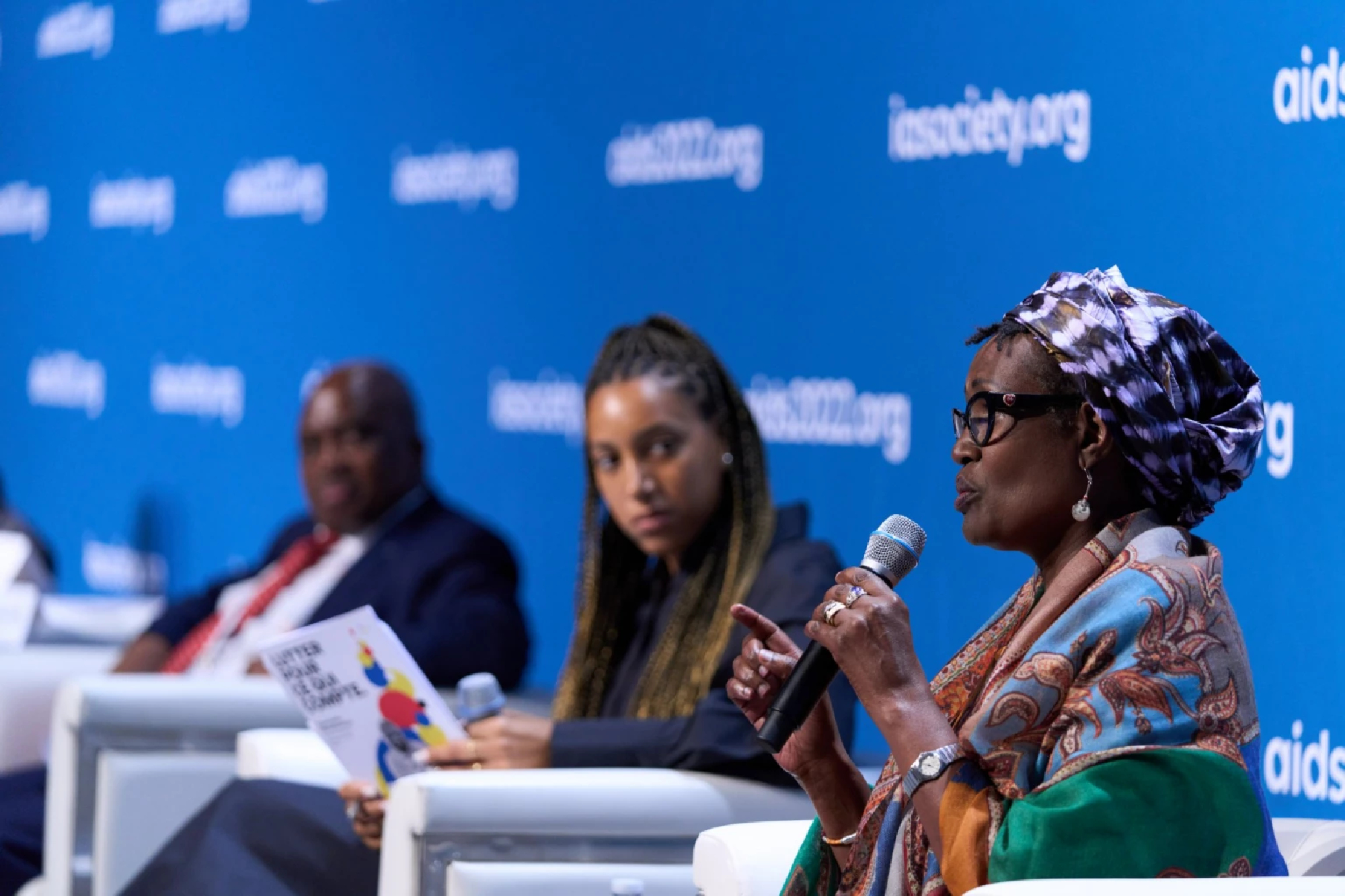
A new report released by the Global Fund at the 24th International Aids Conference in Montreal, Canada July 29, unveils key findings of the activities supported by the Global Fund’s Breaking Down Barriers initiative.
Breaking Down Barriers initiative is the groundbreaking program launched in 2017 to provide intensive financial and technical support to 20 countries* to address stigma and discrimination, criminalization and other human rights-related obstacles that continue to threaten progress against HIV, tuberculosis (TB), and malaria.
“One of the most powerful lessons from the history of the fight against HIV is that success in confronting such a formidable disease cannot be achieved through biomedical interventions alone,” said Peter Sands, Executive Director of the Global Fund. “We must also confront the injustices that make some people especially vulnerable to the disease and unable to access the health services they need. The same is true for TB, malaria, and other diseases, including Covid-19.”
In the context of HIV and TB, men who have sex with men, transgender people, sex workers, people who inject drugs, people living with HIV, and people in prisons and other closed settings are socially marginalized, often criminalized and face a range of human rights abuses that increase their vulnerability to the diseases and undermine their access to health services.
The key findings of the midterm assessments, which were conducted between 2019 and end 2021, reveal all countries involved in the Breaking Down Barriers initiative saw progress in removing human rights-related barriers to HIV services, with a mean increase of 0.9 points from baseline on the 0-5 scale. However, even the top five scoring countries (Ukraine 3.7, Jamaica 3.5, Botswana 3.3, Senegal 3.1 and Kenya 3.1) are falling short of the scores that would represent a comprehensive response at a national level (above 4.0). Sierra Leone (+1.7), Jamaica (+1.6), Cameroon (+1.3) and Mozambique (+1.3) showed the greatest increase in scores.
All countries surveyed also showed progress on TB programming. The TB scores at midterm ranged from Ghana (2.8) to Sierra Leone (0.2), with an average increase from baseline of 0.6. For many countries, addressing human rights barriers to TB services entailed the development of new interventions, and the progress reported in the midterm assessment reflects a rapid expansion. The greatest increase was seen in Ukraine (+1.1) and Côte d’Ivoire (+1.5).
However, the assessments also show that Covid-19 slowed the progress of the Breaking Down Barriers initiative in many countries. But they also chronicle the ways in which human rights-related work on HIV contributed to rights-based approaches to Covid-19. In a few countries, support was provided to community-based paralegals to address human rights violations that occurred during lockdowns. Many innovative measures were undertaken to ensure that key populations would continue to receive services despite lockdowns or quarantines. In several countries, community awareness-raising focused on the prevention of gender-based violence during lockdown periods.
Another round of evaluations, planned for late 2022 and the first six months of 2023, will capture up to five years of activity and provide further insights into the results and impact achieved in the countries involved in the Breaking Down Barriers initiative.
Global Fund human rights funding is unprecedented. In the 20 countries of the Breaking Down Barriers initiative, Global Fund investments in programs to reduce human rights-related barriers have increased more than 10-fold – from slightly over US$10 million to now over US$130 million. Never has there been this much funding to support the implementation of comprehensive programs to remove human rights-related barriers to health services.
“The Breaking Down Barriers experience demonstrates that, where there is sufficient funding and technical support, multiple stakeholders can be energized to combine and strengthen their efforts, and as a result, can make real progress in removing long-standing barriers,” concluded Sands. “This is critical to defeating HIV, TB and malaria, building truly inclusive systems for health that leave no one behind, and enabling everyone, everywhere to realizing their right to health and well-being.”
The Global Fund provides 30% of all international financing for HIV programs (12% of all available resources) and has invested US$22.7 billion in programs to prevent, diagnose and treat HIV and Aids and US$3.8 billion in TB/HIV programs as of June 2021. In countries where the Global Fund invests, total Aids-related deaths have dropped by 65% over the last 20 years.
The U.S. will host the Global Fund’s Seventh Replenishment Pledging Conference in New York City on 19-21 September 2022. With a Replenishment of at least US$18 billion, the Global Fund, together with partners, could reduce (from 2020 to 2026) new HIV infections by 68%, from 1.1 million to 348,000; Aids-related deaths by 59%, from 579,000 to 239,000; incidence and mortality rates by 71% and 63% respectively; HIV incidence among adolescent girls and young women in most affected countries by 72%; and provide antiretroviral therapy to 28 million people in 2026 to reach 91% treatment coverage in 2026.
The 20 countries involved in the Breaking Down Barriers initiative are Benin, Botswana, Cameroon, Côte d’Ivoire, Democratic Republic of the Congo, Ghana, Honduras, Indonesia, Jamaica, Kenya, Kyrgyzstan, Mozambique, Nepal, the Philippines, Senegal, Sierra Leone, South Africa, Tunisia, Uganda and Ukraine.
The Global Fund is a worldwide partnership to defeat HIV, TB and malaria and ensure a healthier, safer, more equitable future for all. We raise and invest more than US$4 billion a year to fight the deadliest infectious diseases, challenge the injustice which fuels them and strengthens health systems in more than 100 of the hardest hit countries.
Since the beginning of the COVID-19 pandemic, we have invested an additional US$4.3 billion to fight the new pandemic and reinforce systems for health. We unite world leaders, communities, civil society, health workers and the private sector to find solutions that have the most impact, and we take them to scale worldwide.
Since 2002, the Global Fund partnership has saved 44 million lives.
Serbia’s President Aleksandar Vucic said on Sunday he wanted “everyone to try to preserve the peace at almost any cost” after Kosovo police said they closed two border crossings in the volatile north.
It came after local Serbs blocked roads and fired shots at police in protest at an order to switch Serb car license plates to Kosovan ones within two months.
Fourteen years after Kosovo declared independence from Serbia, some 50,000 Serbs living in the north use license plates and documents issued by Serbian authorities, refusing to recognise institutions under the capital, Pristina. Kosovo has been recognised as an independent state by more than 100 countries but not by Serbia or Russia.
The government of Prime Minister Albin Kurti said it would give Serbs a transitional period of 60 days starting Aug 1 to get Kosovo license plates, a year after giving up trying to impose them due to similar protests.
The government also decided that as of Aug 1, all citizens from Serbia visiting Kosovo would have to get an extra document at the border to grant them permission to enter.
A similar rule is applied by Belgrade authorities to Kosovars who visit Serbia.
“If they’d dare to persecute Serbs, mistreat Serbs, kill Serbs – Serbia will win. That’s all I have to say,“ Vucic added during a news conference in Belgrade.
The protesters parked trucks filled with gravel and other heavy machinery on roads leading to the two border crossings, Jarinje and Bernjak, in a territory where Serbs form a majority.
As a consequence, Kosovo police said they had to close the border crossings. “We call on all citizens to use other border crossings,” the police said on their Facebook page.
Police said there were shots fired “in the direction of police units but fortunately no one was wounded.”
It also said angry protesters beat up several Albanians passing on the roads that had been blocked and that some cars had been attacked.
Air raid sirens were heard for more than three hours in the small town of North Mitrovica inhabited mainly by Serbs. A year ago, after local Serbs blocked the same roads over license plates, Kosovo’s government deployed special police forces and Belgrade flew fighter jets close to the border.
Tensions between the two countries are now at their highest in years and Kosovo’s fragile peace is maintained by a Nato mission which has 3,770 troops on the ground. Italian peacekeepers were visible in and around Mitrovica on Sunday.
President Vladimir Putin on Sunday signed a new naval doctrine which cast the United States as Russia’s main rival and set out Russia’s global maritime ambitions for crucial areas such as the Arctic and the Black Sea.
Speaking on Russia’s Navy Day in the former imperial capital of St Petersburg founded by Tsar Peter the Great, Putin praised Peter for making Russia a great sea power and increasing the global standing of the Russian state.
After inspecting the navy, Putin made a short speech in which he promised that what he touted as Russia’s unique Zircon hypersonic cruise missiles, cautioning that Russia had the military clout to defeat any potential aggressors.
Shortly before the speech, he signed a new 55-page naval doctrine, which sets out the broad strategic aims of Russia’s navy, including its ambitions as a “great maritime power” which extends over the entire world.
The main threat to Russia, the doctrine says, is “the strategic policy of the USA to dominate the world’s oceans” and the movement of the NATO military alliance closer to Russia’s borders.
Russia may use its military force appropriately to the situation in the world’s oceans should other soft powers, such as diplomatic and economic tools, be exhausted, the doctrine says.
Putin did not mention the conflict in Ukraine during his speech but the military doctrine envisages a “comprehensive strengthening of Russia’s geopolitical position” in the Black and Azov seas.
It also set out the Arctic Ocean, which the United States has repeatedly said Russia is trying to militarize, as an area of particular importance for Russia.
Russia’s vast 37,650 km (23,400 miles) coastline, which stretches from the Sea of Japan to the White Sea, also includes the Black Sea and the Caspian Sea.
Putin said the delivery of Zircon hypersonic cruise missiles to the Admiral Gorshkov frigate would begin within months. The location of their deployment would depend on Russian interests, he said.
“The key thing here is the capability of the Russian navy… It is able to respond with lightning speed to all who decide to infringe on our sovereignty and freedom.”
Hypersonic weapons can travel at nine times the speed of sound, and Russia has conducted previous test launches of the Zircon from warships and submarines over the past year.
In Crimea, Sevastopol governor Mikhail Razvozhayev said Ukrainian forces struck the headquarters of Russia’s Black Sea Fleet in the Russian-held port city early on Sunday, wounding five members of staff.
On a busy downtown street in the Chinese city of Shenzhen, a taxi moves without a driver, navigating among jaywalkers and haphazard traffic.
The steering wheel turns itself a notch and the vehicle slows to a gentle halt, while the safety driver looks on from the passenger seat. The vehicle is one of a hundred sensor-laden robotaxis belonging to start-up DeepRoute.ai cruising Shenzhen’s dense central business district Futian, giving 50,000 trial rides to passengers in the last year.
Shenzhen, a city of 18 million, has now brought in China’s clearest autonomous vehicle (AV) regulations. From Monday (August 1) registered AVs will be allowed to operate without a driver in the driving seat across a broad swathe of the city, but a driver must still be present in the vehicle.
Maxwell Zhou, the chief executive officer of self-driving technology company DeepRoute, welcomed the move and said it would assist in collecting data and developing driving algorithms.
But Zhou also said that having more vehicles on the road would potentially lead to more accidents, and added the new regulations would be important in achieving mass deployment eventually.
So far, Chinese cities like Guangzhou and Beijing have allowed robotaxis to operate on a more limited basis with the permission of local authorities, but Shenzhen’s regulations provide a crucial framework for liability in the event of an accident.
If an autonomous vehicle (AV) has a driver behind the wheel, the driver will be liable for an accident. If the car is completely driverless, the owner of the vehicle will be responsible, unless the vehicle is defective.
However, in a city with a state-owned fleet of 22,000 electric taxis from Shenzhen-based BYD, where a 20 km (12 miles) trip costs about 60 yuan ($8.90), production costs for AVs will need to come down before robotaxis are commercially viable, Zhou said.
Deeproute and other robotaxi companies like Whale Dynamic are banking on mass production to lower costs and make the mainstream use of AVs a reality.
“We have a battery supplier, we have the sensors, we have most of the integration, we can do beautifully in Shenzhen,” said Whale Dynamic’s CEO and founder David Chang, adding production costs were only a third of what they would be in the United States.
“But the revenue is one-twelfths to California, so that may not be a fancy business to do,” he said.
While Shenzhen’s supply chain and lower costs give it a major production advantage over competitors based around Silicon Valley, Chang does not want to be constrained to one market.
“As a company with international vision, we don’t want to shrink ourselves into a well and fight with other frogs… we want to jump out (of) the well.”
Japan like many countries has been hit by heatwaves this summer with humans and pets suffering alike. To help dogs that can’t shed their fur coats to stay cool, a Tokyo clothing maker and veterinarians have teamed up to create a wearable fan just for dogs and even cats.
Abattery-operated, 80-gramme (3 ounces) fan is attached to a special mesh outfit which blows cool air which helps circulate cool air around the animal’s body. The outfits come in five different sizes and are priced at 9,900 yen (74 USD).
Rei Uzawa, president of maternity clothing maker Sweet Mommy, says she was motivated to create the device after seeing her own pet chihuahua exhausted every time it was taken out for a walk in the scorching summer heat. She got the idea of the cooling fan came from air-conditioned jackets for humans which are often worn by construction workers and other labourers who have to work outside.
“There was almost no rainy season this year, so the hot days came early, and in that sense, I think we developed a product that is right for the market,” says Uzawa.
This year the rainy season in Tokyo abruptly ended at the end of June, the earliest since data began to be kept in 1951, leaving the capital to suffer the longest heatwave on record with temperatures up to 35 degrees Celsius (95 Fahrenheit) for nine days.
The devices debuted in early July and Sweet Mommy has received around 100 orders for the product, Uzawa said.
“It’s impossible to walk my dog during the daytime in such a hot weather. I usually use dry ice packs (to keep the dog cool). But I think it’s easier to walk my dog if we have this fan,” said 48-year-old Mami Kumamoto, an owner of a miniature poodle named Pudding and a terrier named Maco.
A kimono version went on sale from Friday and is sold at the same price as the original. A try-on event on Thursday (July 28) drew several dog lovers, their canine companions, and even a cat.