Boeings Starliner set to launch to space station this week
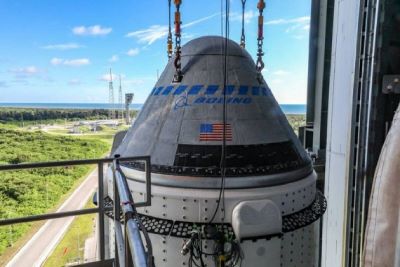
The Starliner spacecraft is scheduled to dock to the International Space Station at 3:06 p.m. Saturday.
NASA and Boeing are targeting launch of the Starliner spacecraft on a United Launch Alliance Atlas V rocket on Friday.
The launch was scheduled at 2:53 p.m. Eastern Day Time Friday from Space Launch Complex-41 on Cape Canaveral Space Force Station in Florida, according to NASA.
ADVERTISEMENTx
About 31 minutes after launch, Starliner will reach its preliminary orbit. It is scheduled to dock to the International Space Station (ISS) at 3:06 p.m. Saturday.
Various tests have been completed to ensure all systems between the rocket and spacecraft are communicating and functioning properly before rollout to the pad, said Boeing on Tuesday.
The integrated Starliner and the Atlas V is set to rollout to the launch pad on Wednesday.
Starliner’s last mission was in December 2019, when it failed to dock with the ISS due to an orbit insertion anomaly.
U.S. Fed debate over taper expected to intensify amid inflation, Delta variant concerns
Most economists expected a formal announcement of tapering by the Fed in December and actual reductions starting in the first quarter of 2022, according to a survey of 51 economists released by Bloomberg.
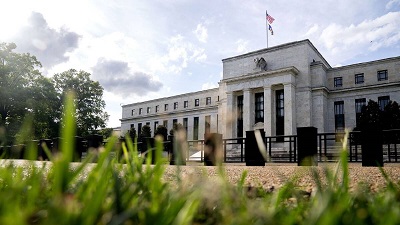
The debate over when and how the U.S. Federal Reserve should begin tapering its asset purchases is expected to intensify this week amid inflation and Delta variant concerns, economists have said.
“Inflationary risk and the delta variant of the coronavirus will be front and center” at the Fed’s two-day policy meeting that started on Tuesday, while policy changes will take a back seat, said Joseph Brusuelas, chief economist at accounting and consulting firm RSM US LLP.
ADVERTISEMENTx
“The primary takeaways of the meeting, should there actually be anything other than a reaffirmation of the status quo, will be the inclusion of policymakers noting the news around rising inflation,” Brusuelas said.
The meeting came as U.S. consumer prices in June rose 0.9 percent from the previous month and 5.4 percent from a year earlier, the largest 12-month increase in roughly 13 years, according to the Labor Department.
Diane Swonk, chief economist at Grant Thornton, a major accounting firm, believed that “many within the Fed will be pushing to taper” the central bank’s monthly asset purchase program of 120 billion U.S. dollars amid inflation concerns.
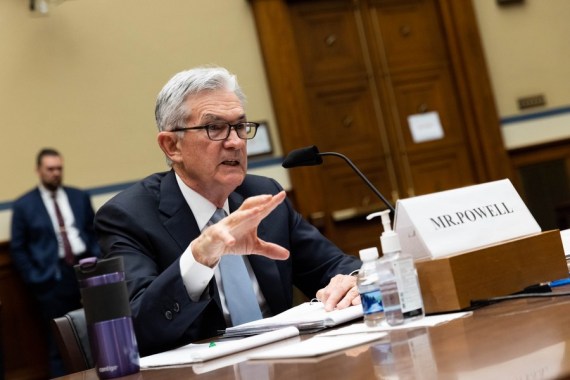
“(Fed Chairman Jerome) Powell will acknowledge that the Fed is discussing the asset purchase program but has yet to agree upon timing or strategy for tapering,” Swonk said Sunday in an analysis, noting Fed officials will want to see more progress toward their goals, notably on employment.
The Fed has pledged to keep its benchmark interest rates unchanged at the record-low level of near zero, while continuing its asset purchase program at least at the current pace of 120 billion dollars per month until “substantial further progress” has been made on employment and inflation.
Meanwhile, the Fed has to acknowledge the “downside risks from the spread of the Delta variant,” as the honor system for masking has failed, which is fueling the spread in less vaccinated areas and upping the ante for breakthrough infections, Swonk noted.
“The question mark is how spread of the Delta variant affects the return to work and whether it dampens some of the demand for services,” she said.
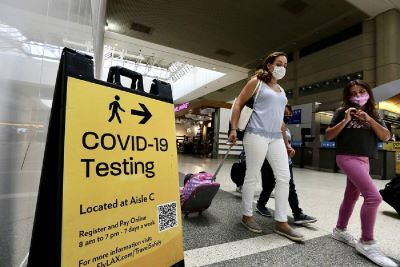
COVID-19 cases are on the rise in nearly 90 percent of U.S. jurisdictions, with outbreaks in parts of the country that have low vaccination coverage, according to the U.S. Centers for Disease Control and Prevention (CDC).
To prevent further spread of the Delta variant, the CDC on Tuesday updated its masking guidelines, recommending that even vaccinated people return to wearing masks indoors in COVID-19 hot spots.
It’s too early to know if this latest wave of COVID-19 cases will have significant economic effects, according to Nick Bennenbroek and Brendan McKenna, economists at Wells Fargo Securities.
“Should the latest COVID outbreak persist for an extended period, perhaps until the end of this year, there would be a higher likelihood of governments reimposing restrictions and central banks delaying their tightening plans,” the economists wrote Monday in a note.
Swonk still expected the Fed to begin tapering by the end of this year, but she did not expect more clarity on the time frame from this week’s meeting.
Brusuelas believed that the rise of the variants will present the Fed with the opportunity to “postpone a more in-depth discussion” around tapering that many market participants would like to see take place at the Kansas City Fed’s symposium on monetary policy at Jackson Hole, Wyoming, next month.
Most economists expected a formal announcement of tapering by the Fed in December and actual reductions starting in the first quarter of 2022, according to a survey of 51 economists released by Bloomberg last week.
The number of Covid-19 cases in Southeast Asia crossed 6.91 million, with 96,526 new cases reported on Tuesday – higher than Monday’s tally of 78,444. There were 2,824 more deaths, increasing from Monday’s 2,376 and taking total coronavirus deaths in Asean to 136,564 so far.
Thousands of medical professionals in Malaysia, attired in black, held a peaceful rally on Tuesday at several hospitals nationwide to protest against the government’s employment regulations for medical professionals that have been in place since 2016. The regulations stipulate that newly graduated medics must work under a government contract in public hospitals for four-and-a-half years while receiving lower wages compared to full-time medics before they can work at private hospitals.
Meanwhile, Cambodia’s Public Health Ministry reported 39 new Delta variant infections on Tuesday, bringing cumulative Delta cases in the neighbouring country to 114 patients.
The ministry said of the 39 patients, 21 had just returned from Thailand while 18 are locals from Oddar Meanchey, Kampong Thom and Siem Reap provinces.
The ministry urged people to strictly follow disease control measures, warning the Delta variant can spread easier than other Covid-19 variants.
South Korea and the DPRK decided to resume their direct communication hotlines that had been severed for over a year as of 10:00 a.m. local time Tuesday.
South Korea and the Democratic People’s Republic of Korea (DPRK) restored their cross-border communication lines that had been severed for over a year, the South Korean presidential Blue House said Tuesday.
The Blue House said in a statement that the two Koreas decided to resume their direct communication hotlines as of 10:00 a.m. local time (0100 GMT) Tuesday.
All of the inter-Korean communication lines had been severed since June last year when the DPRK cut them off in protest against Seoul’s failure to stop civic activists from sending anti-Pyongyang propaganda leaflets into the DPRK.
ADVERTISEMENTx
According to the statement, South Korean President Moon Jae-in and top DPRK leader Kim Jong Un have exchanged personal letters several times since April to communicate about issues on restoring inter-Korean relations.
Moon and Kim agreed first to restore the severed inter-Korean communication lines, the statement noted.
The two leaders also agreed to restore mutual trust and enhance ties as early as possible.
The Blue House said the resumed inter-Korean communication lines would play a positive role in the improvement and the development of the inter-Korean relations.
Meanwhile, the military authorities of South Korea and the DPRK reopened their military communication lines and put them back to normal operations from 10:00 a.m., the South Korean defense ministry said in a separate statement Tuesday.
Fixed-line phone calls through the fiber-optic cable and faxing to exchange documents are currently under a normal operation, the ministry noted.
From Tuesday afternoon, the military authorities of the two Koreas planned to restart their regular phone calls twice a day at 9:00 a.m. and 4:00 p.m. local time.
The western military hotline across the inter-Korean border worked normally, but some technical problem was found in the eastern hotline, the ministry said.
The ministry said the restored hotline would substantially contribute to the defused military tensions on the Korean Peninsula.
State of emergency declared in Italys wildfire-ravaged Sardinia.
The wildfire started with a car that caught fire after a crash, and has forced the evacuation of at least 1,500 people from their homes. It has devastated some 20,000 hectares of land so far.
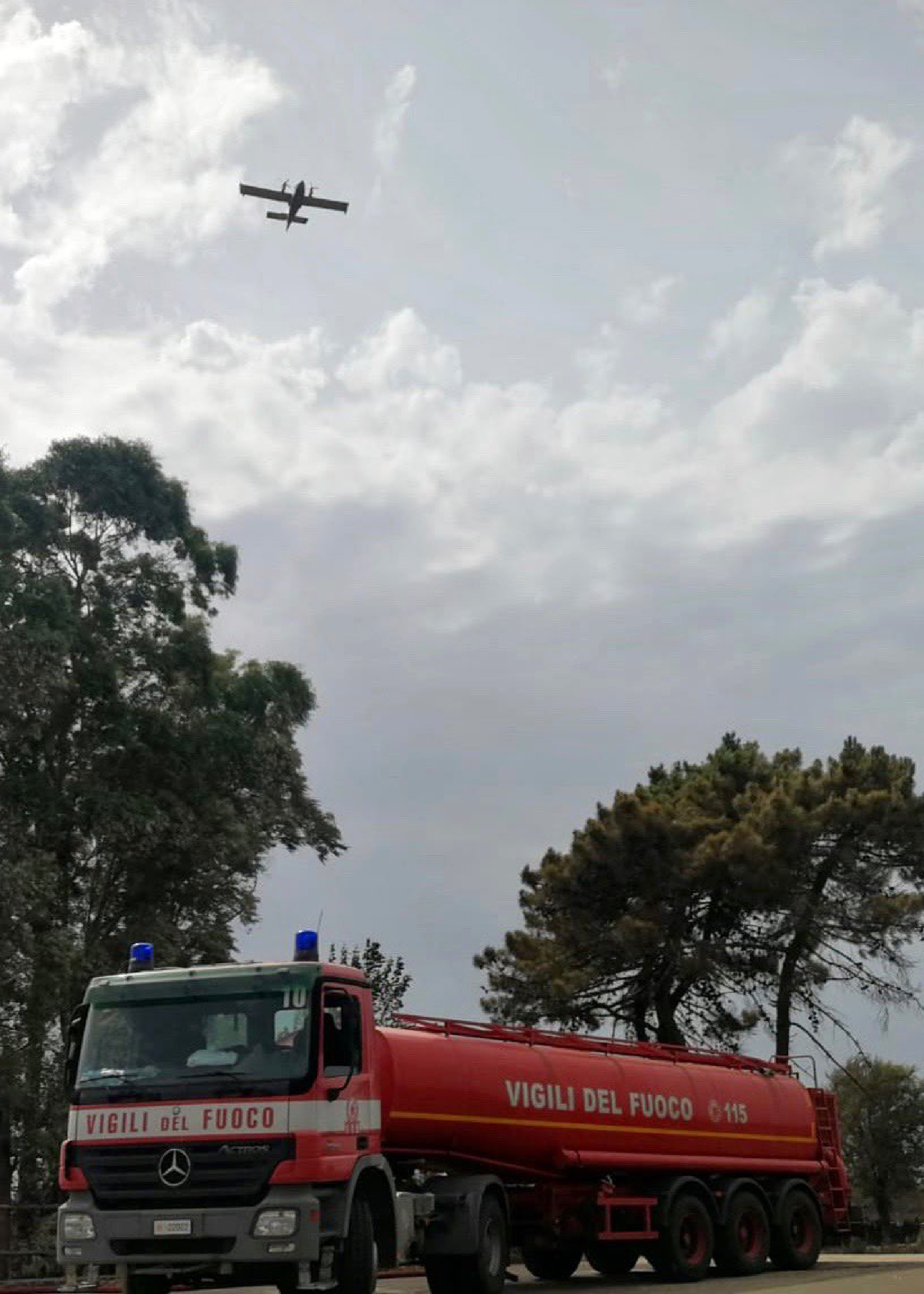
Regional emergency services in Italy’s Sardinia issued a new adverse weather warning for Monday, and the regional government has declared a state of emergency after large swaths of the major island were ravaged by wildfires in the last few days. The hot weather alert especially concerned central and western Sardinia and some areas around northern Coghinas, and would last until 6 p.m. local time on Monday, according to the local civil protection department. The alert entails a high risk of new bushfires. In an emergency meeting Sunday night — after the national civil protection launched five operations with Canadair water-dropping planes on the island — the regional government declared the state of emergency.
State of emergency declared in Italys wildfire-ravaged Sardinia.
ADVERTISEMENTx
State of emergency declared in Italys wildfire-ravaged Sardinia.
The wildfire started on Friday with a car that caught fire after a crash, and has forced the evacuation of at least 1,500 people from their homes. It has devastated some 20,000 hectares of land so far.
Sardinia’s governor Christian Solinas said several farms and homes were destroyed, along with thousands of hectares of vegetation. No casualties were reported yet. Fanned by hot southwest winds, the largest bushfire in the Oristano area kept spreading along a front of almost 50 km as of Monday morning, according to the Nuova Sardegna newspaper. Local firefighters have received support from Greece and France, which sent two Canadair planes through the European Union Civil Protection Mechanism.
State of emergency declared in Italys wildfire-ravaged Sardinia.
U.S. to maintain travel restrictions due to Delta variant
The United States currently bars entry for most noncitizens who within the last 14 days have been in Britain, the European Schengen area, Ireland, China, Iran, South Africa, Brazil, and India. It also keeps non-essential travel restrictions across its borders with Canada and Mexico.
The United States will keep existing travel restrictions from entering the country due to the surging cases of COVID-19 Delta variant, the White House said on Monday. Driven by the rising Delta variant cases here at home, particularly among those who are unvaccinated, “we will maintain existing travel restrictions at this point,” White House Press Secretary Jen Psaki told reporters at a daily briefing. The federal administration has been under pressure from the travel industry and allies to lift these restrictions. The United States currently bars entry for most noncitizens who within the last 14 days have been in Britain, the European Schengen area, Ireland, China, Iran, South Africa, Brazil, and India. It also keeps non-essential travel restrictions across its borders with Canada and Mexico. Last week, the U.S. State Department and the Centers for Disease Control and Prevention issued a warning against traveling to Britain due to the country’s high level of COVID-19 cases.
Asean Covid cases fall sharply amid improvement in Indonesia
Southeast Asia saw another day of sharp decline in new Covid-19 cases on Monday, but deaths hit a single-day high, collated data showed.
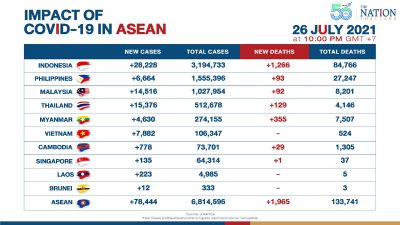
Asean reported 78,444 new cases on Monday, lower than Sunday’s 90,178, while 2,376 people died, increasing from Sunday’s 1,965.
The number of Covid-19 cases in the region since the outbreak crossed 6.81 million, with 133,741 deaths.
Indonesia reported 28,228 new cases, the lowest in weeks, and 1,487 deaths on Monday, bringing cumulative cases in the country to 3,194,733 patients and total deaths to 84,766 deaths.
Indonesian President Joko Widodo announced the extension of lockdown to August 2 to contain the virus but promised to gradually relax disease control measures for some activities and businesses, including markets, outdoor restaurants (with some restrictions), beauty salons, laundry, and auto repair shops.
Vietnam reported 7,882 new cases and 154 deaths on Monday, bringing cumulative cases in the country to 106,647 and the death toll to 524.
From July 26 until further notice, Ho Chi Minh City will impose curfew from 8pm to 6am. Officials requested all residents to remain at home except when seeking medical care, working in essential industries, or purchasing essential goods.
South Africa unveils post-riot relief, eases virus lockdown
South African President Cyril Ramaphosa unveiled a new relief package to help businesses and individuals recover from a week of deadly riots and coronavirus curbs, as he eased lockdown restrictions amid slowing infections.
The measures include reinstating a monthly welfare grant of $24 (350 rand) for the poor until the end of March, a $27 million (400 million rand) state contribution to a humanitarian relief fund and support for uninsured businesses, Ramaphosa said Sunday in a televised speech. The government will also expand an employment tax incentive, and give companies an additional three months to pay taxes collected from their workers, he said.
The imposition of stop-start curbs since the pandemic hit in March last year has shuttered thousands of businesses and added to already rampant unemployment. The economy shrank 7% last year, the most in a century.
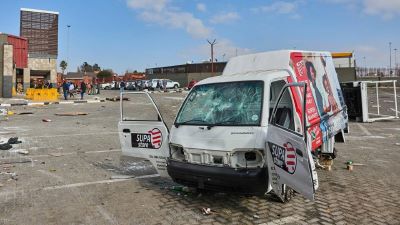
The nation’s misery was compounded by protests that erupted in two provinces after former President Jacob Zuma was jailed this month on contempt-of-court charges and morphed into a week-long looting spree in which thousands of businesses and street traders were targeted. At least 330 people died in the unrest, which the South African Property Owners Association estimates cost the country about $3.4 billion (50 billion rand) in lost output and placed 150,000 jobs at risk.
“We have a duty to support those affected by this violence,” Ramaphosa said. “Many small and medium-sized businesses, formal and informal, have lost everything and will not be able to rebuild on their own. We will not abandon them.”
ADVERTISEMENTx
The president moved the country to an adjusted virus alert level 3, from alert level 4, after a third wave of Covid-19 cases peaked and the government’s vaccination program gathered pace.
Alcohol sales, which have been banned for the past four weeks, will now be permitted at retail outlets from 10 a.m. to 6 p.m. Monday to Thursday, and at restaurants and bars up to 8 p.m. A moratorium on leisure travel in some areas was revoked, while gatherings of as many as 50 people will be allowed indoors and as many as 100 outdoors. A curfew will be imposed from 10 p.m. to 4 a.m.
An average of about 12,000 new Covid-19 cases were detected daily in South Africa last week, a 20% decline on the week before, although the situation varied widely from area to area. Infections continued to climb in the Western Cape, KwaZulu-Natal and Northern Cape provinces.
“Infections remain high and we must continue to exercise caution at all times,” Ramaphosa said.
The country has issued more than 6.3 million vaccines so far, and will have enough shots to last until the end of the year, with 31 million doses from Johnson & Johnson and Pfizer expected to arrive within in the next three months. Inoculations will be available to all over the age of 18 from Sept. 1, the president said.
Published : July 27, 2021
By : Syndication Washington Post, Bloomberg · S’thembile Cele
Tokyo Olympics has 16 more virus cases, including three athletes
Japanese Olympics organizers reported sixteen more coronavirus cases, including three infections among athletes, as the spectator-free Tokyo games continued under tight restrictions.
Those who tested positive included contractors and employees of Tokyo 2020, according to a statement on the organizer’s website, as well as eight others connected to the Games whose exact roles weren’t made clear. Six of the total are residents of Japan, though the statement didn’t identify the nationalities of the athletes or the events they were scheduled to compete in.
Only one of those affected was staying in the Olympic Village. The new figures bring to 148 the total number of reported infections connected with the event.
The Japanese government and organizers have tried to overcome public unease over the games by pledging to make them “safe and secure.” Tokyo Governor Yuriko Koike and Prime Minister Yoshihide Suga met on Sunday to discuss the situation and agreed the Games were going “very smoothly,” Kyodo News reported.
A poll published by the Nikkei newspaper on Monday found that 37% of respondents said the decision to hold the event without spectators was appropriate, while 28% said some spectators or full crowds should have been allowed. A further 31% said the event should have been postponed again or canceled outright.
Many residents of Japan had opposed the staging of the games amid the pandemic, fearing that the arrival of tens of thousands of athletes and others from around the world could make for a superspreader event. While Monday marks the fifth straight day of infections in double figures, with a record 19 reported on Friday, the total so far is relatively small as a percentage of the number of attendees. Just 0.02% of tests in the three days to Sunday returned a positive result.
Nevertheless, some experts remain uneasy about the effect of the games on the spread of the virus as the more infectious delta variant becomes more dominant.
“It’s best to assume our experience and knowledge up to now don’t apply to the delta variant,” said Norio Sugaya, an infectious-disease expert and visiting professor at Keio University’s school of medicine. “There’s considerable doubt about how effective the current system of ‘bubbles’ will be against the delta variant.”
ADVERTISEMENTx
International Olympic Committee spokesman Mark Adams said that while it was impossible to make the event “zero-risk,” the participants made up “the most-tested community in the world.”
The unprecedented Olympics is taking place amid a virus state of emergency in Tokyo, under which bars and restaurants are being urged to stop serving alcohol and to close by 8 p.m. Case numbers in the capital rose to 1,763 on Sunday, though the number of serious cases fell by two to 72.
Published : July 27, 2021
By : Syndication Washington Post, Bloomberg · Isabel Reynolds
WTO summer holiday from vaccine-equity talks draws calls for action
An urgent global effort to rebalance the inequity between rich, vaccinated nations and poor nations sliding further into pandemic misery is colliding with an immovable calendar conflict: the European summer holiday.
Next week World Trade Organization delegates are planning to depart Geneva for their August break and, in doing so, pause their fractious debate over a proposal to waive intellectual-property protections for covid-19 shots until the second week of September.
Before they leave, members will adopt a report that acknowledges they’ve made scant headway on the proposal aimed at making doses more widely available, which the world’s top health expert says is critical to ending a “moral failure.”
“With so many lives on the line, profits and patents must come second,” World Health Organization Director General Tedros Adhanom Ghebreyesus said during a virtual summit last week.
WTO Director General Ngozi Okonjo-Iweala previously urged ambassadors to shorten their usual six-week summer holiday to focus on pressing issues like the waiver. Nevertheless, members aren’t planning to reconsider the matter until the week of Sept. 6, according to officials familiar with the planning.
“August doesn’t matter in Geneva; it doesn’t matter if people are dying around the world,” said Shailly Gupta, a spokesperson at Médecins Sans Frontières. “We hope members will move at a faster pace.”
Disagreement persists on the fundamental question of whether a waiver is the “appropriate and most effective way” to address the shortage of vaccines, according to a draft status report produced by Dagfinn Sørli, the chairman of WTO council on Trade-Related Aspects of Intellectual Property Rights, or TRIPS.
That split could sink prospects for an ambitious vaccine waiver because WTO decisions must be taken on the basis of consensus — which means any of the 164 members can veto a final agreement for any reason.
“The WTO’s response to covid is the most critical issue before our organization right now,” WTO spokesman Keith Rockwell said a phone interview. “Millions have died and lives are at stake. Finding a pragmatic outcome by December is essential.”
ADVERTISEMENTx
Proponents of the waiver had hoped to conclude their negotiations by the end of July and are now criticizing the European Union and other developed nations for sandbagging the talks.
The European Commission, which opposes a WTO TRIPS waiver, has proposed a series of measures that it argues will create greater legal certainty for nations to leverage existing trade tools in order to expand their production capacities.
“The EU is not interested,” Gupta said. “Switzerland, Norway and the United Kingdom are not engaging. They’re saying: ‘This or that won’t work; the waiver won’t work.’ There is no intention of engaging.”
A spokesman for the EU mission in Geneva declined to comment.
Critics counter that the proposal from Brussels is a distraction to redirect focus from India and South Africa’s earlier waiver proposal and to prevent members from engaging in more detailed negotiations.
ADVERTISEMENT
“The EU’s actions are incredibly cynical and dangerous,” said Lori Wallach, the founder of Public Citizen’s Global Trade Watch. “They have submitted a paper that basically conflicts with the text-based negotiations by saying ‘We don’t want a waiver.'”
The U.S., meanwhile, has taken a back seat in the process and enthusiasm about Washington’s engagement on the issue has begun to wane in the three months since Trade Representative Katherine Tai announced American support for a waiver.
Though Tai’s surprise announcement briefly knocked shares of Moderna Inc., Pfizer Inc., and BioNTech SE, the stocks quickly rebounded and all are now trading at or near their highest levels of the year.
“People feel that message from Ambassador Tai is not playing out on the ground or being implemented in a meaningful way,” said Thiru Balasubramaniam a managing director at Knowledge Ecology International in Europe.
“U.S. support for waiving intellectual property protections for coronavirus vaccines provided important momentum for the WTO process,” U.S. Trade Representative spokesman Adam Hodge said via email. “We remain deeply engaged in discussions towards finding consensus while the Biden-Harris Administration continues to ramp up our efforts to donate doses and expand the manufacturing and equitable distribution of vaccines around the world.”
ADVERTISEMENT
Most nations producing the vaccines oppose a blanket waiver to the WTO’s intellectual property rules because they say it would harm innovation, do little to expand access to vaccines and may even backfire.
Specifically, opponents to the waiver say it would create a chaotic patchwork of laws, unravel existing industry partnerships, lead to a supply crunch for scarce vaccine inputs and inject even more uncertainty into already complex arrangements.
There’s also the possibility that an IP waiver could result in the production of counterfeit and substandard medicines, which could increase vaccine hesitancy that’s already pervasive in even the world’s wealthiest nations.
“Everybody knows IP isn’t the problem and there is no quick fix to vaccinating the world with the latest technology,” said Robert Grant, a senior director at the U.S. Chamber of Commerce. “Most governments know this but due to the political sensitivities they won’t say it publicly.”
Indeed, the waiver debate is a politically explosive issue for nations with high vaccination rates because they don’t want to be seen as standing in the way of getting life-saving drugs to poor nations whose citizens are suffering at disproportionate rates.
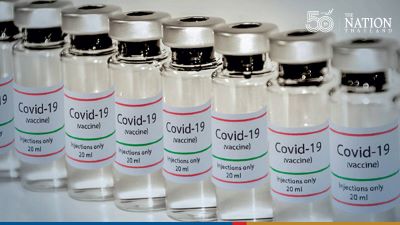
To date, 75% of vaccines have been administered in just 10 countries and only 1% of people in low-income countries have received at least one dose, according to WHO statistics.
Drug manufacturers say they are working every day to address the real bottlenecks and are on track to deliver 11 billion vaccines by year-end — enough to inoculate the world’s entire adult population.
While diplomats go on holiday, the process of getting the vaccines out there hasn’t stopped, said a spokeswoman for the International Federation of Pharmaceutical Manufacturers and Associations.
Published : July 27, 2021
By : Syndication Washington Post, Bloomberg · Bryce Baschuk




 State of emergency declared in Italys wildfire-ravaged Sardinia.
 State of emergency declared in Italys wildfire-ravaged Sardinia.
 State of emergency declared in Italys wildfire-ravaged Sardinia.