While Asia wants a baby boom, Indonesia says enough Is enough #SootinClaimon.Com

#SootinClaimon.Com : ขอบคุณแหล่งข้อมูล : หนังสือพิมพ์ The Nation.

https://www.nationthailand.com/news/30404527

While Asia wants a baby boom, Indonesia says enough Is enough

InternationalApr 05. 2021A closed store at Tanah Abang market in Jakarta in August 2020. MUST CREDIT: Bloomberg photo by Dimas ArdianA closed store at Tanah Abang market in Jakarta in August 2020. MUST CREDIT: Bloomberg photo by Dimas Ardian

By Syndication Washington Post, Bloomberg · Claire Jiao, Grace Sihombing, Michelle Jamrisko

Countries across Asia are trying everything from fertility tours to baby bonuses to spur population growth in an aging world. Not so in Indonesia, where officials are trying to convince people to have fewer children.

The world’s fourth most-populous country is promoting later marriages, family planning and contraception to lower its fertility rate to 2.1 children per woman by 2025. That’s the “replacement rate” that would effectively flatten population growth in the country of 270 million, damping some concerns that overcrowding could mean fewer job opportunities and strains on government services.

Indonesia’s latest push – a family planning campaign starting from late January – follows a decades-long struggle to bring the fertility rate down from 3 children per woman in the early 1990s. The difference now, National Population and Family Planning Agency Head Hasto Wardoyo says, is that instead of just slowing population growth, Indonesia is aiming to simultaneously improve other factors such as health, education and employment.

“In the past, the focus was on reducing the quantity of the population. Now it’s more on improving the quality of the population,” Wardoyo said. “The quality and productivity of human resources must be improved because we’re currently in a demographic dividend period. If not utilized, the demographic bonus can actually become a burden for development, rather than development capital.”

That might appear to be a risky venture for an emerging market, especially one that has lured investors with its youthful demographics and cheap labor. China famously has found it’s a struggle to reset the habits of families who for decades were restricted to one child. And development economists generally advise that overpopulation tends to resolve itself as a country climbs the income ladder, making counter-efforts unnecessary.

Indonesia is saying it can’t afford to wait, especially as it’s bracing in the short term for potentially more pregnancies and less contraceptive use amid the pandemic’s stay-at-home orders.

Like many of her friends and relatives, Yulia Purnamasari said she got pregnant right after getting married in 2018. But when she and her husband realized the time and money needed to raise a child, they delayed having another baby so they could save up for a few years.

“We think it’s a plan that fits with our capacity with time, energy and money,” the 29-year-old working mother said. “We want to be able to provide our children with our maximum attention, care and education.”

Purnamasari said she didn’t know about family planning or how to access counseling where she lives on Lombok island in eastern Indonesia. Luckily, a local midwife was able to give her advice on contraception and installed an intrauterine device.

But Purnamasari still sees herself as an exception.

“My sister, for example, doesn’t do family planning and doesn’t use contraceptives regularly,” Purnamasari said. “If she gets pregnant out of plan, she just sees it as a blessing.”

The government’s campaign to make Purnamasari less of an exception, along with emphasizing a more digital-ready workforce, seems to be winning over analysts and investors.

The drive to develop human capital “aligns with broader strategies to move Indonesia up the industrial value chain in areas like electric vehicles and downstream processing, as well as accelerating growth in what is already Asean’s largest digital economy,” said Patrick Cooke, a managing editor of research firm Oxford Business Group, referring to a group of Southeast Asian nations. “On balance, I believe investors would be happier with rising prosperity and skill levels in Indonesia rather than an ever-rising population.”

Given the size of Indonesia’s population, even a modestly higher-than-average fertility rate can balloon the numbers. At its current pace of 2.3 children per woman, Indonesia will add 30 million people in the next decade – an increment that dwarfs the total population of Australia, United Nations projections show.

The new population strategy would be a fundamental reworking of the growth model that has Indonesia on course to be one of the world’s five largest economies by 2030, overtaking the likes of Germany, Japan, Russia and Brazil, according to Standard Chartered projections from 2019 using purchasing power parity exchange rates and nominal GDP. The country has long banked on its huge domestic market for consumption, while its abundant cheap labor has propped up sectors like manufacturing, mining and agriculture.

Indonesia’s efforts contrast with regional neighbors, especially in rapidly aging Thailand and Singapore.

In Thailand, the government has embarked on a long-term campaign to avoid being a rare economy that grows old before it grows rich. The central bank has warned repeatedly that Thailand could be the first developing country to become an “aged society” by next year, and is pushing to raise the retirement age, support reverse mortgages for the elderly and give employers incentives to hire workers older than 60.

Singapore has offered to increase cash support for citizens who have kids amid reports that many could delay parenthood due to job losses and wage cuts during the pandemic. The number of marriages in the city-state fell about 10% last year.

“To secure our future, we must make our own babies, enough of them,” Singaporean Prime Minister Lee Hsien Loong said in 2019.

As Indonesia embarks on the opposite course and seeks to change attitudes, it also faces the challenge of adapting to a higher-income economy.

Despite graduating to upper-middle income status last year, Indonesia lags countries in the Organisation for Economic Cooperation and Development – a group of richer nations, where it’s a “key partner” rather than a member – across a range of development indicators like health care spending, youth employment, tertiary educational attainment and life expectancy.

The pandemic has aggravated the situation, especially as Indonesia battles Southeast Asia’s worst coronavirus outbreak. The OECD warns of “severe” social fallout even if the economy returns to growth, as shrinking job opportunities threaten to swell the ranks of the poor to 36 million.

“Even without a pandemic, Indonesia’s job market is already quite tight with around 2.5 million new entrants to the workforce each year,” said Turro Wongkaren, director at the University of Indonesia’s Institute of Demography. If the government can’t keep people healthy, educated and employed, its “demographic bonus” can just as easily become a “demographic disaster,” he said.

Bringing down the fertility rate is a long and gradual process, according to Satyawanti Mashudi, a commissioner with the National Commission on Violence Against Women. It took the country more than two decades to lower the fertility rate from around 3 children per woman in 1991 to 2.4 in 2017, she said.

“As populations get wealthier they tend to have less kids, as they don’t rely on them when they are older and it becomes more expensive for education and other needs,” said Joshua Crabb, a senior money manager at Robeco in Hong Kong. “This is indicative of a growing middle class and a focus on the quality of life. Either way, it will be many years before that would impact the demographics of Indonesia, which is still very young.”

There are also deeply ingrained cultural and religious values at play. The predominantly Muslim nation has tight-knit extended families, and having more children is considered to bring more blessings from God, Mashudi said. Even when women are open to contraception, their husbands and relatives may not be supportive, she said.

The government also will have to confront a more-is-more mindset among Indonesian families, especially those in the provinces that still consider children as potential human capital for their businesses, Mashudi said.

“I once talked to a person in Kalimantan island about family planning and they said, ‘Why should I have fewer children? My family still has this large plot of land, so why should we have a small family?'”

Some say Indonesia may not have to do much at all. Fertility rates are falling across the world, although the pace is slower in Indonesia.

Potent socioeconomic forces such as rapid urbanization, rising incomes, and improving female education and labor participation are giving rise to smaller families, Asian Development Bank principal economist Donghyun Park said.

Indonesia would do well to prepare for the shift and invest in improving the productivity and innovation of its human capital, especially amid its “gaping shortage” of technical and professional skills, Park said.

Years of inadequate investment in education have led to a deficit of 1.3 million high-skilled workers in 2020, OECD data showed. The gap is estimated to grow to 3.8 million by 2030, equivalent to one-third of the high-skilled workforce.

ADB’s Park said Indonesia eventually will need to shift away from a growth paradigm of low-wage employment toward one geared for a higher-value knowledge economy.

“In short, Indonesia’s future growth model envisions better workers instead of more workers,” Park said.

World’s biggest wind farm may be answer to South Korea’s net-zero dream #SootinClaimon.Com

#SootinClaimon.Com : ขอบคุณแหล่งข้อมูล : หนังสือพิมพ์ The Nation.

https://www.nationthailand.com/news/30404526

World’s biggest wind farm may be answer to South Korea’s net-zero dream

InternationalApr 05. 2021Wind turbines manufactured by Doosan Heavy Industries & Construction Co. and the offshore substation stand at the Korea Offshore Wind Power wind farm in Buan, South Korea, on Thursday, March 25, 2021. MUST CREDIT: Bloomberg photo by SeongJoon Cho.Wind turbines manufactured by Doosan Heavy Industries & Construction Co. and the offshore substation stand at the Korea Offshore Wind Power wind farm in Buan, South Korea, on Thursday, March 25, 2021. MUST CREDIT: Bloomberg photo by SeongJoon Cho.


By Syndication Washington Post, Bloomberg · Heesu Lee, Will Mathis

The fishing grounds where Jung Kuenbae and his forbears have caught shrimp, butterfish and croakers for three generations are going to be turned into the world’s largest offshore wind farm. He’s okay with that.

“I initially opposed the idea when the plan was proposed because it will destroy our livelihood,” said Jung, who leads a group of local fishermen in some 200 ships that drop nets in the waters off the southwestern tip of the Korean peninsula. “But I realized the project is part of the country’s transition to cleaner energy, which is something we have to come to terms with, rather than fighting against it.”

The 48.5 trillion won ($42.8 billion) wind farm, to be built over the next decade off the southwest coast of the country, would generate up to 8.2 gigawatts of power, one of a catalog of grand projects the government wants to roll out with private sector backing to meet its ambition of becoming carbon neutral by 2050.

It’s a momentous challenge. South Korea’s industrial ascent since the 1960s has made it one of the world’s top 10 energy users, with electricity consumption per capita ahead of both Japan and Germany. And two thirds of that comes from fossil fuels. Renewable energy accounted for only 6.5% of South Korea’s generation in 2019, with nuclear making up the balance.

“South Korea will have to source almost all of its electricity from renewable energy if it’s ever going to reach climate neutrality by 2050,” said Lee Sanghoon, president of the New and Renewable Energy Center at Korea Energy Agency. It “is a daunting task.”

Many countries are scaling up wind energy. Developers set a record last year as they installed 96.3 gigawatts of wind turbines globally, according to clean energy research group BloombergNEF. That would be enough to power about 36 million American households. The International Energy Agency estimates that at least 160 gigawatts of wind has to be added per year by 2025 in order to meet the Paris Agreement’s goals.

After retaining power last year on the promise of a “Green New Deal,” President Moon Jae-in’s Democratic Party has brought a new urgency to the transition, with a proposal to get more than 20% of its energy from renewables by 2030. For South Korea, it’s not just about curbing emissions. Apart from a tiny amount of gas and coal, all its fossil fuels are imported, costing the nation $73 billion a year.

With its conventional hydropower resources almost fully utilized and a climate and topography ill-suited for large solar and onshore wind plants, the country is looking out to sea to solve the problem. It already has the world’s biggest tidal power plant at Sihwa Lake. But the government sees one of its best prospects is to harness 12 GW from offshore wind by 2030, compared with less than 0.2 GW now.

The open seas have more consistent wind speeds and provide space to install the biggest, most efficient turbines. Just by using sites in shallow water that are near to shore, the world could get enough electricity to meet all global demand. With floating turbines that go further out to sea, wind power could satisfy more than 10 times the world’s total electricity demand by 2040, an IEA analysis showed.

So far countries in northern Europe such as the U.K., Denmark and Germany have dominated the offshore wind industry, thanks to generous government subsidies and unusually shallow waters of the North Sea. But that’s starting to change. Last year China installed a record-number of offshore wind turbines to become the world leader in total capacity. U.S. President Joe Biden’s administration plans to rapidly scale up wind farms off the east coast.

About 80 miles from the Korean island of Shinan, where the fisherman Jung lives, maintenance workers in helmets and orange life jackets climb a 200 meter-tall tower at the nation’s biggest existing commercial offshore wind farm, 30 minutes by boat from the port of Buan. The project’s 60 MW capacity is less than 1% of the proposed new wind farm in Shinan.

The complex, in the Southwest Sea, will be expanded to 2.46 GW after 2027, according to Korea Offshore Wind Power Corp., a special purpose company formed by state-run Korea Electric Power Corp. and six other generators.

One of the major challenges to achieving these goals is local opposition. A BloombergNEF report in September predicted that South Korea could fall short of the government’s target wind power by 4.6 GW, mainly due to “severe opposition” from local residents.

To ease conflict with the community, the Shinan government in 2018 passed rules allowing them to acquire a 30% stake in local renewable energy projects. That will provide a windfall for residents of six of the islands in the archipelago this month when last year’s profits from two solar plants are distributed.

“Renewable energy will become a stable source of income for Shinan residents, who are mostly in their 70s and 80s,” said Kim Jung Dae, a 63-year-old farmer who represents a group of local residents. “I wouldn’t be surprised if Shinan became the most well-off island in the country.”

There are other challenges. Wind power in South Korea currently costs about $220 per megawatt hour, according to IHS Markit, among the highest in the world.

“You’d need the wind to blow at 13 meters per second all day every day to run at full capacity of 8.2 gigawatts, which is impossible,” said Joo Han Gyu, a professor at Seoul National University’s department of nuclear engineering. “The economics of these wind turbines make no sense and the increased cost will eventually fall upon individuals.”

South Korea’s wind ambitions also rely on a sustained effort from dozens of private companies. The Shinan wind project, for example, is composed of about 20 separate ventures by corporations including SK E&S Co. and Hanwha Engineering & Construction. That means plans could get scrapped or modified as each company goes through the long process of obtaining permits and calculating costs.

To help accelerate installations, a “one-stop shop” bill will be proposed in the first half of this year that will allow the government to take the helm in exploring potential offshore sites and getting required permits, said Yoon Sunghyuk, a director of the renewable energy division at the Ministry of Trade, Industry and Energy.

One answer may be to develop floating plants that can be moored further out than fixed turbines, which are limited to shallow water, said Lee from the Korea Energy Agency. Several such projects are planned by companies including Korea National Oil Corp. and Equinor ASA, which aim to jointly construct a 200-megawatt complex in the East Sea near Ulsan.

For Jung, sitting in his office in Mokpo, the country’s interest in offshore wind has led him to see the energy transition as an opportunity, rather than the end of his career.

“No one knows the sea here better than us. I’m sure there will be plenty of work we can do,” Jung said. “If you can’t turn the tide, it’s better to embrace the flow.”

Biden vaccination goal stands despite plant contamination, White House says #SootinClaimon.Com

#SootinClaimon.Com : ขอบคุณแหล่งข้อมูล : หนังสือพิมพ์ The Nation.

https://www.nationthailand.com/news/30404525

Biden vaccination goal stands despite plant contamination, White House says

InternationalApr 05. 2021

By The Washington Post · Amy Goldstein, Jon Swaine, Christopher Rowland

WASHINGTON – The Biden administration said Sunday that the country will have sufficient coronavirus vaccine supply to meet the president’s goal of enabling every adult in the United States to get immunized by the end of May, despite the contamination of millions of doses at a troubled Baltimore manufacturing facility.

A senior administration official, who spoke on the condition of anonymity to discuss the sensitive matter, said health officials had negotiated for more than a week for an arrangement, announced late Saturday, under which Johnson & Johnson would take over responsibility for manufacturing at the plant. Johnson & Johnson developed one of the two coronavirus vaccines being made at the Baltimore facility where the cross-contamination occurred.

Federal officials were working over the weekend to pin down another U.S. site where the other vaccine produced in the facility – developed by AstraZeneca – could be manufactured and have identified potential locations.

Meanwhile, the company that owns the plant, Emergent BioSolutions, may be allowed to retain some of its employees in making the Johnson & Johnson vaccine, as long as it relinquishes all control of the manufacturing and quality inspections, the official said. Emergent Biosolutions is a major government contractor.

The developments followed the news that a batch amounting to 15 million doses of Johnson & Johnson’s vaccine was spoiled at the Emergent plant after being contaminated with ingredients for AstraZeneca’s vaccine.

The error was caught, and no contaminated vaccine left the plant, according to the companies involved. No doses had shipped, because the plant has not yet been certified by the Food and Drug Administration as a manufacturer of coronavirus vaccine.

When President Joe Biden took office in January, his administration inherited a scarcity of the two vaccines that the FDA had by then authorized for emergency use against the novel coronavirus, which can cause the illness covid-19. Those vaccines were developed by Pfizer-BioNTech and Moderna. Johnson & Johnson’s was authorized in late February.

The president and his aides have prioritized increasing vaccine supplies. A month ago, Biden pledged that stepped-up vaccine manufacturing would lead to enough doses for every adult who wanted one by the end of May.

On Sunday, the senior official said that, no matter what happens with the Baltimore plant or the manufacturing of AstraZeneca vaccine, which is not authorized for U.S. use, “there is enough vaccine for all adult Americans who want it by May 31.”

Federal rules specify that “live vector” vaccines should not be made at the same facility, but the official said it had been ambiguous whether the rule applies to the type of vaccines developed by Johnson & Johnson and by AstraZeneca, or whether two vaccines could be made in separate areas of a plant. “They proved they can’t,” the official said.

That official and two other administration officials who also spoke on the condition of anonymity to discuss the sensitive situation said that, in deciding which vaccine should continue at the Emergent facility, the Department of Health and Human Services chose to keep Johnson & Johnson because those shots could be used in the United States if the FDA certifies the plant for that use.

According to the officials, the Biden administration negotiated a path out of the plant’s contamination troubles without explicitly invoking the Defense Production Act, a 1950s-era law that has been used to accelerate vaccine-making material and other coronavirus-fighting supplies.

Johnson & Johnson said in a statement Saturday that it “is adding dedicated leaders for operations and quality, and significantly increasing the number of manufacturing, quality and technical operations personnel to work with the company specialists already at Emergent.”

The company said it expects to deliver 100 million doses of its single-shot vaccine to the U.S. government by the end of May.

Emergent spokeswoman Nina DeLorenzo said the company intends to stop making the AstraZeneca vaccine in the next few days.

AstraZeneca said in a statement that it is working with the federal government “to support agreed-upon plans for the development, production and full delivery of the vaccine.”

AstraZeneca did not say how much its departure from the Emergent plant could set back its manufacturing timeline in the United States. It has taken other manufacturers six months or more to ramp up new supply of coronavirus vaccine lines.

Unrelated to the contamination by Emergent employees, AstraZeneca already has been beset by problems with clinical trials, controversy over reporting of its data, and concerns in Europe about blood clots showing up as a rare side effect. In May 2020, the company predicted that it would begin delivering the first of 300 million doses of its vaccine for the United States in the fall, but it did not meet that promise, nor has the FDA authorized it for emergency use.

For Emergent to spoil raw vaccine substance amounting to 15 million doses suggests a breakdown in quality control at early stages of manufacturing that should have been caught in subsequent steps, said John Avellanet, an FDA compliance expert who is managing director at Cerulean Associates, a pharmaceutical consulting firm.

If contamination had been detected earlier in the process, he said, it probably would have affected far less product. Johnson & Johnson had said last year that Emergent would be making vaccine in single-use, 1,000-liter bioreactor bags. The magnitude of this incident indicates that more than one bag’s product was probably affected, Avellanet said, adding that it was highly unusual for so much vaccine substance to be ruined in one incident.

“This kind of thing just does not happen,” Avallenet said.

The changes in vaccine production at the plant were first reported Saturday by The New York Times.

The Washington Post reported last week that an FDA investigator flagged problems at the Baltimore facility six weeks before the Trump administration announced a $628 million deal with Emergent as part of Operation Warp Speed, the government’s program at the time to develop and produce vaccines to fight the novel coronavirus.

Emergent secured deals totaling more than $740 million with Johnson & Johnson and AstraZeneca to produce vaccines for both companies at the Baltimore site.

The Post reported last year that Emergent had benefited from billions of dollars in federal contracts as health officials directed public spending toward the threat of bioterrorism attacks at the expense of some preparations for a pandemic.

Emergent’s Warp Speed deal was made as part of a long-standing contract between the company and the agency within the Department of Health and Human Services responsible for preparing for public health threats.

At the time of the award, that agency was led by Assistant Secretary Robert Kadlec. The Post previously reported that before joining the Trump administration, Kadlec was paid as a consultant to Emergent and formed a start-up company with Emergent’s chairman. Kadlec did not mention either role in a questionnaire about his career that he completed for the Senate when it considered his nomination by Trump in 2017. Kadlec and Emergent previously told The Post that Kadlec’s past work for Emergent had no bearing on the firm’s government contracts.

Australia sets national record for virus vaccinations in a day #SootinClaimon.Com

#SootinClaimon.Com : ขอบคุณแหล่งข้อมูล : หนังสือพิมพ์ The Nation.

https://www.nationthailand.com/news/30404524

Australia sets national record for virus vaccinations in a day

InternationalApr 05. 2021

By Syndication Washington Post, Bloomberg · Thuy Ong

Australia says it has given nearly 80,000 people a virus vaccination to set a new single-day high, boosted by strong stockpiles.

A record 79,283 people received an initial dose on Thursday, the latest day that such data is available, Health Minister Greg Hunt told a press briefing on Sunday.

“The supply at this stage is looking strong,” he said. “Given the great and enormous global competition, the fact we have this domestic supply is fundamental.”

Australia has nearly eliminated local transmissions by closing its international border to non-residents, but occasional cases have leaked into the community from quarantine hotels where returned overseas travelers must isolate for 14 days. States have imposed several snap lockdowns in recent months to contain clusters.

Australia has met its principal targets for vaccination start dates, Hunt added, and wants to see everyone who wants a shot getting an initial dose by the end of October. More than 841,000 vaccinations have been completed across Australia as of Saturday evening, he added.

The government is behind on its vaccine rollout plans, Mark Butler of the opposition Australian Labor Party said Sunday. Prime Minister Scott Morrison had promised 4 million doses would be given by the end of March, Butler said.

Australian authorities said on Saturday they were working with the European Union and the U.K. to investigate the first local case of an unusual clotting in a patient after receiving the AstraZeneca Plc vaccine.

Phone numbers, personal information for 533 million Facebook users exposed online, report says #SootinClaimon.Com

#SootinClaimon.Com : ขอบคุณแหล่งข้อมูล : หนังสือพิมพ์ The Nation.

https://www.nationthailand.com/news/30404523

Phone numbers, personal information for 533 million Facebook users exposed online, report says

InternationalApr 05. 2021

By The Washington Post · Hannah Knowles

Personal information on more than 500 million Facebook users – previously leaked and now made more widely available – was shared online Saturday, according to the news site Insider, worrying experts who said the compromised data could make people more vulnerable to fraud.

Insider said it reviewed a sample of the leaked phone numbers, birth dates, biographical details and more and found that some data matched known Facebook users’ records. The Washington Post has not independently verified the information. Facebook said the leak involved “old” data stemming from a problem resolved in 2019, but the news still sparked renewed scrutiny of a social media giant previously dogged by high-profile concerns about data privacy.

“Bad actors will certainly use the information for social engineering, scamming, hacking and marketing,” tweeted Alon Gal, the co-founder of an Israeli cybercrime intelligence company called Hudson Rock, who flagged the release of the Facebook data Saturday. Social engineering involves getting access to people’s confidential information by gaining their trust rather than overcoming technical barriers – for example, by impersonating a tech support person.

“I have yet to see Facebook acknowledging this absolute negligence of your data,” Gal tweeted. Gal said the compromised data also included Facebook IDs, full names, locations, some email addresses, relationship statuses and other details.

Facebook did not immediately respond to questions Saturday evening, but company spokeswoman Liz Bourgeois tweeted Saturday that the leak detailed by Insider involved “old data that was previously reported on in 2019.”

“We found and fixed this issue in August 2019,” Bourgeouis wrote.

Insider said a Facebook spokesperson told the news organization that the data was scraped through a now-fixed vulnerability.

The breach affected more than 533 million users spanning 106 countries, according to Insider, and includes more than 32 million records for users in the United States.

Gal told The Washington Post that the leaked database was previously sold for tens of thousands of dollars and then circulated, selling for lower prices until it finally was offered at no charge.

Early this year, Gal said, someone built a bot that gave people access to the database for a fee – a development that made the trove of data “much more worrisome,” Gal tweeted at the time. Motherboard reported in January on that peddling of access in a “low-level cybercriminal forum.”

On Saturday a user posted on a forum offering the data free.

The Post messaged the user on the app Telegram and did not immediately hear back.

Facebook – the world’s most popular social media site, with well over 2 billion users – has drawn rebukes before for its handling of people’s data. In 2019, the Federal Trade Commission fined the company $5 billion, alleging that it misled users about how third parties such as advertisers were accessing their personal information. Facebook did not have to admit guilt, but its settlement with the government included what was the largest privacy violation fine in American history.

The FTC began investigating after reports that Cambridge Analytica, a firm that worked with the campaign of former president Donald Trump, had improperly accessed names, “likes” and other information for millions of users without their knowledge.

Johnson & Johnson says it will take full control of its coronavirus vaccine production at Baltimore plant #SootinClaimon.Com

#SootinClaimon.Com : ขอบคุณแหล่งข้อมูล : หนังสือพิมพ์ The Nation.

https://www.nationthailand.com/news/30404522

Johnson & Johnson says it will take full control of its coronavirus vaccine production at Baltimore plant

InternationalApr 05. 2021

By The Washington Post · Jon Swaine

Johnson & Johnson will take full control of the production of its coronavirus vaccine at a troubled plant in Baltimore where millions of doses worth of drugs were contaminated, the company said late Saturday.

Production at the plant of the vaccine developed by AstraZeneca will be relocated with help from the Biden administration following the mix-up, according to AstraZeneca and a seniorfederal health official.

The developments followed the news that a batch amounting to 15 million doses of Johnson & Johnson’s vaccine was spoiled at the plant after being contaminated with ingredients for AstraZeneca’s vaccine.

The error was caught and no contaminated drugs made it out of the plant, according to the companies involved.

The plant is operated by Emergent BioSolutions, a major government contractor. The senior health official said the administration had determined that only one vaccine should be made at the facility.

Johnson & Johnson said in a statement that it was “assuming full responsibility” of production of its vaccine at the plant and that it was sending additional staff to Baltimore to oversee production.

“Specifically, the company is adding dedicated leaders for operations and quality, and significantly increasing the number of manufacturing, quality and technical operations personnel to work with the company specialists already at Emergent,” the statement said.

AstraZeneca said in a statement that it was working with the government to find an alternative location for production of its vaccine, which has not yet been authorized by U.S. authorities.

“AstraZeneca and the U.S. government continue to work closely together to support agreed upon plans for the development, production and full delivery of the vaccine,” the statement said.

Johnson & Johnson said that it still expected to deliver 100 million doses of its single-shot vaccine to the U.S. government by the end of May. President Biden has pledged that all American adults will be eligible for vaccination by that time.

Emergent spokeswoman Nina DeLorenzo confirmed Saturday that the company had been notified that production of the AstraZeneca vaccine would be relocated and that Emergent intended to stop making the vaccine in the next few days.

“We are welcoming additional Johnson & Johnson personnel on-site at Bayview for their technical expertise and support,” DeLorenzo said.

The changes in vaccine production at the plant were first reported Saturday by the New York Times.

Emergent’s coronavirus vaccine production line has not yet been certified by the Food and Drug Administration. Until it is certified, vaccines made there cannot be distributed to consumers. Drugs made at the Baltimore plant have been set aside while the FDA reviews the Emergent plant.

The Washington Post reported on Thursday that an FDA investigator flagged problems at the Baltimore facility six weeks before the Trump administration announced a $628 million deal with Emergent as part of Operation Warp Speed, the government’s program to rapidly produce vaccines to fight the novel coronavirus.

Emergent secured deals totaling more than $740 million with Johnson & Johnson and AstraZeneca to produce vaccines for both companies at the Baltimore site.

The Post reported last year that Emergent had benefited from billions of dollars in federal contracts as health officials directed public spending toward the threat of bioterrorism attacks at the expense of some preparations for a pandemic.

Emergent’s Warp Speed deal was made as part of a long-standing contract between the company and the office in the Department for Health and Human Services responsible for preparing for public health threats.

At the time of the award, that office was led by Assistant Secretary Robert Kadlec. The Post previously reported that before joining the Trump administration, Kadlec was paid as a consultant to Emergent and formed a startup company with Emergent’s chairman. Kadlec did not mention either role in a questionnaire about his career that he completed for the Senate when it considered his nomination by Donald Trump in 2017. Kadlec and Emergent previously told The Post that Kadlec’s past work for Emergent had no bearing on the firm’s government contracts.

How the Ever Given was freed from the Suez Canal #SootinClaimon.Com

#SootinClaimon.Com : ขอบคุณแหล่งข้อมูล : หนังสือพิมพ์ The Nation.

https://www.nationthailand.com/news/30404516

How the Ever Given was freed from the Suez Canal

InternationalApr 04. 2021

By Atthar Mirza, Júlia Ledur, Ruby Mellen
The Washington Post

The crisis in the Suez Canal last month turned the world’s attention on a single challenge few had ever considered: how to refloat a 200,000-ton mass of steel, as long as the Empire State Building is high.

Digging, tugging and pulling, it turned out, freed the ship. The days-long, round-the-clock effort to move the massive vessel involved sucking sand and mud from underneath its hull, as tugboats pushed and pulled the ship in confluence with a swelling tide.

Here’s how it happened.

The Ever Given container ship became stuck at an angle in the Suez Canal during a sandstorm on March 23, blocking for six days a vital waterway through which about 15 percent of all shipping passes.

Using satellite imagery and vessel data, The Post reconstructed the operation that released the ship

The canal narrows below the shoreline, which meant the ship was much more stuck than it appeared to be in photos. Riprap, or loosely placed stones, lines the banks, which made it even harder to dislodge the ship.

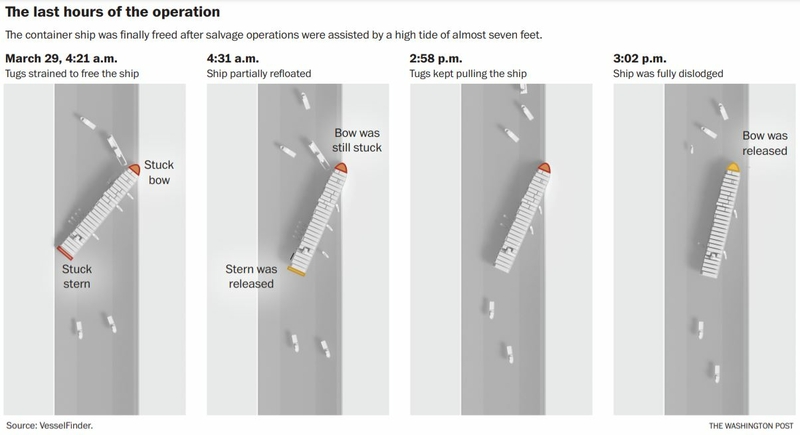
A fleet of tugboats, dredgers and salvage crews worked for several days to refloat the ship. On Monday morning, they managed to free the stern, the back of the vessel, the most visible sign of progress since the blockage.

After a morning boost from a high tide reaching nearly seven feet, a new attempt to release the Ever Given began Monday afternoon.

The Ever Given was fully dislodged on Monday at 3:05 p.m. local time.

The Ever Given got stuck the morning of March 23, amid poor visibility and high winds in one of the narrower parts of the 120-mile canal. Egyptian officials have launched an investigation into the details of the crash.

“When you’re traveling on a boat and you hit something, there’s a tremendous sense of loss,” said Gregory Tylawsky, a licensed shipmaster and founder of the Maritime Expert Group.

Early in the crisis, experts were unsure how they would be able to move the ship. “It is not really possible to pull it loose,” said Peter Berdowski, the CEO of Dutch dredging company Boskalis, which helped with the week’s efforts.

The vessel, he said, was like “an enormous beached whale.”

The canal is dug in sand and mud, meaning a boat hitting the edge would get “stuck in the sand rather than [getting] repelled by a hard wall,” said Ragui Assaad, a professor at the University of Minnesota and research fellow at the Economic Research Forum in Cairo.

There is little room for error. “As a pilot, you cannot deviate from that center line,” Tylawsky said.

Within hours of the blockage, tugboats were on the scene, followed by dredgers, working through the week to free the Japanese-owned, Taiwanese-operated ship.

– – –

Each hour the Ever Given remained stuck on a muddy bank of the Suez Canal meant worse disruptions to international commerce. A substantial share of all shipping passes through the waterway. In the face of delays, the prices of oil and coffee began to rise, and livestock faced starvation aboard some of the hundreds vessels left waiting indefinitely.

With a ship that size already caught in the canal’s bank, there wouldn’t be much for the operators to do.

“It’d be controlled chaos onboard,” said Gary Cordes, a retired shipmaster and senior adviser at the Maritime Expert Group, who said he transited the canal nine times between the 1960s and 1980s. He said it would fall on those familiar with the landscape to come up with a plan to free the ship.

Authorities worked day and night, dredging and using tugboats to dig and pull the ship away from the banks. Salvagers dredged underneath and around the hull, pumping sediment from the bottom of the canal.

The dredgers on scene were heavy-duty. The 10th of Ramadan came to help, as did the Dutch-made Mashhour, owned and operated by the Suez Canal Authority, which was touted by the Transportation Research Board in 1996 as the “world’s largest and most powerful stationary cutter suction dredger,” capable of sucking up “abrasive sand with gravel, compacted sand, sticky clay and rocks.”

Often more than 10 tugboats were also leading the effort, pushing and pulling the ship in an effort to dislodge it from the bank.

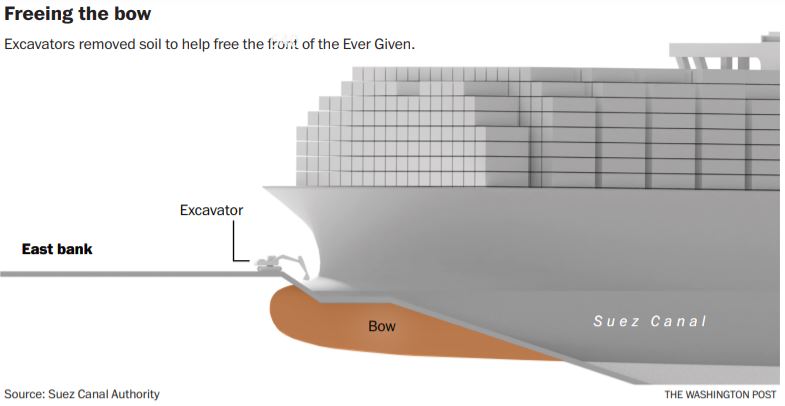
Loaders excavated the eastern embankment at the ship’s bow. Over the weekend, those efforts removed nearly 1 million cubic feet of mud and water, officials said.

In an added effort to refloat the ship, some 9,000 tons of the Ever Given’s ballast water – used to stabilize the ship – were released to help lighten the vessel, officials said.

– – –

While efforts throughout the week proved unsuccessful, the weekend bore promises of shifting tides. A full moon on Sunday night meant unusually high waters that could help refloat the ship. And more help was on the way: two big and powerful tugboats, the Dutch-flagged Alp Guard and the Italian-flagged Carlo Magno.

Through Sunday night into Monday afternoon, teams worked tirelessly to get enough of the sand and mud out from under the boat that it would rejoin the canal’s waters, staving off a catastrophe for global trade.

On Monday afternoon around 3 p.m., the Ever Given broke free, its leviathan haul slowly creeping north to the Great Bitter Lake.

“I think they did a spectacular job,” said Cordes, acknowledging he initially thought the effort would maybe take “a couple of weeks.”

The mood on the scene in the Suez Canal was ebullient, as workers cheered and vessels honked. But the ripples of the Ever Given’s release were felt around the globe.

“To do that is one thing but to do it in front of the world, with the world watching, it was massive,” Tylawsky said.

– – –

About this report: Sources: VesselFinder, Suez Canal Authority, Leth Agencies. Satellite image 2021 Maxar Technologies. The 3-D models of the Suez Canal were built based on measurements from the engineering department of the Suez Canal Authority. The positions of the Ever Given container ship and the tugboats are based on satellite imagery by Maxar, Airbus Space and Planet Labs Inc., as well as location data from VesselFinder. The dredger position is an approximation based on satellite images of the scene.

Cairo’s mummies get a new home and a grand procession on the way. #SootinClaimon.Com

#SootinClaimon.Com : ขอบคุณแหล่งข้อมูล : หนังสือพิมพ์ The Nation.

https://www.nationthailand.com/news/30404515

Cairo’s mummies get a new home and a grand procession on the way.

InternationalApr 04. 2021

By Sudarsan Raghavan
The Washington Post

CAIRO – It was a parade unlike any other this city has seen.

A procession of 22 ancient Egyptian royal mummies streamed Saturday from downtown Cairo, where revolutionaries rose up to topple autocrat Hosni Mubarak a decade ago, to a new museum three miles away that represents Egypt’s future as much as its past.

At 8 p.m., the mummies – 18 kings and four queens – left the famed ochre-hued Egyptian Museum near Tahrir Square, where they had rested for decades. They were each atop specially decorated gold-and-blue-hued vehicles, resembling a boat. Or perhaps the symbol of a winged sun, an ornament worn by Egypt’s ancient rulers and seen as providing protection. Each of the 22 vehicles was emblazoned with the name of the royals mummy it carried.

The multimillion-dollar affair – called the Pharaohs’ Golden Parade – had been promoted for months. Egyptian authorities are seeking to attract tourists, a key source of foreign currency, and alter the course of an economy battered by the coronavirus pandemic, Islamist attacks and political chaos in past years.

The highly choreographed ceremony was also a nationalist vehicle to highlight Egypt’s place in history. The nation’s authoritarian president, Abdel Fatah al-Sissi, who himself is often referred to as “a new pharaoh” for his ambitious projects and iron-fisted rule, presided over the ceremony.

In a Facebook post, Intisar al-Sissi, Egypt’s first lady, said Saturday’s event “expresses the greatness of the ancient civilization that provided humanity, and still does, with a unique and diverse legacy, contributing to its progress and prosperity.”

Most Egyptians saw the parade on television with the entire route and surrounding bridges and roads closed for security. With parts of the program prerecorded, viewers were treated to an orchestra and singer playing patriotic music and videos extolling many of the country’s famous temples, churches and mosques.

Sissi, along with senior officials and aides, watched the parade on a giant screen inside a hall of the National Museum of Egyptian Civilization, where the mummies would be displayed.

The ceremony sought to recreate the ancient existences of the royals. In the procession were horse-drawn chariots and hundreds of performers wearing the traditional attire worn by ancient Egyptians.

The vehicles circled around Tahrir Square, the epicenter of Egypt’s revolution, which is now centered with an ancient obelisk and statues of lions. Flood lights bore into the night sky as yellow and blue lights lit up the area.

The mummies carried in boxes filled with nitrogen and their vehicles were fitted with special shock-absorbers to protect their millennia-old remains. Nothing was taken to chance: even their route was freshly paved.

The mummies in the procession were lined up in chronological order. The oldest rulers came first, starting with Seqenenre Taa, the last king of the 17th Dynasty, who reigned in the 16th century B.C. The last was the 12th century B.C.. pharaoh Ramses IX.

In between were two of the most well-known of ancient Egypt’s rulers: Ramses II, widely seen as the greatest pharaoh of the New Kingdom period, and Queen Hatshepsut, who ruled at a time when women pharaohs were very rare. The temples of both rulers, in Luxor and Abu Simbel, are among the most visited.

At 8:30 p.m., after following a large motorcycle escort through the empty Cairo streets, the 22 vehicles stopped in front the National Museum of Egyptian Civilization in the capital’s Fustat enclave. Then, a 21-gun salute followed. Minutes later the parade entered the compound and Sissi walked out to greet the new arrivals.

They will be housed in the museum’s royal hall of mummies and will go on display by mid-month, said officials.

Amazon admits it was wrong to suggest its workforce never needs to pee in bottles on the job #SootinClaimon.Com

#SootinClaimon.Com : ขอบคุณแหล่งข้อมูล : หนังสือพิมพ์ The Nation.

https://www.nationthailand.com/news/30404502

Amazon admits it was wrong to suggest its workforce never needs to pee in bottles on the job

InternationalApr 04. 2021

Last week, in an unusually combative tweet-response to a congressman, Amazon insisted that its workers did not urinate in bottles.

“If that were true, nobody would work for us,” wrote the e-commerce giant that employs more than a million people worldwide. Disbelief, derision and fact-checking ensued as journalists weighed in with reported memos and contractor policies suggesting otherwise: “Documents show Amazon is aware drivers pee in bottles and even defecate en route,” the Intercept reported, citing workers who described intense pressure to hit their quotas.

Now Amazon says it was wrong.

“[We] know that drivers can and do have trouble finding restrooms because of traffic or sometimes rural routes, and this has been especially the case during Covid when many public restrooms have been closed,” the retail giant wrote in a Friday blog post, apologizing to Rep. Mark Pocan, D-Wis., for its “incorrect” response to him.

“This is a long-standing, industry-wide issue and is not specific to Amazon,” the company said, including links to various news stories. “Regardless of the fact that this is industry-wide, we would like to solve it. We don’t yet know how, but will look for solutions.”

The company’s mea culpa came as several thousand Amazon employees in an Alabama warehouse vote on whether to unionize – a local referendum with national implications as advocates see a spark for broader changes and as President Biden and Sen. Bernie Sanders, I-Vt., back workers’ right to organize. Amazon has fought unionization aggressively, fueling long-standing criticisms that it mistreats workers even as the retail giant touts its $15 minimum wage.

Pocan rebuffed Amazon’s apology on Saturday, tweeting that it is “not about me” but about Amazon’s workers “who you don’t treat with enough respect or dignity.”

“Start by acknowledging the inadequate working conditions you’ve created for ALL your workers, then fix that for everyone & finally, let them unionize without interference,” Pocan wrote.

Amazon did not immediately respond to a request for further comment Saturday. Amazonchief executive Jeff Bezos owns The Washington Post.

The Twitter-fight began on March 24 after Pocan tweeted a critical response to Amazon executive Dave Clark, who suggested his company shared common ground with their strident critic Sanders – while also taking a jab at Sanders and other progressive politicians’ struggle to pass national reforms such as a $15 minimum wage.

“I often say we are the Bernie Sanders of employers, but that’s not quite right because we actually deliver a progressive workplace,” Clark said.

Pocan, who bills himself as a “small business owner, union member, and lifelong advocate for progressive causes,” objected.

“Paying workers $15/hr doesn’t make you a “progressive workplace” when you union-bust & make workers urinate in water bottles,” he tweeted.

That drew an eye-catching and soon-to-go-viral response from Amazon News that began, “You don’t really believe the peeing in bottles thing, do you?”

On March 25, Amazon also tweeted a combative response to another high-profile critic, Sen. Elizabeth Warren, D-Mass., who had accused large companies such as Amazon of exploiting tax “loopholes.”

“You make the tax laws @SenWarren; we just follow them,” Amazon News wrote.

Online, people swiftly cited reporting that some people felt compelled to pee in bottles on the job. The Intercept’s Ken Klippenstein reported that Amazon’s tweet to Pocan raised eyebrows among staffers, too, with one security engineer suggesting the company’s account may have been hacked.

“These tweets are unnecessarily antagonistic (risking Amazon’s brand), and may be a result of unauthorized access by someone with access to the account’s credentials,” the engineer’s report read, according to the Intercept.

Nine days after its tweet to Pocan, Amazon backed off.

“This was an own-goal, we’re unhappy about it,” the company said in its blog post, using a soccer term for the unfortunate moment when someone scores on their own team.

That tweet “did not receive proper scrutiny,” the company said, and “did not contemplate our large driver population and instead wrongly focused only on our fulfillment centers.”

“A typical Amazon fulfillment center has dozens of restrooms, and employees are able to step away from their work station at any time,” the statement continued. “If any employee in a fulfillment center has a different experience, we encourage them to speak to their manager and we’ll work to fix it.”

Reporting over the years has said that both Amazon warehouse workers and contract drivers sometimes urinate in bottles to minimize their time off-task.

“I saw no effort on Amazon’s part to push delivery service providers to allow their drivers to use the restroom on a normal human basis, leading many, myself included, to urinate inside bottles for fear of slowing down our delivery rates,” former driver James Meyers recently told the Guardian, describing shifts that could stretch 14 hours.

Last fall, Amazon said it had 1,700 delivery-service partners in the United States, Canada, Germany, Spain and the United Kingdom. More than 400,000 drivers deliver goods for Amazon, all either self-employed or working for other companies even if they wear Amazon uniforms and drive trucks with its branding.

– – –

The Washington Post’s Hamza Shaban and Jay Greene contributed to this report.

Nearly 20 arrested in alleged plot against Jordan’s King Abdullah II #SootinClaimon.Com

#SootinClaimon.Com : ขอบคุณแหล่งข้อมูล : หนังสือพิมพ์ The Nation.

https://www.nationthailand.com/news/30404501

Nearly 20 arrested in alleged plot against Jordan’s King Abdullah II

InternationalApr 04. 2021

By Joby Warrick, Sarah Dadouch, Steve Hendrix
The Washington Post

Jordanian authorities on Saturday arrested as many as 20 people and sought to restrain the movement of a former crown prince amid what officials called a threat to the “security and stability” of a country long regarded as a vital U.S. ally in the Middle East.

Prince Hamzah bin Hussein, the eldest son of the late King Hussein and his American-born fourth wife, Queen Noor, was told to remain at his Amman palace amid an investigation into an alleged plot to unseat his older half brother, King Abdullah II, according to a senior Middle Eastern intelligence official briefed on the events.

The move followed the discovery of what officials described as a complex and far-reaching plot that included at least one other Jordanian royal as well as tribal leaders and members of the country’s political and security establishment. One official cited unspecified evidence of “foreign” backing for the plan.

Biden administration officials were briefed on the arrests, which come at a time of heightened economic and political tension in a country long regarded as a bulwark of stability and an essential partner in U.S.-led counterterrorism operations.

Additional arrests were expected, said the intelligence official, who, like others, spoke on the condition of anonymity, citing security sensitivities surrounding the law enforcement operation.

In a formal statement late Saturday, the Jordanian Armed Forces confirmed that multiple arrests had occurred and that Hamzah had been “asked to cease all movements or activities that could be employed to target Jordan’s security and stability.” The statement said that the former crown prince had not been arrested but that “comprehensive investigations” were underway.

In a video statement late Saturday, Hamzah denied wrongdoing and said the actions against him were an attempt to silence him for speaking out against corruption in Jordan. In the statement delivered to the BBC by his lawyer, he confirmed that he was “not allowed to go out, to communicate with people or to meet with them, because in the meetings that I had been present in – or on social media relating to visits that I had made – there had been criticism of the government or the king.”

“I am not the person responsible for the breakdown in governance, for the corruption, and for the incompetence that has been prevalent in our governing structure for the last 15 to 20 years, and has been getting worse by the year,” he said. Hamzah, whose relations with Abdullah have been strained since his title was stripped from him in 2004, has sparred with his half brother frequently over the years, though mostly in private.

In Washington, State Department spokesman Ned Price said U.S. officials were closely following the reports and were in touch with Jordanian officials. “King Abdullah is a key partner of the United States, and he has our full support,” Price said.

Hamzah served as Jordan’s crown prince for four years before the title was transferred to the current monarch’s eldest son, Hussein, in 2004. He has held multiple positions within the monarchy, including in the army, where he holds the rank of brigadier. He commands a loyal following in Amman and, with his trim mustache and checkered headdress, often styles himself after the late King Hussein, a revered figure in Jordan.

The prince was informed of the investigation by Jordanian military officers who arrived at his house with an escort of guards, as arrests were getting underway elsewhere, the intelligence official said. Hamzah was told to refrain from travel and from posting on social media, the intelligence official said.

It was unclear how close the alleged plotters were to carrying out the supposed plan, or what, exactly, was intended. The intelligence official described the plan as “well-organized” and said some of the plotters appeared to have “foreign ties,” though he did not elaborate on that point.

The arrests of other officials were reported by Jordanian news outlets. Among them was Sharif Hasan, who also is a member of the royal family, and Bassem Awadullah, a former senior official in Jordan’s Royal Hashemite Court. An investment banker and CEO of Tomoh Advisory, a consultant firm based in Dubai, Awadullah had also served as special Jordanian representative to the Saudi government, and held Jordanian and Saudi passports, the intelligence official said.

In Israel, where news of the possible coup plot emerged at the end of the Passover holiday, officials had no immediate comment. But Israel, which has had a peace treaty with Jordan since 1994, considers stability in Amman as vital to Israel’s national interest. The two share Israel’s longest border, and Israel looks to Jordan to provide a buffer against threats from Iran.

“If this turns out to have been a serious attempt, it would be of a great deal of concern,” said Chuck Freilich, a former Israeli deputy national security adviser. “Israel takes the stability of the Hashemite Kingdom extremely seriously. They are a close security relationship.”

Jordan has been hit hard economically by the coronavirus pandemic as well as by the fallout from massive waves of refugees from Syria, its northern neighbor. Abdullah has ruled the country since King Hussein’s death in 1999, and cultivated close ties with a succession of U.S. presidents, while also clashing at times with U.S. officials over Palestinian peace initiatives. In recent years, he sparred with Trump administration officials over plans that would essentially bypass the Palestinians in seeking to redraw the boundaries of a future Palestinian state.

Under the king, the resource-poor kingdom of 10 million has been a major partner in the U.S.-led campaign against the Islamic State and has assisted U.S. forces in security operations around the globe.

– – –

Warrick reported from Washington. Hendrix reported from Jerusalem. Dadouch reported from Beirut. The Washington Post’s Shira Rubin in Jerusalem and John Hudson in Washington contributed to this report.