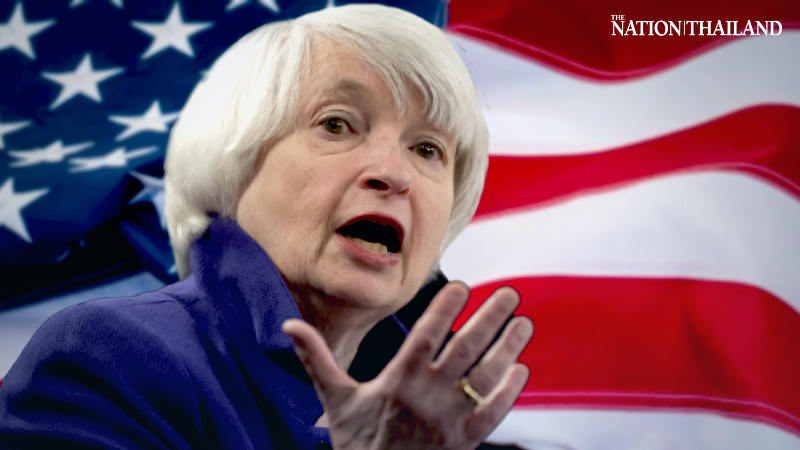
The Fed is making Wall Street forecasters pay attention to Black unemployment #SootinClaimon.Com

#SootinClaimon.Com : ขอบคุณแหล่งข้อมูล : หนังสือพิมพ์ The Nation.

https://www.nationthailand.com/news/30404599

The Fed is making Wall Street forecasters pay attention to Black unemployment

InternationalApr 07. 2021
By Syndication Washington Post, Bloomberg · Matthew Boesler

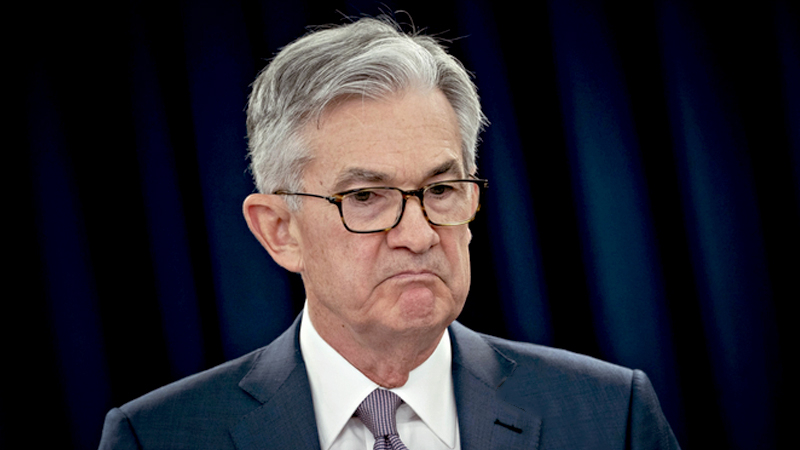
To get an idea of what Jerome Powell’s Federal Reserve will do next, Wall Street economists are having to try their hand at forecasting new variables — like the Black unemployment rate.

That shift in focus could itself contribute to the outcome that the Fed chair says he wants: an economic expansion reaching corners of the labor force that have been slower to recover in the past.

As the U.S. economy rebounds from the pandemic slump, Powell is spotlighting the kind of job-market metrics that will show Fed officials when it’s time to raise interest rates under their new framework, which explicitly redefines their goal of maximum employment as “broad-based and inclusive.”

Instead of across-the-board measurements like overall employment and wage growth, the focus is on groups that typically take longest to regain lost ground.

That means a prominent place on the Powell dashboard for metrics like the Black unemployment rate, wage growth for low-income workers, and labor-market participation among Americans without college educations.

Those gauges are signaling there’s still a long way to go. And if investors absorb that message, it will help to reinforce the economic support being provided by easy Fed policy.

Employers added 916,000 Americans back onto payrolls in March, in the first of what’s expected to be a string of big months for hiring as the U.S. rolls out vaccines and service industries reopen. Unemployment fell to 6%, down from a peak close to 15% last April.But Black unemployment was 9.6% — still above where it was as recently as January — and labor-force participation for high-school graduates without college educations remained near the lowest levels in decades, at 54.9%.

Annual average wage growth for the bottom 25% of earners was 4.2% in February (the March numbers aren’t out yet), compared with 4.7% just before the pandemic, when low-income jobs were posting their strongest relative pay gains since the late 1990s. Fed officials have been highlighting variables like these while remaining vague about exactly how they’ll play into an eventual decision about when to raise interest rates. Fed-watchers will inevitably press for more clarity as the first hike — which policymakers don’t currently expect before the end of 2023 — draws nearer.

But some Wall Street analysts aren’t waiting for the Fed’s guidance.

In a recent report, Goldman Sachs economists tried to quantify the impact of the new inclusive employment framework on monetary policy. Banks typically come up with monthly forecasts for headline unemployment and labor-force participation, but the Goldman team led by Joseph Briggs took the novel step of writing down a forecast for the Black unemployment rate as well.

While the overall jobless rate should drop to 4% this year and 3.5% by the end of 2022, Black unemployment probably won’t fall to its pre-pandemic low of 5.2% until the second half of 2023, and will still be above 4% by the end of 2024, they said. The forecasts were based on historical statistical relationships.If this kind of more granular forecasting takes hold, it could have an impact on the variables being forecast. That’s because monetary policy is a kind of public-private partnership.The Fed controls short-term interest rates. But it allows investors to set the longer-term rates, which central bankers typically view as more important because they determine the cost of mortgages or auto loans. So investor clarity about how the Fed will implement its new framework tomorrow is a crucial determinant of financial conditions today.

Right now, the Fed-markets partnership is delivering lower interest rates than at comparable points in the last recovery.Yields on 10-year Treasuries have surged to about 1.7% this year after Democrats won control of the Senate, which paved the way for additional fiscal support to speed up the recovery.

Still, yields remain well below the 2.5% level of September 2014, when the U.S. jobless rate first declined under 6% after the financial crisis — or the 2.3% yield in July 2015 when Black unemployment first reached today’s number.As well as shaping financial conditions, Powell’s new dashboard could help steer economic research toward key social questions.

Trillions of dollars hinge on the Fed’s interest-rate moves, which are among the most closely watched events in the financial world. If investors are demanding forecasts for Black unemployment or wages among the low-paid — because they’re key inputs for rate decisions — it could spur more analysis of why those labor-force discrepancies exist in the first place.

But so far, the Fed has been hesitant to make its own forecasts.

In a March 17 news conference, Powell said Fed officials are paying close attention to those variables but are not considering publishing projections for them because “it would not be practical” to do so.

The Fed’s staff economists, who prepare the groundwork for discussion at policy meetings, don’t typically incorporate forecasts for such indicators into their work either.

So for now, Wall Street still has a wide range of outcomes to consider — both for how the economic recovery will progress, and for how the central bank will respond.

The Goldman economists say they expect the Fed will begin raising rates in the first half of 2024, once the headline unemployment rate has fallen to 3.2%.

But even then, there’s “a more than 20% chance that the Black unemployment rate will still be above its last cycle low of 5.2% and a more than 90% chance” that it will be above 4%, they wrote. “Some FOMC members may see this as a reason to wait for further improvement before tightening.”

And according to Goldman, if the Fed decides to adopt a June 2020 proposal — from Jared Bernstein, now a member of President Joe Biden’s Council of Economic Advisers, and Janelle Jones, now chief economist at the Department of Labor — to target the Black unemployment rate instead of overall unemployment, that could delay interest-rate liftoff until 2025.

Millions speed up retirement because of pandemic #SootinClaimon.Com

#SootinClaimon.Com : ขอบคุณแหล่งข้อมูล : หนังสือพิมพ์ The Nation.

https://www.nationthailand.com/news/30404598

Millions speed up retirement because of pandemic

InternationalApr 07. 2021

By Syndication Washington Post, Bloomberg · Alex Tanzi

More than 3.1 million Americans ages 55 or older plan to apply for Social Security benefits earlier than they once thought because of the pandemic, according to the Census Bureau.

That’s offset by 1.4 million people in the same age group who anticipate working longer due to the impact of covid-19, according to the bureau’s latest Household Pulse survey conducted between March 3-15.

The upshot is a net 1.7 million early retirements, which will likely mean more positions opening up for younger Americans. Older workers — the so-called baby boomers’ born in the two decades after World War II — have accounted for essentially all of the more than 17 million jobs created in the U.S. since 2000.

“In a good economy, older workers can work and claim later; in a bad economy, older workers are pushed out into the arms of Social Security,” said Teresa Ghilarducci, professor of economics at the New School for Social Research. “Claiming early means a lifetime permanent cut in monthly benefits for you and your spouse and survivors.”

The shift may prove especially significant for some regions. In the New York City metro area, for example, a net 300,000 people expect to apply earlier for Social Security, according to the Census Bureau.

That could add to other evidence suggesting an exodus from New York — even though home sales in Manhattan are now booming after a slump in 2020 — and point to demographic changes ahead. A 2018 study of retired municipal employees by the city’s Independent Budget Office found that more than one-quarter left the state.

“In this bad economy caused by a disease that hit older New Yorkers hard, I’m not surprised older people are paying a high financial cost to leave the workforce and claim Social Security early,” said Ghilarducci. A drop in spending by that age group will slow the city’s economy, she said.

None of the country’s other 15 biggest metro areas came close to the New York numbers. The next-highest figures in the Census Bureau survey were Philadelphia, with a net 85,000 people planning earlier retirement, and Chicago with 68,000.

The Census survey also found that white Americans, who typically have a larger amount of accumulated wealth, were more likely to be planning to bring forward their retirement because of the pandemic.

Yellen declares end to Trump’s global retreat, eyes tax deal #SootinClaimon.Com

#SootinClaimon.Com : ขอบคุณแหล่งข้อมูล : หนังสือพิมพ์ The Nation.

https://www.nationthailand.com/news/30404569

Yellen declares end to Trump’s global retreat, eyes tax deal

InternationalApr 06. 2021

By Syndication Washington Post, Bloomberg · Saleha Mohsin, Christopher Condon

Treasury Secretary Janet Yellen outlined the case for a harmonized corporate tax rate across the world’s major economies, part of an effort to restore global leadership and credibility with U.S. allies following the unilateralist approach of the Trump era.

In her first major speech on international economic policy, Yellen marked an American return to the “global stage.” She singled out China as she said that the US. needs a “strong presence in global markets” to level the playing field.

“America first must never mean America alone,” she said in remarks to a conference Monday ahead of the spring meetings of the International Monetary Fund and World Bank. “A lack of global leadership and engagement makes our institutions and economy vulnerable.”

Yellen criticized the strategy of President Donald Trump’s administration, decrying four years when the U.S. “isolated ourselves and retreated from the international order that we created.”

The new multilateral approach begins with the U.S. taking a leading role in working with Group of 20 nations to find an appropriate minimum corporate tax. Yellen wants to halt what she described as an international “race to the bottom” by countries competing to lure corporations with lower taxes.

– – –

The U.S. is involved in talks led by the Organization for Economic Cooperation and Development with about 140 countries to develop a global agreement on minimum levies, but participants haven’t yet reached a deal.

Yellen is participating in her first round of meetings as Treasury secretary during the spring IMF and World Bank meetings, being held virtually this year.

During the week, she will meet with finance ministers to discuss climate change, finalize a boost to IMF resources to help poor nations cope with covid-19, President Joe Biden’s “Made in America tax Plan,” and attend bilateral meetings, including with her Canadian counterpart.

“Competitiveness is about more than how U.S.-headquartered companies fare against other companies in global merger-and-acquisition bids,” Yellen said in her remarks to the Chicago Council on Global Affairs. “It is about making sure that governments have stable tax systems that raise sufficient revenue to invest in essential public goods and respond to crises, and that all citizens fairly share the burden of financing government.”

– – –

The Treasury chief also called on other major economies “to continue a strong fiscal effort and avoid withdrawing support too early, to promote a strong recovery and help avoid the emergence of global imbalances.”

She highlighted the Biden administration’s plans for sustained economic support, with a $2.25 trillion infrastructure plan following the $1.9 trillion pandemic-relief bill signed last month. She said 130 million relief payments have now been sent to individuals and families.

Four years ago, then-President Donald Trump’s newly sworn-in Treasury secretary, Steven Mnuchin, shocked American allies during the administration’s first international meeting with an approach so unilateral that it extended to outright disengagement.

Mnuchin barely spoke a word during closed-door sessions in his first meetings with Group of 20 finance ministers in March 2017, held in Germany. He spoke up during a plenary session just once — to urge the group to set aside any vows to avoid protectionism.

– – –

Yellen’s speech demonstrates a major about-face. “Credibility abroad begins with credibility at home,” she said Monday.

Yellen also declared that the U.S. would lead a charge against global poverty, beginning with efforts to stamp out Covid-19 in developing countries and helping their economies recover from it. And she again cast the goal as one that aligned not only with U.S. values, but its interests, as well.

Yellen said failure to help poorer countries get past the pandemic “would be a profound economic tragedy.””What’s less obvious — but equally true — is that this divergence would also be a problem for America,” she added. “With few exceptions, stable and prosperous economies tend to be less of a security threat to the United States.”

Yellen warns that slow vaccine rollout in poor countries poses threat to U.S., global economies #SootinClaimon.Com

#SootinClaimon.Com : ขอบคุณแหล่งข้อมูล : หนังสือพิมพ์ The Nation.

https://www.nationthailand.com/news/30404568

Yellen warns that slow vaccine rollout in poor countries poses threat to U.S., global economies

InternationalApr 06. 2021

By The Washington Post · Jeff Stein

WASHINGTON – Treasury Secretary Janet Yellen on Monday called for speeding up the distribution of the coronavirus vaccine in poorer nations, arguing the U.S. and global economies are threatened by the impact of covid-19 on the developing world.

While the United States and other rich countries are hoping for a return to normalcy as soon as this fall, many parts of the developing world are not on pace to have widespread vaccination of their populations until 2023 or 2024. Those countries have largely suffered more devastating economic impacts from covid, in part because they do not have the fiscal capacity to authorize the levels of emergency spending approved in the United States.

In prepared remarks Monday to the Chicago Council on Global Affairs ahead of meetings this week of international finance officials, Yellen called on richer countries to step up both economic and public health assistance to poorer nations reeling from covid. She noted as many as 150 million people across the world risk falling into extreme poverty as a result of the crisis.

“This would be a profound economic tragedy for those countries, one we should care about. But, that’s obvious. What’s less obvious – but equally true – is that this divergence would also be a problem for America,” Yellen said. “Our first task must clearly be stopping the virus by ensuring that vaccinations, testing and therapeutics are available as widely as possible.”

Still, Yellen’s calls for a forceful global effort face significant head winds. The Biden administration has so far resisted pressure to change intellectual property rules in a way that would allow more countries to produce coronavirus vaccines. Democratic members of Congress and some global health experts have warned that refusing to do so could make it harder to vaccinate billions of people in poorer countries such as Africa and parts of South America and Asia.

Meanwhile, Republican opposition has intensified in recent weeks to several of Yellen’s global initiatives. GOP lawmakers have in particular criticized Yellen’s push for a new international minimum tax, as well as her support for foreign emergency aid through the International Monetary Fund.

Yellen’s remarks come at a pivotal juncture for her ambitious international agenda. In a reversal from the decision of the Trump administration, the Treasury Department under Yellen will this month authorize a new allocation of an emergency form of aid to developing nations known as “Special Drawing Rights.”

This form of international aid, which does not need congressional approval, would allocate a special currency reserve through the IMF to dozens of countries across the globe. That special currency could then be traded to the United States in exchange for dollars, which would help distressed foreign countries shore up their financial reserves.

The move has sparked a backlash on Capitol Hill, where Sens. Patrick J. Toomey, R-Pa., and John Kennedy, R-La., criticized the measure as “inappropriate, ineffective, and a wasteful use of taxpayer dollars” that would benefit both countries who do not need help and foreign adversaries such as China and Iran. The Treasury Department responded that the United States would retain the right not to purchase SDRs from foreign countries, such as those being sanctioned by the U.S. The department also said there would be no budget cost to the United States from the initial allocation of SDRs.

On top of these efforts, Yellen is also pushing for an agreement through the Organization for Economic Co-operation and Development on a new global minimum tax. That effort aims to put a floor on taxes internationally to stop corporations from playing nations off each other. Treasury officials have eyed an agreement on international taxes as early as this summer. The Biden administration has cited the effort as central to its proposed international tax hikes, which form a key element of how the White House plans to pay for its $2 trillion jobs and infrastructure proposal.

The Biden administration’s global tax push has also been extensively criticized by Republicans, who worry the United States will allow European countries to tax profitable American tech companies with no significant domestic benefit. “My big concern is that – as part of their desire to be on a ‘let’s be friends’ parade – the Biden administration will give away too much,” Douglas Holtz-Eakin, president of the center-right American Action Forum and a former director of the Congressional Budget Office, previously said.

Yellen cited the need for international action on an additional range of issues, including climate change, a digital divide that has exacerbated global inequality, and the danger posed by cybersecurity attacks.

President Joe Biden’s treasury secretary compared the daunting task to the 1944 Bretton Woods conference, which established the IMF and the basic framework of the global financial system following the devastation of World War II.

“Though it was a different time, I empathize with the enormous weight they faced; the pressure to come together after a global catastrophe in building an enduring and interconnected system aimed at promoting peace and prosperity throughout the world,” Yellen said. “Our current juncture is no less significant.”

Supreme Court vacates ruling barring Trump from blocking Twitter critics, saying case is moot #SootinClaimon.Com

#SootinClaimon.Com : ขอบคุณแหล่งข้อมูล : หนังสือพิมพ์ The Nation.

https://www.nationthailand.com/news/30404566

Supreme Court vacates ruling barring Trump from blocking Twitter critics, saying case is moot

InternationalApr 06. 2021Donald TrumpDonald Trump

By The Washington Post · Robert Barnes

WASHINGTON – The Supreme Court on Monday vacated a lower court opinion that said President Donald Trump could not block critics from his Twitter feed, which since has been suspended by the company.

The U.S. Court of Appeals for the 2nd Circuit in New York had ruled that because the president had used the forum to regularly communicate with the public, he could not block critical individual users. The case held implications for how elected officials nationwide interact with constituents on social media.

But Trump lost reelection, and Twitter canceled his account, leading the Supreme Court to tell the lower court to vacate the judgment and dismiss the case as moot.

There were no noted dissents from the order, but Justice Clarence Thomas wrote separately to say the court at some point will need to examine the power of tech media companies.

It is “unprecedented,” Thomas wrote, to have “control of so much speech in the hands of a few private parties. We will soon have no choice but to address how our legal doctrines apply to highly concentrated, privately owned information infrastructure such as digital platforms.”

Thomas said it was true that some aspects of Trump’s account “resemble a constitutionally protected public forum.” But he said the real work for government might be to limit the ability of social media companies to remove users.

“If the aim is to ensure that speech is not smothered, then the more glaring concern must perforce be the dominant digital platforms themselves,” Thomas wrote. “As Twitter made clear, the right to cut off speech lies most powerfully in the hands of private digital platforms.”

The Justice Department had asked the Supreme Court to declare the case moot.

Because “the @realDonaldTrump account belongs to Mr. Trump personally, he will continue to have control over that account after his term of office has ended, subject to Twitter’s terms of service,” the department said in a brief. “After the inauguration, though, Mr. Trump will no longer be a party to this case, because respondents sued him only in his official capacity.”

Twitter suspended the account on Jan. 8, two days after a mob of Trump supporters stormed the U.S. Capitol in a bid to reverse his election defeat by stopping lawmakers from tallying electoral-college votes.

The organization that brought the lawsuit, the Knight First Amendment Institute at Columbia University, requested that the Supreme Court not disturb the lower court ruling, but it said the point has been made.

“This case was about a very simple principle that is foundational to our democracy: Public officials can’t bar people from public forums simply because they disagree with them,” said Jameel Jaffer, the Knight Institute’s executive director, who argued the case before the Second Circuit.

“While we would have liked the Supreme Court to leave the Second Circuit’s ruling on the books, we’re gratified that the appeals court’s reasoning has already been adopted by other courts, and we’re confident it will continue to shape the way that public officials use social media.”

The case had been renamed Biden v. Knight First Amendment Institute.

China pushes vaccine on bankers, colleges to catch up with U.S. #SootinClaimon.Com

#SootinClaimon.Com : ขอบคุณแหล่งข้อมูล : หนังสือพิมพ์ The Nation.

https://www.nationthailand.com/news/30404565

China pushes vaccine on bankers, colleges to catch up with U.S.

InternationalApr 06. 2021

By Syndication Washington Post, Bloomberg

China is ramping up its covid-19 vaccination push, aiming to be twice as fast as the U.S. by pressuring Communist Party members, bank workers and college staff to get shots, as the lagging rollout threatens to undermine the advantage it secured by effectively wiping out the virus.

The inoculation effort has been stepped up markedly in recent weeks, with China now administering an average of 5 million doses a day from less than a million at the start of the year. While a significant increase, that translates to five doses for every 100 people, compared to 25 in the U.S. and 56 in Israel, according to Bloomberg’s vaccine tracker.

Like other countries in the Asia-Pacific region that have quashed the coronavirus, China is facing significant hurdles in its vaccination drive, as people don’t see the same urgent need to get inoculated as those in places still battling covid-19. However, the prospect of other countries — particularly geopolitical rivals like the U.S. — achieving herd immunity and reopening their economies and borders sooner is hardening the resolve to speed up vaccinations in China.

“It will challenge the success of China’s covid response if developed countries are reopening to each other and China still tries to contain the virus from coming in,” said Yanzhong Huang, director of the Center for Global Health Studies at New Jersey’s Seton Hall University.

The Chinese Center for Disease Prevention and Control upped its vaccination target earlier this month, and now aims to get as many as 560 million people, or 40% of its vast population, injected by the end of June. That means China will need to give out some 460 million doses in the next three months — more than two times as much as the goal stated by U.S. President Joe Biden for roughly the same timespan.

Just as some in the U.S. are eligible for doughnuts after vaccination, part of China’s approach to get people to vaccinate involves dishing out freebies.

One poster in downtown Beijing, for example, says that residents over 60 are eligible for a basket of eggs after getting vaccinated. The city’s Daxing district, home to major technology companies, is luring residents by offering shopping coupons. On one such voucher, slogans encourage people to heed the call to get vaccinated to secure the ultimate covid victory.

Accompanying the accelerated rollout is also a hardening propaganda campaign that increasingly links vaccination to maintaining national pride and China’s place on the world stage.

“Injecting the coronavirus vaccine is not simply an option, it is the responsibility and duty of every Chinese citizen,” according to a news anchor on a program broadcast on state broadcaster CCTV last week. “If we do not rely on vaccinations to consolidate our hard-earned strengths in fighting the virus, we could suddenly slide from commanding heights to troughs.” The news clip has been distributed widely by community workers on chat groups to convince people to get vaccinated.

To achieve its goals, China is calling on its 92 million Communist Party members, plus tens of millions of people employed at state-owned companies.

Some party members have been summoned to meetings where they’ve been told to get shots as soon as possible to set an example, according to people familiar with the matter. At one such meeting in Beijing, cadres were told they had to get vaccinated unless they got a medical exemption.

Employees of at least three state-owned banks and at least one major university who would not speak on the record said that staff have been repeatedly urged to get vaccinated, and had to provide an official reason if they declined.

The information office of China’s State Council didn’t respond to requests for comment. The State-owned Assets Supervision and Administration Commission, or SASAC, which oversees China’s government-run companies, didn’t immediately respond to a fax seeking comment.

“We’ve seen populations of entire cities queue up and be tested within a few days, and the same kind of infrastructure could be used for mass vaccination,” said Benjamin Cowling, head of epidemiology and biostatistics at the University of Hong Kong.

Indeed, China has experience in getting vaccination on such a large scale accomplished in the past. In 2010, the government launched a measles inoculation blitz, giving out 100 million doses to children around the country in 10 days to quell a resurgence in the disease.

The question is whether the current approach, comprising of small incentives and societal and peer pressure, can get China’s vaccination numbers sufficiently high enough in the face of widespread vaccine hesitancy.

Observers expect officials may need to escalate incentives, for example using punitive measure like restricting the movement of people who haven’t been inoculated.

Cowling said that the government could further link vaccination status with the existing health code system, which allows vaccinated people to travel more easily and perhaps be exempt from some quarantine policies.

Some local officials are already escalating measures: a city in Hainan province put out posters warning that if people didn’t get vaccinated they would be blacklisted, and barred from public transport, receiving government subsidies and other benefits. The city government later apologized for the harshness of the notice and rescinded the rules.

Lin Liwei, 35, a migrant worker in Beijing, is waiting to receive her second dose of the vaccine. Lin fears that she wouldn’t be allowed to board a train to return home to Inner Mongolia if she isn’t inoculated.

“If you’re not vaccinated, you’re out,” said Lin.

For the time being, the government is still waiting to see how far the existing approach can get them in the vaccination drive, said Seton Hall’s Huang. It could ultimately move to make vaccines compulsory, as some other countries like Indonesia have done.

“I don’t think China would mind eventually making vaccination mandatory considering they have implemented far more draconian measures,” said Huang. “As long as you have the vaccine supply and the ability to widely administer shots, it won’t be a problem to make vaccination an obligation.”

British Prime Minister Boris Johnson is offering two at-home coronavirus tests a week to everyone in England #SootinClaimon.Com

#SootinClaimon.Com : ขอบคุณแหล่งข้อมูล : หนังสือพิมพ์ The Nation.

https://www.nationthailand.com/news/30404564

British Prime Minister Boris Johnson is offering two at-home coronavirus tests a week to everyone in England

InternationalApr 06. 2021British Prime Minister Boris JohnsonBritish Prime Minister Boris Johnson

By The Washington Post · William Booth

LONDON – The British government announced Monday that it will offer every citizen in England two at-home rapid coronavirus tests a week, in an audacious, costly bid to reopen the economy while avoiding another wave of infections.

Prime Minister Boris Johnson is betting that relentless, repeated testing for as many people as possible – including those who feel perfectly fine – will help break transmission chains, limit future outbreaks, and get people back to work, sporting events, theaters and normal life.

The country’s fast-moving vaccination campaign has administered at least one dose to nearly half the population, but adults under 50 in England could still be waiting until May for their first jab, and scientists don’t yet know how easily vaccinated people can transmit the virus. So the ability to test and trace is still seen as critical to keeping the virus in check.

The prime minister promised the free, simple tests will help “to stop outbreaks in their tracks, so we can get back to seeing the people we love and doing the things we enjoy.”

But questions remain about who will bother to take the tests. The United States has seen a dramatic decline in demand for testing, as the public instead looks to vaccines as the way to end the pandemic.

And if the self-administered tests show an infection, will people accurately report that to the government and then stay home? A recent review in the BMJ, a medical journal, found that only 42% of symptomatic Britons were following isolation rules.

Many in Britain are also concerned that Johnson’s mass testing will soon dovetail with a parallel effort to create “covid status certificates,” or vaccine passports.

The certificates – which would probably appear on a mobile phone app – would show whether an individual has been vaccinated, recently tested negative for the virus or has natural immunity due to previous infection within the past six months. These data would come from the public health service and self-reports.

The government said Monday that the certificates could be useful for mass gatherings, and it will begin experimenting with them for attendance at an upcoming comedy festival and a few sporting events. Johnson dismissed the idea they would be needed to enter a shop or pub garden.

Still, there continues to be strong opposition. One reporter asked at Monday’s news conference whether such documents were un-British. More than 70 members of Parliament have launched a campaign to oppose them.

Britain is slowly exiting its third national lockdown. A week from now, England will reopen nonessential shops, gyms, hair salons and barber shops, and pubs and restaurants will be allowed to serve meals and drinks outdoors.

“As we continue to make good progress on our vaccine program and with our road map cautiously easing restrictions underway, regular rapid testing is even more important to make sure those efforts are not wasted,” Johnson said.

Starting Friday, people in England will be offered lateral flow testing kits, which can be used at home, with nasal and throat swabs, and give results in less than 30 minutes. The regional governments in Northern Ireland, Scotland and Wales may soon follow.

The tests can be ordered through the mail from National Health Service (NHS) or picked up at pharmacies or testing centers, or from employers.

Speaking on the BBC, Health Minister Edward Argar said the tests would be paid for by a $50 billion NHS fund to support its test-and-trace effort, which has struggled.

The program remains controversial among some scientists, who question whether the cost and effort are worth it. They say that without better incentives for people who test positive to stay at home, most will not. They also warn of the potentially large number of cases missed by the tests, which are far speedier but less accurate than polymerase chain reaction (PCR) tests. A mass testing experiment in Liverpool last year showed the rapid test kits most widely used in Britain missed more than half of infections in asymptomatic people.

Supporters of mass testing say it doesn’t really matter – on a population scale – whether the tests miss some cases, as long as they help alert a large number of people with no symptoms that they might be infected and persuade them to stay home.

Those who test positive will be told to self-isolate, along with their household. They will also be encouraged to get a more accurate PCR test, and if that one says they are not infected, then they are free to go about their lives.

The program to mass test the population was first floated last year as “Operation Moonshot,” a plan to test 10 million people a day, or everyone in the country every week, at a cost of $130 billion. That program envisioned people being tested before they go to work, attend sporting matches or other mass gatherings.

At that time, many scientists were skeptical. “This is not going to work,” said Jon Deeks, a professor of biostatistics at the University of Birmingham, who dismissed Moonshot as the work of bureaucrats and consultants, not scientists.

Giving 10 million tests a day would certainly be a stretch. Currently, Britain records 1.2 million daily tests.

Robert Mundell, Nobel laureate who inspired the euro, dies at 88 #SootinClaimon.Com

#SootinClaimon.Com : ขอบคุณแหล่งข้อมูล : หนังสือพิมพ์ The Nation.

https://www.nationthailand.com/news/30404563

Robert Mundell, Nobel laureate who inspired the euro, dies at 88

InternationalApr 06. 2021Robert MundellRobert Mundell

By Syndication Washington Post, Bloomberg · Nancy Moran, Shobhana Chandra

Robert Mundell, the Nobel Prize-winner and supply-side economist who was considered the intellectual father of the euro, has died. He was 88.

His death was confirmed by Sophia Johnson, assistant director of the program for economic research at Columbia University, where Mundell was professor emeritus.

A Columbia University professor of economics, Mundell won the Nobel Prize in economics in 1999 for his theory that flexible markets, including the free movement of labor and capital, are necessary for a single-currency zone to succeed. His research helped lay the foundation for the euro, set up by 11 European governments earlier that year.

“The political glue inside Europe to keep it together — the euro — is the best thing going for it since the creation of the Common Market,” Mundell said in a 2012 interview with Bloomberg. “The end game is going to be deeper integration in Europe and more centralization of the fiscal authority.”

Mundell was also considered an architect of supply-side economics, primarily focused on the lowering of marginal tax rates to incentivize the production and consumption of goods and services. President Ronald Reagan embraced that philosophy in the form of tax cuts and inflation control that helped produce economic growth of 7.3% in 1984, the strongest in three decades.

An advocate of free markets, open trade and limited government, Mundell supported fixed-exchange rates. In 2009, in the aftermath of the world’s worst recession since the 1930s, he renewed his call for the European currency to be fixed against the dollar, saying exchange-rate swings had caused imbalances that led to the global financial crisis.

His views diverged with the late Milton Friedman, also a Nobel winner, who said that flexible exchange rates are more conducive to trade because they adjust automatically while letting a country control its own money supply.

Later in his career, Mundell proposed a world currency, the “DEY” — a basket of U.S. dollars, euros and yen — as a way to stabilize financial markets under a new international monetary system.

In the early 1960s, he laid out independently, with the late Marcus Fleming, a model that asserts a country can’t simultaneously pursue a fixed exchange rate, free capital flows and an independent monetary policy — the “impossible trinity.”

The most relevant aspect of his work was the theoretical cornerstone for the euro. Europe needed unifying frameworks and institutions, such as the Economic and Monetary Union established by the 1991 Maastricht Treaty, to foster peace on the continent and compete with the U.S. and China. The euro, considered the biggest economic experiment of the 21st century, took the region’s economic and political integration to the next level.

“It’s very difficult to attribute such a complex project to a single person, but certainly in terms of intellectual inspiration, he has played a very important role,” former European Central Bank board member Lorenzo Bini Smaghi said in a February 2016 interview.

Robert Alexander Mundell was born Oct. 24, 1932, in Kingston, Ontario, in Canada, one of four sons to William Mundell and the former Lila Knifton. He received a bachelor’s degree from the University of British Columbia in 1953 and his masters a year later from the University of Washington in Seattle, according to Marquis Who’s Who.

In 1956, he earned his Ph.D. in economics from the Massachusetts Institute of Technology and also became a postdoctoral fellow in political economics at the University of Chicago, where he met Friedman.

His academic career included stints at the University of British Columbia, Stanford University, the University of Chicago and Geneva’s Graduate Institute of International Studies. In 1974, he joined Columbia University.

Mundell advised the United Nations, the International Monetary Fund and the World Bank, and was also a consultant to governments in the U.S., Canada, Latin America and China.

He was an outspoken critic on economic and political issues. In November 2008, he questioned President-elect Barack Obama’s plan to raise U.S. income taxes for the highest earners, proposing instead a cut in corporate taxes to as low as 15% from 35%.

In December 2009, he said that Federal Reserve policies had helped trigger the collapse of Lehman Brothers Holdings Inc. by allowing the dollar to rise in the months before the investment bank’s bankruptcy. A year later, he criticized the Fed’s unconventional monetary policy actions, arguing it had been “negligent” in not anticipating so-called quantitative easing would have the undesired effect of pushing up the dollar.

Mundell was prepared for Europe’s economic and currency union to be an ongoing process, and “he understood perfectly that you wouldn’t have the perfect euro from the start,” Bini Smaghi said.

“In facilitating the agglomeration of the European economies to rival those of the U.S. and China, Mundell’s work was critical,” said Stephen Jen, co-founder and chief executive of London-based Eurizon SLJ Capital and a former IMF economist.

Mundell was also an early advocate of getting the IMF to consider adding China’s yuan to its Special Drawing Rights valuation basket, predicting it would eventually become a reserve currency. The yuan eventually won that status from the institution in November 2015.

Mundell and his first wife, Barbara Sheff, had three children: Paul, William and Robyn. After the couple the divorced, he married Valerie Natsios in 1998 and they had a son, Nicholas, according to Who’s Who.

Dollar keeps Citigroup, Morgan Stanley wary of emerging markets #SootinClaimon.Com

#SootinClaimon.Com : ขอบคุณแหล่งข้อมูล : หนังสือพิมพ์ The Nation.

https://www.nationthailand.com/news/30404562

Dollar keeps Citigroup, Morgan Stanley wary of emerging markets

InternationalApr 06. 2021Shoppers wearing protective face masks walk down a street full of shops selling textiles and clothing garments in Istanbul, Turkey, on Thursday, Aug. 27, 2020. MUST CREDIT: Bloomberg photo by Nicole TungShoppers wearing protective face masks walk down a street full of shops selling textiles and clothing garments in Istanbul, Turkey, on Thursday, Aug. 27, 2020. MUST CREDIT: Bloomberg photo by Nicole Tung

By Syndication Washington Post, Bloomberg · Netty Ismail, Lilian Karunungan, Sydney Maki

Emerging-market investors reeling from last month’s losses head into the first full week of April bracing for more pain driven by higher U.S. Treasury yields and a stronger dollar.

Stronger-than-expected U.S. jobs data on Friday prompted traders to price in an earlier start to Federal Reserve interest-rate increases. That’s fueling concern the higher returns offered for risk-free investments in the world’s largest economy may drive even more money away from emerging markets. Demand for developing-nation assets waned in March, with flows to equity funds falling to less than a third of the levels seen in February and bond funds seeing outflows, according to EPFR Global data.

Morgan Stanley is staying bearish on emerging-market currencies, saying the slow pace of vaccine rollouts in many developing economies is threatening to ensure growth will lag behind the U.S.

Meantime, Citigroup expects higher U.S. yields and a resilient dollar to put further pressure on the asset class in the coming months.

“This quarter can be big for the dollar and not necessarily amazing for emerging markets,” said Luis Costa, Citigroup’s London-based head of CEEMEA strategy. “We don’t believe the U.S. curve is pretty much done adjusting. Between now and June/July, we could see a further leg higher here in yields.”

Developing-nation currencies and bonds posted their first quarterly decline in a year in the three months ending March 31, while the dollar approached its strongest level since November. Stocks slid for the first month since September, paring their gains for the quarter.

Investors will turn their attention this week to inflation data across emerging markets as they seek clues on the path for monetary policy after Turkey, Russia and Brazil raised borrowing costs last month.

– – –

Price Pressures:

– Turkey’s inflation accelerated as expected to an annual 16.2% in March, up from 15.6% the previous month. That leaves the new central bank chief little room to enact the interest-rate cuts that would mollify President Recep Tayyip Erdogan. Central bank Governor Sahap Kavcioglu signaled last week he wouldn’t stray from his predecessor’s hawkish policies.

– Russia’s inflation probably accelerated to 5.8% in March, when the central bank raised interest rates in an effort to combat the effects of ruble weakness and rising food prices. The ruble was the worst-performing emerging-market currency last week amid concerns over U.S. sanctions.

– Colombian inflation data, scheduled for Monday, may show a slowdown in March and push traders to trim odds of a tightening cycle starting this year.

– While Chile’s March inflation figures on Thursday may flag an increase from a month prior, investors will be more focused on what a renewed lockdown in the nation’s capital means for a recovery. Chile’s vaccine rollout has been the quickest in the region, yet peso bulls are eyeing near-term risk as covid cases reach record levels.

– Mexico will release both March CPI data and central bank meeting minutes Thursday, offering clues on the monetary authority’s plans. Data-dependent policy makers kept the key rate at 4% in March given an uptick in consumer prices. Industrial production figures for February are set to be posted Friday.

– Thailand on Monday reported consumer prices fell 0.08% in March from a year ago. The Philippines, Taiwan and China are due to report similar data on Tuesday, Thursday and Friday, respectively. China’s producer price index probably rose to the highest in more than two years last month, according to economists. Quickening price growth is raising concern the country will export inflation globally given its role as manufacturer to the world. Philippine inflation is expected to remain above the central bank’s 2% to 4% target band for a third month due to rising food prices. The peso has fallen 1% this year

– – –

Central Banks on Hold:

– India’s central bank will keep interest rates at a record low when policy makers meet Wednesday, according to all of the economists surveyed by Bloomberg. Bond traders pared bets that the central bank will shift to a tighter policy stance as early as this year after the nation reported a record jump in coronavirus cases. “We will look for any guidance on possible normalization of liquidity conditions,” Rini Sen, an economist at Australia & New Zealand Banking Group in Bengaluru, wrote in a research note. “At this juncture, the financial system is in a unique environment of excess liquidity but rising long-term yields on government securities.” India’s local bonds have lost 1.3% this year in dollar terms, according to a Bloomberg Barclays index.

– Investors will watch Peru’s central bank decision on Thursday for any signs of change by the monetary authority. Borrowing costs have been steady at 0.25%, the lowest in Latin America, since last April. The nation is also scheduled to post trade balance figures for February.

– Poland’s central bank will probably keep interest rates unchanged. Polish inflation unexpectedly rose in March to the highest level since September, piling pressure on the country’s central bank to reconsider its dovish stance. The zloty strengthened against the euro last week after touching a 12-year low on March 29.

– – –

What Else to Watch:

– The International Monetary Fund and World Bank’s Spring meetings will take place virtually for a second year starting on Monday. The IMF will post its updated World Economic Outlook on Tuesday, with Managing Director Kristalina Georgieva already indicating an upgrade to January’s forecast for 5.5% global economic growth for 2021.

– South Korea’s current-account balance is due Wednesday. The won has dropped 4% this year despite a current-account surplus.

– China, Indonesia, Malaysia, Taiwan and the Philippines will all release foreign-exchange reserves data on Wednesday.

– The Philippines will publish February trade figures on Thursday.

– Taiwan’s trade statistics for March are due Friday. Robust export growth has helped the local dollar defy gains in the U.S. currency this year, weakening just 0.8%.

– In Brazil, investors will weigh the risk of spending-cap breaches as officials debate the budget. They will also watch a reading of March IPCA inflation data on Friday as the pandemic rages on.

When police kill people, they are rarely prosecuted and hard to convict #SootinClaimon.Com

#SootinClaimon.Com : ขอบคุณแหล่งข้อมูล : หนังสือพิมพ์ The Nation.

https://www.nationthailand.com/news/30404528

When police kill people, they are rarely prosecuted and hard to convict

InternationalApr 05. 2021Thousands of people protest the death of George Floyd in Minneapolis on June 5, 2020. MUST CREDIT: Washington Post photo by Salwan GeorgesThousands of people protest the death of George Floyd in Minneapolis on June 5, 2020. MUST CREDIT: Washington Post photo by Salwan Georges
By The Washington Post · Mark Berman

The footage plays inside the downtown Minneapolis courtroom where Derek Chauvin is on trial, charged with murder. It shows George Floyd, a Black man, gasping for air under the White police officer’s knee.

That video is the centerpiece of the case against Chauvin, which prosecutors emphasized by urging jurors to “believe your eyes.”

But prosecutors face a steep legal challenge in winning a conviction against a police officer. Despite nationwide protests, police are rarely charged when they kill someone on duty. And even when they are, convictions often are difficult.

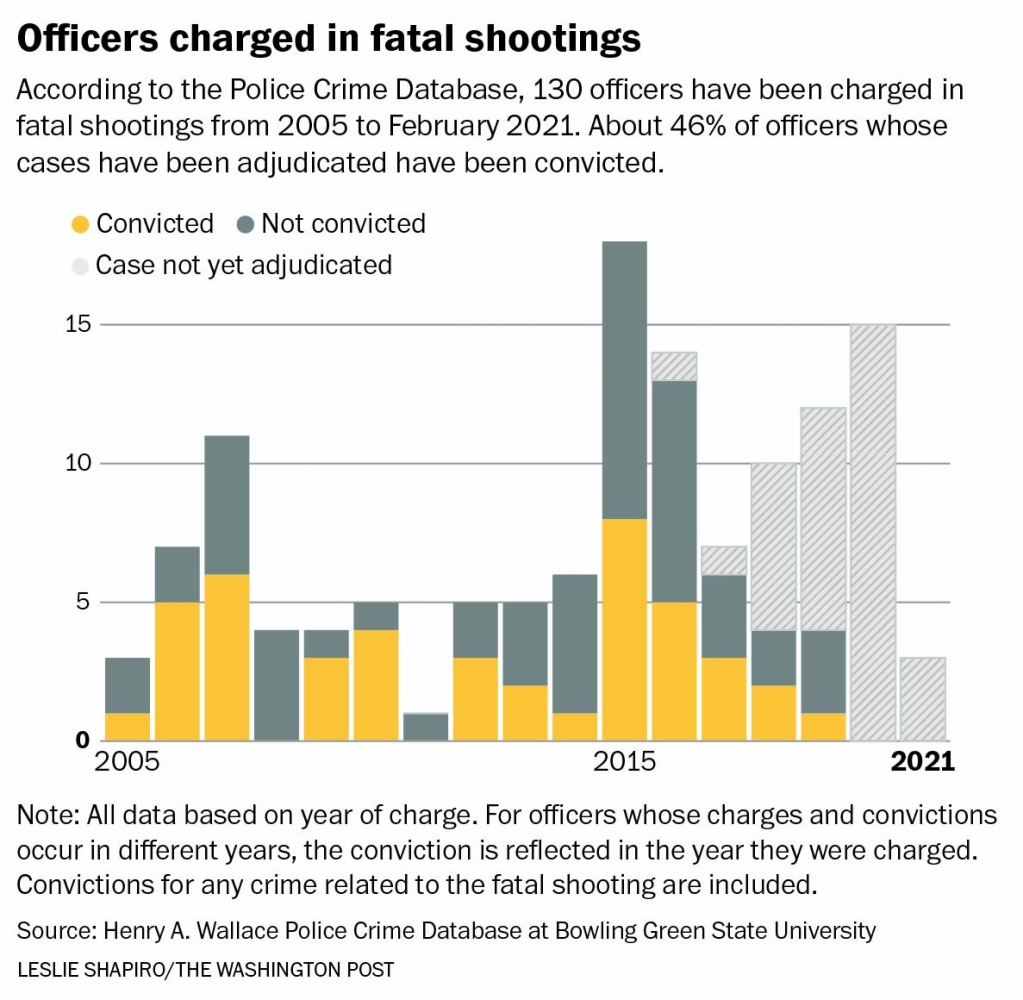
Between 2005 and 2015, more than 1,400 officers were arrested in a violence-related act committed on duty, according to data tracked by Philip Stinson, a criminologist at Bowling Green State University. In 187 of those cases, people were fatally injured in shootings or from other causes. The officers charged represent a small fraction of the hundreds of thousands of police officers working for about 18,000 departments nationwide.

Police charged with committing violent crimes while on duty were convicted more than half the time during that period. In the most serious cases – those involving murder or manslaughter – the conviction rate was lower, about 50%.

About 6 in 10 people charged with violent crimes were convicted, according to a federal report that examined cases adjudicated in the country’s 75 most populous counties in 2009. The number increased to 70% when murder was the most serious charge. Most criminal cases in the United States end in plea bargains, rather than court trials.

Chauvin’s case is different from many of the most high-profile police prosecutions in recent memory, in part because it centers on an officer who never fired his gun, experts say.

There are a few reasons it is difficult to convict a police officer, according to legal experts and attorneys who have worked on such trials: Police have considerable leeway to use force, can cite their training and are typically trusted by juries and judges.

“The law favors the police, the law as it exists,” said David Harris, a law professor at the University of Pittsburgh and an expert in policing.

“Most people, I think, believe that it’s a slam dunk,” Harris said of the case against Chauvin. But he said, “the reality of the law and the legal system is, it’s just not.”

Attorneys who have worked both sides of these cases say they invite heightened scrutiny and raise a host of issues about the authority police have, the force they are allowed to use and the dangers they could confront on the job.

“It’s fundamentally different than handling any other kind of case,” said Neil Bruntrager, a St. Louis-based attorney who has represented officers in high-profile cases.

“We grant [police] very significant power,” Bruntrager said. “And when we see the prosecution of a police officer for a line-of-duty act . . . what we’re really talking about is not the violation of that particular law, whatever it may be, but the violation of that trust.”

A key element that experts say factors into many of the cases is the Supreme Court’s 1989 Graham v. Connor decision, which found that an officer’s actions must be judged against what a reasonable officer would do in the same situation.

“A police officer can use force, but it has to be justifiable,” Bruntrager said. “And what the Supreme Court has told us is we have to see it through the eyes of the police.”

Police shoot and kill about 1,000 people a year, according to The Washington Post’s database tracking such cases. Most of these people are armed, and most of the shootings are deemed justified. When police are charged in fatal shootings, officers are convicted less than half the time, often on lesser charges.

Chauvin’s case is unlike those in key ways, experts say. “It’ll be much harder . . . for Mr. Chauvin to claim the usual justification of self-defense than it is when there are shooting deaths,” said Kate Levine, a professor at Yeshiva University’s Benjamin N. Cardozo School of Law. “It’s very hard for him to say, ‘I was in fear for my life when I knelt on this man’s neck.’ “

When police shoot and kill someone, the officers’ descriptions of what they saw and felt – and accounts of the danger facing them or someone else – can be a major part of the defense, experts say.

“In many of the shooting cases, the officer will say, ‘I perceived a threat in the form of reaching for a gun, or an aggressive move towards me,’ ” said Rachel Harmon, a law professor at the University of Virginia. “It is difficult for the state to disprove the perception of that threat.”

In this case, Harmon said, “there’s not the same kind of ability to claim a perception of a threat.”

Chauvin’s attorney argued in his opening statement that the officers charged in Floyd’s death felt the “growing crowd” at the scene was threatening. But Chauvin’s core defense, as presented in legal filings and his attorney’s remarks in court, appears to be focused on something else: making a case that he did not actually kill Floyd.

In court filings, Chauvin’s attorneys noted Floyd’s health issues and said he “most likely died from an opioid overdose,” trying to break the chain of causation between Chauvin’s knee and Floyd’s death. Medical experts have said say they disagree with the defense’s argument.

Debates over causation have come up in other cases not involving gunfire, including when people die behind bars or after being shocked by stun guns, said Craig Futterman, a University of Chicago law professor and director of the Civil Rights and Police Accountability Project. In those cases, he said, the argument is often made that “other contributing factors,” such as drugs in someone’s system, played a role.

The invocations of Floyd’s drug use in Chauvin’s trial also echo previous cases in another way, Futterman said.

“One of the standard strategies in the playbook that I’ve seen, when police officers are accused of misconduct, are charged with killing someone, is putting the victim and the victim’s character on trial,” he said.

But it’s unclear how that might play out in an evolving environment, in which attitudes on how police use force have changed, Harmon said.

“One of the things that’s really shifted in the public debate over use of force is that many people think that there’s too much force even against people who committed crimes, and may use drugs, and may have problems in their lives,” Harmon said. “The public tolerance for the argument that the victim of misconduct or victim of police use of force has done something wrong is less broad than it once was.”

Another key shift observers said may affect these cases is the changing way people may view police officers.

Juries have typically been inclined to trust officers, who come to court with no criminal record and with experience in testifying, experts and attorneys said. But, they said, recent years of repeated viral videos of police shootings and other uses of force may have chipped away at that perception.

The wave of protests that followed Floyd’s death last year was accompanied by a decline in public approval of police, and last fall voters in several places approved more scrutiny and oversight for police in their communities.

“It’s not an easy place to be in a position where you’re defending police officers who are charged these days,” said Bruntrager, the defense attorney who represented former officer Jason Stockley in St. Louis and former officer Darren Wilson in Ferguson, Mo.

Wilson’s fatal shooting of Michael Brown, a Black 18-year-old, fueled widespread unrest in 2014 and helped lead to a years-long nationwide focus on how police use force. Before then, Bruntrager said, if police “had any kind of credible defense, people wanted to believe that . . . police were following the law.”

“Now it is the reverse,” he said. “Now it is a situation where you start out with the idea where people believe police officers are violating the trust.”

But prosecutors still worry about persuading juries to convict on the most serious charges.

When Joseph McMahon, a former Kane County, Ill., state’s attorney, was preparing to try a Chicago police officer on murder charges, his team contacted other prosecutors who had charged officers – often unsuccessfully.

These prosecutors had spoken to the juries after their cases. Again and again, McMahon said, they reported hearing the same message about the officers from jurors: ” ‘We were convinced what he did was wrong. But we weren’t convinced what he did was murder.’ “

McMahon and his team were preparing a case against Jason Van Dyke, who fatally shot Laquan McDonald, a Black 17-year-old. Video footage of the shooting, which showed the officer firing 16 shots at the teenager, set off unrest when it was released in 2015. Van Dyke was charged with murder the same day the video was released.

After speaking to other prosecutors who said jurors in their cases could not bring themselves to convict the officers of murder, McMahon said he had Van Dyke charged with another 16 counts of aggravated battery, one for each gunshot.

“I didn’t want my jury to be faced with an all or nothing decision,” said McMahon, who was named special prosecutor in the case.

If the only option facing jurors involved the word “murder” in it, McMahon said, he was worried one or two jurors might be unwilling to sign off on it. Jurors get instructions about the legal definitions of specific crimes, he said, but people might still walk in with preconceived notions of what murder is and not think an officer’s actions fit the bill.

It wound up being unnecessary, he said. The jury convicted Van Dyke on all counts in 2018, including second-degree murder.

Chauvin, who was fired after Floyd’s death, is charged with second-degree murder and second-degree manslaughter in Floyd’s death, and the judge in the case reinstated a third-degree-murder charge during jury selection.

Attorneys representing police in controversial use-of-force cases have defended them by saying that they can use force and often have to make split-second decisions in tense, potentially dangerous moments.

Police officers are only human and can get “scared like everyone else” during stressful situations, said Dan Herbert, the Chicago attorney who represented Van Dyke. “The fact of the matter is that the law recognizes that police are allowed to use force, including deadly force, in a number of situations,” he said.

Eric Nelson, Chauvin’s attorney, invoked this argument during his opening statement when he called police uses of force “not attractive” but sometimes necessary.

Herbert said it is “probably naive” for the defense in Chauvin’s case to hope it can persuade a dozen jurors to vote to acquit.

Instead, Herbert said, Chauvin’s defense probably will aim to “pick off one or two of those jurors and possibly hang the case” by having the jury deadlock. The defense’s best chance heading into the trial, he said, probably was its attempt to break the chain of causation and argue that Chauvin did not kill Floyd.

Prosecutors sought to fight the defense’s claims of an overdose by having Floyd’s girlfriend testify about his struggles with substance abuse, a testimony aimed at establishing his tolerance for opioids.

The defense’s argument on that front could appeal to someone inclined to blame Floyd, rather than the police, for what happened, said Harris, the law professor at the University of Pittsburgh. Chauvin’s team does not have much else to work with, he added.

But while the prosecution must persuade every juror to vote to convict him, the defense just needs “one juror who feels a little funny about convicting a police officer,” Harris said.

“You have the law leaning in the direction of, give police the benefit of the doubt,” he said. “That seems a difficult thing to do with this video. But if somebody had that inclination, deep down, here’s your way to exercise it.”