‘A moment of peril’: Biden’s coronavirus response collides with case spikes #SootinClaimon.Com

#SootinClaimon.Com : ขอบคุณแหล่งข้อมูล : หนังสือพิมพ์ The Nation.

https://www.nationthailand.com/news/30404643

‘A moment of peril’: Biden’s coronavirus response collides with case spikes

InternationalApr 08. 2021President Joe Biden answers a question from a reporter Tuesday after giving remarks at the White House on the U.S. vaccination effort. MUST CREDIT: Washington Post photo by Demetrius FreemanPresident Joe Biden answers a question from a reporter Tuesday after giving remarks at the White House on the U.S. vaccination effort. MUST CREDIT: Washington Post photo by Demetrius Freeman

By The Washington Post · Dan Diamond, Fenit Nirappil

WASHINGTON – For the first two months, all the coronavirus numbers brokein the Biden administration’s favor.

More than 100 million Americans have gotten at least one shot of vaccine and more than 200 million doses have been sent to states, a dramatic acceleration of the bumpy vaccine operation itinherited. Virus-related cases and deaths, which peaked in January, have fallen by about two-thirds since President Joe Biden’s inauguration.

But the Biden White House is now seeing new infections climb on its own watch – a potential crisis that could erase many of the hard-won gains of the president’s first 75 days, should the numbers keep rising. And after railing for a year about the last administration’s responseand vowing a more muscular strategy, Biden is encountering the limits of his own authority. The president can help secure and distribute supplies and medicines, issue guidance and urge caution – but like Donald Trump before him, he has few tools when governors decide tolift coronavirus protections at the wrong moment,manufacturers botch vaccine production, or Americans refuse to wear masks or get vaccinated.

“We need you to spread the word,” Biden told faith leaders last week, saying he was worried about Americans becoming “cavalier” about the virus. “They’re going to listen to your words more than they are me as president of the United States.”

Biden also has no more sway than Trump over a mutating virus that scientists have only begun to understand.The Washington Post’s rolling seven-day national average of coronavirus cases is more than 65,000 new cases per day, an 18% uptick since the middle of last month, even as many states drop public health restrictions and new variants spread. More than 146,000 new cases were reported on Thursday and Friday, the highest two-day count in several weeks, according to state data tracked by The Post.

The B.1.1.7 variant first identified in the United Kingdom, which has been shown to be more contagious and lethal than the original “wild” virus, is now the most common lineage in the United States, administration officials said Wednesday.

After three coronavirus surges under Trump, most experts think a “fourth wave” is unlikely given the accelerating pace of vaccinations and the number of Americans who have acquired natural immunity after being infected by the virus. But the trends have alarmed some public health experts, who are calling on Biden to adopt new strategies to speed up shots or take a harder line with states relaxing restrictions.On Tuesday, the president announced he was moving up the deadline for all adults to be eligible for vaccines to April 19, although that doesn’t guarantee they will be able to be inoculated right away.

“Let me be deadly earnest with you,” Biden said during the announcement. “We aren’t at the finish line. We still have a lot of work to do. We’re still in a life-and-death race against this virus.”

Public health experts say the president has benefited from good policy, as well as good luck. Virus cases, which spiked in mid-January, began to recede before Inauguration Day.Biden’s team also spent months studying Trump’s stumbles, while figuring out how to buildonhis successes, such as exercising contract options negotiated by the Trump administration to produce vaccine supply and avoiding unrealistic promises that could disappoint Americans.

“They benefited from Operation Warp Speed. They benefited from the variants coming in late and not supercharging what was a pretty destructive surge” in the winter, said J. Stephen Morrison, who oversees global health policyat the Center for Strategic and International Studies. “And they benefited from the six months they had in planning their response out, beginning in July 2020, and then making it a top priority and executing with a great amount of speed this year.”

Nearly three-quarters of Americans approve of Biden’s handling of the pandemic, including almost half of Republicans, according to an AP-NORC poll last week. Biden’s poll numbers are well ahead of his predecessor’s, with most Americans before November’s election critical of Trump’s response and saying they had lost trust in Trump’s claims as the virus flared again and again.

Biden’s recent poll numbers also have boosted his efforts to pass a $1.9 trillion coronavirus relief bill and pursue other priorities, like a possible $2 trillion infrastructure package, and White House officials hope that a successful coronavirus response will helpthe president restore faith in government, laying the groundwork for other goals.

But there’s risk in raising expectations that are pinned tothat response, said Robert J. Blendon, a Harvard University professor who studies public opinion about health care.

“It’s all tied in people’s minds to what I call the key policy measure: ‘Next Thanksgiving, can I eat with my family in person?'” Blendon said, adding that Americans would blame Biden if virus-related shutdowns are needed again. “They can’t blame a variant.”

White House officials fear their nuanced message – urging Americans to see the light ahead, while remaining vigilant against the virus – is being lost as the rising numbers of coronavirus infections and vaccinations collide, potentially stretching out the nation’s pandemic fight. The challenge is compounded because public health officials are trying to speak to a fractured America. Tens of millions of people are still eager to get their first shots, many more are asking what they can do now that they’re vaccinated and others remain hesitant about getting inoculated at all.

“It’s important to level with the public. It’s very hard to keep in your mind it’sokayto be optimistic, but also to be concerned,” said Andy Slavitt, a senior adviser for the White House’s coronavirus response. “But that’s where we’re at. The job is not done.”

In statements last week, Biden stressed that, while urginggovernors to keep safeguards in place and saying in response to a reporter’s question that states should alsopause reopenings. “Please, this is not politics,” he said. “Reinstate the mandate if you let it down.”

But governors who rolled back mask mandates and other restrictions are mostlyshrugging himoff.

North Dakota Gov. Doug Burgum, R – who tearfully begged residents last year to wear masks and to stop demonizing those who did – said he wouldface a credibilitycrisisif he reinstated a mask mandate after lifting it in January. Less than 30 people in North Dakota are hospitalized with the virus, compared with more than 300 in November when Burgum imposed it. Most new cases are among young people and college students, who are far less likely to get severely illand overload hospitals,Burgum said.

Burgum said that reinstating the mandate could be interpreted as “a huge overreach by government.”

Administration officials say most conversations with governors now center on a single issue: They want more shots. Michigan Gov. Gretchen Whitmer (D) last week appealed to the White House to rush doses to her state and other areas where the virus is surging. Whitmer in February rolled back some restrictions on indoor dining and, as in North Dakota, the increase in cases has been driven by younger residents. Like Burgum,she has not reversed the rollbacks.

Public health experts said they’re frustrated that states are dropping their guard before a majority of Americans are vaccinated, arguing the results are predictable: More cases now, more hospitalizations and deaths later.

“This is the pattern of every previous surge,” said Atul Gawande, a surgeon and public health professor who served on Biden’s coronavirus advisory board during the transition. “This is the pattern of the surge that started over a month ago in Europe and Asia and has been ongoing in Latin America. Wishful thinking is not a strategy.”

– – –

Inside the White House’s coronavirus response, where leaders strategize about how best to address more than a dozen pandemic scenarios as theywork to accelerate vaccine distribution, six officials described a non-blamingculturethat is unruffled by the uptick in cases, messaging missteps or a recent manufacturing error that led to the loss of millions of potential Johnson & Johnson vaccine doses.

“Prepare for the worst, hope for the best, and don’t be shocked by anything in between that,” said one official, speaking on the condition of anonymity to characterize private conversations. “That’s been the focus from the beginning.”

“We have an accelerated virus, and we have an accelerated response,” said Slavitt. “What’s important is that we’ve been readying our response to get better and better and better.”

Both Biden and Ron Klain, the White House chief of staff who helped lead former president Barack Obama’s response to Ebola, have continually counseled a long-term outlook and eschewed political battles. “Ron’s not taking the bait from a governor who wants to pick a fight over a mask,” said a senior official, who also spoke on the condition of anonymity to discuss private conversations.

Jeffrey Zients, who runs the White House coronavirus response, also has stressed a businesslike approach.

“Jeff has created a culture where we identify issues early enough and that allows people to avoid blame,” Slavitt said. “He says at the end of basically every call, ‘If you have a problem or concern, let us know what it is. Bring it forward and we can problem-solve.'”

It’s a departure from last year’s coronavirus response, when Trump publicly feuded with Democratic governors, such as Washington’s Jay Inslee and New York’s Andrew M. Cuomo, and internal turf wars could rage for days. Trump also cycled through leadership, first replacing then-Health and Human Services Secretary Alex Azar with the vice president as head of the White House coronavirus task force, and later sidelining then-White House coronavirus coordinator Deborah Birx and infectious-disease expert Anthony S. Fauci.

And after Trump used last year’s media briefings to tout his administration’s success, broadcast unproven theories about the virus and issue political attacks, this White House has opted for a lower-profile approach in which government health experts offer regular, science-focused updates three times per week. The strategy hasn’t been seamless. Rochelle Walensky, director of the Centers for Disease Control and Prevention, recently warned reporters about her “feeling of impending doom.”

“We have so much to look forward to, so much promise and potential of where we are, and so much reason for hope, but right now I’m scared,” Walensky said last week.

Her dire remark, which she said was off the cuff, sparked days of questions.

“I’m pretty sure ‘impending doom’ isn’t in the CDC communication playbook,” said a former Obama administration official, who spoke on the condition of anonymity because of ongoing conversations with the Biden administration.

White House officials defended Walensky, saying her comments were intended to resonate with people after weeks of more formal warnings.

“She was trying to talk to people like she knew them,” a senior White House official said, characterizing her remarks as a sound bite that was taken out of context. “For the 99.9 percent of Americans who didn’t watch her say that, it really sounded like she was predicting doom. And she really wasn’t. There’s no message in which we’re doomed.”

– – –

Surveying the state of the response, public health experts agree that “doom” is unlikely. The next coronavirus case spike “won’t be as huge and not nearly as deadly as past surges, because so many of the most vulnerable people have now been vaccinated,” former CDC director Tom Frieden wrote on March 22, estimating that vaccinations had already saved at least 40,000 lives in the United States.

But he noted that the virus is a “wily enemy” and warned of emerging variants that could someday evade existing vaccines and treatments. “If we let our guard down too early, covid will take advantage,” Frieden added.

The most obvious test of whether the nation will keep its guard up is the fight over mask mandates, with at least 10 governors bucking Biden’s call to restore them.

“I just think we need to give ourselves another four to six weeksor so to get more people vaccinated, and then we’d be in a much better place to drop mask mandates,” said Celine Gounder, an infectious-disease specialist who served on Biden’s coronavirus advisory board during the transition.

Wyoming Gov. Mark Gordon, R, who on March 16 lifted a mask requirement for most public places, as well as restrictions on restaurants and gyms, was unmoved by Biden’s plea. “Given Wyoming’s current metrics, the governor has no plans to reinstate statewide mask protocols,” spokesman Michael Pearlman wrote in an email.

A spokeswoman for Alabama Gov. Kay Ivey. R, said Ivey also would not budge on plans toend a mask mandate on April 9. “We have made progress, and we are moving toward personal responsibility and common sense, not endless government mandates,” saidspokesperson Gina Maiola.

But Lina Hidalgo, a Democrat who is the top elected official in Harris County, Texas, praised Biden’s call for requiring masks. Hidalgo clashed last year with Republican Gov. Greg Abbott, R, when she first attempted to impose a mask order in her county, which includes Houston, the state’s largest city.Abbott rescinded a statewide mask mandate last month, effectively doing away with Harris County’s order.

“The biggest challenge in this pandemic has been mixed messaging,” Hidalgo said, adding that county residents were confused by the conflicting advice.

– – –

Officials and outside advisers pointed to one strategy the White House could immediately deploy to help stave off a fourth wave: find ways to get shots into arms more quickly.

Gawande, the surgeon and public health professor, said the recent uptick in coronavirus cases changed his mind about the nation’s strategy to administer two doses of the Pfizer-BioNTech or Moderna vaccines in strict adherence to the three- and four-week timelines used in their clinical trials. He cited new CDC data that a single dose of either vaccine provides comparable protection to the single-shot Johnson & Johnson vaccine.

“Push the second shot out to 12 weeks and get doses into as many people as we possibly can,” Gawande said, noting that it would effectively double the amount of available doses. “It is the one pathway that we have.”

Gawande also noted the success of nations such as Israel and the United Kingdom, which opted to delay second doses to prioritize the first for as many people as possible. Both nations have seen coronavirus cases and deaths fall at a more rapid rate than the United States.

But Fauci and other senior doctors advising Biden continueto stand by the two-shot strategy as the safest approach to protect Americans against the virus, and White House officials say they have no plans to overrule them.

“That’s a decision made by the scientists,” Slavitt said.

Burgum, North Dakota’s governor, said in an interview last week that Biden might also accomplish more if top administration officials, including the president and vice president, joined weekly calls with governors. He noted that Vice President Mike Pence and Trump Cabinet officials were on such calls last year, which Burgum said were a platform for candid discussions.

Vice President Kamala Harris did join Tuesday’s call, and White House officials said she and the president could be made available for future events if it would help the coronavirus response. “Any feedback that you want to give us, we’re happy to take,” Slavitt said.

The White House also has focused on building relationships with local officials and businesses in states like Florida and Texas, recognizing the possibility of constructive partnerships even as governors roll backstatewide restrictions.

Miami Mayor Francis Suarez, a Republican, said he would give the Biden administration “an A+” for making more vaccine available, including swiftly setting up a mass vaccination site in Miami-Dade County after Suarez appealed for additional doses.

Suarez acknowledged that cases in Miami-Dade County have “slightly” trended upward following spring break celebrations.

That uptick, driven by younger Americans, is precisely what worries Morrison, the Center for Strategic and International Studies expert, who warned that the nation is still facing a “moment of peril.”

“We’re still at 65,000 cases per day. We’ve got to get to 10,000 to control this,” he said, adding: “We’re in a great moment of anxiety and optimism mixed together. And I don’t think we’re going to exit from that moment for quite a while.”

Tokyo eyes tighter virus restrictions as cases rebound in Japan #SootinClaimon.Com

#SootinClaimon.Com : ขอบคุณแหล่งข้อมูล : หนังสือพิมพ์ The Nation.

https://www.nationthailand.com/news/30404642

Tokyo eyes tighter virus restrictions as cases rebound in Japan

InternationalApr 08. 2021People walk past cherry blossom trees in bloom along the Meguro River in Tokyo on March 27, 2021. MUST CREDIT: Bloomberg photo by Soichiro Koriyama.People walk past cherry blossom trees in bloom along the Meguro River in Tokyo on March 27, 2021. MUST CREDIT: Bloomberg photo by Soichiro Koriyama.

By Syndication Washington Post, Bloomberg · Gearoid Reidy

Tokyo is planning to seek a return to stricter virus measures as coronavirus cases in the Japanese capital hit a two-month high, less than three weeks after a state of emergency was lifted.

The capital recorded 555 cases on Wednesday, the most since early February, as officials feared a “rebound” in cases had begun to hit earlier than expected, amid an increase in virus variants. Tokyo Governor Yuriko Koike said she’d decide on formally requesting the measures after consulting with experts.

The extra steps, already imposed on the Osaka area, are broadly similar to the emergency declaration, itself much less strict than lockdowns seen in European capitals. Bars and restaurants in urban areas would likely to be asked to close early, and may face the threat of fines for non-compliance.

Osaka, the current center of the pandemic in Japan, has seen cases hit record highs since lifting its state of emergency in February. The prefecture has a population just over half that of Tokyo’s, but saw 878 infections on Wednesday, topping those in the capital for almost two weeks. Experts fear that the sudden surge seen in Osaka could be repeated in Tokyo.

“Tokyo could go the way of Osaka,” Shigeru Omi, the head of a panel of experts advising the government, said in parliament on Monday. “It takes a week or two after the lifting of the state of emergency for this impact to appear.”

The slow pace of vaccine rollout is adding to concerns. Japan is set to begin vaccinating over-65s starting Monday, but supply constraints mean mass inoculations won’t begin in earnest until May. Less than 1% of the population have received just one dose of vaccine.

Japan imposed the state of emergency in January, initially on Tokyo before expanding to other areas. Despite lacking the ability to enforce lockdowns, the steps mostly targeting bars and restaurants had immediate success in reducing new infections. But the pace of decline slowed, with new cases hitting a floor of around 300 in Tokyo in early March, even before the emergency was lifted.

While the raw numbers pale in comparison to other metropolitan areas worldwide struggling with the pandemic, the renewed surge is a concern for a country preparing to host the Olympics in just over 100 days. Osaka Governor Hirofumi Yoshimura said Wednesday he would cancel the Olympic Torch Relay in the prefecture, which was set to be held April 13 and 14, Kyodo reported.

The surge in cases will likely have political implications as well. The Osaka governor came under fire on social media as case numbers jumped, and a broader surge would probably further undermine support for Prime Minister Yoshihide Suga, who faces an election by October.

India’s virus epicenter has only three days of vaccines in stock #SootinClaimon.Com

#SootinClaimon.Com : ขอบคุณแหล่งข้อมูล : หนังสือพิมพ์ The Nation.

https://www.nationthailand.com/news/30404641

India’s virus epicenter has only three days of vaccines in stock

InternationalApr 08. 2021A healthcare worker administers a rapid antigen test near the Gateway of India monument in Mumbai on March 31, 2021. MUST CREDIT: Bloomberg photo by Dhiraj Singh.A healthcare worker administers a rapid antigen test near the Gateway of India monument in Mumbai on March 31, 2021. MUST CREDIT: Bloomberg photo by Dhiraj Singh.

By Syndication Washington Post, Bloomberg · Dhwani Pandya, Chris Kay

India’s fight against a renewed wave of coronavirus infections is beset by vaccine shortages in several states and cities including the financial capital, Mumbai.

The nation’s worst-hit state, Maharashtra, has only three days worth of vaccines in stock, Health Minister Rajesh Tope told reporters Wednesday, even as the country reported a record of over 115,000 daily new cases. Maharashtra alone accounts for some 55,000 infections. Other states, including southern Andhra Pradesh is also running low on shots, according to the Economic Times.

The steep jump in infections from early February, when the country reported around 11,000 daily infections, has forced states to reinstate movement curbs and other restrictions. Maharashtra has halted all non-essential services, ordered private companies to work from home, and shut malls and restaurants through April.

India’s federal Health Minister Harsh Vardhan released a statement Wednesday in which he deflected blame for the shortages and said some states, including Maharashtra were “trying to divert attention from their poor vaccination efforts by just continuously shifting the goal-posts.”

For Prime Minister Narendra Modi, whose party is fighting five state elections, the unfolding health crisis may continue to dent his international image after India curbed vaccine exports this month as the second covid wave mounted. The renewed restrictions are also spurring public anger at the government’s failure to get ahead of the virus despite a monthslong lull.

After the country shipped or donated more than 60 million doses of covid vaccine, India last month said it would slow down exports to focus on its own requirements. The world’s biggest vaccine manufacturer, the Serum Institute of India Ltd., is a key supplier to Covax, a program through which 2 billion vaccine doses are supposed to be distributed to middle and low-income countries, many of which can’t afford to sign procurement contracts on their own.

But domestic demand is expected to outrun supply despite those export curbs.

For now, one month of supplies from India’s two approved vaccines only last 17 days at peak demand, without taking existing inventories into account, according to Abhishek Sharma, a Mumbai-based healthcare analyst at Jefferies.

“As vaccination picks up pace across India, we expect to see demand outstripping supply over the next few months,” Sharma wrote in a report on Tuesday. “Approved vaccines are ramping up capacity but only slowly.”

Maharastra has only 1.4 million doses of the immunizations left, Tope said, adding that the administration has asked the federal government to arrange for at least 4 million doses a week to get a grip on the state’s soaring pandemic.

“Many of our vaccination centers are facing shortages and had to be shut due to unavailability of vaccines,” he said. “Healthcare workers at many centers are forced to send back people saying the vaccine has not arrived yet.”

Still, Indian medical groups, public health experts and business leaders have called for the government to fully open up the inoculation drive to all age groups as the second-wave continues to build. The nation currently only allows people over 45 years of age to get shots. For a country of India’s size and population density movement curbs are likely to only offer a temporary respite.

India is mostly relying on its inoculation drive to curb the second wave, said Charles Clift, a senior consulting fellow with the Centre on Global Health Programme at Chatham House in London. “Locking down effectively in that environment is rather difficult so they have to rely heavily on the vaccine to get control.”

The government has also decided to allow public and private workplaces to arrange vaccination drives from April 11, according to an April 6 letter, which has not yet been public, and was seen by Bloomberg News. A spokesperson of the health ministry could not be reached for comment.

The nation’s tally of cases now stands at 12.8 million — behind Brazil and the U.S. — with the new virus wave threatening nascent growth in Asia’s third-largest economy, which had slumped into a historic recession last year after Modi’s strict nationwide lockdown.

India’s failure to quickly examine Covid-19 samples for new variants also risks hurting its ability to contain the fresh outbreaks, with scientists warning the delays could damage everything from vaccine efficacy to effective hospital treatments. The South Asian nation has tested less than 1% of its positive samples, according to government data.

“We are also observing people suddenly getting worse in home isolation, and we are suspecting certain virus mutations or strains may be causing this,” Tope said. “There is a need to identify these different strains that are being detected in Maharashtra” and get fresh treatment protocols to the states.

Biden says he’s open to compromise with Republicans on $2 trillion infrastructure plan #SootinClaimon.Com

#SootinClaimon.Com : ขอบคุณแหล่งข้อมูล : หนังสือพิมพ์ The Nation.

https://www.nationthailand.com/news/30404640

Biden says he’s open to compromise with Republicans on $2 trillion infrastructure plan

InternationalApr 08. 2021 President Joe BidenPresident Joe Biden

By The Washington Post · Jeff Stein, Tony Romm

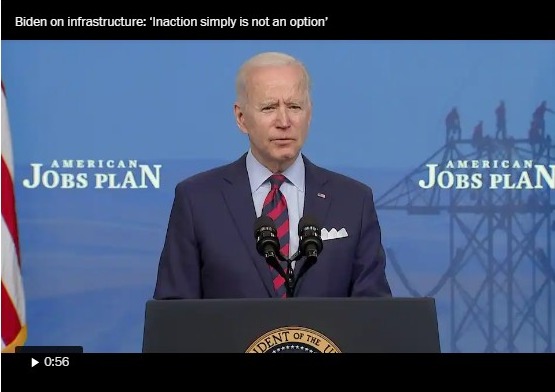
WASHINGTON – President Joe Biden on Wednesday said he was open to compromise with Republicans on how to pay for his approximately $2 trillion jobs and infrastructure package, but insisted that inaction was unacceptable.

His comments, delivered at the White House, reflect how he is quickly recalibrating his political strategy after passing a $1.9 trillion stimulus bill into law without any GOP support. The infrastructure package marks another of his top campaign promises, but it has been met with a torrent of criticism from Republicans, and even some Democrats have appeared squeamish.

“Debate is welcome. Compromise is inevitable. Changes are certain,” Biden said. He added he would soon invite Republican lawmakers to the White House and that the administration is “open to good ideas and good-faith negotiations.”

He said, for example, he was willing to agree to a lower corporate tax rate than his proposal of 28% if Republicans had other ideas that would work. Such a change could be politically necessary. Sen. Joe Manchin III, D-W.Va., said earlier this week that he supported raising the corporate rate from 21% to 25%, but not all the way to 28%.

But, Biden said: “Here’s what we won’t be open to: We will not be open to doing nothing. Inaction is simply not an option.”

The remarks reflect a changing political calculus for Biden.

Some Republicans, like Senate Minority Leader Mitch McConnell, R-Ky., have said they support a more scaled-back infrastructure plan, but they have attacked both the proposed tax hikes and the large scale of Biden’s pitch. And with Manchin earlier this week saying he had the “leverage” to demand changes, Biden appears to be bending to a new political calculus.

On Wednesday, he said he would work with Republicans on how best to design the package but he was unapologetic about the scope of his proposal. He said the money was needed to finance projects beyond just roads and bridges. He said, for example, that new spending was needed to do things like improve waste treatment plants and remove asbestos from schools.

“Damnit, Maybe it’s because I come from a middle-class neighborhood, but I’m sick and tired of ordinary people being fleeced,” he said.

Biden has so far not backed down on his insistence that the proposed spending increases be offset by a range of corporate tax hikes. This has prompted bipartisan unease.The Department of Treasury on Wednesday outlined the proposed tax increases on businesses that Biden is seeking in his initial plan. It would raise about $2.5 trillion over 15 years, meant to offset the costs of the infrastructure package. These changes would have to be approved by Congress. They would also amount to one of the largest tax increases in decades.

“I’m open to ideas about how to pay for this plan,” Biden said. Biden added he would not raise taxes on households earning less than $400,000 per year, a pledge he made during the presidential campaign.

In a 19-page report, Treasury officials called for more than a half-dozen tax measures affecting U.S. firms, including an increase in the corporate tax rate and subjecting the overseas earnings of businesses to higher tax rates.

Unlike the $1.9 trillion stimulus plan that passed in March, the cost of which was almost entirely added to the national debt, the White House has said it will seek to pay for the infrastructure plan through tax hikes on businesses and corporations.

Fifty-five corporations saw zero federal tax liability in 2020, according to a report this week by the Institute on Taxation and Economic Policy, a left-leaning think tank. The amount of corporate tax revenue raised by the government has fallen from above 2% of the United States’ gross domestic product before the GOP tax law to half that, the Treasury report says.

“Here you have 51 or 52 corporations of the Fortune 500 haven’t paid a single penny in taxes for three years. Come on, man. Let’s get real,” Biden said earlier this week, after walking off Marine One.

Biden’s plea arrived as House and Senate leaders forged ahead with their early work to translate his multi-trillion-dollar blueprint into a legislative reality. The process of writing infrastructure reform into law is one that spans much of Congress, where many Democrat-led committees have already held hearings to examine federal funding for roads, bridges, pipes and other policy priorities including housing and climate change.

In doing so, Democratic leaders have echoed Biden’s pledge to work with Republicans and compromise. But they have also threatened to try to move forward without Republicans if they must. Democrats passed the $1.9 trillion coronavirus stimulus package in March without GOP support through a budget process known as reconciliation, which in the Senate only requires Democrats to obtain 51 votes to pass legislation.

Democrats have signaled they could use reconciliation again to adopt some or all of Biden’s infrastructure reforms, seeking to bypass a potential Republican filibuster. They gained an additional political advantage on Monday, when the Senate’s parliamentarian appeared to open the door for the party to use reconciliation at least three more times than they initially anticipated between now and the 2022 midterms. So far, Senate Majority Leader Charles Schumer, D-N.Y., has declined to say how, exactly, he plans to take advantage of the ruling.

As the administration ramps up its push for the package, Biden transportation secretary Pete Buttigieg spoke on a Zoom call with moderate House lawmakers in the New Democrats caucus on Wednesday for about 45 minutes, two people familiar with the matter said. They spoke on condition of anonymity because they weren’t authorized to reveal the back and forth. The call reflected how the Trump administration is hearing opinions from a wide range of people about what should and shouldn’t be included in the package.

On the call, Rep. Cindy Axne, D-Iowa, raised concerns about the impact of transitioning to an electric vehicle fleet on farmers in Iowa, given the role of ethanol in gasoline production, the people said. Several lawmakers on the call also asked Buttigieg to press for high-speed rail, the people said.

Many Democrats are trying to push the White House to keep the package as big as possible.

“The American people want bold action to address our country’s many challenges, and Democrats now have more options to overcome Republican obstruction and get things done,” Sen. Ron Wyden, D-Ore., the chairman of the Senate Finance Committee, said in a statement Monday heralding the announcement.

First, however, Democrats face the daunting task of passing major tax hikes to fund their infrastructure push. The centerpiece of Biden’s tax hikes is increasing the corporate rate from 21% to 28%, after President Donald Trump’s 2017 tax law cut it from 35% to 21%. Trump also was forced to compromise on his tax proposal, as he insisted for months that the rate needed to be lowered to 15%. He eventually softened his proposal, but Biden appears to be signaling much faster that he is open to hearing other ideas.

The report released by the Treasury also details more than $700 billion in new government revenue through revamping America’s international tax system. In particular, the plan would increase the global minimum tax paid by U.S. firms operating abroad from about 13% to 21%. It would also repeal provisions from the Republican tax law that the Biden administration says encourage outsourcing of U.S. manufacturing and production.

Parts of corporate America have appeared more open to Biden’s push than expected. John Zimmer, the CEO of the ride-share company Lyft, told CNN that the company supported the 28% corporate tax rate and Biden’s push for electrical vehicles and infrastructure. Amazon founder and CEO Jeff Bezos also said Tuesday that the e-commerce giant supports a rise in the corporate tax rate, while also calling for a “balanced solution that maintains or enhances U.S. competitiveness.” (Bezos also owns The Washington Post.) Still, Biden’s plans have been sharply criticized by American business groups and congressional Republicans.

“What the president proposed this week is not an infrastructure bill,” Sen. Roger Wicker, R-Miss., said earlier this month. “It’s a huge tax increase, for one thing. And it’s a tax increase on small businesses, on job creators in the United States of America.”

The Treasury report included an analysis showing a rising share of income from multinational corporations ending up in tax havens, along with data showing only a handful of countries in the world collect less revenue from corporations than the United States.

Conservatives have called these measures misleading. Donald Schneider, who served as chief economist to Republicans on the House Ways and Means Committee said the revenue declines are overstated due to temporary provisions in the GOP tax law. Schneider said the analysis also misses the rise in pass-through entities, which make the fall in corporate revenue appear larger than it actually is.

The administration has countered with estimates from Moody’s Analytics showing the spending from Biden’s infrastructure proposal would grow the economy by about 1.6%. The Treasury plan also calls for beefing up corporate tax enforcement at the Internal Revenue Service; shifting subsidies for fossil fuel production to clean energy production; and pushing a global minimum tax through international negotiations.

“By choosing to compete on taxes, we’ve neglected to compete on the skill of our workers and the strength of our infrastructure. It’s a self-defeating competition, and neither President Biden nor I am interested in participating in it anymore,” Treasury Secretary Janet Yellen wrote in a Wall Street Journal op-ed announcing the plan. “We want to change the game.”

Myanmar teeters toward state collapse and civil war #SootinClaimon.Com

#SootinClaimon.Com : ขอบคุณแหล่งข้อมูล : หนังสือพิมพ์ The Nation.

https://www.nationthailand.com/news/30404638

Myanmar teeters toward state collapse and civil war

InternationalApr 08. 2021Photo credit: SNIPER NEWsPhoto credit: SNIPER NEWs

By The Washington Post · Ishaan Tharoor

On Tuesday, protesters spilled metaphorical blood on the streets of Yangon, Myanmar’s biggest city. They sprayed and splashed red paint on roads, pavement and bus stops across town to mark the death toll exacted by security forces on demonstrators standing against the Feb. 1 coup carried out by the country’s junta. “The blood has not dried,” read one daubed message.

At least 570 people, including more than 40 children, have been killed in two months of unrest. More than 2,720 politicians, activists and civil society figures have been detained by authorities. At least 25 journalists are in detention, while others covering protests have been brutalized by state forces. On Tuesday, police and soldiers in Yangon carted off Zarganar, the country’s most well-known comedian, in an army vehicle on unspecified charges. In the past week, authorities issued arrest warrants for at least 60 artists, writers, thespians and other cultural celebrities accused of spreading information that supposedly endangered national stability.

Last week, authorities further tightened curbs on broadband access, ordering private providers to suspend wireless data services. According to one research firm, Internet shutdowns over recent months in Myanmar may have already cost the local economy close to $1 billion. That’s a price the regime appears happy to pay to deter protesters from coordinating their actions and disseminating further information. Undaunted, dissidents have taken to older forms of communication, launching rogue radio stations and spreading leaflets urging a national boycott of next week’s official state celebration of Thingyan, Myanmar’s traditional new year.

The junta, which presides over a sprawling military apparatus and one of Asia’s largest armies, doesn’t have an answer for the leaderless anti-coup movement’s creativity and courage. Activists have developed a new pop-up economy to support fellow dissidents. They have built networks to smuggle defectors from the police out of the country. They have carried out themed “strikes” around Myanmar, laying flowers in public places where fellow demonstrators were killed or, as they did this Easter Sunday, carrying eggs painted with protest slogans and symbols.

Still, the resilience and determination of the protesters “is not unambiguously good news, because the military junta also will not give up, no matter the cost, leaving little hope of salvaging Myanmar’s political liberalization, economic reform, and development progress during a decade of civilian rule,” wrote Thitinan Pongsudhirak, an esteemed political scientist at Bangkok’s Chulalongkorn University. “Instead, the country faces the imminent threat of economic collapse, state implosion, and internal strife – perhaps even full-fledged civil war.”

As state authorities gunned down ordinary people gathering in the streets, more radical factions among the protesters are starting to embrace armed resistance. Improvised weaponry and tactical gear are appearing in pockets on protest front lines. The security forces “just shoot us. We don’t have anything. We just walk on [the] street with nothing in our hand and then they shoot us,” a Yangon activist who claims to have recently received training in a jungle camp told CNN. “It should be weapon and weapon, it should not be non-violence and then weapon. It became no choice for us.”

In a dramatic development, the anti-coup movement won the backing of multiple militia groups that claim to represent various marginalized ethnic minorities scattered around the country’s borderlands. For some in Myanmar’s big cities, the viciousness of the junta has awakened a newfound solidarity with communities long battered or neglected by the state.

“We were all brainwashed since we were very young,” Yin Yin, a Yangon resident from the country’s Bamar majority, told Foreign Policy magazine. “The military did countless dirty acts and cruel things in the past 70 years. The [non-Bamar] ethnic groups have fought and faced it, and now we are all facing it.”

While there are reinvigorated calls for a more egalitarian federalism in the country, the current reality is one of escalating conflict. The military is locked in clashes with ethnic armed groups on at least two fronts; government airstrikes on villages and suspected militia positions in southeastern Karen state have forced thousands to flee across the border with Thailand.

Though some Western governments imposed sanctions on the regime, they have little leverage over the junta. So far, the U.N. Security Council and the Association of Southeast Asian Nations, or ASEAN, the region’s main geopolitical bloc, have failed to muster any meaningful diplomatic response to what seems a spiraling crisis. The political instability that followed the coup led to rising fuel prices and, as a result, a spike in the cost of food – prompting the U.N.’s World Food Program to warn of the growing risk of food insecurity in parts of the country.

“Beyond being morally repugnant, the regime’s actions risk precipitating state collapse – where the generals may control the trappings of state but be unable to impose their will on the country as a whole, maintain order, or govern and deliver services effectively,” noted the International Crisis Group, a conflict watchdog, in its latest report on Myanmar. “Increasing levels of violence are hardening opposition and broadening a popular consensus that a return to military rule must be prevented at all costs. The banking system is hardly functioning, transport and logistics are crippled, and ports paralysed, sending the country spiralling into economic crisis.”

The junta, though, is more interested in trying to crush its perceived enemies – and the ethnic armed groups are a long-standing target. “It’s gloves off, it’s right back to the early 2000s when it was just a brutal war,” said Steve Gumaer, president of Partners for Relief & Development, which works in Myanmar’s borderland states. He added that, for all their defiance, neither the protest movement nor the rebel militias were “going to stop this army. Without external support, they really don’t have a chance.”

Myanmar ambassador in London locked out of embassy after speaking out against military #SootinClaimon.Com

#SootinClaimon.Com : ขอบคุณแหล่งข้อมูล : หนังสือพิมพ์ The Nation.

https://www.nationthailand.com/news/30404637

Myanmar ambassador in London locked out of embassy after speaking out against military

InternationalApr 08. 2021Kyaw Zwar MinnKyaw Zwar Minn

By The Washington Post · Ruby Mellen

Myanmar’s ambassador to the U.K., who has spoken out again the military coup in his country, said he was barred from the embassy in London Wednesday by officials loyal to the military junta.

“They are refusing to let me inside,” Kyaw Zwar Minn told the Telegraph. “They said they received instruction from the capital, so they are not going to let me in.”

Kyaw Zwar Minn told the British newspaper that when he left the embassy during the day, colleagues and officials linked to the military stormed the premises and kept him from reentering that evening.

“They betrayed me, because they are from the military side,” he said.

In early March, the ambassador, a former military colonel, spoke out against the military’s detention of the former British colony’s leader, Aung San Suu Kyi, drawing criticism from the junta that had orchestrated her ouster and praise from the British government for his “courage.”

The London-based ambassador was recalled, according to Myanmar state television, after he posted a statement on the embassy’s Facebook page demanding “the release of State Counsellor Daw Aung San Suu Kyi and President U Win Myint,” but he did not return to Myanmar.

On Feb. 1, Myanmar’s military seized power, detaining Aung San Suu Kyi and other democratically elected leaders of her ruling party, the National League for Democracy.

The coup has been decried internationally, including by the United Nations. Since taking power, the military has gunned down more than 500 civilian protesters calling for democratic rule.

Myanmar’s embassy in the District of Columbia has also spoken out against the junta, calling on the military to “exercise utmost restraint” in its response to demonstrations. The embassies in London and Washington did not respond immediately to requests for comment on what had transpired Wednesday.

Kyaw Zwar Minn told Reuters he was in contact with Britain’s foreign ministry regarding his ouster from the embassy.

“This is London you know. They can’t be able to do this coup in the middle of London,” he said.

According to Reuters, Kyaw Zwar Minn’s deputy, Chit Win had taken over the embassy along with a military attache.

Footage on social media showed police posted outside the embassy in Mayfair, an upscale neighborhood in central London.

People described by journalists as members of Myanmar’s community in London gathered around the building’s gates, which were draped with flowers, slogans and photographic tributes to the pro-democracy protesters.

“We are aware of a protest outside the Myanmar embassy in Mayfair, London. Public order officers are in attendance. There have [been] no arrests,” police said in a statement, according to Reuters.

AstraZeneca’s coronavirus vaccine plausibly linked to rare brain clots, European regulators say #SootinClaimon.Com

#SootinClaimon.Com : ขอบคุณแหล่งข้อมูล : หนังสือพิมพ์ The Nation.

https://www.nationthailand.com/news/30404636

AstraZeneca’s coronavirus vaccine plausibly linked to rare brain clots, European regulators say

InternationalApr 08. 2021

By The Washington Post · Loveday Morris, William Booth

BERLIN – Medical regulators in Britain and the European Union on Wednesday said it was “plausible” that the Oxford-AstraZeneca’s coronavirus vaccine is linked to rare but sometimes deadly blood clots, a development that could complicate plans to roll it out around the world.

The European Medicines Agency stressed that the benefits of vaccination still outweigh the risks, as thousands of people die of coronavirus across the continent each day. But British officials advised that adults under 30 be offered alternative vaccines, noting that the calculus is different for young and otherwise healthy people who are at relatively low risk of serious covid-19.

Italy and Belgium also put new restrictions on the vaccine for people under 60 and 55 respectively, bringing them in line with other European countries, including Germany and France.

But the new guidelines marked a particularly notable shift for the United Kingdom, where the government has wholeheartedly backed its homegrown vaccine even as other European countries raised concerns. British newspapers had pounced on initial pauses of AstraZeneca inoculations in Europe as being more about politics than safety, while members of the scientific community had said they were baffled at the decisions.

“This is a course correction,” acknowledged Jonathan Van-Tam, England’s deputy chief medical officer, in a televised briefing on Wednesday.

He compared Britain’s fast-moving and relatively successful vaccine campaign to an ocean liner. “If you sail a massive liner across the Atlantic, then it’s not really reasonable that you aren’t going to have to make at least one course correction in that voyage,” Van-Tam said. He called the chances of anyone – including the young – getting unusual blood clots in relation to the AstraZeneca vaccine “vanishingly small.”

Still, the suggestion of a link could have global implications, even as the World Health Organization continues to recommend the vaccine.

AstraZeneca has billed its shot as “a vaccine for the world.” Cheaper and easier to store than others on the market, there are plans to roll it out in more than 140 countries through Covax, a program designed to ensure equitable distribution. But roughly half the global population is under 30, according to United Nations figures, and many low-income countries have limited ability to diagnose and treat the complicated and potentially grave side effect.

Wednesday’s duel reports also raise questions about how U.S. regulators will handle an application from the company for emergency authorization, especially given that the United States has a comfortable supply of other vaccines.

AstraZeneca said Wednesday it has been working with European regulators to update product information and better understand the individual cases of concern.

“Overall, both of these reviews reaffirmed the vaccine offers a high-level of protection against all severities of COVID-19 and that these benefits continue to far outweigh the risks,” it said, adding that the regulatory investigations had been unable to identify any specific risk factors, such as age or sex.

The vaccine has been under intense scientific scrutiny since a 49-year-old nurse died following her vaccination in Austria in mid-February.

Concerns center on a rare condition called cerebral venous sinus thrombosis, or CVST, a clot that stops blood from draining from the brain, which have occurred among those vaccinated at a rate above normally expected in the population.

“Our conclusion is that these clotting disorders are very rare side effects of the vaccine,” Sabine Straus, chair of the EMA’s assessment committee, said Wednesday.

A total of 169 cases of CVST have been reported among 34 million people given the AstraZeneca vaccine across continental Europe and Britain as of April 4, the EMA said. In addition, there have been 53 other cases of rare blood clots. While incident rates have differed from country-to-country, the regulator said that could reflect different reporting standards and estimated the overall risk to be about 1 in every 100,000 shots, in line with rates seen in Germany.

Both EU and British regulators said that while the majority of the blood clots have been recorded in younger women, that may reflect who has been getting the vaccine.

Asked whether the risks of the vaccine for young women might outweigh the benefits, EMA’s Straus said, “At the moment, that is something that is very difficult to answer.”

The oral contraceptive pill, which comes with its own risk of blood clots, does not appear to be a risk factor, the EMA said.

British officials said that although 51 of the 79 cases they assessed involved women, looking at the numbers as a proportion of people inoculated with AstraZeneca, there was no difference between women and men.

But Van-Tam said that while the absolute risk might not be higher for younger people, for otherwise healthy people in their 20s, the risk of serious harm from the vaccine slightly outweighed the potential for it to keep them out of coronavirus intensive care wards.

Of the more than 20 million people in Britain who had received at least one dose of AstraZeneca vaccine as of the end of March, 19 people died of rare blood clots and three of those people were under 30 years of age, officials said.

The EMA said that it is “plausible” that the vaccine is triggering an overactive immune response, which is causing clots medically most similar to those seen in a rare adverse reaction to another drug. Teams in both Norway and Germany have put forward that theory, saying that the antibodies can be detected in lab tests.

The regulators said that AstraZeneca has been asked to conduct more laboratory tests and to provide data from closed clinical trials in an attempt to get a better idea of risk factors.

Peter Arlett, head of pharmacovigilance at the EMA, said J&J’s vaccine “uses a similar technology,” but there have been just three cases of blood clots accompanied by low platelet counts among 4.5 million recipients of that vaccine that “have some similarities” to those seen following AstraZeneca.

Regulators emphasized that for most people – especially the elderly – it is far better to get any safe and effective vaccine than not.

“This vaccine has proven to be highly effective in preventing severe disease and hospitalization, and it is saving lives,” EMA chief Emer Cooke said of AstraZeneca. “Vaccination is extremely important in helping us in the fight against covid-19 and we need to use the vaccines.”

Four wealthiest Thais included in Forbes’ record-breaking list of billionaires for 2021 #SootinClaimon.Com

#SootinClaimon.Com : ขอบคุณแหล่งข้อมูล : หนังสือพิมพ์ The Nation.

https://www.nationthailand.com/news/30404626

Four wealthiest Thais included in Forbes’ record-breaking list of billionaires for 2021

InternationalApr 07. 2021(Photo: www.forbes.com/billionaires/)(Photo: http://www.forbes.com/billionaires/)

By THE NATION

In a year when most economies are struggling from the fallout of the Covid-19 pandemic, the world also has an unprecedented number of billionaires. Forbes’ on Wednesday announced 2,755 richest people, including 493 newcomers. Together, these billionaires are worth US$13.1 trillion, up from $8 trillion last year.

Also on the list are CP Group’s senior chairman Dhanin Chearavanont (103), founder of Thai Beverage Charoen Sirivadhanabhakdi (156), CEO of Gulf Energy Development Sarath Ratanavadi (264) and CP Group’s executive chairman Sumet Jiaravanon (502).

“This was a record-breaking year in multiple ways, with more newcomers than ever before and more billionaires globally,” said Kerry A Dolan, the magazine’s assistant managing editor. “It was also the first time that the combined net worth of the world’s billions crossed into double-digit trillions. The pace at which huge fortunes have been created is astonishing.”

In a comprehensive essay, titled “Operation Wealth Speed”, Forbes’ chief content officer Randall Lane writes: “While the initial reaction to the billionaire surge of 2021 will lean toward outrage, the underlying trends offer a road map to greater prosperity for all. Like anything else salvaged from a once-a-century plague, we just need to be brave enough to harness it.”

Despite the turmoil that we’ve seen, Lane writes, people are defying the odds to overcome challenges, like Tyler Perry, who created his own studios in Atlanta because no one would give him a break in Hollywood, or Uğur Şahin, the Turkish immigrant to Germany whose BioNTech helped produce a Covid-19 vaccine in months, rather than years – all embody economic dynamism.

Key facts of the 2021 world billionaires list:

• Top Five:

1. Soon-to-be former Amazon CEO Jeff Bezos retains top spot for fourth year running

2. Elon Musk shoots up from No 31 last year

3. Bernard Arnault of LVMH

4. Bill Gates

5. Facebook’s Mark Zuckerberg

• This is the first time in two decades that Warren Buffet is not among the top five richest people in the world, coming in at No 6.

• Newcomers: The most notable newcomer is Whitney Wolfe Herd, founder and CEO of dating app Bumble, which went public in February.

• Self-Made: This year’s list features a record 1,975 self-made billionaires, who have built a company or established a fortune on their own.

• Women: There are 328 female billionaires, up from 241 last year.

• Globally: Asia-Pacific boasts 1,149 billionaires, followed by the United States with 724 and Europe with 628.

Visit www.forbes.com/billionaires for the full list.

Biden team to help AstraZeneca find U.S. plant after mix-up #SootinClaimon.Com

#SootinClaimon.Com : ขอบคุณแหล่งข้อมูล : หนังสือพิมพ์ The Nation.

https://www.nationthailand.com/news/30404602

Biden team to help AstraZeneca find U.S. plant after mix-up

InternationalApr 07. 2021Joe BidenJoe Biden

By Syndication Washington Post, Bloomberg · Josh Wingrove, Jordan Fabian

President Joe Biden’s administration is working with AstraZeneca Plc to find new manufacturing capacity in the U.S. after the company agreed to abandon a Baltimore coronavirus vaccine plant that will focus exclusively on making doses for Johnson & Johnson.

The talks are the latest development after an error at the Emergent BioSolutions Inc. facility — in which ingredients for the two companies’ vaccines were mixed up — led to a batch of 15 million doses worth of drug substance being spoiled.

J&J announced Saturday that it had taken over production of its vaccine at the Emergent facility, which was manufacturing J&J and AstraZeneca doses. The Department of Health and Human Services worked with AstraZeneca to shift production from the plant.

AstraZeneca’s vaccine hasn’t been authorized for U.S. use yet the government has ordered 300 million of its shots, some of which have already been made. The U.S. loaned 4.2 million of its first doses to Canada and Mexico, which have cleared use of the vaccine.

The manufacturing move was made “to ensure that Johnson & Johnson is the only drug that is being produced at this site, given that the issue was about the cross-contamination of AstraZeneca and Johnson & Johnson,” White House press secretary Jen Psaki said at a briefing Monday. “We’re working with AstraZeneca to immediately identify other facilities to continue their domestic manufacture of AstraZeneca drug substance and several options.”

J&J’s single-dose vaccine has been authorized in the U.S., “hence the importance of Johnson & Johnson production continuing to be expedited,” Psaki said.

The Baltimore plant hasn’t been authorized for production of J&J’s vaccine, meaning that none of the doses administered and distributed in the U.S. so far were manufactured there or affected by the error. The U.S. still has enough doses to meet its goal of having vaccine supply for all U.S. adults by the end of May, Psaki said.

“We were not betting on these to vaccinate the American public,” she said.

J&J said in a statement Saturday that it “is adding dedicated leaders for operations and quality, and significantly increasing the number of manufacturing, quality and technical operations personnel to work with the company specialists already at Emergent.”

At a briefing Monday, White House covid adviser Andy Slavitt stressed the importance of that influx of people, along with the plant now producing only one vaccine’s drug substance instead of two. HHS supports both actions, he said.

Moving AstraZeneca from the facility will “eliminate the potential for any cross-contamination,” Slavitt said. “This was a decision that HHS made with Johnson & Johnson and AstraZeneca in complete collaboration, and so AstraZeneca also agreed that this was the right course.”

The decision “says absolutely nothing about our belief one way or the other” as to whether AstraZeneca’s vaccine will eventually be authorized in the U.S., he said. Slavitt said the AstraZeneca vaccine will go through the Food and Drug Administration authorization process “as soon as an application is submitted.”

AstraZeneca has been confronted with growing concerns in the U.K. and Europe over its vaccine, which is the backbone of the U.K.’s successful inoculation campaign. Many countries around the world were relying on AstraZeneca to drive their immunization programs and some are reconsidering.

The U.K. over the weekend confirmed seven people had died OF rare blood clots after receiving AstraZeneca’s vaccine and Australia is also investigating a case of clotting, raising questions about the safety of the widely used vaccine. More than 18 million doses have been administered in the U.K. and the regulator there insists the shot is safe.

New Zealand agrees to open travel corridor with Australia #SootinClaimon.Com

#SootinClaimon.Com : ขอบคุณแหล่งข้อมูล : หนังสือพิมพ์ The Nation.

https://www.nationthailand.com/news/30404601

New Zealand agrees to open travel corridor with Australia

InternationalApr 07. 2021New Zealand Prime Minister Jacinda Ardern announces the upcoming restoration of unrestricted, two-way travel between neighbor Australia for the first time since the pandemic forced them to close their international borders more than a year ago. Ardern is photographed during a news conference in Wellington on April 6, 2021. MUST CREDIT: Bloomberg photo by Mark CooteNew Zealand Prime Minister Jacinda Ardern announces the upcoming restoration of unrestricted, two-way travel between neighbor Australia for the first time since the pandemic forced them to close their international borders more than a year ago. Ardern is photographed during a news conference in Wellington on April 6, 2021. MUST CREDIT: Bloomberg photo by Mark Coote

By Syndication Washington Post, Bloomberg · Matthew Brockett

New Zealand has agreed to open a quarantine-free travel corridor with Australia in a major boost for its ailing tourism industry.

The so-called travel bubble will open on April 19, New Zealand Prime Minister Jacinda Ardern said Tuesday in Wellington. It will restore unrestricted, two-way travel between the two neighbors for the first time since the coronavirus pandemic forced them to close their international borders more than a year ago.

“The bubble will give our economic recovery a boost and represents a world leading arrangement of safely opening up international travel while continuing to pursue a strategy of elimination and keeping the virus out,” Ardern said. “We have worked hard to ensure travel is safe and that the necessary public health measures are in place.”

While the resumption of trans-Tasman travel will benefit the economies of both countries, New Zealand is a popular holiday destination for its much larger neighbor and stands to gain the most. Before the pandemic, Australian visitors accounted for a quarter of the revenue generated by foreign tourists. Ardern has nevertheless resisted pressure to open a bubble sooner, citing the risks of allowing covid-19 back into the community.

New Zealand and Australia are among the top performers in the global battle against the virus — New Zealand has consistently topped Bloomberg’s covid resilience ranking and Australia currently lies third. But both have also suffered sporadic outbreaks requiring regional lockdowns.

Brisbane, Australia’s third most-populous city, entered a three-day lockdown last week after the U.K. strain of the virus was discovered in the community.

One of the difficulties in establishing an international corridor between the two nations has been working out how to react when there are localized outbreaks at either end.

Ardern warned today that travelers should have contingency plans in place should an outbreak in Australia force a pause or suspension of the travel bubble and prevent them from returning on schedule. Visitors would need to abide by any local restrictions that are imposed, including lockdowns, and may need to enter quarantine on their return, she said.

“Quarantine-free travel will not be what it was pre-covid-19, and those undertaking travel will do so under the guidance of ‘flyer beware’,” Ardern said. “People will need to plan for the possibility of having travel disrupted if there is an outbreak.”

New Zealand virtually eliminated covid-19 from the community, allowing its economy to stage a V-shaped recovery from its initial slump. But it is now facing the prospect of a double-dip recession as the closed border decimates the tourism industry, once its biggest foreign-exchange earner.

The expected influx of Australians will be a huge relief for tourism operators, particularly in South Island ski resorts such as Queenstown as winter approaches. Before the pandemic, about 70% of overseas visitors to New Zealand ski-fields came from Australia, according to Tourism Industry Aotearoa.

“Surveys have shown there is pent-up demand for travel and Australians have no other options for international travel at present,” said TIA Chief Executive Chris Roberts. “But we anticipate that travelers on both sides of the Tasman will be cautious until they are comfortable with the health precautions being taken in both countries. We expect that people reuniting with family and friends will lead the way, followed by holidaymakers.”

Travel bubbles were proposed as pathway to a recovery in the early months of the pandemic, though they’ve largely failed to gain traction. New Zealand and Australia initially aimed to open a quarantine-free flight corridor in the middle of last year.

A travel bubble between Hong Kong and Singapore has also repeatedly been delayed, six months after it was proposed, because of additional waves of infections in Hong Kong.

Ardern said travelers from Australia will be on “green zone” flights, meaning there will be no passengers who have come from anywhere but Australia in the last 14 days.

“On arrival, passengers will be taken through what we call the green zones at the airport, meaning there will be no contact with those who are arriving from other parts of the world and going into managed isolation or quarantine,” she said.

The rollout of vaccinations may make corridors more workable. Australia’s government plans to set up quarantine-free travel to and from Singapore, and perhaps other countries, for those who’ve been inoculated. On March 17, the European Union gave the go-ahead for its own form of vaccine passport, a “Digital Green Certificate.”

The battered airline industry is pinning its hopes on such quarantine-free travel. As of late March, global commercial airline traffic was down 40% from pre-pandemic levels, according to FlightAware data.

New Zealanders were already able to travel to Australia without having to quarantine on arrival, but the necessity to enter a managed isolation facility for two weeks on their return home made it unattractive.