
How billionaire Robert Smith avoided indictment in a multimillion-dollar tax case #SootinClaimon.Com

#SootinClaimon.Com : ขอบคุณแหล่งข้อมูล : หนังสือพิมพ์ The Nation.

How billionaire Robert Smith avoided indictment in a multimillion-dollar tax case

InternationalFeb 04. 2021Robert Smith, chairman and chief executive officer of Vista Equity Partners LLC, speaks during the Milken Institute Global Conference in Beverly Hills, Calif., on May 1, 2019. MUST CREDIT: Bloomberg photo by Patrick T. Fallon.Robert Smith, chairman and chief executive officer of Vista Equity Partners LLC, speaks during the Milken Institute Global Conference in Beverly Hills, Calif., on May 1, 2019. MUST CREDIT: Bloomberg photo by Patrick T. Fallon.

By Syndication Washington Post, Bloomberg · Neil Weinberg, David Voreacos

U.S. prosecutors and Internal Revenue Service agents spent four years piercing the veil of secrecy that billionaire money manager Robert F. Smith wove to hide more than $200 million in income. Last year, according to people familiar with the matter, a team led by the Justice Department’s top tax prosecutor argued to then-Attorney General William Barr that the evidence warranted indicting Smith, who had made headlines for pledging to pay the student debt of a Morehouse College graduating class.

But rather than expose a man worth about $7 billion to a possible prison term and potentially force him to give up control of his private equity firm, Vista Equity Partners, Barr signed off on a non-prosecution agreement. It required Smith to admit he had committed crimes, pay $139 million and cooperate against a close business associate indicted in the largest tax-evasion case in U.S. history-Texas software mogul Robert T. Brockman.

Smith, the richest Black person in the U.S. according to the Bloomberg Billionaires Index, agreed to cooperate after spending years raising his public profile as a philanthropist and advocate for racial justice. He praised the Trump administration’s efforts to provide economic assistance to minority business owners amid the covid-19 pandemic. As his wealth tripled over the past five years, he also gave away more than he had hidden abroad. All that complicated the possible prosecution of a defendant whom jurors may have viewed sympathetically.

This account of what went on behind the scenes leading up to the non-prosecution agreement is based on interviews with a dozen people involved in the negotiations or briefed on them. All requested anonymity because they aren’t authorized to talk about the case. They tell a story about a man who spent freely on his defense and worked all the angles.

Smith began assembling a team of prominent attorneys after his tax problems surfaced in 2013. They included former Acting Attorney General Mark Filip and former Obama White House Counsel W. Neil Eggleston at Kirkland & Ellis, where Barr had worked before going to the Justice Department. Charles Rettig, then in private practice and now IRS commissioner, was engaged, as were former Commissioner Fred Goldberg and Mark Matthews, a former deputy commissioner.

As Justice Department tax prosecutors pushed closer to an indictment in late 2019, another issue came into play-Smith’s connection to a national security matter-according to people who heard about the discussions. The people, who don’t have security clearances, said they didn’t know the specifics, whether it involved Vista or how Smith might have been of assistance to the government.

A schism between tax prosecutors and national security officials led to months of wrangling. Twice the matter went up to Barr, once at the end of 2019 and again in July. Late in the game, facing an imminent indictment, Smith agreed to cooperate against Brockman, whose $1 billion investment launched his private equity career two decades earlier.

In the end, Barr intervened to settle the dispute, two of the people said. The decision to refrain from charging Smith was conveyed in a July 21 email to Filip from top tax prosecutor Richard Zuckerman reviewed by Bloomberg News. Smith’s team would get what they wanted: a stay-out-of-jail card.

It would take weeks to negotiate the details of the agreement, which allowed Smith, 58, to remain at the helm of a firm that manages more than $73 billion for public pension funds and other wealthy investors. He’s free to carry on with a lifestyle that has included homes in France, New York City, Colorado, California wine country, Austin, Texas, and North Palm Beach, Florida. And he can keep playing starring roles at institutions such as Cornell University, which named an engineering school after him in 2016, and Carnegie Hall, where he became chairman that year.

The agreement came at a cost. In a six-page statement of facts, Smith acknowledged evading more than $43 million in taxes over a decade and repeatedly filing false tax forms. He agreed to pay a penalty, forsake tax-deduction claims for $182 million of charitable contributions and cooperate for five years with prosecutors on investigations, including their case against Brockman, whose web of opaque Caribbean entities was allegedly used to hide $2 billion in income earned from Vista.

The Justice Department got an attention-grabbing fine and a cooperation agreement without having to risk losing at trial. But the decision to let Smith walk away unscathed by criminal charges doesn’t sit well with some former prosecutors, who said it illustrates how the richest Americans can maneuver the justice system in their favor. “This case sends a message that wealthy people will be treated differently than not-so-wealthy people,” said Paul Pelletier, a former Justice Department fraud section supervisor now in private practice who wasn’t involved in the case. “People of lesser economic means normally don’t avoid getting charged when they cooperate. The magnitude of the tax fraud here is enormous.”

Smith, his lawyers and his company all declined to comment. So did Barr and spokespersons for the Justice Department. An IRS spokesperson said of Rettig: “Without acknowledging whether the commissioner represented any particular client in any particular matter while he was in private practice, the commissioner recused himself from all such matters upon taking office.” Brockman has pleaded not guilty and denies wrongdoing in his case.

– – –

In the months leading up to the agreement, as his legal fate hung in the balance, Smith told Vista insiders his tax dispute was strictly a personal matter, people familiar with the conversations said. He hosted lavish holiday celebrations in December 2019 for clients and employees, including a New York-themed party celebrating his firm’s 20th anniversary at an airport hangar in Smith’s hometown of Austin.

But things weren’t looking good. Around that time, prosecutors told Smith’s lawyers they had enough evidence to bring criminal tax charges, two people with knowledge of the discussions said.It’s also when some people close to Vista say they first heard talk of a national security matter that might help Smith avoid tax charges. Smith’s legal team, which had been working its way up the tax division hierarchy, swung into high gear, arguing for a civil settlement.

Vista had long counted on Kirkland, one of the world’s largest law practices, as its main legal adviser. The private equity firm, which buys and sells enterprise software companies, generates annual billings for Kirkland of about $80 million, according to people with knowledge of the matter. Its chief operating officer, David Breach, who’s also the firm’s top lawyer, had been a partner at Kirkland. The firm represents some of the biggest corporations and private equity companies, including Blackstone, Carlyle Group and KKR. Filip, who works out of the Chicago office, has helped negotiate settlements for BP and Boeing. Another partner, Norm Champ, a former head of the Securities and Exchange Commission’s investment management division, was involved in discussions about whether Smith could remain at Vista given the serious nature of the findings, two people familiar with the matter said.

In addition to attorneys from Kirkland, there were lawyers from Caplin & Drysdale, a leading U.S. tax shop, and Skadden, Arps, Slate, Meagher & Flom. Smith also retained Kenneth Wainstein, who previously led the Justice Department’s national security division. Reid Weingarten, one of the country’s top white-collar trial attorneys, was prepared to try the case if Smith were indicted.

By the end of 2019, Smith’s lawyers secured a meeting with the department’s top tax officials to make their case. It then went to Barr, who also considered the national security matter, people familiar with the discussions said. Assistant Attorney General for National Security John Demers got involved, and Barr eventually weighed in, telling tax and national security officials to resolve the dispute between their divisions, according to the people. Barr also made it clear that for Smith to avoid indictment, he would have to cooperate against Brockman and pay a hefty penalty.

Over the next few months, as the covid-19 pandemic swept across the U.S., Smith raised his public profile. He joined President Donald Trump and Vice President Mike Pence in March to discuss the economy with fellow billionaire financiers Ken Griffin, Dan Loeb and Stephen Schwarzman. And he praised White House efforts to get Cares Act assistance to minority communities.

In a May 10 appearance on Meet the Press, Smith said Treasury Secretary Steven Mnuchin and Ivanka Trump were “very engaged” in the effort. He started having daily calls with Mnuchin and weekly ones with the president’s daughter, the Washington Post reported in June, quoting her saying she’d had “very substantive discussions” with Smith about supporting businesses in minority communities. Smith “didn’t have a particular agenda” and was “legitimately interested in helping the program,” Mnuchin told the paper. “You know, the dynamic I’ve been focused on is working with the administration, with Ivanka and Secretary Mnuchin in particular, as well as on both sides of the aisle,” Smith said on Fox Business on June 17.

Smith’s open support of the Trump administration didn’t seem to influence the Justice Department. In June, prosecutors told his lawyers they were still planning to indict Smith on charges of conspiracy and filing false tax returns, three of the people familiar with the discussions said.

Smith’s lawyers continued to push for a non-prosecution agreement, and the case went to Barr a second time, people with knowledge of the matter said. Again, the attorney general drew a line: He told Zuckerman, the top tax prosecutor, that he would green-light an indictment if Smith didn’t agree to cooperate fully against Brockman and pay a sizable penalty, one person said.

In July, Smith’s team made a direct appeal to Barr, according to people with knowledge of the matter. It isn’t known what was said in that meeting, or whether the national security matter came into play. But on July 21, Zuckerman reached out to Filip to set up a conference call, saying the Justice Department’s tax division “will not be presenting the indictment of Mr. Smith to a grand jury at this time,” according to an email reviewed by Bloomberg.

The call two days later was the first step in negotiations that would lead to the agreement Smith signed in early October and that the Justice Department announced later that month, along with Brockman’s indictment. Barr approved the deal after tax prosecutors assured him they were satisfied with Smith’s offer, according to a person familiar with the discussions. The agreement also had the advantage of keeping the national security matter under wraps.

In the weeks leading up to the announcement, Smith had pressed his legal team to obtain an assurance that the government wouldn’t publicly disclose his misconduct, people familiar with the matter said. The request was denied.”Smith committed serious crimes, but he also agreed to cooperate,” David Anderson, the U.S. attorney in San Francisco, said at an Oct. 15 press conference. “Smith’s agreement to cooperate has put him on a path away from indictment.” Jim Lee, chief of criminal investigation for the IRS, made it clear that the alleged tax evasion by Smith and Brockman was a serious matter. “I have not seen this pattern of greed or concealment and cover-up in my 25-plus years as a special agent,” he said.

– – –

The son of two Denver educators, Smith earned a degree in chemical engineering at Cornell and an MBA at Columbia University. He went to work as an investment banker at Goldman Sachs Group Inc. in 1994 and moved to Silicon Valley as part of its push into tech. A few years later he tried to arrange a buyout for Brockman, whose company, now known as Reynolds & Reynolds, was emerging as a leading provider of software used to manage auto dealerships.

On the surface, the men had little in common. Brockman, a generation older than Smith, is a former Marine Corps reservist who early in his career sold software for IBM. But both men live in Texas, have homes in Colorado and brought an engineer’s eye to technology. They saw an opportunity in what became Vista’s trademark-buying business software ventures and increasing their value by managing them more efficiently.

A few years after they met, Brockman offered to put up $300 million to launch Smith into the private equity business. There would be at least $700 million more. But the money came with some take-it-or-leave-it conditions. Smith had to locate his first fund in the Cayman Islands, agree to settle any disputes outside U.S. courts and set aside some of the carried interest he earned from it to protect Brockman against losses, according to the statement of facts Smith signed as part of the settlement.

Smith concluded that Brockman was structuring the deal to prevent the IRS from learning about his investment. But he saw the proposal as a unique opportunity and went along, according to the statement. He even worked with one of Brockman’s lawyers to set up entities to help him dodge his own U.S. tax bill, he admitted.

Smith proved to be a private equity wizard. Vista’s first fund earned a net internal rate of return of 29% over its lifetime, according to Bloomberg data. Starting around 2005, some of Smith’s earnings from that fund went to a bank account in the name of Flash Holdings that Brockman’s lawyer had advised him to set up in the British Virgin Islands and that Smith controlled, according to the statement. He paid the lawyer $800,000 over 15 years to create a false paper trail, Smith admitted.

Also in 2005, Smith and his wife, Suzanne McFayden, whom he met at Cornell, purchased a $2.5 million home in California’s Sonoma County with untaxed income from a Caribbean bank account. A few years later they bought two ski properties and a commercial one in Megeve, France, with Smith directing that they be paid for with 13 million euros ($16 million) of untaxed funds from a Swiss bank account.

Smith filed a Report of Foreign Bank and Financial Accounts, or FBAR, for that year which didn’t disclose his financial interest in accounts in the British Virgin Islands and Switzerland. Although American citizens with foreign holdings are required to file such reports annually, Smith failed to do so in 2011, and his 2012 submission again didn’t list his interest in the Caribbean and Swiss accounts.

The following year McFayden filed for divorce, listing several homes and a private jet among the marital assets. Except for her original petition, the filings in that case are sealed. But during the contentious proceedings that followed, McFayden asserted that Smith’s assets included substantial foreign holdings, according to a person familiar with the matter. It was the divorce that piqued the government’s interest in Smith, two people said.

The prospect that Smith’s divorce could stir up unwanted scrutiny doesn’t appear to have surprised Brockman. Two years earlier Evatt Tamine, a Bermuda-based lawyer managing his offshore entities, received an email from a colleague. It said Brockman had “called concerned about the Robert Smith situation and what effect a nasty divorce might have on us,” according to a 2011 email the government filed in court. Tamine, who wasn’t charged with a crime and is cooperating with prosecutors, declined to comment.

Soon, pressure was building on Smith’s Swiss bank, Banque Bonhote & Cie SA. It was one of dozens of Swiss banks the U.S cracked down on over accounts hidden from the IRS. Banks could reduce their financial penalties if they convinced American clients to enter an IRS amnesty program that let taxpayers avoid prosecution.

Smith applied for the amnesty program but was rejected. Typically, the IRS turns down taxpayers if it already knows about their undeclared assets. Later, Smith filed a false FBAR for 2013, again not disclosing his financial interest in the BVI and Swiss accounts.

In 2014, the same year his divorce was finalized, Smith turned to Brockman for a $75 million loan, according to prosecutors. The following year he married Hope Dworaczyk, Playboy’s 2010 Playmate of the Year and a Celebrity Apprentice participant. The couple’s seven-month-old son floated down the aisle on an artificial cloud created for their wedding at a hotel on Italy’s Amalfi Coast. John Legend entertained.

Around that time, Smith directed a Belize-based entity he controlled to transfer $182 million in assets to a new charitable foundation. One of its first donations was $15 million for a music education program operated by the Carnegie Hall Society. In its 2015 tax year, the foundation gave at least $149 million to the United Negro College Fund, the National Park Foundation, Cornell and other organizations, according to an IRS filing.

Smith tried to get right with tax authorities by amending past returns, but prosecutors were undeterred. In 2016, a San Francisco grand jury began investigating. It issued subpoenas to some Vista limited partners, according to a person familiar with the matter. In 2018, Brian Sheth, Vista’s co-founder and president, and Tamine were asked to testify. Sheth, who wasn’t a target of the investigation, declined to comment.

That August, federal authorities raided the home in Texas of the attorney who’d set up offshore entities for Smith and Brockman. A few weeks later, IRS agents and Bermudian police seized documents and encrypted electronic devices from Tamine’s home.

In a letter to Vista investors after the settlement was announced, Smith wrote that “the essence of this case involves an offshore structure I created twenty years ago at the insistence of my only investor in my first private equity fund.” It was, he said, a “personal tax matter,” and “the Department of Justice never claimed that Vista or any Vista funds were involved or under investigation.”

Justice Department legal filings tell a more complicated story. The Brockman indictment mentions Vista more than 80 times. In one filing, the government wrote that his scheme included “a machine built of two components.” One, it said, involved the offshore entities Brockman had used to conceal his income and assets. The other was “an investment vehicle through which Defendant secretly funded his offshore structure. That vehicle was Vista Equity Partners.”

The two components were intertwined and “involved continuous contacts with Vista employees,” the government alleges. In one 2010 transaction, Brockman directed that a $799 million distribution from Vista be deposited in a Swiss bank account in the name of Point Investments, the entity he’d set up in the British Virgin Islands a decade earlier to invest in Vista. Two years after that transfer, Tamine, Brockman’s trust manager, wrote to his boss: “My relationship with Robert and his team at Vista is going very well,” according to a court filing.

Smith has continued to put a positive spin on events, carrying on much as before. Shortly after the settlement was announced, he pledged $50 million to programs at historically Black colleges and universities. He also bought a pair of North Palm Beach mansions for $48 million, the Wall Street Journal reported. In December, Vista closed on $2.7 billion in capital commitments, according to a company presentation reviewed by Bloomberg. But Smith will have to move forward without his co-founder, Sheth, whose resignation was announced on Thanksgiving Day.

In his letter to Vista investors, Smith said the government’s criminal investigation into his finances left him humbled but unbowed. “I am as committed as ever to moving forward as a CEO, an investor, a community leader, and a philanthropist-in order to continue to be a productive person trying to leave the world better than I found it,” Smith wrote.

That effort may not include taking the witness stand against Brockman, who stepped down as chief executive officer of Reynolds & Reynolds in November. His lawyers said in court that the 79-year-old is suffering from dementia. They said the case should be dismissed because he’s unable to assist in his own defense.

Prosecutors characterized the timing of the claim as suspicious and urged the court to regard it with “healthy skepticism.” A federal judge in Houston will decide if he’s competent to stand trial in the coming months.

House moves toward passage of budget bill unlocking partisan path for Biden coronavirus relief bill #SootinClaimon.Com

#SootinClaimon.Com : ขอบคุณแหล่งข้อมูล : หนังสือพิมพ์ The Nation.

House moves toward passage of budget bill unlocking partisan path for Biden coronavirus relief bill

InternationalFeb 04. 2021

By The Washington Post · Erica Werner, Jeff Stein

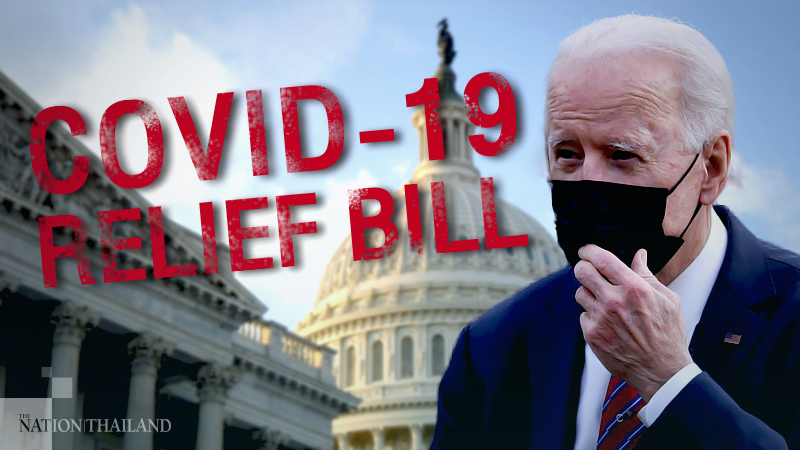
WASHINGTON – House Democrats voted Wednesday to set the stage for party-line approval of President Joe Biden’s $1.9 trillion coronavirus relief bill, heeding the president’s calls for swift action on his first big agenda item – but without the bipartisan unity he promised.

The 218 to 212 nearly party-line House vote Wednesday evening approved a budget bill that would unlock special rules in the Senate allowing Biden’s relief package to pass with a simple majority, instead of the 60 votes usually needed. The Senate is expected to take action on the same legislation later in the week

With the budget resolutions in place, Democrats would be able to get to work in earnest on writing Biden’s $1.9 trillion proposed relief bill into law – and ultimately pass it without any Republican votes if necessary, though they continued to insist that is not their preference.

Biden himself said Wednesday that “I think we’ll get some Republicans.” Biden made the remark as he met in the Oval Office with Senate Majority Leader Charles Schumer, D-N.Y., and the Senate committee chairs who will be responsible for writing the actual relief legislation.

Biden has courted Senate Republicans, and repeatedly expressed the desire to get their support. But he and his advisers have made increasingly clear that any such agreement must be on Biden’s terms, and that he will not compromise on the price tag or major components of his relief legislation, which comes at a moment of economic need for the nation and with Democrats in control of both chambers of Congress and the White House.

Earlier Wednesday Biden told House Democrats on a conference call: “We need to act … We need to act fast,” according to two people on the call who spoke on condition of anonymity to relay his comments.

“It’s about who the hell we are as a country,” Biden said on the call.

Biden’s approach is informed by his experience as vice president during the Obama administration, including helping to negotiate a $787 billion rescue package for the financial crisis that many economists later concluded should have been bigger. White House press secretary Jen Psaki has said repeatedly that Biden is more concerned about his relief bill being too small than being too big.

But most Republicans are opposed to spending nearly another $2 trillion after devoting some $4 trillion to fighting the pandemic through a series of five bipartisan bills last year, including a $900 billion measure passed in December.

The so-called “budget reconciliation” bills passing this week simply set spending levels for committees and instruct them to report back with legislation, so the real fights over the contents of the package are still to come. Those are likely to be fierce, even if it’s just Democrats fighting among themselves, because Democrats have a very narrow majority in the House and the Senate is split 50-50 between the parties, with Vice President Kamala Harris’s tiebreaking vote giving Democrats the majority.

If Republicans stay united against Biden’s proposal, as is looking likely, any individual Democratic senator will have outsized influence to make demands. Already, the Biden team has been working with aides to Sen. Joe Manchin, D-W.Va., the most conservative Senate Democrat, who has questioned whether the relief package could be more targeted.

Biden’s plan includes an array of proposals including $1,400 stimulus checks, an increase and extension of unemployment benefits that are set to expire in mid-March, an increase in the federal minimum wage to $15 an hour, some $350 billion for cities and states, around $130 billion for schools, and $160 billion for vaccines, testing and other help for the health care system.

In debate on the House floor, Republicans took turns criticizing Democrats and Biden for choosing to go down a partisan path after Biden campaigned on promises to make bipartisan deals and unify the nation. They criticized his relief package as a wish list of liberal packages disguised as a covid relief bill.

“Democrats in Washington are setting up a partisan process to have the vice president cast the decisive vote in the Senate on an array of radical policies,” said Rep. Jason Smith, R-Mo., top Republican on the House Budget Committee. “Their plans are to try to use this pandemic to seize more government control of your life.”

Democrats countered that Republicans have not offered solutions to meet the needs of the country at a time of continued high unemployment, with more funding for vaccines urgently needed as variants of the coronavirus emerge.

“We cannot afford to slow down our response to these urgent crises while Republicans decide if they want to help or not,” said House Budget Chairman John Yarmuth, D-Ky.

The intensifying debate over the stimulus comes amid weeks of elevated jobless claims and fears that the more transmissible form of the coronavirus could cause further economic pain. The monthly jobs report for January will be released on Friday, providing a snapshot of the American economy that could bolster or deflate Biden’s push for a large stimulus package.

Biden earlier this week met with a group of 10 Senate Republicans who offered a $620 billion counter-proposal to his $1.9 trillion plan. Democrats have panned the GOP plan as inadequate, and Jen Psaki started the White House briefing on Wednesday by emphasizing the differences between the Republican plan and Biden’s. She pointed out that Biden’s plan would offer significantly larger stimulus payments, and unemployment benefits that would last through the fall instead of expiring during the summer like under the GOP plan, among other differences.

Psaki also criticized a new study by The Wharton School of the University of Pennsylvania that found more than 70% of the stimulus payments would be saved rather than spent. Psaki called that analysis “way out of step with the majority of studies,” citing research from the Brookings Institution and JP Morgan.

Psaki said Biden’s stimulus had bipartisan support because it was backed by most Republican voters, despite appearing to be rejected by all congressional Republicans.

Pressed on whether the amount of state and local aid in the bill was up for negotiation, Psaki said the White House would welcome an offer from Senate Republicans, noting the plan from 10 GOP lawmakers included no additional state relief.

Psaki said the income threshold for the $1,400 stimulus payments remains “under discussion” and had not been finalized. “Further targeting means not the size of the check — it means the income level of people who receive the check.”

Despite the GOP criticism of the partisan “budget reconciliation” approach, it’s a tool both parties have used. Republicans used budget reconciliation to pass their big tax cut bill after President Trump took office. And Obama used it for key legislation to amend the Affordable Care Act, after months of fruitless negotiations with Republicans yielded no GOP support for the ACA – another lesson for Biden from the Obama years.

GameStop frenzy leaves mess for Wall Street regulators #SootinClaimon.Com

#SootinClaimon.Com : ขอบคุณแหล่งข้อมูล : หนังสือพิมพ์ The Nation.

GameStop frenzy leaves mess for Wall Street regulators

InternationalFeb 04. 2021

By The Washington Post · Tory Newmyer, David J. Lynch

Long before an army of small investors buying shares of GameStop shocked Wall Street, regulators saw the need for a clearer, real-time view of the trillions of dollars that sloshed through the markets each day.

In May 2010, a trader in London using an algorithm to manipulate a futures market helped trigger a chain reaction that wiped 9% off the Dow Jones industrial average in minutes. The market quickly recovered. But that “flash crash” underscored regulators’ urgent need for a tool that would allow them to pinpoint who was buying and selling what securities down to the millisecond, equipping them to monitor a business already transformed by the explosion of computerized trading.

More than a decade later, industry resistance and bureaucratic snags have conspired to leave that database – known as the Consolidated Audit Trail or CAT – years behind schedule and a shell of what regulators originally envisioned, advocates of stronger financial oversight say.

Now the system’s limitations will make it harder for Wall Street’s Washington minders to make quick sense of the turmoil still rocking the markets. Amid the GameStop furor, regulators face a growing list of questions over the potential use of social media to manipulate stock trading, the adequacy of online brokers’ capital reserves, and the need for hedge funds to disclose more about their holdings.

“Understanding the sequence of events will be very hard to do, and it would have been relatively easy if the CAT [consolidated audit trail] was up and running,” says Tyler Gellasch, founder of the nonprofit Healthy Markets Association and a former Securities and Exchange Commission counsel. He said it points to the agency’s disappointing track record. “The smart bet on the SEC historically has been: Name the issue, and the response will be muted.”

The SEC and the Financial Industry Regulatory Authority, Wall Street’s self-regulator that controls the database, declined to comment.

Regulators are not waiting for an authoritative timeline of the market frenzy apparently initiated by amateur traders organizing on the Reddit forum WallStreetBets. As soon as Thursday, Treasury Secretary Janet Yellen is convening leaders of the SEC, the Federal Reserve, the Federal Reserve Bank of New York and the Commodity Futures Trading Commission to review the matter.

Yellen requested a “discussion of recent volatility in financial markets and whether recent activities are consistent with investor protection and fair and efficient markets,” Treasury spokeswoman Alexandra LaManna said in a statement.

Regulators face questions about whether the apparently amateur trading crowd’s activities amounted to illegal market manipulation and whether sophisticated professionals used the cloak of online anonymity to stoke the frenzy. The SEC already is sifting through social media and message boards for evidence of such efforts, Bloomberg News reported Wednesday.

Beyond nabbing any wrongdoers, those who set and enforce market rules are considering a wide array of issues raised by the emergence of retail traders as a powerful force. Possible responses range from the practical – barring online brokers from selling their customers’ orders to giant Wall Street firms – to the philosophical. Some are calling for a wholesale rethinking of a system they say operates more like a casino than an efficient machine for redistributing capital.

“The best mathematicians in America are trying to beat the other best mathematicians to a stock trade by a millionth of a second,” said Rep. Brad Sherman, D-Calif., chair of the House Financial Services subcommittee on investor protection, entrepreneurship and capital markets. “I’d like to see our capital markets be a place for investing because you think a company is going to do well, and where companies can raise the capital they need to create jobs. Instead you have high-frequency trading, whose social utility is hard to identify, consuming enormous intellectual resources, and I don’t know with what purpose.”

The full House committee will consider the issue at a Feb. 18 hearing. The Senate Banking Committee has announced its own hearing, though no date has been set. And its as-yet unscheduled confirmation hearing for Gary Gensler, President Joe Biden’s pick to head the SEC, will focus at least in part on how he intends to address the matter.

Allison Herren Lee, the agency’s acting chair, said her first priority is to look into the decision-making by Robinhood and other online trading platforms, which caused an uproar last week when they limited trading in GameStop and other stocks that retail investors had sent soaring. In a Monday interview with NPR, Lee said the SEC wants to ensure that those decisions are “compliant with regulations, that they’re transparent to their customers and that they’re consistently and fairly applied.”

Hedge funds – a number of which suffered billions of dollars in losses from taking short positions against stocks that retail traders bought up – also face greater scrutiny. House Financial Services Committee Chair Maxine Waters, D-Calif., said in a statement their “unethical conduct directly led to the recent market volatility.” And Sherman and others have called for more disclosures from hedge funds, including their short positions, and potentially higher capital requirements.

The industry is primed to fight back. “Short sellers conduct in-depth research and analysis that can expose financial fraud and corruption,” said Bryan Corbett, who leads the Managed Funds Association, the industry’s lobbying group. “This is a highly regulated activity through both the SEC and [the Commodity Futures Trading Commission], and existing frameworks provide abundant protection for the markets and all investors.”

The GameStop mania is not the first time the SEC has probed the link between the Internet and securities fraud. But the market watchdog has lagged in policing the use of social media and other new technologies in the financial markets, a position that could hamper efforts to unravel the GameStop episode, according to Joshua Mitts, an associate professor at Columbia University’s law school.

“They’re really behind the curve,” he said. “The SEC isn’t really stepping in and saying ‘these are the rules of the road on social media.’ “

The commission in recent years has made greater use of advanced data analytics to detect cases of insider trading and accounting and disclosure violations. But the SEC’s enforcement division remains heavily populated by securities law experts and lacks the data-science specialists needed to fight market manipulation on social media, Mitts said.

“The average SEC enforcement person is a lawyer who probably hasn’t done much with data,” Mitts said. “They need data scientists.”

More than two decades ago, as the 1990s tech bubble was drawing to a close, the commission pursued several cases involving alleged securities fraud involving the use of digital tools.

Any GameStop investigation probably will share similarities with these earlier Internet-era cases, according to John Stark, the first head of the SEC’s Office of Internet Enforcement. Many involved scammers posting false or misleading information on websites to drive up the price of selected stocks.

In the GameStop case, which has seen an army of retail investors enthusiastically posting about the video game retailer’s shares, individuals who were paid to post about the stock and had not disclosed that fact could be vulnerable to manipulation charges, Stark said. But given the volume of postings on WallStreetBets, which has 8.4 million members, sifting the evidence will be a daunting task.

Along with countless Reddit postings, investigators also will confront a potential avalanche of tips submitted by members of the public through an online SEC form.

“I’m confident the SEC enforcement staff will get to the bottom of it if manipulation occurred. But it will be difficult to prove,” said Stark.

After the tech bubble burst in 2000, with the Nasdaq index losing more than half its value, SEC officials pursued a number of fraud cases involving the use of the Internet to goose stock prices.

In 2002, the SEC reached a settlement of civil charges with Cole Bartiromo, a high school student who had engaged in an Internet “pump-and-dump scheme.” Bartiromo, 17, manipulated the stock prices of 15 companies by buying large numbers of shares and then posting “false and misleading information” about them on Yahoo! Finance and Raging Bull message boards, the commission alleged.

Over less than two months, Bartiromo posted more than 6,000 messages claiming news of imminent merger deals or buyouts, which he falsely attributed to sources such as Bloomberg and JP Morgan. In the case of one over-the-counter stock that Bartiromo claimed was headed to $10 per share, he sold his entire stake for less 25 cents, the SEC told a federal district judge in Manhattan.

The settlement required Bartiromo to disgorge $93,731 in the illicit gains and interest.

Two years earlier, the commission settled civil fraud charges against an even younger Internet tout. Jonathan Lebed, 15, a high school sophomore, without admitting or denying the charges, agreed to pay the government $285,000 in ill-gotten gains and interest, the commission said.

On 11 occasions, Lebed purchased shares in thinly traded small companies, then used phony names to post “baseless price predictions and other false and/or misleading statements,” the SEC said.

Lebed posted claims that a $2 stock would soon trade for $20 or that a stock would be the next “to gain 1000 percent,” the commission said. He often set automatic sell orders with his broker to “ensure that he would not miss the price increase of the stock while he was in school the next day,” the commission said.

“I implore investors to be highly skeptical of any advice they receive from the Internet,” Ronald Long, administrator of the SEC’s regional office in Philadelphia, who led the probe, said at the time. “People should do thorough research before making investment decisions and verify all information before acting on it.”

In 1999, the SEC filed a civil complaint alleging that four Southern California men had joined in a scheme to manipulate the stock of a bankrupt commercial printer company by spreading phony takeover rumors on the Web.

Over a November weekend, working in a library at the University of California at Los Angeles, the three created numerous accounts on Internet message boards and posted messages falsely claiming that NEI Webworld would be acquired by LGC Wireless, a privately held telecommunications company.

The rumors, which were fabricated, drove NEIP’s share price from 13 cents on a Friday to more than $15 by Monday, according to the SEC complaint, giving the men a profit of about $364,000.

Two of the men, who had done the same thing with several other thinly traded stocks, pleaded guilty to one criminal charge of securities fraud and were sentenced to short prison terms. Courts eventually ordered the four men to pay roughly $1 million in disgorged profits and fines.

S&P 500 rises after earnings reports; Nasdaq falls #SootinClaimon.Com

#SootinClaimon.Com : ขอบคุณแหล่งข้อมูล : หนังสือพิมพ์ The Nation.

S&P 500 rises after earnings reports; Nasdaq falls

InternationalFeb 04. 2021

By Syndication Washington Post, Bloomberg · Rita Nazareth, Vildana Hajric

Stocks rose for a third straight day, with investors assessing corporate earnings. Treasurys retreated. Oil climbed.

The S&P 500 advanced at a slower pace relative to the surge of the past two sessions, with energy and financial shares outpacing tech even after Google’s parent Alphabet Inc. hit a record on stellar results. The Nasdaq 100 fell, led by Amazon.com Inc. Banks climbed as JPMorgan Chase & Co. and Morgan Stanley issued bullish calls on the industry. GameStop Corp., the poster child for Redditors looking to squeeze short sellers, and movie-theater chain AMC Entertainment Holdings Inc. rebounded following Tuesday’s plunge. Drugmaker Biogen Inc. slumped after disappointing forecasts.

Bonds fell as the U.S. Treasury held steady its planned issuance of longer-dated securities at a quarterly debt auction next week, with officials awaiting the result of the government’s push for a fresh coronavirus relief package. Data showed companies added more jobs than forecast in January, while growth at service providers accelerated. The scattered signs of a pickup in activity come as President Joe Biden tries to win congressional passage of a $1.9 trillion stimulus proposal. Federal Reserve Bank of St. Louis President James Bullard said stock prices reflect optimism about the economic recovery.

“There has been a ton of noise in the stock market these past few weeks, so it’s encouraging to see solid economic reads,” said Mike Loewengart, managing director of investment strategy at E*Trade Financial Corp. “There may be signs of overextension when it comes to single stocks, but under the surface there is an economy regaining serious momentum.”

Normalcy has yet to return to the Cboe Volatility Index even after its biggest two-day decline in about three years. Tuesday’s close was 31% higher than the average since VIX calculations began in 1990, according to data compiled by Bloomberg. There hasn’t been a below-average close in about a year. VIX futures are indicating that “volatility will remain elevated for many months,” Nicholas Colas, co-founder of DataTrek Research LLC, wrote Tuesday in a report.

Elsewhere, crude climbed as OPEC+ said it will keep pushing to quickly clear the oil surplus left behind by the pandemic — a bullish signal for prices that have already surged to a one-year high.

These are some of the main moves in markets:

Stocks

– The S&P 500 advanced 0.1% at 4 p.m. EST.

– The Stoxx Europe 600 Index climbed 0.3%.

– The MSCI Asia Pacific Index increased 1.1%.

Currencies

– The Bloomberg Dollar Spot Index was little changed.

– The euro dipped 0.1% to $1.2035.

– The Japanese yen was little changed at 105.02 per dollar.

Bonds

– The yield on 10-year Treasurys rose three basis points to 1.13%.

– Germany’s 10-year yield climbed three basis points to -0.46%.

– Britain’s 10-year yield jumped two basis points to 0.371%.

Commodities

– West Texas Intermediate crude increased 2% to $55.85 a barrel.

– Gold lost 0.2% to $1,833.85 an ounce.

– Silver rose 0.6% to $26.83 per ounce.

E.U. faces 100 billion euro cost for vaccine push #SootinClaimon.Com

#SootinClaimon.Com : ขอบคุณแหล่งข้อมูล : หนังสือพิมพ์ The Nation.

E.U. faces 100 billion euro cost for vaccine push

InternationalFeb 04. 2021

By Syndication Washington Post, Bloomberg · Alexander Weber

The European Union is facing a cost of tens of billions of euros for the slow and chaotic rollout of coronavirus vaccinations compared to countries such as the United Kingdom and the United States.

Lockdowns mean the bloc’s economy is operating at about 95% of its prepandemic level, equating to about 12 billion euros ($14 billion) a week of lost output, according to calculations by Bloomberg Economics. It’s also weeks behind its peers in vaccinations, and progressing at a slower pace.

Unless it can make up ground, the European Union will be forced to keep lockdowns or similar restrictions in place even as other major economies get fully back to work. A delay of 1-2 months would amount to a 50 billion-100 billion euro blow.

The numbers highlight the massive stakes for the European Commission, which became embroiled in a public standoff with drugmaker AstraZeneca over supply curbs before imposing export restrictions for coronavirus vaccines. That turned into a U-turn for President Ursula von der Leyen over shipments to Northern Ireland.

“Every week that the lockdown has to be extended because the population isn’t vaccinated and vulnerable means substantial economic costs,” said Guntram Wolff, director of the Bruegel think tank in Brussels. “Those costs are a lot higher than the costs of the vaccinations themselves.”

The European Union has administered 3 doses per 100 people, far behind the 15 in the United Kingdom and 10 in the United States, according to the Bloomberg Vaccine Tracker. In the meantime, more-contagious strains of the coronavirus are spreading, forcing governments to extend lockdowns.

“The U.K.’s early progress means we expect a vigorous economic recovery to take root sooner than in mainland Europe,” said Jamie Rush, chief European economist at Bloomberg Economics. “The higher transmissibility of new covid-19 strains is prompting tougher containment measures in much of Europe, raising the cost of vaccine delays.”

The European Union predicts a surge in vaccine supply in the second quarter, and it plans to have 70% of the adult population vaccinated by the summer. That’s a level that should allow governments to lift many of the current restrictions that have shut down shops, restaurants and travel.

Yet Allianz estimates that countries are five weeks behind with respect to meeting that target, and that vaccinations need to happen at six times the current pace to catch up. It puts the cost at 90 billion euros.

“In vaccine economics there is only black or white: Economies that finish the race first will be rewarded with strong positive multiplier effects supercharging consumption and investment activity in the second half of 2021,” economists led by Ludovic Subran said in a report. “Vaccination laggards will remain stuck in crisis mode and face substantial costs – economic as well as political.”

Southern countries including Spain and Italy – already the most harmed by the pandemic – will suffer most from a delay if it hits international tourism. Even a partial opening around the Easter holidays at the beginning of April would bring much-needed revenue, according to Reinhard Cluse, an economist at UBS Group.

“With the slow progress on vaccinations, it’s not clear we’ll have a good Easter season,” he said, adding that the summer is also under threat, as many travelers books their holidays in the spring and may opt to stay closer to home for another year.

Each extra week the economy is subject to restrictions also increases the risk that companies that ate into their financial buffers for the last year will be pushed over the edge and file for insolvency. That would raise unemployment and undermine the prospect of rapid rebound.

The European Union could still catch up with its peers, or all nations could plunge into another crisis, for example if further coronavirus mutations emerge that are resistant to the current vaccines.

On current form, though, the likelihood is that continental Europe is headed for a painful reckoning.

“To the extent that we don’t get the necessary run rates in the coming weeks and months, our concerns will rise on a daily basis,” said Cluse.

U.S. moves to seize oil shipment it says Iran exported covertly #SootinClaimon.Com

#SootinClaimon.Com : ขอบคุณแหล่งข้อมูล : หนังสือพิมพ์ The Nation.

U.S. moves to seize oil shipment it says Iran exported covertly

InternationalFeb 04. 2021

By Syndication Washington Post, Bloomberg · Verity Ratcliffe

The U.S. has gone to court to seize 2 million barrels of oil that it claims came from Iran, as Joe Biden’s administration shows little sign of taking a softer line on Tehran.

The Department of Justice filed a case in a U.S. district court, seeking to seize the cargo on the Greek-owned Achilleas tanker, according to a statement on Tuesday. The U.S. alleges that Iran’s Islamic Revolutionary Guard Corps and the IRGC-Qods Force covertly shipped the oil abroad.

They “attempted to disguise the origin of the oil using ship-to-ship transfers, falsified documents, and other means, and provided a fraudulent bill of lading to deceive the owners of the Achilleas,” the department said.

While President Joe Biden has signaled he wants to reengage with Iran, his Secretary of State Antony Blinken said last week the Islamic Republic must first rein in its nuclear activities. Biden’s predecessor, Donald Trump, tightened sanctions on Iran in an effort to halt its oil sales, reduce its nuclear program and stop it interfering in other Middle Eastern countries.

The IRGC and the IRGC-QF, both designated as terrorist organizations by the U.S., use oil money to buy weapons of mass destruction and carry out human rights abuses, according to the DOJ.

The Achilleas’ owner, Capital Ship Management Corp., alerted U.S. authorities to the possibility that it had unknowingly taken on Iranian crude, after initially thinking it came from Iraq, Bloomberg reported last month.

Washington ordered the Liberia-flagged ship to sail to the U.S. before Biden came to power on Jan. 20, according to people familiar with the matter.

The vessel is known as a Very Large Crude Carrier and is fully loaded, according to shipping documents. It’s heading to the U.S. and is currently sailing close to the South American coast, according to tracking data compiled by Bloomberg.

Iranian oil production has almost halved since mid-2018, when Trump pulled out of a nuclear accord with Iran and tightened sanctions. Tehran has increased energy exports in recent months, according to several firms that monitor its output, in what may be an attempt to test Biden’s resolve.

The bulk of the oil that is shipped out of Iran ends up in China. Most traders are avoiding buying Iranian petroleum as long as the sanctions are in place.

Iran seized a South Korean tanker last month in the Strait of Hormuz amid a spat over $7 billion of oil sales it says is trapped in the Asian country due to the sanctions. Crew members were released this week, but the ship hasn’t been.

Tehran is pushing Seoul to release the money. South Korean officials are finalizing talks with the U.S. about unfreezing some of it, Yonhap news agency reported on Wednesday.

The U.S. will need to prove its allegations about the Achilleas’s oil in court proceedings, said Tuesday’s statement. If it wins the case, it may send proceeds from the oil to a government fund for victims of terrorism.

“The U.S. Attorney’s Office for the District of Columbia will continue working with our law enforcement partners to stem the flow of illicit oil from Iran’s Islamic Revolutionary Guard Corps and Qods Force,” Acting U.S. Attorney Michael R. Sherwin said in the statement.

One of world’s richest nations taps wealth fund as cash dries up #SootinClaimon.Com

#SootinClaimon.Com : ขอบคุณแหล่งข้อมูล : หนังสือพิมพ์ The Nation.

One of world’s richest nations taps wealth fund as cash dries up

InternationalFeb 04. 2021

By Syndication Washington Post, Bloomberg · Fiona MacDonald

Kuwait’s government has transferred the last of its performing assets to the country’s sovereign wealth fund in exchange for cash to plug its budget deficit after a political dispute over borrowing left one of the world’s richest nations short of cash and prompted Fitch to cut its outlook to negative.

Fitch affirmed Kuwait’s AA rating but said “the imminent depletion of liquid assets” and “absence of parliamentary authorization for the government to borrow” was creating uncertainty. Its report follows S&P Global Ratings’ recent warning that it would consider downgrading Kuwait in the next six to 12 months if politicians do not overcome the impasse.

Though it’s a high-income country, years of lower oil prices have forced Kuwait to burn through its reserves. Desperate to generate liquidity, the government last year began swapping its best assets for cash with the $600 billion Future Generations Fund, which is meant to safeguard the Gulf Arab nation’s wealth for a time after oil. With those now gone, it’s not clear how the government will cover its eighth consecutive budget deficit, projected at 12 billion dinars for the fiscal year beginning April.

The assets include stakes in Kuwait Finance House and telecoms company Zain, a person familiar with the matter said, asking not to be named because the information is private. State-owned Kuwait Petroleum, which has a nominal value of 2.5 billion dinars ($8.3 billion), was also transferred from the government’s treasury in January, the person said.

The Finance Ministry declined to give details about the swaps. Responding to Fitch, however, Finance Minister Khalifa Hamada said Kuwait’s financial position remained “robust” because of the cushion provided by the FGF. The government’s priority would be to replenish the treasury, he said without specifying how.

“It’s a very immediate crisis now, not a long-term one like it was before,” said Nawaf Alabduljader, a business management professor at Kuwait University. “The Future Generations Fund is our life jacket, but we don’t have a boat to take us to shore, we have no vision. We need to restructure our economy and move away from the welfare state.”

Like its neighbors, Kuwait is contending with the twin pressures of the coronavirus pandemic and lower oil prices. Unlike Saudi Arabia and others, however, Kuwaiti lawmakers have blocked proposals to borrow on international markets to cover the fiscal shortfall. Kuwait has not returned to the market since its debut Eurobond issuance in 2017.

Although nearly three-quarters of the budget is dedicated to public-sector salaries and subsidies, parliamentarians have opposed any hint of spending cuts, saying the government must reduce waste and corruption before passing the burden on to the public or resorting to debt.

The FGF, meanwhile, cannot be touched without legislation, and the idea of dipping into the national savings pot is deeply unpopular. Parliament already passed a law last year exempting the government from transferring the usual 10% of revenue into the FGF during years of deficit.

The swaps have bought the government a few months to push through its borrowing law. If that fails, it could still take a loan from the FGF or a debt plan could be issued by decree, though both scenarios are unlikely.

“They’re just buying time,” said Jassim Al-Saadoun, head of Al-Shall Economic Consultants.

With 80% of government income based on oil, Kuwait needs crude to be $90 to balance the new budget. But benchmark Brent was trading at about $58 a barrel Wednesday while spending is projected to rise 7%.

Parliament’s finance committee began reviewing the borrowing bill again Tuesday, raising expectations of a thaw, but the brinkmanship has prompted warnings that repeated delays could carry long-term costs.

Kuwait would be looking at “the imposition of high taxes,” said Talal Fahad Alghanim, former CEO of Boursa Kuwait. “Or, if the government fails to convince parliament, the central bank will have to resort to devaluing the dinar.”

Oxford-AstraZeneca coronavirus vaccine may help prevent transmission, study finds #SootinClaimon.Com

#SootinClaimon.Com : ขอบคุณแหล่งข้อมูล : หนังสือพิมพ์ The Nation.

Oxford-AstraZeneca coronavirus vaccine may help prevent transmission, study finds

InternationalFeb 04. 2021

By The Washington Post · Karla Adam, William Booth, Carolyn Y. Johnson

LONDON – The developers of the Oxford-AstraZeneca coronavirus vaccine report that it may help keep people from spreading the virus, offering a hopeful but uncertain answer to one of the great remaining questions of the pandemic.

Vaccines have produced evidence that they are effective at reducing the number of people who experience symptoms or suffer severe illness or die, but much less is known about whether any of the available vaccines can prevent asymptomatic infections that can pass from one person to another – thereby reducing the need for social distancing and allowing a return to more normal life.

In a preprint of an article under review at the Lancet medical journal, the Oxford University vaccine developers report that based on follow-up studies of their clinical trials, which found the vaccine safe and effective, there is also “the potential for the vaccine to reduce transmission of the virus.”

The study found that after people received two doses of the vaccine, they were 54% less likely to have an infection confirmed by a nasal swab, regardless of whether they had symptoms.

In addition, the researchers said a single dose of the vaccine was 76% effective against symptomatic virus infection, for up to three months.

Independent scientists who were not involved in the Oxford study called the data intriguing but incomplete. They warned that results were preliminary, that the sample size was too small to make bold claims, and that there could be alternative explanations for the findings, such as that the group receiving a single dose included more women, younger people and health workers.

But British officials on Wednesday hailed the report on the homegrown vaccine. They promoted the findings as a vindication for their controversial decision to delay second doses – from four weeks to 12 weeks – while trying to get first shots to as many people as possible.

British Health Secretary Matt Hancock said the research results were “absolutely superb.”

“It categorically supports the strategy we’ve been taking on having a 12-week gap between the doses,” Hancock told Sky News.

Pfizer-BioNTech scientists have warned that they do not have evidence to support the British dosing strategy for their vaccine, also in wide use in Britain.

Paul Hunter, a professor of medicine at the University of East Anglia, said the report by the Oxford researchers seemed to support the idea that efficacy of the vaccine was improved by having a long stretch between first and second doses.

“Taking all this evidence together, the 12-week gap between first and second dose is clearly the better strategy, as more people can be protected more quickly and the ultimate protective effect is greater,” Hunter said.

Hunter noted, however, that the Oxford vaccine seemed “quite poor at preventing asymptomatic infection.”

Andrew Pollard, the chief investigator of the Oxford vaccine trial, said the results support the British government’s decision to give one dose followed by a second booster shot 12 weeks later. Pollard called it “an optimal approach” that “reassures us that people are protected from 22 days after a single dose of the vaccine.”

Pollard also told the BBC on Wednesday: “We found that there was a big reduction in people being infected with coronavirus and, because they were not infected, they can’t go on and transmit to other people. That is really important in potentially curbing the pandemic.”

Natalie Dean, a biostatistics expert at the University of Florida, said: “If you think about the way that vaccines work, they can work in two major ways: one is by preventing infection entirely and the other by taking someone who is infected and preventing them from getting symptoms.”

The data suggest that “there were some infections that were prevented, but there were some that were bumped down in severity,” Dean said.

Oxford is eager to further establish the credibility of its vaccine after inconsistent dosing in its clinical trials muddied assessments of its effectiveness and a lack of data on the efficacy in people 65 and older has given some public health officials pause.

The European Union’s regulator of medicines has authorized the vaccine for use in all adults, but officials in France, Germany, Italy, Poland, Sweden and Belgium have cautioned against using it in older populations. Switzerland on Wednesday rejected the vaccine, saying it wanted to see more data. The United States, too, is waiting for more clinical trial data before an authorization decision.

French President Emmanuel Macron last week criticized the Oxford vaccine for use among those older than 65. Macron told the news media that the British vaccine “doesn’t work the way we were expecting to.”

European Commission President Ursula von der Leyen, defending the European Union’s regulatory approach, implied that Britain may have cut corners in its coronavirus vaccine rollout.

She told Le Monde that the bloc “agreed not to compromise with the safety and efficacy requirements linked to the authorization of a vaccine.”

Britain, von der Leyen said, was able to start its mass inoculation program earlier because it had taken “emergency, 24-hour marketing authorization procedures.”

A spokesman for the British prime minister’s office responded that all of the vaccines approved for use in the United Kingdom – Oxford-AstraZeneca, Pfizer-BioNTech and Moderna – are “safe and effective.”

Britain has one of the highest per capita coronavirus death tolls in the world. More than 108,000 people have died after being diagnosed with virus, with a more contagious variant propelling the latest wave.

The vaccine manufacturers have said their formulas are effective against the variant.

Myanmar military coup sparks resistance – with boycotts, noise and digital activism #SootinClaimon.Com

#SootinClaimon.Com : ขอบคุณแหล่งข้อมูล : หนังสือพิมพ์ The Nation.

Myanmar military coup sparks resistance – with boycotts, noise and digital activism

InternationalFeb 04. 2021

By The Washington Post · Shibani Mahtani, Andrew Nachemson

HONG KONG – Lynn Nu, an assistant surgeon at a government hospital in northern Myanmar, did not show up to work on Wednesday. Neither did 36 other assistant surgeons, almost the entire medical staff at the 500-bed facility, leaving one nurse to tend to patients.

The “military says they rule Myanmar, and are in charge of the government now,” he said. “But we are refusing to work under them and their dictatorship.”

Across Myanmar, a campaign of civil disobedience is swelling in response to this week’s military coup, which ousted the civilian government led by Aung San Suu Kyi and her National League for Democracy (NLD). Unlike past resistance movements, notably the 1988 pro-democracy uprising that made Suu Kyi a national icon, Myanmar’s new dissenters are keeping their activism off the streets – finding safer, digitally driven ways to reject military rule.

“We want to make our feelings heard, but at the same time to do what we could without being rash and demonstrating on the streets,” Lynn Nu, 32, added. “We thought this movement was the safest bet.”

The campaigns have targeted institutions directly run by the military and government-run hospitals. Staffers at 70 hospitals and medical departments across 30 towns and cities in Myanmar are refusing to go into work at government-run hospitals, treating patients in private facilities instead. Others quit their jobs at Mytel, a telecommunications company run by the military. And some are calling for a boycott of goods made by military-linked companies, which include Myanmar Beer and Red Ruby cigarettes, ubiquitous in the country’s tea shops.

Earlier this week, Myanmar’s military, led by commander in chief Min Aung Hlaing, detained Suu Kyi and her ministers and declared they had taken over the government. NLD lawmakers were barricaded inside their guesthouses in the capital, Naypyidaw.

On Wednesday, Suu Kyi was charged with possessing electronic equipment allegedly imported illegally, while ousted civilian president Win Myint was charged with breaching coronavirus rules that ban gatherings – allowing the military to keep the pair detained for another two weeks.

The spark for the coup was the military and its proxy party’s refusal to accept the results of November elections that Suu Kyi’s party won in a landslide. But tensions between Suu Kyi’s civilian government and the generals had been building over five years of a fragile power-sharing agreement.

Since the coup on Monday, some level of normalcy has returned to Myanmar. Communications are functioning. Chief ministers and NLD lawmakers have returned to their homes.

But public anger appears to be growing.

It started with the faint, tinny sound of tapping around 8 p.m. Tuesday, as residents in Yangon, the largest city, began to bang on pots and pans from their balconies to register their disgust with the military’s actions.

Whole streets and neighborhoods joined in, following a local tradition to ward off evil spirits with drums, eventually reaching a crescendo as people made noise any way they could. Some whooped and cheered, banging on tables and the roofs of their cars, while taxi drivers sounded their horns.

The campaign is gaining momentum; more honking and banging again erupted on Wednesday night, this time even louder and more sustained than before, with more people out on the streets. Some also sung a revolutionary anthem from 1988 after lyrics circulated earlier in the day.

Doctors, celebrities and NLD politicians are also raising the three-finger salute of defiance popularized by the Hunger Games trilogy, also a symbol of resistance in neighboring Thailand against the monarchy and the army-backed government

Kyaw Thu Win, of the punk band Rebel Riot, said the group is recording a new song called “One Day” in solidarity with the growing resistance. Similarly, their fight for injustice will be kept off the streets for now, in fear of what might come next.

“Right now we are showing solidarity online, from home,” he said. “No one is going out yet, so we are showing we do not agree with the new law and new system.”

Despite their caution, pushback from the authorities has already begun. A 35-year old resident of South Okkalapa, a neighborhood in east Yangon, said soldiers and community leaders visited their houses Tuesday night, complaining about the pot-and-pan protest.

“They said, ‘this is none of your business, do you all want to be captured?’ ” said the resident, who declined to give her name for safety reasons. Soldiers, she added, warned them that they would patrol the streets and arrest anyone who participated.

The military ruled Myanmar for half a century until a quasi-democratic transition began in 2010. Its brutal reign was defined by its brutality: arbitrary arrests, torture and ill-treatment. There was no free speech or free assembly, and residents who lived through those times describe a police state, where neighbors would snitch on each other and where fear was prevalent.

Even under the NLD-led civilian government, which took power in 2015, the military remained powerful. The army has continued to wage wars against ethnic militias and minorities – most notably, the Rohingya, more of a million of whom were driven from their homes in a scorched-earth campaign in 2017.

The military’s record is on the minds of resistance campaigners and organizers, worried that a wrong move could herald a wider crackdown.

“We don’t want to give them any excuse to crack down on us more, and say there is instability,” said Lynn Nu, the assistant surgeon. “We have fear, because they have guns, and we have no guns. But we will do our best.”

Democrats describe Trump’s actions as ‘betrayal of historic proportions’ #SootinClaimon.Com

#SootinClaimon.Com : ขอบคุณแหล่งข้อมูล : หนังสือพิมพ์ The Nation.

Democrats describe Trump’s actions as ‘betrayal of historic proportions’

InternationalFeb 03. 2021House Speaker Nancy Pelosi, D-Calif., after the House voted to impeach President Donald Trump on Jan. 13. MUST CREDIT: Washington Post photo by Bill O'Leary.House Speaker Nancy Pelosi, D-Calif., after the House voted to impeach President Donald Trump on Jan. 13. MUST CREDIT: Washington Post photo by Bill O’Leary.
By The Washington Post · Amy Gardner, , Karoun Demirjian, Colby ItkowitzWASHINGTON – House Democrats made their case to convict former president Donald Trump of inciting the Jan. 6 riot at the U.S. Capitol in a sweeping impeachment brief filed with the Senate on Tuesday, accusing Trump of jeopardizing the foundations of American democracy by whipping his supporters into a “frenzy” for the sole purpose of retaining his hold on the presidency.

https://www.washingtonpost.com/video/c/embed/f4e9bf6e-9433-4441-bdbf-f4fa3b19b8b3?ptvads=block&playthrough=false

In the brief, the House’s nine impeachment managers made a case that Trump was “singularly responsible” for the mayhem, accusing him of “a betrayal of historic proportions.” They argued that he is guilty of high crimes and misdemeanors, the threshold for conviction laid out in the Constitution, primarily because he used the powers of his office to advance his personal political interests at the expense of the nation.

To bolster their case, the managers turned to the words and actions of the country’s founders, citing passages from the Federalist Papers and contrasting Trump’s efforts to stay in office despite his electoral loss with George Washington’s insistence upon relinquishing the presidency after two terms in the interest of preserving democracy.

“The Framers of the Constitution feared a President who would corrupt his office by sparing ‘no efforts or means whatever to get himself re-elected,’ ” the House Democrats wrote, adding: “They were well aware of the danger posed by opportunists who incited mobs to violence for political gain. They drafted the Constitution to avoid such thuggery, which they associated with ‘the threat of civil disorder and the early assumption of power by a dictator.’ “

“If provoking an insurrectionary riot against a Joint Session of Congress after losing an election is not an impeachable offense,” they wrote, “it is hard to imagine what would be.”

Hours later, Trump’s new defense attorneys filed a 14-page response to the House article of impeachment, denying that Trump incited the crowd at his Jan. 6 rally to storm the Capitol and “engage in destructive behavior.”

While the former president’s attorneys stopped short of embracing his baseless claims that the election was rigged, they defended his right to argue that massive fraud led to his defeat, a false claim echoed by his supporters as they ransacked the Capitol that day.

Democrats drew a direct line between Trump’s rhetoric and the violence. But Trump’s defense team argued that free-speech protections allowed him to make such allegations without penalty.

“The 45th President exercised his First Amendment right under the Constitution to express his belief that the election results were suspect,” the brief states.

“Insufficient evidence exists upon which a reasonable jurist could conclude that the 45th President’s statements were accurate or not, and he therefore denies they were false,” his attorneys added.

The twin filings offer a preview of how the two sides will present their cases when the Senate trial begins Feb. 9. A majority of GOP senators have signaled their plans to acquit Trump. But House Democrats made clear that they intend to force Republicans to contemplate the terror of the Jan. 6 attack, which led to the deaths of one Capitol Police officer and four rioters. In addition, two officers, one with District of Columbia police, have since died by suicide.

The impeachment managers argued that Trump laid the groundwork for the insurrection in the preceding weeks with his relentless attacks on the integrity of the election and attempts to subvert the results through pressure on state officials.

Trump’s defense team rejected that claim, addressing an episode cited in the House impeachment article in which he called Georgia Secretary of State Brad Raffensperger, a Republican, early this year to discuss that state’s election results.

They argued that Trump’s exhortation during the Jan. 2 phone call that Raffensperger “find” the votes to overturn Joe Biden’s victory was simply an expression of the president’s belief that a careful examination of the evidence would produce a more accurate vote count that favored Trump.

David Schoen, one of Trump’s new attorneys, told The Washington Post in interviews this week that he did not plan to put forward a defense based on allegations of election fraud, a strategy Trump was said to be pushing his previous legal team to embrace.

On Tuesday, Democrats seized on the defense filing’s references to Trump’s fraud claims, with Senate Majority Leader Chuck Schumer, D-N.Y., saying that by citing baseless allegations Trump’s attorneys proved that “they have no argument against the charges.”

Senate Minority Leader Mitch McConnell, R-Ky., meanwhile, said he plans to listen to the arguments next week. Although McConnell voted last week with most Republicans on an unsuccessful motion to declare an impeachment of a former president unconstitutional, on Tuesday he said, “I think that is an interesting constitutional question.”

In their brief, the Democratic managers cited Trump’s behavior during the insurrection, when he initially did nothing to quell the rioters. They cited Sen. Ben Sasse, R-Neb., who said senior White House aides told him Trump was “delighted” at the mayhem he was watching on television.

There is no evidence, the brief added, that Trump called Vice President Mike Pence or any legislative leaders “to check on their safety during the attack.”

In fact, lawmakers and other allies called, texted or tweeted at Trump to implore him to step in and help restore order, the Democrats noted – evidence that they believed Trump was responsible for the violence and had the power to stop it.

In their response, Trump’s attorneys insisted that he never attempted to interfere with the counting of the electoral college votes in a joint session of Congress that day.

When Trump encouraged the rallygoers to go to the Capitol and “fight like hell,” the attorneys wrote, it had nothing to do with “the action at the Capitol” but “was clearly about the need to fight for election security in general.”

As Trump concluded his speech that day, he told the crowd, “We’re going to the Capitol,” adding: “We’re going to try and give them the kind of pride and boldness that they need to take back our country.”

Democrats noted in their brief that one call Trump did make to the Capitol during the unrest was intended for a close ally, Sen. Tommy Tuberville, R-Ala. – not to check on his well-being but to “try to persuade him to delay and further obstruct” the count.

Trump’s attorneys did not dwell on the mayhem itself, whereas the Democratic managers used dramatic imagery captured by cellphone footage and media reports of “terrified” lawmakers trapped inside the building who “prayed and tried to build makeshift defenses while rioters smashed the entryway.’ “

In their brief, managers compiled what had unfolded inside the Capitol that day: members donning gas masks and calling loved ones for fear that they would not survive the assault; Capitol Police officers dragging furniture to barricade the House chamber; the staff of House Speaker Nancy Pelosi, D-Calif., hiding under a table with the lights out for hours as they listened to the rioters just outside the door.

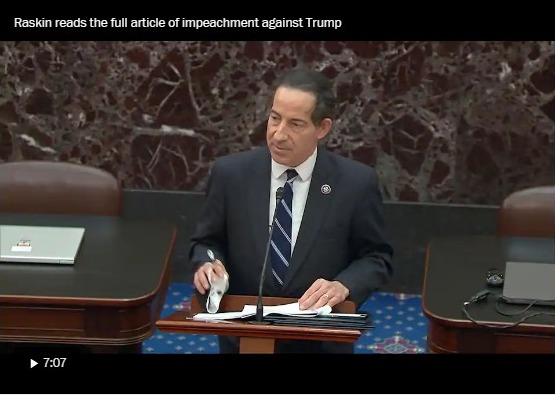
“One Member asked his chief of staff to protect his visiting daughter and son-in-law ‘with her life’ – which she did by standing guard at the door clutching a fire iron while his family hid under a table,” the brief stated, in a reference to Rep. Jamie Raskin, D-Md., the lead impeachment manager.

House managers are hoping to call witnesses in next week’s trial, including possibly police officers who fought to fend off the attackers. The prospect of injured police officers describing the brutality of pro-Trump rioters to Republicans who regularly present themselves as advocates of law enforcement could make for an extraordinary nationally televised scene. The mob injured more than 140 police officers, many seriously.

However, Senate Democrats and Republicans alike are reluctant to allow witnesses because it would extend the trial’s length, possibly by weeks. Democrats have said they are eager to focus their attention on President Biden’s agenda, while Republicans are ready to change the subject from Trump’s role in the Jan. 6 riot, which has divided the GOP ranks.

Tuesday’s brief methodically laid out the Democrats’ legal argument for conviction. In addition to asserting that Trump is guilty of high crimes and misdemeanors, the impeachment managers argued that Trump is not protected by the First Amendment’s freedom-of-speech provision, which was never intended, they wrote, to allow a president to “provoke lawless action if he loses at the polls.”

Democrats also rejected the claim embraced by many Republicans that it is unconstitutional to convict a president after he has left office – an argument that Trump’s attorneys made reference to multiple times in their brief.

“There is no ‘January Exception’ to impeachment or any other provision of the Constitution,” the House Democrats wrote. “A president must answer comprehensively for his conduct in office from his first day in office through his last.”

To bolster their case, the managers cited examples in which the Senate had tried officials who had already left office – albeit none of them presidents – and a lineup of conservative officials and scholars to make the point that departing or resigning is not a way of escaping culpability.

Plus, they argued, “because President Trump was in office at the time he was impeached,” the Senate has no choice but to proceed.

The managers pointed to Article I, Section 3, Clause 6 of the Constitution, which reads that “the Senate shall have the sole Power to try all Impeachments.”

They quoted Michael McConnell, a former appeals court judge appointed by President George W. Bush: “The key word is ‘all.’ . . . It does not say ‘the Senate has power to try impeachment against sitting officers.’ “

The argument probably will be a pivotal one after 45 of the 50 Republican senators voted last week to support a resolution from Sen. Rand Paul, R-Ky., that sought to declare that the impeachment trial is unconstitutional because Trump is no longer in office.

Trump’s attorneys and his supporters in the Senate are expected to further drill at the argument that the trial is invalid. Such an argument is expected to be embraced by many GOP senators who are loath to weigh in on the question of whether Trump incited the riot.

The managers’ brief warns that the consequences of taking such a procedural exception to the case before them would be dire.

“If the Senate does not try President Trump (and convict him) it risks declaring to all future Presidents that there will be no consequences, no accountability, indeed no Congressional response at all if they violate their Oath to ‘preserve, protect and defend the Constitution’ in their final weeks,” the managers wrote.

House Democrats said Trump’s embrace of baseless accusations that the 2020 election was stolen from him helped foment his supporters’ attack on the Capitol. When those false assertions failed to overturn the election, the Democrats wrote, Trump “summoned a mob to Washington, exhorted them into a frenzy, and aimed them like a loaded cannon down Pennsylvania Avenue.”

They added, “The Framers themselves would not have hesitated to convict on these facts.”

The House impeachment managers urged senators to bar Trump from serving again in elected office: “This is not a case where elections alone are a sufficient safeguard against future abuse; it is the electoral process itself that President Trump attacked and that must be protected from him and anyone else who would seek to mimic his behavior. Indeed, it is difficult to imagine a case that more clearly evokes the reasons why the Framers wrote a disqualification power into the Constitution.”