
Chaotic presidential transition brings vulnerability, security risks to nation #SootinClaimon.Com

#SootinClaimon.Com : ขอบคุณแหล่งข้อมูล : หนังสือพิมพ์ The Nation.

Chaotic presidential transition brings vulnerability, security risks to nation

InternationalNov 11. 2020President Donald Trump arrives in the White House briefing room in Washington on Nov. 05, 2020. MUST CREDIT: Washington Post photo by Jabin Botsford
President Donald Trump arrives in the White House briefing room in Washington on Nov. 05, 2020. MUST CREDIT: Washington Post photo by Jabin Botsford 

By The Washington Post · Paul Sonne · NATIONAL, NATIONAL-SECURITY 

President Donald Trump’s firing of Defense Secretary Mark Esper, days after losing the election, and a Pentagon personnel shake-up that has followed have injected uncertainty into the ranks of national security leadership at a vulnerable moment for the United States, adding more turmoil to a period that already carries risk for the nation.

In the week since Election Day, Trump has refused to concede and has publicized spurious claims of fraud to overshadow the result. He also has declined to give President-elect Joe Biden resources and daily presidential intelligence briefings to aid the transition to the new administration. The Pentagon turmoil could further jeopardize the prospect of a seamless handover, at what experts say is a sensitive time.

“It is a time of vulnerability, and it’s a time when your enemies can be testing you,” said Martha Joynt Kumar, director of the nonprofit White House Transition Project. “It is the kind of thing that you have to get right.”

National security crises have challenged presidents during past transitions. The Iran hostage crisis – after militant students stormed the U.S. Embassy in Tehran – came to a close in 1981 during the transition between Presidents Jimmy Carter and Ronald Reagan; the bombing of Pan Am Flight 103 over Lockerbie, Scotland, occurred in 1988 during the transition from Reagan to President George H.W. Bush; and Bush ordered U.S. troops into Somalia in his final weeks in office, in 1992, during the transition to President Bill Clinton.

Direct threats to the homeland have emerged during transitions as well. As George W. Bush welcomed President-elect Barack Obama to the White House for coffee on the morning of the 2009 inauguration, their respective national security aides sat in the Situation Room, discussing a possible threat to the event that U.S. intelligence had picked up from the extremist group al-Shabab, according to Kumar, who wrote a book about that transition.

The feared attack never took place, and the inauguration went off without a problem. But the Situation Room meeting, which came after joint crisis training sessions, underscored the vulnerability of the nation during presidential transitions – and how cooperation between the outgoing and incoming teams can reduce risk.

“Foreign adversaries believe that the United States is preoccupied during transitions, and it’s in our national security interest to demonstrate that we are not,” said David Marchick, director of the Center for Presidential Transition. He warned: “Failure to have a smooth transition could put our national security, our economic security and our health security at risk.”

Trump has signaled no interest in ensuring a seamless transition, instead proceeding as though he won a second term. The White House has told federal agencies to continue preparing for Trump’s budget submission to Congress in February.

The situation has prompted accusations that Trump is endangering the country.

“By destabilizing our national security team, we could increase the likelihood that one of our adversaries tries to take advantage of us,” Sen. Chris Murphy, D-Conn., a member of the Senate Foreign Relations Committee, said in an interview. “Trump is always distracted, but he is particularly distracted now, and there’s now also the possibility of having a fractured or inexperienced or incomplete national security team to deal with a crisis.” 

In addition to personnel changes, Trump also could make foreign policy moves before leaving office that could hem in Biden’s future choices, for example by increasing pressure on Iran to make reviving the 2015 nuclear accord even more difficult.

Foreign powers such as Russia, Saudi Arabia and Turkey that are likely to receive more pushback from a Biden administration could use the final months of the Trump administration to accomplish goals that might present challenges later, particularly if Washington is preoccupied with a chaotic presidential transition.

Neither Chinese President Xi Jinping nor Russian President Vladimir Putin has extended congratulations to Biden. A discordant transition could give both leaders an opportunity to make moves in their own regions. 

China could extend its crackdown on Hong Kong or make a move on more disputed islands in the South China Sea, while Russia could take measures in its proxy war in the eastern part of Ukraine. 

“Congress can fill part of the void,” Murphy said on Twitter. “Bipartisan statements, resolutions, and legislation can make clear there will be a cross-party consensus around consequences for any escalatory actions by other powers in the transition period.”

Uncertainty about how the United States would react during a lame-duck presidency could also deter foreign powers from taking the risk. 

“The problem is, if you actually try to exploit it in a period of this kind of transition, you have absolutely no idea of what the American reaction would be, both immediately or over time,” said Anthony Cordesman, a foreign policy expert at the Center for Strategic and International Studies. 

A chaotic transition could disadvantage the Biden administration if a crisis, in addition to the coronavirus pandemic, emerges during its first months in office.

The 1993 World Trade Center bombing, which killed six people and injured more than 1,000, occurred just a month after Clinton took office. The same month, federal law enforcement officers began a siege of a religious sect compound in Waco, Tex., that ended with the deaths of dozens of cult followers. When the siege began, Clinton didn’t have a confirmed attorney general. Two months later, authorities foiled a plot linked to Iraqi leader Saddam Hussein to assassinate George H.W. Bush during a visit to Kuwait. 

The rocky transition between Clinton and George W. Bush in 2000, following a recount in Florida and subsequent Supreme Court case, delayed the final result by more than 30 days, halving the normal transition period. The 9/11 Commission Report later found “this loss of time hampered the new administration in identifying, recruiting, clearing and obtaining Senate confirmation of key appointees” ahead of the attacks of Sept. 11, 2001.

The report recommended that administrations minimize the disruption of national security policymaking during the transition by accelerating the process for key appointments, noting that the Bush administration didn’t have a team on the job with critical sub-Cabinet officials for at least six months, making the team less prepared to deal with the Sept. 11 attacks.

Russian interference in the 2016 election to boost Trump loomed over the transition from Obama to Trump four years ago, leading to the publication of a special U.S. intelligence report on the matter, scrutiny of incoming national security adviser Michael T. Flynn’s interactions with the Russian ambassador and later veto-proof sanctions on Russia that passed in the Senate.

The inexperience of the Trump team amplified the chaos during the transition and afterward. George W. Bush had 35 Senate-confirmed positions by the end of the first 100 days because of the shortened transition and Obama had 69; Trump had only 28, according to the Center for Presidential Transition. 

Marchick said the Bush-Obama transition set a gold standard, in part because Bush made the matter a priority after his own rushed experience coming into office. 

Biden is entering the White House after recent updates to the law – some of which were written and introduced by former senator Ted Kaufman (Del.), Biden’s longtime chief of staff in the Senate and head of his transition team – setting out requirements for the transfer of power. 

Among other things, those changes require the creation of a White House transition coordinating council six months before the election. The Trump administration set up the council, which is chaired by White House Chief of Staff Mark Meadows and vice chaired by Chris Liddell, the deputy chief of staff. The law also requires each federal agency to put a senior career employee in charge of the transition activities. 

But Trump has refused to set in motion much of what the laws require. The administrator of the General Services Administration, a Trump appointee, is supposed to sign a formal notice to begin the transition but has declined to do so.

“Transitions have taken on a new form since 2010. Prior to 2010, they were much less formal, primarily in secret. After 2010, they have emerged as an important obligation of a candidate, and that’s because of legislation,” said Mike Leavitt, a former Utah governor who worked on the changes to the law after serving in George W. Bush’s Cabinet.

Leavitt said the first priority for the incoming administration is to choose a White House staff and the second priority is to select a national security team, including a national security adviser, secretary of state and defense secretary.

“One of the most important components and most important reasons for [an orderly] transition is that if you are a foreign power and looking for an opportunity to be harmful to the interests of the United States, you’d look for a period of confusion and a lack of controls – and those could potentially come in transitions,” Leavitt said.

The United States has endured disorderly and acrimonious transitions in the past. Presidents John Adams, John Quincy Adams and Andrew Johnson, for example, didn’t attend the inaugurations of their successors. During the transition from James Buchanan to Abraham Lincoln, seven Southern states seceded from the Union, setting the stage for the Civil War.

“Chaos is probably more the historical normal, but recently we have established new standards, and that’s appropriate – and the question is: Will the current administration meet the task?” said Stephen Hadley, who served as George W. Bush’s national security adviser and played a crucial role in the Bush-Obama transition. 

Hadley said that even if Trump doesn’t support the transition, people in his administration and career employees at the agencies understand the importance of a presidential handover and are determined to have a good transition.

“If the president doesn’t disrupt it, it will happen,” he said. 

Biden warns Johnson of Brexit risk to Northern Ireland peace #SootinClaimon.Com

#SootinClaimon.Com : ขอบคุณแหล่งข้อมูล : หนังสือพิมพ์ The Nation.

Biden warns Johnson of Brexit risk to Northern Ireland peace

InternationalNov 11. 2020U.S. President-elect Joe  BidenU.S. President-elect Joe Biden 

By Bloomberg · Tim Ross · NATIONAL, BUSINESS, WORLD, POLITICS, EUROPE 
Joe Biden used his first phone call with Boris Johnson as U.S. president-elect to warn the British leader not to compromise peace in Northern Ireland in his pursuit of Brexit.

During the course of a 20- to 25-minute conversation on Tuesday, Biden “reaffirmed his support” for the 1998 deal that put an end to the violence in Northern Ireland, according to a statement from the president-elect’s team.

A British official confirmed that Biden raised the Good Friday Agreement in the context of Brexit negotiations, and that Johnson responded by promising the president-elect that Britain would uphold the peace accord. Biden spoke later to Irish Prime Minister Micheal Martin, and again made a point of emphasizing his backing for peace in the region.

The fact that Johnson was number two on the list of leaders Biden called, after Canada’s Justin Trudeau, will be welcomed in London as a sign that the incoming White House team still regards Britain as a vital ally.

But the exchange over Northern Ireland marks an uncomfortable start to the newest incarnation of the so-called special relationship between the U.K. and the U.S. and suggests Biden will not be an unequivocal backer of Johnson’s Brexit project in the way President Donald Trump has been.

The two men have never met in person, and Biden has shown himself to be fiercely proud of his Irish roots. His transition to power comes at a delicate phase in the U.K.’s divorce from the European Union. Unlike Trump, Biden was opposed to Brexit and has aired his views on it.

Back in September, Biden raised his concerns over Johnson’s plan to break international law by reneging on parts of the Brexit divorce agreement he struck with the EU relating to trade with Northern Ireland. President Barack Obama, who Biden served under, famously weighed in on the 2016 referendum to say that if the U.K. opted out of the EU the U.S. would be put at the “back of the queue” when it came to trade talks.

Those talks, begun under Trump, will now likely be followed up by a Biden administration in a process that could take years, judging by the length of previous trade negotiations.

Biden had said in September that any U.S. trade deal with the U.K. must be “contingent” on respecting the Northern Ireland peace agreement and avoiding a return to a hard border with the Republic of Ireland.

A British official said the call was friendly and good. The U.K. has always insisted its plans do not compromise peace in the region and are intended to safeguard stability.

Multiple people injured in attack on Armistice Day ceremony in Jiddah, Saudi Arabia says France #SootinClaimon.Com

#SootinClaimon.Com : ขอบคุณแหล่งข้อมูล : หนังสือพิมพ์ The Nation.

Multiple people injured in attack on Armistice Day ceremony in Jiddah, Saudi Arabia says France

InternationalNov 11. 2020

By The Washington Post · James McAuley · WORLD, EUROPE, MIDDLE-EAST 

PARIS — Several people were injured Wednesday by an explosion at an Armistice Day commemoration in the Saudi Arabian port city of Jiddah, the French Foreign Ministry confirmed. 

The incident occurred at a non-Muslim cemetery, where a number of foreign diplomats had gathered to mark the end of World War I at an annual event organized by the French consulate. 

“This morning, at the Jiddah Cemetery, a ceremony commemorating the end of World War I was the target of an improvised explosive device attack,” the French Embassy in Saudia Arabia said in a statement. “The Embassies of France, Greece, Italy, the United Kingdom and the United States, which were associated with this commemoration, strongly condemn this cowardly attack.”

Although details of the incident remain unclear, it follows a knife attack on a security guard at the French Consulate in Jiddah late last month after France doubled down on defending caricatures of the prophet Muhammad, a stance that triggered protests and boycotts across the Muslim world. 

France has defended the caricatures and the principle of free expression after a teacher was beheaded in October in the Paris suburbs for showing students those images. Three people were subsequently killed in a knife attack in a basilica in Nice in a similar attack. 

In an interview with Al Jazeera late last month, President Emmanuel Macron sought to calm rising tensions between France and much of the Muslim world over the Muhammad caricatures. 

Macron said he could “understand the sentiments being expressed, and I respect them.” But he refused to budge in defending free expression. “I will always defend in my country the freedom to speak, to write, to think, to draw,” he added, although he has since taken aim at foreign press articles that he said “divide us” and that “we can do without.” 

The perpetrator of the earlier Jiddah stabbing was a Saudi citizen who was immediately taken into custody by authorities. The kingdom has expressed its solidarity with France and condemned the recent terrorist attacks on French soil. 

Saudi Arabia has been frequently targeted by terrorist groups, including al-Qaeda, which carried out a series of large-scale attacks beginning in 2003, and more recently by assailants sympathetic to the Islamic State militant group. Attacks have been directed at government facilities, Westerners stationed in the kingdom and members of Saudi Arabia’s Shiite minority, who are considered heretics by hard-line Sunni Muslims.

“Such attacks on innocent people are shameful and entirely without justification,” said the statement from the French Embassy in Riyadh. A man who answered the phone at the embassy declined to comment further on Wednesday’s attack. 

China forces ouster of Hong Kong pro-democracy lawmakers as crackdown intensifies #SootinClaimon.Com

#SootinClaimon.Com : ขอบคุณแหล่งข้อมูล : หนังสือพิมพ์ The Nation.

China forces ouster of Hong Kong pro-democracy lawmakers as crackdown intensifies

InternationalNov 11. 2020

By The Washington Post · Shibani Mahtani, Theodora Yu · WORLD, ASIA-PACIFIC

HONG KONG – China forced the ouster of four pro-democracy lawmakers from Hong Kong’s legislature on Wednesday, triggering a mass walkout of opposition lawmakers and solidifying Beijing’s stranglehold on the city.

The move, announced by Hong Kong officials after Beijing issued a new directive to disqualify lawmakers it deemed unpatriotic, represented a decisive blow that virtually eliminates opposition in the legislature for the first time since Hong Kong’s handover from Britain in 1997.

Beijing’s ruling, bypassing Hong Kong’s courts and political structures, underlined its efforts to sharply curb the financial center’s autonomy. The intervention and its timing also signaled to President-elect Joe Biden that the ruling Communist Party has no intention of easing its crackdown on Hong Kong, a subject of bitter dispute between the United States and China.

The four lawmakers – among them the accountant Kenneth Leung and lawyer Alvin Yeung, who leads a liberal party – were barred in July from recontesting legislative elections originally scheduled for September but which the government postponed for a year, citing the coronavirus.

They were initially told they could stay on until the election. But on Wednesday, Beijing passed a resolution that any lawmakers who support Hong Kong’s independence, or are otherwise deemed unpatriotic for reasons such as petitioning foreign powers to intervene in the city’s affairs, must be disqualified. 

Pro-democracy representatives had already threatened to resign en masse if that happened, and they announced hours later that they would walk out of the legislature, saying it was no longer a legitimate political forum. 

“They have totally given up on ‘one country, two systems’ in Hong Kong,” said Wu Chi-wai, leader of the Democratic Party, referring to the framework by which the city enjoyed autonomy within China. “Our colleagues are being disqualified by the central government’s ruthless rules.”

They would formally resign Thursday, he said, adding, “We will continue to fight, and find a path.” 

Almost a dozen pro-democracy legislators have been arrested in recent months on various charges, an indication of the pressure on them after backing anti-government protests last year.

In a news conference, the four expressed sadness and dismay, and said they had fought for the democratic principles in Hong Kong’s mini-constitution and laws. 

“We are all professional people, giving up a lot of our time and resources, because we want to fight for justice and the core values of Hong Kong,” said Leung, who has represented the accountancy sector for the past eight years. In a previous interview with The Washington Post, Leung pushed back against the government’s allegations that he had supported U.S. sanctions against Hong Kong officials, the reason election officials used to ban him from seeking office again. 

Dennis Kwok, another ousted lawmaker, had drawn China’s ire for using filibuster rules to stall the passage of laws pushed by Beijing – including one, since approved, that criminalized mockery of the national anthem. 

“If observing due process and protecting systems and functions and fighting for democracy and human rights will lead to the consequences of being disqualified, it will be my honor,” Kwok said Wednesday. 

The resolution from Beijing marks the second time this year that the central government has directly intervened in a consequential political decision in Hong Kong. Under the terms of the handover, Hong Kong was meant to have a high degree of autonomy in everything but foreign affairs and defense. 

In late June, Beijing passed a new national security law by fiat, similarly bypassing Hong Kong’s political structures. For the democracy movement, the law was chilling both for its content – punishing broadly worded crimes like “sedition” and “subversion of state power” with life in prison – and the way it was enacted. 

The United States responded by ceasing to treat Hong Kong as separate from China and imposing sanctions on officials, including Chief Executive Carrie Lam, for undermining human rights. This week, the Treasury Department added four more people to its sanctions list. 

Lam told reporters Wednesday it was “logical” that one who is “not fit to run for election is not fit to be a lawmaker.” Hong Kong officials could not decide on whether to let the four stay on, so her government sought Beijing’s advice, she added.

China’s liaison office in Hong Kong said in a statement that anyone who ran for office had to be “patriotic” and to love Hong Kong and China. Beijing’s decision, it added, adheres to Hong Kong’s mini-constitution – known as the Basic Law – and the national security law.

Chinese analysts expect tensions between the United States and China, including over Hong Kong, to persist under a Biden administration. Vice President-elect Kamala Harris was among the sponsors of the Hong Kong Human Rights and Democracy Act, which paved the way for sanctions, and has spoken in support of the democracy movement. 

Steve Tsang, director of the SOAS China Institute in London, said Beijing’s latest move “sends a clear message to the Biden administration that nothing has changed.” 

China is saying “we will continue to do what we want to do, and you’d better sort of come to terms with it,” Tsang said. 

He added that by quitting the chamber the pro-democracy lawmakers, while faced with a difficult situation, had effectively helped Beijing create a rubber-stamp legislature.

Lam, the chief executive, said she was not concerned about a lack of opposition members. 

“We are more excited when bills are passed more efficiently,” Lam said.

Shock and frustration inside Justice Dept. over Barr’s vote-investigation memo #SootinClaimon.Com

#SootinClaimon.Com : ขอบคุณแหล่งข้อมูล : หนังสือพิมพ์ The Nation.

Shock and frustration inside Justice Dept. over Barr’s vote-investigation memo

InternationalNov 11. 2020Attorney General William Barr joins President Donald Trump for a White House ceremony last year. MUST CREDIT: Washington Post photo by Jabin Botsford
Attorney General William Barr joins President Donald Trump for a White House ceremony last year. MUST CREDIT: Washington Post photo by Jabin Botsford 

By The Washington Post · Devlin Barrett, Matt Zapotosky · NATIONAL, POLITICS, COURTSLAW 
WASHINGTON – Current and former Justice Department officials said Tuesday they were stunned and frustrated by Attorney General William Barr’s move to loosen internal restrictions on how and when federal prosecutors investigate certain election-fraud cases before the results are certified – and worried that Barr was aiding President Donald Trump’s effort to cast doubt on his defeat. 

The blow to morale was felt most acutely in the Justice Department’s Criminal Division, which is typically a key player in prosecuting election-related offenses and setting department policy in that area, people familiar with the matter said. Like others, they spoke on the condition of anonymity to discuss internal Justice Department deliberations. 

Some weeks ago, when Barr had first proposed the move, Criminal Division officials – including political leadership – had pushed back vigorously and thought they had dissuaded the attorney general from taking such a step, the people said. Then, without warning, Barr’s memo hit their email Monday night.

Within hours, the head of the department’s election crimes branch, Richard Pilger, told colleagues he was stepping down from that job to a lesser position at the department, citing the new guidance, as others privately seethed. 

“It’s hard to know yet whether this amounts to something worrisome, or whether it’s just pleasing the boss,” said Richard Hasen, a law professor at University of California, Irvine who wrote a book, “Election Meltdown,” about the growing public distrust of election results.

Hasen said that the nuts and bolts of 2020’s election went fairly well, particularly considering the extra complication of a pandemic.

“The real problems came because of the delay in counting the votes,” said Hasen, faulting Republican legislators in some states who did not support early counting, which, he said, created “space for all kinds of conspiracy theories,” including from the president.

Current Justice Department officials said they were puzzled by what could have motivated Barr’s move. His memo suggested prosecutors could take public steps in cases “if there are clear and apparently-credible allegations of irregularities that, if true, could potentially impact the outcome of a federal election in an individual State.” 

But current and former Justice Department officials said they were unaware of any such cases amid the myriad allegations raised by the Trump campaign and the president’s supporters. Even if judges agreed with the campaign, the officials said, the challenges generally did not seem to implicate enough votes to change any results. 

Current and former Justice Department officials said they now feared some of the more politically minded U.S. attorneys might be spurred by Barr’s memo to issue news releases, send letters demanding documents or take other public steps that might wrongly suggest widespread voter fraud. That, in turn, would incentivize political parties to gin up more allegations and push the department to investigate those as well.

On Tuesday, there was no immediate outward sign of such activity in various U.S. attorney’s offices. In Pennsylvania, spokespeople for three federal prosecutors’ offices all declined to comment or referred questions to Justice Department headquarters in D.C.

While Barr’s memo might placate Trump in the short term, the current and former officials said, the investigations would not likely vindicate his broad claims. And in the meantime, such cases would damage public faith in the election results and eat away at the Justice Department’s credibility.

“This is a terrible idea,” said one person familiar with the debate over the directive. “You get baited into these cases all the time.”

Some current and former officials said they were concerned that Barr seemed at times to embrace theories without evidence, and they worried he might be changing department policy based on his personal suspicions about mass mail-in balloting. Before the election, Barr repeatedly attacked the practice and generally exaggerated evidence of widespread voter fraud.

“You can’t just change a policy that’s been around for 30 years based on conjecture,” the person familiar with the debate said. 

A Justice Department official disputed that criticism, saying Barr and Pilger had a fundamental disagreement over the policy. Barr, this official said, believed election fraud allegations should be reviewed nimbly, on a case-by-case basis, and disliked what he saw as the automatic and irrebuttable presumption of the old policy that no overt investigative action should be taken.

This official said the disagreement divided both career and politically appointed prosecutors, and ultimately the attorney general made the call as the head of the department.

Outside the department, Barr also drew widespread criticism. 

House Judiciary Committee Chairman Jerrold Nadler, D-N.Y., who has clashed with Barr repeatedly since his appointment in early 2019, said in a statement that the memo was “both flawed and deeply disturbing.”

“The Attorney General may think that he is merely humoring a President who will eventually concede the race and transfer power to his successor,” Nadler said. “This approach is as shortsighted as it is cynical and destructive. To be clear, Barr cannot change the outcome of the election – but in aiding President Trump in spreading lies about election officials, and in seeding doubts about the legitimacy of the election without a shred of evidence to back up their claims, Barr and the President’s other enablers threaten real harm to our country. “

Michigan Attorney General Dana Nessell, a Democrat, blasted Barr’s move as further politicization of criminal investigations.

The memo, she said in a statement “is transparently a favor to the President, as it lends a misplaced air of legitimacy to his baseless claims of massive widespread voter fraud in Michigan and elsewhere.”

Barr’s Monday night missive also revealed that in “specific instances” he had already authorized prosecutors to pursue “substantial allegations of voting and vote tabulation irregularities prior to the certification of elections in your jurisdictions in certain cases.” But officials on Tuesday were uncertain to which cases the attorney general was referring. 

Last week, lawyers for the Trump campaign sent a letter to Barr alleging voter fraud in Nevada, where they claimed to have identified more than 3,000 people who voted improperly because there was some evidence to suggest they moved out of state. But state officials soon pushed back on that claim, saying some of those voters might have been serving in the military. A Justice Department official, speaking on the condition of anonymity, said at that time that the department was “looking into” the matter, but declined to comment further. 

Republican National Committee Chairwoman Ronna McDaniel similarly last week said she had sent claims to the Justice Department about election workers in Michigan being told to backdate certain ballots, though she conceded the allegations were not fully vetted. A Justice Department official said the information McDaniel provided has been referred to the FBI, though the FBI has declined to say what – if anything – it was doing. 

On Sunday, Sen. Lindsey Graham, R-S.C., sent a letter to Barr and FBI Director Christopher A. Wray asking them to investigate claims made by a postal worker in Erie, Pa., that there was mishandling of mail-in ballots by postal supervisors there. A Justice Department official said officials are reviewing Graham’s letter.

Several people familiar with the investigation said Tuesday that the purported whistleblower in that case had recanted to internal U.S. Postal Service investigators.

Republicans echo Trump’s baseless election claims, undermining Biden’s transition #SootinClaimon.Com

#SootinClaimon.Com : ขอบคุณแหล่งข้อมูล : หนังสือพิมพ์ The Nation.

Republicans echo Trump’s baseless election claims, undermining Biden’s transition

InternationalNov 11. 2020President Donald Trump speaks in the White House briefing room on Nov. 5. MUST CREDIT: Washington Post photo by Jabin BotsfordPresident Donald Trump speaks in the White House briefing room on Nov. 5. MUST CREDIT: Washington Post photo by Jabin Botsford 

By The Washington Post · Ashley Parker, Philip Rucker · NATIONAL, POLITICS 
WASHINGTON – Republican officials across Washington are acquiescing to and amplifying President Donald Trump’s baseless claim that he won the 2020 presidential election – raising the risk of undermining the public’s faith in the vote and, by obstructing President-elect Joe Biden’s transition, potentially imperiling national security.

In recent days, Trump’s appointees and allies have alighted on a strategy to support his refusal to admit defeat and initiate a peaceful transfer of power. Instead, they are nurturing the president’s ego by indulging his delusions about the vote count and fueling conspiracy theories that the election is being stolen from him. 

The White House has instructed government agencies to block cooperation with the Biden transition team – including the Government Services Administration, whose Trump-appointed administrator, Emily Murphy, has refused to sign paperwork that releases millions in preallocated dollars to fund the transition and gives Biden’s team access to agency officials and information.

These unprecedented moves risk further eroding public trust in democratic institutions, and they have potentially dangerous consequences. The nation is at its most vulnerable state during the transition period between administrations, according to experts in governance and public service, who worry that the Trump administration is threatening national security by denying Biden the necessary resources, intelligence and other information to conduct his transition.

“We live in an incredibly dangerous world that moves very fast, so having a president truly ready to go on Day One is fundamental to our safety,” said Max Stier, president of the Partnership for Public Service. “There’s no more complicated or important organization on the planet in history than the U.S. government, and taking it over is a massive undertaking.”

The already daunting task is made more challenging by the coronavirus pandemic, he added. “It’s a sprint in the best of circumstances, made even harder by having to do it virtually,” Stier said. “They don’t need these extra problems.”

Almost since Election Day, an increasing number of Trump advisers and allies have privately conceded that they do not think the president will win reelection, even if he pursues all legal options at his disposal. They have said they are simply trying to give Trump – a notoriously sore loser who has long fashioned himself a victim of nefarious forces seeking to undermine him – the time to come to grips with his loss, knowing he is likely to refuse to ever officially acknowledge the election results.

But the delay in a peaceful transition of power – whatever the justification – has potentially devastating effects, not just for Biden but for the nation.

“They all know he lost and they are lying about it to protect his little feelings. It’s insane,” said Tim Miller, a former Republican strategist who led one of several outside groups working to elect Biden. “They’re all playing pretend because Donald wants a participation trophy, and there are real human consequences – not just to our democracy, but threats to individuals and their lives.”

Trump’s false claims undermining the legitimacy of the election are being echoed not only by those in the upper echelons of his administration, but also by senior members of the Republican establishment.

Asked on Tuesday whether the State Department was cooperating with the Biden team to ensure a smooth transition of power, Secretary of State Mike Pompeo responded as if Trump had been reelected.

“There will be a smooth transition to a second Trump administration,” said a smiling Pompeo, leaving it unclear whether his answer was intended as a joke. 

Sen. Roy Blunt of Missouri – a member of Senate Republican leadership who, as co-chairman of the Joint Congressional Committee on Inaugural Ceremonies, has responsibility for ensuring a peaceful transition – similarly called into question the results of the election.

“You know, the president wasn’t defeated by huge numbers,” Blunt said Tuesday. “In fact, he may not have been defeated at all.”

Blunt’s comments represented a remarkable shift from just two days earlier, when he said on ABC’s “This Week” that it was “unlikely” the Trump team’s legal efforts would ultimately produce a Trump victory.

Other Republican lawmakers have joined the chorus, including Sen. Marco Rubio of Florida, who posted a video Tuesday on social media in which he said: “President Trump is well within his legal rights to pursue all these things under these laws now. Now, for those in the media who are angry that Republicans won’t just take their word for it that Biden won, I think you need some self-awareness.”

Trump badly trails Biden, who leads by nearly 5 million votes and has cemented 279 electoral votes – nine more than needed to win – compared to Trump at 214. Biden also has leads in Arizona and Georgia, which would bring him to 306 electoral votes. Any path to victory through legal outcomes is deeply unlikely – and a far cry from the contested 2000 election, which came down to 537 votes in Florida.

Speaking to reporters on Tuesday in Wilmington, Del., Biden made clear he was determined to move ahead with his administration planning, saying he could name Cabinet members as soon as this month, and calling Trump’s continued insistence that he won “an embarrassment, quite frankly.”

“How can I say this tactfully?” Biden said before plowing ahead. “I think it will not help the president’s legacy.”

Michael D’Antonio, a Trump biographer, said that Trump’s party has clearly decided to mollify its temperamental leader. 

“It seems like the Republicans have opted for the coddling approach to parenting a bratty child, and maybe when the child is as powerful as the president there’s no other option,” D’Antonio said. “But really, the child needs a timeout.”

Senate Majority Leader Mitch McConnell, R-Ky., sought to dismiss concerns over Trump’s continued efforts to challenge the election results by saying there was “no reason for alarm.” 

Attorney General William Barr set the law enforcement community on edge Monday when he gave federal prosecutors approval to pursue allegations of “vote tabulation irregularities,” despite there being no evidence of widespread fraud as alleged by Trump and his aides. The move prompted the head of the Justice Department’s Election Crimes Branch to step down in protest.

“It’s meant to damage the confidence of voters that their vote can count, and to get people to believe that no matter what they do, they’re not going to be able to remove Trump from power, that he is stronger than the will of the people,” said Ruth Ben-Ghiat, a historian of authoritarian regimes and author of the new book “Strongmen: Mussolini to the Present.”

She added: “The aim of not allowing Biden to start the transition is to sabotage as much as possible his presidency, and this is typical of authoritarian leaders and the idea that if they have to leave, they’re going to drag the whole edifice down with them.”

Every major news organization on Saturday declared Biden the winner based on preliminary vote totals, as has been done in nearly every modern U.S. election, including in 2016 when Trump won the electoral college by a similar margin. Biden and Vice President-elect Kamala Harris claimed victory, and this week some foreign presidents and prime ministers have called Biden to congratulate him, as is customary.

Only a few GOP lawmakers have publicly acknowledged Biden’s win, however, including Sen. Mitt Romney of Utah, the lone Republican to vote to convict Trump during his impeachment trial this year.

On Saturday, Romney tweeted shortly after the race was called: “Ann and I extend our congratulations to President-elect Joe Biden and Vice President-elect Kamala Harris. We know both of them as people of good will and admirable character. We pray that God may bless them in the days and years ahead.”

Stuart Stevens, a Trump critic who was a top adviser on Romney’s unsuccessful 2012 presidential bid, said he is disgusted by the unwillingness of so many elected Republicans to publicly accept the election results.

“Every one of these Republicans is lying,” said Stevens, a senior adviser on the Lincoln Project, a group of anti-Trump Republicans. “They’re sitting there a few miles from Arlington [National] Cemetery, where people died for democracy, and they can’t get their communications shop to issue a two-sentence statement congratulating Biden.”

He added: “It’s racist and it’s cowardly and it’s going to be defining for a lot of these people.”

Sen. Christopher Coons, D-Del., who is close to Biden, said Tuesday on CNN that many Republican senators accept the reality, even if they won’t admit it.

“They call me to say, you know, ‘Congratulations, please convey my well wishes to the president-elect, but I can’t say that publicly yet,’ ” Coons said, though he did not name anyone.

Paul Light, a professor of public service at New York University who has closely studied presidential transitions over the years, warned that Trump’s refusal to concede and the willingness of Republicans to go along is “planting the seeds of a breakdown” in the federal government.

“I keep thinking of that big baby [Trump] balloon and thinking, ‘Is that what’s going on?’ ” Light said. “What’s the endgame here? Do we just have to soothe the president’s ego until he finally says, ‘OK, I can go home now’?”

Biden, allies decry stalling of transition #SootinClaimon.Com

#SootinClaimon.Com : ขอบคุณแหล่งข้อมูล : หนังสือพิมพ์ The Nation.

Biden, allies decry stalling of transition

InternationalNov 11. 2020President-elect Joe Biden on Tuesday called President Trump's refusal to concede President-elect Joe Biden on Tuesday called President Trump’s refusal to concede “an embarrassment.” MUST CREDIT: Washington Post photo by Demetrius Freeman 

By The Washington Post · Matt Viser, Michael Scherer · NATIONAL, POLITICS 

WASHINGTON – President-elect Joe Biden and his Democratic allies on Tuesday rebuked President Donald Trump and top Republican leaders for refusing to acknowledge the results of the election, even as Biden continued with the pre-presidential necessities of building an administration and fielding congratulatory calls from top European allies. 

Democrats have grown increasingly agitated that Republicans have been unwilling to accept the election results. On Tuesday, they began making more forceful arguments that the intransigence of Trump administration officials was putting national security at risk, and that his arguments contesting election results had little basis in reality. 

“It’s an embarrassment, quite frankly,” Biden said of Trump’s refusal to concede. “How can I say this tactfully? I think it will not help the president’s legacy.”

In the face of repeated challenges from Republicans casting Biden as illegitimate, his early strategy has been to continue making the moves of any traditional incoming president: appointing transition officials, talking to international leaders and deliberating over who will staff his administration. He has offered guidance to Americans on how to handle the coronavirus pandemic, forcefully asking them to wear masks to save lives, and he has pledged to protect their access to health care, even as President Barack Obama’s signature law faced a legal challenge in the Supreme Court on Tuesday.

In private, some of his advisers have discussed potential legal challenges to Trump’s refusal to recognize Biden’s electoral victory. But in public Biden has been trying to cast himself, as he did during the campaign, as a leader intent on soothing the nation’s upset even in the face of one of the most unusual and tense transitions in modern American history.

Biden’s approach so far has reflected the disciplined optimism about bipartisan cooperation for which he was frequently criticized throughout the Democratic primaries and general election from those who said that he underestimates the lengths to which Republicans will go to block his agenda.

He said repeatedly on Tuesday that he believed Republicans would eventually drop their opposition to him and come around, adopting a friendlier brand of politics. While that strikes some in Biden’s party as a throwback to a long-gone period, others said he has no real alternative than to continue to build his administration and appear the bigger man in his public utterances. 

“I understand the sense of loss. I get that. But I think the majority of people who voted for the president . . . I think they understand we have to come together,” Biden told reporters Tuesday after delivering remarks on protecting the Affordable Care Act. “I think they’re ready to unite. And I think we can pull the country out of this bitter politics that we’ve seen the last five, six, seven years.”

When asked how he believes he can work with Republicans who won’t even acknowledge he won the election, Biden smiled. “They will,” he said. “They will.”

Others offered harsher verdicts.

“I don’t think many of us expected President Trump to leave office of the presidency with grace,” Senate Minority Leader Charles Schumer, D-N.Y., said in a floor speech on Tuesday. “But the extent to which the Republican Party is legitimizing the President’s assault on our democracy is infuriating and deeply, deeply wrong.”

Even as most Republicans have refused to concede the election, leaders around the world continued to call Biden on Tuesday to congratulate the incoming American president. He spoke with British Prime Minister Boris Johnson, French President Emmanuel Macron, German Chancellor Angela Merkel and Irish Prime Minister Micheál Martin, according to statements from each country and Biden’s transition team. 

Turkish President Recep Tayyip Erdogan, who developed a close relationship with Trump, also released a statement congratulating Biden. 

The calls were not coordinated with the U.S. State Department, as is the typical practice, because a Trump appointee is refusing to issue an acknowledgment that Biden won, which allows the transition to formally begin. 

“There will be a smooth transition,” Secretary of State Mike Pompeo said on Tuesday, “to a second Trump administration.”

When asked about the message it sends to the world that the United States calls for free and fair elections in other countries but that Trump is refusing to accept the results in his own, Pompeo replied, “That’s ridiculous.”

Biden chuckled later in the day when asked about Pompeo’s remarks. 

Although his top advisers have evaluated legal options – and on Monday night said they were thinking of utilizing them to force the Trump administration to formalize the transition – Biden himself said Tuesday that “I don’t see the need for legal action, quite frankly.”

Despite delays in receiving intelligence briefings, and the potential national security implications that could follow, Biden suggested his team had everything it needed.

“We’re already beginning the transition. We’re well underway,” Biden said. “The fact that they’re not willing to acknowledge we’ve won is not of much consequence.”

He also downplayed the importance of additional intelligence briefings. 

“It would be nice to have it, but it’s not critical,” he said. “I’m not in a position to make any decisions on those issues anyway.”

Though there has been some low-level cooperation between current Trump administration officials and the Biden team, the formal transition process – which includes additional meetings, office space, funding and a handoff of briefing books – cannot begin until the election result is confirmed by the General Services Administration. So far GSA Administrator Emily Murphy, a Trump political appointee, has refused to sign the paperwork. 

Even as the Trump administration continued blocking his access, Biden on Tuesday named a team of 500 experts who will form the backbone of his preparations for leading the federal government in January, learning from the existing workers what to expect at every agency on personnel, technology, policy and program matters.

Even if the Biden team will be unable to make formal contact with Trump appointees and career staff now in government, Biden transition officials stressed that they are working through informal channels to learn what they can, talking with think tanks, labor and nonprofit groups, and those who previously served at federal agencies.

“We may not be making formal contact, but the transition work is continuing to move full speed ahead,” said a Biden transition official, speaking on the condition of anonymity to discuss their planning efforts.

Yet three former senior government officials on Tuesday raised alarms about Trump blocking the transition, with two warning that delays could impact the Biden administration’s ability to respond swiftly to the coronavirus pandemic.

“We are in the midst of a crisis and what we know is that every lost day is a lost life and a lost livelihood,” said Kathleen Sebelius, who began her tenure as secretary of Health and Human Services in 2009 amid the swine flu pandemic. “Every day wasted is a life that is unfortunately wasted.”

The limits on transition cooperation could also prevent Biden’s team from knowing all of the research and capabilities for distributing a vaccine. 

“If you are going to distribute hundreds of millions of vials of vaccine as quickly as possible, the incoming administration needs to know the status of each and every one of them,” said Leslie Dach, a former senior counselor at HHS during the Obama administration and now chairman of the group Protect Our Care, which organized a briefing Tuesday.

Another former Cabinet secretary, David Shulkin, who led the Veterans Affairs department under Trump and was undersecretary in the final years of the Obama administration, said the transition process is governed by law, but the nation is seeing “complete disregard of essentially what should happen.”

Orders from the White House not to recognize the election results are “putting us into quicksand, where [government officials] are feeling paralyzed until they get that direction from the White House,” Shulkin said.

As part of the Democratic pushback, the Biden campaign on Tuesday afternoon dispatched some of its top officials to reject the baseless claims that Trump has made about the elections, with one calling them “noise and theatrics” and “puffery and propaganda.” Biden’s smallest margin in a contested state is more than 14,000 votes, his lead in Georgia. 

“Since 2000, in 31 statewide recounts, the average change in votes was 430,” said Bob Bauer, a top attorney for Biden’s campaign. “End of story. These margins simply cannot be overcome in recounts.” 

“There’s no question. They can’t overturn the outcome of this election,” he added. “Joe Biden will be inaugurated on January 20, 2021.”

But a number of Republicans still called the election returns incomplete and said the country should wait until legal options have been exhausted before declaring a winner. That was not their position in 2016, when Trump won with exceedingly slim margins in three states.

“You know, the president wasn’t defeated by huge numbers. In fact, he may not have been defeated at all,” Sen. Roy Blunt, R-Mo., said at a news conference, in a shift from two days earlier when he said the legal challenges were not likely to change the result. 

Senate Majority Leader Mitch McConnell, R-Ky., also dismissed concerns about a delay.

“At some point here, we’ll find out, finally, who was certified in each of these states, and the electoral college will determine the winner, and that person will be sworn in on January 20th,” he said. “No reason for alarm.”

Republicans are facing a clear dilemma because of Trump’s apparent desire to remain a central player in politics after he leaves office. He retains considerable sway over Republican voters and an ability to weaponize that influence against Republicans who cross him. Few on Capitol Hill forget the tea party uprising that followed Obama’s election, which threatened Republican incumbents as much as Democrats.

With two upcoming U.S. Senate runoff elections in Georgia – which could decide the balance of power in the chamber – the current calculation in the party is that there is no upside in forcing a showdown with Trump now. 

Biden has long argued that he would be able to win over Republicans and that they would shed their loyalties to Trump and be more willing to compromise with Democrats after Trump leaves office. 

“The whole Republican Party has been put in a position, with a few notable exceptions, of being mildly intimidated by the sitting president,” Biden said on Tuesday. 

“Look, I am not a pessimist. I think enough Republicans have spoken out,” Biden added. “And there will be a larger number, once the election is declared, to get things done.”

He said that he had not yet spoken with McConnell but that he would “in the not-too-distant future.” Biden said he had confidence that, if he remains majority leader, McConnell would be fair in considering Biden’s Cabinet nominations. 

“I’ll take Mitch McConnell at his word,” he said. “That’s a negotiation that I’m sure we’ll have.”

Several Democrats said that there was little Biden could do to counter Trump directly and that he was smart to simply prepare for the transition. 

“The Biden campaign is exactly right,” said Jim Messina, former White House deputy chief of staff and the 2012 campaign manager for Obama. “You shouldn’t legitimize what isn’t.”

Simon Rosenberg, a Democratic strategist and founder of the think tank New Democratic Network, said the Republican response amounted to “a level of partisanship that we all hoped would receded after the election.”

“In a few months, Joe Biden will become president, and if he does a good job, he will bring people around,” he said. “There is nothing we can do to control what Donald Trump and the Republicans say. The focus has to be now on governing well and moving beyond this rancor of the American people.”

As states press forward with vote counts, Trump advisers privately express pessimism about heading off Biden’s win #SootinClaimon.Com

#SootinClaimon.Com : ขอบคุณแหล่งข้อมูล : หนังสือพิมพ์ The Nation.

As states press forward with vote counts, Trump advisers privately express pessimism about heading off Biden’s win

InternationalNov 11. 2020President Trump/file photoPresident Trump/file photo 

By The Washington Post · Amy Gardner, Tom Hamburger, Jon Swaine, Josh Dawsey · NATIONAL, POLITICS, COURTSLAW 
 Six states where President Donald Trump has threatened to challenge his defeat continued their march toward declaring certified election results in the coming weeks, as his advisers privately acknowledged that President-elect Joe Biden’s official victory is less a question of “if” than “when.”

Trump began the day tweeting about “BALLOT COUNTING ABUSE” as he and his allies touted unproved claims that election fraud had tainted the election in Arizona, Georgia, Nevada, Pennsylvania, Michigan and Wisconsin. Vice President Mike Pence gave a presentation to GOP senators on Capitol Hill about new litigation expected in Pennsylvania, Michigan and Georgia – imploring them to stick with the president, according several Republicans in the room.

But even some of the president’s most publicly pugilistic aides, including White House Chief of Staff Mark Meadows, Republican National Committee Chairwoman Ronna McDaniel and informal adviser Corey Lewandowski, have said privately that they are concerned about the lawsuits’ chances for success unless more evidence surfaces, according to people familiar with their views.

Trump met with advisers again Tuesday afternoon to discuss whether there is a path forward, said a person with knowledge of the discussions, who, like others interviewed for this report, spoke on the condition of anonymity to describe internal discussions. The person said Trump plans to keep fighting but understands it is going to be difficult. “He is all over the place. It changes from hour to hour,” the person said. 

In the states, Democratic and some Republican officials said they have seen no evidence of fraud on a scale sufficient to overturn the results. “There is no evidence of widespread voter fraud,” one GOP official in Georgia said.

The vote counting, meanwhile, continued apace as the states work toward certifying the vote, a process that should largely be finished by the beginning of December. In Georgia, the deadline for county certification is Nov. 13, but the majority of counties had already completed the task by Tuesday afternoon. Next comes a statewide audit, after which Secretary of State Brad Raffensperger, a Republican, must certify the results no later than Nov. 20.

In Arizona, county canvassing results go to the secretary of state, who must certify on Nov. 30, the fourth Monday after the election, a deadline that can be extended just a few days to accommodate missing county totals. Michigan state law requires certification on Nov. 23. In Nevada, the date is Nov. 24, while in Wisconsin, it is typically Dec. 1. In Pennsylvania, there is no statewide deadline for certification, but counties must certify their results by Nov. 23.

Multiple election officials and legal scholars said there is little Trump can do to stop the process. Even where the opportunity for a challenge exists, it rests on difference-making evidence of wrongdoing – which the Trump campaign has not presented.

“With a 12,000-vote outcome, they’d have to show some irregularity, some fraud, some error in a quantity that exceeded 12,000 votes statewide,” said Cathy Cox, a Democratic former secretary of state in Georgia. “If you come up with 100 voters who were ineligible, it’s going to be a big ‘so what,’ because it’s not going to change the outcome of the election.” 

Trump almost certainly cannot delay certification around the country, barring the emergence of major new evidence of fraud, said Derek Muller, a professor of law at the University of Iowa. 

“I don’t see anything significant at the moment,” Muller said, noting that he could not recall an instance in which a federal court has delayed the certification of a statewide election.

Opportunities to challenge the results remain, however – and if Trump takes them, it could delay the ultimate outcome, several election officials said.

On Tuesday, Trump continued to question the integrity of the count and refused to allow Biden’s transition officially to begin. 

“WE ARE MAKING BIG PROGRESS. RESULTS START TO COME IN NEXT WEEK. MAKE AMERICA GREAT AGAIN!” he tweeted around 8:45 a.m.

“WE WILL WIN!” he tweeted a moment later. 

Republican officials in key states echoed his allegations. In Georgia, state GOP Chairman David Shafer and U.S. Rep. Douglas Collins, who is leading the recount effort for the Trump campaign in the state, claimed voting discrepancies without evidence and called on the secretary of state to manually recount the ballots.

In Pennsylvania, where Biden leads by just under 50,000 votes, Republican lawmakers launched an investigation of the election by a committee of the state House of Representatives.

Perhaps the greatest opportunity for Republicans to try to upend the vote certification process lies in Michigan, where a four-person state canvassing board made up of two Democrats and two Republicans is responsible for certifying the state results. If they deadlock, the decision could fall to the Republican-controlled state legislature.

Of all six states in question, Michigan delivered Biden the largest margin of victory, nearly 150,000 votes, raising questions about what justification Republicans would offer to reverse the popular vote. 

Stu Sandler, a former director of external affairs for the Michigan attorney general’s office and now a leading GOP political consultant in the state, said Tuesday that there is growing concern in Michigan about “irregularities and anomalies” in the counting of ballots in the state. He said he is being very cautious in evaluating the claims, but he said that some reports of irregularities seem credible.

Sandler and other Republican officials also expressed concern this week about “the cavalier attitude” of Wayne County elections officials when Republican poll watchers tried to flag concerns.

Such claims have not been substantiated in the courts. Four lawsuits contesting the counting have been filed in Michigan state court by Republican interests. Three have been dismissed by judges in the state, and lawyers for Republican interests have said they will appeal. A fourth lawsuit is expected to be considered during a court hearing Wednesday. A fifth suit, expected to be filed in federal court Tuesday evening by the Trump campaign, will allege fraud and discrimination against Republican voters.

The two Republicans on Wayne County’s canvassing board said in interviews that they had some concern about the security of the count but stopped short of saying they would object to certifying the vote.

“It’s way too early to say anything about that,” said William Hartmann, one of the GOP board members.

Democrats in the state said they were taking Republican efforts seriously.

“Look, because Donald Trump is capable of anything, we have to be prepared for everything,” said Mark Brewer, a Democratic election lawyer in Michigan.

Michigan House Minority Leader Christine Greig said party leaders have “strategized about a range of possible antics,” but the GOP efforts appear to be “a pathetic attempt to delay the inevitable.”

Meanwhile, in Pennsylvania, state Rep. Dawn Keefer, a Republican, whose district spans two counties won by Trump, said the inquiry by state GOP lawmakers would seek to determine whether the election “was conducted fairly and lawfully.”

The lawmakers said in a news release that they “demand election results not be certified, nor electors be seated, until the audit is complete.”

But under state law, the power to certify the election and to appoint the state’s presidential electors falls to Secretary of State Kathy Boockvar and Gov. Tom Wolf, both Democrats, who must act according to the popular vote.

Jacklin Rhoads, the communications director for Pennsylvania Attorney General Josh Shapiro, also a Democrat, said the Republican-led legislature is unable to stop that process.

“There is no legal mechanism for the General Assembly to act alone and appoint electors. None,” Shapiro said in a statement.

In Georgia, where Biden leads by less than 0.5%, Trump can request a recount within two days of the state’s certification of results. Recounts rarely change the outcome of elections, however. In addition, Georgia law allows candidates five days to contest results in court once they are certified.

As in other states, the legal bar for successfully challenging election results is high in Georgia. The party contesting the vote has to show not only that misconduct or errors occurred, but also that they were widespread enough to affect the outcome of the election. 

Trump’s prospects appeared dimmest in Arizona, Nevada and Wisconsin.

Arizona Secretary of State Katie Hobbs, a Democrat who has said she has full faith in this year’s election process, is alone responsible for certifying the results, although she will do it in the presence of the governor, attorney general and chief justice of the Arizona Supreme Court. Hobbs has every intention to do so, spokeswoman Sophia Solis told The Washington Post, short of “a court order” expressly ordering her to do otherwise.

On Tuesday, Hobbs wrote a fiery letter to Arizona’s Republican Senate president after she requested public records in light of the “current controversy” over election counting.

“To be clear, there is no ‘current controversy’ regarding elections in Arizona, outside of theories floated by those seeking to undermine our democratic process for political gain,” Hobbs wrote.

Biden leads in the state by just under 15,000 votes.

In Nevada, state law calls for counties to canvass their votes on Nov. 16 and to forward their results to Secretary of State Barbara Cegavske, a Republican. Nevada Supreme Court justices then canvass the statewide vote on Nov. 24, and Democratic Gov. Steve Sisolak issues a public proclamation of the winner.

Trump could challenge the results in Nevada by filing a written statement in court within two weeks of Election Day, Nov. 17 – or, if he requests a recount, within five days of a completed recount. A hearing, oral arguments and a decision would follow. However, a reversal of Biden’s roughly 37,000-vote lead would require proof that illegal votes amounted to a number at least equal to that number.

In Wisconsin, where Biden unofficially holds a lead of about 20,500 votes, or 0.6%, the Republican-led state legislature plays no role in certifying elections, and Biden’s victory could be finalized by early December. The Trump campaign has said it will request a recount, as allowed under state law, citing “irregularities” in the Wisconsin vote but has provided no evidence or cited any specific examples of potential problems. 

Wisconsin’s top election official, Meagan Wolfe, said in a statement Tuesday evening that “no evidence” has been provided to the state that “supports allegations of systematic or widespread election issues” in the state.

One Trump adviser said most of the legal actions did not amount to much, and he expected it to be over by Saturday or Sunday “unless something really changes and we find real evidence.”

But the president is getting reports from “all these people that he has a chance,” including from his personal attorney, Rudy Giuliani, and the Trump children, said one adviser who has spoken directly to the president, 

Aides also said Pence is expected to be more vocal. Scheduled to take a short vacation in Florida in the coming days, he canceled the trip to stay in Washington and appeared at a private GOP lunch Tuesday to defend Trump.

The vice president was asked to appear with Trump advisers in Pennsylvania on Saturday, where they claimed without evidence that massive fraud had tainted the Pennsylvania result. Pence’s chief of staff, Marc Short, nixed the appearance, multiple advisers said, believing it would be inappropriate for the vice president and beneath the dignity of his office.

Said one adviser of the president who speaks to him regularly: “He wants to sow discontent in the public that the election was illegitimate, so he can say he didn’t lose.”

Postal worker admits fabricating allegations of ballot tampering, officials say #SootinClaimon.Com

#SootinClaimon.Com : ขอบคุณแหล่งข้อมูล : หนังสือพิมพ์ The Nation.

Postal worker admits fabricating allegations of ballot tampering, officials say

InternationalNov 11. 2020A citizen deposits a ballot into a box at the county clerk's office in Erie, Penn., on Oct. 15, 2020. MUST CREDIT: Washington Post photo by Bonnie Jo Mount
A citizen deposits a ballot into a box at the county clerk’s office in Erie, Penn., on Oct. 15, 2020. MUST CREDIT: Washington Post photo by Bonnie Jo Mount 
By The Washington Post · Shawn Boburg, Jacob Bogage · NATIONAL, POLITICS, COURTSLAW 
A Pennsylvania postal worker whose claims have been cited by top Republicans as potential evidence of widespread voting irregularities admitted to U.S. Postal Service investigators that he fabricated the allegations, according to three people briefed on the investigation and a statement from a House congressional committee.

Richard Hopkins’ claim that a postmaster in Erie, Pa., instructed postal workers to backdate ballots mailed after Election Day was cited by Sen. Lindsey Graham, R-S.C., in a letter to the Department of Justice calling for a federal investigation. Attorney General William Barr subsequently authorized federal prosecutors to open probes into credible allegations of voting irregularities and fraud, a reversal of long-standing Justice Department policy.

But on Sunday, Hopkins, 32, told investigators from the U.S. Postal Service’s Office of Inspector General that the allegations were not true, and he signed an affidavit recanting his claims, according to the sources who spoke on the condition of anonymity to describe an ongoing investigation. Democrats on the House oversight committee tweeted late Tuesday that the “whistleblower completely RECANTED.” 

Hopkins did not respond to messages seeking comment.

The reversal comes as Trump has refused to concede to President-Elect Joe Biden, a Democrat, citing unproven allegations about widespread voter fraud in an attempt to swing the results in his favor. Republicans held up Hopkins’ claims as among the most credible because he signed an affidavit swearing that he overheard a supervisor instructing colleagues to backdate ballots mailed after Nov. 3.

The Trump campaign provided that affidavit to Graham, who in turn asked the Department of Justice and Federal Bureau of Investigation to launch an investigation. 

The Trump campaign also cited reports of the allegation in a federal lawsuit filed Monday against Pennsylvania election officials that seeks to prevent them from certifying the states’ election results.

The Trump campaign, the Department of Justice and Graham did not immediately respond to requests for comment Tuesday. 

The Erie postmaster, Rob Weisenbach, called the allegations “100% false” in a Facebook post and said they were made “by an employee that was recently disciplined multiple times.”

“The Erie Post Office did not back date any ballots,” Weisenbach wrote.

The Postal Service Inspector General’s Office informed members of Congress in a briefing on Tuesday that Hopkins had recanted his allegations, according to a Congressional aide. The investigators first interviewed Hopkins on Friday, the aide said.

Hopkins’ allegations, without his name, were first aired last week by Project Veritas, an organization that uses deceptive tactics to expose what it says is bias and corruption in the mainstream media. Hopkins agreed to attach his name to the allegations late last week. He was instantly celebrated by Trump supporters. 

Project Veritas’ founder James O’Keefe on Saturday hailed Hopkins as “an American hero” on Twitter. A GoFundMe page created under Hopkins’ name had raised more than $129,000 by Tuesday morning, with donors praising him as a patriot and whistleblower. 

“Your donations are going to help me in the case I am wrongfully terminated from my job or I am forced into resigning due to ostrizization (sic) by my co-workers,” the page states. “It will help me get a new start in a place I feel safe and help me with child support until I am able to get settled and get a job.”

Separately, on Monday Project Veritas announced it was offering a “$25,000 reward” for “first hand election fraud tips in Pennsylvania.”

The U.S. Postal Service said in a statement over the weekend that it had referred Hopkins’ allegations to the U.S. Postal Inspection Service and the Office of Inspector General. 

The U.S. Postal Inspection Service declined to comment on Tuesday morning, referring questions to the Office of Inspector General. A spokesperson for that office said it was still “looking into the matter” Tuesday afternoon and declined to elaborate.

The U.S. Postal Service also did not respond to questions about Hopkins’ employment status on Tuesday.

A page on the social networking site LinkedIn that matches Hopkins’ name and other biographical details says he served in the United States Marine Corp from 2007 to 2012. Hopkins subsequently held numerous jobs for short periods of time, including as a nurse’s aide and as an employee at a hydrologic fracking company in Texas, according to a Facebook profile. The Facebook page says he became a letter carrier in Erie in August 2018.

The Washington Post’s Dalton Bennett, Alice Crites, and Jacob Bogage contributed to this report.

Senators elect McConnell, Schumer as leaders in next Congress, but majority still to be decided #SootinClaimon.Com

#SootinClaimon.Com : ขอบคุณแหล่งข้อมูล : หนังสือพิมพ์ The Nation.

Senators elect McConnell, Schumer as leaders in next Congress, but majority still to be decided

InternationalNov 11. 2020

By  The Washington Post · Felicia Sonmez · NATIONAL, POLITICS, CONGRESS 
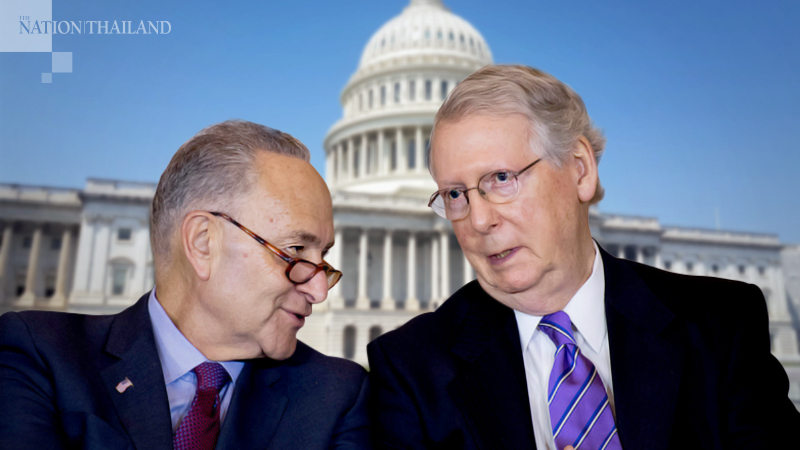
WASHINGTON – Senate Democrats and Republicans elected their leaders for the 117th Congress on Tuesday, reaffirming support for the current top leadership while the question of who will be the Senate majority leader remains to be determined by runoff elections in Georgia in January.

Sen. Mitch McConnell of Kentucky, who just won a seventh term, was unanimously reelected Republican leader. Sen. Charles Schumer, D-N.Y., was reelected Democratic leader by acclamation, as were the other members of the leadership team, according to aides who were present who spoke on the condition of anonymity to discuss the private session.

“We’re ready to get going, even though there’s some suspense about whether we’ll be in the majority or not, which will be answered in Georgia on January 5th,” McConnell said at a news conference with members of the GOP leadership Tuesday morning.

The looming question is whether McConnell will remain majority leader, with Republicans controlling the chamber as a counterweight to President-elect Joe Biden and House Democrats, who hold a slim majority.

On Tuesday, Republicans got a major boost in their effort to hold the majority as Sen. Thom Tillis, R-N.C., was projected to win reelection, defeating Democrat Cal Cunningham. 

Tillis and Cunningham had been locked in a tight race, but the Democrat had to answer in the campaign’s final weeks for illicit texts to a woman not his wife and revelations of infidelity.

“The voters have spoken and I respect their decision. While the results of this election suggest there remain deep political divisions in our state and nation, the more complete story of our country lies in what unites us,” Cunningham said in a statement in which he noted that he’d just called Tillis to congratulate him.

Republicans will have 49 seats to Democrats’ 48 while both parties await the results in Alaska, where Sen. Dan Sullivan, a Republican, held the lead over independent Al Gross, who is supported by the Democratic Senatorial Campaign Committee .

The majority would come down to the Jan. 5 runoffs in Georgia. One race pits Sen. David Perdue, a Republican, against Jon Ossoff, while appointed Sen. Kelly Loeffler, a Republican, is trying to win the seat outright against Raphael Warnock.

If Democrats win those races, establishing a 50-50 tie, Vice President-elect Kamala Harris would break the tie.

“It is time for us to turn the page on one of the most divisive and chaotic chapters in our history, and I am looking forward to leveraging the expertise our diverse caucus, working in a bipartisan fashion – but never compromising on our values – to improve the lives of American families,” Schumer said in a statement.

At a Senate Republican news conference Tuesday, McConnell dismissed concerns about President Donald Trump’s ongoing efforts to challenge the results of the presidential election, telling reporters that there’s “no reason for alarm.”

He made the remarks a day after he backed Trump’s legal challenges, saying that the president is “100 percent within his rights” to pursue recounts and litigation, though Trump has produced no evidence of widespread voting fraud.

“What it says about America is that until the electoral college votes, anyone who’s running for office can exhaust concerns about counting in any court of appropriate jurisdiction,” McConnell said when asked about GOP support for Trump’s efforts. “It’s not unusual. It should not be alarming. At some point here, we’ll find out, finally, who was certified in each of these states, and the electoral college will determine the winner, and that person will be sworn in on January 20th. No reason for alarm.”

McConnell also played down reports that Trump is seeking to block the Biden team’s transition efforts. According to administration officials, the White House has instructed senior government leaders to block cooperation with Biden’s transition team, escalating a standoff that threatens to impede the transfer of power and prompting the Biden team to consider legal action.

“I don’t think anything that’s occurred so far interrupts an ordinary process of moving through the various steps that I indicated and allowing – if there is a new administration – it to work through the transition. All of these steps will be taken at the appropriate time,” McConnell said.

Sen. Roy Blunt, R-Mo., another member of Senate GOP leadership, said at Tuesday’s news conference that Trump actually may have won the election – a shift from two days earlier, when Blunt said the president’s legal challenges were not likely to change the result.

“Virtually every predictor of what was going to happen in the elections was wrong,” Blunt, a former Missouri secretary of state, said Tuesday. “You know, the president wasn’t defeated by huge numbers. In fact, he may not have been defeated at all.”

On Sunday, in an interview on ABC News’s “This Week,” Blunt acknowledged that Trump was unlikely to prevail.

“Seems unlikely that any changes could be big enough to make a difference,” Blunt said. “But this is a close election, and we need to acknowledge that.”

In the leadership elections, Sens. Cory Booker, D-N.J., Catherine Cortez Masto, D-Nev., and Rick Scott, R-Fla., joined the top ranks of their party in the chamber.

The other Senate Democratic leadership members include Senate Minority Whip Richard Durbin of Illinois, Assistant Leader Patty Murray of Washington, Democratic Policy and Communications Committee Chairwoman Debbie Stabenow of Michigan, Conference Vice Chairs Elizabeth Warren of Massachusetts and Mark Warner of Virginia, Steering Committee Chairwoman Amy Klobuchar of Minnesota, Outreach Chairman Bernie Sanders, I-Vt., DPCC Vice Chairman Joe Manchin III of West Virginia and Conference Secretary Tammy Baldwin of Wisconsin.

Schumer named Booker vice chairman of the DPCC and Cortez Masto vice chair of outreach.

Scott was named chairman of the National Republican Senatorial Committee, succeeding Sen. Todd Young, R-Ind.

The other members of Senate Republican leadership include Republican Whip John Thune of South Dakota, Republican Conference Chairman John Barrasso of Wyoming, Republican Policy Committee Chairman Blunt and Republican Conference Vice Chairman Joni Ernst of Iowa.