Chiang Mai’s communicable diseases committee has announced that it is lifting some restrictions as of Thursday.
After this, restaurants offering diners self-service options such as buffets, shabu-shabu, hot pot, etc, can open normally. Alcohol, however, can only be served until 10pm.
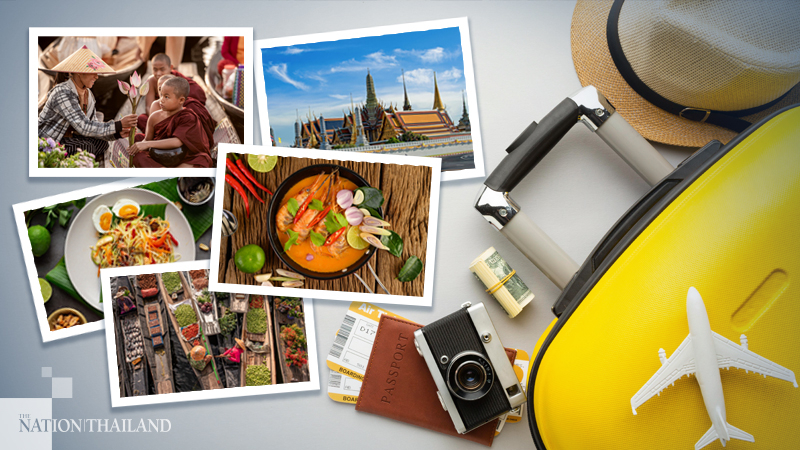
With the pandemic costing Thailand trillions in lost tourism, the Tourism Authority of Thailand (TAT) has launched a “nostalgic warm-up” campaign to keep the country on “top of people’s minds”.
TAT governor Yuthasak Supasorn said the country should start slowly opening up in the third quarter, and in the meanwhile, TAT is launching several marketing activities.
He said all 29 TAT offices overseas have been tasked with collecting information on what other countries are doing to market themselves.
“This is very important, because every country is waiting for this pandemic to end and for business to return to normal. For this, every country is preparing strategies and policies to attract foreign tourists. That’s why I have assigned all TAT offices overseas to collect information so we can prepare fully,” Yuthasak added.
Thanet Phetsuwan, TAT’s deputy governor for marketing communications, said the agency has launched several campaigns to keep Thailand in people’s minds.
For instance, the TAT office in London has called in members of the Oxford United Football Club (OUFC) to cook the much-loved Thai delicacy Pad Thai in front of the camera, and has prepared DIY kits of the dish that people can order.
The TAT office in the Chinese city of Guangzhou is collaborating with media company Sina Guangdong and local Muay Thai camp to hold Muay Thai/Chinese boxing activities.
TAT hopes activities organised by its offices overseas will keep Thailand in people’s minds, so they can plan holidays once travel restrictions are lifted.
TAT has also launched a “Save Partners” campaign, which aims to help agents, tour operators, destination management companies and other businesses that sell tourism products in Thailand.
“TAT is helping by updating information about the situation to maintain relationships so that when the crisis is over, these partners can return to be a major force in the tourism sector,” Yuthasak said.
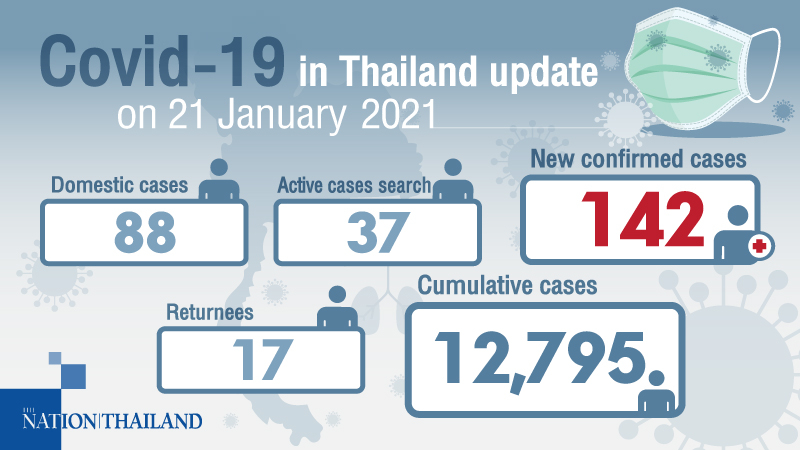
The Centre for Covid-19 Situation Administration (CCSA) on Thursday reported 142 new cases over 24 hours, including 17 who flew in from abroad.
Of the new cases, 88 had been exposed to the virus while visiting high-risk areas. Samut Sakhon had the highest number of infections, with 63, followed by Bangkok with 14.
Proactive testing led to the discovery of 37 cases, mostly in Samut Sakhon, where 26 foreigners and three Thais tested positive.
Of the returnees, 11 are Thai nationals, two from Myanmar, one from Sweden, three from Turkey, one from India, three from the United States, and one from Malaysia.
Also testing positive were a Vietnamese woman and Cambodian man who travelled from Malaysia, a Swiss man, a Japanese man and two Indian men, who flew in from their respective nations.
Meanwhile, 221 patients have recovered and been discharged.
As of Thursday, the number of confirmed cases in Thailand had risen to 12,795 – 10,468 of whom had contracted the virus locally, including 4,167 who were found positive via proactive testing, while 2,327 were returnees. So far, 9,842 have recovered and been discharged, 2,882 patients are still in hospital and the death toll remains unchanged at 71.
According to Worldometer, as of midnight on Wednesday, the number of confirmed cases globally had risen to 97.3 million (up by 671,189), 69.85 million of whom have recovered, 25.38 million are active cases (112,255 in severe condition) and 2.08 million have died (up by 17,299).
Thailand ranks 128th on the global list of most cases. The US tops the list with 25 million, followed by India 10.61 million, Brazil 8.63 million, Russia 3.63 million and the United Kingdom 3.5 million.
CCSA spokesman Taweesin Visanuyothin, meanwhile, reported the case of a woman in Nakhon Phanom who was infected by a relative with possible links to the Rayong gambling den cluster. Many high-risk contacts linked to this cluster have tested negative, though some 1,000 are being isolated.
The baht opened at 29.95 to the US dollar on Thursday, unchanged from Wednesday’s close.
The Thai currency is likely to move between 29.90 and 30.05 on Thursday, Krungthai market strategist Poon Panichpibool said.
On Wednesday, financial markets were in a risk-on state as Joe Biden officially became the US President and investors’ fear of US political turbulence abated after his inaugural statements.
As a result, the S&P 500 index rose by 1.4 per cent, the highest recent increase.
The price of WTI crude oil rose by 0.5 per cent to $53.20 (Bt1,592.41) per barrel, while the yen weakened by 0.4 per cent to 103.5 per US dollar. The dollar itself was stable compared to other currencies, while the Canadian dollar strengthened by almost 1 per cent to C$1.26.
Market strategist Poon suggested that investors should monitor the first 100 days of the Biden administration, any stimulus measures issued by his government and his line-up of ministers. These would also reflect how the US would handle ties with its allies as well as China, he said.
Poon also predicted that the Bank of Japan would freeze its policy rate at -0.1 per cent, and try to control the direction of bonds at the same time.
Meanwhile, the European Central Bank was expected to continue exercising relaxed policies on financial matters amid unsure EU economic recovery.
Poon said financial policies of the two central banks would not be a main factor affecting the direction of the dollar. In fact, it’s Biden’s measures and policies that would effect the US currency more.
In Thailand, the baht would still move in a predictable range as most market players were awaiting the results of a key Bank of Thailand meeting this week, he added.
The Government Savings Bank (GSB) announced on its MyMo by GSB Facebook page on Thursday that it has closed the app due to a high volume of applicants until Saturday, January 23.
Low-income borrowers could apply for loans of up to Bt50,000 via the MyMo app.
“Those who have already submitted their applications will still be considered during the period of closure,” the bank reassured. “Those who have not applied yet can start doing so from Saturday.”
Earlier this week bank president Vitai Ratanakorn said the GSB had approved around 110,000 loans since the MyMo scheme had been launched on January 15.
The scheme is also open to self-employed customers who availed of GSB’s emergency Covid-19 loans last year. They, too, can apply for loans of up to Bt20,000 via the MyMo app from January 23.
The bank has prepared a budget of Bt10 billion for the scheme, which is one of the measures issued by the Finance Ministry to alleviate the financial burden of people during this Covid-19 crisis.
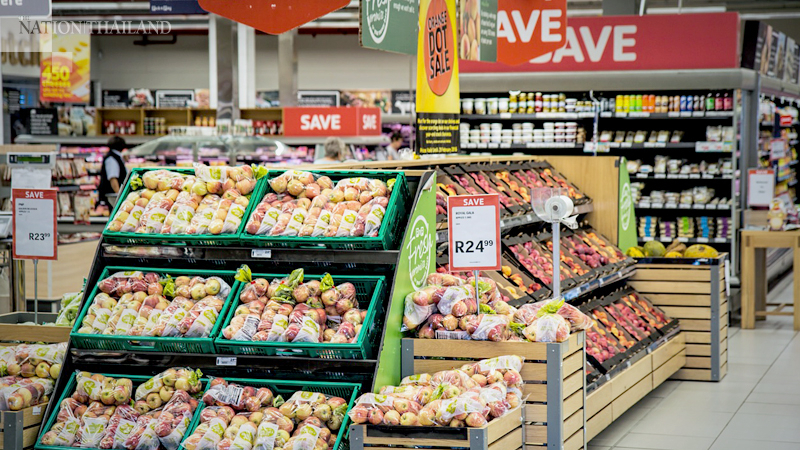
The Thai Retailers Association estimates the retail index in the first quarter of 2021 will contract by 7-8 per cent, while it could contract by 4-10 per cent or more for the whole year.
“The projected contraction could be worse if there are no factors that stimulate economic recovery later this year, such as the ready availability of a vaccine, the government’s tax-break measures and soft loans to SMEs,” association chairman Yol Phokasub warned.
Earlier this week the association reported the 2020 retail index plunged from 2.8 per cent growth in 2019 to a deficit of 12 per cent – its first ever two-digit contraction.
“The Covid-19 crisis has heavily affected the retail industry,” Yol pointed out. “It is estimated that the industry has lost around Bt500 billion of its total value of Bt4 trillion because of the pandemic,” he said.
“The association has estimated that we have already passed the lowest point in the third quarter of last year, when the durable goods sector [electrical appliances, construction material, telecom products], recorded 15 per cent contraction due to lockdown measures at department stores, while semi-durable goods [clothes, leather products, cosmetics] suffered up to 40 per cent contraction,” Yol said.
“In the fourth quarter, the situation started to improve following the government’s ‘Shop Dee Mee Kuen’ [Shop and Payback] scheme that has driven the growth of semi-durable goods to an 18 per cent contraction.”
Yol said that besides tax breaks and soft loans, the government needs to expand sales channels for modern trade retailers to improve the retail index.
“For example, modern trade retailers should be allowed to participate in the state welfare card scheme, which should also help distribute revenues to farmers, SMEs and local communities,” he added.
The Stock Exchange of Thailand (SET) index opened at 1,526.89 points on Thursday morning, increasing by 11.17 points, or 0.47 per cent, compared to the previous day’s closing.
Krungsri Securities forecast the SET would move between 1,510 and 1,530 points, while the market has been supported by investors’ expectation that the new US administration would come out quickly with an “American rescue plan”.
However, Krungsri Securities said fund inflows from foreign investors would influence the index’s performance.
It advised investors to purchase shares of BBL, PTTGC, Top, IVL, EPG, VNT, SCGP, CBG, Rojna, TVO, STGT, CPF, RCL, PSL, Synex, Com7, XO, Wice, JMT, MTC, Sawad and KCE as these companies were expected to announce growth in turnover. Among them, it said, BBL tended to grow the highest from quarter to quarter.
Krungsri Securities also recommended stocks with high dividends, such as Advanc, Intuch, AP, Siri and WhaUp, and suggested that the drop in new Covid-19 cases in the country was also advantageous to a company such as Erawan Group.
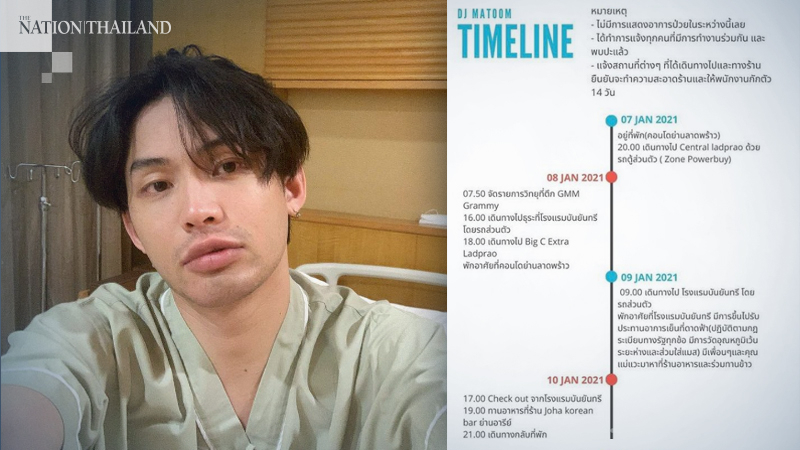
Covid-19 has become a hot topic in the entertainment industry and some stars have gone for virus tests after well-known host Techin Ploypetch, or DJ Matoom, posted a video clip on Instagram saying he was infected with the coronavirus and apologised to everyone affected. He also posted pictures of himself in hospital.
Friends in the entertainment industry, as well as Fanclub, commented to encourage him to overcome and recover from the virus.
DJ Matoom first met an infected but then-asymptomatic friend on January 9. It was later, on January 19, that friends called and informed him that the man was infected. Matoom said he went to hospital immediately to check. After a test showed that he, too, was infected, he reported the results to everyone.
Celebrities and actors including well-known actress Nakorn Silachai, who worked with him, and his family have now gone for Covid-19 tests.
Previously, in the first outbreak early last year, Matthew “Deane” Chanthavani also made a video announcing his infection, picked up at a boxing stadium, which was responsible for a cluster of cases.
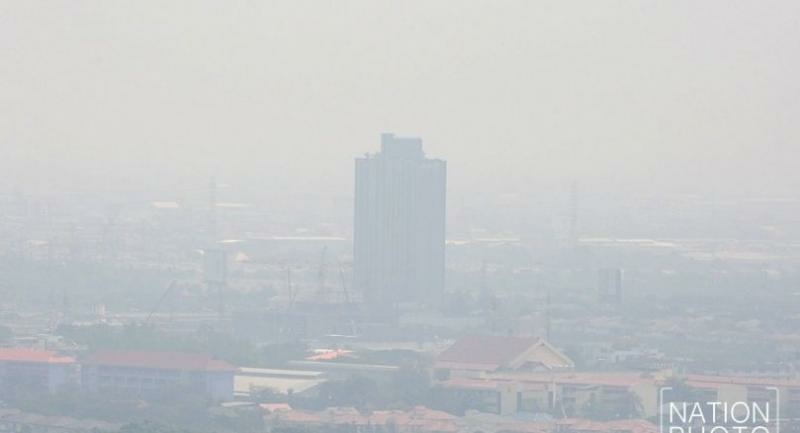
The amount of PM2.5 dust particles has been found to exceed safety standards in most parts of the country except for the South, the Air Pollution Solution Centre reported at 7am on Thursday.
Provinces where air quality has exceeded healthy standards are Bangkok, Pathum Thani, Nonthaburi, Nakhon Pathom, Samut Sakhon, Samut Prakan, Phayao, Chiang Mai, Lampang, Phrae, Uttaradit, Sukhothai, Phitsanulok, Tak, Phichit, Nakhon Sawan, Uthai Thani, Lopburi, Saraburi, Suphanburi, Prachinburi, Sa Kaeo, Chachoengsao, Ratchaburi, Chonburi, Rayong, Nong Khai, Nakhon Phanom, Khon Kaen, Kalasin, Roi Et, Chaiyaphum and Nakhon Ratchasima.
The North has an average PM2.5 particulate level of 32-72 mcg/m3, the Northeast 35-108, the central and western regions 49-79, the East 38-55, the South 13-37, and Bangkok and its vicinity 50-105.
The Meteorological Department predicts that until January 26, dust is likely to accumulate and even increase in every region except for the South, which expects to continue experiencing “good” air quality.
The price of gold increased by Bt150 in morning trade on Thursday, the Gold Traders Association reported.
As of 9.23am, the buying price of a gold bar was Bt26,400 per baht weight and selling price Bt26,500, while gold ornaments cost Bt25,823.60 and Bt27,700, respectively.
The spot gold price moved to US$1,868.30 (Bt55,918) per ounce in the morning, while the Comex (Commodity Exchange) gold price to be delivered in February rose by $26.30 to $1,866.50 per ounce.

 File Photo