Many scientists think coronavirus is airborne, regardless of what CDC says #ศาสตร์เกษตรดินปุ๋ย

#ศาสตร์เกษตรดินปุ๋ย : ขอบคุณแหล่งข้อมูล : หนังสือพิมพ์ The Nation.

Many scientists think coronavirus is airborne, regardless of what CDC says

Health & BeautySep 22. 2020
By The Washington Post · Ben Guarino, Chris Mooney · NATIONAL, HEALTH, POLITICS, HEALTH-NEWS 
WASHINGTON – The Centers for Disease Control and Prevention on Monday removed language from its website that said the novel coronavirus spreads through airborne transmission, the latest example of the agency backtracking from its own guidance.

The agency said the guidance, which went up Friday largely without notice until late Sunday, should not have been posted because it was an early draft.

“Unfortunately an early draft of a revision went up without any technical review,” said Jay Butler, the CDC’s deputy director for infectious diseases. “We are returning to the earlier version and revisiting that process. It was a failure of process at CDC.”

Evidence that the virus floats in the air has mounted for months, with an increasingly loud chorus of aerosol biologists pointing to super-spreading events in choirs, buses, bars and other poorly ventilated spaces. They cheered when the CDC seemed to join them in agreeing that the coronavirus can be airborne.

Experts who reviewed the CDC’s Friday post had said the language change had the power to shift policy and drive a major rethinking on the need to better ventilate indoor air.

Jose-Luis Jimenez, a chemistry professor at the University of Colorado at Boulder who studies how aerosols spread the virus, told The Washington Post before the CDC reversed its guidance that “this is a good thing, if we can reduce transmission because more people understand how it is spreading and know what to do to stop it.”

Although CDC officials said Friday’s post was a mistake, Democratic lawmakers were incredulous. Rep. Raja Krishnamoorthi, D-Ill., tweeted Monday afternoon that he would investigate why the language to airborne transmission had been scrubbed.

The change on Monday was the third time the CDC provided coronavirus guidance or recommendations only to reverse its stance. In the spring, it revised information about contact transmission within days of publishing it. The White House coronavirus task force had directed the agency to change those guidelines in August, stating that asymptomatic people did not need to be tested. Last week the CDC changed its position again, encouraging anyone at risk to get tested.

The agency had posted information Friday stating that the virus can be transmitted over a distance beyond six feet, suggesting that indoor ventilation is key to protecting against a virus that has now killed nearly 200,000 Americans. Whereas the agency previously warned that the virus mostly spreads through large drops encountered at close range, on Friday, it said “small particles, such as those in aerosols,” were important vectors.

“Airborne transmission is plausible and, I would say, possible,” Butler said. But he said data did not suggest that the coronavirus is spread primarily through the air, unlike diseases such as tuberculosis.

Butler said the Friday guidance overstated the agency’s stance on airborne spread. “If I did not know any better, I would think that we were saying that airborne transmission is very important, if not the main mode of transmission,” he said. “That does not reflect our current state of knowledge.”

If airborne spread were the main route, Butler said he would have expected the disease to travel even faster around the globe than it did. “The epidemiology seems pretty clear that the highest risk is in household contexts,” he said, meaning through the proximity of one family member or roommate to another.

Sudden flip-flops on public guidance is antithetical to the CDC’s rules for crisis management. After disastrous communications during the 2001 anthrax attacks – when white powder in envelopes sparked widespread panic – the agency created a 450-page manual outlining how U.S. leaders should talk to the public during crises.

Protecting vulnerable people from a virus that is infecting millions depends on U.S. leaders issuing clear public-health instructions and the public’s trust to follow directions that could save their lives.

It was also the latest disorienting turn in a scientific debate with enormous public consequences for how we return to schools and offices. The debate is over whether the extreme infectiousness and tenacity of the coronavirus is due to its ability to spread well over six feet, especially indoors, in small particles that result from talking, shouting, singing or just breathing.

Many experts outside the agency say the pathogen can waft over considerably longer distances to be inhaled into our respiratory systems, especially if we are indoors and air flow conditions are stagnant.

“Poor ventilation can play a major role in super spreading events when individuals unaware that they are shedding virus, and are highly contagious, spend a long time in a crowded indoor environment where most people are not wearing masks,” said Shelly Miller, a professor of mechanical engineering at the University of Colorado at Boulder who focuses on the quality of indoor air.

“There was a lot of confusion early on because WHO said adamantly that the disease is not airborne. There’s also, somehow, a higher bar of proof required for a disease to be officially considered to transmit through the air,” added Virginia Tech civil and environmental engineering professor Linsey Marr. “That’s due to historical bias, I think, and the fact that you can’t see aerosols.”

Jimenez said a default assumption exists among public health experts that airborne transmission is rare in the world of pathogens. For other diseases, it required decades of research to overcome that assumption, he said, as was the case with measles and tuberculosis, both of which were originally assumed to be passed by large droplets. Experiments with sneezing guinea pigs, conducted by Richard Riley and his colleagues at Johns Hopkins University in the 1950s, ultimately helped persuade the medical field that tuberculosis was airborne.

In July, Marr, Miller, Jimenez and more than 200 of their colleagues sent a letter about airborne coronavirus transmission to the World Health Organization, which responded by acknowledging the “emerging evidence” that the pathogen can spread through the air.

“To the general public, airborne can evoke fear and panic. People think of the movie ‘Contagion,’ which is like ‘Jaws’ but for infectious diseases,” Marr said at a workshop on airborne transmission held in late August sponsored by the National Academies of Sciences. She cited a report by public-health experts in Hong Kong who concluded that a fear of “panic and political blame” caused a reluctance among officials to label the first SARS virus as airborne.

But she emphasized that there are important differences in the environments that might alter how an airborne virus might spread – indoors vs. outdoors, a clinical setting vs. not.

She described a theoretical exhalation of coronavirus akin to the plume of smoke from a cigarette. “Once you get beyond that plume, anything that small enough to stay floating in the air can travel, you know, quite far all the way across the room,” Marr told The Post. “Even if you’re in a room where the air seems still, there’s actually movement of the air that can carry things all the way across the room.”

Unlike ballistic droplets from a cough, which arc like cannonballs launched from a nose or mouth until they splash against a person or drop to the ground, aerosols float on the wind and can be unwillingly inhaled.

– – –

Scientists are trying to understand how some of the biggest virus super-spreading events can be explained by not only the assumption of airborne viral particles but also the conditions of particular indoor spaces, including their ventilation systems and how much they allow for the circulation of fresh air.

In one of the most startling scientific offerings, Bjorn Birnir, a mathematician at the University of California at Santa Barbara, studies three well-documented cases in which the coronavirus spread rapidly and widely in an enclosed or indoor environment – a restaurant in Guangzhou, China; a bus traveling in China’s Zhejiang province; and a call center in Seoul.

Constructing a model of how virus particles from our breath flow through indoor air when ventilation is low, Birnir found that the popular six-foot rule for social distancing can be insufficient in these circumstances. People much farther away from an infected individual can breathe in levels of the virus that might be expected only if they were standing or sitting right next to that person.

In the case of the restaurant, for instance, where one sick person infected nine others. Birnir’s model, which has not yet been published in a peer-reviewed journal, found that thanks to poor ventilation, the virus’s concentration away from the sick person grew so high that within seven minutes, it was as if many others in the space were sitting directly next to that person.

On the bus, a single person infected 24 others over the course of two 50-minute rides, but people sitting near open windows were spared. In the call center, where 97 people were ultimately infected, one individual appears to have infected several others through close contact, and then as the group worked together, the virus spread through the air thanks to the presence of several sick people in a large indoor work area.

“The SARS-CoV-2 Coronavirus attacks in two steps,” Birnir wrote. “The first step is a linear spread between individuals with a couple of days delay. The second step is an exponential spread effected by the air-conditioning system affecting a much larger number of people. Thus in the second step, the ventilation becomes the super-spreader.”

Several experts consulted by The Post offered technical critiques of Birnir’s model, but did not disagree with the main conclusion: Viral particles can build up high concentrations in spaces where the air is not adequately changed.

“It makes sense the concentration of droplets increases over time and if they are not removed by the HVAC system, they stay in the space and increase the probability of infection,” said building engineer Raj Setty, the principal of Setty Associates and a member of the Epidemic Task Force at ASHRAE, an international society focused on building standards.

The model “highlights the need that if you are in an enclosed space – a range of different types of spaces, from a building to a public transit or vehicle – that there’s an importance for outdoor air in moving out that contaminated air stream,” said Krystal Pollitt, an environmental health sciences expert at Yale University, who was not involved with this research.

Much remains unknown. It’s not clear precisely what the infectious dose of the coronavirus is – and it probably varies for different individuals. It is clear that the duration of time that one spends in an infectious space matters, but no one can give precise guidelines on how long is too long. Nor is it entirely clear to what extent there are real “super-spreading” individuals who, for some reason, carry extremely high viral loads that they expel into the air – something Birnir says he doubts – as opposed to particularly stuffy indoor spaces, which allow the virus to accumulate.

What’s clear from such cases is that while the virus surely spreads slowly in households among family members, it also spreads rapidly in indoor events that bring lots of people together.

Perhaps most telling of all is the infamous March choir practice in Skagit Valley, Wash., where 53 out of 61 attendees are suspected to have been infected by a single sick individual over roughly 2 1/2 hours of practice. The participants did not interact much socially, except to sing – making this a difficult-to-dispute case of airborne transmission over large distances in a space where the air was not changing often enough to clear out the virus, and where someone was propelling the virus over extra long distances due to the exertion of singing.

The Skagit choir case is “the most damning” of the superspreading events he’s examined, Jimenez said. He and his colleagues, in a study in review and submitted for publication to the journal Indoor Air, modeled the likely spread of the virus through the church hall based on the behavior of the one choir member who infected dozens of others.

That person, the “index case,” arrived just as the rehearsal began and did not mingle. Because the singers remained in fixed positions in the hall, “there were no opportunities for large droplets to travel from person to person,” Jimenez said. “It becomes extremely implausible it was anything but aerosol transmission.”

In the meantime, many experts are racing ahead with plans to make indoor spaces safer by improving their ventilation.

Pollitt and Sten Vermund, the dean of the Yale school of public health, are working with public and private schools in Connecticut to prevent the spread of coronavirus. Pollitt and her colleagues created a flowchart to guide schools, which, she said, could apply to offices and other public spaces.

Recommendations include: disable sensor-based ventilation to ensure the air in a room is constantly flushed. Reverse the blades of ceiling fans to draw air up and away from the plumes. And open windows.

But industrial hygiene only works if human behavior rises to meet it. “If you’re not having individuals wearing masks, physical distancing, having good hand hygiene, then you can’t engineer yourself out of a bad situation,” Pollitt said.

Vaccine companies reveal their study designs, even as Trump sows confusion #ศาสตร์เกษตรดินปุ๋ย

#ศาสตร์เกษตรดินปุ๋ย : ขอบคุณแหล่งข้อมูล : หนังสือพิมพ์ The Nation.

Vaccine companies reveal their study designs, even as Trump sows confusion

Health & BeautySep 18. 2020President TrumpPresident Trump 

By The Washington Post · Carolyn Y. Johnson · NATIONAL, HEALTH, SCIENCE-ENVIRONMENT, HEALTH-NEWS 
WASHINGTON – President Donald Trump stood before a televised audience Wednesday and proclaimed that “results are very good” for vaccines targeting the novel coronavirus. A day later, Moderna and Pfizer, two front-runner drug companies developing a shot, released the full rule books for their studies, revealing that no one yet knows conclusively whether a vaccine is safe and effective – not even company executives.

Trump’s imprecise, extemporaneous comments about vaccines have frequently clashed with messages from government officials, outside scientists and companies. That discord has intensified concerns that political pressure will force a vaccine to be prematurely approved but also has sown public confusion as important public health messages have become entangled with politicians’ appeals to voters and companies’ communications to shareholders.

“We need trust as much as we need efficacy,” said Andrew Pavia, an infectious-diseases specialist at the University of Utah School of Medicine. “We can’t afford to do anything that reduces the trust. It’s not just the trust of the public. Experts in the field have to see enough of the data to feel comfortable to recommend it.” 

Leaders of Moderna and Pfizer cited the need for greater transparency than usual in covid-19 clinical trials as the reason behind their decision to release the full documents describing how their studies will measure safety and effectiveness.

The documents confirm that study participants, physicians running the trials and the companies are “blinded,” unable to tell who received a real vaccine and who received a placebo.

Moderna’s trial contains preprogrammed milestones – when there are 53, 106 and 151 cases of covid-19, the illness caused by the coronavirus, among all participants – that allow an independent committee to analyze data to assess if there’s a signal of effectiveness. A key metric in vaccine studies involves examining who falls ill during the course of a trial and whether that person received a shot of protection or a placebo. It’s only then that anyone will know how well the vaccine is protecting people from becoming sick.

After reviewing the infection findings, the data committee will then make recommendations to an oversight group on whether to continue the trial. According to Moderna’s document, the first analysis is projected to be completed by the end of the year, but the timeline will vary depending on how many people get sick while participating in the trial.

“I have seen no data since the Phase 3 [trial] started,” Moderna chief executive Stéphane Bancel said in an interview. He predicted the company may have enough cases to detect whether the vaccine is effective in November, and it is possible but unlikely there could be a signal in October. Bancel predicted it would take a week or two to analyze and clean up data and submit it to regulators.

“We really have to wait for the data,” Bancel said. “We need to wait for the science to cook in the oven.” 

Trump predicted Wednesday a vaccine would probably be available by mid-October, an apparent reference to the Pfizer vaccine.

Pfizer chief executive Albert Bourla said he expects there will be enough data for a “conclusive result by the end of October” during an event reviewing the company’s research portfolio, although he told CNBC he did not expect the data to come before a scheduled Oct. 22 meeting of a vaccine advisory committee for the Food and Drug Administration.

But experts have said they believe at that time, the most advanced trials in the United States will be administering the second booster shot needed to trigger immunity to the last participants – or waiting for participants’ immune systems to muster a response before they can begin to count cases.

“Mid-October – that all defies the math of the enrollment, the follow-up, the second booster shots. It doesn’t even compute, if it’s done right,” said Eric Topol, a cardiologist at Scripps Research Translational Institute.

Pfizer spokeswoman Amy Rose said the company traditionally does not share the full protocol of its trials until results are published but is doing so now in recognition that “the covid-19 pandemic is a unique circumstance and the need for transparency is clear.” 

Pfizer’s trial protocol shows that interim analyses of data are planned at regular intervals, when there are 32, 62, 92, 120 and 164 cases of covid-19 among study participants.

Late-stage testing of an experimental vaccine from AstraZeneca is paused in the United States after a possible adverse event in a British trial, even as other countries have restarted their trials. Physicians have been calling for transparency about that event to shore up public trust in the vaccine.

Trump’s comments have often made it appear that people already know the vaccine works and getting it approved is a formality that could occur at any time.

But as the documents provided by both companies show, the reasons for stopping a trial early have been carefully delineated. The data analyses by independent committees allow those panels to recommend whether to stop the trial early – because the vaccine is so effective it would be unethical to continue or because it is clearly not working or it is harmful.

The possibility that the vaccine trials will be stopped early has been endlessly examined by politicians and the media, but experts said it is important to remember that stopping a trial early is a rare outcome, not the norm.

David DeMets, a University of Wisconsin at Madison biostatistics expert who has served on data safety and monitoring committees for nearly half a century, said the overwhelming majority of trials are not stopped.

“If we stop too soon, we won’t have as reliable an answer as we set out for,” DeMets said. “If you stop early, not because the data are mature enough but because of other pressures, then you might not have the same confidence in the answer you want to know or needed.” 

While the criteria for stopping a trial are heavily dependent on statistics, that should not be the only factor, Topol said.

“If you stop a trial early, it’s not just a statistical assertion; it’s saying it’s unethical to proceed because of overwhelming efficacy,” Topol said. “You sure want to know it works, and you could say it’s unethical not to proceed, to get more compelling and complete data.” 

Approving or authorizing any vaccine on incomplete data would spark a cascade of follow-on questions, including whether the people in the placebo arm of the trial should be given the vaccine right away and how future vaccine trials should be structured. Most experts say multiple vaccines will be needed to end the pandemic, but it might become harder to recruit volunteers, or even unethical, to test a vaccine against a placebo if another has been deemed safe and effective by regulators.

Trump indicated the vaccine would be available to the general public right away after it is authorized. His coronavirus adviser, Scott Atlas, said high priority groups would probably be vaccinated by January.

Prioritizing the people who need the first doses of the vaccine is a huge part of the planning process, and those guidelines have not even been finalized. Discussions have focused on prioritizing doses for those at greatest risk for infection, including front-line health-care workers and older people with conditions that increase their risk for serious illness.

Peter Hotez, dean of the National School of Tropical Medicine at Baylor College of Medicine, said the only way to convince the public of the safety and effectiveness of vaccines that utilize new technologies and are likely to get a form of authorization that is short of full approval is through clear and open communication.

“The world is littered with very good vaccines that never get used due to public perception. It could easily happen here,” Hotez said. “We still don’t know if these vaccines are going to work, we have no evidence they’re going to work [yet]. . . . The only way you’ll be able to sell this to the scientific community is through complete transparency.” 

CDC director says coronavirus vaccines won’t be widely available till the middle of next year #ศาสตร์เกษตรดินปุ๋ย

#ศาสตร์เกษตรดินปุ๋ย : ขอบคุณแหล่งข้อมูล : หนังสือพิมพ์ The Nation.

CDC director says coronavirus vaccines won’t be widely available till the middle of next year

Health & BeautySep 17. 2020CDC director Robert RedfieldCDC director Robert Redfield 

By The Washington Post · Amy Goldstein, Sean Sullivan · NATIONAL, HEALTH, HEALTH-NEWS 

WASHINGTON – The director of the Centers for Disease Control and Prevention predicted Wednesday that most of the American public will not have access to a vaccine against the novel coronavirus until late spring or summer of next year – prompting a public rebuke from President Donald Trump, who declared the CDC chief was wrong.

At a Senate hearing on the government’s response to the pandemic, CDC director Robert Redfield adhered to Trump’s oft-stated contention that a safe and effective vaccine will become available in November or December – perhaps just before the presidential election seven weeks away.

But Redfield said the vaccine will be provided first to people most vulnerable to covid-19, the disease caused by the virus, and supplies will increase over time, with Americans who are lower priority for the protection offered the shot more gradually. For it to be “fully available to the American public, so we begin to take advantage of vaccine to get back to our regular life,” he said, “I think we are probably looking at late second quarter, third quarter 2021.”

Hours later, Trump sought to knock down Redfield’s predicted timeline from the White House press briefing room, saying at a news conference, “I think he made a mistake when he said that. . . . We’re ready to distribute immediately to a vast section of the country.”

The president said that, when he heard what the CDC director had told senators, he called him directly. Trump said Redfield “didn’t tell me that,” though the president declined to disclose how Redfield replied.

“It was an incorrect statement. . . . We are ready at a much faster level than he said,” Trump said, reiterating a recent talking point that a vaccine could be ready to begin administering as early as mid-October.

Multiple experts – including top scientists leading the vaccine effort – have said it is very unlikely a vaccine will be available by then.

Speaking alongside the president, Scott Atlas, a recent addition to the White House’s coronavirus advisers, noted that the administration Wednesday circulated a vaccine distribution strategy to states and others. Atlas said the plan anticipates that “no later than January, all the top-priority people will be able to receive the vaccine,” with other Americans receiving it starting soon after.

The CDC director issued his prediction and received the presidential drubbing the same day that Democratic presidential nominee Joe Biden raised questions about the safety of a coronavirus vaccine approved during Trump’s tenure, warning something so complex and vital to the public’s well-being takes time.

“Scientific breakthroughs don’t care about calendars any more than the virus does,” the former vice president said.

Redfield said that though any individual vaccinated should benefit from a vaccine, the progressive widening of its availability means there will be a time lag between when a vaccine is approved and when it could have a measurable effect in controlling the pandemic. That might be six to nine months after the day it is approved by federal drug regulators, Redfield predicted.

Redfield said that lag between when a vaccine is approved and when the public can get it reinforces the importance of safety measures, such as keeping a proper distance, washing hands and wearing masks.

“I might even go so far as to say that this face mask is more guaranteed to protect me against covid than when I take a covid vaccine,” Redfield said, because the vaccine is unlikely to produce the desired immune response in everyone who gets it. 

But Trump at his briefing continued to cast doubt on the value of masks, saying, “The mask is a mixed bag.”

Redfield’s comments were the most detailed time frame outlined so far by the leader of the government’s main public health agency. They are consistent with the perspective of Anthony Fauci, director of the National Institute of Allergy and Infectious Diseases, who said in a recent interview with CNN that relatively small amounts of vaccine will be available at first.

“It won’t be until we get into 2021 that you’ll have hundreds of millions of doses, and just the logistics, constraints in vaccinating large numbers of people,” Fauci said. “It’s going to take months to get enough people vaccinated to have an umbrella of immunity over the community so that you don’t have to worry about easy transmission.”

Redfield’s forecast came as Trump has latched onto the prospect of a vaccine as crucial to his prospects for a second term, with low approval ratings among voters for his handling of the worst public health crisis that the country and world have confronted in a century.

A vaccine also is widely regarded as a pivot point for Americans to be unfettered from the constraints the pandemic has imposed on daily life – from recreation such as concerts and movie theaters to workplaces that remain shuttered.

A race is underway internationally among pharmaceutical makers to develop vaccines that are safe and effective against the virus, which has infected nearly 6.6 million people in the United States and killed almost 200,000. Developing a vaccine typically takes years, but researchers are working with unprecedented speed. U.S. researchers in January established the goal of a world-record pace of developing an inoculation against the coronavirus within a year to 18 months.

Now, three experimental vaccines have entered the final stage of testing in the United States – giving each one to thousands of people to check effectiveness and safety – before submission for federal approval. A debate is raging over whether the Food and Drug Administration should hasten a vaccine’s availability by employing emergency authority it has before going through the process of a formal approval.

The CDC told states this month they should be ready to receive a coronavirus vaccine as early as Nov. 1 – two days before the election – prompting allegations from critics that the date was politically motivated. Sen. Patty Murray, D-Wash., the subcommittee’s senior Democrat, accused the administration of “rampant political interference in scientific decision-making.”

Redfield pressed back against such suggestions during an appearance Wednesday before a Senate subcommittee with jurisdiction over the Department of Health and Human Services, of which the CDC is a part. He said the advice to states was based on the pace of the science, not any electoral considerations. And he said his agency was eager to avoid a repetition of a problem that emerged during a pandemic of the H1N1 virus in 2009, when a vaccine became available and states were not ready to receive and distribute it.

“We don’t want to repeat that hiccup,” Redfield told senators.

He also said the government does not have an estimated $6 billion it needs for the distribution of a coronavirus vaccine. Such funds were proposed in pandemic relief legislation that Congress has not adopted, among partisan disputes over how much more aide the government should provide for laid-off workers and a variety of other purposes.

Providing that money, Redfield said, “is as urgent as getting these manufacturing facilities up.”

Biden’s remarks Wednesday show how the pandemic has increasingly become a focal point for both candidates in the final weeks of the race. Biden campaign advisers have regarded the election as a referendum on Trump and his handling of the pandemic. The campaign continues to hold events and run advertisements squarely on this theme.

The former vice president’s comments, extending suspicions Biden has expressed in recent weeks, highlight the extraordinary roughness of this presidential contest. In past election cycles, calling into question whether an incumbent might risk deliberate harm to Americans to forward his political ambitions was not the norm.

But speaking in Wilmington, Del., Biden expressed reservations about whether a covid-19 vaccine approved by the Trump administration would be safe, casting doubt on the incumbent’s willingness to put the health of Americans before politics. 

“I trust vaccines. I trust scientists. But I don’t trust Donald Trump,” Biden said. “And at this point, the American people can’t, either.”

Biden raised the possibility of Trump pressuring his administration’s health officials to sign off on a vaccine in which scientists do not yet have full confidence in order to gain an election advantage. The Democratic nominee expressed skepticism about the CDC and FDA, as well as the president.

The former vice president essentially echoed Redfield’s point that vaccinating the nation will happen gradually. “It’s not going to happen overnight,” Biden said. “Once we have it, it’s going to take months to distribute.”

If a vaccine is swiftly approved, it could upend the campaign, and both sides are increasingly bracing for how to deal with the political uncertainty of the coming weeks. Still, experts have questioned whether it is realistic for one to become available before the election.

Biden made his remarks after receiving a briefing Wednesday about the quest for a vaccine from scientific, public health and health policy experts. Creating the drug is only “part of the battle,” said Biden, who likened effective distribution to a complex military operation. He said a vaccine should be free and that priority should go to those who need it most – and that includes Black and Hispanic communities. 

The Democrat’s view about the possibility of a vaccine has become a point of contention in the campaign, with Trump accusing Biden and his running mate, Sen. Kamala Harris, D-Calif., of spreading “anti-vaccine rhetoric.”

Biden said he would have no problems endorsing a vaccine – provided it met certain criteria. If the current administration allows a vaccine to be distributed, Biden said, “who will validate it was driven by science? What groups of scientists?” 

He added that Americans must be confident “distribution will be safe and cost-free” with a plan for doing so “without a hint of favoritism.”

Biden also lambasted Trump for not aggressively encouraging mask-wearing and alleging that waiters do not like to wear them. The Democrat defended his own calls for a national mask mandate, saying he would seek to implement one by working with governors but that he was not yet completely sure what legal authority he would have to deploy such a rule.

Biden questions whether a vaccine approved by Trump would be safe #ศาสตร์เกษตรดินปุ๋ย

#ศาสตร์เกษตรดินปุ๋ย : ขอบคุณแหล่งข้อมูล : หนังสือพิมพ์ The Nation.

Biden questions whether a vaccine approved by Trump would be safe

Health & BeautySep 17. 2020Joe BidenJoe Biden 

By The Washington Post · Sean Sullivan · NATIONAL, HEALTH, POLITICS, SCIENCE-ENVIRONMENT, HEALTH-NEWS
WILMINGTON, Del. – Joe Biden on Wednesday expressed reservations about whether a coronavirus vaccine approved by the Trump administration would be safe, raising doubts about the president’s ability to put the health of Americans before politics.

Biden said Americans should trust a coronavirus vaccine developed under the Trump administration only if the president gives “honest answers” to questions about its safety, effectiveness and equitable distribution. “I trust vaccines. I trust scientists. But I don’t trust Donald Trump,” Biden said. “And at this point, the American people can’t, either.”

Biden also raised the possibility of President Trump pressuring agency officials to sign off on a vaccine that scientists are not yet confident in, to gain an electoral advantage.

The comments, which echo suspicions Biden has expressed in recent weeks, highlight the extraordinary division between the two candidates. Biden’s remarks also show how the pandemic has become a focal point in the final weeks of the race.

Biden campaign advisers have long felt that the election will be a referendum on Trump and his handling of the pandemic, which has stoked widespread anger and received low marks in public polls. They continue to hold events and run advertisements focused on this theme.

Trump has pressed health officials to accelerate the vaccine timeline and deliver one by the end of the year. At a news conference Wednesday, the president said that the vaccine “could be announced in October” and that as soon as it is available it can be distributed “immediately” to the general public. “To the general public immediately – when we go, we go,” he said.

If a vaccine is swiftly approved, it could upend the campaign. However, experts have said it is unlikely that a vaccine could be approved and come into full circulation before the Nov. 3 election.

Centers for Disease Control and Prevention Director Robert Redfield told senators Wednesday that after a safe and effective vaccine becomes available, it probably will take six to nine months for enough Americans to get vaccinated to significantly affect the pandemic.

Redfield said he expected a vaccine to start being available in November or December, with the first people to receive it being those with health problems that make them most vulnerable to a severe case or death if they are infected.

Biden spoke here in his hometown after receiving a briefing from experts about developing and distributing a vaccine. Creating the drug is only “part of the battle,” said Biden, who likened effective distribution to a complex military operation.

The former vice president said that a vaccine should be free and that priority should go to those who need it most – and that includes Black and Brown communities.

Biden received his briefing virtually from experts who appeared on a large screen that was set up inside the downtown theater where he spoke. He sat at a desk and listened to his briefers, which included some boldface names from the Obama administration.

Among the participants were former surgeon general Vivek Murthy; Zeke Emanuel, chair of the Department of Medical Ethics and Health Policy at the University of Pennsylvania; former Chicago health commissioner Julie Morita; and former Food and Drug Administration commissioner Peggy Hamburg.

Biden cast doubt not only on Trump but also on those around him. Asked whether he trusted the CDC and FDA, Biden said he did not trust “people like the fellow that just took a leave of absence.” He appeared to be referring to Michael Caputo, assistant secretary for public affairs at the Department of Health and Human Services, who urged Trump’s supporters to prepare for an armed insurrection and accused scientists in his agency of “sedition.”

As Biden addressed reporters, he attacked Trump’s handling of the pandemic and comments in an ABC town hall defending his administration’s response, despite widely documented problems with it. Biden urged Americans to ask themselves how it made them feel to hear Trump say he would not have done things differently.

Biden said people should not expect results just because the president is talking up the possibility of a vaccine. “Scientific breakthroughs don’t care about calendars any more than the virus does,” he said. He warned that politics should have no place in the production of a vaccine.

The Democrat’s position has become a point of contention in the campaign, with Trump accusing Biden and his running mate, Sen. Kamala Harris, D-Calif., of spreading “anti-vaccine rhetoric.”

At a Wednesday news conference, Trump said Biden’s comments were “anti-vaccine” and “hurting the importance of what we’re doing.” He added, “I know that if they were in this position, they’d be saying how wonderful it is.”

Biden said he would have no problems endorsing a vaccine – provided it met certain criteria. If the administration greenlights a vaccine, Biden said, “who will validate it was driven by science? What groups of scientists?”

He added that Americans must be confident “distribution will be safe and cost-free,” with a plan that is “without a hint of favoritism.”

Polls show Biden leading Trump nationally and in key battleground states. But one area where Trump’s standing has shown strength is his handling of the economy. Asked Wednesday why that is the case, Biden replied, “I’ve been out of office for four years,” arguing that voters do not have an immediate sense of the progress the Obama administration made.

Biden also lambasted Trump for not aggressively encouraging mask-wearing and alleging that waiters do not like to wear them. The Democrat defended his own calls for a national mask mandate, saying he would seek to implement one by working with governors but was not completely sure yet what legal authorities he would have to deploy such a rule. (He said his advisers think they can create a mandate.)

He also sought to rebut attacks Trump has lobbed at him for unrest across the country. “I’m not the president. He’s the president,” Biden said, arguing that his opponent should be held to account for the country’s woes.

Lilly says antibody therapy may lower covid hospitalizations #ศาสตร์เกษตรดินปุ๋ย

#ศาสตร์เกษตรดินปุ๋ย : ขอบคุณแหล่งข้อมูล : หนังสือพิมพ์ The Nation.

Lilly says antibody therapy may lower covid hospitalizations

Health & BeautySep 17. 2020Lab technicians produce covid-19 diagnostic kits in a laboratory at the Newtech Medical Devices facility in Faridabad, Haryana, India, on July 15, 2020. MUST CREDIT: Bloomberg photo by T. Narayan.Lab technicians produce covid-19 diagnostic kits in a laboratory at the Newtech Medical Devices facility in Faridabad, Haryana, India, on July 15, 2020. MUST CREDIT: Bloomberg photo by T. Narayan. 

By Syndication Washington Post, Bloomberg · Riley Griffin, Cristin Flanagan · BUSINESS, HEALTH, HEALTH-NEWS 
Eli Lilly and Co.’s experimental antibody treatment for covid-19 reduced the rate at which symptomatic patients were hospitalized compared to a placebo, according to preliminary study results released by the company and its partner.

Indianapolis-based Lilly and AbCellera Biologics Inc., a closely held Canadian biotechnology company, are co-developing neutralizing antibodies derived from one of the earliest patients in the U.S. to contract covid-19. They are among a handful of companies, including Regeneron Pharmaceuticals Inc., AstraZeneca Plc., GlaxoSmithKline Plc and its partner Vir Biotechnology Inc. pursuing antibody therapies to combat the pandemic.

Interim results from a mid-stage trial that evaluated multiple dosages found that Lilly and AbCellera’s treatment, known as LY-Cov555, was associated with a 1.7% rate in hospitalizations and ER visits among those who took the treatment compared with a 6% rate among people on a placebo, a 72% reduction in risk. No patients in the study progressed to mechanical ventilation or died.

Lilly’s shares rose 0.9% to $151.48 at 10:29 a.m. in New York trading on Wednesday. The lack of a response at the highest dose and scant detail on the lower hospitalization rates drew Wall Street analyst scrutiny.

The results were “odd,” Bloomberg Intelligence’s Sam Fazeli wrote in a note, adding “It’s not clear which dose drove the 72% reduction in hospitalizations. Very few patients were hospitalized, raising a risk that the effect is by chance. We need to see more data.”

The early results also showed that one of three doses of the antibody drug tested against covid-19 lowered the amount of virus present 11 days after patients received the treatment compared to the placebo. A 2,800 milligram dose version of the drug reduced the viral load, though the 700 mg and 7,000 mg doses did not achieve that end point. Most patients, including those receiving the placebo, demonstrated near complete viral clearance by the eleventh day.

Lilly said it will soon publish the results of this interim analysis in a peer-reviewed journal and discuss appropriate next steps with regulators.

Regeneron is expected to report results of its own at the end of this month. Jefferies analyst Biren Amin was confident the biotech company’s antibody cocktail approach could prove more effective than Lilly’s, which relies on a single antibody..

On Tuesday, top officials at Operation Warp Speed, the Trump administration’s effort to expedite the development of an inoculation and treatment, identified antibody therapies as one of its foremost R&D priorities to counter covid.

Moncef Slaoui, who is leading the Trump Administration’s Warp Speed initiative, wrote in The New England Journal of Medicine that the U.S. government plans to support manufacturing of the “most potent” monoclonal antibody products “so that hundreds of thousands of doses could be deployed this fall and winter.”

Slaoui touted the potential for monoclonal antibodies not just to serve as treatments for sick patients who’ve become infected, but as a preventive drug for those at high-risk.

In August, Lilly and AbCellera kick-started a trial of its antibody drug in nursing homes, suggesting it may have the potential protect vulnerable groups that vaccines may not cover. Slaoui said it will continued to be tested in nursing homes, as well as “meat-packing plants, and other settings” beginning in October.

The “true utility” of neutralizing antibody treatments will be in the preventing infections in unexposed people — not as a treatment of the virus, as seen in Wednesday’s results, Evercore ISI analyst Umer Raffat said in an email.

Medicaid rolls swell amid the pandemic’s historic job losses, straining state budgets #ศาสตร์เกษตรดินปุ๋ย

#ศาสตร์เกษตรดินปุ๋ย : ขอบคุณแหล่งข้อมูล : หนังสือพิมพ์ The Nation.

Medicaid rolls swell amid the pandemic’s historic job losses, straining state budgets

Health & BeautySep 15. 2020“We are going to have to make some difficult decisions,” said Howard Baron, a pediatric gastroenterologist, about his medical practice in Las Vegas. MUST CREDIT: Photo by Bridget Bennett for The Washington Post. 

By The Washington Post · Amy Goldstein · NATIONAL, HEALTH, HEALTH-NEWS 

The unlikely portrait of Medicaid in the time of coronavirus looks like Jonathan Chapin, living with his wife and 11-year-old daughter in a gated community in the Sierra Nevada foothills.

Chapin had a thriving Reno, Nev., production company, We Ain’t Saints, booking bands, managing weddings, hosting 600-strong karaoke nights at the Tahoe Biltmore Lodge & Casino. When the novel coronavirus came, forcing northern Nevada’s entertainment industry to go dark, he said, “everything I knew all disappeared.”

The family’s health insurance gone along with their income, Chapin applied online for Medicaid on April 1, the day after his wife’s job ended and three days before he needed a molar pulled. By the time his mouth was throbbing, Chapin and his family had become early additions to Nevada’s Medicaid rolls – rolls swollen now to record levels while pandemic-inflicted fiscal wounds have damaged the state’s ability to afford the safety-net health coverage.

By the most recent count, the roster of Nevadans on Medicaid has climbed from fewer than 644,000 in February, the month before the state reported its first case of covid-19, the disease caused by the virus, to about 731,000 through August.

That 13.5% increase places Nevada among at least three states, along with Kentucky and Minnesota, where the cadre of people on Medicaid has spiked that much, including families, like the Chapins, who have never before asked for government help. But increases are widespread: Caseloads had risen on average 8.4% through July in 30 states for which researchers have enrollment information. And in 14 states with enrollment data through August, the average is 10%.

If the past is a guide, this is merely the beginning.

During the Great Recession from late 2007 to mid-2009 and previous bad economic spells in the history of Medicaid, Americans have turned to the program more gradually than to unemployment benefits, food stamps and other aid for people sliding out of comfortable lives. Medicaid is insurance for the poor that is a shared responsibility of the federal government and states, begun as a pillar of President Lyndon B. Johnson’s Great Society expansion of government help of the 1960s.

“We believe Nevada has not yet seen the full impact as a result of the covid pandemic,” said the state’s Medicaid director, Suzanne Bierman, echoing expectations elsewhere of experts on the social safety net.

With Nevada’s tourism-fueled economy stalled, the unemployment rate soared to 30.1% in April, the highest ever recorded for any state in any month.

“You can pick just about any adjective you like to describe just how unprecedented the numbers are, and you wouldn’t be exaggerating,” said David Schmidt, chief economist for the Nevada Department of Employment, Training and Rehabilitation.

“When all the casinos had to close all at once by the end of March, 95% of our members were off work, so it was a complete wipeout,” said Bobbette Bond, director of public policy for the Culinary Health Fund, which provides insurance to about half the cooks and dishwashers, porters and housekeepers and other unionized casino workers. The fund is covering unemployed members for another month.

Some casinos’ lights are back on, but fewer than one-third of workers have returned to their jobs, Bond said, and some have too few hours to qualify for their old health benefits. Even Nevada’s most recent reported unemployment rate – 14% for July – is higher than the nationwide rate at the Great Recession’s worst.

With most Americans’ private health insurance tethered to their jobs, this enormous disappearance of work is a central reason Medicaid programs are swelling and strained.

Another reason: Under the Cares Act, a broad set of pandemic relief measures Congress adopted in the spring, states may not remove anyone from their rolls if they accept extra federal Medicaid aid provided by the law. But in Nevada, most of the growth is fueled by people joining, with about two-thirds of the enrollment boom most months attributed to new applicants, according to state estimates.

The spiraling demand for Medicaid is colliding with a diminished ability by the state to pay for it. With Nevada confronting a $1.2 billion deficit and a requirement to balance its budget, the legislature has taken steps to slow the program’s spending – notably, curbing payments to doctors, hospitals and others who care for Medicaid patients to save $53 million through next summer. That 6% rate cut is the largest so far in the nation.

“Nevada is the extreme of what’s happening around the country,” said Aviva Aron-Dine, vice president for health policy at the Center on Budget and Policy Priorities, who has been tracking Medicaid in the pandemic. “The fear is that it’s the leading edge.”

Chapin finally posted on his personal Facebook page July 1 what had been true for months: “It’s with a heavy heart and a lot of fantastic memories, I regret to announce the closing of my business of 19 1/2 years. . . . With covid spiking again. Wedding season cancelled, no bars to do Karaoke, no venues to book bands, and no real return for the music and entertainment industry in sight.”

It had been 2001, months into his sobriety, when he launched We Ain’t Saints, with its logo of a devil holding a beer and its motto straight from Alcoholics Anonymous. Over the years, the weddings he hosted twice made Brides magazine. He counted Google, Instagram and Squaw Valley Ski Resort among his clients for events.

The business earned him $80,000 to $140,000, depending on the year. “My company allowed me to raise a family nicely,” Chapin, 49, said. “This is what we do seriously for years and years and years. Bringing live music for people. . . . Making sure your bar is filled on Friday night. Not only is it something financially but emotionally you have all these ties with all these people.”

His wife’s final day as an administrative assistant for an organization working with children who have autism was March 31. Her health benefits ended at once. He already had stopped paying into Access to Healthcare Network, a nonprofit medical discount program that covered him and their daughter for a monthly fee. Chapin was approved for Medicaid hours after he typed up an application – a contrast to delays often vexing people as they try to get unemployment checks flowing.

For the emergency molar extraction, he had to find a dentist open in the pandemic and willing to accept SilverSummit, a Medicaid managed-care plan. Discovering none in Reno, he drove to Carson City, about 30 miles south. But he could still go to Northern Nevada HOPES, a community health center where he gets some of his care, when he awoke in April with a blood clot in his left calf. Medicaid paid for him to have it removed and is paying for a blood-thinning drug. His daughter, who has entered sixth grade online, has just been approved for braces.

If not for Medicaid, “we would have sold things, or we would have gone into debt,” Chapin said. “I think about it all the time.”

As it is, they are scraping by, using savings for house payments. Even without a job, he is finding a way to give back. Before starting his production company, he was a chef. Now, he is raising money, making beef stroganoff and peach and avocado salad, pork loin with mushroom sauce and grilled asparagus, and giving the meals to families in need. A lot of the people picking up his meals are recent exiles from the middle class.

Looking over his own rise and pandemic fall, Chapin said, “It’s part of being American. I started this business, and I was living the dream.” And now, to get health insurance, “I have to ask” the state.

– – –

Nevada Democratic Gov. Steve Sisolak issued a report just after July 4, laying out the depth of the economic wreckage wrought by the coronavirus. In nearly three years during and after the Great Recession, the governor noted, Nevada lost 180,000 jobs; in the previous three months, the state had hemorrhaged more than 250,000.

The governor said he wanted to go easy on cuts to health services. But with the Nevada Department of Health and Human Services accounting for one-third of the state’s budget through next summer, and Medicaid the department’s biggest expense, the program was a target.

To help carve $233 million from the department, Sisolak urged lawmakers to eliminate a raft of services that Nevada has offered Medicaid patients, beyond what the federal government requires.

A $3.2 million savings by getting rid of optometry for adults. Another $2.1 million by no longer covering adults’ prostheses. Other services would be restricted. No more than a dozen physical therapy sessions. Limited dental care, except for pregnant women and children.

By the time state legislators finished their special session in late July, they had set aside the idea of reducing benefits – for as long as the nationwide public health emergency continues, at least through the end of the year. Other cuts were approved and, if federal health officials accept them, will be retroactive to mid-August.

Beyond lowering doctors’ pay, the state reversed a 2.5% increase that had begun in January in the daily rate for hospitals’ inpatients. It delayed certain payments to HMOs. It reduced payments for treating the sickest newborns. More than $130 million worth of Medicaid cuts in all.

The health-care industry and some consumers are fuming.

“We have real concerns about our ability to continue to provide for Nevada Medicaid patients,” William Ziesmer, chief financial officer for Sunrise Hospital & Medical Center, the state’s largest, said at a public hearing last month on the changes.

Sunrise officials are examining services “to determine which can be saved and which we’ll be forced to reduce,” Ziesmer said. “This is an incredibly difficult position to put hospitals in, when there is so much need in the community.”

Pam Berek, whose 18-year-old son, Carson, has cerebral palsy, epilepsy and autism, implored officials at the hearing to rethink the cuts. “We don’t want to put our children away in an institution,” Berek said, predicting that an undersupply of home therapists and nurses will worsen, costing the state more in the long run. “We are not just numbers on a paper. We are actually families struggling to keep our children at home.”

On the third floor of a medical office building three miles east of the Las Vegas Strip, Howard Baron has been in practice for 27 years. Nevada’s first pediatric gastroenterologist recruited him in 1993. Baron was the second.

He and three partners treat children with growth failure, nutritional deficits, malfunctioning gastrointestinal tracts, liver disease, a need for feeding tubes. Their patients’ families vary from well-off to undocumented, but many live in the poor neighborhoods nearby. Nearly 6 in 10 of the children the practice cares for are on Medicaid.

To avoid the virus, Baron and his partners stopped performing elective procedures for two months. Other patients simply stayed away. He applied for a federal Paycheck Protection Program loan for small businesses, was turned down on the first round, then received nearly $150,000 on the second. It allowed his practice to pay two months’ salaries and health benefits for the nurse practitioner and dietitian who work with the doctors.

The immediate past president of the Nevada State Medical Association, Baron was in his office around the time the loan ran out in early July, before a special session of the legislature began, when he got an email from Jaron Hildebrand, the association’s executive director. The governor, Hildebrand was hearing, wanted to cut doctors’ Medicaid payments by 6%.

Baron’s first thought: “Wow, how are we going to continue to do what we do?”

He does not yet know how he and his partners will cope. But he knows that, even before these cuts, Medicaid reimbursement for their patient visits are slightly less than they usually cost. “We are going to have to make some difficult decisions,” he said. Perhaps letting staff go. Perhaps limiting patients on Medicaid.

And he knows the costs to Nevada’s low-income children and their parents if his practice was to shut its door to Medicaid – and if other doctors reeling from the fresh cuts did the same.

In a state with a scarcity of medical professionals, Hildebrand said, “It’s only going to exacerbate the shortage and lack of access to care,” coinciding with more and more Nevadans depending on Medicaid.

At Nevada HOPES, the Reno community health center where Chapin gets care, executive director Sharon Chamberlain steels for the strain on clinics such as hers as more doctors with private practices may become less welcoming of Medicaid patients.

“We’re bracing for it,” said Chamberlain, who founded Nevada HOPES as a pioneering HIV clinic 23 years ago, eventually turning it into a full-service health center.

The clinic has always helped patients apply for Medicaid. Before the pandemic, it was helping an average of eight households a month get on the program. Since mid-March, the monthly average has been 24. Of the 136 households HOPES has led onto Medicaid during the pandemic, almost half are new to it.

“I just think we are headed into a dark time,” Chamberlain said, with private doctors likely to back away.

Baron broached the subject a couple of weeks ago, at the monthly lunch when he and his partners gather in their small conference room, usually ordering in Thai. The cuts are significant, he said. If Medicaid patients could return more often to their main pediatricians for follow-up care, that might be something to consider.

He hates the idea of treating sick children differently, depending on who is paying the bill. Still, Baron said, “the fact is, we won’t be here for any patient if we continue to absorb the cost of providing the care.”

– – –

In this time of covid, Medicaid offers a broader tent than it did during the Great Recession. The Affordable Care Act, the sprawling health-care law, did not exist then. Now, 38 states and the District have expanded Medicaid as the law allows, enabling people with somewhat more money to sign up.

In Nevada, 4 in 10 of the state’s new enrollees are in that group, according to state estimates.

That does not mean Medicaid is rescuing everyone who needs it. Rechica Ledesma, 48, was an administrative assistant in the conventions and catering department at Caesars’s Rio Hotel and Casino. Her last day in the office was March 18. After working from home, she was furloughed a month later, then laid off in August. Conventions were not viable once the governor banned public gatherings of more than 50 people.

Her husband, Arnulfo Ledesma, lost his commercial roofing job in May, the month he was diagnosed at age 44 with colon cancer. With unemployment checks of about $700 between them and her health insurance ending, she realized last month the price of Cobra coverage – insurance laid-off workers can buy – that the hotel offered was out of reach. She began exploring Nevada’s ACA insurance marketplace, soon turning off her phone, pummeled with marketing calls for health plans she could not afford.

Finally, with a medical appointment looming to decide on treatment for her husband’s Stage 2 cancer, she applied to Medicaid. When she checked the online app Aug. 31 – the last day of her coverage from Caesars – she found a ruling that they are ineligible because they have too much money.

She does not understand the denial. After months of looking for work, she finally had a job interview this month. She does not know how many other out-of-work Nevadans are being interviewed, or how she and her husband will pay for his cancer treatment if she is not hired.

If Nevada’s Medicaid is not rescuing everyone, it is helping many. It is helping Rich Cox, who takes 14 medications, nine of them psychiatric drugs for the chronic PTSD he came home with after Army stints in Somalia, Bosnia, North Africa and Iraq.

Cox, 47, lost his Aetna health plan when he got an email in mid-April, abruptly ending the job he’d held for 15 years with an auto-repair retailer, working his way up to running a store and being sent into stores around the country to train other managers.

He’d been earning $150,000 to $180,000 a year, mostly in commissions and bonuses, said Cox, whose two daughters live with him half the time.

“I was not exactly careful with my money,” he said. “So losing my job meant losing everything – home, car, of course the insurance.”

He gave up a five-bedroom house on a lake in Summerlin, on Las Vegas’s west side, his bedroom the size of the entire first floor of the two-bedroom he found for a cheap rent. He traded his high-horsepower truck for a small car.

Medicaid approved him before his one month of Cobra insurance ran out in May. He discovered that his psychiatrist, primary care doctor and the orthopedic surgeon – for his bad knees and tendon trouble in his arms – he’d been seeing through Aetna do not accept Medicaid. He has found doctors who do.

Still, he said, Medicaid is “the only good thing to come about with this whole lifestyle change that covid forced me into. . . . Instead of feeling like I was thrown off a cliff, I feel like I was thrown off a boat.”

Oregon residents struggle to live with relentless smoke #ศาสตร์เกษตรดินปุ๋ย

#ศาสตร์เกษตรดินปุ๋ย : ขอบคุณแหล่งข้อมูล : หนังสือพิมพ์ The Nation.

Oregon residents struggle to live with relentless smoke

Health & BeautySep 15. 2020Smoke blankets the tree line Sunday in Troutdale, Ore., east of Portland. MUST CREDIT: Photo by Mason Trinca for The Washington Post.Smoke blankets the tree line Sunday in Troutdale, Ore., east of Portland. MUST CREDIT: Photo by Mason Trinca for The Washington Post. 

By The Washington Post · Samantha Schmidt · NATIONAL, HEALTH, HEALTH-NEWS 
HAPPY VALLEY, Ore. – It’s been a week since Deborah Stratton breathed clean air.

The 54-year-old and her friend evacuated their homes in Estacada, Ore., last week as flames approached. They spent days sleeping in their cars in a Walmart parking lot, using their last $12 on showers at a truck stop. Finally, they found their way here, to a shopping mall about 20 miles away from their town, in a parking lot where a Red Cross volunteer began pitching them a tent.

Portland, Ore., on Sunday. MUST CREDIT: Photo by Mason Trinca for The Washington Post.

Portland, Ore., on Sunday. MUST CREDIT: Photo by Mason Trinca for The Washington Post.

But the smoke followed them, hanging heavy in the air, sticking to the back of Stratton’s throat.

“It burns your chest,” Stratton said, eating nachos in the Clackamas Town Center parking lot Sunday afternoon. “It’s gotten thicker and thicker.”

A week after wildfires began ravaging the state and displacing thousands of people, the air quality in many parts of Oregon ranks among the world’s worst, as bad as the pollution “airpocalypse” in Beijing in 2013. As white, thick clouds hover over buildings and highways, a miserable reality is setting in for Oregonians: They can flee from the fires, but they can’t escape the smoke.

Nauseating and suffocating, it lingers – in clothes, on hair, in bedsheets. No shower seems capable of getting rid of it, no air freshener can mask the scent. It seeps inside, even with windows and doors closed. Crack a car door open and it finds its way in. Turn on the air conditioning and the vents spit out even more. Put on your mask and it smothers you in the smell of ash.

“It’s like sticking yourself in a little room with 12 people all around you, smoking cigarettes,” said Lisa Jones, Stratton’s friend. It’s a terrifying reminder that somewhere, nearby, a fire is still burning. “It makes me feel like it’s not over, like it’s still coming.”

The wildfires ripping through Oregon have claimed at least 10 lives and at least 22 people have been reported missing, state officials said Monday. Lower temperatures and higher humidity have allowed firefighters to make progress on the blazes, but many of the state’s fires continue to rage with little containment. A long-awaited rain, originally forecast for Monday, is not expected until Wednesday or Thursday, said Doug Grafe, chief of fire protection at the Oregon Department of Forestry. And with it, the rain could bring thunderstorms and lightning, which could ignite more fires, he said.

“Without question, our state has been pushed to its limits,” said Democractic Gov. Kate Brown. “The smoke blanketing the state is a constant reminder that this tragedy has not yet come to an end.”

In hospitals across the state, health officials already are seeing the impact of the hazardous air. Ten percent of all emergency-room visits in Oregon are for asthma-like symptoms, said Gabriela Goldfarb, a manager in the environmental public health section of the Oregon Health Authority. State officials said they plan to send 250,000 N95 respirator masks to agricultural workers and Native American tribes to protect them from the smoke. And they do not expect to see somewhat clearer skies until late in the week.

“Even in some places where there may be limited improvement at times,” Goldfarb said, “that just means dropping from one bad air category to the next.”

In Portland, the smoke and fog Sunday and Monday covered everything in sight. The waterfront, usually filled with runners and dog-walkers, was empty. On bridges above the Willamette River, nothing but white clouds could be seen on either side.

In the city’s Hawthorne district, known for its boutiques and restaurants, many businesses were dark Sunday. Coffee shops and storefronts that had recently hung up signs with the words “Welcome back!” and “We’re now open” now displayed scrawled-out words on sheets of paper taped to their doors: “Closed due to air.”

Across town, Mark Rohner sat waiting at a bus stop, wearing a neck gaiter over an N95 mask, dampened with water and eucalyptus to help him breathe. He had stayed home for the past three days, hiding from the smoke that had been giving him headaches and making him dizzy. Even a half-hour trip to the grocery store left him feeling nauseated.

He wished he did not need to go out, but he had rent to pay, and he needed to go to his job in property leasing. It felt like the beginning of the pandemic all over again, each trip out of the house bringing risks of exposure.

“It’s like, OK, what next?” he said. “When is it too much? When do you stop?”

Not owning a car, Rohner had no way to escape the city. And even if he could, where would he go? He could take a train to the outskirts of Portland, but “what do you do when you get to the edge of town?”

The smoke was even worse in other parts of the state. He envied one of his friends, who fled to Boise, Idaho.

“It just feels claustrophobic,” he said. Even after being stuck in quarantine in the pandemic, “I feel more trapped than usual.”

In northeast Portland, DeShawn Brown pulled his FedEx truck to the side of the road, its doors and windows open as always. A delivery driver for a private contractor, Brown rolled a cart up to an apartment building and unloaded cardboard boxes.

“It slows me down,” Brown, 45, said of the smoke. “The other guys, too, trying to figure out how to breathe. Because this is how we roll, with the door open.”

Across town, standing outside a church, 60-year-old Teberih Medhanie wore a blue mask and a headscarf as she waited for her son to pick her up from a funeral for a relative. She had been trying to avoid the outside at all costs and was too scared to drive in the heavy smoke.

Her son, Jordan Taylor, worried about how the smoke could affect his mother’s health, and his own. The outdoors had been his way of coping with quarantine. He missed the sunlight, the vitamin D, the long walks outside.

“We can’t be inside with people. Now we’ve got this smoke and we can’t be outside,” Taylor said. “You can’t get a breath of fresh air.”

As darkness fell Sunday over the Clackamas Town Center parking lot, about 10 miles from Portland, Karol Parham’s eyes were swollen and her voice raspy from the smoke. She sat on a lawn chair drinking a beer next to her new friend, Ryan Brault, using an upside-down cardboard box as a makeshift table. After spending days parked next to each other, each living out of a car, they had become neighbors in their community of fire evacuees.

A Red Cross volunteer had given them a tent, but neither wanted to sleep in it. They felt more comfortable in their cars, where they could circulate the air to keep from breathing in the smoke. Brault had figured out a nightly routine: He runs the air in his car for half an hour, turns it off, and turns it back on a few hours later. He knows it is time for more air when he feels his eyes start to burn, he said.

“Every couple of hours you can just feel it,” he said. “It wakes you up.”

The headaches and pain in Parham’s chest always feel worse at night, when the smoke feels thicker, she said.

“Your lips get dry,” Parham said. “You drink water like crazy.”

Yards away, Stratton held her inhaler to her mouth and breathed in. Before, she used the inhaler rarely, only about once a week. Since the smoke arrived, she has used it nearly five times a day, she said.

With a toothbrush, shampoo and towel in her hands, she walked to the Red Cross showers, hoping to finally feel clean after another day smothered in smoke. It made her anxious to always smell like this, she said: “I just feel dirty, all the time.”

Minutes later, she returned with wet hair and clean pajamas, ready to crawl into her tent and watch TV on her phone. She opened up the driver’s door to her Ford Explorer and spritzed some of her favorite body wash, a “Twilight” scent she hoped would mask the smoke.

It barely worked.

“I can smell it already,” she said. More smoke.

Pandemic limits on alcohol, indoor dining fuel a restaurant rebellion in Pennsylvania #ศาสตร์เกษตรดินปุ๋ย

#ศาสตร์เกษตรดินปุ๋ย : ขอบคุณแหล่งข้อมูล : หนังสือพิมพ์ The Nation.

Pandemic limits on alcohol, indoor dining fuel a restaurant rebellion in Pennsylvania

Health & BeautySep 13. 2020Kristen and Rush Burpee of Michigan relax with drinks outside Pittsburgh's Wigle Whiskey. Owner Meredith Meyer Grelli doesn't blame the state, but says, Kristen and Rush Burpee of Michigan relax with drinks outside Pittsburgh’s Wigle Whiskey. Owner Meredith Meyer Grelli doesn’t blame the state, but says, “We are bleeding money like anyone else.” MUST CREDIT: Photo by Jeff Swensen for The Washington Post 
By Special to The Washington Post · Christine Spolar · NATIONAL, BUSINESS, FEATURES, HEALTH, POLITICS, FOOD 
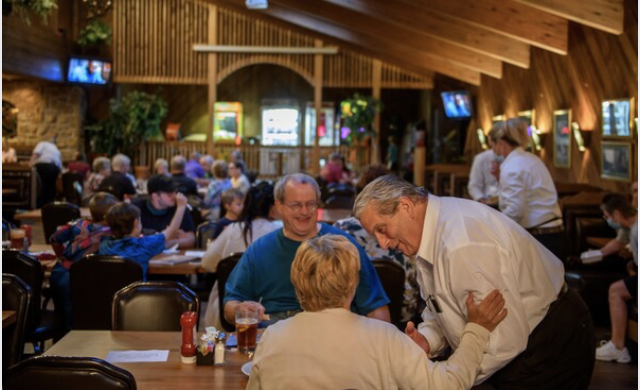
PITTSBURGH – Since 1959, Al’s Cafe has been known for cold beer, hearty hoagies and the occasional coconut shrimp platter. But since the coronavirus outbreak, the Bethel Park eatery has become the staging ground for an unlikely anti-government rebellion.

First came complaints that owner Rod Ambrogi and his patrons were failing to abide by a statewide mask mandate imposed in July by Pennsylvania Gov. Tom Wolf, a Democrat. Ambrogi has since put on a mask, but he refuses to prevent customers from bellying up to the bar in defiance of state rules strictly limiting indoor dining.

Rpd Ambrogi greets patrons at the restaurant his family has run since 1959.  CREDIT: Photo by Jeff Swensen for The Washington Post

Rpd Ambrogi greets patrons at the restaurant his family has run since 1959. CREDIT: Photo by Jeff Swensen for The Washington Post

“I can see [wearing] the mask now. But the rest of it is stupid,” said Ambrogi, 74, who has rallied local tavern owners to defy the rules. “There are people going out of business every day around here.”

Six months into the coronavirus pandemic, restrictions on dining have left restaurants and taverns across the nation struggling to stay afloat. Democratic presidential candidate Joe Biden has blamed President Donald Trump for a bungled pandemic response that has left at least 190,000 dead and millions unemployed. But in Pennsylvania, a crucial swing state Trump carried by just 44,000 votes in 2016, a debate is raging over whether the Republicans in Washington or the Democrats in Harrisburg bear more responsibility for the industry’s economic pain.

Nationally, jobs in food service and drinking places fell 49 percent from February to April, according to Gus Faucher, chief economist for Pittsburgh’s PNC Financial Services Group. In Pennsylvania, the job loss was steeper, at 59 percent. And in the Pittsburgh metropolitan statistical area, which includes seven counties in the state’s southwest corner, those jobs plummeted by 62 percent.

While some have bounced back, July figures show that Pennsylvania bars and restaurants are still hurting. In Pittsburgh, only about a third of lost food and drink jobs have returned, leaving about 33,000 people still unemployed. 

“Who are those 33,000 people out of work?” Faucher said. “And who are they going to hold responsible?” 

For some, the answer is the governor. After closing restaurants and bars along with other nonessential businesses when the pandemic struck in mid-March, Wolf began permitting them to reopen this spring. But when the number of new infections began rising, the state health commissioner cranked up restrictions on indoor dining, a key vector of infection. 

Under the new rules, alcohol could be sold only if customers also ordered food. Sidling up to a bar for a brew was forbidden. 

Most infuriating to owners: Eateries that had been preparing to reopen at 50 percent capacity were suddenly told they would have to operate at 25 percent capacity. Pennsylvania is one of just three states to impose such severe limits, according to a database compiled by the National Restaurant Association, though some local jurisdictions have done so.

Many bar and restaurant owners say the state is denying them the right to earn a living. Rui Lucas, 45, who owns three restaurants in suburban Philadelphia, formed a trade association this summer to push for counties, rather than the state, to set coronavirus standards for bars and restaurants. 

“Of course, we’re all scared. On many levels,” Lucas said. “We know we are at the fate of the virus. But we are also at the fate of Governor Wolf.”

State health officials defend the decision to keep a tight rein on bars and restaurants, saying it is based on data, including information from people who tested positive after dining out. The number of new cases has fallen, and White House coronavirus response coordinator Deborah Birx praised the state earlier this month, saying only five others have a lower case count. 

Still, Sarah Boateng, executive deputy secretary at the Pennsylvania Department of Health, said she understands the blowback. “I hear the frustration of the restaurant owners. I appreciate it,” she said. “We know it’s not been easy.”

In general, state residents give Wolf good marks for his handling of the crisis. According to an August Monmouth University poll, 62 percent of Pennsylvania voters said the governor has done a good job, while more than half the state’s voters – 53 percent – said they disapproved of Trump’s handling of the virus. 

But approval for Wolf’s performance slipped from 67 percent in July. And the same survey showed Biden leading Trump by just four points – 49 percent to 45 percent – down from a 13-point advantage a month earlier. 

Lara Putnam, a history professor at the University of Pittsburgh who monitors political activity on Facebook and other social media sites, said she sees “an intensity of agitation online, especially farther outside of metropolitan areas, to blame Tom Wolf” for the grim economic situation. The state’s overall unemployment rate was 13.7 percent in July, the most recent available, significantly above the national July average of 10.2 percent. 

“If you’re a waitress who has lost all your hours,” Putnam said, “who are you going to blame?” 

Ambrogi, who so far has called back only 40 of 60 employees at Al’s Cafe, knows precisely whom he blames. He blasts Wolf’s restrictions on dining as “unconstitutional.” 

“Look, I know it’s a bad virus. And no one wants to see anyone get sick,” Ambrogi said. “But it comes to a point: The general public has had enough of this.”

On Tuesday, with new infections down, Wolf granted restaurateurs a reprieve: Starting Sept. 21, they can operate at 50 percent capacity. But they will also have to stop serving alcohol at 10 p.m., an hour earlier. 

“We wanted a ham and he gave us a hot dog,” complained Ambrogi, a stalwart Trump supporter. Of the new time for last call, he said, “I don’t know what that will mean” for business.

Since leading a local revolt against the restrictions, Ambrogi has corresponded with restaurant owners across the state. He said he has also written to Wolf and reached out to state lawmakers from both parties. Only Republicans responded, he said. 

“Where are the Democrats? Are they waiting to make Trump look bad?” said Phil Catagnus, one of Ambrogi’s brothers in arms and the owner of the Double Visions go-go bar outside Philadelphia. “We are the people stuck in the middle of this.”

Because people can no longer drink without ordering food, Catagnus, 64, joked that he now sells “virus-killing hot dogs.” Still, the restrictions on indoor dining are killing business, he said. 

“I’m very grateful for being open. But the margins are so small,” said Catagnus, who plans to vote for Biden despite feeling neglected by Democrats in Harrisburg.

Meredith Meyer Grelli grew up in Pittsburgh’s North Hills, teaches entrepreneurship at Carnegie Mellon University and runs Wigle Whiskey, the first distillery in Pittsburgh since Prohibition. Before the pandemic, nearly 150 customers showed up for Saturday tours. These days, Grelli relies heavily on bottle sales to stay afloat.

“What’s frustrating for bars and restaurants is they have been singled out, but there has been no effort to provide specific support,” said Grelli, 35. “We are fortunate that we have bottle sales. But this capacity issue? No one builds a business to operate at 25 percent or 50 percent.”

Grelli said that she doesn’t blame the state for her problems but that she understands why many bar owners are angry. 

The distillery “gave up on profitability a long time ago,” she said. “We are bleeding money like anyone else.”

Lawyer-cum-brewer Peter Kurzweg co-owns the Independent Brewing Company and two other craft beer halls in Pittsburgh. He used to pack 120 people into his hipster beer room in the city’s Squirrel Hill neighborhood on Friday nights. Today, he has no indoor seating because he thinks ventilation is key to controlling the virus.

Kurzweg, too, is unhappy with the statewide restrictions. “I have lost count of the number of good restaurants that have closed,” he said.

But Kurzweg, 38, said he places greater blame on Trump. While countries like Germany kept the virus at bay and largely have returned to normal life, he said, the White House failed to gain control of the outbreak, allowing it to become a national calamity.

“I have mixed feelings about what the state did. They needed to find a happy balance,” Kurzweg said. But “fundamentally, I attribute what we have now to a lack of a strong federal response and strong federal guidance.”

Coronavirus lockdown steals Gazans’ last vestiges of normal life #ศาสตร์เกษตรดินปุ๋ย

#ศาสตร์เกษตรดินปุ๋ย : ขอบคุณแหล่งข้อมูล : หนังสือพิมพ์ The Nation.

Coronavirus lockdown steals Gazans’ last vestiges of normal life

Health & BeautySep 13. 2020A photo from the top of Al-Wehda Street in Gaza City, considered the area's busiest street for traffic, is nearly empty on Aug. 25 because of the lockdown. CREDIT: photo for The Washington Post by Loay Ayyoub.A photo from the top of Al-Wehda Street in Gaza City, considered the area’s busiest street for traffic, is nearly empty on Aug. 25 because of the lockdown. CREDIT: photo for The Washington Post by Loay Ayyoub. 
By Special To The Washington Post · Hazem Balousha · WORLD, MIDDLE-EAST 
GAZA CITY – It was late at night in Gaza. Adam and Karam, my two little sons, were asleep. But the sound of the bombing was very loud as Israeli jets targeted Hamas military sites. My fear, as always, was that the noise would wake and scare them. But when I checked, they were asleep.

There would be nowhere to go if they did wake up. For the first time since the coronavirus pandemic began, all 2 million Gazans are in home quarantine to slow a growing outbreak. Our movements are always restricted within Gaza’s 140 square miles, bound by the Mediterranean on one side, fenced in by the Israeli army on another. But now, as the jets strike outside for the 20th straight night, we cannot even leave our houses. 

A woman on Al-Nasr Street in Gaza City brings bread from a bakery back to her family on Sept. 10. CREDIT: photo for The Washington Post by Loay Ayyoub.
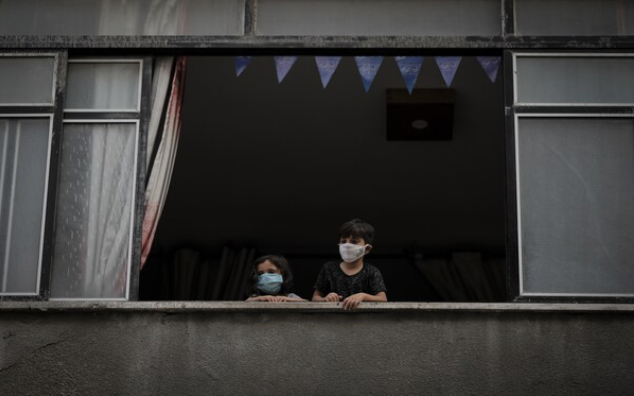
A woman on Al-Nasr Street in Gaza City brings bread from a bakery back to her family on Sept. 10. CREDIT: photo for The Washington Post by Loay Ayyoub.

We are stuck in a lockdown within a lockdown.

For months, we’d recorded only about 100 coronavirus cases in Gaza, all among residents returning from the outside and who were immediately quarantined. But on Aug. 24, the first cases of unknown origin were reported, in the tightly packed Maghazi refugee camp, and Gaza was placed under a complete lockdown that very same night. Since then, we’ve recorded more than 1,400 local cases.

Children look out the window of their house in Gaza City on Sept. 9, amid a lockdown imposed due to the coronavirus. CREDIT: photo for The Washington Post by Loay Ayyoub.

Children look out the window of their house in Gaza City on Sept. 9, amid a lockdown imposed due to the coronavirus. CREDIT: photo for The Washington Post by Loay Ayyoub.

It is beautiful to be a parent. But in Gaza it is also especially difficult. This has been true since Adam was born 10 years ago: It was two months before I even met him because Israel’s blockade of Gaza meant I couldn’t be with his mother, Ruba, when she gave birth in the West Bank, where her family lives.

“Will I be able to shield him and give him a good life in besieged Gaza?” I wondered as I marveled at my tiny boy. In the decade since, the question has never gone away. The constant cycle of escalation between Israel and Hamas, the militant group that governs here, has meant frequent explosive nights and, twice, all-out war. Rockets. More recently, Hamas and other militant groups have launched incendiary balloons that cause fires in nearby Israeli communities and farms. Israel retaliates each night by blowing up Hamas facilities. It is the violent background of our lives.

The boys slept, and I turned on a light to read. We are lucky that we can afford our own solar power system that provides about 70 percent of our household needs. Many of my neighbors in Gaza City, and almost all of the 600,000 people living in Gaza’s eight refugee camps, are spending the lockdown mostly in the dark.

The Israeli army destroyed Gaza’s main power station in the 2006 war. In the best of times, we have only eight hours of electricity a day as blackouts rotate through the neighborhoods. But three weeks ago, as a reprisal against the balloon launches, Israel cut off fuel shipments to Gaza’s last power plant. As the outbreak began to spike in late August, Gaza had only four hours of electricity a day.

– – – 

Being locked in the house while also locked in our small coastal enclave is very annoying. One of the ways to stay sane while living under siege is to move around where it’s possible, to gather with your fellow Gazans at cafes, in mosques or on the beach. In the camps, social life centers on families and friends, gathering on sidewalks and apartment stoops. Now, even that connection to a normal society is cut.

Like everywhere, Gaza has been under coronavirus restrictions for months. Restaurants have been closed or limited to takeout. Mosques and churches were shut. But everyone who entered Gaza through the checkpoints was quarantined for three weeks, and the number of infections remained low.

My boys had returned to school in the second week in August, after an absence of five months. The term started early in hopes that the kids could catch up on what they had missed. They were excited to get back to school and see their classmates. They had heroic achievements to share: Karam had won his karate yellow belt and Adam had learned new soccer moves. School is one of the few places where Gazan life feels normal.

Within weeks, classes stopped again due to a sudden outbreak of new cases. The airstrikes hit every night, the pandemic was closing in and our world was shrinking once again.

The kids miss school as much as their parents do. Now most of their play is on PlayStation. Their social life is when the cousins and friends can join them online for a couple of hours of “Fortnite.”

Maybe it’s good they are still too young to understand the layers of conflict and pandemic pressing on them. We are able to keep them busy. When we are free to move around, we give them a life that is rich by Gaza standards, with extended family, friends, school and public places. You want to shield them. But the reality in Gaza makes that feel increasingly like a mission impossible.

– – – 

Adam and Karam get lessons every day in how their lives are different from the young people they see on their screens. They ask me when we will travel to see their grandmother in the West Bank, something that can require months to plan. Permits are needed from Israel, and sometimes from Hamas and the Palestinian Authority – all three maintain checkpoints at the one crossing into Israel for individuals. Any of them can say no, and Israel often does.

Now, even that possibility is gone.

Technology is a blessing that opens my kids’ minds and expands their knowledge. But it can also be curse in besieged places like Gaza. So much of what we see, we cannot do. The places brought to us by the Internet are forever out of reach. I think of my friends who won scholarships to study abroad but could not get out of Gaza to attend.

For many Gazans, their farthest travel is the edge of the sea, where we cool ourselves in the Mediterranean breezes and look out to a world all but closed to us.

But this being Gaza, even a day on the beach is complicated by conflict. There is not enough electricity to run the waste treatment plants and we cannot swim because of the untreated sewage that is pumped into the sea.

One evening a few days before the lockdown, I took the boys to the beach. It is always a mix of pain and pleasure to sit with them, watching them play but knowing they will run to the water’s edge and back, asking every five minutes if they can swim. I have to say no.

Soon after the pandemic flared up, Israel and Hamas negotiated another cease-fire, brokered by Qatar. The balloons and bombs have stopped for now; we have four more hours of electricity to light our quarantine.

We know from experience that this quiet will soon cycle back to violence. Of the two lockdowns, the one caused by the virus will be the first to be resolved. We can only pray that we can keep our children safe until it is.

When this quarantine is over, we will go back to the beach to claim one of the pleasures available to us. That is the life of a Gaza parent, a cycle of tension and relief, despair and joy. They will be happy in the sand, and I will say no to swimming, waiting as always for the day I can say yes.

Italy’s Bergamo is calling back coronavirus survivors. About half say they haven’t fully recovered. #ศาสตร์เกษตรดินปุ๋ย

#ศาสตร์เกษตรดินปุ๋ย : ขอบคุณแหล่งข้อมูล : หนังสือพิมพ์ The Nation.

Italy’s Bergamo is calling back coronavirus survivors. About half say they haven’t fully recovered.

Health & BeautySep 09. 2020A patient gets an X-ray at a Bergamo, Italy, convention center that was converted for covid-19 patients in the spring and is now used for follow-up care. MUST CREDIT: Photo by Alberto Bernasconi for The Washington Post.
A patient gets an X-ray at a Bergamo, Italy, convention center that was converted for covid-19 patients in the spring and is now used for follow-up care. MUST CREDIT: Photo by Alberto Bernasconi for The Washington Post. 

By The Washington Post · Chico Harlan, Stefano Pitrelli · WORLD, HEALTH, EUROPE, HEALTH-NEWS 
BERGAMO, Italy – The first wave is over, thousands have been buried, and in a city that was once the world’s coronavirus epicenter, the hospital is calling back the survivors. It is drawing their blood, examining their hearts, scanning their lungs, asking them about their lives.

Twenty people per day, it is measuring what the coronavirus has left in its wake.

“How are you feeling?” a doctor recently asked the next patient to walk in, a 54-year-old who still can’t ascend a flight of steps without losing her breath.

“I feel like I’m 80 years old,” the woman said.

Six months ago, Bergamo was a startling warning sign of the virus’s fury, a city where sirens rang through the night and military trucks lined up outside the public hospital to ferry away the dead. Bergamo has dramatically curtailed the virus’s spread, but it is now offering another kind of warning, this one about the long aftermath, where recoveries are proving incomplete and sometimes excruciating.

Those who survived the peak of the outbreak in March and April are now negative. The virus is officially gone from their systems.

“But we are asking: Are you feeling cured? Almost half the patients say no,” said Serena Venturelli, an infectious-disease specialist at the hospital.

The follow-ups are the basis for medical research: Data on the patients now fills 17 bankers’ boxes, and scientific reports are on the way. Bergamo doctors say the disease clearly has full-body ramifications but leaves wildly differing marks from one patient to the next, and in some cases few marks at all. Among the first 750 patients screened, some 30% still have lung scarring and breathing trouble. The virus has left another 30% with problems linked to inflammation and clotting, such as heart abnormalities and artery blockages. A few are at risk of organ failure.

Beyond that, according to interviews with eight Pope John XXIII Hospital doctors involved in the work, many patients months later are dealing with a galaxy of daily conditions and have no clear answer on when it will all subside: leg pain, tingling in the extremities, hair loss, depression, severe fatigue.

Some patients had preexisting conditions, but doctors say survivors are not simply experiencing a version of old problems.

“We are talking about something new,” said Marco Rizzi, the head of the hospital’s infectious-disease unit.

One patient, Giuseppe Vavassori, 65, has developed short-term memory loss and now lives under a mountain of Post-it notes and handwritten reminders, with names and phone numbers, so he can still run his funeral home business. A post-covid MRI showed dot-like lesions on his brain.

Another, Guido Padoa, 61, recovered well enough that he was able to go on vacation this summer. But he sleeps four extra hours per night and sometimes falls asleep suddenly midday, head on the computer keyboard.

Some patients who were self-reliant before contracting the virus remain so weakened that, when they arrive for their follow-up appointments, they’re helped to the waiting room by relatives, or in wheelchairs. Four people so far were too frail to make it through the several hours of testing and were rushed instead to the emergency room. Other times, people show up months later, having been through the worst – oxygen support, intubations – and are, improbably, almost fine. Doctors say one of the virus’s mysteries is how recoveries can be swift for some and brutal for others.

Venturelli mentioned a man in his 80s who’d come in for his follow-up visit, mostly recovered. His son, who’d also been infected, hadn’t fared as well. When Venturelli tried to refer the father to a specialist, he said he was too busy these days.

Covid had turned the father into his son’s caretaker.

– – –

The Bergamo research is being led by the same doctors who worked frantic 14-hour days in March, sometimes falling sick themselves, while watching patients rapidly outnumber the beds. Now, wearing just masks, those same doctors and patients are sitting down together in a way that was impossible months ago.

“We did feel a moral obligation to call them back,” said Venturelli, who helped start the study in early May. “It was such a tsunami for us. What we saw in March was a tragedy, not a normal hospitalization.”

Bergamo, in March, was a place with six-hour waits for ambulances and 16-hour waits in the ER. At one point, the hospital had 92 people on ventilators – compared with 143 now in all of Italy – and so many who required breathing assistance that it needed to pipe in oxygen from a rush-delivered emergency tank. In the province of 1.1 million people, 10,000 were hospitalized, including more than 2,000 at Pope John XXIII.

“I have a picture in my mind from that time of the ER with eight ambulances queuing outside,” said doctor Monica Casati. Inside the hospital, she said, people were crying, moaning and gasping for air. “It was a noise that would remind you of Dante’s inferno,” she said.

The hospital was admitting only the worst cases, and to keep pace with the influx, it sometimes had to discharge patients before they were fully ready – something confirmed when the hospital started calling people for the follow-ups. In addition to the 440 people who died while hospitalized, 220 died after being told to go home.

The study in Bergamo is one of multiple efforts around the world to examine aspects of covid’s lingering damage. One German study of 100 people found that nearly 80% had heart abnormalities several months after infection. Other studies are underway to look specifically at “long-haulers” – a subset of people, some never hospitalized, who nonetheless have fatigue and other symptoms months after the illness.

Some of the doctors in Bergamo see reasons for encouragement in their findings, especially given the severity of what patients faced in March and April and the trial-and-error treatments they were given. They say that patients’ breathing seems to gradually improve, even though the lung scarring is permanent. Doctors have found nobody with a fever.

“Many of them coming in for repeat visits, they are doing better now than they were in May,” said Caterina Conti, a lung specialist.

For the patients who have been able to regain a semblance of their lives, the last barrier is the trauma itself – the raw memory of being in a hospital where so many were dying, and wondering if they might be next. Padoa, a photographer, said he remembers hearing others in his ward struggling to breathe, and seeing hospital workers remove the bodies, change the bedsheets. With his own lungs on the brink of failure, he worried what might happen if he let his eyes close, so he drew on his training four decades earlier as a paratrooper. Under an oxygen helmet, as it beeped and hissed, he willed himself to stay awake for five days, he said.

“It’s like when you are on a high mountain in the cold,” Padoa said. “If you fall asleep, you die.”

– – –

But the gravest patients of all, like Mirco Carrara, 55, have no recovery in sight.

By the time he arrived for his follow-up, it was late August, and he’d moved back into his home on the outskirts of Bergamo. He’d started going to work again, as a manager at a military parts company. But he was also coming to terms with how drastically his life had changed.

He had spent more than a month in a medically induced coma. In the middle of that, he was transferred on a German medevac plane to a hospital in Cologne. Doctors there saw that his lungs had developed not only scars but also a fungal infection. He was removed from the ventilator, re-intubated after his lung collapsed, then removed again. By the time he returned, conscious, to a rehabilitation center in Italy, Carrara had lost 45 pounds. He needed to relearn to swallow and stand.

And even that he had felt capable of doing, until doctors told him one more thing. The full trauma of covid – the ventilation, the treatment, the compounding infections – meant there were now fungus-filled bubbles inside his lungs, each a bomb-like threat that could critically impair his breathing if it burst.

“I started crying,” Carrara said. “Up until that point, I had thought I’d be able to recover.”

In an interview, Simone Benatti, the doctor at Pope John XXIII who consulted with Carrara, described the air and fungus bubbles as a “bad complication” and mentioned a separate Italian study showing that some deceased covid victims were found to have bacterial or fungal abscesses in their lungs.

“There is an interplay between covid and other infections,” Benatti said.

Carrara said the bubbles were like a “Damocles sword,” and soon enough, in early June, a cough sent his oxygen levels dipping. His girlfriend rushed him to the hospital. He had a tube inserted into his lungs for a week. A month later, it happened again – dipping oxygen; another hospital trip; another surgery to drain his lung – except this time, he wasn’t even sure what set it off. He felt a rage about his body. He said he wished the surgeon would “just cut my lung out.”

He arrived for his follow-up in Bergamo carrying a thick stack of medical paperwork and figured there was only so much more about his body he cared to know. Like the others, he submitted to a CT scan, an echocardiogram and blood tests. But when filling out a survey about how he was feeling and coping, he checked all the boxes in the “middle,” he said – moderate, good, OK.

“I lied,” Carrara said.

He didn’t mention how deep his despair has been, as he comes to grips with his lungs. He didn’t mention the guilt he felt, wondering if he passed the virus to his father, who had not survived. He didn’t mention his first nights back home, when he lay fully awake, one night and then two nights and then three. He didn’t say how his partner then said enough was enough, and went to the pharmacy to get sleeping pills, and how he’d agreed to take them, because that was the one way to briefly quiet his mind six months after being infected with covid-19.

“The bubbles will remain. They’re not going anywhere,” Carrara said, and he figured it was just a matter of time before he was back in the hospital again.

“I live with this terror,” he said.