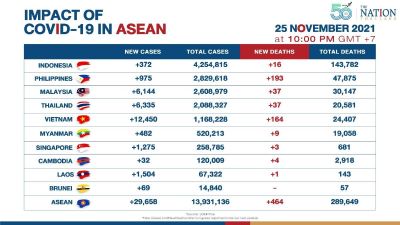
The number of Covid-19 cases crossed 13.93 million across Southeast Asia, with 29,658 new cases reported on Thursday (November 25), higher than Wednesday’s tally at 28,912. New deaths are at 464, decreasing from Wednesday’s number of 465. Total Covid-19 deaths in Asean are now at 289,649.
Singapore and Malaysia to reopen land and air travel on November 29. While the air lanes are open to all vaccinated travellers, the land crossing will for now only open up to vaccinated travellers who hold citizenship, permanent residency or work and student permits.
Singapore’s Prime Minister’s Office said the limitation on who could use the lane for land crossings was to “give priority for those who have been working in either country to visit their families”. It also added that about 95 per cent adult population in both countries have been vaccinated against Covid-19.
Meanwhile, Indonesia’s Domestic Affairs Ministry has issued a ban on civil servants and workers in state-owned and private companies taking leave around Christmas and New Year, in a strong pre-emptive measure to avoid a Covid-19 flare-up. This will affect about 4.2 million civil servants and two million workers in the state-owned companies, and many more in private firms.
Violence shook the capital of the Solomon Islands for a second day despite a lockdown, with protesters targeting Chinatown as the nations embattled leader vowed to hold the perpetrators accountable and Australia said it would send troops to quell the unrest.
Smoke billowed over Honiara on Thursday, a day after protesters demanding the prime minister’s resignation set fire to Parliament and several other buildings.
The escalating riots – fueled by domestic grievances over development priorities and the country’s decision to switch diplomatic recognition from Taiwan to China – led Prime Minister Manasseh Sogavare to call on neighboring Australia for help. His Australian counterpart pledged to send about 120 soldiers and police officers to keep the peace.
“Our purpose here is to provide stability and security to enable the normal constitutional processes in the Solomon Islands,” Scott Morrison said in a news conference Thursday. “It is not the Australian government’s intention in any way to intervene in the internal affairs of the Solomon Islands. That is for them to resolve.”
Morrison said two dozen Australian police officers were on their way to Honiara, where they would soon be joined by more than 40 soldiers and 50 additional police. He expected the deployment to last “a matter of weeks.”
“We have always been there to help our Pacific family when they have needed us, and this is such a time,” Morrison said.
Mihai Sora, a former Australian diplomat who was posted to Honiara from 2012 to 2014, said the quick request for help and Australia’s rapid response were hopeful signs that the Solomon Islands could avoid a repeat of past bloodshed.
“How rapidly the situation escalated came as a surprise to many,” Sora said. “If Australia hesitated, if they took days or weeks to consider a response, the situation may have deteriorated to such a low point where recovery would have been difficult.”
In a national address late Wednesday, Sogavare called the riots a “sad and unfortunate event aimed at bringing a democratically elected government down” and announced a 36-hour lockdown in Honiara.
“Hundreds of citizens took the law into their own hands,” he said, claiming they had been “led astray by a few unscrupulous people” whom he did not name but said would “face the full brunt of the law.”
Many of the protesters came to Honiara, on the island of Guadalcanal, from Malaita, the most populous island in the archipelagic nation in the South Pacific, about 1,000 miles northeast of Australia.
Tensions have simmered between the two islands since the national government switched diplomatic allegiance from Taiwan to China in 2019, a move opposed by Malaita’s premier, Daniel Suidani, who claimed he had been offered a bribe to support the switch. Sogavare denied the accusation.
Suidani pledged Malaita would never engage with Beijing and terminated licenses of businesses owned by ethnic Chinese, drawing a rebuke from the national government. Tensions grew in May when Suidani sought medical treatment in Taiwan, a trip the government said was “unauthorized.”
Chinese Foreign Ministry spokesman Zhao Lijian said Thursday that China paid great attention to the developments in the Solomons and supported the government’s efforts to halt violence. Any attempt to disrupt relations between China and the Solomon Islands would be futile, he said. Beijing, which claims Taiwan as its territory, has been picking off Taipei’s remaining diplomatic partners since the election of Tsai Ing-wen as president in 2016.
Taiwan’s Foreign Ministry spokeswoman Joanne Ou said Taipei was aware of the situation but had no comment on the Solomon Islands’ domestic politics.
On Tuesday, members of Parliament from Malaita issued a statement expressing fear over planned protests in Honiara and calling on Suidani to “recall our people, our brothers and sons from carrying out such a potentially dangerous and violent actions.”
Suidani said the protests, which he did not attend, were the result of the government ignoring the people’s concerns over issues such as the diplomatic switch and infrastructure projects.
“Whatever the government wants the people to know, they must stand and tell them,” he told the Guardian on Wednesday. “They cannot run away from problems. It will not solve anything.”
Hundreds of protesters began to gather in front of the national Parliament building on Wednesday morning, shouting for Sogavare to step down, according to videos posted online by local journalists.
By midday, smoke could be seen coming from a grass hut next to Parliament where lawmakers sometimes gather. Soon, the hut was engulfed in flames. Then a police station and several buildings in Chinatown – including at least one Chinese-owned store – were set on fire.
Salote Mataitini, a Fijian pilot, said she was flying from Kiribati to the Solomon Islands when she and her co-pilot landed in the midst of the unrest on Wednesday. The route to their quarantine hotel was blocked because of the disorder, with police in riot gear using shipping containers to close access to the port. When the pilots arrived at another hotel, they found police officers clashing with protesters.
“I got a shock when I first heard the rubber bullets and tear gas because I thought I heard shootings,” she told The Washington Post in a social media message. “As we entered the room … we were told to stay away from the windows.”
Thursday morning was quiet, she said, but the violence resumed in the afternoon, with rioters again targeting Chinatown. Mataitini watched from her hotel balcony as black smoke began pouring from buildings nearby. Staff told her to pack a small bag with important documents in case the hotel had to evacuate.
As the arson and looting continued, the political situation also kept deteriorating, with national opposition leader Matthew Wale calling for Sogavare to resign.
The Solomon Islands, known for World War II battles between U.S. and Japanese forces, are in a volatile region where Beijing has been expanding its influence.
Sora, who is a research fellow at the Lowy Institute, an Australian think tank, said recent tensions between China and Australia added significance to Morrison’s decision to send troops but would not have been the deciding factor.
“Even without the notion of a geopolitical competitor in the region, Australia would have looked to be the first responder” in the Solomon Islands, he said, citing historical ties between the two countries.
Sogavare, who is serving his fourth stint as prime minister, first came to power in the aftermath of a 2000 coup fueled by tensions between ethnic groups. The conflict, which began in 1998, claimed around 200 lives and lasted until 2003, when an Australian-led force restored law and order.
The prime minister alluded to the history of violence in his address.
“I had honestly thought that we had gone past the darkest days in the history of our country,” Sogavare said. However, he added, the events were “a painful reminder that we have a long way to go.”
Indias population growth is losing steam as the average number of children born crossed below a key threshold, according to newly released data from a government survey.
India’s most recent National Family Health Survey, which is conducted every five years by the Health Ministry, was released Wednesday and showed the total fertility rate (TFR) across India dropping to 2.0 in 2019-2021, compared with 2.2 in 2015-2016. A country with a TFR of 2.1, known as the replacement rate, would maintain a stable population over time; a lower TFR means the population would decrease in the absence of other factors, such as immigration.
The figures were hailed as a heartening signal by government officials and researchers in a country that is expected to overtake China to become the world’s most populous sometime this decade. Since the mid-20th century, Indian leaders have tried to curb high birthrates, which are often reversely correlated with women’s welfare metrics and economic progress. A burgeoning population is seen, in the longer term, as a hurdle to development and a driver of environmental degradation and greenhouse gas emissions.
Indian fertility rates have been trending downward for the last two decades as the country grew richer, underwent rapid urbanization, and rolled out programs that provide contraceptives and family planning education. But the progress shown in just the last two national surveys has been significant, demographers said.
“This is of course good news,” said Nandita Saikia, a professor of public health at the International Institute for Population Studies (IIPS) in Mumbai. “It indicates there has been some kind of transformation in the last four years in socioeconomic conditions.”
India’s population has been expected to overtake China’s sometime around the year 2027. That date “could be delayed if this trend continues,” Saikia added, “but not for long.”
The dropping fertility rate does not mean India’s population is already decreasing, but rather its growth rate is slowing. India’s population, which stands at just under 1.4 billion, will continue to rise beyond the year 2050 and peak at over 1.6 billion before stabilizing and returning to about 1.4 billion by 2100, according to United Nations projections.
Several Indian leaders since the country’s independence in 1947 have grappled with the population question. In the 1970s, Prime Minister Indira Gandhi carried out a controversial mass sterilization drive. Population control measures – and the difference in birthrates between India’s religious groups – remain one of the most polarizing issues in domestic politics today.
The declining fertility rate observed in recent years was backed by an uptick in several key indicators, demographers said. The proportion of women who used contraceptives rose from 54 to 67%, according to the national survey, while those who reported an unmet need for contraceptives fell. The proportion of teenage marriages has also decreased, according to the study, while there has been an improvement in the gender balance of newborns in a country with a deeply held preference for sons. For every 1,000 baby boys, there are now 929 baby girls, up from 919 girls five years ago.
In cities across India – as in other countries – women are opting for fewer children: the urban fertility rate is 1.6.
The study showed the long-standing gap between India’s north and south widening: the large, poor tracts that line the northern Ganges River continue to show high fertility rates, with women in Bihar state having an average of three children each. Southern states including Tamil Nadu and Karnataka had fertility rates below the replacement rate.
“This is not saying the country’s problems of unemployment, inequality, education, and everything else are automatically over,” said Sanjay Kumar Mohanty, the head of population policies at IIPS. “But population is no longer a top priority concern.”
Global health leaders are urging caution as the holiday season gets underway, pointing to a 23% spike in coronavirus cases across the Americas in the past week, a surge that follows spikes in Europe – which officials warn could be a “window into the future for the Americas.”
“Time and again, we’ve seen how the infection dynamics in Europe are mirrored here several weeks later,” Carissa Etienne, director of the Pan American Health Organization, said during a Wednesday briefing. “The future is unfolding before us, and it must be a wake-up call for our region because we are even more vulnerable.”
On the same day, the head of the World Health Organization urged against complacency, expressing concern about a “false sense of security that vaccines have ended the pandemic and that people who are vaccinated do not need to take any other precautions.”
WHO Director General Tedros Adhanom Ghebreyesus said: “While Europe is again the epicenter of the pandemic, no country or region is out of the woods.”
He underlined the trouble in Europe, where the agency reports nearly 60% of worldwide coronavirus deaths were concentrated from Nov. 15 to 21. In that time, the WHO said new cases jumped 11%. Countries in Europe have been implementing new lockdowns and restrictions – an effort to reduce numbers ahead of the end-of-year holidays.
The PAHO pointed to upward trends in new cases in the United States and Canada, with a “two-to-three-fold increase in new infections over the last week” in Canada’s Yukon and Northwest territories.
In the United States, new daily reported cases have increased 8% in the past week, and deaths have grown 9%, according to tracking by The Washington Post. In that time, hospitalizations have inched up 6%. The situation is particularly dire in pockets of the nation. In Michigan, which leads the nation in covid hospitalizations, the unvaccinated covid-19 patients are swarming emergency departments and driving capacity to grueling levels.
In Canada, there was a 5% increase as of Wednesday in new confirmed cases over the past two weeks, compared with the previous two weeks, according to Our World in Data, which cites data gathered by Johns Hopkins University’s Center for Systems Science and Engineering.
During the Thanksgiving eve briefing, health officials urged that mitigation measures – including mask-wearing, social distancing and staying away from crowds – should be kept up regardless of vaccination status.
“During these holiday periods, not just for Thanksgiving in the U.S., of course, but through the end of the year, it’s really important that all of us continue to take measures to keep us and our loved ones safe,” said Maria Van Kerkhove, an epidemiologist leading WHO’s coronavirus response during the briefing. “Those of you who have access to vaccines, who are offered vaccination, please get vaccinated when it’s your turn.”
In the United States, slightly more than 59% of the entire population is fully vaccinated, according to tracking by The Post. More than 19% has been fully vaccinated and has received a booster shot.
As of Nov. 19, about three-quarters of the total population of Canada is fully vaccinated, according to the government dashboard.
In South America, many countries are reporting an increase in cases, including in the Southern Cone, with the highest spikes in Bolivia and Paraguay. Central America is the only area to have experienced a drop in new infections.
Bolivia has reported a 50% increase in the number of new confirmed cases over the past 14 days, compared with the number in the previous 14 days, according to Our World in Data.
In the Bolivian department of Santa Cruz, which includes the city of the same name – the highest populated area in the country – cases have increased by 400% following recent strikes and protests, where hundreds of thousands of people gathered for days to protest anti-money laundering laws passed in August, the PAHO reported.
Paraguay – where only a little more than a third of the population is vaccinated – there has been a 73% spike in cases in the past two weeks, which has prompted health officials to sound the alarm.
Ecuador, which experienced one of Latin America’s most aggressive covid outbreaks in the region, and where nightmarish images of bodies abandoned on the streets of cities such as Guayaquil shocked the world, is also showing a 32% increase in new cases.
The country recovered from the brutal first wave in 2020 and has now one of the highest vaccination rates in South America, with 62.5%. Five out of the 12 nations in the region have a vaccination rate of over 60% of the population, according to data tracked by The Post.
In Peru, a country with the world’s highest covid death rate per capita, Health Minister Hernando Cevallos warned this week that the small nation is facing a “dangerous increase in cases” and urged people to be careful ahead of the Christmas holidays, according to local news reports.
Colombia’s two largest cities – Bogotá and Medellín – are reporting a rise in cases and hospitalizations, especially among younger people. The country is also seeing an overall 30% increase in cases.
The Southern Cone countries of Chile, where over 84% of the population has been vaccinated, and Argentina, which has imposed strict curfews and prolonged lockdowns throughout the pandemic, are also seeing a rise in new cases.
In the Caribbean, Trinidad and Tobago reached a seven-day average of about 555 daily new confirmed cases, its highest, according to Our World in Data. At least five of its hospitals are at more than 80% capacity, the PAHO reported. Barbados, the Cayman Islands and the Dominican Republic are also reporting high rates of new infections.
The uptick in many South American countries comes after the region experienced a brief but sharp drop in cases following a dramatic surge in the summer.
Containment measures in Latin America and the Caribbean have been uneven and largely lackadaisical as governments have had to grapple with financial devastation and poor health infrastructure, and have long wanted to jump-start the languishing economies.
Vaccination rates have been similarly unequal.
While just more than half of people are fully vaccinated in Latin America and the Caribbean, there are 19 countries where vaccination coverage lags below 40% of the population – a factor that could spearhead further surges, according to the PAHO.
The PAHO warned Wednesday that despite the sluggish vaccination rates and case surges, protective measures are being lifted or relaxed in densely populated areas.
“This is a worrisome combination that keeps us vulnerable to the virus and threatens our hard-fought gains,” Etienne said.
BRUSSELS -The European Commission recommended Thursday that member countries apply more travel restrictions to people who are unvaccinated in the 27-nation blocs latest attempt to curb the recent surge of cases across the continent.
The commission’s health authorizing agency also approved vaccines for children as young as 5 – a milestone that could help Europe improve vaccination rates at a time when cases and deaths from the virus are up. The commission travel recommendations did not apply to unvaccinated children under the age of 6.
The ability to easily travel between countries in the European Union is a core value of the bloc, and the commission’s latest recommendations attempt to strike the balance between upholding that freedom and implementing restrictions that could slow the spread of the virus.
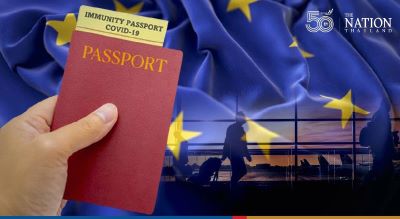
People who have a European Union covid certificate – which means they are fully vaccinated, have proof that they recovered from the virus or recently tested negative – should not have any travel restrictions, according to the recommendations. Everyone else should quarantine or be tested when they travel to a country in the bloc.
The commission also said travelers coming into the bloc should not be considered vaccinated if they received their doses more than nine months ago and have not yet received a booster.
Countries do not have to adopt the commission’s recommendations.
“The travel rules need to take into account this volatile situation,” Didier Reynders, European commissioner of justice, said at a news conference announcing the recommendations.
Across Europe, countries are applying lockdowns and restrictions to contain the latest wave of the pandemic – and hopefully bring case numbers down ahead of the Christmas holidays. Reported deaths in Europe reached nearly 4,200 a day last week – twice the number since the end of September, according to the World Health Organization, which counts 53 countries as part of Europe.
The Netherlands ordered restaurants and bars to close at 8 p.m., while Slovakia implemented a two-week lockdown on Wednesday, in which people can only leave home for work, grocery shopping or to get vaccinated. Austria also is under a lockdown that could last for 20 days.
“We need to convince more people to get vaccinated,” Ursula von der Leyen, president of the European Commission, said in a taped message to the public that also encouraged people to get a booster shot six months after their initial vaccination. “A quarter of E.U. adults are still not fully vaccinated. If you are unvaccinated you are more at risk of having severe covid symptoms. Vaccinations protect you and the others.”
While the European Commission issued its recommendations Thursday, the French government announced that booster shots would be available for all adults beginning Saturday. Boosters are already available to residents 65 and older.
France’s health minister said that vaccination certificates of people who do not get the booster will start expiring in mid-January. Earlier this month, President Emmanuel Macron introduced a similar rule for those over 65, with a deadline in mid-December.
Proof of vaccination can help people enter restaurants, bars and other entertainment venues in France.
At a news conference on Thursday, Health Minister Olivier Véran appealed to the French to respect distancing measures and mask mandates.
“We have to pull ourselves together,” he said. “These small daily constraints are the keys to our freedom.”
PARIS – Less than a day after at least 27 migrants died while trying to cross from France to Britain by boat, in the worst migrant tragedy in the English Channel in years, the two countries were sparring Thursday over who was to blame and what should be done in the future.
Britain reiterated calls for joint patrols along the French coast in hopes of preventing migrants from starting the perilous journey across the channel, and France demanded more support from its neighbors. “Yesterday was the moment that many of us have feared for many years,” British Home Secretary Priti Patel told Parliament.
In a letter to his French counterpart on Thursday evening, British Prime Minister Boris Johnson called for the establishment of “joint patrols” by Britain and France or by “private security contractors.” Johnson also called for a pact that would allow migrants to be deported back to France.
Previous British proposals of joint patrols had raised concerns in France over sovereignty. The French government accuses Britain of a lack of action against traffickers as well as businesses that employ undocumented migrants. On Thursday, the French called for more European and British support for their efforts to combat human trafficking in the channel.
In a phone call with Johnson on Wednesday evening, French President Emmanuel Macron “underlined the shared responsibility” and urged Britain to “refrain from exploiting a dramatic situation for political purposes,” the Élysée presidential palace said early Thursday.
Speaking on French radio Thursday morning, French Interior Minister Gérald Darmanin said “pregnant women, children died” in the tragedy in the channel. A local prosecutor told Agence France-Presse that 17 men, seven women and three presumed minors are known to have died. Efforts to identify the victims and their countries of origin were underway.
Two people, from Iraq and Somalia, survived and were treated for hypothermia, according to Darmanin.
In a mayday call obtained by Sky News, the French coast guard can be heard putting out an alert to “all ships” in the area. Charles Devos, a regional manager of the life boat association in Calais, told the broadcaster that when he arrived on the scene, “it was a bit like the film Titanic when you saw all these people plunged into the water, drowning.”
During their call Wednesday, Macron and Johnson agreed to step up Anglo-French cooperation and to do all they could to stop those trafficking migrants, according to Downing Street. But it was also clear that the leaders had different ideas about how to proceed.
French officials have in the past repeatedly accused Britain of responsibility for a surge in migrant crossings in the channel. Darmanin recently singled out British nongovernmental organizations in northern France that “prevent the police and the gendarmerie from working.”
He has also faulted Britain as not acting decisively enough against trafficking networks based in Britain and attracting migrants by allowing “irregular workers” to be “employed at low cost.”
Meanwhile, charities and aid agencies on both sides of the channel have long called on the British government to open safe routes to the country for asylum seekers. Currently, the migrants who are in France can apply for asylum in Britain only if they are physically there – meaning they have to take deadly risks in rickety boats with traffickers.
But speaking to Parliament on Thursday, Patel did not suggest changes to the British immigration system and reiterated an offer to “put more officers on the ground” and “do absolutely whatever is necessary to secure the area so that vulnerable people do not risk their lives by getting into unseaworthy boats.”
She also did not rule out tough new tactics to push boats back toward France.
Speaking to The Washington Post on Thursday, Bruno Bonnell, a French lawmaker for Macron’s party, said joint patrols are “probably a good idea,” partly because they may ease British-French tensions and “finger-pointing.”
But Bonnell said that the patrols should be only the “tip of the iceberg of the solutions” and that an adjustment of immigration policies may be needed on both sides of the English Channel “to help people to legally enter” and “to protect them from the smugglers.”
Nearly three times as many migrants have crossed by sea this year compared with last year as authorities have clamped down on other routes, including crossings by train and cargo trucks. Successful crossings have encouraged a growing number of migrants to attempt the journey via the Dover Strait. But the route, which uses the channel’s narrowest point, also crosses one of the world’s busiest shipping lanes and is highly dangerous for people in small, flimsy boats, especially when strong currents and high winds prevail.
Some policymakers in France dismissed the British proposal for joint patrols. Pierre-Henri Dumont, a lawmaker for Calais, told the BBC that it would not work as there was a “question of sovereignty. I’m not sure the British people would accept it the other way round, with the French army patrolling the British shore.”
He said also that such an undertaking was not practical on the long coastline.
“It only takes 5 to 10 minutes to take a boat and put it at sea filled with migrants, so I’m not sure it is only a question of money and question about the number of [personnel],” he said, echoing reports from French police officers who say they operate under tight rules. French authorities say they are allowed only a limited time window in which to try to prevent crossing attempts – usually after migrants reach the dunes and before the boats are underway.
“If you have the impression that some policemen don’t look at a specific boat, it’s because they usually look at other boats on the other side of the beach,” said Bonnell, the French lawmaker, responding to photos that appeared to show police standing by Wednesday as a group of migrants hurried toward the channel, carrying an inflatable boat.
French police regularly clear makeshift migrant camps on France’s northern coastdrawing complaints of heavy-handedness from migrants and human rights groups. Dumont, the French lawmaker, said one solution was not only to close the migrant camps around the coast, but also to move their occupants into “welcoming centers” where they can apply for asylum in France – or in Britain, where many want to go.
Aid groups say that most migrants who come to Europe remain on the continent, but a minority tries to reach Britain because of family or other ties or because they speak English.
The number of asylum applications to Britain is relatively small in comparison with the numbers received by countries of similar size in Europe. In the third quarter of 2021, 17,400 people applied for asylum in Britain; in France in that same period, 31,000 people applied.
Rob McNeil, a spokesman for the Migration Observatory at the University of Oxford, said that most migrants arriving in Britain on boats are from countries where claims for asylum in Britain are typically approved. Those countries include Eritrea and Syria, where 90% of applications are successful as a result of the danger people face in those places, he said.
French officials also called for more support from within the European Union in response to Wednesday’s incident.
In his radio interview Thursday, Darmanin named Belgium, the Netherlands and Germany as countries that are also linked to trafficking networks, adding that one of five people suspected as traffickers involved in Wednesday’s crossing attempt had bought boats in Germany. The five were among more than 1,500 smugglers the French government says it has caught in the region since the beginning of the year.
“We need to stop being effectively the only ones who are able to act against traffickers,” he said.
Wednesday’s tragedy did not deter others from trying to reach England. In the early hours on Thursday, the BBC reported, two boats made the journey across the channel and landed at Dover with about 40 people wearing life jackets and wrapped in blankets.
“Regional and global growth, sustainable development and prosperity cant be achieved by unilateralism and protectionism, so multilateralism is very important,” said Kin Phea, director-general of the International Relations Institute at the Royal Academy of Cambodia.
“It’s hoped that the ASEM13 will reinforce Asia-Europe partnership to ensure that multilateralism can bring about global growth that is not only sustainable but can also be shared.”
Post-COVID-19 socio-economic recovery, multilateralism and connectivity are expected to be high on the agenda for the 13th Asia-Europe Meeting (ASEM) Summit (ASEM13), which is due to be held via video link on Nov. 25 to 26, Cambodian experts said on Wednesday.
The summit will be chaired by Cambodian Prime Minister Samdech Techo Hun Sen and participated by the heads of state/government and high-level representatives of 51 ASEM countries from Asia and Europe, the President of the European Council, the President of the European Commission, and the Secretary-General of ASEAN.
Kin Phea, director-general of the International Relations Institute at the Royal Academy of Cambodia, said the pandemic and multilateralism will remain the top agenda during the ASEM13, adding that fighting against the disease requires joint efforts from all countries.
Aerial photo taken on Nov. 15, 2020 shows the construction site of the first expressway in Cambodia in Kampong Speu Province, Cambodia. (Photo by Li Zhen/Xinhua)
“Regional and global growth, sustainable development and prosperity can’t be achieved by unilateralism and protectionism, so multilateralism is very important,” he told Xinhua. “It’s hoped that the ASEM13 will reinforce Asia-Europe partnership to ensure that multilateralism can bring about global growth that is not only sustainable but can also be shared.”
Commenting on China’s engagement with ASEM countries, Phea said as a global great power and the world’s second-largest economy, China’s presence at the ASEM13 is very important and will greatly contribute to the success of the summit.
“Beyond the Asia and Europe continents, China has played a crucial role in the establishment of a new multi-polar world, in promoting multilateralism and win-win cooperation for inclusive and sustainable growth and development, and in the fight against COVID-19,” he said.
A man sanitizes his hands at a market
Mey Kalyan, chairman of the Cambodia Development Resource Institute, said as the world is facing so many existential problems such as COVID-19, unilateralism, and climate change, the ASEM13 has come at the right time to tackle these challenges.
“Over the past two years, COVID-19 has turned the world upside-down, so it is expected that the ASEM countries will reaffirm their commitment to address issues caused by COVID-19, to revitalize multilateralism for global peace and stability, and to accelerate their cooperation in science and technology, tourism, trade, and investment, among others to rebuild a resilient Asia-Europe future,” he said.
“In summary, people in Asia region expect to see a stable and predictable good relation between the two continents, Asia and Europe,” he added.
“In a multipolar world today, China represents an important role in Asia on the world affairs,” Kalyan said. “Without a stable relation between Asia and Europe poles, not much good outcome and development can be expected,” he added.
Joseph Matthews, a senior professor at the BELTEI International University in Phnom Penh, said there is no doubt that post-pandemic economic recovery strategy, multilateralism, and green development will top the agenda at the summit.
“The impacts of COVID-19 have reached every part of our societies and its recovery will surely be a long and difficult process,” he said. “This summit has the potential to highlight the collective actions to promote multilateralism in a more effective way to move slowly but surely towards a post-pandemic recovery period.”
Matthews said China’s participation shows its commitment to multilateralism, inclusive development, connectivity through digitalization, and infrastructure development both in Asia and Europe.
He said China’s state policy of non-interference in other countries’ domestic and internal affairs, co-existence, and mutual respect to all neighbors and non-neighbor states has made China a trustworthy friend for all continents in the world.
During the pandemic, China is the biggest vaccine and medical equipment donor to developing and poor countries in Asia, Africa, and South America, he added.
“In my perspective, China, in the post-pandemic era, will have a very important role to play in both continents,” he said. “China will be a driving force in economic recovery, infrastructure building under the Belt and Road Initiative (BRI), inclusive development, and connectivity in both continents.”
Aerial photo taken on March 11, 2021 shows the eighth Cambodia-China Friendship Bridge across the Mekong River, connecting Kampong Cham province and Tboung Khmum province in southeastern Cambodia. (Shanghai Construction Group/Handout via Xinhua)
Nearly 400,000 migratory birds have flown to Beidagang Wetland in north Chinas Tianjin Municipality since the beginning of autumn this year, Beidagang Wetland administration said Wednesday.
“We have spotted over 130 kinds of birds in the wetland, including more than 60 oriental white storks, which are under highest-level protection in China, said Mo Xunqiang, from the Tianjin Normal University.
Tianjin is an important transit point for migratory birds from East Asia and Australasia. In addition to the Beidagang Wetland, other wetlands and nature reserves in the municipality are also expected to see migratory birds.
In recent years, Tianjin has attached great importance to the building of ecological civilization and continuously strengthened wetland protection.
The ecological environment of wetlands and nature reserves has seen continuous improvements, attracting more and more migratory birds, noted the Tianjin Municipal Bureau of Planning and Natural Resources.
According to the bureau, more migratory birds are expected to fly to Tianjin until the end of December, with the total number of migratory birds exceeding 1 million by then.
Bangladesh, Laos, and Nepal are invited to prepare, during the five-year period, their national smooth transition strategy, with the support of the UN system and in cooperation with their bilateral, regional and multilateral development and trading partners.
The UN General Assembly on Wednesday affirmed the graduation of Bangladesh, Laos, and Nepal from the least developed country (LDC) category.
In a resolution, the General Assembly decides to provide the three countries, on an exceptional basis, with a five-year preparatory period leading to graduation as the countries would need to prepare for graduation while planning for a post-COVID-19 recovery and implementing policies and strategies to reverse the economic and social damage incurred by the COVID-19 shock.
The resolution does not rule out the extension of the preparatory period, pending the result of the 2024 triennial review by the Committee for Development Policy, which is responsible for the review of the LDC list every three years.
The three countries are invited to prepare, during the five-year period, their national smooth transition strategy, with the support of the UN system and in cooperation with their bilateral, regional and multilateral development and trading partners.
The resolution reaffirms that graduating from the category of least developed countries should not result in a disruption or reversal of development plans, programs and projects for the three countries.
The Committee for Development Policy uses three criteria to determine LDC status: per capita income, human assets, and economic vulnerability.
Anthony Fauci, U.S. President Joe Bidens chief medical adviser, says that the “overwhelming majority” of vaccinated Americans should receive a booster dose, adding the definition of a full vaccination could expand to include three doses of an mRNA vaccine such as those from Pfizer-BioNTech or Moderna, or two doses of the J&J vaccine.
As families prepare to gather over the Thanksgiving holiday, COVID-19 cases are once again rising in most parts of the United States after a steady decrease since mid-September, with new cases hiking by 25 percent nationally in the past two weeks and 40 percent or more in 14 most-affected states.
“Some of the biggest spikes have been in the Midwest, a region where COVID-19 cases hit an all-time high around this time last year. Michigan and Minnesota, which had only modest waves during the late-summer surge, are now seeing the most cases per capita in the country,” reported The New York Times (NYT) on Wednesday.
“Some hospitals across the country are being overwhelmed by COVID-19 cases and staffing shortages, and surges tied to holiday gatherings could make it worse. Hospitals in the cold Upper Midwest, especially Michigan and Minnesota, are also filled with COVID-19 patients who are mostly unvaccinated,” reported USA Today on Wednesday.
Photo taken on Nov. 23, 2021 shows the vehicles near the White House in Washington, D.C., the United States. (Photo by Ting Shen/Xinhua)
For the holiday, “We would encourage people who gather to do so safely after they’ve been fully vaccinated, as we’ve been saying for months now,” said Rochelle Walensky earlier this week, who is director of the U.S. Centers for Disease Control and Prevention (CDC).
The overall vaccination rate is higher in the United States now than it was during the summertime wave, meaning more people are protected from severe disease, but waning immunity could also play a role, Lauren Ancel Meyers, an epidemiologist at The University of Texas, told NYT.
“We may have higher levels of immunity in many U.S. communities, acquired through a combination of primary vaccines, booster doses and recent infections,” said Meyers. “However, waning immunity means that people who were infected early in the pandemic or received their last dose of vaccine more than six months ago may once again be vulnerable to severe infections.”
Other senior health officials are also repeatedly calling for Americans to get vaccinated, and get their booster shots, as cases tick back up across the country and the approaching holiday season brings with it more indoor, maskless gatherings, reported The Washington Post (WP) on Wednesday.
Anthony Fauci, U.S. President Joe Biden’s chief medical adviser, said on Tuesday in an interview that the “overwhelming majority” of vaccinated Americans should receive a booster dose, adding the definition of a full vaccination could expand to include three doses of an mRNA vaccine such as those from Pfizer-BioNTech or Moderna, or two doses of the Johnson & Johnson vaccine.
As of Wednesday morning, 230,669,289 people had received at least one dose of COVID-19 vaccine, making up 69.5 percent of the whole U.S. population. Fully vaccinated people stood at 195,973,992, accounting for 59 percent of the total. A total of 36,640,102 people, or 18.7 percent of the fully vaccinated group, according to CDC data.
COUNTER ATTACK
The Biden administration on Tuesday filed an emergency court motion that sought the immediate reinstatement of its rules requiring many employers to ensure their workers are vaccinated or tested weekly against COVID-19, a counter attack with much hope to help change the bleak pandemic picture during this holiday season.
The Justice Department filed the request with the Sixth U.S. Circuit Court of Appeals in Cincinnati, which last week was designated as the court that would decide legal challenges filed around the country to the vaccine-or-testing rules.
The Occupational Safety and Health Administration (OSHA) earlier this month formally issued the requirements, which apply to businesses with 100 or more employees. The rules cover roughly 84 million workers and are scheduled to take effect on Jan. 4.
The rules reflected “OSHA’s judgment that these measures are necessary to mitigate COVID-19 transmission in the workplace, and the grievous harms the virus inflicts on workers,” the Justice Department said in Tuesday’s court filing.
The mandate is expected by OSHA to save more than 6,500 worker lives and prevent more than 250,000 hospitalizations over the course of the next six months. However, Republican lawmakers and governors, some employers, as well as labor unions across the country, look determined to take on the White House insistence.
“Many lawsuits challenging the rules, including from Republican-led states and some employers, argue OSHA is engaged in unlawful government overreach. Other challenges, including from labor unions, are based on a belief that the mandate doesn’t go far enough to protect workers,” reported The Wall Street Journal on Wednesday.



 Aerial photo taken on Nov. 15, 2020 shows the construction site of the first expressway in Cambodia in Kampong Speu Province, Cambodia. (Photo by Li Zhen/Xinhua)
 Aerial photo taken on March 11, 2021 shows the eighth Cambodia-China Friendship Bridge across the Mekong River, connecting Kampong Cham province and Tboung Khmum province in southeastern Cambodia. (Shanghai Construction Group/Handout via Xinhua)

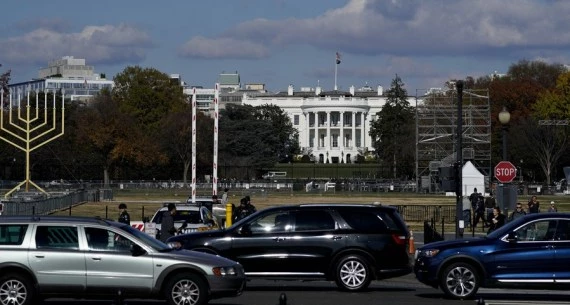 Photo taken on Nov. 23, 2021 shows the vehicles near the White House in Washington, D.C., the United States. (Photo by Ting Shen/Xinhua)
