Biden to begin presidency pushing emergency relief, other ambitious economic plans #SootinClaimon.Com

#SootinClaimon.Com : ขอบคุณแหล่งข้อมูล : หนังสือพิมพ์ The Nation.

Biden to begin presidency pushing emergency relief, other ambitious economic plans

InternationalJan 15. 2021President-elect Joe Biden speaks about the economy at the Queen in Wilmington, Del., on Dec. 4, 2020. MUST CREDIT: Washington Post photo by Demetrius Freeman.President-elect Joe Biden speaks about the economy at the Queen in Wilmington, Del., on Dec. 4, 2020. MUST CREDIT: Washington Post photo by Demetrius Freeman.

By The Washington Post · Jeff Stein, Erica Werner

WASHINGTON – President-elect Joe Biden will arrive in Washington with an ambitious economic agenda, starting with plans to prod Congress to pass a multitrillion-dollar coronavirus relief bill before moving on to enact his other broad proposals to overhaul the U.S. economy.

Biden’s presidency comes at a precarious moment for the nation, with the economy at risk of sliding more deeply into an already devastating recession or expanding into a healthy recovery.

The economy lost 140,000 jobs in December, the first month of job losses since the early months of the coronavirus pandemic, even as infections soared with more than 360,000 already dead. Much of the effort to right the economy will depend on whether the Biden team can get the rollout of the coronavirus vaccines on track, as well as factors outside the administration’s control, including the spread of a potentially more contagious form of the virus and a global economic downturn.

Although Biden’s initial relief package will center on measures such as increasing unemployment insurance and cutting Americans new stimulus checks, he also is expected to push later this year for more permanent economic reform such as investment in infrastructure, clean energy jobs, the health-care system and other domestic priorities. He will aim to raise the minimum wage to $15 an hour and rewrite immigration laws. Overall, Biden will attempt to reverse many of the Trump administration’s economic policies, toward a more activist role for the government.

Biden has made clear that by far his top economic priority is addressing the coronavirus pandemic and its far-reaching fallout. His capacity to do so will set the tone for his entire presidency, and determine whether the nation’s economy can rebound from the pandemic’s grasp.

“Millions of Americans are still hurting through no fault of their own,” Biden said last week in Wilmington, Del.

“The basic story is simple,” he said. “If we don’t act now, things are going to get much worse and harder to get out of the hole later, so we have to invest now.”

A Purple Line overpass in Riverdale Park, Md., near Kenilworth Ave. and Route 410 sits unfinished on June 10, 2020. MUST CREDIT: Washington Post photo by Toni L. Sandys.

A Purple Line overpass in Riverdale Park, Md., near Kenilworth Ave. and Route 410 sits unfinished on June 10, 2020. MUST CREDIT: Washington Post photo by Toni L. Sandys.

Biden has sketched out the broad outlines of a relief bill he said will cost trillions of dollars. It would increase one-time stimulus payments for Americans to $2,000, extend enhanced unemployment insurance set to expire in March, and include assistance for school districts, small businesses, and state and local governments. The legislation would invest heavily in vaccine distribution, as Biden aims to make up for lost ground where the Trump administration has failed to meet its own goals.

“Getting the virus under control and getting the vaccines right is the critical thing to getting the economy back on track. They need to do this, and they need to do it fast,” said Constance Hunter, chief economist at KPMG, adding that the nation is “nowhere close” to vaccinating as many people as it should be daily.

Biden has also proposed temporary increases in Social Security payments to seniors and student loan forgiveness of as much as $10,000 per person, and has called for expanding emergency sick leave and eliminating patient costs for covid-19 treatment.

The legislation would come on top of about $4 trillion Congress already has devoted to addressing the pandemic, most recently with a $900 billion measure President Donald Trump signed in December. Many Republicans are reluctant to spend anywhere near the amount of money Biden is discussing, and the proposal is sure to renew long-simmering disputes about the federal deficit, which ballooned under the Trump administration beginning with the GOP’s unpaid-for tax-cut law.

Biden has made clear that although future programs may be offset with tax increases or other measures, the coronavirus legislation will constitute emergency spending and will be added to the deficit like the previous pandemic stimulus measures. The final cost of the bill might eliminate hopes of bipartisan support and force him to attempt to pass the legislation with only Democratic votes.

Democratic control of the House and the Senate would allow him to do that, but the margins in both chambers are narrow and divisions within the Democratic Party are deep and, in some cases, acrimonious. Therefore, whether Biden will be able to get his coronavirus package passed will stand as an early test of the legislative prowess and dealmaking ability he boasted of bringing to the White House.

“We have these transformational moments, these historical pivots, maybe once in a generation,” said Timothy Naftali, a clinical associate professor of history and public policy at New York University, citing political reforms in the 1960s and after the Watergate scandal in the early 1970s. “Biden and [Vice President-elect Kamala] Harris do not have all the votes they need to enact the progressive agenda, but they have the opportunity to pass legislation that can shape the post-pandemic economic recovery in a way that can be transformational.”
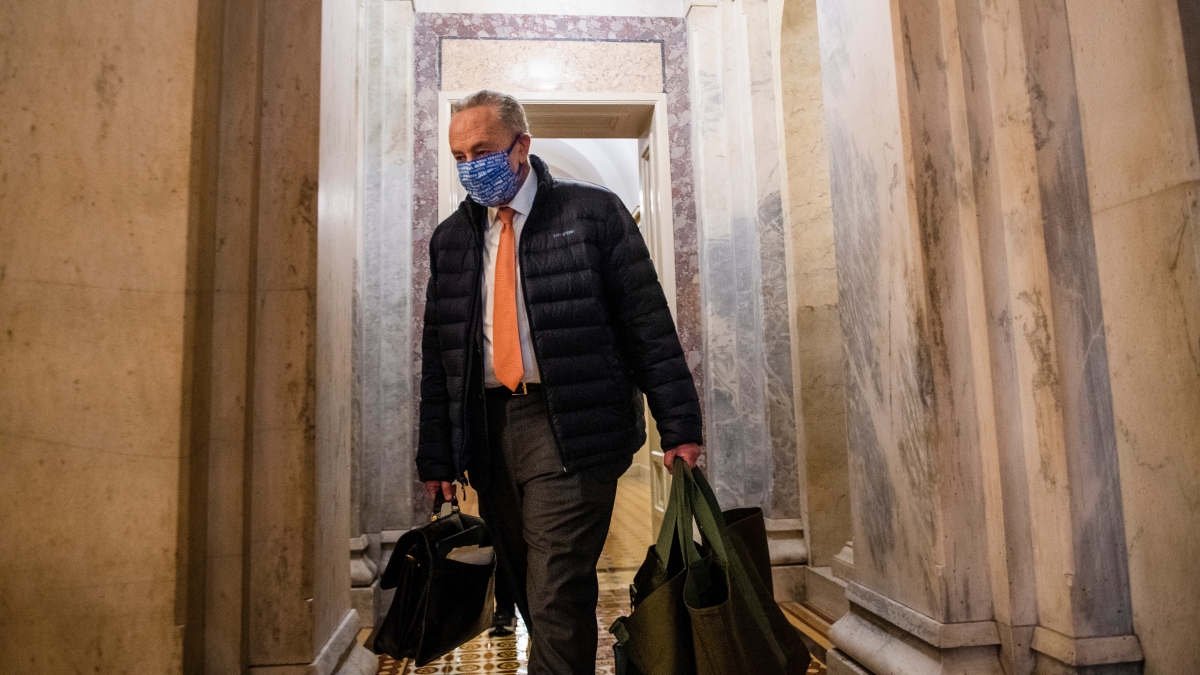
Senate Minority Leader Chuck Schumer, D-N.Y., who will become majority leader now that Democrats have won control of the Senate, leaves the Capitol after a vote on Jan. 1. MUST CREDIT: photo for The Washington Post by Amanda Voisard.

Senate Minority Leader Chuck Schumer, D-N.Y., who will become majority leader now that Democrats have won control of the Senate, leaves the Capitol after a vote on Jan. 1. MUST CREDIT: photo for The Washington Post by Amanda Voisard.

Biden will take office with the House and the Senate both controlled by Democrats, which makes the path for his agenda much smoother than if Republicans were in charge. But the margins are exceedingly narrow. The Senate will be divided 50-50 between Republicans and Democrats, with Harris as the tie-breaking vote for Democrats, giving any individual Democratic senator the ability to hold up legislation with demands. The most conservative Democratic senator, Joe Manchin of West Virginia, has already voiced reservations about the size and scope of Biden’s plan for stimulus payments, forecasting tricky negotiations ahead on that and any number of other issues.

Although major legislation in the Senate usually requires 60 votes, Biden and incoming Majority Leader Chuck Schumer, D-N.Y., will have the ability to use special budget rules to pass at least two major packages this year with a simple majority. The first is expected to be devoted to Biden’s coronavirus relief legislation, while the second is expected to become the vehicle for his other major legislative priorities, including infrastructure and efforts to fight climate change.

That second “budget reconciliation” package also could take in Biden’s health-care proposals, which would constitute the largest expansion of federally run health care in decades, including a government plan that millions of Americans could join. Biden’s proposal would allow companies and patients to buy directly into the government plan, aiming to force private insurers to lower their prices, while also making the subsidies on the Affordable Care Act exchanges more generous.

Biden also has called for federal spending to repair and upgrade infrastructure – repairing roads, bridges and the nation’s electrical grid – which also spurs job growth, economists say. That effort probably would be coupled with an environmental push to encourage move U.S. energy sources away from fossil fuels. Biden has called for trillions in new spending to put the nation on a path to having net-zero emissions by 2050.

Some of these efforts would be financed by proposed tax increases, including Biden’s call to increase the corporate tax rate from 21% to 28% after Republicans cut it from 35% to 21% in 2017. Biden has proposed more than $2 trillion in new tax increases, although it is unclear how many of them would be included in a broader legislative package.

Known as a pragmatic dealmaker who defeated a slate of more liberal opponents in the Democratic presidential primary, Biden will face pent-up pressure from those further to the left. For the past two years, bill after bill passed in the Democratic-controlled House and died in the GOP-led Senate.

“There is no excuse for Biden not to deliver an economic recovery package that confronts wage stagnation, the climate crisis, systemic racism and public health. That is what progressives are hoping to see,” said Waleed Shahid, spokesman for the progressive group Justice Democrats. At the same time, Biden must step carefully to retain support from Manchin and other moderates, and avoid offering ammunition to Republicans, who already are describing his agenda as socialism.

Health-care workers (some with appointments after dusk) wait in line to get coronavirus vaccines at the Fairfax County Government Center in Fairfax, Va., on Jan. 2. MUST CREDIT: Washington Post photo by Michael S. Williamson.

Health-care workers (some with appointments after dusk) wait in line to get coronavirus vaccines at the Fairfax County Government Center in Fairfax, Va., on Jan. 2. MUST CREDIT: Washington Post photo by Michael S. Williamson.

Republicans traditionally outpoll Democrats on the economy, which remained a bright spot for Trump through much of his administration. Even during the pandemic, he scored relatively high marks from voters on the economy. Trump’s connection with working-class voters on economic issues helped him beat Hillary Clinton in 2016, while Biden won on his ability to connect with those voters.

Democrats are desperate to claim a political advantage on economic issues and are hoping that Biden will be able to do so.

“If we get the economics right, if we really stay on that and communicate consistently on it, we have the ability to permanently make ourselves the majority party and shore up weaknesses among blue-collar voters, independents and Latino voters,” said Celinda Lake, a Democratic pollster.

“We need to establish an economic message to win in 2022, or in 2024 or 2044. It’s the most important thing.”

Biden may have a short window to accomplish all his goals. The first two years of a president’s first term are typically the most productive. Because Democrats’ hold on Congress is particularly narrow, losing either chamber in the 2022 midterm election could leave many of Biden’s incomplete agenda items to languish.

New unemployment claims jump to nearly 1 million #SootinClaimon.Com

#SootinClaimon.Com : ขอบคุณแหล่งข้อมูล : หนังสือพิมพ์ The Nation.

New unemployment claims jump to nearly 1 million

InternationalJan 15. 2021

By The Washington Post · Eli Rosenberg

WASHINGTON – The number of new unemployment claims filed last week jumped by 181,000 the week before to 965,000, the largest increase since the beginning of the pandemic.

It was the largest number of new unemployment claims since August.

An additional 284,000 claims were filed for the Pandemic Unemployment Assistance, the insurance for gig and self-employed workers.

The weekly report is President Donald Trump’s last before President-elect Joe Biden is sworn in on Jan. 20. Biden will inherit a labor market badly weakened by the coronavirus pandemic and an economic recovery that appears to have stalled: 140,000 people lost their jobs in December, the first decline in months, with the U.S. still down millions of jobs since February.

The dire numbers will serve as a backdrop for Biden as he formally unveils an ambitious stimulus package proposal on Thursday, which could top $1 trillion, and is expected include an expansion of the child tax credit, a $2,000 stimulus payment, and other assistance for the economy.

Democrats were already using the weak labor to argue about the necessity of more aid.

Economists say that the economy’s struggles could be explained, in part, by the delay Congress allowed between the summer, when many fiscal aid programs expired and December, when lawmakers finally agreed on a new package after months of stalemate.

The number of new jobless claims has come down since the earliest days of the pandemic, but remains at a extremely high level week in and week out.

The total number of continuing people in any of the unemployment programs at the end of the year was 18.4 million, although officials have cautioned that the number is inflated by accounting issues and duplicate claims.

The increase in claims is not entirely unexpected. As the aid package passed by Congress in December kicks in, including a $300 a week unemployment supplement, some economists expected that to result in more workers filing claims.

Trump’s most enduring legacy could be the historic rise in the national debt #SootinClaimon.Com

#SootinClaimon.Com : ขอบคุณแหล่งข้อมูล : หนังสือพิมพ์ The Nation.

Trump’s most enduring legacy could be the historic rise in the national debt

InternationalJan 15. 2021President Trump signed the Tax Cut and Jobs Act into law in December 2017. MUST CREDIT: Washington Post photo by Jabin Botsford.President Trump signed the Tax Cut and Jobs Act into law in December 2017. MUST CREDIT: Washington Post photo by Jabin Botsford.
By The Washington Post · Allan Sloan, Cezary Podkul

One of President Donald Trump’s lesser known but profoundly damaging legacies will be the explosive rise in the national debt that occurred on his watch.

The financial burden that he’s inflicted on our government will wreak havoc for decades, saddling our kids and grandkids with debt.

The national debt has risen by almost $7.8 trillion during Trump’s time in office. That’s nearly twice as much as what Americans owe on student loans, car loans, credit cards and every other type of debt other than mortgages, combined, according to data from the Federal Reserve Bank of New York. It amounts to about $23,500 in new federal debt for every person in the country.

The growth in the annual deficit under Trump ranks as the third-biggest increase, relative to the size of the economy, of any U.S. presidential administration, according to a calculation by Eugene Steuerle, co-founder of the Urban-Brookings Tax Policy Center. And unlike George W. Bush and Abraham Lincoln, who oversaw the larger relative increases in deficits, Trump did not launch two foreign conflicts or have to pay for a civil war.

Economists agree that we needed massive deficit spending during the covid-19 crisis to ward off an economic cataclysm, but federal finances under Trump had become dire before the pandemic. That happened even though the economy was booming and unemployment was at historically low levels. By the Trump administration’s own description, the pre-pandemic national debt level was already a “crisis” and a “grave threat.”

The combination of Trump’s 2017 tax cut and the lack of any serious spending restraint helped both the deficit and the debt soar. So when the once-in-a-lifetime viral disaster slammed our country and we threw more than $3 trillion into covid-related stimulus, there was no longer any margin for error.

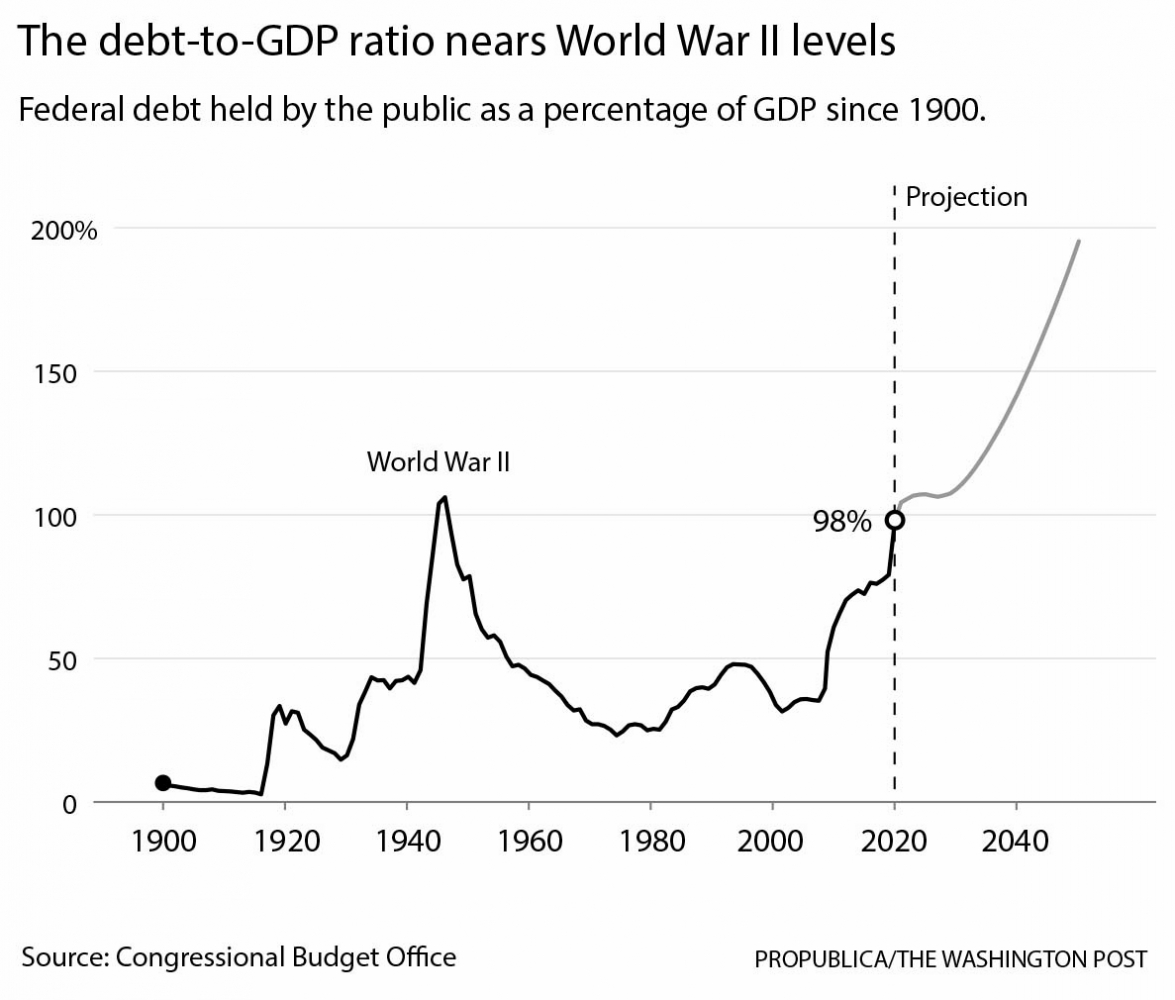
Our national debt has reached immense levels relative to our economy, nearly as high as it was at the end of World War II. But unlike 75 years ago, the massive financial overhang from Medicare and Social Security will make it dramatically more difficult to dig ourselves out of the debt ditch.

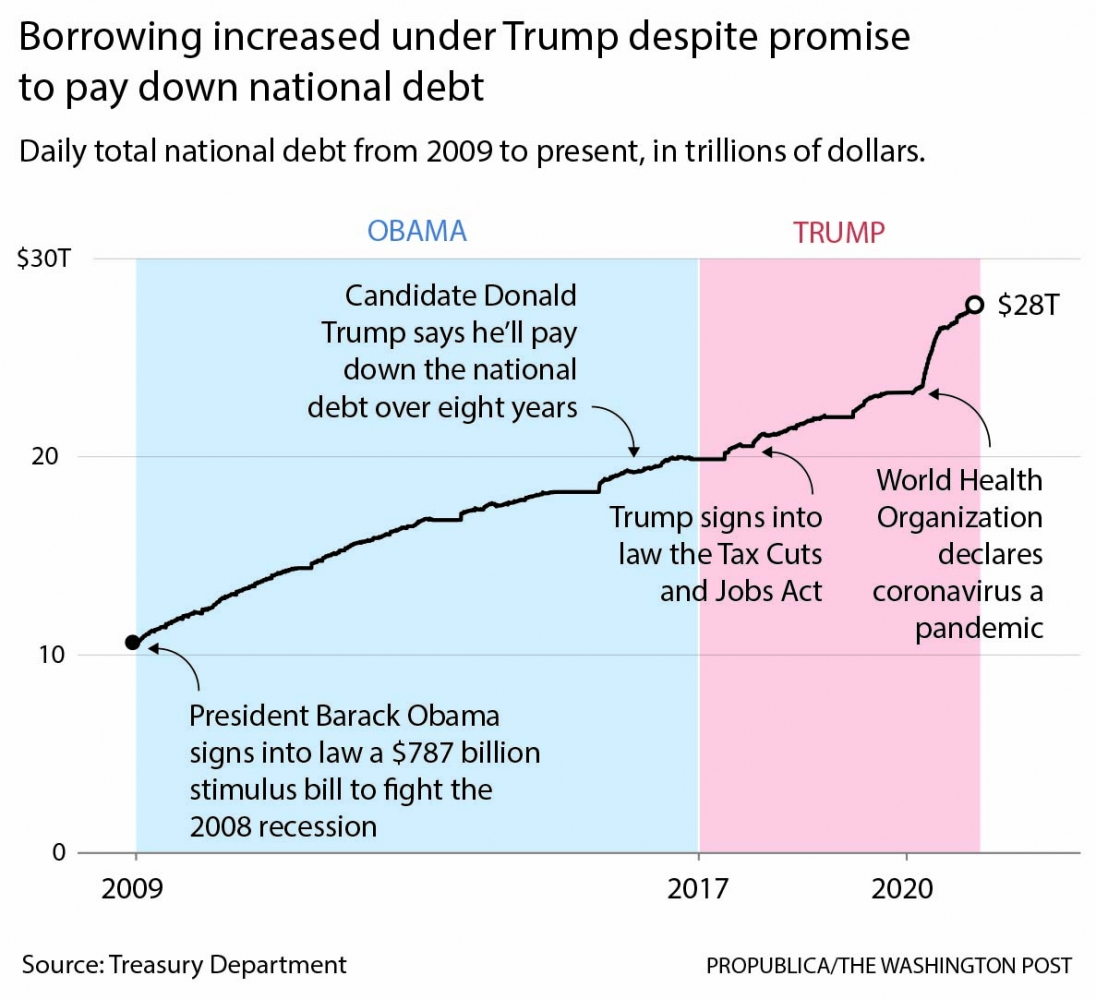
Falling deeper into the red is the opposite of what Trump, the self-styled “King of Debt,” said would happen if he became president. In a March 31, 2016, interview with Bob Woodward and Robert Costa of The Washington Post, Trump said he could pay down the national debt, then about $19 trillion, “over a period of eight years” by renegotiating trade deals and spurring economic growth.

After he took office, Trump predicted that economic growth created by the 2017 tax cut, combined with the proceeds from the tariffs he imposed on a wide range of goods from numerous countries, would help eliminate the budget deficit and let the United States begin to pay down its debt. On July 27, 2018, he told Fox News’s Sean Hannity, “We have $21 trillion in debt. When [the 2017 tax cut] really kicks in, we’ll start paying off that debt like it’s water.”

Nine days later, he tweeted, “Because of Tariffs we will be able to start paying down large amounts of the $21 trillion in debt that has been accumulated, much by the Obama Administration.”

That’s not how it played out. When Trump took office in January 2017, the nonpartisan Congressional Budget Office was projecting that federal budget deficits would be 2% to 3% of our gross domestic product during Trump’s term. Instead, the deficit reached 3.8% of GDP in 2018 and 4.6% in 2019.

There were multiple culprits. Trump’s tax cuts, especially the sharp reduction in the corporate tax rate to 21% from 35%, took a big bite out of federal revenue. The CBO estimated in 2018 that the tax cut would increase deficits by about $1.9 trillion over 11 years.

Meanwhile, Trump’s claim that increased revenue from the tariffs would help eliminate (or at least reduce) our national debt hasn’t panned out. In 2018, Trump’s administration began hiking tariffs on aluminum, steel and many other products, launching what became a global trade war with China, the European Union and other countries.

The tariffs did bring in additional revenue. In fiscal 2019, they netted about $71 billion, up about $36 billion from President Barack Obama’s last year in office. But although $36 billion is a lot of money, it’s less than 1/750th of the national debt. That $36 billion could have covered a bit more than three weeks of interest on the national debt – that is, had Trump not unilaterally decided to send a chunk of the tariff revenue to farmers affected by his trade wars. Businesses that struggled as a result of the tariffs also paid fewer taxes, offsetting some of the increased tariff revenue.

By early 2019, the national debt had climbed to $22 trillion. Trump’s budget proposal for 2020 called it a “grave threat to our economic and societal prosperity” and asserted the United States was experiencing a “national debt crisis.” However, that same budget proposal included substantial growth in the national debt.

By the end of 2019, the debt had risen to $23.2 trillion and more federal officials were sounding the alarm. “Not since World War II has the country seen deficits during times of low unemployment that are as large as those that we project – nor, in the past century, has it experienced large deficits for as long as we project,” Phillip Swagel, director of the CBO, said in January 2020.

Weeks later, the coronavirus erupted and made the financial situation far worse. As of Dec. 31, 2020, the national debt had jumped to $27.75 trillion, up 39% from $19.95 trillion when Trump was sworn in. The government ended its 2020 fiscal year with the portion of the national debt owed to investors, the metric favored by the CBO, around 100% of GDP. The CBO had predicted less than a year earlier that it would take until 2030 to reach that approximate level of debt. Including the trillions owed to various governmental trust funds, the total debt is now about 130% of GDP.

Normally, this is where we’d give you Trump’s version of events. But we couldn’t get anyone from the White House to give us Trump’s side. Judd Deere, a White House spokesman, referred us to the Office of Management and Budget, which is a branch of the White House.

OMB didn’t respond to our requests. The Treasury Department directed us to comments made by OMB Director Russell Vought in October, in which he predicted that as the pandemic eases and economic growth rebounds, the “fiscal picture” will improve. The OMB blamed legislators for deficits when Trump submitted his proposed 2021 budget: “Unfortunately, the Congress continues to reject any efforts to restrain spending. Instead, they have greatly contributed to the continued ballooning of Federal debt and deficits, putting the Nation’s fiscal future at risk.”

Still, the deficit growth under Trump has been historic. Steuerle, of the Tax Policy Center, has done a comparison of every American president using a metric called the “primary deficit.” It’s defined as the deficit minus interest costs, because interest is the only budget expense that presidents and Congress can’t control unless they want to do the unthinkable and default on the debt. Steuerle examined the records of 45 presidents to see how, as of the final year of their administrations, the primary deficit had shrunk or grown relative to the size of the economy.

Trump had the third-biggest primary deficit growth, 5.2% of GDP, behind only George W. Bush (11.7%) and Abraham Lincoln (9.4%). Bush, of course, not only passed a big tax cut, as Trump has, but also launched two wars, which greatly inflated the defense budget. Lincoln had to pay for the Civil War. By contrast, Trump’s wars have been almost entirely of the political variety.

Our national debt is now at its highest level relative to our economy since the end of World War II. After the war ended, the extraordinary military expenses disappeared, a postwar recovery began and the debt began to fall rapidly relative to the size of the economy.

But that’s not going to happen this time. When World War II ended 75 years ago, Social Security was in its infancy and Medicare didn’t exist. Today, many of our biggest and most rapidly growing expenses, especially Social Security and Medicare, are baked into the budget because of our nation’s aging population. These outlays are slated to rise sharply. Steuerle recently calculated that Social Security, health-care and interest costs are projected to absorb 122% of the total growth in federal revenue from 2019 to 2030.

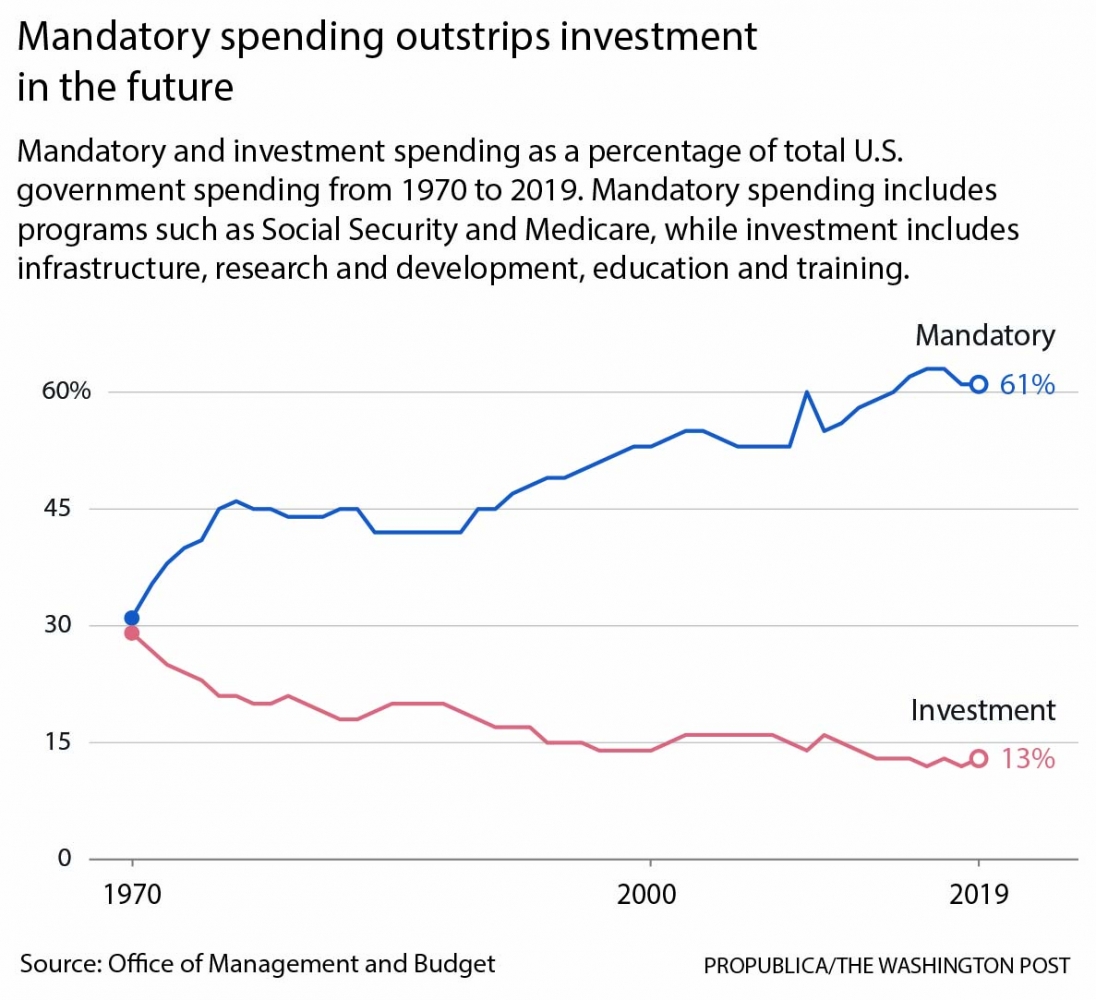
What’s more, our investment in the future – things like research and development, education, infrastructure and workforce training – is declining as a proportion of the budget. OMB data shows that in 1970, mandatory spending (such as Social Security and Medicare, but not including interest on the debt) and investment each made up around 30% of total federal spending. But as of 2019, the most recent available year, mandatory spending had doubled to around 61% of total federal spending, while investment fell by more than half, to around 12.5%.

Spending more and more on past promises and shrinking the proportion of spending for the future doesn’t bode well for our kids and grandkids. Had Trump done what he said he’d do and paid off part of the national debt before the coronavirus struck, rather than adding significantly to the debt, the situation would be considerably less dire. And had Trump done a better job of coping with the pandemic, the economic and human costs would’ve been greatly reduced.

In addition to forcing us to reduce the proportion of the budget spent on the future to help pay for the past, there’s a second reason huge and growing budget deficits matter: interest costs.

Bigger debt ultimately means bigger interest costs, even in an era when the Federal Reserve has forced down Treasury rates to ultralow levels. The government’s net interest cost (including interest paid to government trust funds) was around $523 billion in the 2020 fiscal year. That outstrips all spending on education, employment training, research and social services, Treasury data shows.

Interest costs are way below where they’d be if the Fed hadn’t forced rates down to try to stimulate the economy and mitigate the impact of the pandemic. One-year Treasury securities cost taxpayers a minuscule 0.10% in interest at year’s end, down from 1.59% at the end of 2019. The 10-year Treasury rate was 0.93%, down from 1.92%.

In late December, the Fed reported boosting its Treasury holdings by more than $2 trillion from a year earlier. The increase is primarily in longer-term securities. That has kept the federal government from having to raise trillions of dollars in the capital markets, and therefore has kept longer-term interest rates way below where they would otherwise be.

But unless something changes, even the Fed’s promise to keep interest rates near current levels for several years won’t fend off future problems. Most of the government’s borrowing to fund pandemic relief has been shorter-term borrowing that will have to be refinanced in the coming years. If rates rise, so will the government’s interest expense.

Even with rates where they are, interest on the debt is already going to be the fastest-growing budget category this decade, according to the Peter G. Peterson Foundation, which tracks the issue. Annual net interest costs are projected to double in 10 years and grow so large beyond 2030 that interest will become a driving factor in annual deficit growth, according to Peterson estimates.

Listen to what Swagel, the CBO director, had to say on the subject in a report to congressional Republicans in December: “Although the current low interest rates indicate that the debt is manageable for now and that the United States is not facing an immediate fiscal crisis, in which interest rates abruptly escalated or other disruptions occurred, the risk and potential budgetary consequences of such a crisis become greater over time.”

Trump was asked about this risk during a virtual discussion with the Economic Club of New York in October. “If we have another stimulus bill out of Congress, are you worried that the entire amount of federal debt will be too large for us to pay off in a sensible way?” asked David Rubenstein, a private equity executive.

Trump answered by falsely claiming that the United States was starting to pay off the national debt before the pandemic and claimed that future economic growth would let it do so. “I think you’re going to see tremendous growth, David, and the growth is going to get it done,” Trump said.

Two months later, when Congress finally approved $900 billion of economic stimulus that is being financed with debt, Trump challenged Congress to spend – and borrow – even more. Then he went golfing.

U.S. reportedly decides against investing ban on Alibaba, Tencent and Baidu, source #SootinClaimon.Com

#SootinClaimon.Com : ขอบคุณแหล่งข้อมูล : หนังสือพิมพ์ The Nation.

U.S. reportedly decides against investing ban on Alibaba, Tencent and Baidu, source

InternationalJan 15. 2021

By Syndication Washington Post, Bloomberg · Nick Wadhams

U.S. officials deliberated but ultimately decided against banning American investment in Alibaba Group Holding Ltd. and Tencent Holdings Ltd., a person familiar with the discussions said, removing a cloud of uncertainty over Asia’s two biggest corporations.

The Treasury Department blocked a Pentagon effort to add the two internet firms on grounds they aided the military, the person said, asking not to be identified discussing private talks. Officials also debated blocking search leader Baidu Inc. but dropped the plan, the person added. Alibaba’s Hong Kong stock climbed as much as 3.9% while Tencent rose almost 5% on news of the reprieve, which was first reported by the Wall Street Journal. Their dollar bond spreads tightened Thursday morning.

The decision removes uncertainty hanging over Chinese social media and gaming leader Tencent and Alibaba, the e-commerce titan founded by billionaire Jack Ma that’s now under intense regulatory scrutiny by Beijing regulators. President Donald Trump has signed an amended version of his executive order banning investment in Chinese military-linked companies, the White House said in a statement Wednesday that didn’t mention any company by name.

Imposing a ban on the pair would have marked the most dramatic escalation yet by the outgoing administration, given the sheer size of the two firms and the difficulty unwinding positions. At more than $1 trillion, their combined market value is nearly twice the size of Spain’s stock market, while the firms together account for about a 10th of the weighting for MSCI Inc.’s emerging markets benchmark.

Citing national security, Trump previously signed an executive order in November requiring investors to pull out of Chinese companies linked to that nation’s military. The Defense Department will add more companies to the roster, the person said without elaborating.

That would further fray the relationship between the world’s two largest economies, which have clashed over everything from covid-19 to Hong Kong. Authorities in Washington have ramped up efforts to deprive Chinese companies of U.S. capital in the final months of the Trump administration, adding to economic tensions as President-elect Joe Biden prepares to take over this month.

“China opposes politicizing economic and trade issues and abusing state power and the concept of national security to suppress foreign companies,” Chinese Foreign Ministry spokesman Zhao Lijian said during a regular briefing Thursday. Zhao urged the U.S. to respect market economy principles and provide a fair, unbiased and transparent business environment for foreign companies.

Hasty measures have at times sown confusion in markets and prompted price swings, such as when the New York Stock Exchange reversed course twice on a decision to delist three Chinese telecommunications companies. The NYSE is now proceeding with its original delisting plan after U.S. Treasury Secretary Steven Mnuchin disagreed with its decision to give the firms a reprieve.

Trump’s order banned trading in affected securities starting Jan. 11. If Biden leaves Trump’s executive order in place, U.S. investment firms and pension funds would be required to sell their holdings in companies linked to the Chinese military by Nov. 11. And if the U.S. determines additional companies have military ties in the future, American investors will be given 60 days from that determination to divest.

House hands Trump a second impeachment, this time with GOP support #SootinClaimon.Com

#SootinClaimon.Com : ขอบคุณแหล่งข้อมูล : หนังสือพิมพ์ The Nation.

House hands Trump a second impeachment, this time with GOP support

InternationalJan 14. 2021House Speaker Nancy Pelosi, D-Calif.House Speaker Nancy Pelosi, D-Calif.

By The Washington Post · Mike DeBonis, Paul Kane

WASHINGTON – The House made history Wednesday by impeaching a president for a second time, indicting President Donald Trump a week before he leaves office for inciting a riot with false claims of a stolen election that led to the storming of the Capitol and five deaths.

Unlike Trump’s first impeachment, which proceeded with almost no GOP support, Wednesday’s effort attracted 10 Republicans, including Rep. Liz Cheney, the No. 3 party leader in the House. The Senate now appears likely to hold a trial after Trump’s departure, an unprecedented scenario that could end with lawmakers barring him from holding the presidency again.

The final vote was 232-197.

One of the final dramas of a tumultuous presidency, the impeachment unfolded against the backdrop of near-chaos in the House and uncertainty about where Trump’s exit leaves the GOP. Democrats and Republicans exchanged accusations and name-calling throughout the day, while Trump loyalists were livid at fellow Republicans who broke ranks – especially Cheney – leaving the party’s leadership shaken.

But despite the emotions stirred by the Capitol assault, the great majority of Republicans stood by the president, including Minority Leader Kevin McCarthy, R-Calif.. He argued on the House floor that while Trump bears responsibility for the attack on the Capitol, the snap impeachment would only “further fan the flames of partisan division.”

McCarthy for the first time publicly endorsed a censure for Trump, but the call came too late to serve as an effective alternative to impeachment.

House Speaker Nancy Pelosi, D-Calif., and other Democrats made it clear Wednesday that censure would not suffice given the circumstances, with Trump riling up his supporters with false claims of election fraud, then urging them to march on Congress as it was certifying President-elect Joe Biden’s victory.

“He must go,” Pelosi said. “He is a clear and present danger to the nation that we all love.”

The House took its final vote Wednesday afternoon, one week after the riot and just two days after the impeachment resolution was filed. It was a stunningly swift response from a House that took nearly three months to impeach Trump in 2019 on charges of abuse of power and contempt of Congress.

But with just seven days remaining in Trump’s term, it became increasingly certain Wednesday that Trump would not be removed from office prematurely. The impeachment resolution for “incitement of insurrection,” however, also seeks Trump’s future “disqualification to hold and enjoy any office of honor, trust, or profit under the United States.”

The focus will now turn to how the trial will unfold in the Senate, which has never before held an impeachment trial for a former president.

Biden issued a statement shortly after the House vote signaling his concern that his agenda not be sidelined.

“I hope that the Senate leadership will find a way to deal with their constitutional responsibilities on impeachment while also working on the other urgent business of this nation,” Biden said.

Senate Majority Leader Mitch McConnell, R-Ky., refused a request from Minority Leader Charles Schumer, D-N.Y., to reconvene the Senate early to launch Trump’s trial. That means it can start the proceedings no sooner than Jan. 19 – a day before Biden’s inauguration.

McConnell, who signaled through advisers Tuesday that he would be open to a possible conviction, said in a memo released as the House debated that there was no chance that a trial could be fairly concluded before the inauguration, even if he agreed to Schumer’s request. Previous presidential impeachment trials, he noted, took 83, 37 and 21 days.

McConnell pointedly left open the possibility that he might vote to convict Trump.

“I have not made a final decision on how I will vote and I intend to listen to the legal arguments when they are presented to the Senate,” he said in the note, first sent to his fellow Republican senators.

Schumer, for his part, suggested determination to hold the trial even with Trump gone from the White House. “Make no mistake, there will be an impeachment trial in the United States Senate; there will be a vote on convicting the president for high crimes and misdemeanors; and if the president is convicted, there will be a vote on barring him from running again,” he said.

McCarthy called on the House floor for Trump to “quell the brewing unrest,” and with Republican votes in the balance, Trump quickly issued a brief written statement: “I urge that there must be NO violence, NO lawbreaking and NO vandalism of any kind,” he said. “That is not what I stand for, and it is not what America stands for. I call on ALL Americans to help ease tensions and calm tempers.”

Later Wednesday evening, Trump issued a five-minute video denouncing the protesters: “Mob violence goes against everything I believe in, and everything our movement stands for. No true supporter of mine could ever endorse political violence.”

But the statements came too late for the clutch of Republicans who voted to impeach. Instead, several cited his impromptu remarks the previous day claiming his actions had been “totally appropriate.”

The Republicans who broke from Trump included senior leaders such as Cheney, the Republican conference chairwoman; Rep. John Katko of New York, the top GOP member of the Homeland Security Committee; and Rep. Fred Upton of Michigan, a former chairman of the Energy and Commerce Committee. But junior members such as freshman Rep. Peter Meijer of Michigan and second-term Rep. Anthony Gonzalez of Ohio also voted for impeachment.

Some, such as Rep. Adam Kinzinger of Illinois, have been sharply critical of Trump in the past. Others, such as Rep. Tom Rice of South Carolina, have hardly ever said a cross word about him.

“I have backed this President through thick and thin for four years. I campaigned for him and voted for him twice,” Rice said in a statement. “But, this utter failure is inexcusable.”

Other Republicans voting to impeach Trump were Reps. Jaime Herrera Beutler of Washington, Dan Newhouse of Washington and David Valadao of California.

Rep. Jim Jordan, R-Ohio, one of Trump’s staunchest defenders, said the fact that only nine Republicans joined Cheney, and the dam did not break in a more dramatic way, showed that Trump retained wide support within the GOP.

Asked if Trump could still be an effective leader of the party, Jordan said, “Of course he is. Of course he is. His support is strong because the American people appreciated that over the past four years he did more of what he said he would do than any president in my lifetime.”

Several other Republicans declined to comment on Trump’s future, saying instead that the lopsided GOP vote reflected concerns about the impeachment process and the political environment.

“It actually represents a feeling among Republicans – even Republicans who are disappointed with this president – that with only seven days left to go in his term and with the toxic political environment being what it is, that there’s a real need in the country to lower the temperature,” said Rep. Garland “Andy” Barr, R-Ky. “This is viewed by a lot of Americans as an act of political vengeance.”

Many GOP members said they were struggling to reconcile their anger at last week’s events, and Trump’s culpability in them, with their fears of escalating violence and threats directed at lawmakers.

“This isn’t a fun time, that’s for sure,” said Valadao, who said he was undecided just hours before voting to impeach.

Democrats encouraged the handful of Republicans who came to the floor Wednesday in support of impeachment. When Newhouse broke publicly with Trump on the House floor, colleagues across the aisle delivered applause.

“These articles of impeachment are flawed, but I will not use process as an excuse,” he said. “There is no excuse for President Trump’s actions.”

But most Republicans speaking Wednesday put little distance between themselves and Trump. Many sidestepped the actual charge against Trump, instead arguing that the Democrats were being divisive and that impeachment was unnecessary so close to Trump’s departure.

Rep. Andy Biggs, R-Ariz., leader of the pro-Trump House Freedom Caucus who had embraced the “Stop the Steal” effort that culminated in the Jan. 6 rally, warned Democrats that they would only embolden Trump supporters.

“You believe that your hunger will be finally satiated by impeaching this president without completion of his full term of office,” Biggs said. “Instead of stopping the Trump train, his movement will grow stronger, for you will have made him a martyr.”

The scene in the Capitol highlighted how fluid the political landscape has become one week before the departure of a president who has aggressively shaken up politics for four years. Cheney and Jordan were emerging as leaders of what are roughly anti- and pro-Trump factions of the GOP, with the party’s nominal leader, McCarthy, somewhere in the middle.

Democrats, meanwhile, face what is likely to be Pelosi’s last term as speaker without a clear successor and with the narrowest congressional majority in decades – often a recipe for trouble as voters’ expectations exceed a party’s ability to deliver.

In a sign of the House GOP’s tenuous political standing, McCarthy convened a call about two hours after the vote with his top financial donors. A slew of Fortune 500 companies in recent days have sworn off donations to the Republicans who voted to overturn the electoral college results, a group that includes McCarthy.

McCarthy told the donors that he called Biden on Tuesday and “pledged to work together” with the new administration, according to a participant in the call, who spoke on the condition of anonymity to discuss the private call.

McCarthy also tried to reassure the wealthy contributors that he rejected the conspiracy theory that antifa was responsible for last week’s violence and said Trump deserved “some of the responsibility” for the attacks.

The most immediate fallout from the impeachment effort appears likely to occur inside the Republican Party, as several Trump loyalists called for Cheney to immediately resign her leadership position. A petition for her resignation circulated among GOP offices in the Capitol as hard-right members seethed over her role in backing Trump’s ouster.

Cheney on Wednesday insisted she would not resign: “I’m not going anywhere,” she told reporters. “Our nation is facing an unprecedented, since the Civil War, constitutional crisis. That’s what we need to be focused on.”

Democrats, meanwhile, prepared for a new governing reality – with Biden assuming the presidency in a week and Democrats taking the narrowest of Senate majorities, with Vice President-elect Kamala Harris poised to break 50-50 ties.

With some Democrats openly floating a delay in transmission of the impeachment measure to allow the Senate to confirm at least some of Biden’s Cabinet nominees, Pelosi on Wednesday did not respond to questions about her plans.

Some Republicans predicted that their internal bloodletting over Trump would soon be swept aside once Democrats take unified control in Washington.

“We’re going to get through this, and we’re going to be united, because Speaker Pelosi is going to bring some very dangerous policy to the House floor that’s frankly going to divide them and unite us,” said Rep. Richard Hudson, R-N.C., a junior member of the party leadership.

ระวัง! หนุ่มจีนเฉียดตายเพราะบีบสิว นอนไอซียูร่วมเดือน #SootinClaimon.Com

#SootinClaimon.Com : ขอบคุณแหล่งข้อมูล : หนังสือพิมพ์โพสต์ทูเดย์

https://www.posttoday.com/world/642746

วันที่ 14 ม.ค. 2564 เวลา 19:00 น.ระวัง! หนุ่มจีนเฉียดตายเพราะบีบสิว นอนไอซียูร่วมเดือนชายชาวจีนจากมณฑลเจียงซูถูกหามเข้าโรงพยาบาลหลังปอดติดเชื้อรุนแรงเพราะบีบสิวบริเวณ “สามเหลี่ยมแห่งความตาย”

เว็บไซต์ Daily Mail รายงานว่า “เฉิน” ชายชาวจีนคนหนึ่งจากมณฑลเจียงซูทางตะวันออกของจีนเกือบเสียชีวิตหลังบีบสิวบริเวณใต้ริมฝีปากส่งผลให้มีอาการติดเชื้อรุนแรงทำให้ต้องรักษาตัวในห้องไอซียูนานกว่า 1 เดือน

โดยสื่อท้องถิ่นรายงานว่าในตอนแรกเฉินเริ่มมีไข้ หายใจลำบาก และปากบวมแดงไม่นานหลังจากที่เขาบีบสิวด้วยตนเองในช่วงต้นเดือนธันวาคมที่ผ่านมา

จนกระทั่งภรรยาของเขาเห็นท่าไม่ดีจึงรีบนำตัวส่งโรงพยาบาล โดยแพทย์วินิจฉัยว่าเฉินมีอาการปอดอักเสบติดเชื้อรุนแรงเนื่องจากแผลที่เกิดจากการบีบสิวติดเชื้อและแพร่กระจายไปยังปอดทั้งสองข้างจึงรีบนำเข้าห้องไอซียู

แพทย์กล่าวเพิ่มเติมว่าอาการติดเชื้อของเฉินเกิดจากการที่เขาบีบสิวบริเวณคางซึ่งเรียกกันว่า “สามเหลี่ยมแห่งความตาย” (Triangle of Death) เนื่องจากบริเวณนั้นเป็นบริเวณที่มีเส้นเลือดอยู่มากซึ่งมีความเชื่อมโยงไปยังปอด

เราจึงควรหลีกเลี่ยงการบีบสิวด้วยตัวเอง โดยเฉพาะหากผิวหนังโดยรอบบวมแดง มีอาการเจ็บปวดหรือมีไข้ ควรรีบไปพบแพทย์โดยเร็วที่สุด

ภรรยาของเฉินกล่าวกับผู้สื่อข่าวว่า “ฉันเคยเตือนเขาแล้วว่าอย่าบีบสิวเพราะเขาชอบทำเป็นประจำ แต่ก็ไม่คาดคิดว่าจะส่งผลรุนแรงขนาดนี้”

เฉินใช้เวลารักษาในห้องไอซียูราว 1 เดือนก่อนที่อาการจะทรงตัวแต่แพทย์แนะนำให้ยังคงพักรักษาตัวเพื่อสังเกตอาการต่อไป

Photo by PIERRE-PHILIPPE MARCOU / AFP

จำคุก 20 ปีอดีตผู้นำเกาหลีใต้พัวพันคอร์รัปชัน #SootinClaimon.Com

#SootinClaimon.Com : ขอบคุณแหล่งข้อมูล : หนังสือพิมพ์โพสต์ทูเดย์

https://www.posttoday.com/world/642743

วันที่ 14 ม.ค. 2564 เวลา 18:00 น.จำคุก 20 ปีอดีตผู้นำเกาหลีใต้พัวพันคอร์รัปชันศาลฎีกาพิพากษายืนจำคุกอดีตประธานาธิบดีหญิงเกาหลีใต้ 20 ปี

เอเอฟพีรายงานว่าวันนี้ (14 มกราคม) ศาลสูงสุดเกาหลีใต้พิพากษายืนจำคุกอดีตประธานาธิบดีปาร์ค กึน-เฮ เป็นเวลา 20 ปี ในข้อหาคอร์รัปชัน 15 ปี และข้อหาใช้อำนาจในทางมิชอบอีก 5 ปี รวมทั้งปรับและริบทรัพย์รวม 21,500 ล้านวอน (ประมาณ 587 ล้านบาท)

หลังจากที่ก่อนหน้านี้เธอถูกตัดสินจำคุกเป็นเวลา 30 ปีและปรับเงิน 20,000 ล้านวอนในคำพิพากษาครั้งก่อนเมื่อเดือนกรกฎาคมปีที่ผ่านมา

นอกจากนี้เธอยังถูกตัดสินจำคุกอีก 2 ปีในข้อหาละเมิดกฎหมายการเลือกตั้ง ส่งผลให้เธอถูกจำคุกรวมทั้งสิ้น 22 ปี โดยขณะนี้เธอมีอายุ 68 ปี

ปาร์ค กึน-เฮ ประธานาธิบดีหญิงคนแรกของเกาหลีใต้ถูกฟ้องร้องยื่นถอดถอนออกจากตำแหน่งประธานาธิบดีในปี 2017 หลังจากที่ชาวเกาหลีใต้จำนวนมากออกมาเดินขบวนขับไล่ จึงกลายเป็นประธานาธิบดีที่มาจากการเลือกตั้งคนแรกของเกาหลีใต้ที่ถูกถอดถอนออกจากตำแหน่งและถูกดำเนินคดีในเวลาต่อมา

จนกระทั่งศาลชั้นต้นพิพากษาครั้งแรกในปี 2018 ในข้อหารับสินสนและใช้อำนาจในทางมิชอบโดยถูกตัดสินจำคุกเป็นเวลา 30 ปี จากนั้นมีการยื่นอุทธรณ์หลายครั้งจนได้ลดโทษเหลือ 20 ปี

ทั้งนี้ ศาลพิพากษาว่าเธอสมรู้ร่วมคิดกับเพื่อนสนิท ชอย ซุน-ซิล รับสินบนจากกลุ่มบริษัทรวมถึงซัมซุง และมีความผิดฐานปล่อยเอกสารลับของประธานาธิบดี

จีนสั่งตรวจโควิดเชิงรุกหลังพบผู้เสียชีวิตคนแรกรอบ 8 เดือน #SootinClaimon.Com

#SootinClaimon.Com : ขอบคุณแหล่งข้อมูล : หนังสือพิมพ์โพสต์ทูเดย์

https://www.posttoday.com/world/642736

วันที่ 14 ม.ค. 2564 เวลา 17:00 น.จีนสั่งตรวจโควิดเชิงรุกหลังพบผู้เสียชีวิตคนแรกรอบ 8 เดือนจีนรายงานผู้เสียชีวิตจากโควิด-19 รายแรกของประเทศในรอบ 8 เดือน ด้านผู้ติดเชื้อรายใหม่ทุบสถิติรายวันสูงสุดตั้งแต่มีนาคมปีที่แล้ว

Global Times รายงานเมื่อวันที่ 14 มกราคมว่า จีนรายงานผู้เสียชีวิตจากโควิด-19 ในประเทศเป็นครั้งแรกในรอบ 8 เดือน นับตั้งแต่วันที่ 17 พฤษภาคมปีที่แล้ว

โดยสำนักงานคณะกรรมการสาธารณสุขเหอเป่ย์เผยว่าผู้เสียชีวิตคนดังกล่าวเป็นเพศหญิงจากมณฑลเหอเป่ย์ทางตอนเหนือของจีนซึ่งมีโรคประจำตัวและป่วยหนักก่อนที่จะเสียชีวิตในช่วงบ่ายวันที่ 13 มกราคมตามเวลาท้องถิ่น

ทางการจีนระบุว่าผู้ป่วยส่วนใหญ่จากการติดเชื้อระลอกนี้เป็นวัยกลางคนและผู้สูงอายุในชุมชน โดยอายุเฉลี่ยของผู้ป่วยที่ได้รับการยืนยันในมณฑลเหอเป่ย์คือ 50 ปี โดยร้อยละ 30 ของผู้ป่วยมีอายุมากกว่า 60 ปี

หยาง จางฉิว รองผู้อำนวยการแผนกชีววิทยาจากมหาวิทยาลัยอู่ฮั่นกล่าวว่าผู้ป่วยที่มีโรคประจำตัวอัตราการเสียชีวิตจะสูงกว่าผู้ป่วยทั่วไปเนื่องจากไวรัสจะทำให้โรคที่เป็นอยู่รุนแรงขึ้น และการที่จะมีผู้เสียชีวิตจากโรคโควิด-19 นั้นไม่ใช่เรื่องแปลกเนื่องจากผู้ป่วยในเหอเป่ย์ระลอกนี้มีอายุเฉลี่ยสูง

อย่างไรก็ตามการเสียชีวิตไม่ได้เป็นตัวบ่งชี้โดยตรงว่าไวรัสแพร่ระบาดรุนแรงขึ้นในประเทศจีนแต่อาจมีสาเหตุมาจากโรคแทรกซ้อนอื่นๆ ที่ผู้ป่วยเป็นอยู่แล้ว

ทั้งนี้ จีนได้ยกระดับการตรวจหาเชื้อเชิงรุกเป็นวงกว้าง และยกระดับมาตรการควบคุมและป้องกันโรค เช่น สั่งปิดเมืองทางตอนเหนือของประเทศ หลังจากที่พบผู้ติดเชื้อในประเทศติดต่อกันหลายวัน โดยมีผู้ติดเชื้อรายใหม่ 138 ราย ซึ่งเป็นตัวเลขรายวันที่สูงที่สุดนับตั้งแต่เดือนมีนาคมปีที่แล้ว รวมถึงมีผู้เสียชีวิตจากโรคโควิด-19 ครั้งแรกในรอบ 8 เดือน

Photo by STR / AFP

พบภาพวาดอายุ 45,500 ปีในถ้ำอินโดนีเซีย #SootinClaimon.Com

#SootinClaimon.Com : ขอบคุณแหล่งข้อมูล : หนังสือพิมพ์โพสต์ทูเดย์

https://www.posttoday.com/world/642723

วันที่ 14 ม.ค. 2564 เวลา 15:30 น.พบภาพวาดอายุ 45,500 ปีในถ้ำอินโดนีเซียภาพหมูป่าอินโดนี้นับเป็นภาพวาดที่เก่าแก่ที่สุดในโลกเท่าที่เคยพบมา

วารสาร Science Advance เปิดเผยการค้นพบครั้งสำคัญทางประวัติศาสตร์ว่า ทีมนักโบราณคดีค้นพบภาพเขียนสีรูปหมูป่าอินโดขนาดเท่าของจริงในถ้ำ Leang Tedongnge บนเกาะสุลาเวสีของอินโดนีเซีย โดยคาดว่าภาพดังกล่าวมีอายุอย่างน้อย 45,500 ปี นับเป็นภาพวาดที่เก่าแก่ที่สุดในโลกเท่าที่เคยพบ

แม็กซิม ออแบร์ ผู้เชี่ยวชาญด้านการวิเคราะห์อายุโบราณวัตถุจากมหาวิทยาลัยกริฟฟิธของออสเตรเลียซึ่งเป็นหนึ่งในทีมเผยว่า ภาพเขียนดังกล่าวถูกพบเมื่อปี 2017 โดย บาสราน บูร์ฮาน นักศึกษาปริญญาเอก ที่ร่วมอยู่ในทีมสำรวจที่ทำร่วมกับทางการอินโดนีเซีย

ภาพหมูป่าอินโดขนาด 136×54 เซนติเมตร ถูกวาดโดยใช้สีแดงเหลืองออกน้ำตาล มีงาโผล่ออกมา 1 คู่ซึ่งเป็นลักษณะของหมูป่าเพศผู้ และยังพบภาพพิมพ์รอยมืออยู่เหนือส่วนหลังของหมู่ป่า

ออแบร์เผยว่า เมื่อใช้ไอโซโทปยูเรเนียมวิเคราะห์อายุแร่แคลไซต์ที่ทับถมอยู่เหนือรูปวาดพบว่าแคลไซต์ที่สะสมอยู่มีอายุ 45,500 ปี ทว่าภาพวาดโบราณอาจมีอายุมากกว่านี้ เนื่องจากการคำนวณอายุใช้แร่แคลไซต์ที่อยู่ชั้นบนสุดซึ่งเกิดขึ้นภายหลังเท่านั้น

ทางทีมเชื่อว่าภาพวาดดังกล่าววาดโดยโฮโมซาเปียนส์ ทว่าไม่สามารถระบุได้แน่นอน

ก่อนหน้านี้ นักโบราณคดีทีมเดียวกันได้พบภาพวาดครึ่งมนุษย์ครึ่งสัตว์ที่กำลังล่าสัตว์เลี้ยงลูกด้วยนมอายุอย่างน้อย 43,900 ปี

Photo by Adhi Agus OKTAVIANA / GRIFFITH UNIVERSITY / AFP

WHO เข้าจีนเรียบร้อย เดินหน้าหาต้นตอโควิด #SootinClaimon.Com

#SootinClaimon.Com : ขอบคุณแหล่งข้อมูล : หนังสือพิมพ์โพสต์ทูเดย์

https://www.posttoday.com/world/642720

วันที่ 14 ม.ค. 2564 เวลา 14:00 น.WHO เข้าจีนเรียบร้อย เดินหน้าหาต้นตอโควิดทีมงานขององค์การอนามัยโลกถึงอู่ฮั่น เตรียมสืบหาต้นตอโควิดหลังกักตัวครบ 14 วัน

บีบีซีรายงานว่าทีมงานขององค์การอนามัยโลก (WHO) เดินทางถึงเมืองอู่ฮั่นประเทศจีนเป็นที่่เรียบร้อย เพื่อเริ่มตรวจสอบต้นตอของการแพร่ระบาดของไวรัสโคโรนา หลังจากที่มีการเจรจากับทางการจีนมาเป็นเวลาหลายเดือน

โดยเมื่อต้นเดือนที่ผ่านมาองค์การอนามัยโลกเผยว่าทีมนักวิจัยถูกปฏิเสธไม่ให้เข้าประเทศจีน ขณะที่จีนกล่าวว่าเกิดจากการสื่อสารคลาดเคลื่อนและการเตรียมการสำหรับการสอบสวนโรคยังอยู่ในระหว่างการหารือ

การวิจัยดังกล่าวจะดำเนินการโดยกลุ่มนักวิจัยทั้งหมด 10 คน เข้าสัมภาษณ์ผู้คนในสถาบันวิจัย โรงพยาบาล และตลาดอาหารทะเล ที่เชื่อมโยงกับการระบาดครั้งแรกที่เมืองอู่ฮั่นเมื่อปลายปี 2019 แม้ว่าจีนจะออกมาย้ำหลายครั้งว่าการระบาดไม่ได้เกิดขึ้นที่นั่น

ทั้งนี้ ศาสตราจารย์เดล ฟิชเชอร์ ประธานหน่วยป้องกันและรับมือกับการแพร่ระบาดทั่วโลกขององค์การอนามัยโลกกล่าวกับบีบีซีโดยหวังว่าผู้คนทั่วโลกจะมองว่านี่คือการดำเนินการทางวิทยาศาสตร์ และไม่เกี่ยวกับเรื่องการเมืองหรือการตำหนิกัน แต่เป็นการหาต้นตอเพื่อตอบคำถามทางวิทยาศาสตร์ และนักวิทยาศาสตร์ส่วนใหญ่ล้วนมองว่าไวรัสคือปรากฏการณ์ทางธรรมชาติ

อย่างไรก็ตามทีมนักวิจัยจากองค์การอนามัยโลกจะต้องเข้าสู่กระบวนการกักตัวเป็นเวลา 14 วันก่อนที่จะเริ่มการวิจัยในอู่ฮั่น

ในวันนี้ (14 ม.ค.) จีนยังได้รายงานผู้เสียชีวิตจากโควิด-19 รายแรกของประเทศในรอบ 8 เดือน และพบผู้ติดเชื้อรายใหม่ 138 ราย ซึ่งเป็นตัวเลขรายวันที่สูงที่สุดนับตั้งแต่เดือนมีนาคมปีที่แล้ว

Photo by NICOLAS ASFOURI / AFP