Growth in exports to South Korea is forecast to accelerate again this year making it one of Thailand’s top trading partners, the Department of International Trade Negotiations said on Monday. From January to November 2021, Thai exports to South Korea rose 39 per cent to US$5.373 billion year on year.
The biggest growth came in agricultural and processed agricultural exports, up 21 per cent to US$987 million, led by rubber (+62%), canned and processed seafood (+37%), sugar (+27%), cassava (+25%), and squid (+11%).
Meanwhile, industrial exports rose 37 per cent to $4.012 billion led by wood and wood products (+69%), computers, equipment and components (+60%), chemicals (+43%), circuit boards (+42%), and rubber products (+37%).
And with increased demand expected from its manufacturing sector this year, Thai businesses have an opportunity to expand exports to South Korea, said the department.
Thai exporters already benefit from zero tariffs on 90.6 per cent of goods shipped to South Korea under the Asean-South Korea free trade agreement (AKFTA), including automobiles, equipment and parts, electrical appliances, plastic products, rubber, frozen fish and shrimp meat and raw sugar.
And when the Regional Comprehensive Economic Partnership (RCEP) comes into force on February 1, Seoul will lift import tax on 90.7 per cent of listed products.
Also, South Korea is opening its market to Thai durian, mangosteen, guava, papaya and dates (current tariff 24-36%) and rubberwood (5%), cutting tariffs to zero by 2031.
Also gradually cut to zero by 2036 will be duties on canned sardines, processed tuna and processed seafood (now 20%), pet food (40.4%), dextrin and modified starch (100.6-192.8%) and tapioca starch (5%).
Thai tapioca exports will see their 20 per cent tariff and 40 per cent off-quota tax gradually reduced to zero by 2041.
The Revenue Department expects to issue tax rules for Thailand’s growing cryptocurrency trade by the end of this month, director-general Ekniti Nitithanprapas said on Monday.
His statement came after Prime Minister General Prayut Chan-o-cha urged the department to clarify rules for calculating tax on profits from the sale or investment of digital assets or cryptocurrencies.
Ekniti said his agency is now discussing cryptocurrency tax guidelines with the Bank of Thailand, Securities and Exchange Commission and other bodies.
Noting that cryptocurrency investment and exchange had grown by leaps and bounds over the past year in Thailand, he said this was a new issue for both taxpayers and the Revenue Department.
The baht opened at 33.63 to the US dollar on Monday, strengthening from the previous closing of 33.65.
The Thai currency is likely to move between 33.55 and 33.75 during the day and between 33.30 and 33.90 during the week, Krungthai Bank market strategist Poon Panichpibool predicted.
Poon said that the baht is likely to fluctuate due to the Omicron situation in the country. He said that investors should speculate investments from foreign investors.
However, Poon said that foreign investors will not sell a large number of Thai assets because they are not worried about the Omicron situation too much.
Poon said that the baht will not weaken past 34 to the dollar. if the spreading is not at the crisis.
The baht’s key support level would be from 33.30 to 33.40, the level some importers are waiting for so they can buy dollars, he added.
The key resistance level for the baht would be from 33.75 to 34.00 to the dollar, which is the level at which exporters might sell the US currency.
Poon said that the dollar is likely to strengthen if the US Federal Reserve’s sent a signal to increase the policy interest rate faster than expected. The dollar might go down slightly if the demand for safe-haven assets decreases.
Krungsri Securities forecast the Stock Exchange of Thailand (SET) Index on Monday (January 10) would fluctuate between 1,650-1,670 points due to lack of positive sentiment.
It predicted that uncertainty over the US Federal Reserve signalling it would raise interest rate sooner than expected and rising domestic Covid-19 infections would pressure the index.
“Hence, we advise investors to buy stocks which gained specific positive sentiment,” Krungsri Securities said.
It also recommended buying of the following companies’ shares as an investment strategy:
BCH, CHG, IMH, SMD and TM, which benefit from rising Covid-19 cases.
RCL, LEO, III, WICE, SONIC and JWD, which benefit from rising freight rate.
BBL, TTB, KBANK and BLA, which benefit from news of interest rate hike.
The SET Index closed at 1,657.62 on Friday, up 0.28 per cent, with transactions totalled 89.09 billion baht.
The Thai Digital Asset Association said on Sunday that it will write to the Revenue Department on Monday to seek clarification on collecting withholding tax on profits made from cryptocurrency.
The association’s president, Suppakrit Boonsat, said the Revenue Department is still looking into the taxes it should apply and the association is seeking to discuss the issue with the department.
“Most cryptocurrency investors are ready to pay tax but are concerned whether their move will violate the Revenue Code, which says the statute of limitations for the incorrect filing of tax is five years,” he said.
Suppakirt added that the association will launch public hearings on this issue as well.
“I suggest people wait for the Revenue Department to make a final decision and for results of the public hearing,” he added.
Thailand’s real estate market is now bustling as investors are using cryptocurrency to buy tangible property such as land, luxury homes and cars in a bid to cope with volatility.
Boon Yongsakul, chairman of Boat Pattana, a hotel operator and property developer in Phuket, said digital assets enabled investors, especially people aged 20-30, to generate enough income to buy up to THB300-million properties.
“Our customer bought two houses by using cryptocurrency – the first house worth THB12 million and the second costing THB20 million,” he said. “We accept cryptocurrency because they are the future and we cannot stop it,” he argued.
Amornchai Saehuang, chief operating officer of VIP Property Development in Phuket, said investors, especially Chinese, are using their cryptocurrency to buy tangible properties to cope with volatility.
He said a Chinese person recently bought a pool villa worth THB28 million using cryptocurrency.
“Cryptocurrency investors are the new wealthy who are able to purchase products and services at high prices,” he explained. “These investors will be the main factor in any future economy and this needs close monitoring.”
Amornchai added that cryptocurrency investors are paying attention to luxury houses and land in tourism areas such as Phuket, Pattaya and Hua Hin.
Thai Chamber of Commerce Housing Business Association president Issara Boonyang said cryptocurrency is an issue that everyone should be aware of as it is an inevitable global trend.
“Cryptocurrencies will play an important role in the real estate market in the future as investors will be able to use their real assets to issue cryptocurrencies instead of debentures or borrowing cash from financial institutions,” Issara said.
“This will become popular as new generations prefer investment that provides good and fast returns rather than deposits because the interest rate is low,” he added.
Nearly 60 per cent of condominium units sold in the first nine months of 2021 were bought by Chinese nationals, Wichai Wirattaphan, acting director of the Real Estate Information Centre, said recently.
According to statistics released by REIC, nationals from five countries were the biggest buyers of property in Thailand, namely: • China: 17.8 billion baht (59.9 per cent) • Vanuatu: 1.01 billion baht (3.4 per cent) • United States: 864 million baht (2.9 per cent) • United Kingdom: 732 million baht (2.5 per cent) • France: 711 million baht (2.4 per cent)
Wichai said Vanuatu nationals only bought 23 units, but this made a big dent in the property market because each unit was worth 44 million baht on average.
In the first nine months of 2021, the average size of units bought came in at 43 square metres at an average value of 4.9 million baht or 114,000 baht per square metre.
US nationals bought bigger units averaging at 54.8 square metres, while the most expensive units or 5.1 million baht on average were bought by Singaporeans.
The top five provinces popular among foreign buyers are: • Bangkok • Chonburi • Phuket • Chiang Mai • Prachuap Khiri Khan
CP Foods received the Gold Award for ESG thanks to its performance and multiple activities related to Environment, Society and Governance.
Charoen Pokphand Foods Public Company Limited (CP Foods) received two awards from The Asset ESG Corporate Awards 2021 organized by The Asset, Asia’s leading financial and investment magazine , namely Best CEO Award in the Agro & Food business and Gold Award for ESG, reflecting the commitment and outstanding achievement in strategic management with social responsibility, environment and good corporate governance in a fast-changing business environment.
Mr. Prasit Boonduangprasert, Chief Executive Officer of CP Foods, was named the Best CEO Award from the outstanding ability in the business management under rapidly changing situations, and communicating transparent information to stakeholders as well as being able to create effective cooperation both internally and externally.
Meanwhile, CP Foods received the Gold Award for ESG thanks to its performance and multiple activities related to Environment, Society and Governance.
These awards reflecting CP Foods’s commitment to operate business with social and environmental responsibility. The company also placed utmost importance to good corporate governance and transparency to create sustainable business growth. During the Covid-19 crisis, many measures have been put in place to ensure uninterrupted operations. Moreover, CP Foods, as a good citizen, has provided aids to the society amid the Covid-19 pandemic by delivering food supplies to help those who have affected by the crisis.
In 2022, we find ourselves heading in to the third year of a global health crisis with unparalleled supply chain impact. Repercussions from severe supply and demand imbalances are being felt worldwide. The availability and increasing cost of labor, freight capacity, semiconductors, empty chassis and warehouse storage space will continue to be areas of uncertainty and concern in the coming new year.
With new waves of coronavirus infection appearing globally just in time for the holiday season, our social and economic futures can appear murkier than ever. Still, I believe we can see new supply chain patterns emerging from today’s global trade and shipping chaos. Here are three of those patterns that we will be contending with in the new year:
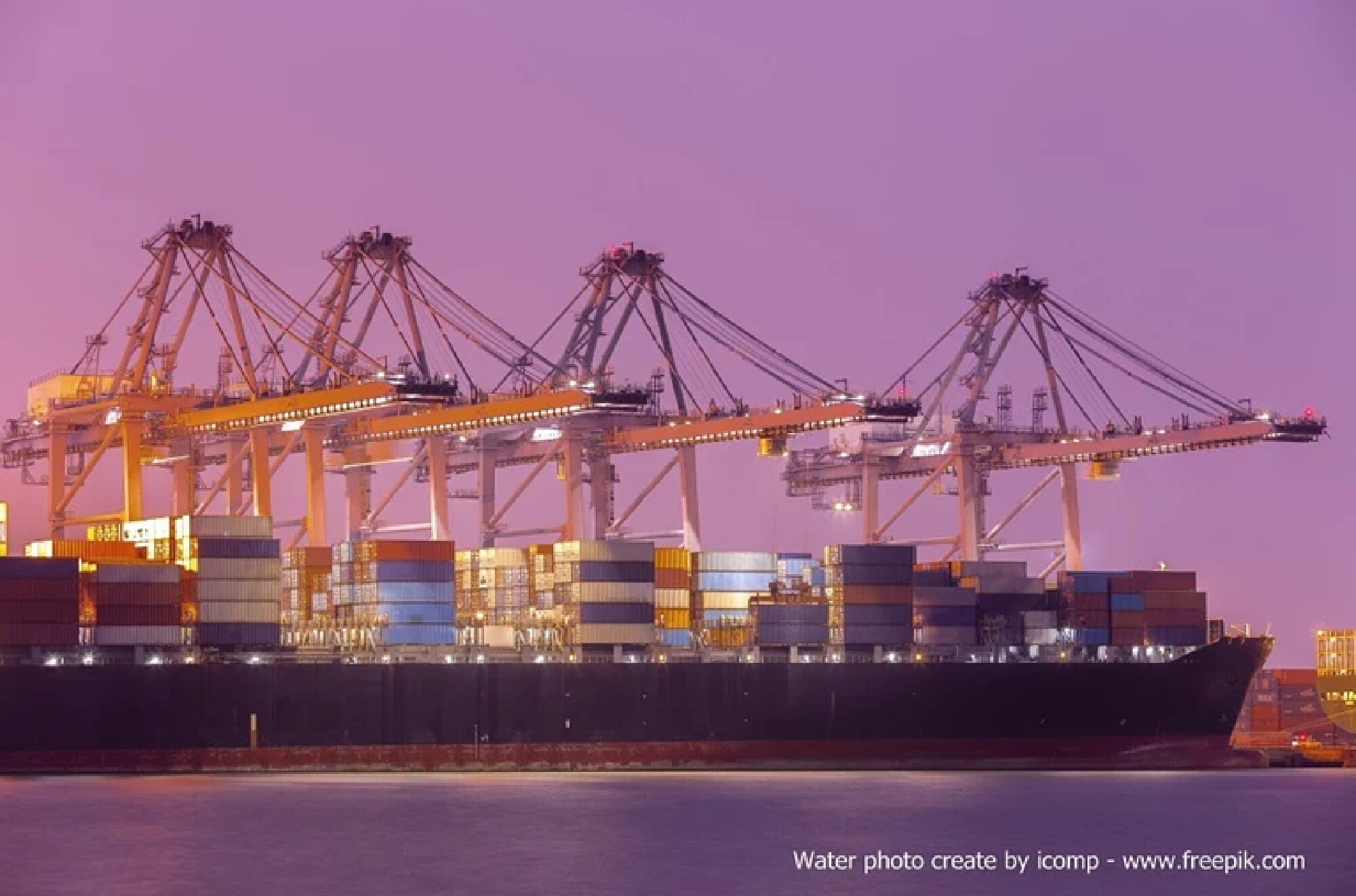
1) Container ship issues at major North American and Northern European ports will continue well in to 2023, because the current congestion and delays are not merely an ‘ocean’ shipping problem, but a global supply chain network problem. Issues with port labor, truck driver labor, warehouse unloading labor and both empty container and container chassis availability are all conspiring with increased inbound shipping volumes out of Asia (sparked by historically high consumer demand) to slow down the loading and unloading of ocean vessels and subsequent movement of goods out of ports to inland warehouse or deconsolidation locations.
2) To increase supply chain resilience as disruptions will continue to increase their pace and their impact scope, companies must prioritize first mile technology investments and collaborative logistics service provider relationships. Single-minded pursuit of lower costs will have to be replaced with new goals for holistic and multi-dimensional forms of visibility to things like freight capacity, supplier work-in-progress and financial health, modal hand-off points and shipment chain-of-custody progress, in addition to real-time visibility to inventory in transit. Resilience demands improved exception monitoring to support faster reaction times when issues arise within supplier networks or global shipping lanes. Success in delivering products the final mile to end customers is now clearly dependent on getting more control and increased flexibility in managing the first mile.
3) The following global supply chain trends we see today are likely to be longer-term:
Higher ocean and air freight shipping costs will remain, even when current congestion and capacity constraints have settled into a new global equilibrium
Traditional ‘peak season’ shipping markets will start earlier and run longer
Freight contracts will increasingly run for shorter terms
Shippers will continue expanded use of Non-Vessel-Operating Common Carriers (NVOCCs) and third-party logistics providers (3PLs) to secure more reliable freight capacity
More shippers will share dynamic freight capacity forecast needs with their key carriers to improve overall freight network planning
More shippers and consignees will be under pressure to improve their loading and unloading efficiency for trailers and containers in order to free up network freight capacity
More C-level executives will be looking closely at global logistics and supply chain strategies, emphasizing reduced supply uncertainty in tandem with cost management to protect their production lines, the end customer experience and total business profitability.
Because uncertainty around pandemic-influenced supply and demand challenges has become “the new normal” for supply chain professionals, it is imperative to improve the technologies and supply chain management tools they work with daily. Broader and more flexible partner connectivity, the addition of more external data sources, and supply network intelligence that finally connects demand signals and stakeholders downstream with procurement and shipment planning activity upstream will help ensure businesses can move quickly, pivot nimbly, and are set up for future success.
By Fabio Tiviti, Senior Vice President & General Manager, ASEAN-India, Infor
Predicting SET Index 2022 in a range of 1550-1750 points, tipping ten outstanding growth stocks benefiting from transforming new world business structures
SCB Securities Co., Ltd. (SCBS) believes that the outbreak of the COVID-19 Omicron strain will impact the economy and investment in 1Q22. Without proper control by 1Q22, the disease could jeopardize the Thai economy’s growth rate and the operating performance of listed companies in 2022, as previously predicted. SCBS see the SET Index fluctuating between 1,550 and 1,750 points this year. SCBS has selected ten outstanding stocks exhibiting good growth at reasonable prices, including those that will benefit from the new world trend of transforming business structures. The economic outlook for 2022 is based on three assumptions and five predictions, which include: 1) COVID-19 becoming endemic as a result of widespread vaccination; 2) the global tourism industry recovering by 60-90%; and 3) supply bottlenecks beginning to ease.
The five predictions are as follows: 1) global economic activity will return to normal in 2022; 2) global inflation will fall in the second half of 2022; 3) global monetary policy will tighten before returning to normal, with the exception of China, which continues to ease its monetary policy to balance its economy; 4) the Cold War between the US and China will intensify; and 5) The slowing Chinese economy, global financial market volatility, global stagflation risks, global climate volatility, and the outbreak of the COVID-19 Omicron strain (which may be more severe than the Delta strain) are all risk factors that must be closely monitored.
However, if the Omicron variant outbreak is not properly contained by the first quarter of 2022, the global economic growth rate in 2022 is likely to fall from 4.9% as predicted earlier by the IMF to 3.6%. In terms of the Thai economy, the GDP growth rate for 2022 is at risk of falling from 3.6 % to 2.5% if the plan to reopen the country to tourists is delayed, including the government’s resumption of tightening economic activities in the country.
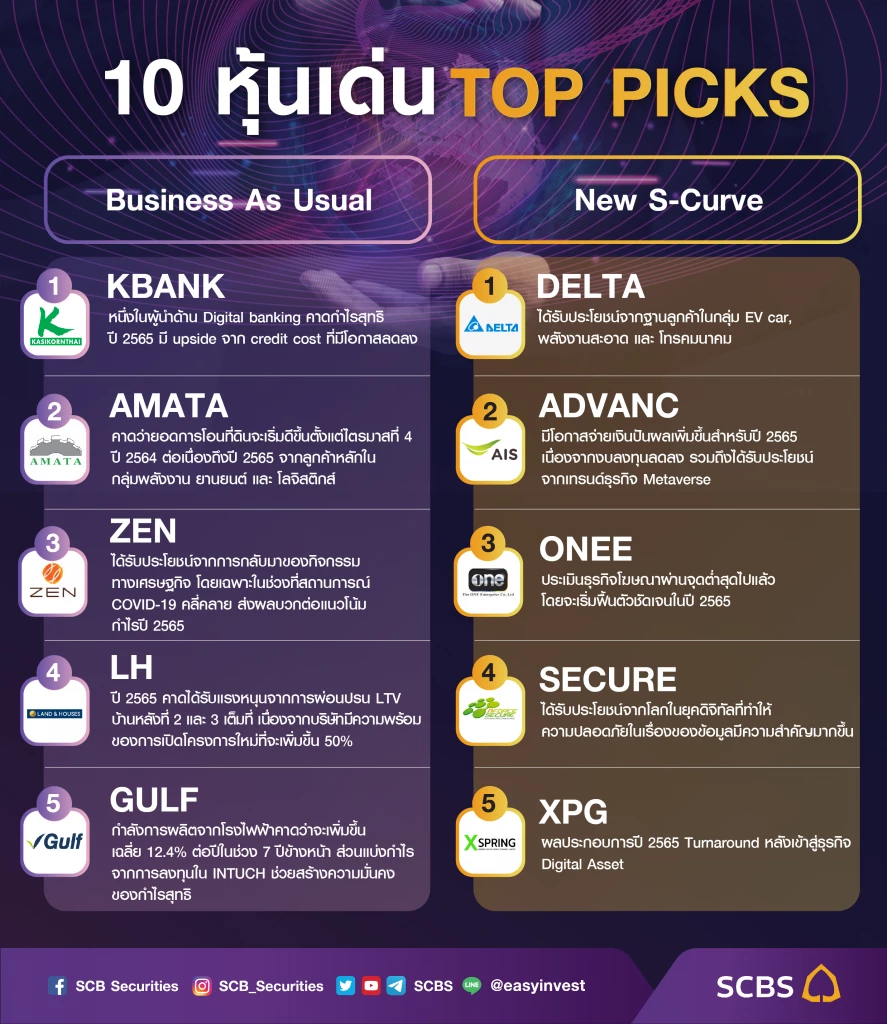
Based on fundamentals, the 2022 SET Index should stand at 1,660 points and move between 1,550 and 1,750 points. SCBS recommends ten stocks that will perform well in 2022, including KBANK, AMATA, ZEN, LH, and GULF, as well as stocks that will benefit from the modern business transformation trend, such as DELTA, ADVANC, ONEE, SECURE, and XPG.
SCBS Research Group Managing Director Sukit Udomsirikul stated that despite the global COVID-19 crisis, stock market volatility has decreased for the year 2021. As can be seen, stock markets around the world, including the Thai stock market, have recovered quickly. Despite the fact that the pandemic is still considered severe, the SET Index has recovered to pre-COVID-19 levels. This is because governments all over the world have accelerated economic stimulus measures and pumped money into financial markets at an unprecedented rate and intensity. Low interest rates and rising inflation have prompted investors to shift their money to higher risk stock markets.
Economic activity is expected to return to pre-COVID-19 crisis levels in 2022, implying stable GDP growth, slower inflation, rising interest rates, and tax increases to balance the government’s financial position. Finally, returns on stock market investments are expected to fall from 2021.
The rate of growth in developed economies (DM) will slow down. According to the IMF, GDP will grow at 4.5%, while the rate of growth in emerging markets (EM) is expected to recover at 5.1% in the latter half of 2022 as countries are reopening. With more and more people getting vaccinated, tourism and hospitality businesses will recover, partially offsetting the reduction in economic stimulus measures designed to boost consumption during the COVID-19 outbreak in 2020-2021. The new outbreak of the Omicron strain, on the other hand, is viewed as a risk that could cause economic forecasts to fall short of expectations.
Based on a “carefully positive” view, Thai economic trends in 2022 are expected to recover to 3.6 – 4.0% growth from a -6.1% contraction in 2020 and 1.0% growth in 2021. Exports are expected to grow by 2%, and approximately 8 million foreign tourists are expected to enter the country. Profits at publicly traded companies will increase by 6% yoy, driven by a 3 – 4% increase in GDP. SCBS estimates the SET Index’s yield to be 5% by the end of 2022, and 8% when dividends are factored in. In the worst-case scenario, the Thai economy’s growth rate could be reduced to a mere 2.6 % if the Omicron strain spreads unchecked, with listed companies growing at or near zero percent.
For investment strategy, investors should focus on growth stocks at reasonable prices, which are divided into two groups: 1) stocks that are expected to return to growth following the economic cycle and the opening up of more economic activities, such as KBANK, AMATA, ZEN, LH, and GULF; and 2) stocks that are likely to grow exponentially and benefit from modern business transformation trends, such as DELTA, ADVANC, ONEE, SECURE, and XPG.
Investment views for individual stocks:
KBANK: A digital banking leader, with an expected increase in net profit in 2022 due to lower credit costs.
AMATA: Land transfers from key customers in the energy, automotive, and logistics sectors are expected to improve beginning in 4Q21 and continue through 2022.
ZEN: The resumption of economic activity, particularly during the easing of the COVID-19 situation, will have a positive impact on its 2022 profit forecast.
LH: The company is ready to launch new projects that will increase by 50% with the relaxation of LTV regulations for second and third homes.
GULF: Over the next seven years, its power plant capacity is expected to grow by 12.4% per year on average, with profit sharing from INTUCH investments helping to stabilize net profit.
DELTA: The company will benefit from its existing customer base in the electrical vehicle, clean energy, and telecommunications sectors.
ADVANC: The company is likely to pay more dividends in 2022 due to a lower investment budget and the benefits of metaverse business trends.
ONEE: Assuming that the advertising industry has reached bottom, the company will begin to recover in 2022.
SECURE: Data security will become even more important in the digital age.
XPG: Following its entry into the digital asset business, its 2022 results will turn around.