The Stock Exchange of Thailand (SET) Index closed at 1,634.20 on Monday, down 9.22 points or 0.56 per cent. Transactions totalled 65 billion baht with an index high of 1,645.91 and a low of 1,631.29.
The index fell after rising by 5.87 points or 0.36 per cent on Thursday. The index on Friday was closed for substitution for Chulalongkorn Memorial Day.
In the morning session, Krungsri Securities forecast the SET Index on Monday would fluctuate between 1,635 and 1,655 points.
It said the index gained positive sentiment from rising oil price of above US$83 per barrel, the government’s move to lift the curfew in 17 provinces and the Bank of Thailand’s move to relax loan-to-value (LTV) mortgage rule.
“However, the index would be under pressure due to uncertainty the US Federal Reserve signalling it would taper its quantitative easing in November and mass sell-offs of shares after the index hit the resistance line,” Krungsri Securities said.
The 10 stocks with the highest trade value today were KBANK, BBL, BANPU, SPALI, AOT, CPALL, IRPC, SCB, BDMS and LH.
Other Asian indices were up with one exception:
Japan’s Nikkei Index closed at 28,600.41, down 204.44 points or 0.71 per cent.
China’s Shanghai SE Composite closed at 3,609.86, up 27.26 points or 0.76 per cent, while the Shenzhen SE Component closed at 14,596.72, up 103.90 points or 0.72 per cent.
Hong Kong’s Hang Seng Index closed at 26,132.03, up 5.10 points or 0.020 per cent.
South Korea’s KOSPI Index closed at 3,020.54, up 14.38 points or 0.48 per cent.
Taiwan’s TAIEX Index closed at 16,894.24, up 5.50 points or 0.033 per cent.
Continuation of an outstanding growth in the 3rd quarter +40% compared to 2019 and +31% compared to 2020 at constant exchange rates
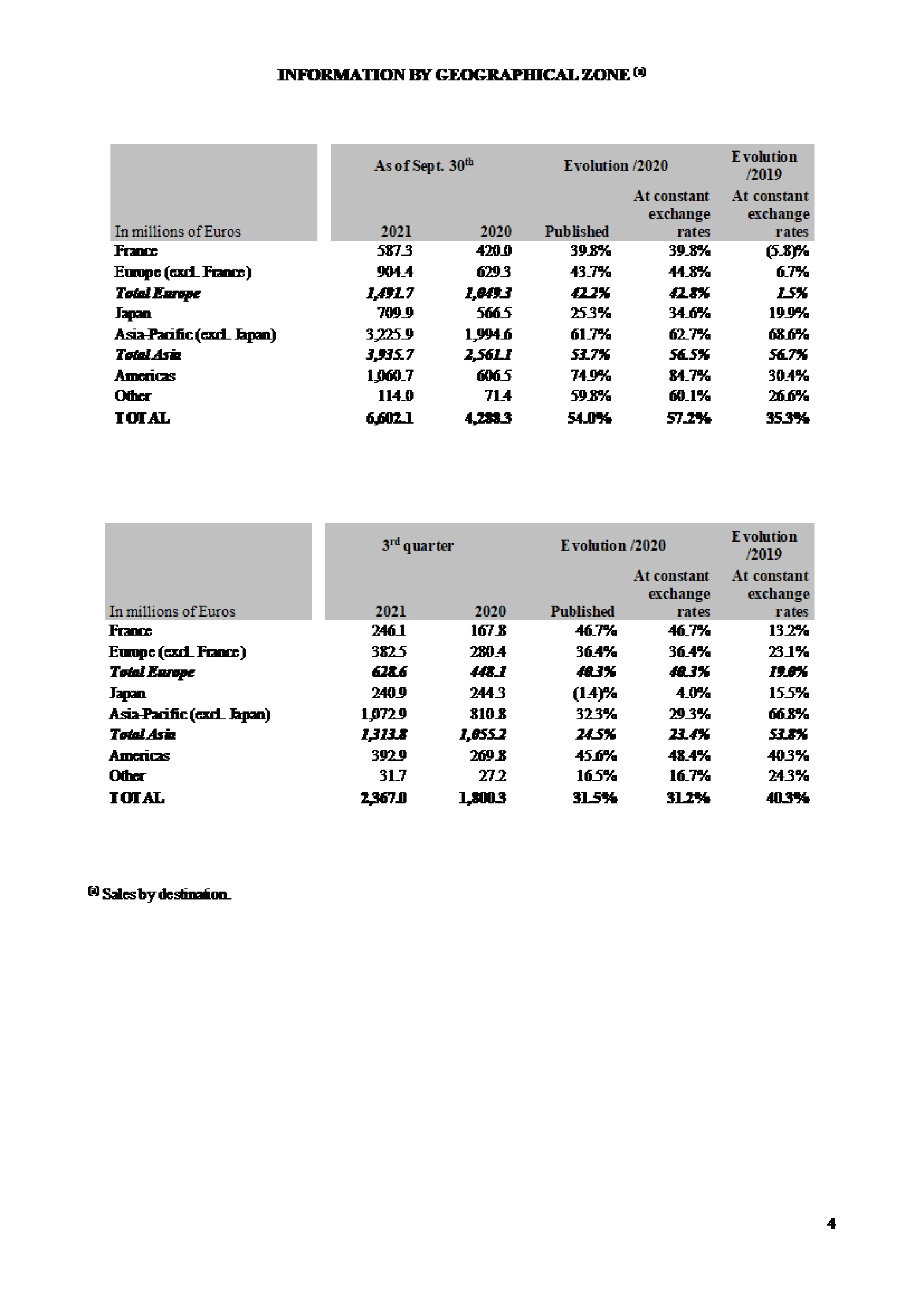
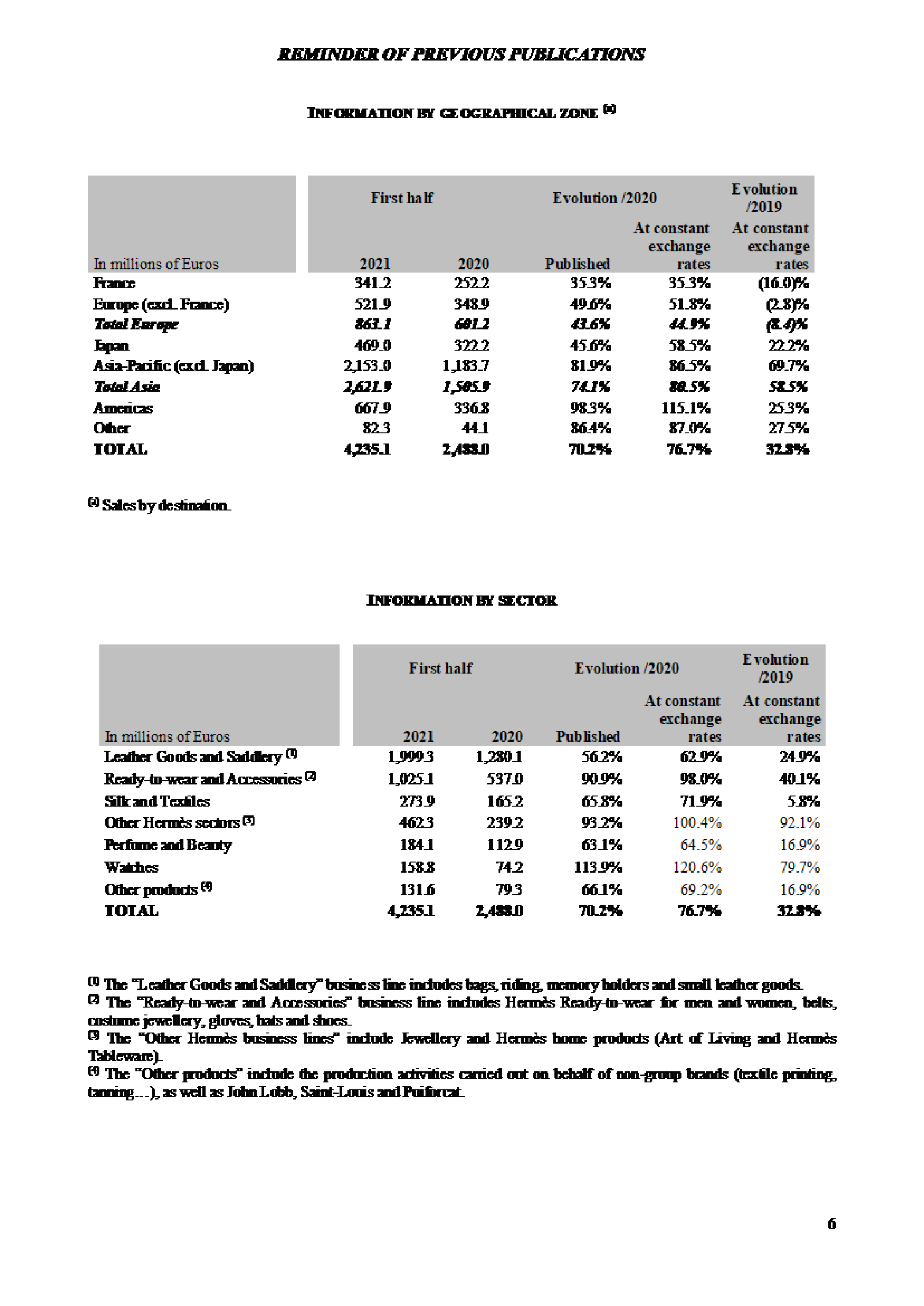
The Group’s consolidated revenue amounted to €6,602 million at the end of September 2021, up 57% at constant exchange rates and 54% at current exchange rates compared to the same period in 2020. This increase is of 35% over two years.
In the third quarter, the Group’s consolidated revenue reached €2,367 million. Sales growth was outstanding at +31% at constant exchange rates compared to 2020 and reached +40% over two years. The activity benefited from an upturn in sales in Europe, an acceleration in America and a sustained dynamic in Asia.
Axel Dumas, Executive Chairman of Hermès, said: “The performance of the third quarter reflects an atypical year, during which we continue our strategic investments and accelerate job creations. In a world that remains unstable, the balance between our sixteen métiers and between our locations around the world, allows us to move forward with optimism and caution, while continuing to create beautiful, high quality, sustainable objects.”
Sales by geographical area at the end of September (at comparable exchange rates, unless otherwise indicated)
At the end of September 2021, all the geographical areas confirmed their strong growth, with each one posting double-digit growth in the third quarter compared to 2019. Over the first nine months of the year, sales in the Group’s stores increased 60% at constant exchange rates compared to last year, and 43% compared to 2019. The network continued to develop with store openings and extensions, and online sales increased worldwide. Wholesale activities remain penalised particularly by travel retail.
• Asia excluding Japan (+63% and +69% over two years) continued to see sustained activity, driven by an excellent third quarter (+29% and +67% over two years). It gained from a remarkable performance in Greater China and other countries in Asia, despite new restrictions in Australia, Thailand and Malaysia in the third quarter. In September, Hermès unveiled a second store in Shenzhen, our 28th address in mainland China.
• Japan (+35% and +20% over two years) confirmed its solid growth, thanks to the loyalty of local customers, despite restrictions due to the health state of emergency.
• America (+85% and +30% over two years) accelerated significantly at the end of September, driven by an outstanding performance in the third quarter (+48% and +40% over two years). A new store opened in Florida’s Aventura Mall on October 1st.
• Europe excluding France (+45% and +7% over two years), and France (+40% and -6% over two years), strongly recovered in the third quarter, with double-digit growth compared to 2019 (+23% and +13% respectively). They benefitted from the support of local customers, growing online sales and the partial return of tourist traffic. The store in Milan reopened in July after renovation and extension work, boasting two extra floors. In September, petit h moved into the rue de Sèvres store in Paris in a location designed to reflect the dialogue created by the métier between sustainability, the creation of objects and the reuse of materials.
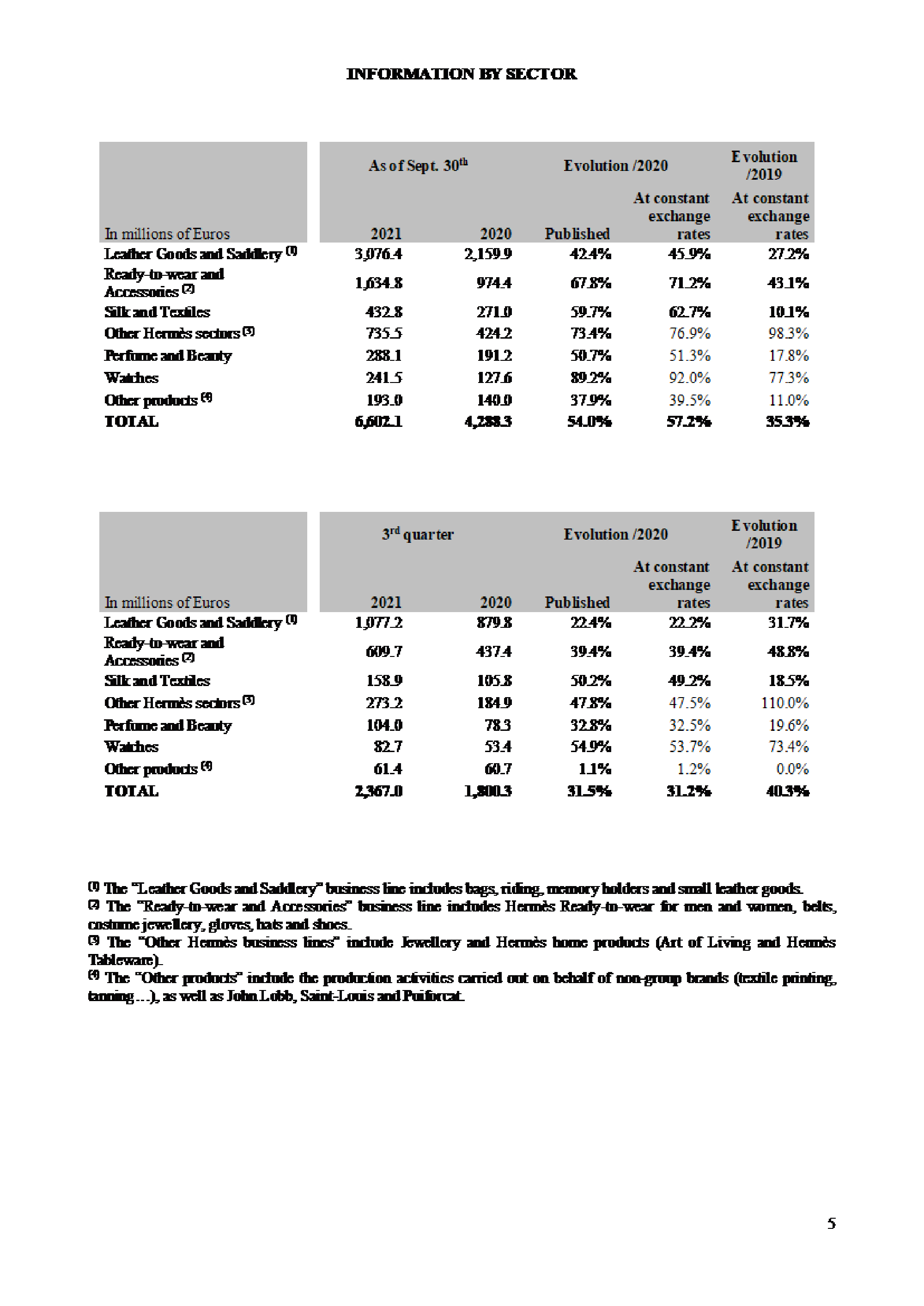
Sales by business line at the end of September (at comparable exchange rates, unless otherwise indicated)
At the end of September 2021, all the business lines posted double-digit growth, both compared to 2019 and 2020, with an excellent performance over the third quarter and an outstanding increase in Ready-to-wear and Accessories, Watches and Other Hermès Business Lines (Jewellery and Homeware).
Sales in the Leather Goods and Saddlery division (+46% and +27% over two years) benefitted from significant deliveries over the third quarter and sustained demand. The maroquinerie de Guyenne (Gironde), the 19th leather goods workshop of the house, opened in September, reasserting our local presence in France and the creation of jobs. The increase in production capacities continues, with the Louviers site (Eure) planned for 2022, the Sormonne site (Ardennes) for 2023 and a new site in Riom (Puy-de-Dôme) for 2024. In September, faithful to our commitments to know-how transmission and education, Hermès opened the École Hermès des savoir-faire (Hermès school of know-how), which is accredited by the French Education Department and will award a State-approved diploma in leatherworking expertise.
The Ready-to-wear and Accessories business line (+71% and +43% over two years) pursued its dynamic growth, thanks to the success of the ready-to-wear, fashion accessories and footwear collections. The Women’s Spring-Summer 2022 fashion show, unveiled early October, revealed a solar collection with aerial silhouettes, after the Men’s collection early July, around an artistic performance filmed in real time.
The Silk and Textiles business line (+63% and +10% over two years) performed well. A new printing line has been inaugurated as part of the development of the production site in Lyon to meet demand.
Perfume and Beauty (+51% and +18% over two years) benefitted from the successful launches of the H24 Perfume for Men and Twilly Eau Ginger, from the development of the Beauty line, with the sustainable, refillable limited edition of Rouge Hermès Éclat de la nuit. After the launch of Beauty in China in July, the métier continues its deployment to expand with hand care products this fall.
The Watches business line (+92% and +77% over two years) confirmed its excellent performance, reflecting the technical watch-making expertise and creativity of the collections, with the success of the men’s watch Hermès H08 and other classics of the house.
The Other Hermès business lines (+77% and +98% over two years) confirmed their momentum, thanks to Homeware and Jewellery.
A responsible, sustainable model
In September, the MSCI ESG rating index published an “A” rating in its analysis of the house’s resilience to environmental, social and governance risks.
Hermès was ranked second best Textiles and Clothing company out of 174 firms in the Sustainalytics ranking, with “low” exposure to ESG risks.
Lastly, the group has been included in the CAC 40 ESG index, after entering the V.E (Vigeo-Eiris) “Advanced” category.
These results reflect the sustainable dimension of Hermès’ craftsmanship model, and our ongoing efforts to improve our social and environmental performance.
Highlights
At the end of September, currency fluctuations represented a negative impact on revenue of €139 million.
Over the first nine months, Hermès International redeemed 142,131 shares for €162 million, excluding transactions completed within the framework of the liquidity contract.
Outlook
In a context of gradual improvement in the health situation, the group is continuing its investments and accelerates job creations. Despite a high comparison base in the 4th Quarter, the group is approaching the end of the year with confidence.
Our highly integrated craftsmanship model and balanced distribution network, as well as the creativity of our collections and our customers’ loyalty, give us confidence in the future.
In the medium-term, despite the economic, geopolitical and monetary uncertainties around the world, the Group confirms an ambitious goal for revenue growth at constant exchange rates.
2021 is marked by the Odyssey, we continue our journey remaining confident in the future, facing the uncertainties of the world whilst remaining true to who we are.
Thanks to its unique business model, Hermès is pursuing its long-term development strategy based on creativity, maintaining control over know-how and singular communication.
The press release on Revenue at the end of September 2021 is available on the Group’s website: https://finance.hermes.com.
Upcoming events:
• 18 February 2022: publication of the 2021 annual results
• 14 April 2022: Q1 2022 revenue publication
• 20 April 2022: General meeting of Shareholders 2022
The research on “Harmonious Justice: Thailand’ s Approach to Harmonious Justice” and “the UN Handbook on Restorative Justice Programs” (Second Edition)” promise to equip judicial personnel with practical tools to remove obstacles, facilitate remedy, and enforce laws.
“Agroup of teenagers attacked a health volunteer out of misunderstanding while he was on guard at a local hospital in Si Sa Ket province. Later on, attackers not only knelt down to ask for an apology through the arrangements of their family and community leaders but also offered Bt20,000 compensation. The victim forgave and returned Bt20,000”.
This case, a solid example of how “community can take part in judicial process”, was highlighted during a webinar on “Harmonious Justice: Background and Expectations of Thailand’s Criminal-Justice Process”. Held by the Thailand Institute of Justice (TIJ), the webinar took place on 15 September 2021 to introduce the research on “Harmonious Justice: Thailand’s Approach to Restorative Justice” and the Thai translation of “UN Handbook on Restorative Justice Programs” (Second Edition)” to provide judicial personnel with tools to upgrade their work and knowledge that can apply to Thai context.
Research Shows Restorative Justice Reduces Reoffending Rate, Presents Solution to Problems in Judicial Process, Prison Overcrowding
TIJ advisor Prof. Dr. Kittipong Kittayarak, who has advocated restorative justice in Thailand throughout the past few decades, told the webinar that restorative justice promised solutions based on the consensus of all relevant parties including victims and offenders thus paving way for remedy as well as harmony.
“Instead of focusing on retribution, Thailand should change its paradigm and embrace restorative justice. Several foreign countries have already jumped on this path. Excessive emphasis on retribution-based punishment has not only overwhelmed courts and prisons but it has also failed to curb crimes,” he pointed out.
Restorative justice in essence resonates with Thailand’s deep-rooted culture. Therefore, if the concept applies systematically, it should be able to solve many judicial issues. Importantly, the proper application must include clear identification of crimes’ root causes. Restorative justice is about bringing parties in conflict together on a voluntary basis for heart-to-heart talks in an appropriate atmosphere to encourage repentance, forgiveness, and then the new beginning. Restorative justice process must also recognize that parties involved must be forgiving for harmony to really happen.
Prof. Dr. Kittipong hoped that the concept of restorative justice would be used outside judicial system too, for example at schools where bullying was reported. In his view, harmonious justice will materialize not just with the introduction of supportive laws, legal mechanisms, and strategies but also the engagement of communities. When communities acknowledge the concept, they will be able to help take care of both offenders and victims.
Conducted nationwide through collaboration with foreign experts, a TIJ research has found that restorative justice can prevent reoffending when communities play an active role in support of judicial process.
“Restorative justice can fill the gap within Thailand’s criminal justice system. Retribution now separates offenders from victims, depriving them of opportunities to clear up the air and to reach mutual understanding. Victims have little participation in judicial process and end up having no say about what their remedy should be,” Prof. Dr. Kittipong commented.
Research Shows Restorative Justice Reduces Reoffending Rate, Presents Solution to Problems in Judicial Process, Prison Overcrowding
Mr. Ukrit Sornprohm, lead researcher and project manager at TIJ, said victim-centric judicial system accorded importance to the remedial process as it improved the relationships among parties in conflict and promoted social harmony. When restorative process was integrated into justice system, victims and offenders could talk in a way that led to repentance, the show of responsibility, and the delivery of remedy.
According to him, the restorative justice concept can apply to the stage of legal enforcement too. In Thailand, the Corrections Department has deployed the concept in designing activities between prisoners and victims/communities as well as among prisoners, and in preparing prisoners’ social reintegration. Even though the application has run into some problems, it marks progress for restorative justice in Thailand.
Presently, restorative justice has been most accepted in juvenile cases in Thailand. Directors of juvenile observation and protection centers are allowed by laws to consider using restorative justice. With this option, young offenders will not have criminal records and get opportunities to improve their behaviors. Their family will take part in restorative-justice talks with victims.
According to research findings, key indicators of restorative-justice success should be offenders’ improved behaviors/ability to avoid reoffending; agreements reached by parties in conflict; and victim satisfaction.
Research Shows Restorative Justice Reduces Reoffending Rate, Presents Solution to Problems in Judicial Process, Prison Overcrowding
Prof. Yvon Dandurand, another key researcher, revealed during the webinar that Canada’s justice system complied with international standards, and all its states were required to promote restorative justice. He said restorative justice promised to satisfy victims during the remedial process, reduce reoffending rate, offer offenders’ smoother reintegration into society, and boost public confidence in the justice system. According to him, restorative justice worked especially well in cases where parties in the conflict used to have good relations before. If offenders are underage, parents/guardians will be engaged in the decision making process. Both victims and offenders can opt-in or opt-out of the restorative justice stage, with full information on their choices provided.
Research Shows Restorative Justice Reduces Reoffending Rate, Presents Solution to Problems in Judicial Process, Prison Overcrowding
Mrs. Santanee Ditsayabut, director of Nitivajra Institute, disclosed that a total of 612,830 cases reached Thailand’s courts of first instance in 2019. Of them, 103,121 resulted in jail terms while 265,840 led to suspended jail terms. Statistics back to 2013 also revealed that 30 percent of convicts had reoffended for three consecutive years. These figures reflect that although courts have meted out retributive punishments, reoffending rate is still relatively high.
Believing that “overwhelmed courts and prisons” are proofs of the ineffective judicial process, Mrs. Santanee described restorative justice as a solution. She also pointed out that restorative justice would encourage repentance, not just confession, and lead to proper remedy.
Research Shows Restorative Justice Reduces Reoffending Rate, Presents Solution to Problems in Judicial Process, Prison Overcrowding
National Human Rights Commissioner Ms. Pitikan Sithidej strongly recommended restorative justice for environmental-crime cases in which ethnic groups were accused of encroaching on national parks despite the fact that their families had lived there for generations. She added that medical-malpractice cases should also be handled on the basis of restorative justice.
Mr. Atiruj Tunbooncharoen, presiding justice of Chon Buri Court, said the criminal justice process now attached importance to remedy for victims and even encouraged mediation before the cases came to courts. However, he pointed out that the restorative justice process was not without challenges given that remedy was mostly in the form of financial compensation and sometimes victims felt they were not compensated emotionally.
Also, Mr. Atiruj pointed out that courts needed supervisors from communities to watch over suspects who were bailed out without a bond.
Research Shows Restorative Justice Reduces Reoffending Rate, Presents Solution to Problems in Judicial Process, Prison Overcrowding
TIJ executive-director Prof. Phiset Sa-ardyen reckonedthat challenges existed for the implementation of restorative justice especially in the face of the huge number of cases, the need to efficiently protect criminal victims’ rights, and legal constraints. However, he explained that in essence, it took community engagement and understanding for restorative justice to materialize as at its heart were cooperation from all sides and a focus on victims.
The research on “Harmonious Justice: Thailand’ s Approach to Harmonious Justice” and “the UN Handbook on Restorative Justice Programs” (Second Edition)” promise to equip judicial personnel with practical tools to remove obstacles, facilitate remedy, and enforce laws.
You may download the full research and the Thai translation of the UN Handbook from
The baht has strengthened to 33.20 per US dollar from an opening of 33.25, Kasikorn Research Centre reported on Monday morning.
It said the dollar had seen no new supporting factors while investors in the currency are monitoring the US inflation rate.
Moreover, the increased price of commodities has stimulated the selling rate of the dollar, the centre added.
The centre also predicted the baht to move between 33.10 and 33.40 today, while relevant factors included investing money of foreign investors, the Covid-19 situation in Thailand, and the direction of oil price worldwide.
The price of gold in Thailand on Monday morning was unchanged from the one-time trading price announcement on Saturday.
A9.26am report from the Gold Traders Association showed the buying price of gold bar at THB28,200 per baht weight and selling price at THB28,300, while the buying and selling price of gold ornaments is THB27,697.32 and THB28,800, respectively.
The spot gold price on Monday morning was hovering around US$1,795 (THB59,462) per ounce after Comex gold at close on Friday rose by $14.4 to $1,796.3 per ounce due to support in buying gold as a safe-haven asset amid concerns about rising US inflation.
Krungsri Securities forecast the Stock Exchange of Thailand (SET) Index on Monday would fluctuate between 1,635 and 1,655 points.
It said the index gained positive sentiment from rising oil price of above US$83 per barrel, the government’s move to lift the curfew in 17 provinces and the Bank of Thailand’s move to relax loan-to-value (LTV) mortgage rule.
“However, the index would be under pressure due to uncertainty the US Federal Reserve signalling it would taper its quantitative easing in November and mass sell-offs of shares after the index hit the resistance line,” Krungsri Securities said.
It also recommended buying of the following companies’ shares as an investment strategy:
▪︎ AOT, AAV, BA, MINT, KBANK, SCB, CPN, CRC, HMPRO, CPALL, AMATA, WHA, MAJOR, BTS and BEM, which benefit from the country reopening.
▪︎ PTT, PTTEP, TOP, PTTGC, SPRC and BCP, which benefit from rising oil price and gross refining margin.
▪︎ GULF, CHG, BCH, BDMS, KCE, PSL and TTA, whose third-quarter profit is expected to grow.
The SET Index rose by 0.28 points or 0.02 per cent to 1,643.70 on Monday morning, witnessing a high of 1,645.91 and a low of 1,643.18 in opening trade.
255 electric vehicles (EVs) have been registered in September, bringing total EV registration in the nine months of 2021 to 1,485 units, increasing 42.4 per cent year on year, according to the Federation of Thai Industries Automotive Industry Club.
“As of September 30, Thailand recorded cumulative number of BEVs (battery electric vehicles) at 3,547 units, increasing 92.56 per cent from the previous year,” said club vice president and spokesman Surapong Pisitpattanapong. “Meanwhile, the number of HEVs (hybrid electric vehicles) was at 180,175 units, increasing 11.29 per cent year on year. Plug-in hybrid electric vehicles (PHEVs) were recorded at 29,401 units, increasing 337.25 per cent year on year.”
For electric motorcycles, the club reported total number of BEVs at 5,548 units, increasing 102.93 per cent year on year, and HEVs at 8,510 units, increasing 31.96 per cent year on year. Lastly, Thailand recorded total 123 electric buses at the end of September, increasing 2.5 per cent from the previous year.
“The government has been supporting the manufacturing of electric buses by domestic factories. We estimated that this year up to 500 units will be produced domestically,” said Surapong.
He further added that the government set the target that by 2027 Thailand will use 282,240 electric vehicles or 26 per cent of total vehicles used in the country, and will manufacturer at least 380,250 electric vehicles, or 17 per cent of total vehicles manufactured in the country.
“The export of electric vehicles and their parts are expected to grow at 5 per cent annually, while the investment in research and development of technology related to electric vehicles is expected to increase by 20 per cent by 2027,” he said. “We also expect to have trained not less than 30,000 skilled personnel in the fields related to electric vehicles and have installed additional 5,000 public fast charge stations for electric vehicles nationwide by 2027.”
TOKYO – Major Japanese companies are putting more focus on the development of femtech-related products and services that help women deal with wellness issues they face.
From moisture-absorbing underwear for use during menstruation and menstrual cups, to items that help women deal with the physical issues that occur during pregnancy or menopause, a wide range of products make use of technology to support women.
In the past decade, femtech goods and services have become popular overseas, mainly in countries in Western Europe and North America. In Japan, the market is growing, centering around goods and services related to menstruation.
A start-up’s online sales of femtech products have been leading the way in Japan, but this year, major companies dealing in clothing and daily goods have entered the market. There is now a broader selection of such goods and services for women.
In mid-September, Uniqlo Co. started selling period underwear that can absorb 1-1.5 ounces (30 to 40 milliliters). The triple-layered underwear made with the company’s Airism material is also antibacterial and odor- and water-resistant.
Uniqlo has set the price at $17.50 (1,990 yen), lower than similar products being sold for around $45 (5,000 yen) by major underwear manufacturers.
“There were many requests for the product from customers, and their response after its release was great,” said Tadashi Yanai, chairman and president of Uniqlo operator Fast Retailing Co. “By discovering the needs of people who face various situations, we want to continue developing better products.”
According to a public relations official at the company, the product has been well-received by people across a wide age range. A typical comment is along the lines of, “As the material feels smooth and comfortable, I have no sense of discomfort, even if I wear it all day long.”
Unicharm Corp. has developed a menstrual cup and began selling the product on a limited basis in late April. A 30-year-old from Chiba Prefecture, who started using the product after giving birth, said: “I can’t even feel it. Daily life during my period has become very comfortable.”
New types of services related to femtech have also started. From this month, the Prince Park Tower Tokyo has been offering an overnight package for women to heal mentally and physically through listening to infrasound or bathing in a natural hot spring.
The global femtech market is projected to reach $50 billion (5.7 trillion yen) in 2025, according to U.S. market research firm CB Insights, which is why major companies are being drawn to this sector.
Another reason has to do with productivity in Japan. According to the Economy, Trade and Industry Ministry, the annual economic loss due to menstruation is $6 billion (682.8 billion yen).
“Pushing ahead with the improvement of the working environment for women will lead to enhanced productivity at businesses,” the ministry said in a presentation material.
In Japan, women tend to avoid discussing topics related to their physical health such as menstruation. Many women often put up with their period-related symptoms, considering it normal to be in pain.
According to a labor force survey taken by the Internal Affairs and Communications Ministry, however, the employment rate of women ages 15 and over was 51.8% in 2020, up 5.5 percentage points from 2010. As the number of working women has increased and topics such as menstruation are more visible than before via social media and the like, women’s interest in femtech goods and services has grown.
As the economy ministry anticipates that the femtech sector has the potential to become a growth industry, in June it began extending support. For instance, it has designated 20 business schemes with femtech-related service projects to be eligible for government subsidy.
For many people in Japan, their attention was first drawn to femtech thanks to Fermata Inc., which was founded in October 2019. The company started selling only femtech-related products online. This proved so popular that it began selling some of its items at a store in the Roppongi district of Tokyo in 2020.
That year, when various femtech-related products came on the market, was dubbed the “first year of femtech in Japan.” This year as well, the trend continues.
A country which hosts scores of outstanding startups that make it an example for the world.
Australian Ambassador Allan McKinnon will enlighten the audience about his experiences in successfully developing and effectively promoting startup in Australia, a country which hosts scores of outstanding startups that make it an example for the world.
See you at our informative & exciting “Virtual Forum: Thailand Startup in the Post-Covid Era” on October 29, 2021, from 2PM to 4PM
For three centuries, a handful of insurers have dominated the market from the City of London. The upstart intent on challenging them rents two floors just outside the district in an area known as Silicon Roundabout, where its employees work while lounging on cushioned windowsills.
Marshmallow, a car insurance app which recently became the U.K.’s second Black-founded firm to reach a billion-dollar valuation, won’t be working from its current Old Street digs for much longer. It’s moving to a nearby office with triple the space after headcount grew more than threefold during the pandemic and as it plows ahead with expansion plans into Europe.
Founded by identical twins Oliver and Alexander Kent-Braham, the startup is the latest insurtech firm targeting a sector ripe for disruption. Investors have taken notice in the wake of Investec’s early backing after Oliver met the bank’s co-founder Bernard Kantor during an internship there. Since launching four years ago, Marshmallow’s valuation has leaped to $1.25 billion.
“It was really clear again and again that insurers play this hugely pivotal role in society, yet they probably weren’t digitizing fast enough,” Oliver Kent-Braham said in an interview. “We found that we were able to use data that other insurers aren’t using.”
Watching the ascent of app-based financial services like Monzo Bank, the 29-year-old brothers wondered if the insurance sector’s comparatively archaic underwriting methods was an opportunity waiting to happen. When a South African told them of the eye-watering amount he was forced to pay for motor insurance in the U.K., they asked around and found that was a common complaint from recently arrived foreign residents — regardless of their driving ability.
Initially working from the lounge of a Virgin Active gymnasium for nine months, the twins devised an algorithm aimed at lowering premiums for immigrants and expats. The startup attracted backers such as Investec and tech investor Passion Capital and has since sold more than 100,000 policies.
Those figures are of course nothing like the millions of drivers served by established rivals such as Admiral Group and Direct Line Group, but it’s early days. Indeed, much of Marshmallow’s recent growth was achieved amid the pandemic’s reduced traffic levels, and the end of U.K. lockdowns potentially poses another challenge for the firm.
“Insurers are spending big on tech so this won’t be the death of insurance,” said Bloomberg Intelligence insurance analyst Kevin Ryan. “The advantage insurtechs have is a lack of baggage — they don’t have legacy systems to digitize and they can be quick and agile.”
Marshmallow achieved its so-called unicorn status last month following a fresh round of fund-raising. The second of just two black-owned firms out of 48 U.K. startups that have become unicorns, it narrowly missed out on being the first when Zepz, a money transfer service that also targets immigrants, surpassed that valuation just weeks earlier.
Those mark important milestones for what has been an under-represented group of companies. Startups with black founders received just 0.24% of all venture capital invested in the U.K. in the past decade despite black people making up 3.5% of the population, according to an Extend Ventures report.
While Kent-Braham didn’t recall any major hurdles in Marshmallow’s fund raising, he said that connections via the university you attend can make all the difference when seeking investor attention. In the U.S., a dozen universities produce 42% of all venture capitalists with Harvard and Stanford topping the list, according to a report by Crunchbase.
“You go to one of these universities, and your network is automatically connected to them,” said Kent-Braham, who went to Bristol Business School in the U.K.
One of Marshmallow’s backers is London-based Impact X Capital, which seeks to invest in under represented firms. CEO Eric Collins has been vocal about the entrenched bias faced by start ups led by minorities.
“Networks are very school oriented, regionally oriented, some here in the U.K. would say class oriented,” Collins said in an interview. While Marshmallow currently covers “a small portion of the market, there is a lot of growth that can actually be done here.”
Investments in insurtech have more than tripled in the past six years, totaling $48 billion so far this year, according to insurance collaboration platform Sønr. The data also shows that merger and acquisition activity is booming, with the firm predicting that 2021 volumes will be more than double last year’s.
But Kent-Braham says Marshmallow has no interest in being swallowed up by one of the City’s behemoths, and is instead focused on continuing to chip away share from established competitors.
“Some insurers aren’t great run companies, some are better run, but I think that the industry could play its role a bit better in terms of trying to prevent people going through bad scenarios,” he said.




 Research Shows Restorative Justice Reduces Reoffending Rate, Presents Solution to Problems in Judicial Process, Prison Overcrowding
 Research Shows Restorative Justice Reduces Reoffending Rate, Presents Solution to Problems in Judicial Process, Prison Overcrowding
 Research Shows Restorative Justice Reduces Reoffending Rate, Presents Solution to Problems in Judicial Process, Prison Overcrowding
 Research Shows Restorative Justice Reduces Reoffending Rate, Presents Solution to Problems in Judicial Process, Prison Overcrowding
 Research Shows Restorative Justice Reduces Reoffending Rate, Presents Solution to Problems in Judicial Process, Prison Overcrowding
 Research Shows Restorative Justice Reduces Reoffending Rate, Presents Solution to Problems in Judicial Process, Prison Overcrowding