By Syndication Washington Post, Bloomberg · Vildana Hajric
U.S. equities fell, with companies that would benefit from an end to lockdowns faring the worst, amid concern that rising virus cases and new restrictions in Germany signal the global reopening will be delayed.
The S&P 500 Index slumped and the small-cap Russell 2000 dropped 3.6% as beneficiaries of the reopening trade including Carnival Corp. and TripAdvisor Inc. tumbled. An index of airline shares fell the most since October.
The dollar strengthened, while the 10-year U.S. Treasury yield slid for a second day after Federal Reserve Chairman Jerome Powell played down the risk that economic growth would spur unwanted inflation. Oil dropped below $60 a barrel on concern the market is oversupplied.
While setbacks in the coronavirus fight are putting investors on the back foot, the stabilization in bond yields is providing some relief against fears that heavy U.S. spending could reignite inflation and force tighter central-bank policy. Investors also took stock of equity gains on the first anniversary of the S&P 500’s bear-market bottom. The gauge has surged about 75% since then.
“When you consider how far we’ve come it is truly staggering,” said Chris Larkin, managing director of trading and investing product at E*Trade Financial. “The market today has some jitters as it considers what a return to normal means for easy money policies, fiscal support, and interest rates, but for any investor thinking we’re poised for a drop, it’s important to remember that the market is going through historically healthy growing pains and there is still a lot more recovery ahead of us.”
Elsewhere, European shares slumped after Chancellor Angela Merkel put Germany into lockdown over Easter to try to defuse another wave of coronavirus infections. Asian shares also declined.
These are some of the main moves in financial markets:
Stocks
– The S&P 500 Index fell 0.8% as of 4 p.m. EDT.
– The Stoxx Europe 600 Index decreased 0.2%.
– The MSCI Asia Pacific Index decreased 0.9%.
– The MSCI Emerging Market Index fell 1.1%.
Currencies
– The Bloomberg Dollar Spot Index gained 0.6%.
– The euro fell 0.7% to $1.1849.
– The British pound weakened 0.8% to $1.3752.
– The Japanese yen strengthened 0.2% to 108.62 per dollar.
Bonds
– The yield on 10-year Treasurys fell eight basis points to 1.62%.
– Germany’s 10-year yield dropped three basis points to -0.34%.
– Britain’s 10-year yield declined five basis points to 0.76%.
Commodities
– West Texas Intermediate crude declined 6.6% to $57.48 a barrel.
Thansettakij business newspaper identified 10 stocks on the SET100 Index whose price was lower than the book value on Tuesday.
Generally, shares with a price-to-book value (P/BV ratio) of less than 1 are considered good value by investors.
The P/BV ratio of the 10 stocks listed by Thansettakij was between 0.49 and 0.99.
Mostly commercial bank stocks, they could offer annual dividends of at least 2-3 per cent, reported Thansettakij. Of these, Thanachart Capital (TCAP) offered dividends of up to 8 per cent:
Cabinet okays Bt350bn aid measure for tourism industry, small businesses hit by Covid
CorporateMar 23. 2021Arkhom Termpittayapaisith, Minister of Finance (left) and Supattanapong Punmeechaow, Minister of Energy (right)
By The Nation
The Cabinet approved two aid measures proposed by the Finance Ministry on Tuesday, Deputy PM Supattanapong Punmeechaow said.
Under the scheme, Bt250 billion under a revive and restart credit measure for hotel operators and tourism businesses and about Bt100 billion for an “asset warehousing” project to help small businesses.
Under the warehousing project, small business owners can “park” their assets and buy them back over five years. The businesses will be allowed to continue using the property.
The Thai Bankers Association has said it is ready to support both measures to help businesses affected by the Covid-19 fallout to survive as well as help revive the national economy.
Billionaire’s workaday clothing firm becomes a sportswear sensation
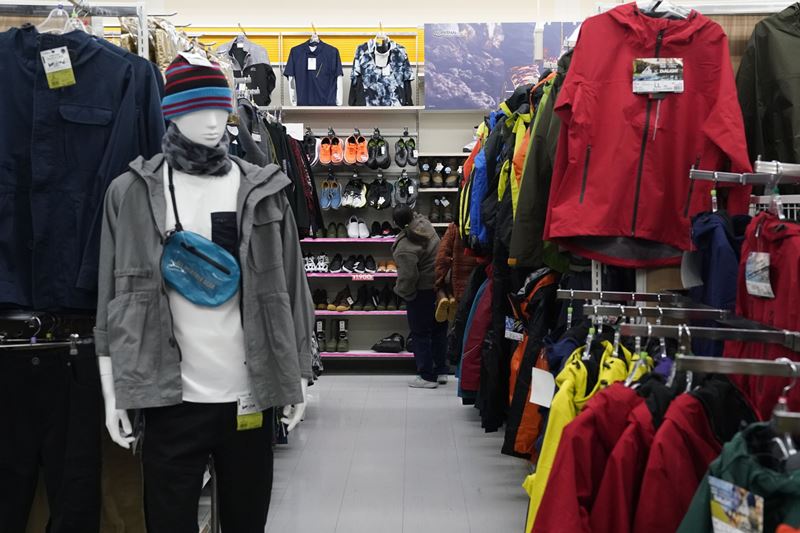
CorporateMar 23. 2021A WORKMAN Plus store in Tokyo. MUST CREDIT: Bloomberg photo by Toru Hanai
By Syndication Washington Post, Bloomberg · Min Jeong Lee, Yoojung Lee
When it comes to Japanese retail billionaires, the first name that springs to mind might be Tadashi Yanai, the entrepreneur behind the Uniqlo brand and the nation’s richest man.
But there’s another founder who’s drawing attention as one of his biggest companies transforms in the country.
Yoshio Tsuchiya’s Workman Co. has expanded beyond its roots as a maker of drab uniforms for laborers into low-cost, functional sportswear and outdoor gear. The evolution has won praise from investors, analysts and even Fast Retailing Co.’s Yanai, who says the company has created a “new market.” Other observers question whether the positive momentum has reached its limit.
Workman’s shares have more than quadrupled since the start of 2018, despite paring some of their gains recently. That boosted Tsuchiya and his family’s stake in the company alone to about $4.5 billion, according to the Bloomberg Billionaires Index. For one analyst, the retailer has the potential to really take off when the country gets clear of the covid-19 pandemic.
“It’s one of the more exciting stories in Japanese retail” once things get back to normal, said Ruhell Amin, global head of retail equity research at William O’Neil & Co. in London.
Tsuchiya opened Workman’s first store in 1979 when he was in his late 40s. The company specialized in work clothing for construction laborers, a booming business in the country’s bubble economy of the 1980s.
In 2016, Workman moved into low-cost outdoor gear before opening its first WORKMAN Plus store two years later to focus on sports and outdoor clothing. The company had 632 regular stores and 269 WORKMAN Plus shops across Japan as of March 10, often in areas where blue-collar workers live.
One popular product is a waterproof jacket that costs $36 (3,900 yen), much lower than comparable offerings by other companies. A “climb light jacket” from The North Face, for example, retails for about $300 (33,000 yen).
“Because our clothes were originally designed to suit workers, they weren’t inferior to sportswear in functionality, and most importantly, they could be made at cheap prices,” Tetsuo Tsuchiya, a family member and senior managing director at Workman, said in an interview with ITmedia Business Online in January. “We realized that was Workman’s strength.”
Richard Kaye, a portfolio manager at Comgest Asset Management Japan Ltd., which owns Workman shares, said the quality of the company’s products can be better than more expensive brands because of its established supply chain.
The apparel maker boasts “high performance at one-half to one-third the cost of famous brands,” Ryozo Minagawa, a senior analyst at SMBC Nikko Securities Inc. in Tokyo, wrote in a November note. It has “no competition” in the cheap sportswear segment, he wrote.
“I want them to keep it up — competition is a source of development,” Fast Retailing’s Yanai told reporters following an earnings release in October when asked about the threat of Workman. “We created a new market and so has Workman,” he said. “The clothes have functionality and I think they’re very good.”
But others, such as Citigroup Inc., say that while Workman has performed strongly in casual wear, growth in the category may be hitting a wall.
“It seems that the boost generated by the expansion of the existing format to include casual wear is reaching its limit,” Citigroup analyst Yingqiu Zhang wrote in a note this month after the company’s same-store sales for February fell 3.7% year on year, the first such decline since September 2017.
A a WORKMAN Plus store in Tokyo. MUST CREDIT: Bloomberg photo by Toru Hanai
Workman declined to make any of the company’s executives available for an interview. Beisia Group, which is behind the family’s various businesses, declined to make Yoshio Tsuchiya available for an interview. The 88-year-old entrepreneur, who rarely speaks to media, established a supermarket operator in the late 1950s and built it into a retail empire with Workman as the flagship listed entity.
The conglomerate counts home-center chain Cainz Co., shopping-center operator Beisia Co. and Workman as the largest of its 28 companies, according to a Toyo Keizai report in December. They’re followed by convenience-store operator Save On Corp., consumer-electronics retailer Beisia Denki Co. and car-goods shop Auto R’s Co.
Those six chains account for 90% of the group’s revenue, according to the Toyo Keizai report. In an interview for the article, Tsuchiya said the group’s sales topped 1 trillion yen for the first time in the 12 months ended October.
Tsuchiya and his family may be worth more than $8 billion when its holdings in the other group companies, which are privately held, are also included. That makes them among the richest people in Japan, according to the Bloomberg Billionaires Index. But the family’s gains have grown harder to come by in recent months, with Workman shares losing more than a fifth of their value from a recent high in July.
William O’Neil has removed Workman’s stock from its firm’s “focus” basket in the recent sell-off, but Amin says that’s just because it’s going through a “technical breakdown.”
The company, meanwhile, is set for a new challenge. It plans to open a new category of stores called WORKMAN Girl, which offer casual and outdoor gear for women. It has only one such store and aims to launch 399 more in 10 years.
Over the longer term, Workman’s prospects remain good, according to Amin.
“It’s a great company, well-managed with a clear, unique focus,” he said. “Sales growth has been phenomenal on a month-on-month basis over the past three to four years,” he said. “Clearly they’ve been doing something well.”
The Stock Exchange of Thailand (SET) Index closed at 1,564.25 on Tuesday, down 2.11 points or 0.13 per cent. Total transactions amounted to Bt93 billion with an index high of 1,574.14 and a low of 1,562.03.
In the morning session, a Krungsri Securities analyst expected the day’s index to fluctuate between 1,560 and 1,575 points despite the US push for another $3 trillion in stimulus spending, plus the sliding US Treasury bond yield.
“However, volatility in fund flows is expected to pressure the index today,” the analyst said.
He advised investors to follow Wednesday’s Bank of Thailand Monetary Policy meeting, which is expected to maintain the interest rate at 0.5 per cent.
The 10 stocks with the highest trade value today were OR, JMART, BANPU, TTA, KBANK, CPF, SCGP, SCC, JMT and CPALL.
Other Asian indices were on the slide:
Japan’s Nikkei Index closed at 28,995.92, down 178.23 points or 0.61 per cent.
China’s Shang Hai SE Composite Index closed at 3,411.51, down 31.93 points or 0.93 per cent, while Shenzhen SE Component Index closed at 13,607.27, down 153.70 points or 1.12 per cent.
Hong Kong’s Hang Seng Index closed at 28,497.38, down 387.96 points or 1.34 per cent.
South Korea’s KOSPI closed at 3,004.74, down 30.72 points or 1.01 per cent.
Taiwan’s TAIEX Index closed at 16,177.59, down 11.63 points or 0.072 per cent.
Thailand and the United Kingdom will sign an agreement to set up a Joint Trade Committee on Commerce and Economic Cooperation this month, with both countries eying a free trade agreement (FTA).
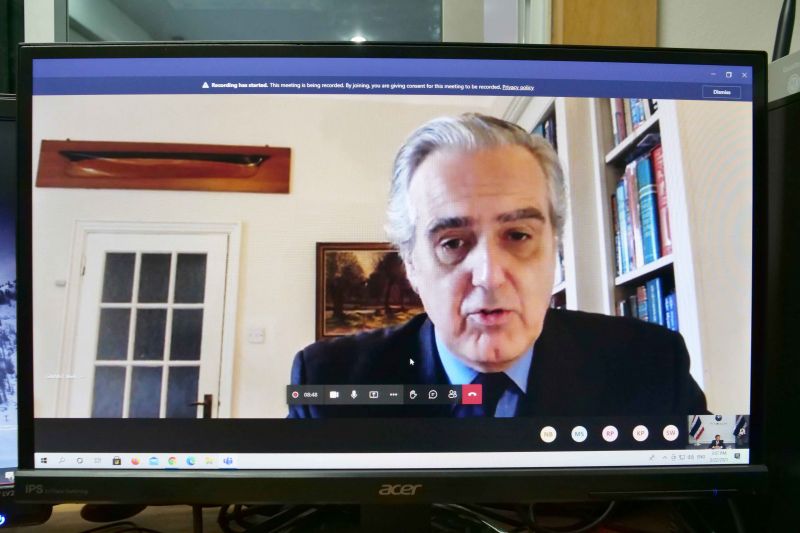
Thailand informed the UK it was interested in forging an FTA at a teleconference meeting with Britain’s trade envoy Mark Garnier on Monday (March 22), said Sansern Samalapa, deputy commerce minister.
Mark Garnier
Thailand will become the first country in Asean to sign a trade deal with the UK after it left the European Union at the beginning of this year.
The Commerce Ministry will sign a memorandum of understanding with the UK minister of international trade next Monday (March 29) to set up the Joint Trade Committee. The committee will promote expansion of Thai-UK trade and investment in agriculture, food and beverage, technology and financial services, Sansern said. It will run in parallel with the private-sector Thai-UK Business Leadership Council.
In 2020, Thai-UK trade amounted to $4.876 billion (Bt154.8 billion) with Thai exports worth $3.087 billion and imports from the UK worth $1.788 billion. Major Thai exports to the UK are processed chicken, motorcycle rubber products and components, autos and equipment, circuit boards, and gems and jewellery. Major Thai imports from the UK include machinery and components, circuit boards, chemicals, pharmaceuticals, electrical machinery and components, and drinks.
Thailand and the UK also discussed the Comprehensive and Progressive Agreement for Trans-Pacific Partnership (CPTPP) at the March 22 meeting. The UK has applied to join the trade pact of 11 members (Australia, Brunei, Canada, Chile, Japan, Malaysia, Mexico, New Zealand, Peru, Singapore and Vietnam) while Thailand is still studying the benefits of becoming a member.
The Stock Exchange of Thailand (SET) Index rose by 6.33 points, or 0.40 per cent, to 1,572.69 in the morning session on Tuesday.
A Krungsri Securities analyst expected the SET Index to fluctuate between 1,560 and 1,575 points despite the US move to consider an estimated $3-trillion economic recovery proposal, plus the slide in the US Treasury yield.
“However, volatility in funds flows is expected to pressure the index today,” he said.
He advised investors to follow the Monetary Policy Committee meeting on Wednesday, as it is expected to maintain the interest rate at 0.5 per cent.
He recommended that investors buy:
▪︎ AOT, MINT, CENTEL, AAV, BA, CPN, CRC and MAJOR, which benefit from positive news of Covid-19 vaccine in Thailand.
▪︎ HANA, KCE, TU and CPF, which benefit from the weakening baht.
▪︎ ICHI, SAPPE, RBF, DOD, IP, TACC, GUNKUL, KISS and ZIGA, which benefit from positive news on hemp production and its general use.
The SET Index closed at 1,566.36 on Monday, up 2.40 points or 0.15 per cent. The volume of total transactions was Bt76 billion with an index high of 1,571.74 and a low of 1,555.38.
The price of gold rose by Bt50 per baht weight in morning trade on Tuesday, the Gold Traders Association reported.
As of 9.26am, the buying price of a gold bar was Bt25,300 per baht weight and selling price Bt25,400, while gold ornaments were priced at Bt24,847.24 and Bt25,900, respectively.
At close on Monday, the buying price of a gold bar was Bt25,250 per baht weight and selling price Bt25,350, while gold ornaments were Bt24,801.76 and Bt25,850, respectively.
Spot gold price dropped to US$1,734 (Bt53,689) per ounce after falling by $3.6 to $1,738.1 on Monday due to mass sell-offs of safe-haven assets after the US stock market surged on mass buy-ups of tech shares.
Meanwhile, uncertainty over Turkey’s economic direction also affected the demand for the precious metal.
Hong Kong gold price rose by HK$60 to $16,080 (Bt64,105) per tael, the Chinese Gold and Silver Exchange Society reported.
By Syndication Washington Post, Bloomberg · Claire Ballentine, Vildana Hajric
Tech companies led U.S. equity gains as a dip in Treasury yields provided a tail wind for stocks.
The S&P 500 Index climbed 0.7% and the Nasdaq 100 fared even better as the 10-year U.S. Treasury yield fell from the highest levels in about 14 months. Small-cap shares underperformed. The bond market remains in focus this week amid a slate of auctions and moves by the Federal Reserve to let a key bank capital exemption lapse.
The dollar weakened slightly and oil edged higher after its worst week since October. Turkey’s markets tumbled after the central bank governor was ousted.
Steadier yields provided relief after last week’s Treasury sell-off served as a stark reminder of concern that a stronger economic recovery could fuel inflation, despite reassuring comments from policymakers. At the same time, traders are betting that growth will swell corporate profits as vaccines work to curb the global pandemic.
“The rise in long-term yields has kind of affected every move we’ve seen in equity markets, from the big sell-off in the higher growth stuff to the rotation into the more economically sensitive sectors,” said Ross Mayfield, investment strategy analyst at Baird. “Any time there is some rate stabilization, it’s kind of the spark for tech to capture a little bit of gains.”
There’s no sign yet that faster economic growth will deliver unwanted inflation or a need to adjust monetary policy, Federal Reserve Bank of Richmond President Thomas Barkin said Monday. For unwanted inflation to take hold, expectations for price increases would have to really move and begin to get factored into business decisions and wage bargaining, he added.
In European markets Monday, gains in tech were offset by declines in travel firms on the Stoxx 600 Index. Banks exposed to Turkey fell after President Recep Tayyip Erdogan moved to replace the country’s third central bank chief in less than two years, sparking a decline of 7% in the lira. Asian shares slipped.
These are some of the main moves in financial markets:
Stocks
– The S&P 500 Index increased 0.7% as of 4 p.m. EDT.
– The Stoxx Europe 600 Index rose 0.2%.
– The MSCI Asia Pacific Index fell 0.3%.
– The MSCI Emerging Market Index was little changed.
Currencies
– The Bloomberg Dollar Spot Index slipped 0.1%.
– The euro strengthened 0.3% to $1.1937.
– The British pound fell 0.1% to $1.3863.
– The Japanese yen strengthened 0.1% to 108.79 per dollar.
Bonds
– The yield on 10-year Treasurys fell four basis points to 1.68%.
– Germany’s 10-year yield declined two basis points to -0.31%.
– Britain’s 10-year yield decreased two basis points to 0.81%.
Commodities
– West Texas Intermediate crude rose 0.2% to $61.55 a barrel.
The Stock Exchange of Thailand (SET) Index closed at 1,566.36 on Monday, up 2.40 points or 0.15 per cent. The volume of total transactions was Bt76 billion with an index high of 1,571.74 and a low of 1,555.38.
In the morning session, a Krungsri Securities analyst expected the day’s index to fall to a support line between 1,555 and 1,560 after the US Federal Reserve declined to extend a post-pandemic rule that lowered the amount of capital banks had to hold.
“The index would also be under pressure from rising US bond yield and volatility in fund flows,” said the analyst.
The 10 stocks with the highest trade value today were OR, BANPU, TTA, PRM, CPALL, PTT, AMANAH, CPF, KBANK and AOT.
Other Asian indices were mixed:
Japan’s Nikkei Index closed at 29,174.15, down 617.90 points or 2.07 per cent.
China’s Shang Hai SE Composite Index closed at 3,443.44, up 38.78 points or 1.14 per cent, while Shenzhen SE Component Index closed at 13,760.97, up 154.96 points or 1.14 per cent.
Hong Kong’s Hang Seng Index closed at 28,885.34, down 105.60 points or 0.36 per cent.
South Korea’s KOSPI closed at 3,035.46, down 4.07 points or 0.13 per cent.
Taiwan’s TAIEX Index closed at 16,189.22, up 118.98 points or 0.74 per cent.


 Arkhom Termpittayapaisith, Minister of Finance (left) and Supattanapong Punmeechaow, Minister of Energy (right)
 A WORKMAN Plus store in Tokyo. MUST CREDIT: Bloomberg photo by Toru Hanai