A guide to sexuality as Pride month rolls in Thailand

#SootinClaimon.Com : ขอบคุณแหล่งข้อมูล : หนังสือพิมพ์ The Nation.

https://www.nationthailand.com/in-focus/40016286


New governor Chadchart Sittipunt has designated June as “Pride month” in Bangkok, reflecting the city’s diverse sexuality and respect for human rights.

A guide to sexuality as Pride month rolls in Thailand

LGBT Pride month is being celebrated around the globe to commemorate the landmark Stonewall uprising, when the gay community of New York rose up against police oppression in June 1969.

Former US president Bill Clinton enshrined June as “Gay & Lesbian Pride Month” in 1999 while his successor Barack Obama declared June as LGBT Pride Month in 2009.

The abbreviation LGBT was coined in the 1980s by gay rights activists. Over the past 40 years, it has expanded to incorporate more sexual orientations, and LGBTQIA+ is now recognised across the globe.

Each sexuality in LGBTQIA+

Used by human rights activists since 1988, the four letters LGBT stand for:

  • L (Lesbian) – a woman who is attracted to other women
  • G (Gay) – those who are attracted to people of the same gender (most commonly associated with men)
  • B (Bisexual) – a person who is attracted to two or more genders
  • T (Transgender) – people with a gender identity or gender expression that differs from the sex that they were assigned at birth.

The original letter order was GLBT but this was changed in the 1990s when lesbians stepped up in solidarity with the male gay community who were facing the HIV crisis, donating blood and showing solidarity through activism. The L was duly moved up to reflect lesbians’ significant role in the fight for gay rights and recognition.

In 2016, the American NGO GLAAD added the letter Q to reflect another recognised sexual orientation.

  • Q stands for Queer – people who are neither heterosexual nor cisgender (a person who gender-identifies with their birth sex)

Q can also be defined as “questioning”, to describe people who are questioning and undecided about their sexuality.

Then came the letters I and A.

  • I (Intersex) – individuals born with sex characteristics – including chromosome patterns, gonads, or genitals – that do not fit binary notions of male and female bodies.
  • A (Asexual) – a person who lacks sexual attraction to others, or has a low or absent interest in or desire for sexual activity.
  • A (Agender) – those who identify as having no gender or being without a gender identity.

However, the number of sexual orientations is increasing, so the plus symbol has been added.

Genders not represented by the letters in LGBTQIA include:

Non-binary describes gender identities that are not solely male or female‍ —‌ identities that are outside the gender binary.

Two-spirit is a term for people who identify as having both a masculine and feminine spirit as per Indigenous North American tradition.

Pansexual denotes people who have an attraction toward other people regardless of their sex or gender identity.

Demisexual is a term used to describe those who do not experience sexual attraction to others unless they form a strong emotional bond with someone first.

The terms mentioned above represent the variety of human sexuality as we know it now. It is up to each person to define their sexuality for themselves, so they feel happy and comfortable in themselves. Each of us is different, as reflected in the variety of terms to define sexuality, but all of us have value and human dignity.

Published : June 04, 2022

By : THE NATION

Chiang Mai facing huge shortage of massage workers as shops reopen

#SootinClaimon.Com : ขอบคุณแหล่งข้อมูล : หนังสือพิมพ์ The Nation.

https://www.nationthailand.com/in-focus/40016284


Chiang Mai is facing a critical shortage of traditional massage practitioners following two years of Covid-19 shutdowns, according to the Thai Lanna Massage Operators Association.

Chiang Mai facing huge shortage of massage workers as shops reopen

Association president Nantawan Chutipongvivate said on Friday that the number of massage employees in Chiang Mai has plummeted by almost two-thirds – from 9,000 pre-Covid to 3,600 now.

She explained that many massage practitioners switched jobs or returned to their hometowns during the Covid lockdowns, adding it may now be difficult to get them back.

Meanwhile, many massage workers feel the profession does not offer job security as foreign tourists have yet to return in large numbers and they are afraid that a flare-up of Covid-19 could force massage shops to close again.

She added that it was hard to find replacements as massage practitioners must be trained before offering services to customers.

Nantawan said that only a few of her own employees returned to work after the Covid-19 lockdowns. As a result, she has been forced to seek replacements through job adverts.

However, 200 of the 492 Thai massage shops under the association have reopened and she expects business to improve gradually once the Covid-19 situation eases further.

After reopening in April, revenue from her own shop is at 40 per cent of pre-Covid levels.

She expects takings to improve at the end of the year if Chinese tourists return to Thailand. Chinese customers accounted for 80 per cent of her total revenue before the pandemic.

Published : June 04, 2022

By : THE NATION
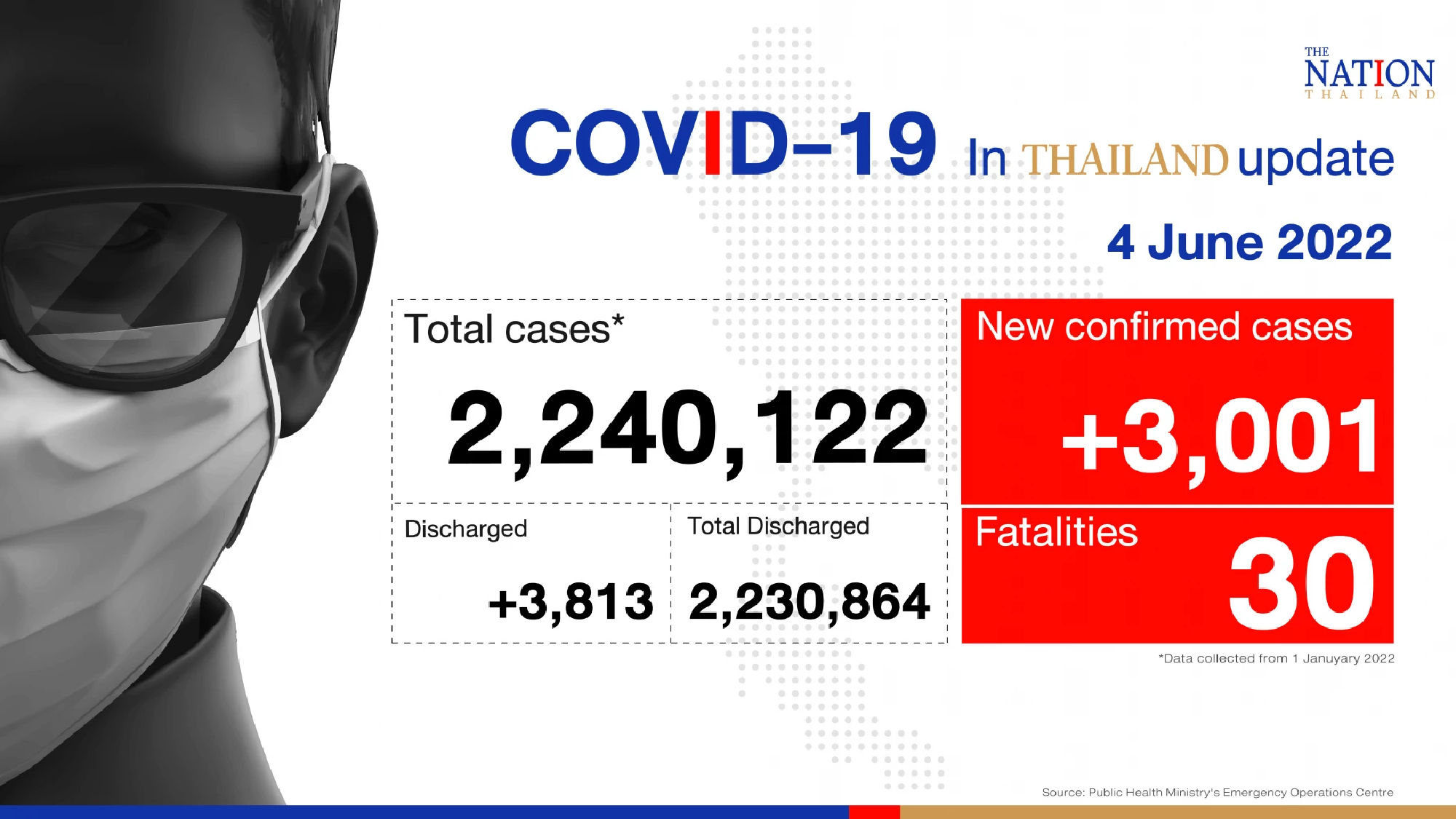
Thailand records 3,001 Covid-19 cases and 30 deaths on Saturday

#SootinClaimon.Com : ขอบคุณแหล่งข้อมูล : หนังสือพิมพ์ The Nation.

https://www.nationthailand.com/in-focus/40016274


Ministry of Public Health reported on Saturday (June 4) morning that in the past 24 hours there are 3,001 new patients who tested positive for Covid-19 in the country.

Thailand records 3,001 Covid-19 cases and 30 deaths on Saturday

Death toll increased by 30, while 3,813 patients were cured and allowed to leave hospitals.

Cumulative cases in the country since January 1, 2022 are at 2,240,122.
 

Published : June 04, 2022

By : THE NATION
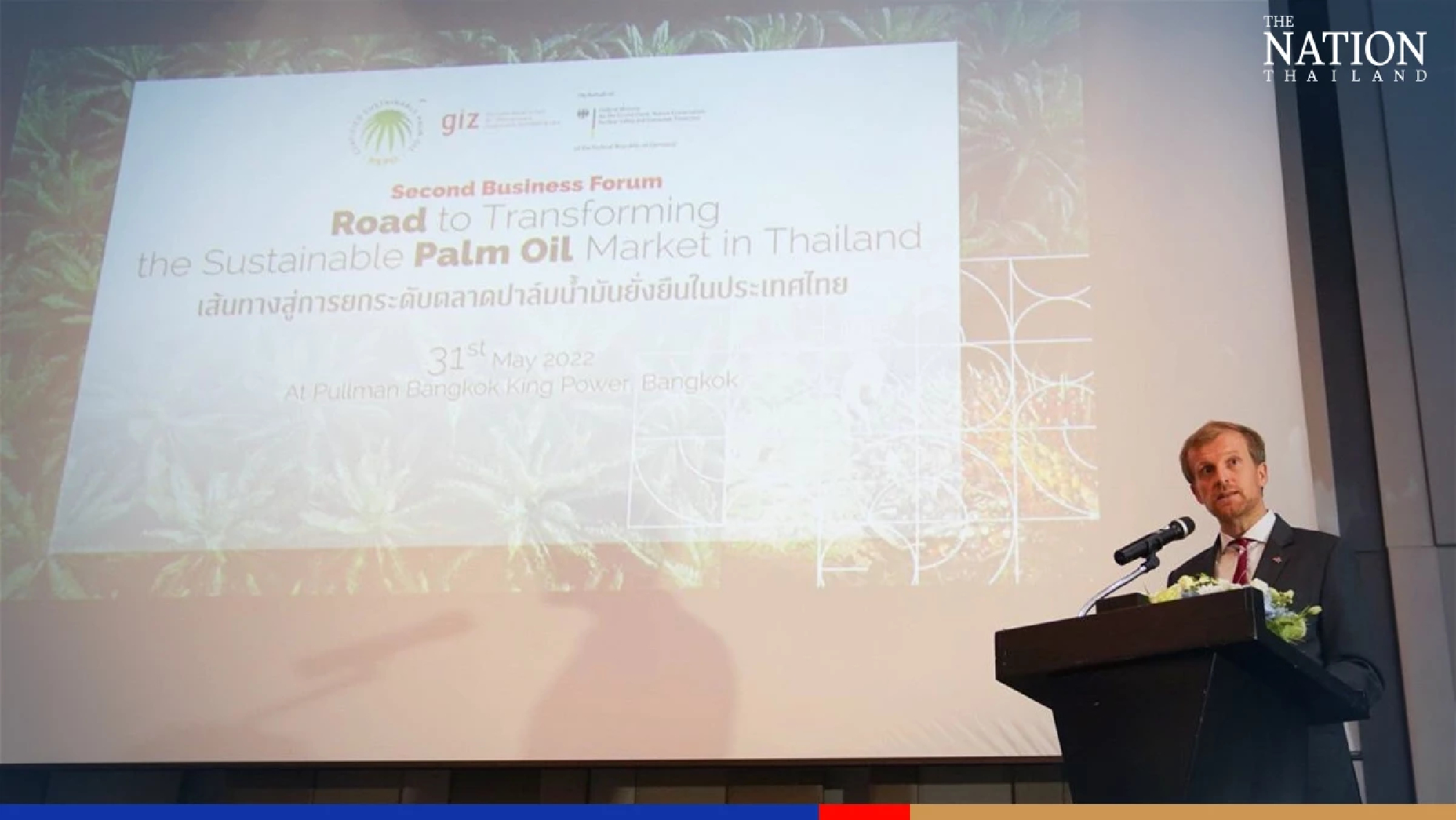
Thailand joins RSPO, GIZ in making palm oil industry more sustainable

#SootinClaimon.Com : ขอบคุณแหล่งข้อมูล : หนังสือพิมพ์ The Nation.

https://www.nationthailand.com/in-focus/40016270


The Agriculture Ministry aims to allocate more land to palm plantations in Thailand to boost productivity and meet future demands.

Thailand joins RSPO, GIZ in making palm oil industry more sustainable

Alongkorn Phonbutr, adviser to the agriculture minister, made this remark on Tuesday at the Second Business Forum organised by the Roundtable on Sustainable Palm Oil (RSPO) and the German Organisation for International Cooperation (GIZ).

“We are increasing the yield per rai by no less than 10 per cent and the extraction rate of 22-23 per cent to increase productivity to meet future demand,” he said.

He added that the Agriculture Ministry, alongside RSPO, will work on raising the standard of sustainable palm-oil production in Thailand and in line with this, the Thailand Sustainable Palm Oil Alliance has been established. Standards on agricultural commodities related to oil palm will also be established by the National Bureau of Agricultural Commodity and Food Standards.

Thailand joins RSPO, GIZ in making palm oil industry more sustainable

“Considering various crises with unpredictable volatility, this is an opportunity for all parties to review and share our goals towards a more sustainable future,” he said.

“Establishing the Thailand Sustainable Palm Oil Alliance could not have come at a more perfect time.

“We continue to cooperate closely with the networks of all sectors, including the public sector, the private sector and civil society,” he added.

Thailand joins RSPO, GIZ in making palm oil industry more sustainable

RSPO’s CEO Joseph D’Cruz said Thailand finds itself in a unique position to help ensure global food security as the world’s third-largest palm oil producer.

What sets Thailand apart is the capacity of smallholders to propel the Thai palm oil industry, he pointed out.

“RSPO recognises the integral role of smallholders in achieving our overall vision of market transformation; ensuring their greater inclusion in sustainable solutions that positively impact their livelihoods remains one of our main goals,” he said.

“We see this as a shared responsibility that all players in the palm oil supply chain must commit to supporting.”

Thailand joins RSPO, GIZ in making palm oil industry more sustainable

Meanwhile, GIZ country director for Thailand and Malaysia, Reinhold Elges said moving toward sustainable and deforestation-free production and climate change mitigation and adaptation has become an essential pathway to secure food production and meet global demand.

“Mobilising investments to engage oil palm smallholders and enhance their capacity to achieve RSPO certification – which we regard as a viable Shared Responsibility – means upgrading Thailand’s palm oil industry to meet the global market, as well as helping to secure global food supply and reducing negative climate and environmental impacts,” he said.

He explained only 19.3 per cent or 14.8 million tonnes of global palm oil supply is RSPO certified and sustainable.

In Thailand, RSPO-certified sustainable palm oil accounts for just 4.97 per cent of the country’s total palm oil supply, he added.

He said GIZ works with both public and private partners to mainstream sustainable palm oil production in the country, such as organising a series of intensive training sessions to improve the capacity of over 3,000 smallholders in sustainable agricultural practices to achieve RSPO certification and gain improved access to international markets.

“Trainers are key in engaging and improving smallholders’ capacity and knowledge on sustainable palm oil production,” he said.

He added that RSPO adopted the Independent Smallholder Standard in 2019, which aims to help more smallholders achieve certification through a stepwise mechanism while adhering to the key sustainability requirements.

“Despite the challenges of the global pandemic, we have witnessed positive progress among smallholders towards achieving ISH certification,” he added.

Published : June 03, 2022

By : THE NATION

BMA may lower speed limit at accident-prone areas, says Chadchart

#SootinClaimon.Com : ขอบคุณแหล่งข้อมูล : หนังสือพิมพ์ The Nation.

https://www.nationthailand.com/in-focus/40016269


Bangkok Governor Chadchart Sittipunt said on Friday that the city administration may consider speed limit at no more than 80 kilometres per hour to help prevent frequent road accidents at certain locations.

BMA may lower speed limit at accident-prone areas, says Chadchart

He said this could start with the long bend in front of the Criminal Court on Ratchadaphisek Road, which is nicknamed “100-Body Curve” due to frequent deadly accidents.

“The Bangkok Metropolitan Administration may limit the maximum speed here of 120kph to even lower at 80kph. This will be considered in detail later,” the newly elected governor told reporters while inspecting the site of another fatal road mishap there.

When asked to comment on a perception that the curve was jinxed, Chadchart said such a belief was “a good view”, as it could discourage speeding.

He said other locations in Bangkok where frequent road accidents happened would also be considered. He added that in addition to road accidents, flooding and personal safety would also be discussed.

Early in the morning, a pickup truck rammed into a power pole on an inbound lane opposite the court, leaving five occupants dead and two others injured. The speedometer needle was stuck at 120kph. Before the accident, the road was slippery following a downpour.

Chadchart said on Friday that road accidents have reduced due to physical improvements of roads but that motorists still need to contribute, by driving carefully and obeying the speed limit.

Published : June 03, 2022

NBTC restores its anti-monopoly rule to deal with True-Dtac merger

#SootinClaimon.Com : ขอบคุณแหล่งข้อมูล : หนังสือพิมพ์ The Nation.

https://www.nationthailand.com/in-focus/40016267


The National Broadcasting and Telecommunications Commission (NBTC) voted 3-2 to confirm its authority in blocking a planned merger of True Corporation and Total Access Communication (Dtac) if it is deemed as a monopoly, a source disclosed on Friday.

NBTC restores its anti-monopoly rule to deal with True-Dtac merger

The NBTC source said the commissioners resolved on Wednesday to notify the Administrative Court that the 2006 anti-monopoly directive and the 2018 NBTC regulation on business mergers empower the regulator to stop the merger from creating a monopoly or unfair competition in the telecom sector.

The 2006 directive, issued by NBTC’s precursor National Telecommunications Commission, requires merger deals to be approved by the regulator. However, the authority was abrogated by the NBTC’s 2018 regulation, which allows businesses wishing to merge to only notify the regulator, not seek its approval.

According to the source, the NBTC commissioners’ decision at their meeting on Wednesday reinstated the 2006 anti-monopoly directive.

However, NBTC president Sarana Boonbaichaiyapruck said on Friday that the executive board has yet to make a decision on the matter.

The NBTC move came after Napat Winitchaikul, a member of the committee or “superboard” monitoring the NBTC’s work performance, petitioned the Administrative Court, seeking an injunction against enforcement of the NBTC’s 2018 regulation.

In his petition, Napat argued that the 2018 regulation was unlawful and went against relevant laws, including the 2006 anti-monopoly directive.

Published : June 03, 2022

Ministry clarifies its Covid-19 vaccine outreach through subdistrict hospitals

#SootinClaimon.Com : ขอบคุณแหล่งข้อมูล : หนังสือพิมพ์ The Nation.

https://www.nationthailand.com/in-focus/40016266


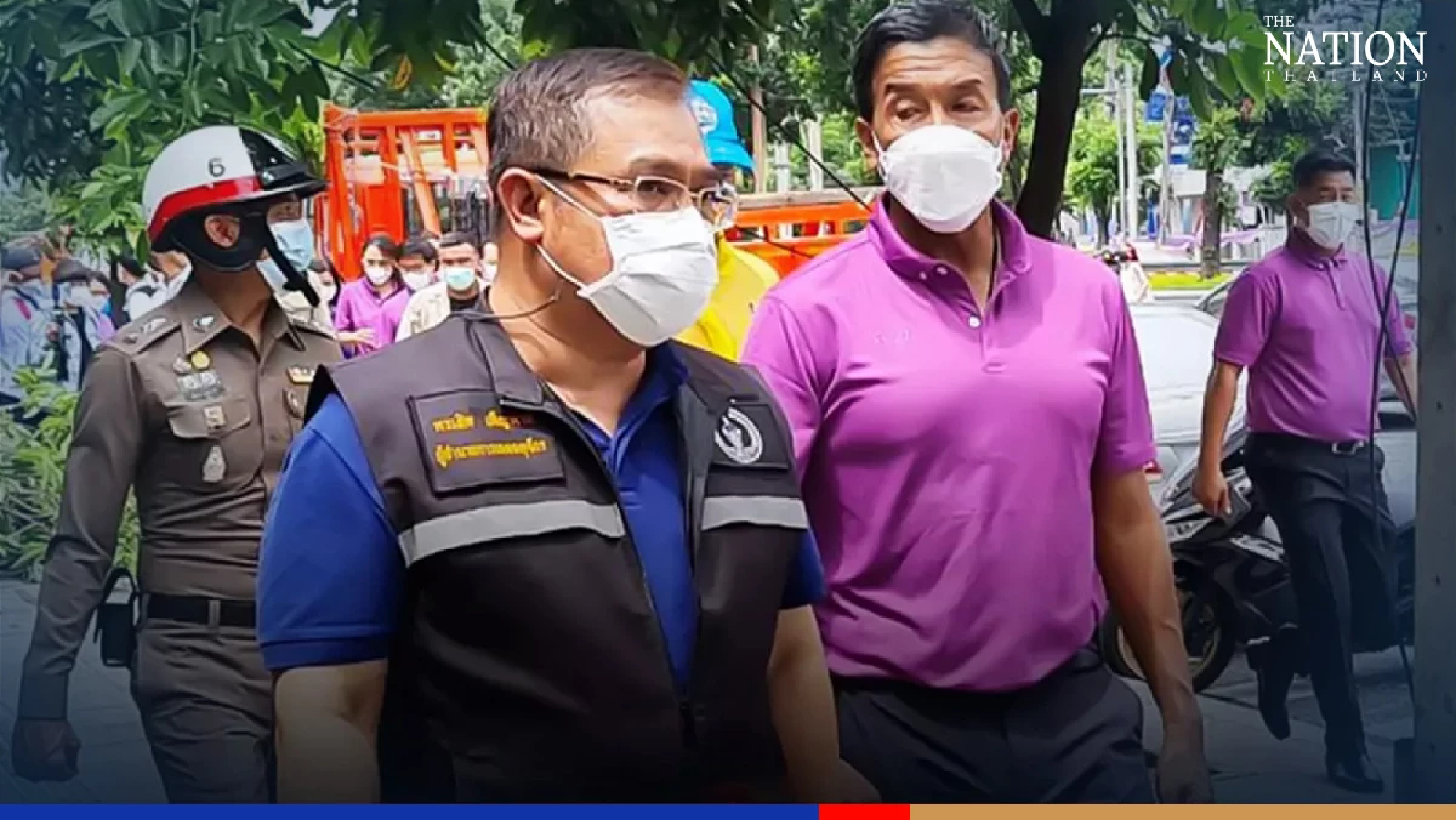
The Public Health Ministry is distributing Covid-19 vaccines to subdistrict health promoting hospitals nationwide to ensure that local people can get a jab at vaccination units closest to their homes.


Ministry clarifies its Covid-19 vaccine outreach through subdistrict hospitals

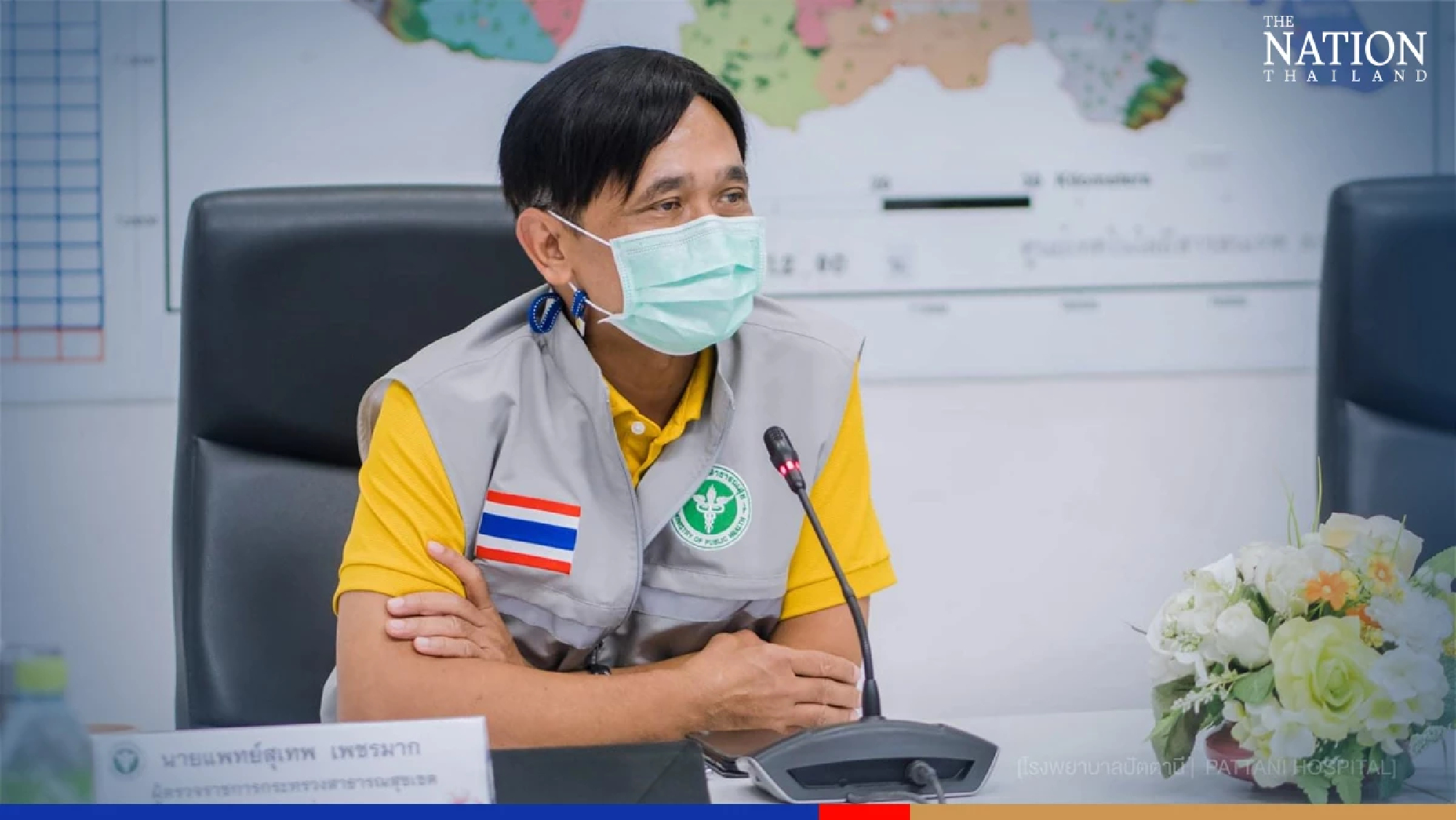
The ministry’s head inspector, Dr Suthep Phetmark, said on Friday the move will help promote comprehensive vaccination at community level to prepare for the redesignation of Covid-19 as an endemic in the future.

“The plan has been implemented for about a month after our surveys found that one of the reasons people are still not vaccinated is because the vaccination unit is too far away, or that they have no one to take them there,” he said. “The vaccines provided to subdistrict health promoting hospitals include Sinovac, Astra Zeneca and Pfizer that are still usable. The ministry is not dumping expired vaccines on subdistrict hospitals as some have speculated.”

Suthep was referring to a Facebook post by the Rural Doctors Society on Thursday, which said that “subdistrict health promoting hospitals are not garbage dumpster for CCSA’s leftover vaccines”. He added that most of these hospitals have no cold storage large enough for high volume of vaccine, whereas the number of people interested in getting a jab now is also low, which means these vaccines will most likely become unused and eventually expire.

“The ministry has been working with subdistrict hospitals to survey people who are still unvaccinated in each province, in order to give a jab at home for those who are unable to travel to the hospital,” said Suthep. “The ministry will provide the vaccine while the National Health Security Office will support vaccination fee for public health officials/volunteers at 40 baht per jab.”

“Giving Covid-19 vaccines to these hospitals is not a ploy to eliminate leftover vaccines. Furthermore, these hospitals are capable of storing the vaccines as they must have storage for other types of vaccines such as diphtheria, pertussis and tetanus,” he added.

“The ministry hopes that the plan will help people in remote areas get vaccinated with full doses to reduce the risk of severe symptoms or deaths now that Covid-19 is becoming an endemic, meaning more disease control measures will be relaxed.”

So far, Thailand has given 138 million doses of Covid-19 vaccine: 81.6 per cent of the population have received the first jabs and 75.7 per cent have got their second jab. Only 40.7 per cent of people in Thailand have taken booster shots.

Published : June 03, 2022

By : THE NATION

Phuket does U-turn on lifting mask-wearing mandate one day later

#SootinClaimon.Com : ขอบคุณแหล่งข้อมูล : หนังสือพิมพ์ The Nation.

https://www.nationthailand.com/in-focus/40016262


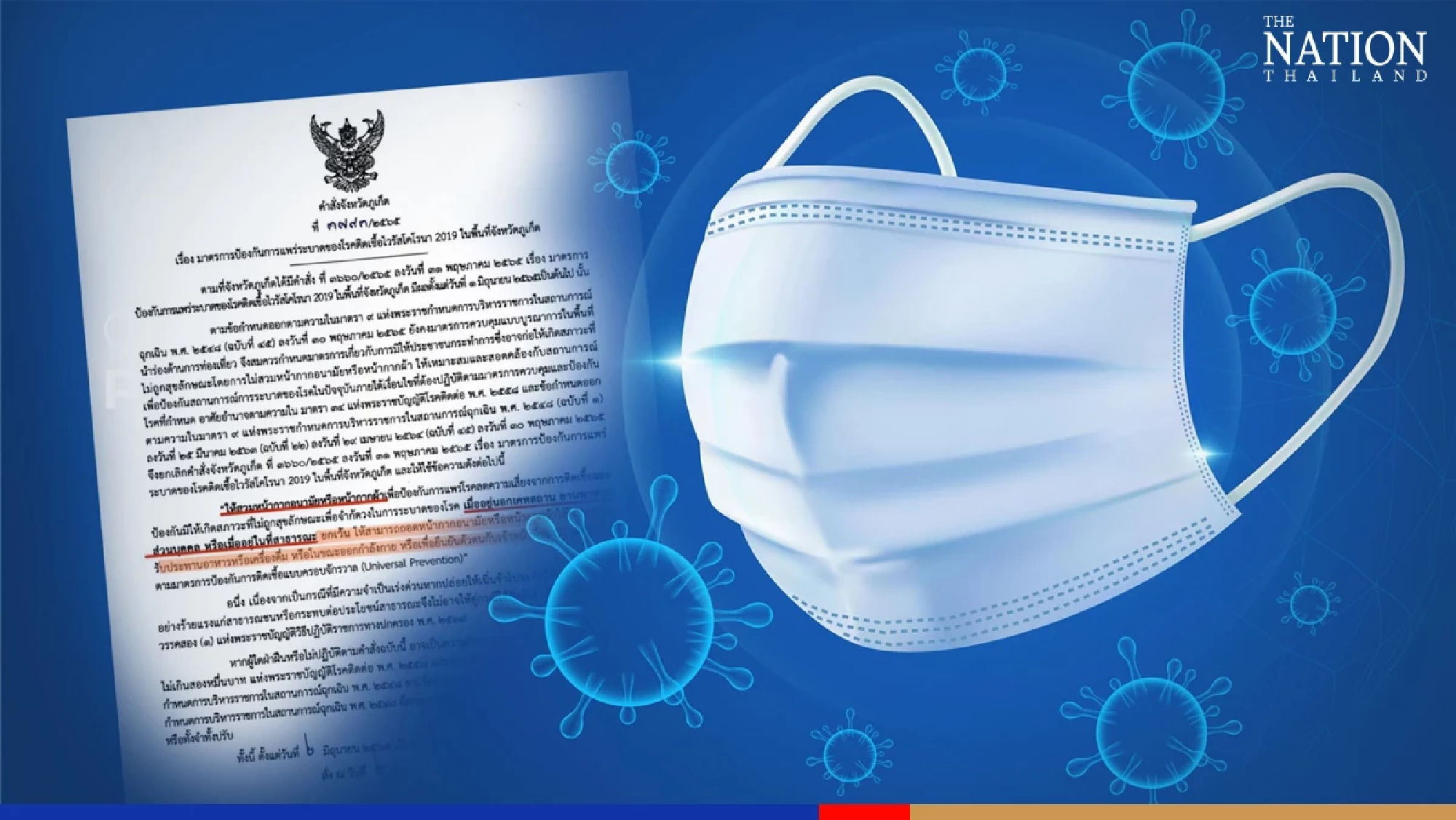
Phuket authorities have rescinded their order exempting people from having to wear a mask at beaches, public parks and other places.

Phuket does U-turn on lifting mask-wearing mandate one day later

The new order, issued by governor Narong Woonciew on Thursday, came the day after the mask-wearing mandate was lifted on Wednesday.

According to the new order, people are still required to wear a mask outdoors, in a vehicle or in public places, except when eating, drinking, exercising in open areas or showing their face to confirm their identity to authorities.

The governor’s order stated that the latest directive was in line with the extension of the emergency decree, which will retain preventive measures against Covid-19 in tourism provinces.

“Hence, measures will still be in place to prevent unhygienic behaviour like not wearing masks,” the Phuket order said.

Violators can face a fine of up to 20,000 baht under Section 51 of the 2015 Communicable Disease Act. They may also be deemed as violating the 2005 Emergency Decree and face up to two years in jail and/or a fine of up to 40,000 baht.

Published : June 03, 2022

EPPO wants refiners to cut profit margin in bid to control oil price

#SootinClaimon.Com : ขอบคุณแหล่งข้อมูล : หนังสือพิมพ์ The Nation.

https://www.nationthailand.com/in-focus/40016263


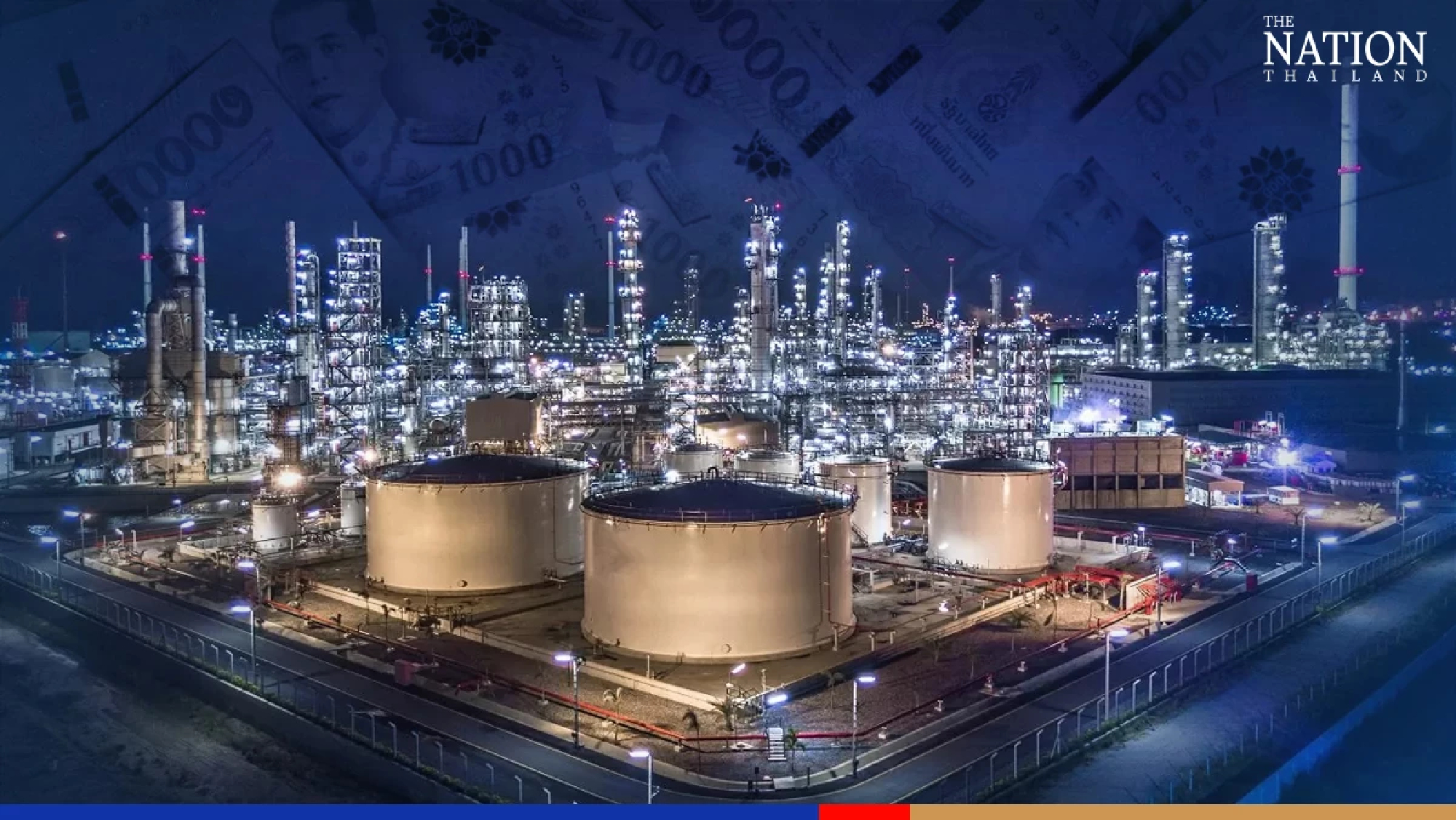
A refining profit of two baht per litre is appropriate, the Energy Policy and Planning Office (EPPO) said, as the rising price of crude oil puts pressure on the overall price.

EPPO wants refiners to cut profit margin in bid to control oil price

EPPO director-general Wattanapong Kurovat said on Friday that the crude oil situation had led to a hike in refining cost as well. The recent refinery margin is THB5 per barrel in April and May.

Therefore, the EPPO will cooperate with related organisations, especially the Commerce Ministry, to find a solution. Moreover, it will talk with oil refineries about the cost and is expected to reach a conclusion this month.

He said some people have criticised the THB5 refinery margin as too high, but they should consider the true cost of buying crude oil. He said the refining cost is also increasing in the current situation.

He said the Energy Ministry must be fair to every sector. Oil price will decrease if the refinery margin decreases.

Wattanapong explained that a profit of THB2-3 per litre is suitable as refineries do not have a role in lowering the ex-refinery price because the figure from the Energy Ministry is the estimated number, not the actual number.

Wattanapong said that he did not expect crude oil price to increase as much as in the past for the rest of 2022. He expected it to stay at around $110 per barrel because European countries have adapted to use more of other energy sources.

Meanwhile, he expected the US to release shale gas into the market at an attractive price even if there is a carbon problem, as a necessary situation.

He forecast that energy usage will grow by 2.1 per cent in 2022 if Thailand’s gross domestic product grows by 2.5 to 3.5 per cent, the baht stays at 33.3 to 34.3 to the dollar, the Dubai crude oil price is $105-110 per barrel, and the world GDP grows by 3.5 per cent.

Meanwhile, primary energy consumption is expected to increase in almost every category. Oil consumption is expected to increase by 12.9 per cent, coal/lignite by 6.8 per cent, and hydroelectric/imported electric consumption by 8.2 per cent.

In contrast, natural gas usage is expected to decrease by 9.5 per cent as the price goes up due to the Ukraine-Russia conflict. Users will have to use diesel fuel and stove oil instead.

Wattanapong said that energy usage in the country is increasing due to the economic recovery and the country’s post-Covid opening. However, the Covid-19 situation and the prolonged Ukraine-Russia conflict might affect power usage so they should be monitored.

Published : June 03, 2022

By : THE NATION

City of stress: Bangkok work-life balance ranked near bottom

#SootinClaimon.Com : ขอบคุณแหล่งข้อมูล : หนังสือพิมพ์ The Nation.

https://www.nationthailand.com/in-focus/40016255


Bangkokians have the right to feel stressed out after their city ranked 96th out of 100 countries in this year’s Work-Life Balance Index, published by software firm Kisi.

City of stress: Bangkok work-life balance ranked near bottom

Only Sao Paolo, Kuala Lumpur, Dubai and Cape Town had a worse work-life balance according to the Kisi study. The top five cities with the healthiest balance between work and play were all in Europe.

Norway’s Oslo ranked first, followed by Bern, Helsinki, Zurich and Copenhagen.

The cities were evaluated according to three criteria: work intensity, society and institutions, and city liveability.

Bangkok scored badly for remote working, overworked population, minimum vacation offered, affordability, happiness, culture & leisure, city safety, outdoor spaces, and air-quality sub-categories. Bangkok’s work-life balance also showed no improvement from last year’s ranking, when it came 49th out of 50 cities.

The stress of city living in Thailand’s capital was reinforced by its ranking of 7th in the overworked population index.

Kris cited the economic fallout from Covid-19 and high inflation affecting day-to-day life.

“Against this worrying backdrop, the onus is on companies – and governments – to take steps to establish a positive balance between work and life commitments for the mental well-being of employees,” said the firm’s 2022 work-life study.

Top 10 cities for work-life balance:

  1. Oslo, Norway
  2. Bern, Switzerland
  3. Helsinki, Finland
  4. Zurich, Switzerland
  5. Copenhagen, Denmark
  6. Geneva, Switzerland
  7. Ottawa, Canada
  8. Sydney, Australia
  9. Stuttgart, Germany
  10. Munich, Germany

Top overworked cities:

  1. Dubai, UAE
  2. Hong Kong
  3. Kuala Lumpur, Malaysia
  4. Singapore
  5. Montevideo, Uruguay
  6. Tokyo, Japan
  7. Bangkok, Thailand
  8. Cape Town, South Africa
  9. Lisbon, Portugal
  10. Budapest, Hungary

Source: Kisi

City of stress: Bangkok work-life balance ranked near bottom

Published : June 03, 2022

By : THE NATION