BOT cuts growth forecast amid falling exports, delay to recovery

#ศาสตร์เกษตรดินปุ๋ย : ขอบคุณแหล่งข้อมูล : หนังสือพิมพ์ The Nation

https://www.nationthailand.com/business/30379593?utm_source=category&utm_medium=internal_referral

BOT cuts growth forecast amid falling exports, delay to recovery

Dec 18. 2019
By The Nation

1,497 Viewed

The Bank of Thailand today (December 18) lowered its GDP forecast for this year and 2020, due largely to continuous export contractions and slower economic recovery than previously expected.

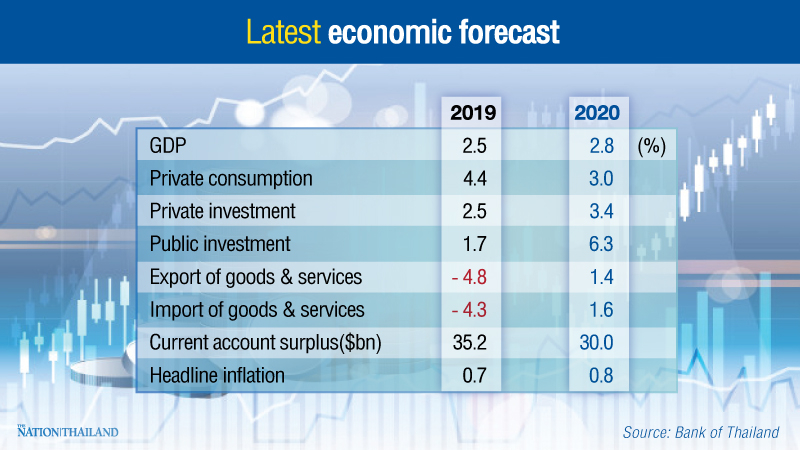
The central bank revised downward its forecast of economic growth to 2.5 per cent this year from 2.8 per cent while the forecast for next year was cut to 2.8 per cent from 3.3 per cent.

The central bank cited deeper export contractions and delay to an economic recovery for the lower projections. Headline inflation rate is expected to remain at a low level of 0.7 and 0.8 per cent for this year and next.

Thai exports were hit by the global slowdown and impact from the US-China trade war, in addition to structural changes in production which have eroded the competitiveness of Thai products.

Exports are expected to drop by 4.8 per cent this year, down from the previous projection of 2.3 per cent while a mild growth of 1.4 per cent is seen for next year, compared to an earlier forecast of 2.3 per cent.

Expansion of public investment at 1.7 per cent also fell below the previous projection of 2.5 per cent for this year.

With regard to private investment, it is expected to post growth of 2.5% this year, down from the earlier estimate of 3 per cent. Growth forecast for next year has been cut to 3.4 per cent from 4.8 per cent.

Meanwhile, growth in household consumption this year is expected at 4.4 per cent, up from the previous forecast of 3.8 per cent, but an expansion of just 3 per cent is projected for next year, down from 3.1 per cent. High household debts, less employment opportunities especially in the manufacturing sector and a drop in incomes would combine to make consumers more cautious on spending.

The central bank foresees continuous expansion in tourist arrivals, estimated at 39.9 million and 41.7 million for this year and 2020, up from 38.3 million last year.

The central bank expected Dubai’s oil price to stay at $63.4 per barrel this year before dropping to $ 62.5 next year, down from an average of $69.6/barrel last year.

Thailand’s current account surplus is estimated to remain at a high level of $35.2 billion this year and $30 billion in 2020, up from $28.5 billion last year.

Four projects granted BoI tax privileges

#ศาสตร์เกษตรดินปุ๋ย : ขอบคุณแหล่งข้อมูล : หนังสือพิมพ์ The Nation

https://www.nationthailand.com/business/30379589?utm_source=category&utm_medium=internal_referral

Four projects granted BoI tax privileges

Dec 18. 2019
BoI secretary-general Duangjai Asawachintachit

BoI secretary-general Duangjai Asawachintachit
By THE NATION

2,072 Viewed

The Board of Investment (BoI) has approved tax incentives for four projects worth Bt30.170 billion, BoI secretary-general Duangjai Asawachintachit has said.

One of them is an ethanol production plant in Nakhon Sawan province worth Bt7.8 billion. The project is in line with the government’s policy of promoting a bio-economy.

Another one is the production of radial tyres for cars worth Bt11.018 billion. The project is situated in the Laem Chabang Industrial Estate in Chonburi. It will use local natural latex of around 17,006 tonnes per year.

Another one is the extract of some ores such as copper, nickel and tin from the waste of printed circuit boards for reuse. The project is worth Bt3.874 billion. It is located in Pinthong Industrial Estate, Chonburi. The project has a production capacity of 148,000 tonnes per year.

Central bank maintains its policy rate

#ศาสตร์เกษตรดินปุ๋ย : ขอบคุณแหล่งข้อมูล : หนังสือพิมพ์ The Nation

https://www.nationthailand.com/business/30379585?utm_source=category&utm_medium=internal_referral

Central bank maintains its policy rate

Dec 18. 2019
By THE NATION

1,670 Viewed

The Monetary Policy Committee (MPC) of the Bank of Thailand on Wednesday (December 18) voted unanimously to maintain the policy rate at 1.25 per cent, MPC secretary Titanun Mallikamas said.

The MPC assessed that the Thai economy would expand at a lower rate than the previous forecast and would be below its potential due to a decline in exports, which affected employment and domestic demand.

Headline inflation was projected to be below the lower bound of the inflation target.

Overall financial conditions remained accommodative due to the previous two policy rate cuts.

Financial stability risks had already been addressed to some extent, although there remained pockets of risks that warranted monitoring, the MPC said.

The committee viewed that a more accommodative monetary policy in the recent period would contribute to economic growth and support the rise of headline inflation towards the target.

Looking ahead, the committee said it would monitor developments in economic growth, inflation, and financial stability, together with associated risks, in deliberating monetary policy going forward.

The MPC said it stands ready to use policy tools as appropriate.

5G to improve quality of life: Deputy PM

#ศาสตร์เกษตรดินปุ๋ย : ขอบคุณแหล่งข้อมูล : หนังสือพิมพ์ The Nation

https://www.nationthailand.com/business/30379579?utm_source=category&utm_medium=internal_referral

5G to improve quality of life: Deputy PM

Dec 18. 2019
Deputy Prime Minister Prawit Wongsuwan

Deputy Prime Minister Prawit Wongsuwan
By THE NATION

1,796 Viewed

The adoption of 5G wireless broadband technology will bring social and economic benefit to Thailand, Deputy Prime Minister Prawit Wongsuwan said on Wednesday (December 18).

Prawit was presiding over the event “5G The New BEGINNING to change Thailand’s economic landscape”, co-hosted by Krungthep Turakit newspaper, The Nation, Thansettakij newspaper, Kom Chad Leuk newspaper, and Khao Hoon newspaper.

He added that the 5G technology would help bridge the income gap and widen people’s accessibility to information and education as well as healthcare services. All these will lead to the improvement of people’s living quality.

The National Broadcasting and Telecommunications Commission plans to hold a multiple spectrum band auction in February next year.

He added that the government is aware of the challenges that telecom operators will face in planning the investment in the 5G network and service.

The NBTC telecom subcommittee has recently announced that it will auction only three spectrum bands in February, a change from thefour bandsoriginally planned.

NBTC’s secretary-general Takorn Tantasith said the subcommittee resolved to auction 1800MHz, 2600MHz, 26 GHz, while the 700MHz will be auctioned later.

The subcommittee is of the opinion that the 700MHz band should be auctioned together with 3500MHz band at a later date.

Total Access Communication, Alexandra Reich

Total Access Communication, Alexandra Reich

Merely rolling out 5G networks will not be enough for Thailand to reap the full economic benefits of 5G, the chief executive officer of Total Access Communication, Alexandra Reich, said in a keynote address.

She added that unlocking the full benefits of 5G would require a collaboration of all state and private parties.

She encouraged businesses to reach out to all telecom operators to jointly build 5G use cases together and drive sustainable economic growth in Thailand.

According to a report by the National Broadcasting and Telecommunications Commission report, the lack of a 5G ecosystem in Thailand by 2030 would come at an opportunity cost of Bt2.3 trillion.

She said that 5G growth will be very different from 4G: it will come from B2B (business-to-business) and B2B2C (business to business to consumer) use cases rather than just consumers and mobile network operators.

She said there is still time to start exploring what 5G can do for Thai businesses.

She pointed out some areas where businesses can most benefit from 5G.

She said 5G could bring vastly improved upload and download speeds, a game changer for video surveillance and analytics.

This was set to improve efficiencies across a wide range of industries, from energy and transportation to cities and facility management, she said.

She added that in the world of retail, in-store video surveillance and analytics could identify consumer-purchasing patterns and behaviours in real-time, allowing optimised pricing, quickly spotting shifting retail trends and even predicting where demand is headed.

She said DTAC remained committed to promoting 5G in Thailand and it was responding by upgrading its network and exploring multiple-use cases, from fixed wireless access to connected vehicles.

Public support for migrant workers in M’sia, S’pore and Thailand decreasing

#ศาสตร์เกษตรดินปุ๋ย : ขอบคุณแหล่งข้อมูล : หนังสือพิมพ์ The Nation

https://www.nationthailand.com/news/30379620?utm_source=category&utm_medium=internal_referral

Public support for migrant workers in M’sia, S’pore and Thailand decreasing

Dec 19. 2019
Migrant workers in Malaysia shopping in Kuala Lumpur. The Star filepic

Migrant workers in Malaysia shopping in Kuala Lumpur. The Star filepic
By The Star Online/Asia News Network

225 Viewed

BANGKOK: Public support for migrant workers in Malaysia, Singapore and Thailand is decreasing, a United Nations poll found on Wednesday that campaigners said raised concerns about the risk of slavery.

Most people in the three nations have limited knowledge about and increasingly negative attitudes towards migrant workers, and do not think they should receive the same benefits or pay as local workers, showed the survey by two U.N. agencies.

Such attitudes can condone discrimination, exploitation and violence against migrant workers, and influence policies on labour migration, according to the U.N. International Labour Organisation (ILO) and U.N. Women.

As many as 10 million migrants are estimated to work across Malaysia, Singapore and Thailand, and campaigners say debt bondage, limited state oversight, and unscrupulous employment practices leave them vulnerable to labour abuses and slavery.

Many are undocumented, meaning they are not only exempt from state benefits but at greater risk of being exploited or enslaved and less likely to speak out for fear of reprisals.

“While the research did not determine why attitudes towards migrant workers are declining, it does demonstrate that we are not successfully countering racism, xenophobia and hate,” ILO advisor Anna Engblom told the Thomson Reuters Foundation.

“It is likely that discriminatory practices are allowed to flourish if the general public sympathises with such values and behaviours,” Engblom said on International Migrants Day on Dec. 18 – set by the United Nations to raise awareness on the issue.

The research – a follow-up to a 2010 poll – was based on interviews with about 4,100 people in the three countries as well as Japan, which did not feature in the previous survey.

More than half the respondents in Malaysia and Thailand, and a quarter in Singapore, said there was a need for more migrant workers in their countries but over a third of those polled in each nation agreed that migrants were “a drain on the economy”.

About half of the people surveyed in Singapore, 77% in Thailand and 83% in Malaysia said they thought crime rates had increased in their countries because of migration.

“There is a belief that migrant workers are taking away our social, economic and political resources,” said Glorene Das, head of the Malaysian migrant workers rights group Tenaganita.

Adisorn Kerdmongkol, a coordinator at the Migrant Working Group, a network of charities promoting migrant rights, said such negative attitudes would result in further exploitation.

“Governments will take less action to protect migrant workers because they will be concerned with public perception.”

“Workers will also be afraid to speak out due to concern they will be disliked by locals, which will cause problems.” – Thomson Reuters Foundation

House impeaches Trump, creating indelible mark on his presidency

#ศาสตร์เกษตรดินปุ๋ย : ขอบคุณแหล่งข้อมูล : หนังสือพิมพ์ The Nation

https://www.nationthailand.com/news/30379619?utm_source=category&utm_medium=internal_referral

House impeaches Trump, creating indelible mark on his presidency

Dec 19. 2019
Protesters in support of President Donald Trump's impeachment gather outside the Capitol in Washington, D.C., on Dec. 18, 2019. MUST CREDIT: Washington Post photo by Sarah Voisin

Protesters in support of President Donald Trump’s impeachment gather outside the Capitol in Washington, D.C., on Dec. 18, 2019. MUST CREDIT: Washington Post photo by Sarah Voisin
By The Washington Post · Philip Rucker, and Felicia Sonmez 

377 Viewed

WASHINGTON – The House of Representatives voted late Wednesday to impeach President Donald Trump on charges that he abused his office and obstructed Congress, with Democrats declaring him a threat to nation and branding an indelible mark on the most turbulent presidency of modern times.

After 11 hours of fierce argument on the House floor between Democrats and Republicans over Trump’s conduct with Ukraine, lawmakers voted almost entirely along party lines to impeach him. Trump becomes the third president in U.S. history to face trial in the Senate – a proceeding that will determine whether he is removed from office less than one year before he stands for reelection.

On Trump’s 1,062nd day in office, Congress brought a momentous reckoning to an unorthodox president who has tested America’s institutions with an array of unrestrained actions, including some that a collection of his own appointees and other government witnesses testified were reckless and endangered national security.

The Democratic-controlled House passed two articles of impeachment against Trump – abuse of power and obstruction of Congress – related to the president’s attempts to withhold military aid to Ukraine and pressure its government to investigate former vice president Joe Biden, a potential 2020 Democratic opponent.

The House voted 230 to 197 to approve the article charging abuse of power, with the gavel falling about 8:30 p.m. On the obstruction of Congress vote, which followed soon after, the tally was 229 to 198.

All Republicans voted against both articles. Among Democrats, two voted no on the first article and three on the second, with one – Rep. Tulsi Gabbard, D-Hawaii – voting “present” both times.

House Speaker Nancy Pelosi, D-Calif., framed the day’s proceedings through the long lens of history, reciting the Pledge of Allegiance and singling out the line, “the republic for which it stands.”

“Very sadly, now our founders’ vision of a republic is under threat from actions from the White House,” Pelosi said. She added, “If we do not act now, we would be derelict in our duty.”

The Senate is widely expected to acquit Trump, since conviction and removal would require 67 votes in a chamber where Democrats and their allies hold 47 seats. If Trump were acquitted, it would launch an unpredictable stretch of his presidency; his reaction would be uncertain after opponents had taken a powerful but ultimately unsuccessful shot at removing him.

In coming days, Pelosi will name House impeachment “managers,” who will act as prosecutors in the Senate trial in January. The White House, for its part, has begun the process of selecting the lawyers who will mount its defense. And lawmakers from both parties are heading home for a recess, during which they are likely to confront voters on all sides of the impeachment issue.

Wednesday’s action punctuated a quarter-century of increasingly poisonous partisanship in Washington, one that arguably began during Bill Clinton’s presidency, was extended with rebellions against presidents George W. Bush and Barack Obama, and is culminating in the Trump era.

The intensity and polarization of the debate on the House floor vividly illustrated the extent to which leaders of the two parties now believe entirely different facts and are motivated by different concerns. At times they sounded almost as if they were representing different countries.

Democrats characterized Trump as an immediate threat to the nation he was elected to lead, casting his actions as an unprecedented affront to American values. Republicans denounced those charges as unsubstantiated and the process as illegitimate, repeatedly accusing the Democrats of seeking to illegally overturn the results of the last election.

Trump, who has nursed deep feelings of persecution as his impeachment has grown more likely, watched the debate unfold from the White House. Ten minutes after press secretary Stephanie Grisham issued a statement saying the president was “working all day,” Trump vented his fury on Twitter: “SUCH ATROCIOUS LIES BY THE RADICAL LEFT, DO NOTHING DEMOCRATS. THIS IS AN ASSAULT ON AMERICA, AND AN ASSAULT ON THE REPUBLICAN PARTY!!!!”

Just before the House voted, Trump took the stage in Michigan, where he rallied an estimated 10,000 supporters at a sports arena in Battle Creek – a muscular display of political potency even at the historic low point of his presidency.

“This lawless partisan impeachment is a suicide march for the Democratic Party,” Trump told the crowd. He added, “After three years of sinister witch hunts, hoaxes, scams, tonight House Democrats are trying to nullify the ballots of tens of millions of patriotic Americans.”

Back in Washington, Pelosi sought to rebut allegations from Republicans that her party has cast about since Trump took office for a reason to impeach him, saying no lawmaker of either party came to the Capitol to remove a president. She said Trump had forced Congress’s hand because he had “violated the Constitution.”

“He gave us no choice,” Pelosi said, drawing applause from Democrats by declaring that “we are here to defend democracy for the people.”

Barring a drastic shift in momentum, Trump is expected to be acquitted in the Senate, where a two-thirds supermajority is required to remove a president who has been impeached. Senate Majority Leader Mitch McConnell, R-Ky., has said he is planning a short trial and declared himself partial to protecting Trump.

Nevertheless, Trump’s impeachment by the House will be a defining mark on his legacy. Wednesday’s action cemented on a constitutional level the opposition party’s view that Trump is unfit to serve, elevating the informal resistance to his presidency, which has raged from coast to coast, into the permanent historical record.

After Democrats surfed an anti-Trump wave in the 2018 midterm elections to seize the House majority, Pelosi reclaimed the speaker’s gavel she had lost eight years before with a clear mandate from her party’s base to serve as a check on the president’s power and investigate his conduct.

Pelosi at first resisted pressure from the left to impeach Trump, however, arguing that such a move would be unnecessarily divisive. But she formally opened an inquiry in September after a whistleblower reported concerns about Trump’s conduct on a July 25 phone call with Ukrainian President Volodymyr Zelensky, in which Trump explicitly asked Zelensky to investigate Biden.

Marathon hearings last month before the House Intelligence Committee produced damaging testimony detailing Trump’s actions and those of his personal attorney Rudy Giuliani, among others. That helped solidify the support of even centrist Democrats for moving against the president, and the House Judiciary Committee then drafted the two articles of impeachment.

Democrats said Wednesday that declining to punish a presidential demand that a foreign government influence an American election would be an unacceptable abdication of constitutional responsibility. Such an action clearly meets the standard of “high crimes and misdemeanors” that the Constitution lays out for impeachment, they said.

“The evidence is clear that President Trump took advantage of Ukraine’s vulnerability and abused the powers of his office to pressure Ukraine to help his reelection campaign,” said Judiciary Committee Chairman Jerrold Nadler, D-N.Y. “This is the highest of high crimes, and President Trump must be held to account.”

Democrats and Republicans took turns at the rostrum delivering short, impassioned speeches – a furious debate that in many ways showcased how much Trump has remade the two parties.

The Republicans, mostly white men, stood staunchly behind the president and repeated many of his statements vilifying the opposition. The Democrats, notably more diverse in race and gender, uniformly attacked the president’s conduct as an affront to American values.

“When we say we uphold the Constitution, we are not talking about a piece of parchment,” said Rep. Adam Schiff, D-Calif., chairman of the House Intelligence Committee. “We’re talking about a beautiful architecture in which ambition is set against ambition, in which no branch of government can dominate another.”

He added, “That is what it means to uphold the Constitution. If you ignore it, if you say the president may refuse to comply, may refuse lawful process, may coerce an ally, may cheat in an election because he’s the president of our party, you do not uphold our Constitution.”

Republicans responded that Democratic leaders had concocted a scheme to oust the president because they were afraid they could not beat him at the polls in next November’s election.

House Minority Leader Kevin McCarthy, R-Calif., said, “Democrats have wanted to impeach President Trump since the day he was elected – and nothing was going to get in their way, certainly not the truth.”

Though some Republican lawmakers defended Trump on the substance of the allegations, many spent most of their time airing grievances about the process. They often echoed the rambling, six-page letter Trump issued to Pelosi on Tuesday, and they repeated the president’s claims of personal persecution in sometimes overheated terms.

“When Jesus was falsely accused of treason, Pontius Pilate gave Jesus the opportunity to face his accusers,” said Rep. Barry Loudermilk, R-Ga. “During that sham trial, Pontius Pilate afforded more rights to Jesus than the Democrats have afforded this president in this process.”

Other GOP House members described impeachment as the outgrowth of insidious forces.

“I have descended into the belly of the beast. I have witnessed a terror within,” Rep. Clay Higgins, R-La., said.

Rep. Mike Kelly, R-Pa., drew a parallel to the Japanese attack on Pearl Harbor in 1941. After quoting then-President Franklin Roosevelt calling Dec. 7 “a date that will live in infamy,” Kelly said, “Today, December the 18th, 2019, is another date that will live in infamy.”

Democrats captured the House majority last year in part by winning in suburban areas where Trump had prevailed two years earlier. Virtually all the incoming Democrats from such Republican-leaning districts announced they would vote to impeach Trump, risking their seats in the face of aggressive campaigns in their home districts pressuring them to break ranks.

The Democrats’ defectors were Reps. Collin Peterson of Minnesota and Jeff Van Drew of New Jersey. Rep. Jared Golden, D-Maine, voted in favor of the abuse of power article and against obstruction of Congress.

While Republicans supported impeachment, Rep. Justin Amash of Michigan, who left the party earlier this year to become an independent over frustration with the GOP’s fealty to Trump, did so.

Republicans vowed to use the impeachment vote as a political cudgel against Democrats in next year’s elections.

“Those who vote ‘yes’ on today’s articles of impeachment must carry the heavy burden of shame and guilt for as long as they serve in Congress – which won’t be long, because the American people will remember in November,” Rep. Matt Gaetz, R-Fla., said.

Democrats, meanwhile, seemed eager to turn the page and refocus on health care and other issues that propelled them to victory in 2018.

“No one came to Congress to impeach a president,” said Rep. Ben Ray Luján, D-N.M., who ran House Democrats’ campaign organization last year. “We came here to solve the mighty issues that impact the lives of the constituents we pledge to serve.”

But, he added, “this moment has found us.”

As Congress debates impeachment inside, protesters gather outside Capitol

#ศาสตร์เกษตรดินปุ๋ย : ขอบคุณแหล่งข้อมูล : หนังสือพิมพ์ The Nation

https://www.nationthailand.com/news/30379618?utm_source=category&utm_medium=internal_referral

As Congress debates impeachment inside, protesters gather outside Capitol

Dec 19. 2019
Jamiya London, 16, of Washington, holds a sign at the event. MUST CREDIT: Washington Post photo by Sarah L. Voisin

Jamiya London, 16, of Washington, holds a sign at the event. MUST CREDIT: Washington Post photo by Sarah L. Voisin
By The Washington Post · Marissa J. Lang 

229 Viewed

Protesters gather outside the Capitol on Wednesday to call for President Donald Trump's impeachment and removal from office. MUST CREDIT: Washington Post photo by Sarah L. Voisin

Protesters gather outside the Capitol on Wednesday to call for President Donald Trump’s impeachment and removal from office. MUST CREDIT: Washington Post photo by Sarah L. Voisin

WASHINGTON – Hundreds of demonstrators – wrapped in winter scarves and puffy jackets to protect against the morning cold – gathered Wednesday in the shadow of the Capitol to show lawmakers they have constituents across the country who support the impeachment and removal of President Donald Trump.

The rally began as a contentious and historic debate kicked off inside the House of Representatives. Some rallygoers lamented not being able to listen to lawmakers as they debated the articles of impeachment. But many more said they felt it was important to bring their message directly to Congress’ doorstep.

In the biggest show of support since a House impeachment inquiry into Trump’s conduct began in late September, liberal advocacy groups coordinated more than 600 events across the country Tuesday evening, where voters vowed to demand action from elected leaders. Organizers said the nationwide protests – which took place from Hawaii to Maine – demonstrate how widespread support for impeachment is.

Images from the previous night’s demonstrations were printed on poster board and held aloft by protesters in Washington as they cheered for gatherings the evening before in cities such as Lexington, Kentucky, and Portland, Maine, where demonstrators stood in the snow.

“It helps send a message to the traitors in the Senate,” said Bob Smither, 65, who recently moved to Washington from Kentucky. “Do your jobs.”

No lawmakers spoke at the Capitol demonstration, where more than a dozen activists addressed the crowd.

“We saw hundreds of thousands of people out last night in the freezing cold, in snowstorms – also in sunny Florida,” said Rahna Epting, executive director of MoveOn, a lead organizer of the demonstrations. “We demand a fair trial for the United States of America . . . because no one, not even the president, is above the law.”

Protesters called for action from the Republican-controlled Senate, which so far has declined to call witnesses at next month’s impeachment trial.

Brandishing signs that said, “impeach now” and “country over party,” the crowd joined in a chant: “Nobody is above the law.”

Moments later, a bald eagle soared overhead. The crowd cheered as demonstrators spotted the bird gliding past.

“I believe in omens,” said Reggie Hubbard, a rally organizer and MoveOn’s congressional liaison and D.C. strategist. “So, if a bald eagle flies over you when you’re supporting the Constitution, I’m into that.”

The country’s guiding legal document was a major theme of the event.

Speakers spoke to the founders’ reasons for including impeachment in the law of the land, and participants pointed to the document as the reason they stood in near-freezing temperatures Wednesday.

“I’m really more pro-Constitution than I am pro-impeachment, but because of that I do believe that President Trump has violated the Constitution and obstructed Congress trying to do its job,” said Adilah Wutoh-Baylor, 52, a Maryland middle school teacher who attended the rally with her 14-year-old son, KesUranNu. “The U.S. Constitution is the greatest single artifact in the history of all of mankind.”

The House, which for days has been inching closer to impeaching Trump, debated Wednesday over whether Trump’s dealings with Ukraine violated his oath of office. By Tuesday, Democrats had enough votes to adopt the articles charging Trump with abuse of power and obstruction of Congress.

House Democrats allege that Trump tried to leverage a White House meeting and military support, sought by Ukraine to defend against Russian aggression, to pressure Ukrainian President Volodymyr Zelensky to investigate possible 2020 presidential rival Joe Biden and his son Hunter Biden.

Wednesday’s vote will lead to a trial in the Republican-led Senate, where the push to remove the president is expected to fall short.

“Patriotism means doing the hard stuff,” said Diallo Brooks, senior director of outreach and public engagement for liberal advocacy group People for the American Way. “We are asking our Congress to do the hard stuff. We don’t want to impeach a president . . . but when a president thinks that he is above the law, we have to correct him.”

A handful of Trump supporters also turned out Wednesday at the Capitol. One group gathered on the edge of the pro-impeachment crowd and waved a large red, white and blue flag with the president’s name emblazoned in big block letters.

On the northeast corner of Delaware and Constitution avenues NE, a man in a fuzzy red suit held a sign that declared: “Santa says save money. Impeach the impeachers. Vote them out.”

“I think if [Ukraine] gets our tax dollars – or any country – we ought to make sure it’s going to people trying to do the right thing, like investigate Biden and his son,” said Tom McCain, 68, peering over his white beard and half-moon spectacles. McCain said he did not know the pro-impeachment rally was scheduled Wednesday but came to Washington from his home on Maryland’s Eastern Shore because of the House vote.

Yards away, another Santa Claus held court as people stopped to admire his “Naughty List” printed on poster board and a scooter he had transformed into a tiny sleigh.

On the list were Trump; Vice President Mike Pence; Senate Majority Leader Mitch McConnell, R-Ky.; Rep. Devin Nunes, R-Calif.; and Sen. Lindsey Graham, R-S.C.

“I’m the nice Santa Claus; he’s the naughty Santa Claus,” said Daniel Bernier, 41, gesturing in the direction of his Republican rival. “I feel like sometimes in D.C., you just have to shock people out of their stupor, and when people see the red suit, they light up. Then they read my sign – some people give me a thumbs up or they want a picture, some disagree and then they flip me off. But hey, that’s America.”

As House votes in Washington, Trump rallies in Michigan

#ศาสตร์เกษตรดินปุ๋ย : ขอบคุณแหล่งข้อมูล : หนังสือพิมพ์ The Nation

https://www.nationthailand.com/news/30379617?utm_source=category&utm_medium=internal_referral

As House votes in Washington, Trump rallies in Michigan

Dec 19. 2019
House Speaker Nancy Pelosi, D-Calif., center, walks through the U.S. Capitol on Wednesday. MUST CREDIT: Washington Post photo by Matt McClain

House Speaker Nancy Pelosi, D-Calif., center, walks through the U.S. Capitol on Wednesday. MUST CREDIT: Washington Post photo by Matt McClain
By The Washington Post · Ashley Parker, Josh Dawsey

230 Viewed

BATTLE CREEK, Mich. – Just minutes before becoming the third president ever to be impeached, President Donald Trump took the stage here Wednesday evening as House Intelligence Committee Chairman Adam Schiff – one his Democratic tormentors and targets throughout process – was finishing up his own speech criticizing the president’s conduct that led the nation to this historic brink.

As Trump began speaking, the House began voting – a striking and surreal split screen for a president who had journeyed 600 miles from the Capitol but was unable to escape impeachment and the imprint it will leave on his legacy.

“By the way, it doesn’t really feel like we’re being impeached,” Trump said mere moments into his speech, claiming that he did “nothing wrong” and touting the support he has in the Republican Party.

The tableau came after a full day of House debate in Washington over the evening vote to impeach the president, who hunkered down in the White House residence Wednesday with no public events on his schedule, save the rally – but who weighed in on Twitter no fewer than 49 times.

A rage-filled letter laced with falsehoods that Trump sent House Speaker Nancy Pelosi, D-Calif., on Tuesday, however, offered an epistolary preview of what Trump began delivering in performative fashion onstage in Michigan on Wednesday night.

The outcome of the political struggle is largely preordained: House Democrats voted to impeach Trump on Wednesday night, but the Republican-controlled Senate probably will vote to acquit him early next year. Those in Trump’s orbit said the president took solace in the display of Republican unity and in regular briefings from his campaign team, who counseled optimism.

The campaign repeatedly showed Trump their impeachment polling and reassured him that, at least in the short term, the process has ignited fundraising, further solidified his core supporters and even helped boost him slightly in some key battleground states, a senior campaign official said.

Perhaps it was not surprising that the impeachment of Trump – who said Tuesday that he bore “zero” responsibility for his predicament – would ultimately play out not just on separate screens, but across almost entirely separate realities.

By midafternoon, as the debate on the House floor raged on, counselor to the president Kellyanne Conway appeared in the White House briefing room, where she did not officially brief the press but stood just to the side of the podium and denounced the impeachment inquiry.

The statements on the House floor, too, took on a tale-of-two-impeachments tone. Rep. Mike Kelly, R-Pa.- who in 2012 generated considerable criticism after comparing the Affordable Care Act’s birth control mandate to the bombing of Pearl Harbor – wielded the historical allusion again, saying that Trump’s impeachment and Pearl Harbor were both December days “that will live in infamy.”

Rep. Barry Loudermilk, R-Ga., seemed to compare Trump to Jesus, who he claimed received a fairer trial than the president before his crucifixion.

“When Jesus was falsely accused of Treason, Pontius Pilate gave Jesus the opportunity to face his accusers,” Loudermilk said. “During that sham trial, Pontius Pilate afforded more rights to Jesus than the Democrats have afforded this president in this process.”

House Majority Leader Steny Hoyer, D-Md., meanwhile, urged House Republicans to look past partisan politics and instead be “profiles in courage” voting to impeach the president.

Competing realities emerged even from within Trump’s own White House. Press secretary Stephanie Grisham claimed the president was “working all day,” though a cursory read of Trump’s twitter feed cast doubt on that notion. His first tweet, as he watched “Fox & Friends,” came just after 7 a.m., and by midafternoon he had tweeted nearly four dozen times.

He had no publicly scheduled events beyond his rally, though White House officials said he participated in several private meetings, including on the spending package and prescription drug pricing.

Even his fiery Tuesday letter to Pelosi proved something of a Rorschach test, depending on the audience.

The six-page missive contained more than a dozen false and misleading claims, decrying impeachment as “egregious,” “terrible” and “illegal,” and underscored the starkly personal lens through which Trump views the inquiry.

“You do not know, nor do you care, the great damage and hurt you have inflicted upon wonderful and loving members of my family,” he wrote at one point.

At another, he accused Pelosi of offending not just the nation’s founders by also Americans of faith “by continually saying ‘I pray for the President,’ when you know this statement is not true, unless it is meant in a negative sense.”

Pelosi, its intended recipient, described it as “sick.” A White House official happily noted that Trump had managed to dominate news coverage with his letter, amplifying the defiant posture he’s maintained throughout the process.

“I don’t think the tone was new,” said the official, who spoke on the condition of anonymity because the official was not authorized to discuss the matter publicly. “The letterhead was new but the tone was not.”

Other Republicans viewed the letter as not especially productive, but as part of the “normalized crazy” even allies have now come to expect from Trump, said one Republican Senate aide.

Brendan Buck, a longtime former Hill aide who is now a Republican operative, said the historic import of the moment was undermined by the drastically different political perspectives that dominated the proceedings from the outset.

“This debate never felt as weighty as it should because the issues were just no match for the tribalism,” Buck said. “From the very start, the process was predictable and the outcome obvious. And at the end of it all, we’re basically right back where we started. There’s a stain on his legacy but no appreciable change in the political dynamics.”

The most recent previous impeachment, of President Bill Clinton in 1998, played out somewhat differently. Similar to Trump, Clinton decried the “excessive partisanship” and “obsessive animosity” that led to the vote, but he also seemed to acknowledge and accept his reality.

After the House vote was official, he donned a coat and walked to the Rose Garden where, alongside first lady Hillary Clinton and Vice President Al Gore, he offered his remarks.

“I hope there will be a constitutional and fair means of resolving this matter in a prompt manner,” Clinton said, shortly before heading back into the White House to throw a Christmas party. “Meanwhile, I will continue to do the work of the American people.”

This time around, almost exactly 21 years to the day of Clinton’s impeachment, the split screen dichotomy was on display in ways big and small.

Sen. Chris Murphy, D-Ct., shared on Twitter what he called a “true story” of a White House staffer making the round among Senate offices to deliver, as a single holiday package, a copy of Trump’s scathing letter to Pelosi alongside two White House Christmas cards – one large white one and one smaller red one with Trump’s signature Sharpie scrawl in gold.

“What a day,” Murphy concluded.

GOP moderate won’t defend Trump on Ukraine but won’t vote to impeach

#ศาสตร์เกษตรดินปุ๋ย : ขอบคุณแหล่งข้อมูล : หนังสือพิมพ์ The Nation

https://www.nationthailand.com/news/30379614?utm_source=category&utm_medium=internal_referral

GOP moderate won’t defend Trump on Ukraine but won’t vote to impeach

Dec 19. 2019
File Photo: President Trump (centre)

File Photo: President Trump (centre)
By The Washington Post · Colby Itkowitz 

248 Viewed

WASHINGTON – Rep. Brian Fitzpatrick refuses to defend President Donald Trump’s conduct toward Ukraine, but the Pennsylvania Republican is not going to vote to impeach him.

A past critic of the president who has sought to build a reputation on Capitol Hill as a politician untethered to party, Fitzpatrick is also a former FBI agent who spent time in Ukraine advancing anti-corruption efforts. He serves as co-chair of the Congressional Ukraine Caucus.

And he’s one of only two House Republicans running for reelection in a congressional district Hillary Clinton won in 2016 – all others retired or were wiped out in the Democrats’ 2018 rout – making him a top target for national Democrats. The other Republican is Rep. John Katko of New York.

But Fitzpatrick is banking on swing voters come November 2020 caring less that he voted against impeachment and more that last week he and just one other Republican joined Democrats to pass a bill to lower drug prices or that earlier in the month he was the only GOP member to vote with Democrats on restoring voting rights protections.

Ahead of Wednesday’s vote, Fitzpatrick spelled out his opposition to impeachment in a lengthy statement in which he called it “a constitutional nuclear option of last resort,” criticized the House probe as rushed and argued that it was “poisoned from the start” when Democratic leaders tapped the Intelligence Committee rather than law enforcement to investigate.

Sitting in his Washington office on Tuesday – his 46th birthday – Fitzpatrick said he doesn’t oppose impeachment because he finds Trump’s July 25 phone call in which he pressured Ukrainian President Volodymyr Zelensky to help his reelection bid defensible. Instead it’s because, like many of his Republicans colleagues, he opposes the process Democrats took to get there.

“I’ve just been very, very disappointed with how this has transpired because I haven’t reached the conclusion I have because I don’t view the allegation as serious, quite to the contrary,” Fitzpatrick said. “The reason I’m here now is because I thought it was such a serious allegation that was treated in such a fundamentally unserious manner.”

The question is whether Fitzpatrick will pay a political price in November 2020 for his vote. There were no protests at his Capitol Hill office Tuesday in a corner of the Longworth House Office Building – though around 1,000 people gathered at his district office that night to make their displeasure known. The phone rang every 10 minutes or so in the otherwise silent Washington office, and a young aide recited the same niceties, promising to pass the message along. Those calls were all pro-impeachment, he said.

It’s so different, Fitzpatrick said, from the health-care debate in 2017, when his office was inundated with calls and foot traffic from people urging him to save the Affordable Care Act. That spring, he voted against Republicans’ plan to repeal the law.

“I would have expected to hear a lot more than I do. That’s not to say that I don’t hear about it, I do. But just not to the level that you would expect given the magnitude of this,” Fitzpatrick said.

That doesn’t mean there hasn’t been pressure. In early November, a veterans group called Defend American Democracy released a cable ad in the Philadelphia market calling on Fitzpatrick to “hold the president accountable.” Over Thanksgiving, a coalition of liberal groups drove a billboard around his district that urged people to tell Fitzpatrick to “defend democracy” by voting to impeach Trump. And last week, the editorial board of the region’s major newspaper, the Philadelphia Inquirer, wrote that Fitzpatrick needed “to step up on the impeachment vote.”

The two-term congressman eked out a narrow win in 2018 over an unseasoned opponent in a suburban Philadelphia district that has long trended Republican but has in recent years started to turn. Democrats swept local elections this year in vote-rich Bucks County, which makes up the largest share of the district. National Democrats see it as an opportunity to pick up a seat in a cycle in which they’ll otherwise be defending their own moderates.

The Democratic Congressional Campaign Committee held a focus group with swing voters in Fitzpatrick’s district in October, said a national Democratic strategist who spoke on the condition of anonymity to talk freely about internal activity.

The strategist said the focus group participants were “confused” by Fitzpatrick’s effort to build a record as an independent and his vote against impeachment – a narrative the Democrats intend to hammer him on next year.

Chris Pack, spokesman for the National Republican Congressional Committee, responded in an emailed statement that “Fitzpatrick has always put the people of his district above politics and it’s no different when it comes to this sham impeachment process.” He predicted Fitzpatrick would be reelected.

Former Republican congressman Charlie Dent, who represented a similarly bellwether district in southeastern Pennsylvania before retiring in 2018, believes it’s a “manageable political risk” for Fitzpatrick.

But Dent said it did surprise him that no Republicans – other than Rep. Justin Amash, I-Mich., who left the Republican Party in July – supported impeachment given “the facts and the weight of the evidence.” If he were still in Congress, he said, he would have voted to start an inquiry and likely for the articles of impeachment.

“If your argument is this is bad behavior, highly inappropriate, but not impeachable, which is what a lot of them are using, it’s not a great argument,” Dent said. “If these aren’t impeachable offenses, what are? I thought I understood the rules that you can’t use the office for naked political gain. That’s why I keep scratching and slapping my head.”

Fitzpatrick’s call for an independent law enforcement investigation to remove politics from the process is dismissed by Democrats, who argue that Attorney General William Barr wouldn’t have launched a probe of Trump.

“You don’t not do the right thing because you’re afraid that somebody is going to thwart that. You proceed down the right path and if people try to impede that, then you deal with that and you call them out for doing that,” Fitzpatrick said. “But to never go down that path because you’re assuming that people are going to conduct themselves in an unbecoming manner? I’m not sure that’s the way to go here.”

Asked whether he was worried about Democrats’ campaigning against him next year based on his impeachment vote undermining his independent brand, Fitzpatrick dismissed the concern.

Former Democratic congressman Patrick Murphy represented Bucks County for two terms after beating Fitzpatrick’s older brother, Michael G. Fitzpatrick, in 2006, then losing to him in 2010 over support of the Affordable Care Act. Murphy understands better than anyone how quickly the political winds can turn.

“I had death threats, but I said, ‘Hey, I didn’t know if I had two years or 20 years to serve, but I did what I believed was right,” Murphy said. “I think it’s going to haunt him.”

With impeachment, Pelosi emerges as Trump’s most powerful political adversary

#ศาสตร์เกษตรดินปุ๋ย : ขอบคุณแหล่งข้อมูล : หนังสือพิมพ์ The Nation

https://www.nationthailand.com/news/30379613?utm_source=category&utm_medium=internal_referral

With impeachment, Pelosi emerges as Trump’s most powerful political adversary

Dec 19. 2019
File Photo: House Speaker Nancy Pelosi

File Photo: House Speaker Nancy Pelosi
By The Washington Post · Paul Kane

291 Viewed

WASHINGTON – Last December, President Donald Trump mocked Rep. Nancy Pelosi’s leadership skills in an Oval Office meeting, suggesting she needed help to secure enough votes to become the House speaker.

The California Democrat sent a warning shot that set the table for their relationship going forward. “Mr. President,” Pelosi interjected. “Please don’t characterize the strength that I bring to this meeting.”

Over the next year Pelosi firmly established herself as the president’s most powerful political adversary, winning a showdown with him in January on the budget and regularly winning other one-on-one confrontations. A caucus filled with younger Democrats who questioned the 79-year-old’s liberal bona fides now stands firmly behind her.

All that will culminate Wednesday night when, for only the third time in history, the House is set to impeach a president. Members will do it with Pelosi presiding over the chamber, wielding the gavel that Trump once doubted she could ever reclaim.

“Our founders’ vision of a Republic is under threat from actions from the White House. That is why today, as speaker of the House, I solemnly and sadly open the debate on the impeachment of the president of the United States,” Pelosi said early Wednesday afternoon, formally launching the impeachment debate.

In a dark suit to reflect what she has called a “somber” time, Pelosi wore a brooch that was a replica of the Mace of the Republic, the symbol for the power of the House.

That power dynamic left the president fuming, watching the proceedings from the White House and sending out angry tweets, sometimes focused on Pelosi.

“Will go down in history as worst Speaker,” he tweeted. “Already thrown out once!”

Even the architect of the anti-Pelosi campaign in 2018 recognized Wednesday that the speaker had more than overcome the tens of millions of GOP dollars spent against her, winning 40 seats and boosting her image in the first year back in charge of the House.

“I admit she has rehabilitated her image from 2006, 2008, 2010,” said Rep. Steve Stivers, R-Ohio, who chaired the National Republican Congressional Committee last year.

But Stivers, like other Republicans, suggested that her decision to move forward with a partisan impeachment, after months of resisting such an approach, has exposed Pelosi to great risk in the 2020 elections with several dozen Democrats sitting in districts that Trump won or narrowly lost in 2016.

Her impeachment bet places Pelosi back at the center of the political stage, for now serving as the stand in for whoever the Democrats eventually nominate to challenge Trump next November.

“I don’t know that I know exactly where all this goes,” Stivers said, “but I know that the bright spotlight is on her again. And sometimes that melts Icarus’ wings.”

Pelosi’s first stint as speaker, from 2007 through 2010, ended with a disastrous 63-seat loss in those midterm elections, as she became the symbol Republicans used to paint Democrats as careless with federal dollars and forcing an unpopular new health law through Congress on party-line votes.

Republicans spent the next eight years pillorying any Democratic candidate as a Pelosi clone, believing they had a silver bullet to maintain the majority. Failures in 2012, 2014 and 2016 left the Democratic caucus anxious, wondering whether it was time to turn the page to a new generation of leadership.

Pelosi understood the stakes and helped recruit a new generation of candidates, many first-time candidates and many former national security officials who saw Trump’s presidency as an existential threat.

Many of these 2018 candidates ran campaigns promising to vote for other, younger Democrats as speaker, and for a moment, after the Democratic wave gave them a 40-seat pickup and the majority, Pelosi spent weeks rounding up enough the votes to win the race.

Many of those doubts faded over the year, particularly every time she challenged Trump, especially on impeachment.

“I thought it was time for new leadership, and I’ve gotta tell you: Thank goodness, thank goodness, that we have Nancy Pelosi speaking for the House of Representatives,” said Rep. Dean Phillips, D-Minn., who won a suburban GOP seat. “Because I do not think there is a better, more qualified, more principled and more effective person for these times and these circumstances than her.”

There were plenty of ups and downs over the last year, including a generational clash over the summer with a quarter of young first-term women who wanted more direct confrontations with Trump on border issues. Younger members questioned her reluctance to push for impeachment over the special counsel’s investigation into Russian interference in 2016 designed to benefit the Trump campaign.

Boehner returns to Capitol transformed from heated partisanship to cauldron of constitutional standoff

Even when she did shift to support impeachment, it left some anti-Trump Democrats wanting. She limited the inquiry to Trump’s withholding military aid to Ukraine as he pushed its new president to investigate his political rivals.

She also charted a fast-break impeachment strategy that held the vote before some court challenges might have forced Trump advisers to testify.

But, once she shifted gears, Pelosi placed herself at the center of the case. On Sept. 24, Pelosi stood alone to announce the formal inquiry’s launch – a move she informed the president of when he called Pelosi earlier that day and defended his actions.

“I was going to call you to tell you what I was thinking about this. But since you called me and made this assertion, you have to know that this is wrong,” Pelosi told Trump, according to her recollection in an interview with The Washington Post.

In early December, with little warning, she again stood alone to announce that impeachment articles would be voted on, and when preliminary procedural matters were settled, Pelosi kicked off Wednesday’s formal impeachment by declaring Trump an “ongoing threat to our national security.”

Pelosi eschewed the comfortable confines of her Capitol office and set up shop in a seat three rows from the backbench of the House.

Sometimes she sat by herself listening to the debate, other times senior aides huddled with her and occasionally close allies like Rep. Zoe Lofgren, D-Calif., sat with her reviewing pieces of paper.

An occasional cough was her most audible sound, the result of a breakneck pace that has included two trans-Atlantic trips just this month to reassure global allies in Spain and France.

Almost exactly a year ago, when Trump mocked her and offered to push GOP votes her way, Pelosi stood firm in the Oval Office. When she got back to the Capitol, she recounted the conversation to her colleagues, according to a Democratic aide.

‘We can go two routes with this meeting – with a knife or a candy,” Trump told her.