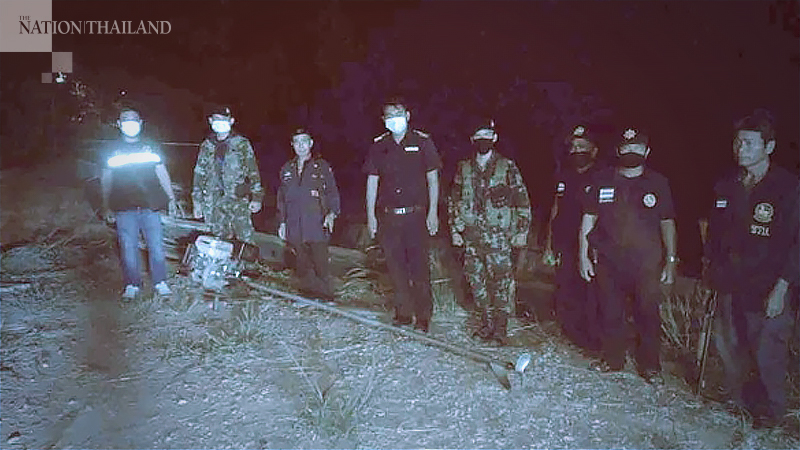
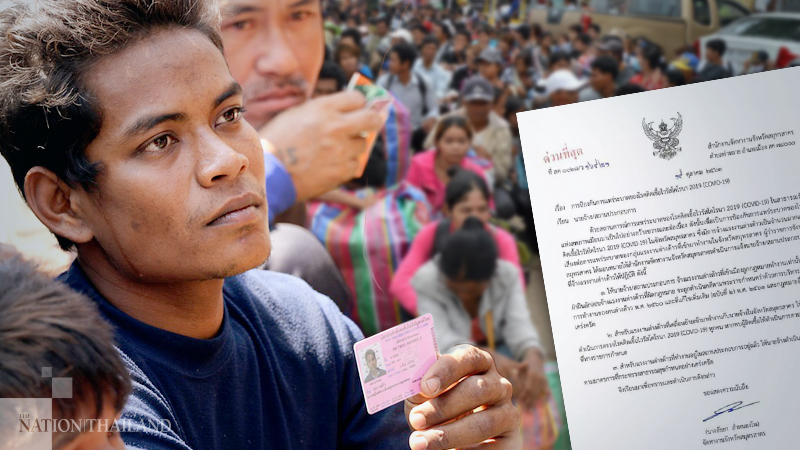
In a bid to curb the spread of Covid-19 and avoid a second wave in Samut Sakhon province, provincial governor Veerasak Vijitsaengri has instructed the employment office to ensure all migrant workers are tested for the virus.
This order comes in response to the recent breakout in Myanmar, where most migrant workers in the province come from.
Veerasak has told the employment office to ensure:
• Businesses only hire migrant workers who have arrived legally. If they are caught hiring any illegal foreign workers, they will be prosecuted in accordance with the emergency decree on management of foreign workers and other laws.
• All employers are required to ensure workers who have just arrived in Samut Sakhon undergo Covid-19 tests. If any infections are found, steps will have to be taken in line with government regulations.
• For migrant workers already working in the province, employers are required to take preventive measures in strict accordance with measures prescribed by the Public Health Ministry.
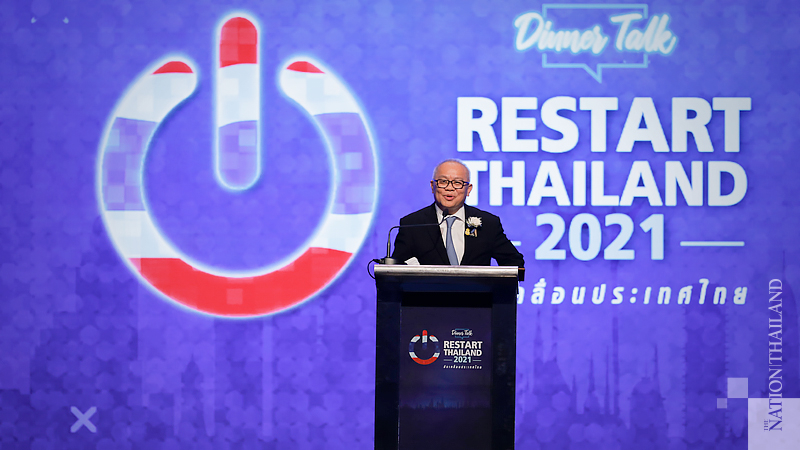
The Covid-19 outbreak that hit Thailand since April has exposed the fragility of the economy and shed light on the fact that we rely too much on export and tourism, Deputy PM Supattanapong Punmeechaow said.
The deputy PM, who also holds the Energy portfolio, was speaking at the “Restart Thailand 2021” dinner talk held on Thursday by Thansettakij and Krungthep Turakij newspapers at Siam Paragon shopping complex in Bangkok.
“The outbreak has had an especially heavy impact on small and medium businesses, prompting the government to spend over Bt800 billion on SME aid measures including postponing debt repayment worth over Bt6.8 trillion for 12 million SMEs,” he said. “However, from July onwards, economic indicators have been pointing toward an improving, trend thanks to cooperation from all parties in outbreak prevention, despite some minor impact from political situations.
“The tourism industry has shown improvement, with about 30 per cent occupation, jumping from just 6 per cent in April, thanks to the government’s economic stimulus campaigns such as the ‘Let’s Go Halves’ shopping subsidy,” he added. “Through the Thai Credit Guarantee Corporation, the government is also planning to provide an additional Bt150 billion in loans to help small and medium businesses.
“The battle against Covid-19 is not over yet. The government still has many projects in the coming year to boost the economy, attract foreign investors and build infrastructure for future expansion,” the minister added.
“These projects include the construction of 14 Skytrain lines in Bangkok covering 500 kilometres in the next four to five years, larger than London’s Underground, and the infrastructure projects in the Eastern Economic Corridor to support digital technology, 5G and robotics industry.
“It is unacceptable to let Thailand slide back to the period before Covid-19. Since the global economy is changing we must be more proactive in attracting foreign investors, and the agencies responsible for this are the Board of Investment Office [BoI] and Eastern Economic Corridor Office,” Supattanapong said.
“The next step will be to put Thailand on the list of top 10 countries with ease of doing business, which is a goal proposed by five countries who are our major trade partners.”
2021 will be the year of investment
The deputy PM further explained that next year the government will focus on investing in new industries that will help reduce reliance on export and tourism. “Bangkok will be the centre of regional offices of multinational companies, while Thailand’s automotive industry will focus on the manufacturing of electric vehicles [EVs],” he said. “EVs will create other related industries such as smart equipment manufacturing and electricity generating from renewable energy. This will create a great opportunity for Thailand to further invest in community power plants, as well as biomass and solar power plants in Laos.
Thai economy to regain its strength in 2022
The minister predicted that in 2022, the economy will become as strong as, or even stronger than before Covid-19 hit the country. “The economy next year will still require aid from the government despite the availability of Covid-19 vaccine. It should take at least six months for the situation to stabilise, and we should see an upward trend in the economy starting from the second half of the year onwards,” he said.
“Next year the government will also focus on creating economic opportunities at the grassroots level to reduce disparity,” he added. “We cannot give people free handouts, we also need to create new jobs and new businesses that will support existing and future industries.”
Prevent 2nd wave of outbreak at all cost
Supattanapong said the government will not allow the outbreak situation to escalate and lead to a country-wide lockdown for the second time. “The first lockdown had a heavy impact on the economy and required a long time for us to recover,” he said. “We will not let that happen again.
“The government has earmarked Bt3 billion to buy the first batch of Covid-19 vaccines, which will be provided to those in risky groups first,” he added. “Then we will use domestic facilities to produce vaccines for the rest of the population. When the outbreak situation returns to normal, we can expect a full recovery of the economy.”
The Centre for Covid-19 Situation Administration (CCSA) reported 15 new cases in quarantine facilities over a 24-hour period on Friday and one domestic case.
The cases, both Thais and foreigners, were found at quarantine centres in Bangkok, Samut Prakan and Chonburi provinces.
▪︎Four Thai women, aged 25, 25, 36, 41, who had travelled back from Myanmar.
▪︎A Thai boy, 9, two girls, 5 and 10, two female teachers, 28 and 39, who had returned from Saudi Arabia.
▪︎ A Thai female trainer, 24, from the United Kingdom
▪︎An Indian male student, 22, a Dutch man, 63, a Swiss girl, 2, and a Swiss man, 61, from their respective countries.
▪︎ A Belarussian woman, 27, from Turkey.
A female prawn merchant in Samut Sakhon, 67, tested positive for Covid-19 at Mahachai Hospital before she was transferred to Samut Sakhon Hospital. Initially, 26 people were considered high-risk close contacts, including her family members, a housemaid, medical officers and two Burmese employees; 13 have tested negative, 10 results are awaited and three people — her mother, elder sister and daughter-in-law — have tested positive. The three who have tested positive will be tested again and their situation confirmed on Saturday, Dr Sophon Iamsirithaworn, general communicable diseases director at the Department of Disease Control, said.
Some 139 people are considered as low-risk close contacts, which includes workers in a fish market, bringing the number of those in close contact to 165 people.
From December 1-13, the patient had sold prawns at the fish market from 6am to 11am every day. Her eldest son, 39, was immediately quarantined.
She suffered mild symptoms with muscle ache and loss of sense of smell on December 13. Three days later, she went to Mahachai Hospital, met eight health officers and took a Covid test at 6pm, then returned home. The hospital confirmed a positive result at 10pm and asked her to return to the hospital for quarantine.
The patient later was sent to Samut Sakhon Hospital on December 17 at 2.30am and tested again. The test result was again positive in the morning at 8am.
A Samut Sakhon provincial official confirmed that her residence area and the fish market have been disinfected.
Meanwhile, 16 patients have recovered and been discharged.
The total number of confirmed cases in Thailand increased to 4,297 (1,302 in state quarantine), 232 are in hospital, 4,005 have recovered and been discharged and 60 have died.
According to Worldometer, as of 10am on Friday, the total number of confirmed cases increased to 75.27 million (up by 721,392), 52.84 million have recovered, 20.76 million are active cases (107,213 in severe condition) and 1.67 million have died (up by 12,825).
Thailand ranks 152nd for most cases in the world, while the US has the most number with 17.62 million, followed by India 9.97 million, Brazil 7.11 million, Russia 2.76 million and France 2.42 million.
The Ministry of Commerce is negotiating a mini free-trade agreement (FTA) with Telangana state in India, aiming to increase trade and investment value between Thailand and the southern Indian state that has a population of 35 million people.
The agreement is expected to be signed by March 2021, Commerce Minister Jurin Laksanawisit said.
“India has a population of 1.3 billion people and its GDP is the world’s fifth largest. It is Thailand’s largest trade partner in South Asia,” he said. “Earlier we had negotiated an FTA with India involving trade valued at Bt10.12 billion. However, so far only 60 per cent of the trade target has been achieved due to lockdown restrictions during the Covid-19 outbreak.
“Next year we expect to sign a mini-FTA with India’s Telangana state and later will expand to signing with other states, such as Gujarat, Karnataka, Maharashtra, Kerala and seven sister states in India’s northeastern region,” added Jurin. “This will help Thai entrepreneurs in penetrating India’s market at the regional level.”
Meanwhile, the chairman of Thai-Indian Business Association, Satish Sehgal, said that Thailand should place as strong a focus on India as on China due to the sheer population size of India.
“Out of over 1.3 billion population, more than 300 million are classified as middle-class, or about five times the Thai population,” he said.
“We should focus on selling to this group, who have always preferred Thai products and services.
“Indians like to organise their weddings in Thailand, where they could spend up to Bt25 million per event, while Indian tourists usually spend around Bt100,000 to Bt1 million per person in Thailand,” he added.
“In the past, we had signed an FTA with India but the trade value was not very high. Signing more mini-FTAs with different states could help increase trade value between the two nations,” he said.



 หน่วยงานสิทธิมนุษยชนยูเอ็นกังวลใจกับการตั้งข้อหา ม.112 กับเยาวชนที่เคลื่อนไหวเรียกร้องประชาธิปไตย
  ทอม ครูซ ประกาศพักกองหลังทีมงาน 5 คนตัดสินใจลาออกเพราะถูกวีนเรื่องฝ่าฝืนมาตรการโควิด
 กัมพูชาห่วง Covid-19 ระบาด สั่งนักเรียน ม.6 ทุกคนไม่ต้องสอบแต่ให้ผ่านอัตโนมัติ
 สหรัฐจะรุกจีนหนักขึ้น ย้ำจีนเป็นคู่แข่งเพียงประเทศเดียวที่เป็นความท้าทายของสหรัฐในระยะยาว
 ประเทศเอเชียไต่อันดับดัชนีชี้วัดประสิทธิภาพระบบรักษาสุขภาพจากการรับมือโควิด-19
