Butler on wheels, robot cutting salad: How covid sped automation #SootinClaimon.Com

#SootinClaimon.Com : ขอบคุณแหล่งข้อมูล : หนังสือพิมพ์ The Nation.

Butler on wheels, robot cutting salad: How covid sped automation (nationthailand.com)

Butler on wheels, robot cutting salad: How covid sped automation

Dec 15. 2020A healthcare worker receives groceries delivered with a Starship Technologies robot in Mountain View, California, on May 18. MUST CREDIT: Bloomberg photo by Nina Riggio.A healthcare worker receives groceries delivered with a Starship Technologies robot in Mountain View, California, on May 18. MUST CREDIT: Bloomberg photo by Nina Riggio. 

By Syndication Washington Post, Bloomberg · Olivia Rockeman, James Attwood, Joe Deaux

For decades, the attitude of unions and their advocates to increased automation could be summed up in one word: no. They feared that every time a machine was slipped into the workflow, a laborer lost a job.

The covid-19 pandemic has forced a small but significant shift in that calculation. Because human contact spreads the disease, some machines are now viewed not exclusively as the workers’ enemy but also as their protector. That has accelerated the use of robots this year in a way no one expects to stop, even after the virus is conquered.

“If you keep me six feet away from the other worker and you have a robot in between, it’s now safe,” said Richard Freeman, a professor of economics at Harvard University, who studies labor. “And the robot companies are selling that as a solution and the unions aren’t going to say, ‘No, you should have the workers standing next to each other so they get sick.'”

The result is the spread of windshield-mounted toll detectors, automated floor cleaners at factories, salad-chopping machines in grocery stores, mechanical butlers at hotels and electronic receipts for road pavers. What remains less clear is where the men and women who used to do some of those jobs will work.

The impact of technology on employment has been a topic of anxiety and study for generations with mixed results. Cars didn’t kill trains, television didn’t end radio. When banks installed ATMs, they hired more people, not fewer, because the variety of their services grew. But machines have eliminated many jobs, and the current wave will prove to be no exception, especially with public health a top concern.

“When we come out of this crisis and labor is cheap again, firms will not necessarily roll back these inventions,” David Autor, an economist at the Massachusetts Institute of Technology, said at a September webinar of the Federal Reserve Bank of Philadelphia. “These are kind of one-way transitions.”

That’s what worries union leaders.

“In the auto industry, we see Covid accelerating transformation toward digitization,” said Georg Leutert, who heads the automotive and aerospace industries at Geneva-based IndustriALL Global Union. While the transition is unavoidable, workers are nervous and need help with up-skilling and re-skilling, he said.

Mark Lauritsen of the United Food and Commercial Workers International Union in North America said that in order to avoid the kind of disruption in the meat industry caused by the virus, automation will clearly continue but warned, “If automation is unbridled it’s going to be a threat.”

With office workers at home communicating via remote tools, a knock-on effect is also being felt: bus drivers, sandwich stall owners and janitors are in trouble as their jobs, which support in-office work, diminish. Jobs in administrative support, which includes roles in office buildings, are down about 700,000 since last year, according to November data from the Bureau of Labor Statistics. In addition, the stock market, already biased toward technology companies, has driven investors away from labor-intensive industries in the pandemic.

New automation also seems to be affecting retail jobs. There are 500,000 fewer of them than last November, according to the BLS. Transportation and warehousing are about 100,000 jobs below year-ago levels. Meanwhile, retail sales are at their highest level on record, mostly driven by e-commerce, which often employs more automation than than brick-and-mortar stores do.
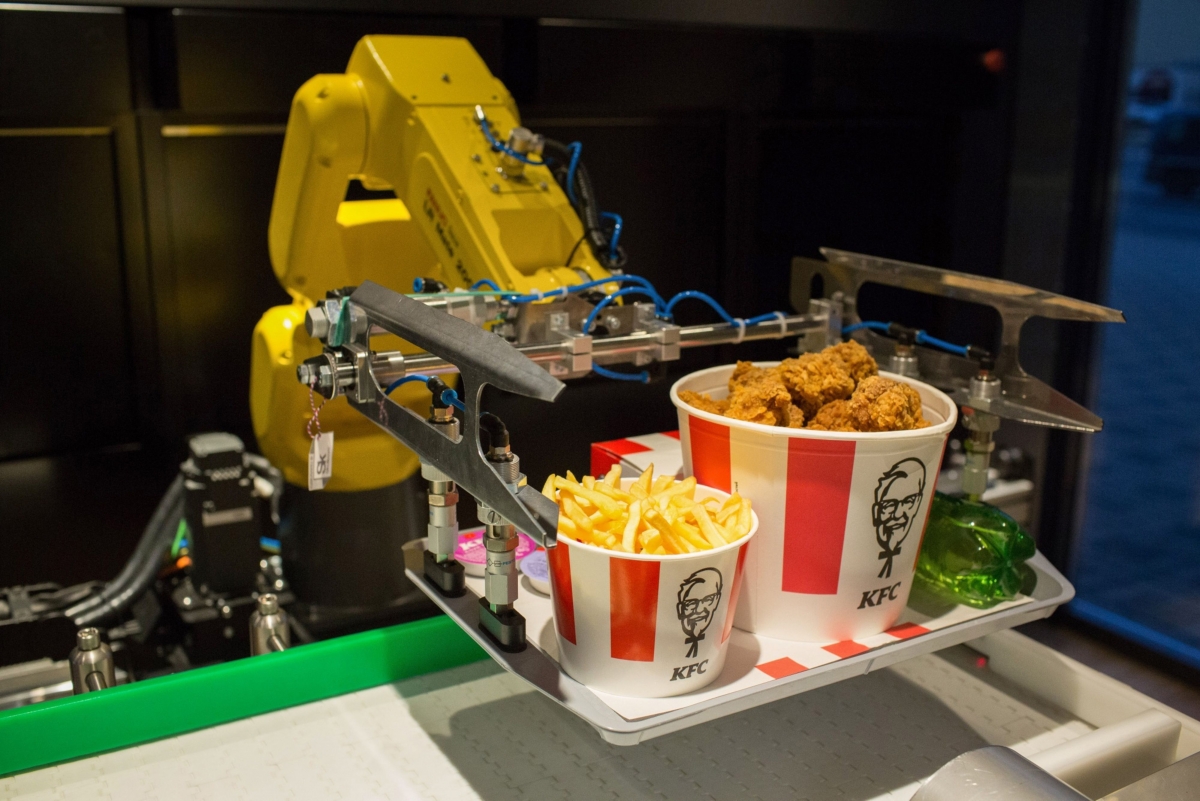
A robotic arm lifts an order of food from a conveyor belt inside a new contactless Kentucky Fried Chicken restaurant in Moscow, Russia, on June 12. MUST CREDIT: Bloomberg photo by Andrey Rudakov

A robotic arm lifts an order of food from a conveyor belt inside a new contactless Kentucky Fried Chicken restaurant in Moscow, Russia, on June 12. MUST CREDIT: Bloomberg photo by Andrey Rudakov

The World Economic Forum reported in October that 43% of businesses surveyed are set to reduce their workforce due to technology integration while 34% plan to expand their workforce for the same reason. By 2025, the time spent on current tasks at work by humans and machines will be equal.

Some argue that turning over repetitive jobs to robots will free up workers to take on new roles in what is now a booming industry — elderly care. There is an urgent need for more workers to look after the “oldest old,” Manoj Pradhan, founder of Talking Heads Macroeconomics, and Charles Goodhart, London School of Economics professor, argue in their book “The Great Demographic Reversal.”

But Marcus Casey, an economist at the University of Illinois at Chicago, says that while some high-skilled workers will be retrained, many low-skilled ones — like toll collectors — won’t, exacerbating inequality.

One case in point: The Pennsylvania Turnpike Commission cut 500 jobs after installing an electronic tolling system in March.

Some companies are preparing for more pandemics, meaning more automation and fewer employees. Lucid Motors, an electric-vehicle startup backed by Saudi Arabia’s Public Investment Fund, has built a 999,000-square-foot electric vehicle factory in Casa Grande, Arizona, where it hopes to start production on a $160,000 EV next year.

“After this pandemic, the next pandemic will show up,” said Peter Hochholdinger, Lucid’s vice president of manufacturing. “We have to put more effort in automation in general assembly.”

In mining, Swedish suppliers Hexagon and Epiroc say interest in automation has suddenly jumped.

Caterpillar Chief Executive Jim Umpleby said recently that older equipment will probably be replaced by more digital trucks and autonomous technologies will reduce close proximity among workers.

Juan Cariamo, chairman of CNP, a public-private group that helps test mining technologies in Chile, said the virus is accelerating long-term changes by forcing companies to relocate employees off-site.

“The pandemic has imposed a sense of urgency,” Cariamo said in an interview. “Projects that were already in the pipeline are being sped up.”

In Chile, requests have grown for permits to pilot a wide range of technologies from tire pressure sensors to mining waste reprocessing and autonomous vehicles. Chile’s mining regulator signed an agreement with CNP in October to streamline the permit process.

BHP Group, the world’s biggest miner, has an $800 million program to add 500 autonomous trucks in iron ore and coal mines in Australia and is considering adopting driverless trucks at copper mines in Chile.

Chile’s mining industry employed 201,000 people in September, down 15% from last year and the lowest in at least a decade, according to the country’s Mining Council. Meanwhile, production has risen slightly and the council has lowered by 12% its projection for the number of mining jobs needed over the next decade.

Recession is a common time for investment in automation because borrowing is cheaper and companies that cut jobs — even if due to automation — can attribute the reductions to the economy and avoid negative publicity, said Ethan Pollack, policy director at The Aspen Institute Future of Work Initiative. The pandemic only adds to the motives, he said.

Currently, Chile, the U.S. and Mexico spend the least on active labor market policies — which are intended to improve job readiness and expand employment — among all countries that belong to the Organization for Economic Cooperation and Development. That isn’t likely to change quickly because health concerns are coming first.

“Politicians are still not paying attention,” Pollack said. “We’re going to be paying the cost for decades if we don’t act now.”

Tax laws also favor automation. U.S. tax on capital — which includes robots and machinery — is about 5%, whereas the tax on labor is about 25%, according to a study from MIT economists.

President-elect Joe Biden acknowledges the threat of job loss but hasn’t mentioned additional funding or changes to the tax code. He has said his administration will ensure that employers give all affected employees advance notice of technology changes and automation in the workplace, put their employees at the front of the line for new jobs and offer paid skills training.

Casey, the University of Illinois economist, says the more people without work, the greater the risk of social unrest.

“Many of these people are prime-age males who have virtually nothing to do and our social policy directs money away from that cohort by and large,” Casey said. Policy makers are “underestimating the political problem and the social problem that’s going to emerge when we go into a world in which there’s just not enough work to go around.”

Amazon’s Zoox unveils robotaxi for future ride-hailing service #SootinClaimon.Com

#SootinClaimon.Com : ขอบคุณแหล่งข้อมูล : หนังสือพิมพ์ The Nation.

Amazon’s Zoox unveils robotaxi for future ride-hailing service (nationthailand.com)

Amazon’s Zoox unveils robotaxi for future ride-hailing service

Dec 15. 2020A Zoox Inc. logo. MUST CREDIT: Bloomberg photo by Michael ShortA Zoox Inc. logo. MUST CREDIT: Bloomberg photo by Michael Short 

By Syndication Washington Post, Bloomberg · Ed Ludlow

Zoox Inc., the self-driving start-up owned by Amazon.com Inc., unveiled a fully autonomous electric vehicle with no steering wheel that can drive day and night on a single charge.

The vehicle, which Zoox describes as a driverless carriage or robotaxi, can carry as many as four passengers. With a motor at each end, it travels in either direction and maxes out at 75 miles per hour. Two battery packs, one under each row of seats, generate enough juice for 16 hours of run time before recharging, the company said. To commercialize the technology, Zoox plans to launch an app-based ride-hailing service in cities like San Francisco and Las Vegas.

“This is really about reimagining transportation,” Zoox Chief Executive Officer Aicha Evans said in an interview with Bloomberg Television. “Not only do we have the capital required, we have the long-term vision.”

The company also plans to launch ride-hailing services in other countries, Evans said. Executives didn’t say how much rides would cost but that they would be “affordable” and competitive with services operated by Uber Technologies Inc. and Lyft Inc. Nor did they say when the service would launch but confirmed it wouldn’t happen in 2021. In a video released Monday, Evans used Zoox’s app to hail the vehicle outside San Francisco’s Fairmont hotel and took a spin around the block.

Acquired by Amazon in June for an undisclosed sum, Zoox is one of several companies racing to put fully autonomous vehicles on the road, an effort that’s taking longer than anticipated. Most are testing retrofitted conventional cars on public roads, and few are commercially deployed. In October, Alphabet Inc.’s self-driving unit Waymo started a fully driverless taxi service in suburban Phoenix. General Motors Co.-backed Cruise LLC is also testing autonomous cars — recently without safety drivers — in San Francisco, using a fleet of electric vehicles based on the Chevy Bolt.

Despite being years from deployment, several of Zoox’s quirky-looking mint-green vehicles are already being built at a facility in Fremont, California. The factory has the capacity to eventually produce 10,000 to 15,000 units annually, executives said. Suppliers send the major components — the drive unit, body, battery pack and so on — pre-assembled, and Zoox then does final assembly in stages, a process it likens to building a Lego set. Executives declined to reveal the battery supplier.

The unveiling of a production car marks a significant step for a company that has been working on an autonomous passenger vehicle since its founding in 2014. At times Zoox was “ridiculed” for what it was trying to do, Chief Technology Officer Jesse Levinson told Bloomberg TV.

“Unlike many of the concept cars other companies have shown in the last several years this vehicle has passed all the FMVSS crash tests,” Levinson said, referring to tests required by U.S. regulators.

Zoox isn’t the first to unveil a fully autonomous passenger vehicle. GM’s Cruise showed off a battery-powered shuttle in January. Called the Origin, it also does away with many of the controls present in conventional cars: pedals, rearview mirrors, steering wheel. Cruise plans to commercialize the Origin through a ride-sharing service and says it’s cheaper to run than a conventional car.

Zoox’s vehicle is similar but smaller. On each corner a “sensor pod” houses a spinning laser sensor and other lidars and as well as cameras to help it navigate. A pair of front-facing cameras sit atop of the vehicle, with other less-visible sensors mounted on the sides. Each corner pod has a 270-degree field of vision, enabling the car to see more than 360 degrees of terrain at once.

The vehicle’s safety features include air bags that form a cocoon around each passenger in the event of a crash, which Zoox says is unlikely given its confidence in the technology. The company can manually operate the vehicles remotely and communicate with passengers in real time. For those worried about privacy, Zoox says passengers will have the option to blur images captured by the onboard camera.

When Amazon acquired Zoox, industry watchers speculated that the e-commerce giant eventually planned to deploy fleets of driverless delivery vehicles. In the interview, Evans said there are currently no plans to do so but acknowledged that “at some point we could move packages.”

India to enhance its weapons, ammunitions stockings for 15 days intense war amid tensions at LAC #SootinClaimon.Com

#SootinClaimon.Com : ขอบคุณแหล่งข้อมูล : หนังสือพิมพ์ The Nation.

India to enhance its weapons, ammunitions stockings for 15 days intense war amid tensions at LAC (nationthailand.com)

India to enhance its weapons, ammunitions stockings for 15 days intense war amid tensions at LAC

Dec 15. 2020

Chief of Defence Staff, Bipin Rawat

Chief of Defence Staff, Bipin Rawat

By The Statesman/ANN

Amid the intense tensions with China at LAC on eastern Ladakh, India asserts that it has enhanced its stocking of weapons and ammunition for a 15-day intense war now.

According reported by news agency ANI, making use of the extended stocking requirements and the emergency financial powers, the defence forces are expected to spend over Rs 50,000 crore for acquisition of equipment and ammunition from both local and foreign sources.

“A number of weapon systems and ammunition are being acquired now under the authorisation of having reserves to fight a 15-day intense war with the enemies. The stocking would now be at 15-I level from the 10 I levels,” government sources told ANI.

The authorisation for enhanced stocking for the defence forces was approved some time ago, they said.

As per the authorisation many years ago, the armed forces were supposed to stock for a 40-day intense war but it was then brought down to 10-I level due to issues with the storage of weapons and ammunition as well as the changing nature of warfare.

In a separate development, the Chief of Defence Staff, Bipin Rawat said, “We are in a standoff situation in Ladakh and based on that there is some development activity which has been ongoing in Tibet Autonomous Region of China. Every nation will continue to prepare for ensuring its security based on their stretagic interest.”

“China’s attempt to change the status quo on Line of Actual Control along the northern border amidst COVID-19 pandemic necessities high-level preparation on land, sea and air,” he said.

“I am fully confident that Indian Armed Forces will leave no stone unturned to safeguard our frontiers be it at land, air or ocean,” he added.

India and China have locked horns at the eastern front after an unprecedented violent clash took place in Galwan Valley at the Line of Actual Control in eastern Ladakh with Chinese People’s Liberation Army soldiers attacking a small group of Indian Army men on patrol, resulting in fatalities which included the commanding officer of the Indian Army.

The stand-off persisted even after series of Commanders level talks from both the sides.

Last week, while addressing a webinar organised by the Lowy Institute –an Australian think-tank, External Affairs Minister S Jaishankar acknowledged that India was probably at the “most difficult phase of our relationship with China in the last 30-40 years or even more” in the wake of the military standoff between the two countries in eastern Ladakh.

S. Korea’s bird flu battle at critical juncture #SootinClaimon.Com

#SootinClaimon.Com : ขอบคุณแหล่งข้อมูล : หนังสือพิมพ์ The Nation.

S. Korea’s bird flu battle at critical juncture (nationthailand.com)

S. Korea’s bird flu battle at critical juncture

Dec 15. 2020
A truck disinfects the surrounding area of a duck farm in Jangseong, 308 kilometers south of Seoul, on Friday. (Yonhap)A truck disinfects the surrounding area of a duck farm in Jangseong, 308 kilometers south of Seoul, on Friday. (Yonhap) 

By The Korea Herald/ANN

South Korea’s agricultural ministry said Tuesday the number of highly pathogenic bird flu cases from local poultry farms may continue to rise down the road due to seasonal migratory birds, urging farmers to beef up preventive measures against the contagious animal disease.

“As migratory birds will continue to flock into the country through January, local poultry farms are currently at a critical juncture,” the Ministry of Agriculture, Food and Rural Affairs said in a statement.

South Korea has reported 13 highly pathogenic bird flu cases from poultry farms so far this year, while three other suspected cases are currently under investigation.

After reporting the first farm-related case on Nov. 26, the virus has spread throughout the nation, with infections being reported from various provinces, with South Jeolla Province alone adding five cases.

In line with efforts to prevent the spread of the virus, the country has culled more than 5 million poultry from infected farms, as well as the surrounding areas, including 3.23 million chickens and 880,000 ducks.

Local authorities slaughtered poultry within a 3-kilometer radius of infected farms.

“As wild animals, including rats, can carry contaminants, farmers should thoroughly block them from entering their farms,” the ministry added.

South Korea said it will slap fines on farms that fail to follow preventive measures.

Highly pathogenic avian influenza is contagious and can cause severe illness and even death in poultry.

The country reported its first highly pathogenic case in 32 months in late October in Cheonan, 92 kilometers south of Seoul, from wild birds.

Since then, a total of 27 cases have been found from wild bird habitats across the country, according to the ministry. Nine other suspected cases are currently under investigation. (Yonhap)

Beijing firms up its ambitions in technology and innovation #SootinClaimon.Com

#SootinClaimon.Com : ขอบคุณแหล่งข้อมูล : หนังสือพิมพ์ The Nation.

Beijing firms up its ambitions in technology and innovation (nationthailand.com)

Beijing firms up its ambitions in technology and innovation

Dec 15. 2020A volunteer wears a hat mounted with a flexible display during the ZGC Forum in Beijing on Sept 17. [Photo by Zhu Xingxin/chinadaily.com.cn]A volunteer wears a hat mounted with a flexible display during the ZGC Forum in Beijing on Sept 17. [Photo by Zhu Xingxin/chinadaily.com.cn] 
By Zhang Zhihao
China Daily/ANN

Officials and experts predict more policy support and investment in various fields

Beijing aims to become a global science, technology and innovation hub by 2025 by providing more incentives for frontier sciences, attracting more global talent, enhancing intellectual property protection and increasing support for small tech ventures, officials and experts said.

Research fields including artificial intelligence, quantum science, medical science, block chain, information technology, the internet of things, materials science, space technology and renewable energy will see more policy support and investment in the nation’s capital, they added.

National planners hope to turn Beijing, Shanghai and the Guangdong-Hong Kong-Macao Greater Bay Area into global science and technology innovation centers, according to the proposals for formulating China’s 14th Five-Year Plan (2021-25) for National Economic and Social Development and the Long-Range Objectives Through the Year 2035.

Cai Qi, Beijing’s Party chief, told experts at a symposium on Beijing’s development in October that the capital will be more open, more innovative and more supportive of tech companies.

Building new infrastructure for artificial intelligence, 5G telecommunication, the industrial internet and internet of things and other major fields will be a priority, which will lay the foundation for upgrading the city’s future industries, he said.

Xu Qiang, director of the Beijing Municipal Science and Technology Commission, said this month that Beijing has several advantages that will help it become a global science, technology and innovation hub.

Sui Zhenjiang, vice-mayor of Beijing, said during the Second World Science and Technology Development Forum early last month that the 3,000-year-old city boasts the most scientific talent and resources in the country, as well as having a rich culture of international cooperation, encouraging innovations and tolerating failures.

In 2016, the State Council issued a plan for Beijing to become a national science and technology innovation center. By October last year, the municipality had implemented 30 new policies toward that goal, ranging from granting scientists more autonomy over research grants to streamlining visa applications for foreign scientists.

“Being the nation’s capital, Beijing has the responsibility, means, foundations and advantages to facilitate scientific and technological innovation and play its role in serving the nation’s modernization process,” Sui said.

Around half of the academicians of the Chinese Academy of Sciences and the Chinese Academy of Engineering are stationed in Beijing, he said. The city is also home to one-third of China’s major scientific instruments, and around 357,000 researchers.

There are 185 researchers for every 10,000 employees in the city, a ratio on par with that of developed countries, he said. The city invests around 6 percent of its GDP in research and development, significantly higher than the average 2.5 percent benchmark for innovative countries, he added.

The World Intellectual Property Organization ranked Beijing this year as the world’s fourth-most-active science and technology cluster in terms of publishing and patent performance, behind Tokyo-Yokohama in first place, Shenzhen-Hong Kong-Guangzhou second, and Seoul third.

The Nature Index 2020 Science Cities, published in September, ranked Beijing as the top global science city for the third year in a row after factoring in the concentration of talent, funding, research institutions, and the quality of published scientific papers and international cooperation.

The city’s “three science cities and one hi-tech area” — Zhongguancun Science City, Huairou Science City, the Beijing Future Science Park and the Beijing Economic-Technological Development Area — have become major hubs for frontier research, Sui said.

About 183 multinational corporations, along with nearly 4,000 foreign companies and research institutions, have either established headquarters in Beijing or are collaborating with partners from the city, he said.

In that ecosystem of international cooperation, Zhongguancun stands out as the forerunner of China’s scientific reform and innovations for being the base for nearly 1,000 foreign companies, Sui added.

In 2018, Chinese scientists from the area published 14,074 papers as first authors with foreign peers, accounting for nearly 25 percent of the national total.

In the next few years, Beijing will attract more foreign talent, optimize planning for the science cities, provide more investment for basic research and incubate more innovative tech companies, Sui said.

Since 2018, Beijing has helped over 3,500 foreign scientists settle in the capital by providing better housing, insurance and educational opportunities for their children. Over 4,000 talented foreigners have been granted permanent resident status, making Beijing the first-choice destination for foreign researchers, he said.

The capital has established a fund of 30 billion yuan ($4.58 billion) to support innovation, provided 160 billion yuan in tax breaks for small and medium-sized companies, and streamlined government administration for science project applications and the procurement of research equipment, he said.

In terms of city planning, Zhongguancun will focus on basic and frontier sciences in key technological sectors, Sui said. Huairou will build more major scientific research infrastructure, with an emphasis on materials science, logistics, energy and space technology.

The Beijing Future Science Park will prioritize public health and biosciences research, as well as the commercialization of new technologies.

The Beijing Economic-Technological Development Area will aim to become a hub for high-end manufacturing, such as producing integrated circuits.

At the same time, Beijing will bolster intellectual property rights protection and related services, including harsher punishments for copyright infringements and allowing small tech companies to pledge their intellectual property for loans, Sui said.

Justin Yifu Lin, a senior economist and honorary dean of the National School of Development at Peking University, said in a seminar in Shenzhen, Guangdong province, last week that innovation, collaboration, being green, openness and sharing are the five key characteristics of new development.

The combination of an effective market and a capable government to support businesses is instrumental in achieving quality economic growth, he added.

Yu Jian, deputy director of the Ministry of Science and Technology’s department of strategic planning, said at a seminar in Beijing in April hosted by the city’s science and technology commission that the capital should set its eyes on becoming a global science and technology center, and create an innovative ecosystem with international influence.

Liu Qiyan, deputy director of the Institute of Scientific and Technical Information of China, said at the seminar that Beijing should enhance its ability to quantify and keep track of tech companies and their resources, and expand the influence of innovation to more local levels.

Li Guoping, president of the Beijing Development Institute at Peking University, said at the same event that innovation cannot do without industrialization, and Beijing’s path toward an innovation center will require support from various industries, especially high-end manufacturing.

First shipments of Pfizer-BioNTech vaccine in Singapore by end-Dec; enough vaccines for all by Q3 2021 #SootinClaimon.Com

#SootinClaimon.Com : ขอบคุณแหล่งข้อมูล : หนังสือพิมพ์ The Nation.

First shipments of Pfizer-BioNTech vaccine in Singapore by end-Dec; enough vaccines for all by Q3 2021 (nationthailand.com)

First shipments of Pfizer-BioNTech vaccine in Singapore by end-Dec; enough vaccines for all by Q3 2021

Dec 15. 2020

By Audrey Tan
The Straits Times/ANN

SINGAPORE – The Health Sciences Authority (HSA) has approved the use of the Pfizer-BioNTech Covid-19 vaccine in Singapore, with the first shipment of the vaccine expected to arrive here by the end of this month.

Prime Minister Lee Hsien Loong revealed this in his address to the nation on Monday (Dec 14), saying: “I am very happy to tell you that after studying the scientific evidence and clinical trial data, the Health Sciences Authority has approved the Pfizer-BioNTech vaccine for pandemic use.”

This makes Singapore one of the first countries to obtain this vaccine, he added.

Mr Lee said other vaccines are expected to arrive in Singapore in the coming months.

“If all goes according to plan, we will have enough vaccines for everyone in Singapore by the third quarter of 2021,” he said.

Britain was the first country to approve the use of the Pfizer-BioNTech vaccine on Dec 2, with the United States following suit on Dec 11.

The approvals come after US pharmaceutical giant Pfizer and its German partner BioNTech released in November the final results from the late-stage trial of the Covid-19 vaccine.

The findings showed that their vaccine was 95 per cent effective at preventing a person from getting infected with the coronavirus.

The Straits Times had earlier reported that American biotechnology company Moderna, which is developing another Covid-19 vaccine that is a front runner, is also seeking HSA approval to roll out its vaccines here. HSA said it has started evaluating the available data.

Both the Pfizer-BioNTech and Moderna vaccines leverage a new technology called messenger RNA.

Traditional vaccines, such as inactivated virus vaccines and live attenuated vaccines, work by injecting whole but inactive viruses into patients to stimulate an immune reaction. This is what is done for polio (inactivated polio vaccine) and chickenpox (a live, but weakened, virus vaccine).

But RNA vaccines involve injecting snippets of the viral genetic code so a patient’s body mounts a protective response without being actually exposed to the whole virus.

The Pfizer-BioNTech vaccine is the first RNA vaccine on the market.

Japan to sell ‘smart city’ services to SE Asian cities #SootinClaimon.Com

#SootinClaimon.Com : ขอบคุณแหล่งข้อมูล : หนังสือพิมพ์ The Nation.

Japan to sell ‘smart city’ services to SE Asian cities (nationthailand.com)

Japan to sell ‘smart city’ services to SE Asian cities

Dec 15. 2020

By The Japan News/ANN

The government has decided to market Japan’s comprehensive technologies and services for “smart cities,” a next-generation city model that optimizes the use of cutting-edge telecommunications, to Southeast Asian countries.

By the end of this year, the government will conduct an aptitude survey on what kind of services will be needed for the endeavor in 26 cities in 10 countries that the government regards as the most important markets. It will use the survey results to encourage domestic companies in various industry sectors to venture into the market. Related expenses will be included in the third supplementary budget for fiscal 2020.

In the smart city model, basic infrastructure, such as homes, companies and cars, and social infrastructure, including electricity, gas and public transport and schools, are interconnected and provide data. By collecting and analyzing this data on consumption and flows of people, smart cities can realize better services and achieve greater energy efficiency.

In Southeast Asian countries, populations tend to cluster in and around big cities. Therefore, the government concluded that the use of information technology could be useful as measures for solving traffic jams, environmental issues and other problems.

The government also has an incentive to compete with China’s government-monitored smart city scheme by promoting the protection of personal information.

The government expects a wide range of items will be exported under the project. They include public transport systems using signal controls, measures against cyber attacks, security measures via surveillance cameras, cashless payments and smart grids — next-generation power grids that efficiently manage and supply power.

By the end of the year, the government will ask Ho Chi Min City, Phnom Penh and some other cities to propose what kind of systems they need to solve problems in their urban policies. Based on the proposals, the government will work with each city and together write up a basic plan for urban development.

In 2019, the government set up a public and private council to market services related to smart cities overseas, together with about 270 companies and organizations, including Hitachi, Ltd. and MUFG Bank, Ltd.

Based on the master plan, the government is considering looking for companies that can provide necessary services through the council and implementing demonstrations of the services and provide training and technical support in the Southeast Asian countries.

Smart city projects in Japan include Woven City, which Toyota Motor Corp. is planning to start building in Susono, Shizuoka Prefecture, in February 2021.

Toward the realization of smart cities, the Land, Infrastructure, Transport and Tourism Ministry started in fiscal 2019 supporting 43 projects, such as the operation of self-driving buses near Haneda Airport in Tokyo. The day when smart cities will be in practical use is coming close.

Principle Capital to significantly boost hospitals, clinics under its banner #SootinClaimon.Com

#SootinClaimon.Com : ขอบคุณแหล่งข้อมูล : หนังสือพิมพ์ The Nation.

Principle Capital to significantly boost hospitals, clinics under its banner (nationthailand.com)

Principle Capital to significantly boost hospitals, clinics under its banner

CorporateDec 15. 2020

By The Nation

Principal Capital Public Co Ltd plans to increase the number of hospitals under its management from 11 to 20, according to its three-year business plan (2021-2023).

It will also increase the number of clinics from 10 to 100, chairman of Principal Capital’s executive committee Satit Viddayakorn said.

He said that from next year onwards the company will focus on seeking partnerships, adding that it is currently in talks with three potential partners. The talks are expected to be concluded in the first half of next year.

SET offers new guidelines for investing in the new normal #SootinClaimon.Com

#SootinClaimon.Com : ขอบคุณแหล่งข้อมูล : หนังสือพิมพ์ The Nation.

SET offers new guidelines for investing in the new normal (nationthailand.com)

SET offers new guidelines for investing in the new normal

CorporateDec 15. 2020Pakorn Peetathawatchai Pakorn Peetathawatchai 

By The Nation

President of the Stock Exchange of Thailand (SET) Pakorn Peetathawatchai on Monday unveiled three guidelines to help drive the Thai capital market in the “new normal” era.

The guidelines are:

Increasing fundraising opportunities: SET will launch a third stock market to help small and medium-sized businesses (SMEs) and start-ups raise funds. Foreign companies will also be helped to raise funds via the Thai stock market.

Developing products to meet investors’ demands: SET will offer more overseas investment opportunities to help investors diversify their investments.

Transitioning to the new normal era: It is necessary for SET to adapt so it is in line with the new normal, because now investors are paying more attention to stocks related to the environment, social causes and good governance that generate good returns.

“The stock market is an important factor that can help boost the country’s gross domestic product [GDP] as it accounts for 31 per cent of the Thai capital market,” Pakorn said.

“However, the Thai capital market has weak points, as the number of SMEs and products related to overseas investment is still low, so the SET and the government are working together to solve these issues.”

Pakorn said the Thai capital market is recovering in a K-shape after Covid-19 emerged at the beginning of the year.

“The Thai capital market has the opportunity to expand further as economies in Asia are likely to recover faster compared to Europe, especially in countries like China, India, Japan and Indonesia,” he said.

However, he added that investors should study each company’s moves to adjust in line with the new normal before they invest.

U.S. stocks fall for fourth day; dollar weakens #SootinClaimon.Com

#SootinClaimon.Com : ขอบคุณแหล่งข้อมูล : หนังสือพิมพ์ The Nation.

U.S. stocks fall for fourth day; dollar weakens (nationthailand.com)

U.S. stocks fall for fourth day; dollar weakens

EconDec 15. 2020

By Syndication Washington Post, Bloomberg · Kamaron Leach, Yakob Peterseil

U.S. stocks fell for a fourth day as investors assessed the prospects for a federal spending package and the likelihood for further virus-related economic restrictions.

The S&P 500 Index capped its longest slide since September and is 1.4% below its Dec. 8 record. The Nasdaq 100 Index advanced 0.9%, led by drugmakers after Alexion Pharmaceuticals Inc. agreed to be bought by AstraZeneca Plc. Energy producers tumbled after OPEC cut its demand forecast. Oil was lower most of the day before reversing. The dollar extended its slump with Treasuries. Brazil’s Ibovespa Index erased losses for the year.

Optimism from the start of covid-19 shots gave way to concern over whether a relief bill from a bipartisan group of lawmakers would gain traction after its release later. The virus continued to rage in the U.S., threatening harsher restrictions across the nation. New York Mayor Bill de Blasio, D, warned that people should be prepared for a full shutdown and start making plans to work remotely.The electoral college will officially elect Joe Biden president.

“Signs of market fatigue are more prevalent today than a month ago, even as the popular average is near all-time highs,” wrote Paul Nolte, a portfolio manager at Kingsview Investment Management. “The much-awaited correction could come as investors tire of Washington, worry about the covid cases over the holidays, or some other concern that is likely to pass in a few months rather than dominate the news cycle the way covid has during the last nine.”

The head of the U.S. government’s vaccination drive said as much as 80% of the population could be given the shot by next summer, putting “herd immunity” within reach. Wall Street strategists are in broad agreement that vaccines will supercharge the economy next year.

“There is huge pent-up investment demand across the entire institutional world,” Michael Strobaek, global chief investment officer at Credit Suisse Group AG, told Bloomberg TV. “We’re steering into year-end with still tons of liquidity on the sidelines. I would not be on the wrong side of that.”

These are the main moves in markets:

Stocks

The S&P 500 Index fell 0.4% as of 4 p.m. EST.

The Dow Jones industrial average lost 0.6%.

The Nasdaq 100 Index climbed 0.7%.

The Stoxx Europe 600 Index added 0.4%.

The MSCI All-Country World Index fell 0.1%.

Currencies

The Bloomberg Dollar Spot Index decreased 0.2%

The euro climbed 0.3% to $1.2142.

The Japanese yen was unchanged at 104.06 per dollar.

The British pound jumped 0.8% to $1.3323, the biggest increase in more than five weeks.

Bonds

The yield on 10-year Treasuries gained less than one basis point to 0.90%.

Germany’s 10-year yield climbed two basis points to -0.62%, the biggest increase in almost two weeks.

Britain’s 10-year yield jumped five basis points to 0.222%, the largest surge in five weeks.

Commodities

West Texas Intermediate crude rose 0.9% to $46.99 a barrel, the biggest dip in almost two weeks.

Gold futures depreciated 0.7% to $1,831 an ounce.