S. Korea’s consumer prices grow less than 1% for 3rd month in Dec.
Dec 31. 2020This file photo, taken Dec. 12, 2020, shows people shopping for groceries at a traditional market in western Seoul. (Yonhap)
By The Korea Herald/ANN
South Korea’s consumer prices grew less than 1 percent for the third straight month in December, data showed Thursday, indicating low inflationary pressure in Asia’s fourth-largest economy amid the new coronavirus outbreak.
For the whole year, the annual inflation rose by less than 1 percent for the second consecutive year for the first time due largely to the fallout of the pandemic.
The consumer price index rose 0.5 percent on-year in December, slowing from a 0.6 percent on-year gain the previous month, according to the data by Statistics Korea.
It marked the third consecutive month that the on-year growth rate of the consumer inflation stayed in the zero range.
Compared with a month earlier, the country’s consumer inflation rose 0.2 percent last month, following a 0.1 percent on-month fall in November.
In 2020, the consumer prices grew 0.5 percent on-year, marking the second straight year of the inflation growing less than 1 percent. In 2019, the consumer price index rose 0.4 percent.
Core inflation, which excluded volatile food and oil prices, grew 0.4 percent in 2020, the lowest since a 0.2 percent fall in 1999.
The country’s inflationary pressure has remained low this year due mainly to a decline in low oil prices and the fallout from the new coronavirus outbreak.
“The annual inflation remained low due to the continued impact of the COVID-19 pandemic and the government’s policy support,” Ahn Hyung-jun, a senior Statistics Korea official, said at a press briefing.
This year, prices of agricultural products shot up due to lingering impacts of typhoons and the rainy season in the summer, with prices of agricultural, livestock and fisheries products jumping 6.7 percent.
But inflationary pressure stabilized as low oil prices drove down prices of petroleum products and stricter social distancing limited a rise in service prices, according to the statistics agency.
Prices of public services also declined due to free high school education and one-off subsidies for mobile phone bills.
Prices of petroleum products declined 7.3 percent this year, while prices for paying personal services, including dining out and recreation, rose 1.2 percent, the lowest growth in eight years. Prices for using public services fell 1.9 percent.
Subdued inflation is expected to give South Korea’s central bank more room to keep an accommodative monetary stance.
The Bank of Korea (BOK) froze its policy rate at a record low of 0.5 percent in November amid heightened economic uncertainties over the COVID-19 pandemic. The bank aims to keep inflation at 2 percent over the medium term.
The BOK revised up its 2020 forecast for inflation to 0.5 percent from its previous estimate of 0.4 percent, citing an economic recovery and a pickup in oil prices. The bank expects next year’s inflation to grow 1 percent.
“Next year, the growth rate of consumer prices is expected to pick up, due to a mild recovery of domestic demand and eased downward prices from the government’s policy supports,” the finance ministry said in a statement.
“But the development of virus cases and oil price movements will serve as major factors that will affect next year’s inflation,” it noted. (Yonhap)
Dec 31. 2020Workers in protective suits are seen at a makeshift nucleic acid testing site inside a parking lot of Shanghai Pudong International Airport, after new cases of COVID-19 in Shanghai, on Nov 22, 2020. [Photo/Agencies]
By WANG XIAODONG China Daily/ANN
The Chinese mainland has reported its first COVID-19 case caused by the new, significantly more infectious variant of the novel coronavirus that is found in the recent outbreak in the United Kingdom, according to research published on Wednesday.
A report on the research was published online by the China CDC Weekly, an academic platform set up by the Chinese Center for Disease Control and Prevention.
The variant poses a great potential threat to epidemic prevention and control in China.
The mild case, a 23-year-old female student who recently returned to Shanghai from the UK by airplane, tested positive for the novel coronavirus on Dec 14, and was sent to a hospital in Shanghai that night for isolation, according to the report.
An epidemiological investigation revealed that the patient had a negative COVID-19 test result on Dec 12, two days before her flight to China. She described running in a park without wearing a mask and taking off her mask to eat and drink while waiting to board the plane, which may be when she was infected, it said.
The patient’s sample was genetically sequenced on Dec 24, and the result showed that the strain was different from the previous Shanghai strain detected in November, suggesting a different route of transmission. Further studies confirmed the strain was the same as the variant that has been spreading since late October in the UK, the report said.
To minimize risks of the new virus strain spreading, authorities in Shanghai have taken a number of measures, including intensified tracing of close contacts of the patient. Comprehensive disinfection has been applied to specific venues associated with the patient, it said.
With the COVID-19 epidemic effectively under control in China, importing of the virus remains a major risk for epidemic control and prevention in the country. China has taken strict measures to prevent importation of the virus via inbound travelers and goods over the past few months.
Gulf Energy Development informed the Stock Exchange of Thailand on Wednesday that the company’s board of directors had approved a Bt8.92 billion budget to boost its Intouch Holdings (Intuch) shareholding by up to 5 per cent.
The move by Thailand’s top private power producer is part of an expansion that also saw Gulf take a 40 per cent stake in PTT Natural Gas Co at a cost of Bt2.7 billion earlier this month.
Gulf executive director and CFO Yupapin Wangviwat said that as of December 28, Gulf held 14.39 per cent of Intuch shares, up 4.39 per cent from the 10 per cent it held previously.
“We have confidence that this investment will generate returns to the company in the long term,” she said.
An analyst at Asia Plus Securities said Gulf’s additional investment in Intuch will help increase the company’s revenue by around Bt324.1 million to Bt1.1 billion annually, at earning-per-share of Bt2.3.
“The company has maintained the fundamental value of Gulf shares at Bt38.5 per share, while the share price is likely to increase,” said the analyst, advising investors to buy Gulf shares.
Thai central bank worried at larger economic impact after virus surge
EconDec 31. 2020Chayawadee Chai-Anant, senior director of the BOT’s economic and policy department
By The Nation
The Bank of Thailand (BOT) has listed three concerns for economic recovery now that Thailand and other countries have been hit by a new surge of Covid-19 cases.
The fresh outbreak may disrupt the recovery more than calculated in the central bank’s December 20 assessment, Chayawadee Chai-Anant, senior director of the BOT’s economic and policy department, warned on Wednesday.
The central bank is watching closely to see whether the government can contain the outbreak, she said.
The second concern is that Thai exports may be hit hard by fresh lockdown restrictions imposed abroad, she warned.
The third concern is the Thai labour market. The job market’s recovery remains very fragile, with unemployment still high and compensation payments not dropping, she pointed out.
Jobless workers in the social security system accounted for 7.8 per cent of total unemployment in November, compared to 8.1 per cent in October. Those receiving compensation payments accounted for 4.7 per cent, little change from 4.9 per cent in the month before. Those working less than 20 hours per week both in farm and non-farm sectors dropped slightly to 2.2 million last month from 2.5 million in October. The weak labour market indicates the economic recovery does not have a broad base, said Chayawadee.
Partial economic recovery in November was driven by government stimulus while contraction of exports decelerated to 2.3 per cent. The baht appreciated sharply in November after Joe Biden won the US presidential election and vaccine development advanced – good news that fuelled capital inflows into Thai stock and bond markets. The baht’s appreciation decelerated in December as the US dollar rebound, she added.
PoliticsDec 31. 2020Panusaya “Rung” Sithijirawattanakul attempts to lead protesters camped at Sanam Luang to the Palace Office nearby, to petition for monarchy reform, on the morning of September 20.
By The Nation
Thailand witnessed its first youth-led uprising against establishment elites for more than a generation in 2020.
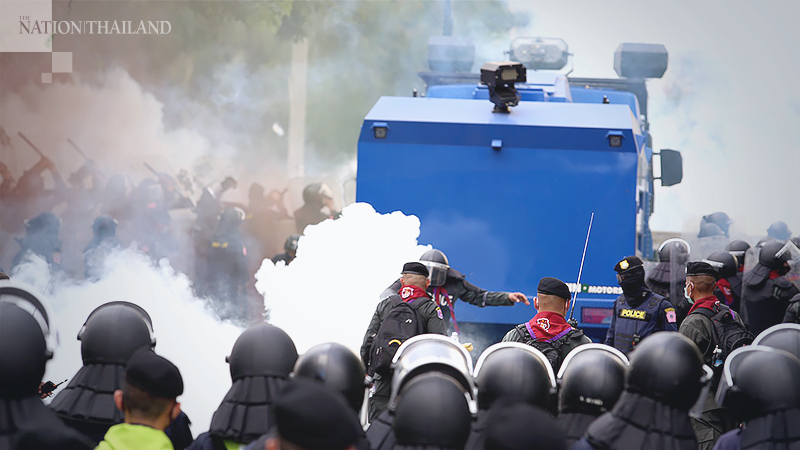
Police fire water cannon laced with tear gas solution at protesters gathered at Siam Square in Bangkok’s downtown business district on October 16.
It began when the Constitutional Court handed down a controversial ruling to disband the Future Forward Party in February.
The political situation had been relatively calm since the military coup in 2014. But early this year, the tide turned against the military-backed government and key institutions that were deemed to be siding with dictatorship.
Pro-democracy demonstrators throng Kasetsart Intersection in Bangkok on October 19.
Future Forward had commanded 81 seats in Parliament after monopolising the youth vote to come third in last year’s election.
When it was banned, flash mobs sprang up in universities and schools as the younger generation rebelled against those in power.
The pro-democracy protesters took a break during the Covid-19 lockdown, before returning to the streets in July. The protests snowballed, gathering support from wider society as more and more Thais vented frustration at what they perceived as extended junta rule.
The turning point was a rally at Democracy Monument in early August, when human rights lawyer Anon Nampa, 36, called for reform of the monarchy. His action shattered a long-held taboo against public debate of the royal institution, which is guarded by a lese majeste law that carries a penalty of up to 15 years in jail.
Later the same month, Thammasat University student Panusaya “Rung” Sithijirawattanakul, 22, stepped onto a protest stage and issued a 10-point manifesto for monarchy reform aimed at making the institution more transparent and accountable to the people.
The pro-democracy protesters took the name Khana Ratsadon, (People’s Movement) and made three demands: PM Prayut Chan-o-cha must step down, the junta-drafted Constitution must be rewritten, and the monarchy must be reformed.
Protesters clash with police who used water cannon and tear gas to disperse them during a rally for charter change outside Parliament on November 17.
The government responded with water cannon, teargas and serious legal charges against demonstrators. On October 14, protesters marched to Government House and camped there overnight to mark the anniversary of the 1973 uprising that ousted a military dictatorship. Early the following morning, the government imposed a severe state of emergency in Bangkok and arrested protest leaders.
On October 26, Khana Ratsadon took their protest to the international stage, marching to the German Embassy in Bangkok to ask its government to investigate whether His Majesty the King was ruling Thailand from German soil. (The German foreign ministry said later that no evidence was found to support the allegation.)
In November, with no sign of an end to pre-democracy protests, PM Prayut announced that “all laws” would be deployed against protesters. Police promptly resumed enforcing the lese majeste law (Section 112) against protesters after a two-year hiatus. Some 37 protesters, including a 16-year-old, have now been summoned to hear lese majeste charges, according to Thai Lawyers for Human Rights. The move drew condemnation from the United Nations High Commission for Human Rights, which called for all charges to be dropped against the peaceful protesters and urged the Thai government to amend Section 112. Protesters took a break from street rallies, but their push to abolish Section 112 saw campaign posters mushroom across Bangkok. They also reminded people of suspected enforced disappearances of Thai political activists since the 2014 coup, by hanging mock corpses at public venues.
Protest leaders vowed to keep up the pressure on the government and elites next year, announcing they would intensify their political activities in 2021.
A Trump-touted covid therapy awaits proof to back up his boasts
InternationalDec 31. 2020Stephen Hahn, commissioner of food and drugs at the U.S. Food and Drug Administration (FDA), center, speaks during a news conference in the James S. Brady Press Briefing Room at the White House in Washington on Aug. 23, 2020. MUST CREDIT: Bloomberg photo by Stefani Reynolds.
By Syndication Washington Post, Bloomberg · Anna Edney
One day before the Republican National Convention kicked off, President Donald Donald Trump and top drug regulator Stephen Hahn held a White House press conference to tout emergency authorization of a promising covid-19 treatment.
Convalescent plasma, a soup of immune factors derived from the blood of recovered covid-19 patients, had shown “an incredible rate of success” and would “save countless lives,” Trump said Aug 23. Yet more than four months later and with more than 330,000 U.S. coronavirus deaths reported since the pandemic began, the jury is still out how much the treatment benefits patients, if at all.
It wasn’t the first or last time that Trump was to promote a therapy for covid-19 based on skimpy data. His faith in since-discredited hydroxychloroquine is well known, and he proclaimed Regeneron Pharmaceuticals Inc.’s antibody cocktail a wonder drug after receiving it to treat his infection in October. Now, as vaccines developed to slow the pandemic begin their roll-out, the saga of convalescent plasma highlights the lack of effective treatments for the killer virus.
As the pandemic consumed thousands of lives around the world, the FDA authorized the use of promising drugs with only early evidence to go on. From Gilead Sciences’s remdesivir to antibody treatments like Regeneron’s, drugs for covid-19 that were cleared to great fanfare have failed to gain backing from top scientists and infectious disease groups.
Convalescent plasma is supported by one of the fuzzier datasets, and just days after Trump’s August victory lap, Food and Drug Administration Commissioner Hahn began walking back remarks that exaggerated its effectiveness. National Institutes of Health advisers who compile covid-19 treatment guidelines said in September that there wasn’t enough evidence convalescent plasma works to recommend its use against the virus.
Data continues to support the FDA’s emergency authorization, Stephanie Caccomo, a spokeswoman, said in an email. The agency in September posted evidence that it said backs the use of convalescent plasma.
While one trial cited by the agency indicated a significant help to patients, others “tended to indicate a modest benefit.” The FDA acknowledged that the studies were less rigorous scientifically than it normally requires to prove efficacy.
The White House didn’t respond to a request for comment.
More than 100,000 people in the U.S. have already been treated with convalescent plasma. That includes a nationwide Mayo Clinic program that infused more than 90,000 people before the FDA’s emergency authorization.
Clinical trials that were supposed to clear up any doubts about the treatment were expected to read out in September or October, just a month or two after the FDA cleared it for emergency use. Those data have yet to appear, but the raging U.S. outbreak should soon serve to enroll more patients in those studies.
Still, the effect is likely to be much more modest than Trump or Hahn originally claimed, experts said.
“It became evident in most people, even when it works, it’s not a Lazarus thing,” said Christopher Austin, director of the NIH’s National Center on Advancing Translational Sciences. “The effect was going to be smaller.”
The center is leading or involved in key clinical trials that will finally offer insight into convalescent plasma’s efficacy more than 100 years after it began being deployed during pandemics. The rationale behind the treatment is that the antibodies people develop after enduring a disease will help newly diagnosed patients recover.
“We do not know whether it works” against covid-19, Austin said. “We all want to know the answer. I want to know the answer more than anybody. We have an obligation to future patients.”
Trials could produce critical data in January or February, Austin said, at least for a potential subset of people who respond to the therapy. Patients who receive convalescent plasma with a high level of antibodies early in their disease course appear to fare better. But whether certain age, race or gender groups are more likely to respond is still unknown.
Andrea Troxel, director of the Division of Biostatistics at New York University School of Medicine, is hoping to soon have answers as well. Troxel is the principal investigator of an effort to combine data from eight trials of convalescent plasma around the world. Among them is an NIH-sponsored trial at NYU Langone Health as well as studies in India, Spain, Belgium, and other countries.
Austin and Troxel are keeping in close touch with the FDA, which could possibly narrow its emergency authorization for the therapy based on what the studies reveal.
When the FDA cleared convalescent plasma over the summer, some researchers were concerned wider use would stymie enrollment in clinical trials. Troxel said this hasn’t been the case for the most part because the Infectious Diseases Society of America advised doctors against using convalescent plasma outside of clinical trials until a benefit was seen.
It’s part of a familiar pattern for covid-19 drugs touted by Trump. For example, the government has distributed hundreds of thousands of antibody therapies from Regeneron and Eli Lilly & Co. to hospitals around the country, but uptake has been minimal. Only 5% to 20% of the antibody treatments were being used, Moncef Slaoui, chief scientific adviser to the Operation Warp Speed drug and vaccine accelerator, said earlier this month.
Like convalescent plasma, antibody therapies are hoped to work best when used early to prevent high-risk patients from worsening. They must be infused typically in a hospital setting, which can be a tough sell for people who don’t feel very ill.
The antibody therapies are basically synthetic versions of convalescent plasma that are more complex and expensive to make. If convalescent plasma does work for some people, Austin said, the relative ease of getting it to patients could make it valuable.
“If you’re a rural hospital in Africa, you can give convalescent plasma,” he said. “You don’t need a supply chain, storage or a pharmacy. Heaven knows we need things like that, and we have areas like that in this country too.”
And drugs with even a potentially modest benefit can be helpful against the virus “both in terms of hospitalization and what we’re learning about its long-term effects,” said Megan Ranney, an emergency physician and associate professor at Brown University. The danger lies in over-promising, she said.
“There is no magic pill that you can take and suddenly avoid all the horrible effects of covid,” Ranney said. Implying otherwise is “dangerous because it gives people a false sense of assurance.”
Was 2020 the worst year ever? Historians weigh in.
InternationalDec 31. 2020Twenty thousand chairs, each representing 10 deaths from the coronavirus pandemic in the United States, are lined up on the Ellipse south of the White House. MUST CREDIT: Washington Post photo by Katherine Frey.
By The Washington Post · Michael S. Rosenwald
So, just to recap, the following events occurred in 2020:
– The coronavirus pandemic swept the globe, killing more than 1.7 million people (so far), including more than 337,000 (so far) in the United States.
– The president of the United States was tried and acquitted, after being impeached at the end of 2019.
– Protests stemming from several police killings of unarmed Black Americans erupted throughout the country, including just outside the White House, where federal law enforcement officers used tear gas on U.S. citizens.
– Wildfires devastated the U.S. West Coast and Australia.
– The president of the United States contracted the coronavirus and then dismissed it.
– Kobe Bryant and his 13-year-old daughter died in a helicopter crash.
The president of the United States disputed the valid results of a peaceful election. (He lost.)
– Alex Trebek died.
– Prince Harry and Meghan, Duchess of Sussex, broke up with the royal family.
– Murder hornets arrived.
As the year finally, mercifully, comes to a close, the above events – and more – have inspired the Internet’s meme machine to declare that 2020 is the worst year ever.
But it’s not just the Internet meme machine that thinks 2020 was the worst year ever.
Earlier this month, Time magazine ran an extraordinary cover image with a big red X drawn over the number 2020. “THE WORST YEAR EVER,” the cover line read. Time certainly wasn’t alone. A recent headline from the Hill: “Why 2020 really was the worst year ever.” Even the York Daily Record of Pennsylvania wondered: “Was 2020 the worst year ever? With pandemic, social unrest, election chaos, it’s in the running.”
Historians demur.
In a clever bit of marketing, the self-therapy app Bloom recently asked 28 historians from Yale, Oxford, Stanford and other major universities to choose the worst year in history – or, as they put it, the most stressful. British historian Philip Parker led the effort. Following a depressing dive down the rabbit hole of historical misery, Parker compiled a list of the top worst/most stressful years in world, British and U.S. history. Then the historians made their picks.
The worst year in world history wasn’t even a close contest.
It was 1348, the height of the Black Death, during which as many as 200 million people died. That would be like wiping out about 65% of the U.S. population. The Holocaust in 1944 ranked second, followed by 1816, when a volcano eruption in Indonesia blocked out the sun, starving millions. 2020 ranked sixth.
In U.S. history, 2020 was well down the list at No. 8, just behind the 2001 terrorist attacks on Sept. 11, the Cuban missile crisis of 1962, the tumult of 1968’s riots and assassinations, the 1918 flu pandemic, the Trail of Tears of 1838, the 1929 stock market crash marking the beginning of the Great Depression, and at the very, very top, 1862.
That was, most historians say, the grimmest year of the Civil War, when the country’s total collapse seemed imminent.
“It’s a symbol of a time when the nation almost broke apart,” Parker said in an interview, “and that, really, goes to the essence of what it is to be a country and a society. It’s almost like a dagger to the heart of the country.”
In many ways, Parker said, we’re still too close to 2020 to understand what its real ranking will be, seen through the lens of time passed.
“As Chairman Mao is reputed to have said about the French Revolution,” Parker said, “it’s a little too early to say.”
Samsung heir faces nine years in jail as bribery trial wraps
InternationalDec 31. 2020Jay Y. Lee, center, arrives at the Seoul Central District Court in Seoul, South Korea, on Dec. 30, 2020. MUST CREDIT: Bloomberg photo by SeongJoo Cho.
By Syndication Washington Post, Bloomberg · Sohee Kim, Heesu Lee, Shinhye Kang
South Korean prosecutors requested a nine-year prison term for Samsung Electronics Co.’s Jay Y. Lee, seeking to put the heir apparent back in jail in a bribery case that rocked the nation and ignited a backlash against its most powerful conglomerates.
Special prosecutors proposed the sentence during a Wednesday hearing at the Seoul High Court, which will make its ruling on the billionaire’s fate Jan. 18. “There’s no denying that it has made a lot of positive impact on our society,” according to a transcript of closing arguments from prosecutors, referring to Samsung. “But just because there’s been an economic contribution, there should be no hesitation in legal enforcement based on the rule of law.”
The 52-year-old billionaire is fighting allegations of graft in a retrial of a case that started four years ago and led to his imprisonment and the ouster of former President Park Geun-hye. The outcome of the case could snarl succession at Samsung, just as Lee is expected to formally take the helm of the mobile and electronics giant after the death of his father in October.
The executive stands accused of making gifts to cement his control over the world’s largest smartphone maker and smooth his ascension. Lee served a year in jail before his release in 2018 after an initial five-year prison term was halved and suspended by an appeals court. But in August, the Supreme Court voided that decision, thrusting the executive back before a judge. Lee faced a tougher sentence this time — a minimum of five years — because the amount of alleged bribery acknowledged by the top court increased.
Yet experts viewed a decreasing chance of imprisonment as the trial drew to a close. Judges at the high court asked Samsung and Lee to impose measures to prevent illegal activity and improve credibility among the group. Lee responded by setting up an independent compliance committee and issuing a personal apology in May over past wrongdoings related to the succession process. He also pledged publicly not to hand down leadership of the Korea’s largest conglomerate to his children. The compliance committee’s activities will be factored into Lee’s eventual sentencing.
“Even though it’s tough and difficult, I’ll walk on the right path,” the billionaire said Wednesday in prepared remarks before the court. “I promise that I’ll create a company with the highest level of transparency and morality.”
“I will make sure, again, my children will not be mentioned in relation to the succession of the company. Samsung will never get into controversy over these related matters,” he added.
The bribery allegations stem from a controversial merger in 2015 between two Samsung units, which helped Lee gain control over the group. Prosecutors argued that Samsung offered horses and financial contributions, via an intermediary, to a confidante of former president Park to try and win the government’s support for the deal.
Lee, who stepped down from an internal director post, remains the tech company’s vice chairman and de facto leader. Although his father and chairman Lee Kun-hee died in October, the Samsung scion has not been immediately crowned his successor. Samsung is likely to hold off on naming Lee to that role at least until the trial is completed.
Separately, Lee is embroiled in another case related to the controversial 2015 merger, with allegations ranging from violation of capital market laws to breach of duty. Prosecutors indicted Lee in September and hearings are set to resume on Jan. 14.
Swedish PM slammed for shopping tour amid latest covid surge
InternationalDec 31. 2020Stefan Lofven, Sweden’s prime minister, at a European Union leaders summit in Brussels on Dec. 10, 2020. MUST CREDIT: Bloomberg photo by Geert Vanden Wijngaert.
By Syndication Washington Post, Bloomberg · Rafaela Lindeberg
A number of the most senior members of Sweden’s government, including the prime minister, have been caught apparently ignoring their own covid guidelines.
Prime Minister Stefan Lofven and Justice Minister Morgan Johansson were among those named in Swedish media this week for seeming to flout restrictions they insist must be followed if the country is to rein in the coronavirus.
Lofven went Christmas shopping in a mall without a face mask after explicitly appealing to Swedes to avoid such excursions ahead of the festive season. His spokesman has acknowledged the trip took place, which he says was “carefully planned” to avoid unnecessary risks.
The development adds a layer of potential embarrassment to Sweden’s handling of the covid crisis. The country initially defended its no-lockdown strategy, before backtracking in recent weeks amid a resurgence of cases that threatens to overwhelm its health-care system. Lofven is now trying to persuade parliament to give him the power to impose a full lockdown.
The government has already seen confidence in its covid strategy sink, with even King Carl XVI Gustaf delivering a rare rebuke for Sweden’s failure to contain the death toll. About 8,500 Swedes have died of covid-19, roughly seven times as many as in neighboring Denmark.
Lofven’s shopping trip lit up Twitter, with several of Sweden’s best known political commentators warning that the incident risks denting his credibility among voters.
“Who should follow the rules if not even the Prime Minister and the Minister of Justice do so?” Dagens Nyheter, Sweden’s biggest morning newspaper, wrote in an editorial published Tuesday evening.
Other government members have also reportedly engaged in conduct that breached covid guidelines, including Sweden’s Finance Minister Magdalena Andersson, Aftonbladet reported on Wednesday. According to the newspaper, she was seen in a ski rental shop in the popular Swedish winter resort of Salen, which is on the list of destinations the National Health Authority has warned against visiting.
With infection rates spreading since the fall, Lofven has had to step up his rhetoric entreating his countrymen to “refrain from staying in indoor environments such as shops, shopping centers.” Last month, he reminded Swedes “how dangerous” such conduct is.
At a briefing this month, Lofven said, “I hope and I think that everyone in Sweden understands the seriousness” of the situation.
A spokesman for Lofven said his Christmas shopping tours included purchases of alcohol and a present for his wife. He also visited a shop that fixes watches and looked for spare parts for his razor. His most recent known shopping trip was on Dec. 23.
By Syndication Washington Post, Bloomberg · Daniel Schaefer, Raymond Colitt
Germany’s daily coronavirus deaths surpassed 1,000 for the first time since the beginning of the pandemic, underscoring the urgency facing Europe’s leaders to slow the spread and roll out vaccines.
There were 1,122 fatalities in the 24 hours through Wednesday morning, according to data from Johns Hopkins University. Along with the mounting death toll, the number of Covid-19 patients in German intensive care units has risen steadily, prompting warnings that the health-care system could become overburdened.
Germany joined its European Union partners in rolling out vaccinations last weekend, but officials have said it will take months for the program to have a tangible impact on contagion rates. Europe’s largest economy has so far inoculated almost 42,000 people, according to data from the RKI public health institute.
On Tuesday, the EU agreed to trigger an option to buy an extra 100 million doses of the shot developed by Pfizer Inc. and BioNTech SE. Vaccines from other producers will follow once they’ve been approved, European Commission President Ursula von der Leyen said on Twitter.
Europe has become an epicenter of the pandemic, with more than 400,000 coronavirus-related deaths and 16.2 million infections.
The rise in Germany’s fatalities comes as Chancellor Angela Merkel’s government considers extending a hard shutdown that was imposed in December. Schools and non-essential stores remain shuttered until Jan. 10, but senior politicians have urged prolonging at least some of the measures.
Karl Lauterbach, a health expert for the ruling Social Democrats, on Wednesday warned that if the virus numbers aren’t slashed to around 25 per 100,000 people over 7 days, the risks will multiply. The current figure is 141.
If the situation doesn’t improve, “we’ll go from one lockdown to the next and then we have the risk of mutations against which vaccines may not work perfectly,” Lauterbach said on ZDF television.
While some countries in the region are gradually relaxing measures to contain the virus, others are still tightening curbs. Ireland’s government is set to announce new restrictions on Wednesday. Among the measures under consideration are the closure of non-essential retail and the reintroduction of a five-kilometer (three-mile) limit on travel from home. Bars and restaurants have already been shuttered.
Authorities are also grappling with ways to ensure widespread uptake of the Covid-19 vaccine. In Italy, where restrictions were severely tightened for most of the Christmas period, cases and deaths have declined sharply from the highs recorded in November. However, concerns are growing over delays and mishaps in the vaccination campaign.
Around 8,000 people have received the first dose of the Pfizer-BioNTech vaccine so far, and the country is behind schedule in hiring personnel and preparing the logistics for mass inoculation.
France is having even less success in the face of strong anti-vaccination sentiment across the country. Less than 100 people have been given a shot, according to the government. It’s target is to administer 1 million doses by the end of February, Health Minister Olivier Veran said late Tuesday.
On Monday, Spain became the fourth European country to record more than 50,000 coronavirus deaths. An initiative to track people who refuse to get inoculated could help the hard-hit country regain trust in its tourism sector, which was linked to the spread of the coronavirus after rules were relaxed in the summer.
For its part, Germany has recorded just over 32,000 deaths since the start of the pandemic. In the 24 hours through Wednesday morning, the number of infections rose by another 19,466, bringing the total to more than 1.69 million.

 This file photo, taken Dec. 12, 2020, shows people shopping for groceries at a traditional market in western Seoul. (Yonhap)
![Workers in protective suits are seen at a makeshift nucleic acid testing site inside a parking lot of Shanghai Pudong International Airport, after new cases of COVID-19 in Shanghai, on Nov 22, 2020. [Photo/Agencies]](https://media.nationthailand.com/images/news/2020/12/31/30400514/800_f890ff2114bc366.jpeg?v=1609381830) Workers in protective suits are seen at a makeshift nucleic acid testing site inside a parking lot of Shanghai Pudong International Airport, after new cases of COVID-19 in Shanghai, on Nov 22, 2020. [Photo/Agencies]
Workers in protective suits are seen at a makeshift nucleic acid testing site inside a parking lot of Shanghai Pudong International Airport, after new cases of COVID-19 in Shanghai, on Nov 22, 2020. [Photo/Agencies]
 Chayawadee Chai-Anant, senior director of the BOT’s economic and policy department
 Panusaya “Rung” Sithijirawattanakul attempts to lead protesters camped at Sanam Luang to the Palace Office nearby, to petition for monarchy reform, on the morning of September 20.

 Stephen Hahn, commissioner of food and drugs at the U.S. Food and Drug Administration (FDA), center, speaks during a news conference in the James S. Brady Press Briefing Room at the White House in Washington on Aug. 23, 2020. MUST CREDIT: Bloomberg photo by Stefani Reynolds.
 Twenty thousand chairs, each representing 10 deaths from the coronavirus pandemic in the United States, are lined up on the Ellipse south of the White House. MUST CREDIT: Washington Post photo by Katherine Frey.
 Jay Y. Lee, center, arrives at the Seoul Central District Court in Seoul, South Korea, on Dec. 30, 2020. MUST CREDIT: Bloomberg photo by SeongJoo Cho.
 Stefan Lofven, Sweden’s prime minister, at a European Union leaders summit in Brussels on Dec. 10, 2020. MUST CREDIT: Bloomberg photo by Geert Vanden Wijngaert.
 SootinClaimon.Com