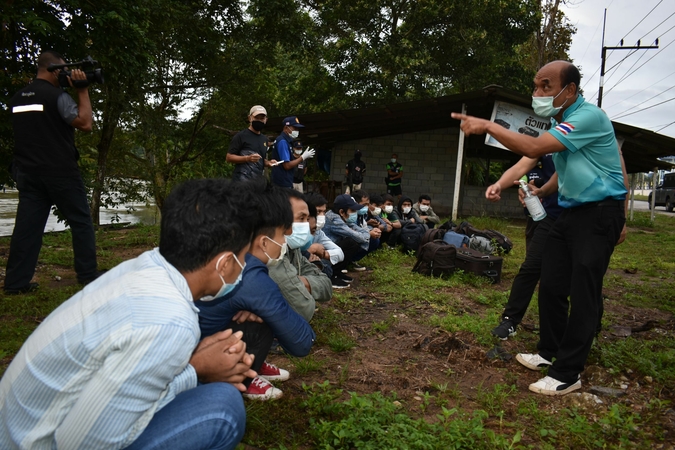
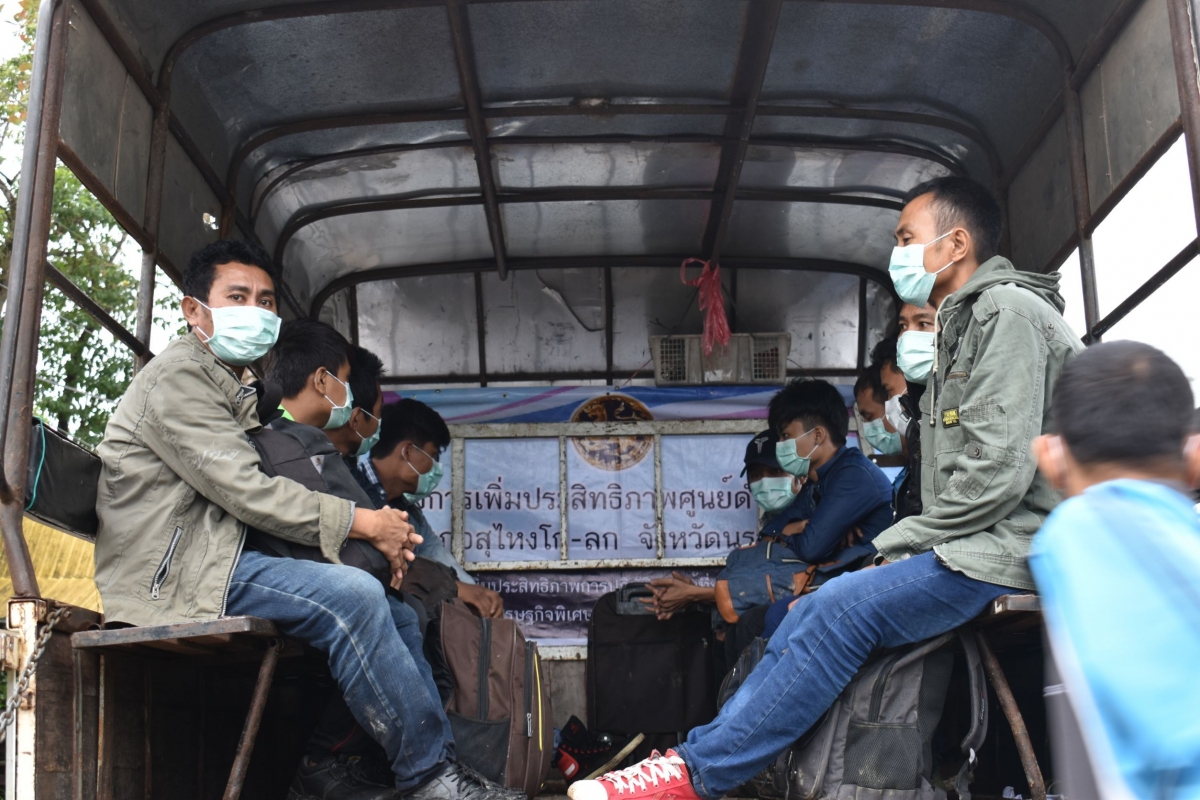
The district chief of Sungai Kolok district in Narathiwat province on Friday announced the arrest of 11 male migrants from Myanmar while they were trying to enter Thailand by crossing a river in Pasemat subdistrict that serves as a border with Malaysia.
“The migrants were disembarking from a ferry when officials confronted them before making the arrests. However, the ferry boat driver fled immediately,” district chief Rungreung Thimabutr said.
“Officials then brought the 11 migrants to Sungai Kolok Police Station for Covid-19 screening and interrogation. None of them has proper documents. They used to work on fishing boats in Malaysia and tried to enter Thailand to find jobs,” he said.
Preliminary screening showed that the 11 migrants have normal temperature. They are still detained in isolation until more detailed tests clear them of Covid-19 infection.
Rungreung added that in the past few months, officials had arrested several illegal migrants trying to enter Thailand via natural channels in Sungai Kolok district.
“Most of them were from Kelantan state in Malaysia and were either trying to escape the escalating Covid-19 situation in Malaysia or trying to find jobs,” he said.
“The agency in Malaysia that facilitated their entry would keep their passports to avoid authorities tracing back to them in case the migrants were arrested. We suspect that they could be international human trafficking rings.”
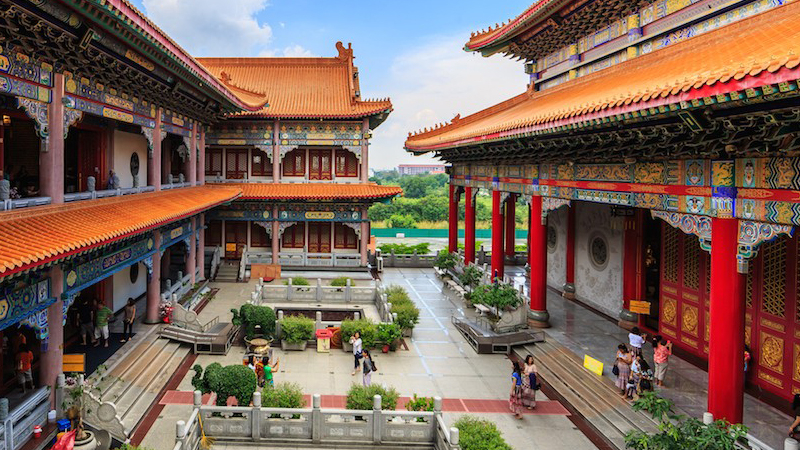
Nonthaburi provincial authorities on Friday ordered Wat Boromracha Kanchanapisek Anusorn, also known as Wat Leng Noei Yi 2, a famous Chinese Buddhist temple located in Bangbuathong district, to be closed temporarily from December 25 until January 8.
“Officials will use the temple’s premises as quarantine location for persons suspected of contracting Covid-19 but are yet to show symptoms,” province officials said on the Facebook page of Nonthaburi Covid-19 Information Centre on Friday evening.
Two new Covid-19 cases have been recently reported in Nonthaburi — both are Myanmar national female workers at the temple aged 54 and 46 years.
After the cases were found, 113 monks and staff of the temple were quarantined within the temple.
Health officials are tracing their travel history and testing people who might have had close contact with the patients.
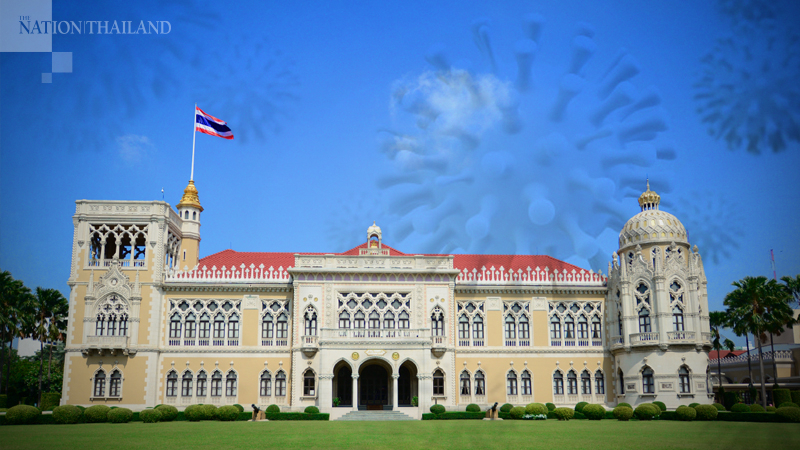
Six officials in the Prime Minister’s Office at Government House who had earlier tested positive for Covid-19 via rapid test were ruled as not infected after swab test, a senior official said.
Government House had performed random screening of its 700 staff on Friday afternoon. The six positive results came from the first batch of 350 staff whose saliva was tested with rapid test kits. The second batch will be tested on Monday.
“The six staffers were ruled as carrying no risk, but were told to work from home for the peace of mind of their colleagues,” Nuttreeya Thaweewong, director at Office of Spokesman, Secretariat of the Prime Minister, said on Friday evening.
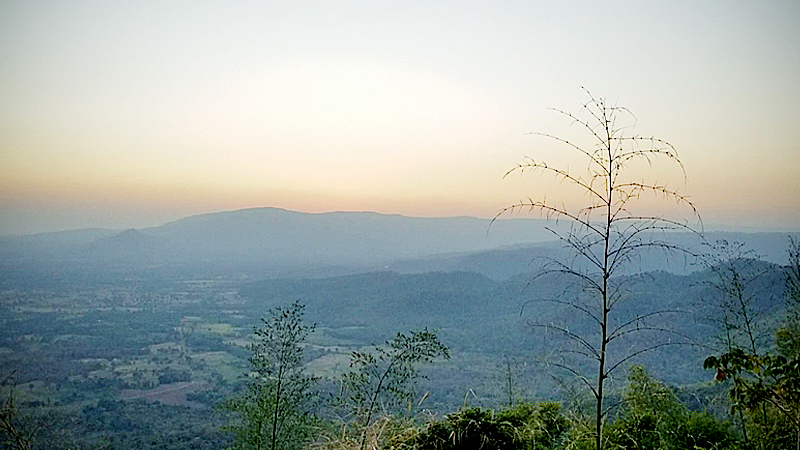
The Thailand Meteorological Department said on Saturday that the high-pressure system over upper Thailand is weakening, causing the temperature to rise by 1-3 degrees Celsius with possible morning fog.
Cool to cold weather continues in the North and the Northeast, while mountaintops remain cold to very cold with frost in some place. Motorists in upper Thailand should proceed with caution due to poor visibility, the department said
Meanwhile, the weak northeast monsoon prevailing over the Gulf and the South, will bring isolated heavy rain to the areas.
The weather forecast for the next 24 hours:
North: Cold to cool weather with light fog in the morning; minimum temperature 10-21 degrees Celsius, maximum 27-34°C; temperature on hilltops likely to drop to 4-12°C with frost in some areas.
Northeast: Cool weather with light fog in the morning; minimum temperature 17-22°C, maximum 30-31°C; temperature on hilltops is likely to drop to 10-15°C.
Central: Partly cloudy with light fog in the morning; minimum temperature 23-24°C, maximum 31-34°C.
East: Partly cloudy with light fog in the morning; minimum temperature 23-25°C, maximum 31-34°C; waves 1-2 metres high and two metres off shore.
South (east coast): Mostly cloudy with thundershowers in 40 per cent of the areas and isolated heavy rain; minimum temperature 23-25°C, maximum 26-30°C; waves 1-2 metres high and two metres during thundershowers.
South (west coast): Mostly cloudy with thundershowers in 20 per cent of the areas; minimum temperature 21-24°C, maximum 28-30°C; waves a metre high and 1-2 metres during thundershowers.
Bangkok and surrounding areas: Light fog in the morning; minimum temperature 23-25°C, maximum 30-34°C.
Time for Prayut and his allies to reflect on national security, amid Covid surge and prolonged political conflict
NationalDec 26. 2020Police erected a barrier of razor wire and shipping containers to prevent a rally at the Crown Property Bureau, so protesters switched their focus to the Siam Commercial Bank headquarters on November 25.
By Wichit Chaitrong The Nation/ Analysis
Flooding and Covid-19 have exposed serious flaws in national security under the government of PM Prayut Chan-o-cha this year.
The deep faults in national security strategy are highlighted by the mismanagement of tax funds and the handling of youth-led protesters under Prayut’s leadership.
The prime minister is again under fire after Covid infections spiked over last weekend. Migrant workers from Myanmar, especially illegal immigrants, are the suspected source of the outbreak, which centred on a Samut Sakhon seafood market and saw cases jump by over 500 last Saturday.
Observers have criticised the government’s failure to monitor migrant workers and crack down on migrant-trafficking gangs at the border, despite setting up the Centre for Covid-19 Situation Administration (CCSA).
Social activist Sombat Boonngamanong noted the government had redirected border patrol police to counter pro-democracy rallies in Bangkok.
Instead of using them to prevent illegal entry by migrants from Covid-ravaged neighbouring countries, the government has deployed border police to keep an eye on protesters during major street rallies in the last few months.
Bangkok police in November and December also barricaded roads with razor wire and shipping containers, in a move ridiculed as overkill by observers.
Some pointed out that the razor wire barriers could be used more productively at borders to prevent virus-infected smugglers sneaking into the country.
The excessive response to peaceful student-led protests that began in July eventually turned violent when the government imposed an emergency decree and police fired water cannon and teargas to clear the gatherings. Royalist counter-protests were also mobilised against the pro-democracy movement, leading to violent clashes.
In a desperate bid to crush protests calling for Prayut to step down, a new Constitution and monarchy reform, police have lately applied the draconian lese majeste law against dozens of protesters, including a 16-year-old child.
The United Nations High Commission for Human Rights criticised the government for using Section 112 – which carries jail sentences of up to 15 years – against demonstrators exercising their internationally recognised right to protest peacefully.
The government defended its actions as “protecting national security”. However, the Covid-19 surge suggests Prayut’s administration has a warped view of national security priorities that has weakened Thailand by shifting human and financial resources to counter protesters rather than the virus. If Prayut and his inner-circle were genuinely focused on the nation’s security, they would have allocated more personnel and budget to combating Covid-19 instead of wasting human and financial resources on countering peaceful protests. More evidence of misplaced priorities came with the Bt54 million in tax money spent by the Royal Thai Air Force to renovate a toilet on its VVIP jet-liner.
The government also fared badly in efforts to combat severe flooding which hit almost 1 million people in the South this year. Prayut’s administration prioritised combat of a different sort, spending billions on military hardware including a submarine, despite the absence of threats – marine or otherwise – from foreign powers. The budget choices were more proof of misplaced national security priorities among Prayut and his military top brass.
Academics duly called on the government to abandon a national security strategy rooted in the military-establishment alliance.
Surachart Bamrungsuk, a political science professor at Chulalongkorn University, urged the government to cancel its 20-year national strategy – a legacy of the post-coup junta – warning the plan would quickly be rendered obsolete by the fast-changing global and local landscape. He observed that the national strategy was a political tool designed to entrench the military’s role in government following the March 2019 general election. Hence it was not capable of addressing the country’s current problems, he added.
The impact of Covid-19 had severely damaged the country’s economy and competitiveness. The unforeseen crisis had rendered the 20-year national strategy worthless, Surachart wrote in a comment piece headlined “Is the 20-year National Strategy relevant post-Covid 19?” published by the Nation Thailand in April.
Meanwhile Thailand is officially becoming an ageing society. Protecting national security now means finding ways to boost productivity of the younger generation, since they are the ones who will have to pay off the huge public debt built up by this generation. The youngsters will need to shoulder the growing burden of caring for the aged. The priority now is to upgrade the quality of education to support this young generation. There is also an urgent need to strengthen key institutions, especially the political and judicial systems that mediate conflicts in society. However, the government has ignored this need, instead exploiting those institutions as weapons to combat younger generations and their demands for national reform and genuine democracy.
Prayut and his Cabinet have branded pro-democracy protesters as youthful troublemakers. The reality is that many in the older generation back their calls for national reform. Former prime minister Anand Panyarachun has expressed support for amendment of the lese majeste law. Business leader Banyong Pongpanich has backed monarchy reform, suggesting that Thailand should return to the benchmark set by King Rama IX. The previous monarch did not take control of two Army regiments in Bangkok, nor did he have direct control over the Crown Property Bureau.
It has become obvious that the youth-led democracy movement wants “rule of law” as the solid ground on which Thailand can develop in the 21st century. This is the priority that all stakeholders in the country can agree on. The youth are already determined to achieve it in their lifetime, but the current government has rewarded their efforts with charges of sedition and lese majeste. Unfortunately, Prayut and his old alliance are still at a loss over the true identity of national security. The New Year is the right time for them and the whole country to reflect on this issue.
CIMB Thai Bank (CIMBT) has said that the bank has set a target for retail loans in 2021 to expand from Bt138 billion to Bt145 billion, or 5 per cent.
Tan Keat Jin, deputy Head of Consumer Banking, said this year loans in this category contracted by 1-3 per cent due to the impact of the Covid-19 outbreak.
“We expect loans for buying houses and used cars to grow significantly next year as in the second half of this year the demand in these categories has been continually rising,” he said.
“Currently home loans are accountable for 60 per cent of total retail roans, while used-car loans take up 30 per cent.
“Used-car loans have higher profit margin at around 6-7 per cent compared to loans to buy new cars at only 1-2 per cent,” he added.
Tan added that next year CIMBT expected to keep the amount of non-performing loans (NPLs) at a suitable level, as he believed the economy would start to recover provided the new Covid-19 outbreak is limited to only some provinces.
“One of our missions is to provide borrowers with moratorium and debt restructuring service to prevent them from becoming NPLs,” he said.
“Statistics show that after the repayment suspension, up to 70 per cent of customers were able to continue repaying their debt, while 20 per cent are still in need of additional assistance. We hope to reduce this number down to 5-10 per cent next year.”
CIMBT also targets up to 25 per cent expansion in fee from its wealth management services, which it has developed into a digital wealth management platform to provide customised services to its ‘CIMBT Preferred’ and private banking customers.
The Stock Exchange of Thailand (SET) Index closed at 1,486.31 on Friday, up 34.79 points or 2.40 per cent. Total transactions amounted to Bt88.24 billion with an index high of 1,486.84 and a low of 1,462.77. The SET rose more than 2 per cent for the second successive day after gaining more than 2.37 per cent on Thursday.
In the morning session, an analyst at Krungsri Securities expected the day’s index to fluctuate between 1,440 and 1,465 points amid news that the European Union and Britain had reached a deal on Brexit, and Thailand had escaped a nationwide lockdown after the latest Covid-19 outbreak.
However, the index would come under pressure from the decline in fund flows over the Christmas and New Year period, said the analyst.
The 10 stocks with the highest trade value today were DELTA, AEONTS, KEX, IVL, SA, IRPC, BANPU, SAWAD, PTTGC and MTC.
Other Asian indices were mixed:
Japan’s Nikkei Index closed at 26,656.61, down 11.74 points or 0.044 per cent.
China’s Shang Hai SE Composite Index closed at 3,396.56, up 33.45 points or 0.99 per cent, while Shenzhen SE Component Index closed at 14,017.06, up 101.48 points or 0.73 per cent.
Taiwan’s TAIEX Index closed at 14,331.42, up 51.14 points or 0.36 per cent.
Hong Kong’s Hang Seng Index and South Korea’s KOSPI Index were closed for Christmas Day.
Banks are preparing cash reserves to accommodate withdrawals during the New Year holidays.
Kasikornbank is planning to allocate Bt36.8 billion for its KBank branches and ATMs from December 28 to January 1.
Of that, Bt10.5 billion will be distributed among KBank’s 860 branches nationwide, with Bangkok getting Bt4.5 billion. Another Bt26.3 billion will be loaded into 8,200 KBank ATMs nationwide, with a whopping Bt14 billion allocated to Bangkok ATMs to support revelry.
Meanwhile, Krungsri will allocate cash reserves of Bt15.24 billion for its nationwide branches and ATMs from December 28 to January 3.
Of the total, Bt11.052 billion will be allocated to its ATMs and Bt4.19 billion to branches. Krungsri had around 632 branches and around 6,121 ATMs as of November.
The Siam Commercial Bank (SCB) is preparing a cash reserve of Bt63 billion, Bt45 billion of which will be for ATMs and Bt18 billion for branches. The bank had 860 branches and 11,926 ATMs nationwide as of November.
Bangkok Bank is preparing cash reserves of Bt50 billion for all its service channels, including ATMs, to cater to spending during December 31 to January 3.
The share price of Delta Electronics (DELTA) has continued to soar since the beginning of this year.
In the morning session on Friday, DELTA’s share price opened at Bt638 per share, up Bt102, or 19 per cent.
The price of DELTA shares rose from Bt53.50 per share at the beginning of this year amid the Covid-19 crisis, as its performance surpassed the market’s expectation.
DELTA’s second-quarter net profit was Bt2.02 billion, up 132 per cent year on year, while its third-quarter net profit was Bt2.64 billion, up 327 per cent year on year.
With the growth in performance and market capitalisation, DELTA was listed in MSCI Global Standard, FTSE SET Large-Cap Index, SET50 and SET100
As of December 24, DELTA’s market capitalisation was Bt668.59 billion, up Bt604.04 billion compared to 64.55 billion at the beginning of this year.
The Criminal Court on Friday dismissed the charges filed against 39 anti-coup protesters who had held a rally at Pathumwan Skywalk in front of MBK Center in Bangkok’s Pathumwan district in January 2018, urging the then junta-backed government to hold general election.
The group later became known as “MBK39”, comprising key activists, such as Veera Somkwamkid, Rangsiman Rome, Sirawit Serithiwat, Nuttaa “Bow” Mahattana, Arnon Nampha, Ekachai Hongkangwan, Sukrit Piansuwan, Netiwit Chotiphatphaisal and Sombat Boongamanong.
They had been charged with sedition under Section 116 of the Criminal Code.
 Police erected a barrier of razor wire and shipping containers to prevent a rally at the Crown Property Bureau, so protesters switched their focus to the Siam Commercial Bank headquarters on November 25.