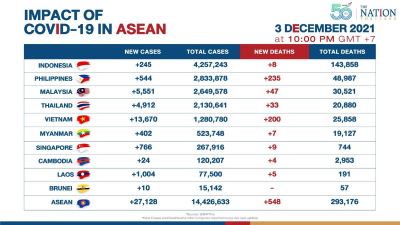
The number of Covid-19 cases crossed 14.4 million across Southeast Asia, with 27,128 new cases reported on Friday (December 3). New deaths are at 548, bringing accumulated Covid-19 deaths in Asean to 293,176.
Singapore’s medical technology firm Acumen Diagnostics announced on Friday that its two PCR test kits – Acu-Corona 2.0 and Acu-Corona Duplex – which can detect the Delta variant, can also identify the Omicron strain. The firm said that since the kits are manufactured locally, they can be deployed quickly and cost about half the price of imported ones. The firm currently operates two laboratories that can process 7,000 diagnostic tests daily.
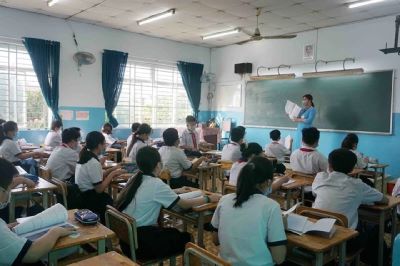
Vietnam’s Department of Education and Training has said that secondary and high school students in HCM City will have 12 to 30 in-person lessons per week, depending on Covid-19 risk levels, when the city allows schools to reopen. Students attending schools in areas of low risk would have no more than 30 in-person lessons per week, while extra classes will be held online.
HCM CITY — The HCM City People’s Committee will begin a pilot school reopening period on December 13.
Under the plan, students from the first, ninth and 12th grade can return to school on December 13, while five-year-old children can go to kindergarten on December 20.
The city will allow Thạnh An Kindergarten, the Thạnh An Primary School, and the Thạnh An Secondary and High School to welcome back students at all levels on December 13.
Schools must discuss pandemic safety measures with parents and submit plans to city districts’ and Thủ Đức City’s pandemic prevention and control steering committees by December 5. They must also offer training on pandemic prevention and control to all teachers and staff.
The pandemic prevention and control steering committees are responsible for checking and supervising pandemic safety measures at schools.
The Department of Education and Training and Department of Health have been asked to submit an evaluation of the school reopening to the city People’s Committee after the two-week pilot period. This is being done to prepare for all-level students to return to school on January 3.
The schools with good facilities and safety assurance will have priority to open in-class learning soon, while students and teachers from very high-risk areas must be tested for SARS-CoV-2 following the Ministry of Health’s guidelines.
According to the level of risk, the city will choose between online or direct learning for high school students on a weekly basis. Its announcement will be released on Monday mornings.
The People’s Committees of Thủ Đức City and districts are responsible for the selection of online or direct learning for the other schools, based on each locality’s level of risk.
Phan Hoàng Thu Anh, a student at the city-based Vietnam Australia International School, said: “I am eager and excited at return to school soon. My class has only 16 students. All of us are fully vaccinated. So we believe we will maintain the 5K protocol at school.”
Her teacher, Nguyễn Thành Luân, said: “The school and teachers are preparing pandemic prevention and control measures to ensure safety for students when they come back to school.” — VNS
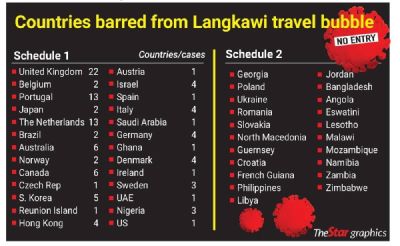
PETALING JAYA: Travellers from a number of countries are temporarily barred from taking part in the Langkawi international travel bubble programme following the detection of cases involving the Omicron variant (see graphic).
This comes as Singapore reported the discovery of two cases of the Omicron variant in the island republic.
The ban also applies to those with a history of having travelled to these countries in the last 14 days. These countries are under the First Schedule, which will be updated daily.
Travellers from countries in the Second Schedule, which are countries at high risk of the Omicron variant but have yet to report any cases, as well as those with a history of travelling within 14 days, are also not allowed to take part in the bubble.
The list of countries in the Second Schedule will be updated weekly.
In a statement, Health director-general Tan Sri Dr Noor Hisham Abdullah said residents of Langkawi, involving both Malaysians and those with long-term visit passes from these countries and with a history of travel to these countries within 14 days, could only enter via Kuala Lumpur International Airport.
“They are also required to undergo 14 days’ quarantine at designated centres before being allowed on to Langkawi. Direct flights to Langkawi are not allowed,” he said.
He added that the ministry was also carrying out a risk analysis based on a set of criteria of countries before they were allowed to take part in the international travel bubble.
“Among the criteria are Covid-19 incidences and immunisation coverage,” he said.
Yesterday, there were 5,806 new Covid-19 cases reported, including 11 imported cases, while the infectivity level is at 0.95. Perlis has the highest infectivity level at 1.09.
Dr Noor Hisham said Malaysian authorities were monitoring the situation in Singapore.
He added that additional testing to detect the presence of the new variant would also be increased, on top of arrival and pre-departure testing.
“We are monitoring the situation closely and increasing additional testing as announced.
“For those who are high risk, we will do the genomic sequencing test,” he said.
The Straits Times reported that two imported Covid-19 cases have preliminarily tested positive for the Omicron variant in Singapore yesterday,
It said both cases were isolated upon arrival in Singapore on Wednesday, and had not interacted in the community.
“There is currently no evidence of any community transmission from these cases,” said the republic’s Health Ministry.
Both cases arrived from Johannesburg on board a Singapore Airlines flight, the paper said.
In Johor Baru, Mentri Besar Datuk Hasni Mohammad said Malaysia and Singapore would need between two weeks and one month to decide whether there was a need for a more appropriate standard operating procedure (SOP) for the land Vaccinated Travel Lane (VTL-Land) following the emergence of the Omicron variant.
He said the time frame was needed by the two sides to determine the effects and position of Omicron.
“But at the same time, the VTL-Land will continue,” he said after the launch of the JohorPay app and Johor Project Monitoring System yesterday.
Hasni also attended the audience granted by Johor Ruler Sultan Ibrahim Ibni Almarhum Sultan Iskandar to Singapore Foreign Minister Dr Vivian Balakrishnan.
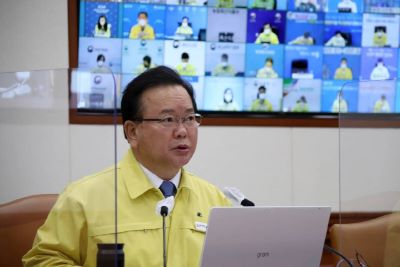
South Korea will limit private gatherings to six people in the capital area and eight in other regions for four weeks starting next week, Prime Minister Kim Boo-kyum said Friday, reversing an easing of distancing rules adopted under the “living with COVID-19” scheme last month.
Kim announced the new measure during a meeting of the Central Disaster and Safety Countermeasures Headquarters amid a surge in COVID-19 infections in the country and heightened fears of the more contagious omicron variant.
Currently the cap is 10 people in the capital area and 12 in other regions.
Kim also said most public facilities, including restaurants and cafes, will be added to the list of businesses requiring proof of vaccination or a negative test for entry.
The government will allow a one-week grace period before enforcing the so-called vaccine pass system at the additional facilities.
The list currently comprises karaoke establishments, public bathhouses, indoor gyms, bars and nightclubs, horse racing and track cycling courses, and casinos.
The vaccine pass system will apply to teenagers starting next February after more of them are vaccinated.
“The government will focus on firmly reinforcing the dike (against COVID-19) for the next four weeks,” Kim said during the meeting.
“Even after today, the government will regularly assess all antivirus conditions and, if necessary, take swift measures to strengthen the antivirus campaign at any time,” he added.
South Korea has seen new cases above 5,000 for the past two days in a record high since the pandemic began early last year.
Critical cases have also hit above 700, leading to shortages of hospital beds and putting additional strain on the health care system.
The emergence of the omicron variant has added to concerns, with six people confirmed to have been infected with the new variant as of Thursday.
Kim urged senior citizens to get their booster vaccine shot and teenagers to receive their regular doses, saying vaccines are the best safeguard against the disease.
He also asked businesses to have employees work from home as much as possible until the end of the year.
Starting Friday, December will be designated as the government’s “special antivirus inspection period” in an effort to contain the virus.
Additional details of the new measures will be announced in a press briefing later Friday. (Yonhap)
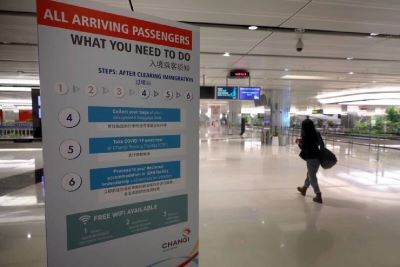
SINGAPORE – Two imported Covid-19 cases have preliminarily tested positive for the Omicron variant on Thursday (Dec 2), the Ministry of Health (MOH) said.
Both cases were isolated upon arrival in Singapore on Wednesday, and had no interaction with anyone in the community.
“There is currently no evidence of any community transmission from these cases,” said MOH in a statement on Thursday.
The ministry added that both cases are currently recovering in isolation wards at the National Centre for Infectious Diseases. They are fully vaccinated, and have mild symptoms of cough and scratchy throat.
Both cases arrived from Johannesburg on board Singapore Airlines flight SQ479 on Wednesday.
The first case is a 44-year-old Singapore permanent resident who was travelling from Mozambique and transited in Johannesburg.
He had tested negative for Covid-19 in his pre-departure test in Mozambique on Nov 29.
The second case is a 41-year-old Singaporean woman who travelled from South Africa.
She had tested negative for Covid-19 in her pre-departure test in Johannesburg on Nov 29.
“They had undergone a polymerase chain reaction (PCR) test upon arrival in Singapore and were immediately conveyed to a stay-home notice (SHN) dedicated facility to be isolated while awaiting their test results,” said MOH.
Their PCR test results revealed the presence of S-gene Target Failure, which may be associated with the Omicron variant, the ministry added.
MOH said the National Public Health Laboratory is conducting whole genome sequencing to confirm if the two cases had indeed contracted the Omicron variant.
The remaining 19 passengers on the same flight have tested negative for Covid-19, said MOH, adding that contact tracing is ongoing.
All 19 were quarantined at designated facilities upon arrival and did a PCR test.
They will have to do another PCR test when their 10-day SHN is over.
Other close contacts will also be placed on 10-day quarantine and undergo PCR tests at the start and end of their quarantine, said MOH.
“All patients suspected or confirmed to be infected with the Omicron variant will be sent to NCID for isolation and clinical management. Home recovery will not apply,” the ministry added.
Nations agree to continuously expand high-quality growth of bilateral trade
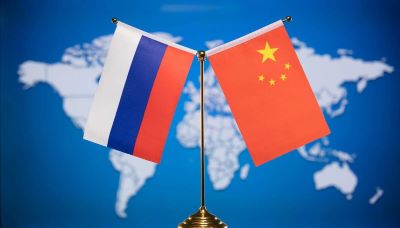
China and Russia are looking into the feasibility of updating their bilateral investment treaty, which was signed in 2006 and took effect in 2009, to provide better institutional support for the two nations’ investment cooperation, the Ministry of Commerce said on Thursday.
Shu Jueting, a spokeswoman for the ministry, made the remark during a news briefing when being asked about a recent meeting via video link between Premier Li Keqiang and Russian Prime Minister Mikhail Mishustin, which was the 26th regular exchange between Chinese and Russian heads of government.
“While fully recognizing the achievements in China-Russia economic and trade relations this year and the upward momentum of bilateral pragmatic cooperation in various areas, the two sides have reached multiple consensuses in furthering cooperation to give new impetus to the China-Russia comprehensive and strategic partnership of coordination in the new era,” Shu said.
Trade between China and Russia is on a fast growth track this year, despite a 2.9 percent decline on a yearly basis in 2020. Their bilateral trade in goods reached more than $115.6 billion in the first 10 months of this year, up 30.9 percent year-on-year, compared with $107.77 billion for the whole of 2020, according to customs statistics.
China’s outbound direct investment in Russia surged 39.1 percent year-on-year in the January-October period, according to the ministry.
Shu said the two sides have agreed to continuously expand the high-quality development of bilateral trade, make new breakthroughs in investment and major project cooperation, deepen industrial and supply chain cooperation, advance cooperation in emerging areas and comprehensively strengthen cooperation on multilateralism.
China will join hands with Russia to fully implement the important consensus that was reached, give further play to the cooperation mechanisms between the two governments and further promote bilateral economic and trade relations and pragmatic cooperation in various fields, to strengthen and deepen the comprehensive and strategic partnership of coordination between the two nations in the new era, she added.
Zhang Jianping, head of the Center for Regional Economic Cooperation at the Chinese Academy of International Trade and Economic Cooperation in Beijing, said that economic and trade ties between China and Russia are well poised to strengthen, with greater potential considering their large populations and economies.
Their strong economic complementarity also points to brighter cooperation prospects, he said.
“Russia’s comparative advantages in sectors such as nuclear energy, aviation, aerospace, agriculture, energy and natural resources match well with China’s needs for economic growth at a time of high-quality development,” Zhang said.
“Upgrading their investment treaty, which was signed years ago under conditions that have changed, will bolster bilateral investment and promote the integration and cooperation of global supply and industrial chains,” he added.
The ministry and its Russian counterpart have joined forces to complete a road map on high-quality development in goods and services trade, and are aiming to increase bilateral trade to $200 billion.
They have also agreed to promote development in cross-border e-commerce and trade in services, improve trade facilitation, expand market access for agricultural products, improve the use of expo platforms and actively implement the trade and economic cooperation agreement between China and the Eurasia Economic Union.
Cooperation has also been progressing between China and Russia on major strategic projects in fields such as nuclear energy, aviation and aerospace. The two nations are in active negotiations on an intergovernmental agreement on cooperation in constructing an international lunar research station, according to Shu.
They will also strengthen coordination on policies, industries and projects, and deepen upstream and downstream cooperation in sectors including energy and minerals, agriculture and forestry, and industrial manufacturing and telecommunication to enhance infrastructure interconnection and the integration of industrial and supply chains.
The two nations will also further cooperation in fields such as technological innovation and multilateralism.
— The China-Laos Railway, a landmark project of high-quality Belt and Road cooperation, started operation on Friday. — As a docking project between the Belt and Road Initiative and Laos strategy to convert itself from a landlocked country to a land-linked one, the line will slash the travel time between Chinas Kunming to Lao capital Vientiane to about 10 hours. — The railway could potentially increase aggregate income in Laos by up to 21 percent over the long term, the World Bank said in a report last year. The China-Laos Railway, a landmark project of high-quality Belt and Road cooperation, started operation on Friday.
Xi Jinping, general secretary of the Communist Party of China (CPC) Central Committee and Chinese president, and Thongloun Sisoulith, general secretary of the Lao People’s Revolutionary Party Central Committee and Lao president, jointly witnessed the opening of the railway via video link.
The electrified passenger and freight railway runs 1,035 km, including 422 km in Laos, from the city of Kunming, southwest China’s Yunnan Province, to Lao capital Vientiane.
On behalf of the CPC, the Chinese government and the Chinese people, Xi extended congratulations on the opening of the China-Laos Railway and hailed the builders of the two countries.
Calling China-Laos Railway a flagship project of mutually beneficial cooperation between the two countries, Xi called on both sides to make persistent efforts, maintain and operate the railway well, develop and construct well the areas along the line, and create a golden line for the benefit of the people of both countries.
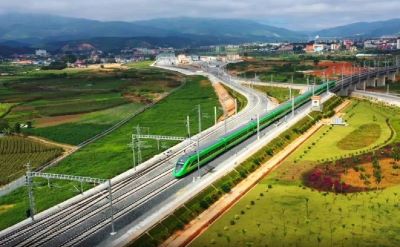
Aerial photo shows an electric multiple unit (EMU) train of the China-Laos Railway crossing a major bridge over the Yuanjiang River in southwest China
Xi said the China-Laos Railway is a landmark project of high-quality Belt and Road cooperation. In recent years, with the goals of high standard, sustainability and improvement of people’s livelihood, China has continuously improved the level of Belt and Road cooperation, achieved mutual benefits and win-win results for participating countries, and opened up new space for the development of the world economy.
As a docking project between the Belt and Road Initiative and Laos’ strategy to convert itself from a landlocked country to a land-linked hub, it will slash the travel time between the two cities to about 10 hours.
An electric multiple unit (EMU) train of the China-Laos Railway arrives at Yuxi Railway Station in Yuxi, southwest China
Sleek bullet trains will travel at a speed of 160 km per hour, through mountains and valleys.
On Friday afternoon, passenger trains left Kunming and Vientiane stations respectively at the same time.
“Today is a proud moment and the dream of all ethnic groups of Laos has finally come true,” Thongloun said, expressing gratitude to China for its support. Laos has finally bidden farewell to the days without trains and possessed a modern railway.
Thongloun said the railway will greatly promote Laos’ national economic and social development.
The China-Laos Railway crosses areas rich in wildlife including wild Asian elephants. Developers skirted environmentally sensitive areas, built bridges, and set up protective fences to minimize the project’s impact on the environment.
Construction of the Laos section started in December 2016, and construction of the China part linking Yuxi and the border town of Mohan started in December 2015.
Aerial photo shows an electric multiple unit (EMU) train of the China-Laos Railway arriving at the border town of Mohan in southwest China
A total of 167 tunnels and 301 bridges were built along the new sections stretching over 900 km, after builders overcame many technical difficulties.
The railway could potentially increase aggregate income in Laos by up to 21 percent over the long term, the World Bank said in a report last year.
The section connecting Vientiane and Boten (at the northern border with China) could provide Laos with a land link to global and regional supply chains, which could make the country more attractive to investors, create new jobs, and accelerate economic growth, the report said.
Many exporters will switch to the railway from road transport, and the cost of transport through Laos could be cut by 30 to 40 percent, said Valy Vetsaphong, vice president of the Lao National Chamber of Commerce and Industry.
As an important part of the trans-Asian railway network, the railway will serve as a “golden key” for Laos to connect with China and other ASEAN countries including Thailand and Malaysia, said Xiao Qianwen, executive manager of the Laos-China Railway Co., Ltd., a joint venture based in Vientiane.
It will exert a positive impact on economic cooperation in China-ASEAN Free Trade Area and the Greater Mekong Subregion, Xiao added.
For 22-year-old Sida Phengphongsawanh, a Lao employee, the rail project will be a boon for Laos.
“Personally, the railway has given me a stable job. At the national level, the railway can drive the multi-level and all-around development of Laos,” Sida said.
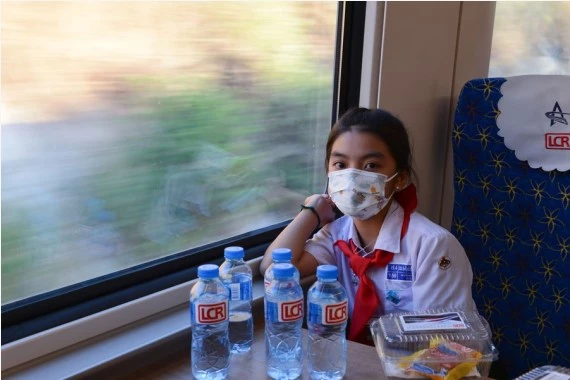
A student from the China-Laos Friendship Nongping Primary School is seen on the Lane Xang EMU train of the China-Laos Railway on Dec. 3, 2021. The China-Laos Railway started operation on Friday. (Photo by Alan Liu/Xinhua)
The Philippine government has tightened the quarantine and testing rules for incoming travelers flying in from countries outside of the 14 banned countries due to Omicron variant outbreaks.
The Philippines has tightened the quarantine and testing rules for incoming travelers flying in from countries outside of the 14 banned countries due to Omicron variant outbreaks.
The Department of Health (DOH) reported 544 new COVID-19 infections on Friday, pushing the number of confirmed cases in the Southeast Asian country to 2,833,878.
The country has recorded less than 1,000 cases for the 10th straight day.
The DOH also reported that 235 more people died from COVID-19 complications, bringing the country’s death toll to 48,987. The number of active cases or patients still battling the disease in the country dropped to 14,977.
A passenger wearing a protective mask pushes a baggage cart after arriving at the Terminal 1 of the Ninoy Aquino International Airport in Manila, the Philippines, on March 17, 2021. (Xinhua/Rouelle Umali)
The government has tightened the requirement for incoming travelers from countries outside of the 14 banned countries due to the Omicron COVID-19 variant.
Cabinet Secretary Karlo Nograles said travelers must present a negative result of reverse transcription-polymerase chain reaction (RT-PCR) swab test conducted 72 hours before departure from the country of origin from Friday.
A boy is inoculated with a COVID-19 vaccine at a sports complex in Marikina City, the Philippines on Nov. 29, 2021. (Xinhua/Rouelle Umali)
Upon arrival, the vaccinated travelers must undergo a facility-based quarantine. On the fifth day, they will be swab tested again, and even if the result is negative, they need to isolate at home until the 14th day from the date of arrival.
Under the previous rule, incoming travelers outside the flagged high-risk countries were only asked to self-monitor after a negative RT-PCR test result.
Unvaccinated, partially vaccinated, or whose vaccination status cannot be independently validated traveler needs to present negative RT-PCR test results taken 72 hours before leaving the country of origin, Nograles said.
For those travelers, they need to undergo facility-based quarantine. While on quarantine, an RT-PCR test will be taken on the seventh day and must complete the 14-day quarantine at home even if the test result is negative, according to Nograles.
“International passengers who have already arrived and are currently undergoing quarantine shall continue with the testing and quarantine protocols in place at the time of their arrival,” Nograles said at a virtual press conference.
From Nov. 15 to 29, the DOH said the country has recorded 253 arrivals from South Africa, 249 are returning overseas Filipinos, and 4 are foreign nationals.
“The Bureau of Quarantine has already verified or contacted 71 of these travelers, while 182 are still being verified,” the DOH said in a statement.
The Philippines has barred travelers from South Africa and 13 countries in Europe and southern Africa with known Omicron outbreaks.
The DOH reported its highest caseload on Sept. 11 with 26,303 cases.
The Philippines, which has around 110 million population, has tested more than 22.5 million people since the pandemic.
The First Lane Xang bullet train of the China-Laos Railway carrying Lao people, including teachers and pupils, departed from Vientiane Railway Station in the Lao capital after the cross-border railway started operation on Friday.
A student from the China-Laos Friendship Nongping Primary School is seen on the Lane Xang EMU train of the China-Laos Railway on Dec. 3, 2021. (Photo by Alan Liu/Xinhua)
A student from the China-Laos Friendship Nongping Primary School is seen on the Lane Xang EMU train of the China-Laos Railway on Dec. 3, 2021. (Photo by Alan Liu/Xinhua)
The Lane Xang EMU train of the China-Laos Railway departs from Vientiane Railway Station in Vientiane, Laos, Dec. 3, 2021. (Photo by Kaikeo Saiyasane/Xinhua)
A student from the China-Laos Friendship Nongping Primary School is seen on the Lane Xang EMU train of the China-Laos Railway on Dec. 3, 2021. (Photo by Alan Liu/Xinhua)
A student from the China-Laos Friendship Nongping Primary School is seen on the Lane Xang EMU train of the China-Laos Railway on Dec. 3, 2021. (Photo by Alan Liu/Xinhua)
A student from the China-Laos Friendship Nongping Primary School is seen on the Lane Xang EMU train of the China-Laos Railway on Dec. 3, 2021. (Photo by Alan Liu/Xinhua)
The China-Laos Railway, a landmark project of high-quality Belt and Road cooperation, started operation on Friday.
The electrified passenger and freight railway runs 1,035 kilometers, including 422 kilometers in Laos, from the city of Kunming, southwest China’s Yunnan Province, to Lao capital Vientiane.
The architecture style of the railway stations is designed to feature local culture.
Sleek bullet trains will travel at a speed of 160 kilometers per hour, through mountains and valleys.
Construction of the Laos section started in December 2016, and construction of the China part linking Yuxi and the border town of Mohan started in December 2015.
A total of 167 tunnels and 301 bridges were built along the new sections stretching over 900 kilometers, after builders overcame many technical difficulties.
As a docking project between the Belt and Road Initiative and Laos’ strategy to convert itself from a landlocked country to a land-linked one, the line will slash the travel time between Kunming to Vientiane to about 10 hours.
The railway could potentially increase aggregate income in Laos by up to 21 percent over the long term, the World Bank said in a report last year.

 A student from the China-Laos Friendship Nongping Primary School is seen on the Lane Xang EMU train of the China-Laos Railway on Dec. 3, 2021. The China-Laos Railway started operation on Friday. (Photo by Alan Liu/Xinhua)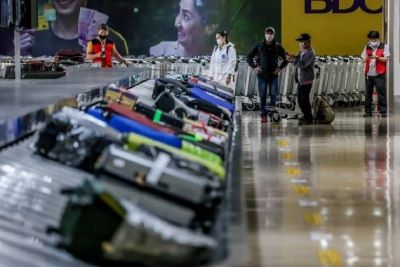
 A passenger wearing a protective mask pushes a baggage cart after arriving at the Terminal 1 of the Ninoy Aquino International Airport in Manila, the Philippines, on March 17, 2021. (Xinhua/Rouelle Umali)
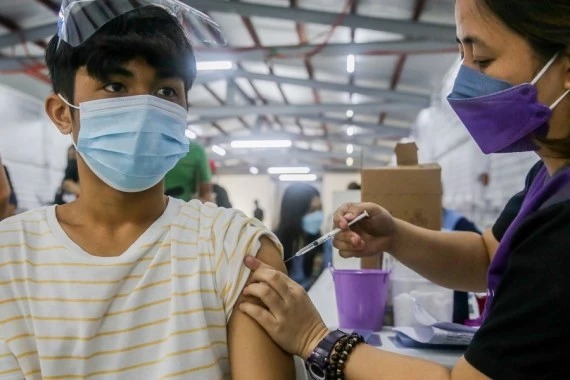 A boy is inoculated with a COVID-19 vaccine at a sports complex in Marikina City, the Philippines on Nov. 29, 2021. (Xinhua/Rouelle Umali)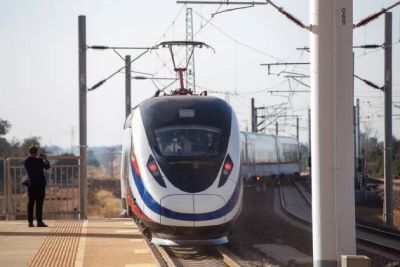
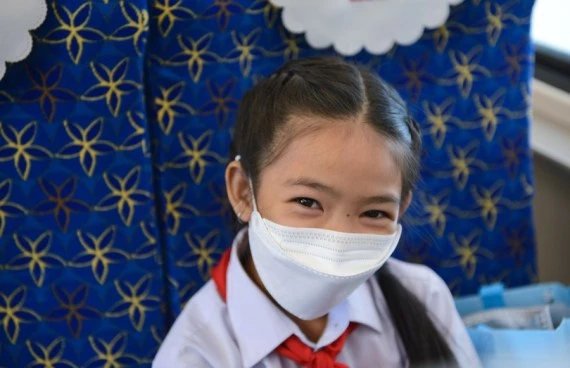 A student from the China-Laos Friendship Nongping Primary School is seen on the Lane Xang EMU train of the China-Laos Railway on Dec. 3, 2021. (Photo by Alan Liu/Xinhua)
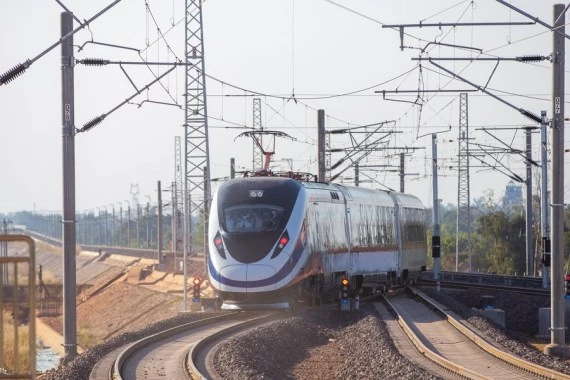 The Lane Xang EMU train of the China-Laos Railway departs from Vientiane Railway Station in Vientiane, Laos, Dec. 3, 2021. (Photo by Kaikeo Saiyasane/Xinhua)
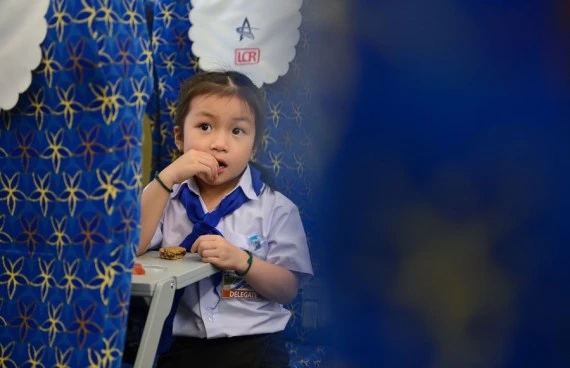 A student from the China-Laos Friendship Nongping Primary School is seen on the Lane Xang EMU train of the China-Laos Railway on Dec. 3, 2021. (Photo by Alan Liu/Xinhua)
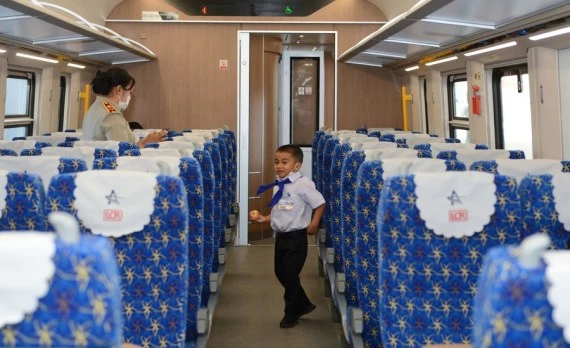 A student from the China-Laos Friendship Nongping Primary School is seen on the Lane Xang EMU train of the China-Laos Railway on Dec. 3, 2021. (Photo by Alan Liu/Xinhua)
 A student from the China-Laos Friendship Nongping Primary School is seen on the Lane Xang EMU train of the China-Laos Railway on Dec. 3, 2021. (Photo by Alan Liu/Xinhua)
 SootinClaimon.Com