Krungsri Securities forecast the Stock Exchange of Thailand (SET) Index on Thursday (December 2) would fluctuate between 1,580-1,600 points.
It said the index would be under pressure due to news of the first Covid-19 patient who has been infected with Omicron variant in the US, the Federal Reserve’s signal it would end its quantitative easing programme soon and Bank of Thailand (BOT)’s move against using digital currency for purchasing goods.
However, mass buy-ups of shares which price dropped sharply would help boost the index, Krungsri Securities said.
It also recommended buying of the following companies’ shares as an investment strategy:
▪︎ COM7, SYNEX, BCH, CHG and MEGA, which benefit from the Covid-19 crisis.
▪︎ HANA, KCE, TU, ASIAN, EPG and XO, which benefit from the weakening baht.
Meanwhile, it asked people to beware of mass sell-offs of JMART, RS and XPG due to BOT’s move against using digital currency for purchasing goods.
The price of gold rose by THB50 in morning trade on Thursday.
AGold Traders Association report at 9.26am said the buying price of a gold bar was THB28,400 per baht weight and selling price THB28,500, while the buying and selling price of gold ornaments is THB27,894.40 and THB29,000, respectively.
At close on Wednesday, the buying price of a gold bar was THB28,350 per baht weight and selling price THB28,450, while gold ornaments were THB27,833.76 and THB28,950, respectively.
The spot gold price on Thursday morning hovered around US$1,782 (THB60,272) per ounce after Comex gold at close on Wednesday rose by $7.8 to $1,784.3 per ounce due to support for buying gold as a safe-haven asset after the fall of the US stock market and concerns about the Covid-19 Omicron variant outbreak.
The baht opened at 33.74 to the US dollar on Thursday, weakening from Wednesday’s closing rate of 33.72.
The Thai currency is likely to move between 33.60 and 33.80 to the greenback during the day, Krungthai Bank market strategist Poon Panichpibool predicted.
Poon said that the baht is weakening as investors sell Thai stocks or short term bonds. Poon said that the baht will be pressured during the day from the worry of the Omicron variant.
Moreover, the technical signs revealed that the baht is still pressured by weakening factors which cause foreign investors to not invest back in the baht. However, Poon said that the gold price rebound and exporters selling the dollar support the baht to not weaken much more.
According to the technical sign, Poon believed that the baht might strengthen in the next two or three weeks if the scientific research revealed that the vaccine distribution could prevent the spread of the Omicron variant which the economic recovery will not affect much.
The key resistance level for the baht would be from 33.80 to 34 to the dollar, which is the level at which exporters might sell the US currency.
The baht’s key support level would be at 33.40, the level some importers are waiting for so they can buy dollars, he added.
Poon said that the currency market will be highly volatile in this period. Business operators should be cautious and use hedging tools to manage the risk.
The return of stricter covid restrictions to fight the latest variant, omicron, has already left some travelers stranded. For many tourism businesses, its also threatening hopes of an upcoming holiday boost this year – especially after last years shutdowns emptied out popular destinations from the Colosseum in Rome to the resort island of Bali.
“There was a kind of sunrise on the horizon” earlier this year, said Tobias Warnecke, the German hotel association’s economic adviser. Now, thanks to infections and rule changes roaring back, and fears over omicron, “we have a lot of cancellations, and we’re on our way down.”
With scientists rushing to better understand the variant and its high number of mutations, governments including in the United States have started tightening masking, quarantine or travel rules. Many have closed their borders to the southern region of Africa where scientists first detected the variant, though it has since popped up in more than a dozen countries, from Canada to Japan.
The timing also has the aviation industry worried. The president of Emirates airline has noted that a hit to the peak travel season in December could cause “significant traumas in the business,” which had been seeing a recovery.
The pandemic was already projected to cost the world’s tourism sector a loss of $1.6 trillion in 2021, the U.N. tourism body said, an estimate it made shortly before the discovery of the omicron variant, which the World Health Organization warns poses a “very high” global risk.
Revenue from global tourism and arrivals rebounded this year to some extent from 2020, while remaining below 2019 levels before the pandemic battered the sector, the United Nations World Tourism Organization said in a report published this week. Last year, the direct economic loss in tourism was about $2.0 trillion.
“Uneven vaccination rates around the world and new Covid-19 strains could impact the already slow and fragile recovery,” the U.N. body also warned.
Weeks before the spread of omicron, a wave of coronavirus infections had already prompted closures and curfews in much of Europe. Warnecke, from the German hotel association, described the new variant as “another bad news,” although he added it was too early to predict its full impact on hotels before it is clear how it interacts with existing vaccines.
For Golden Tours, a London tour operator that takes visitors to the Warner Bros. Studio Tour – where fans can see the sets from the Harry Potter films – trips are still going ahead but cancellations have started streaming in, according to office supervisor Frank Jacobs.
Britain’s high vaccination rates and the lifting of restrictions – including a mask mandate that has just come back – led to a rise in bookings since the summer and an expectation of booming business for the Christmas holidays, he added. “We had December completely booked up,” he said. “But now since last week, everything is changing.”
Berlin also saw “massive cancellations” in the last two weeks, according to Thomas Lengfelder, head of the city’s hotel and restaurant association. Employees were “once again very unsettled” about the possibility of a new lockdown cutting back work, he said, and called for the ramping up of vaccinations.
Still, some businesses remain optimistic about their Christmas prospects.
For Le Meurice hotel in Paris, as well as others the Dorchester Collection oversees in Rome, London and Los Angeles, omicron has yet to hit holiday bookings beyond a “slight” uptick in cancellations. “So far, despite news of the new variant, the end of this year is still looking positive for us,” the hotel operator said in an email. “2021 has definitely been a better year than 2020 and should remain so.”
The European Central Banks insistence that surging consumer prices wont endure is being tested so repeatedly that inflation now threatens to overshadow a meeting in two weeks time to revamp pandemic stimulus.
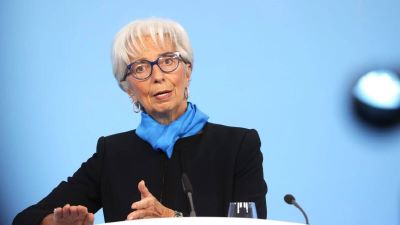
That decision was meant to ease the path away from emergency bond-buying while reassuring investors that support won’t be abruptly removed. Instead, President Christine Lagarde may find the focus has switched to when the ECB may tighten monetary policy, just as other major central banks signal they’ll need to act to curb inflation.
She and her colleagues have insisted soaring prices are fueled by temporary factors such as energy costs that will soon start to fade. In contrast, Federal Reserve Chair Jerome Powell enacted a hawkish pivot on Tuesday, suggesting the word “transitory” should no longer be used to describe what’s happening.
Hours earlier, euro-zone inflation exceeded all forecasts to reach 4.9%, with a core gauge stripping out volatile components also at a record for the era of the single currency. Meanwhile, the omicron coronavirus variant is feeding fears of further price-stoking supply bottlenecks, even before scientists determine its health risks.
“Lagarde’s insistence that inflation is a temporary phenomenon is under severe strain,” said Steen Jakobsen, chief investment officer at Saxo Bank. “The political pressure on the ECB to act is ratcheting higher.”
That pressure is on full view in Germany, the region’s largest and probably most inflation-averse economy, where price growth is outstripping the euro region. If it doesn’t ease as expected, “we have to do something,” Chancellor-designate Olaf Scholz told Bild TV in an interview, without specifying what any action may entail.
In the wake of price data this week, money markets have raised bets on the ECB tightening monetary policy, wagering the deposit rate will be lifted by 10 basis points by end-2022, compared with 5 points on Monday.
While the ECB acknowledges inflation will take longer than originally expected to dip back below its 2% target, it maintains that action isn’t needed for now, and argues that Europe is in a different position to the U.S.
About four-fifths of the region’s price pressures reflect shocks generated abroad, Executive Board member Fabio Panetta said in a recent speech. Spending on services remains well below pre-crisis levels, durable-goods consumption is showing “nothing like the boom” seen in the U.S. and core inflation is much lower too, he said.
“The ECB can afford to wait much longer than the Fed to confirm that we’re moving in the same direction,” said Anatoli Annenkov, an economist at Societe Generale in London. “Should we see inflation accelerating more sustainably — with real evidence of wage pressures — that’s when the ECB would need to start worrying.”
The latest bargaining rounds on salaries don’t offer particular reason for concern. Germany’s second-largest union won a 2.8% raise this week in a deal that will affect about 3.5 million people.
Indeed, central bankers should hold their nerve as they watch the global economic recovery slowing and a stronger and longer-than-expected bout of elevated inflation cast a shadow over the outlook, the OECD said Wednesday in a report.
Omicron, however, may pose the greatest uncertainty. There are fears it will tilt consumers further toward goods purchases and away from services, potentially worsening supply snarls and boosting prices.
“There’s a risk that inflation will not go down as quickly and as much as we predicted,” Lagarde’s deputy, Vice President Luis de Guindos, told French newspaper Les Echos in an interview published Tuesday.
A week earlier, before the discovery of the new strain jolted global markets, his Executive Board colleague Isabel Schnabel suggested the price outlook was shifting by describing risks as “skewed to the upside.”
Before omicron’s heath dangers are fully understood, it’s Powell’s pivot in testimony to Congress that’s most likely to put the ECB on the spot.
At their December meeting, policy makers are set to determine the future course of bond-buying following the scheduled end of its pandemic program in March. That judgment was seen as tricky and controversial even before the latest developments.
If inflation is strong enough to change the mind of the world’s most powerful central bank, investors may expect the ECB to follow suit. The task of Lagarde, who’s struggled to snuff out market bets for an interest-rate hike in 2022, may have just got harder.
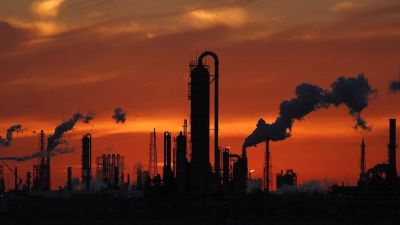
OPEC and its allies pressed on with the first of two days of meetings to debate a planned output increase, with expectations growing that the group will take a pause due to the threat from a new virus variant.
Ministers have been tight lipped about their intentions, and the opening round of talks on Wednesday focused solely on administrative matters, such as the appointment of the next secretary-general, delegates said. The group’s technical experts are now examining forecasts that show a weighty oil surplus re-emerging in the first quarter.
The oil-market situation has reversed abruptly for the coalition led by Saudi Arabia and Russia. Throughout the past month, it faced pressure from major consumers like the U.S. to ramp up supplies more quickly. But after the omicron strain of Covid-19 sent crude crashing into a bear market, even a modest hike looks riskier.
“The sudden appearance of a new and potentially more dangerous variant comes on top of new lockdowns,” Angolan Minister of Mineral Resources and Petroleum Diamantino Azevedo said at the opening session of the meeting on Wednesday. “In these uncertain times it is imperative” that OPEC+ “remain prudent in our approach, and prepare to be proactive as market conditions warrant.”
One of the few ministers to speak on the record about output policy, Iraqi Oil Minister Ihsan Abdul Jabbar Ismaael, said he would go along with whatever the group decides, whether its a supply hike or a pause. The majority of analysts and traders surveyed by Bloomberg expected the latter.
Oil futures are down 18% in New York from the seven-year high reached in late October, when the recovery in global oil demand from the pandemic was stirring fear over the inflationary danger of surging fuel costs.
Frustrated with Riyadh’s refusal to speed up the revival of supplies halted during the pandemic, U.S. President Joe Biden co-ordinated a multinational release of more than 50 million barrels from emergency oil stockpiles, which was announced on Nov 23.
The move prompted the 23-nation OPEC+ alliance to contemplate retaliating by calling off its next output increase, a 400,000 barrel-a-day tranche scheduled for January. When the new virus offshoot triggered a 12% price rout in London on Friday, the group’s inclination toward a pause only hardened.
“This seems precisely the scenario that the pause option was designed for when the producer group announced their phased increase plan in July,” said Helima Croft, chief commodities strategist at RBC Capital Markets.
Internal research by the Organization of Petroleum Exporting Countries suggests that world markets will be inundated with a 3 million barrel-a-day surplus during the first quarter. The excess could be as much as 4.8 million barrels a day in a more pessimistic scenario for demand.
With the outlook deteriorating, 18 of 25 traders, analysts and brokers in global survey by Bloomberg News predicted that OPEC+ will defer the production boost. That could certainly fit the ethos of Saudi Arabian Energy Minister Prince Abdulaziz bin Salman, who has repeatedly opted for caution in restarting halted production.
“Bottom line is, I expect OPEC+ to vigorously defend the supply balance they have worked hard to restore since last year,” said Vandana Hari, founder of Vanda Insights in Singapore.
Traders have even speculated that OPEC+ could reduce rather than increase supplies if crude prices — which were up 4% at about 6 a.m. in New York — deepen their downturn. Such a move would run the risk of straining Riyadh’s already-fraught relationship with Washington. A recent U.S. diplomatic visit to the region suggests the two sides are seeking to cool tensions.
“We cannot entirely rule out that Prince Abdulaziz pulls another rabbit out of the hat given his affinity for surprise endings,” said Croft.
Proceedings began on Wednesday at 1 p.m. London time, when the 13 OPEC members convened online. That will be followed by a meeting of their analytical body — the Joint Technical Committee — a few hours after. The full OPEC+ alliance is due to gather virtually on Thursday.
“Iraq’s position toward continuing the release of 400,000 barrels a day, or pausing it, depends on what OPEC will decide in its meeting,” the country’s oil minister told the Iraq news agency.
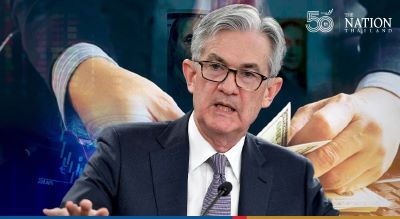
Federal Reserve Chair Jerome Powell reinforced his message that the U.S. central bank would keep inflation in check and said for the second time in two days that officials should consider speeding up how quickly they withdraw policy support.
“We’ve seen inflation be more persistent. We’ve seen the factors that are causing higher inflation to be more persistent,” Powell told the House Financial Services Committee on Wednesday. “Policy has adapted to that and will continue to adapt.”
Powell echoed remarks he made on Tuesday to the Senate Banking Committee that it would be “appropriate” to discuss whether the central bank should wind up its asset purchases at a faster pace given heightened inflation risks.
“If you look at the state of the economy, look at where we are, look at the most recent run of data, you can see that the highly accommodative policy that we have even after the taper is done, it’s really appropriate that we taper,” Powell said. “As I mentioned yesterday, it’s appropriate that we consider at the next meeting tapering faster so that it wraps up a few months earlier.”
He also told the Senate that he wanted to retire the word “transitory” to describe price increases, and indeed in his written remarks, which were repeated to the House panel Wednesday, he said inflation pressures will “linger well into next year.”
Powell, selected last week for a second four year term as chair, was testifying this week alongside Treasury Secretary Janet Yellen as part of Congress’s oversight of pandemic aid.
Stocks rallied during the course of Wednesday morning, reversing some of the losses suffered when news broke Friday of a new strain of Covid-19. Treasury yields were higher.
The U.S. central bank is currently scheduled to complete its asset-purchase program in mid-2022 under a plan announced at the start of November to slow buying by $15 billion a month. The next gathering of the policy-setting Federal Open Market Committee is Dec. 14-15, when they could make a decision to accelerate the tapering.
Powell said the taper had not been a disruptive event so far in financial markets and he didn’t expect it would become one because the Fed has “telegraphed it.”
“The inflation that we’re seeing is still clearly related to pandemic-related factors,” Powell also said. “I would also add, though, that it has spread more broadly in the economy and I think that the risk of persistent higher inflation has clearly risen.”
U.S. central bankers are trying to decide how to manage the highest annual inflation rates in three decades against a labor market that hasn’t fully healed from the massive unemployment caused by Covid-19 last year.
The Black unemployment rate stood at 7.9% in October, compared with a national rate of 4.6%. Labor force participation for women in their prime working years stands at 75.4% versus 76.9% at the end of 2019.
Economic growth has looked on track for a strong rebound after slowing in the third quarter due to headwinds from the delta variant, though news last week about the discovery in South Africa of the new omicron strain has caused fresh uncertainty.
“Price stability is one of our two goals, the other being maximum employment,” Powell said. “We have to balance those two goals when they’re in tension as they are right now. I assure you we will use our tools to make sure this high inflation we’re experiencing does not become entrenched.”
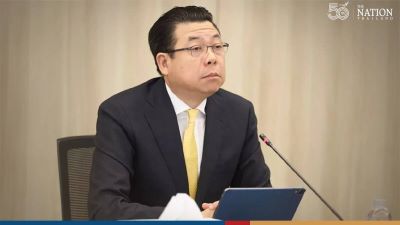
Most Federation of Thai Industries (FTI) operators’ incomes have been reduced by 10-20 per cent while production costs will increase by 10-20 per cent in the next 3-6 months thanks to rising global oil prices as well as container shortages and high freight rates, vice chairman Wirat Uanarumit said according to a November FTI survey.
The FTI has recommended that the government provide assistance in the face of increasing energy prices, freeze electricity prices and reduce electricity and water bills to alleviate the economic impact of both business people and the public.
It also urged entrepreneurs to use technology to increase efficiency in production and product development to maintain competitiveness of the industrial sector.
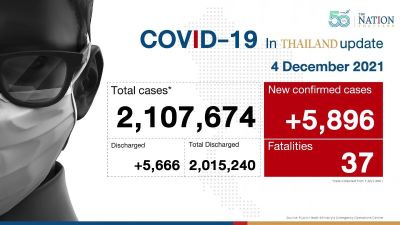
Ministry of Public Health reported on Saturday (December 4) morning that in the past 24 hours there are 5,896 new patients who tested positive for Covid-19, 1,127 of whom have been found in prisons.
Death toll increased by 37, while 5,666 patients were cured and allowed to leave hospitals.
Cumulative cases in the country are at 2,136,537 with 20,917 total deaths.
The Thailand Meteorological Department said on Saturday (December 4) that the strong high-pressure system covers upper Thailand, resulting in cool to cold weather and strong winds in the areas with a drop in temperature by 1-3 degrees Celsius. Mountaintops in the North will be cold to very cold with frost in some areas.
Meanwhile, the weak northeast monsoon prevails over the Gulf and the South, bringing less rains in the South.
The weather forecast for the next 24 hours is as follows:
North: Cool to cold weather; temperature lows of 13-18 degrees and highs of 27-30 degrees Celsius. Temperature on hilltops is likely to drop to 4-10 degrees Celsius with frost in some areas.
Northeast: Cool to cold weather with strong winds; temperature lows of 9-17 degrees and highs of 26-28 degrees Celsius. Temperature on hilltops is likely to drop to 7-12 degrees Celsius.
Central: Cool weather with strong winds; temperature lows of 18-20 degrees, highs of 29-30 degrees Celsius.
East: Cool weather with strong winds; temperature lows of 17-22 degrees, highs of 30-32 degrees Celsius; waves a meter high and 1-2 meters offshore.
South (east coast): Thundershowers in 30 per cent of the areas; temperature lows of 20-23 degrees, highs of 28-30 degrees Celsius; waves 1-2 meters high and 2 meters during thundershowers.
South (west coast): Thundershowers in 20 per cent of the areas; temperature lows of 21-25 degrees, highs of 32-33 degrees Celsius; waves a meter high and 1-2 meters offshore.
Bangkok and surrounding areas: Cool weather with strong winds; temperature lows of 19-20 degrees, highs of 29-30 degrees Celsius.






 SootinClaimon.Com