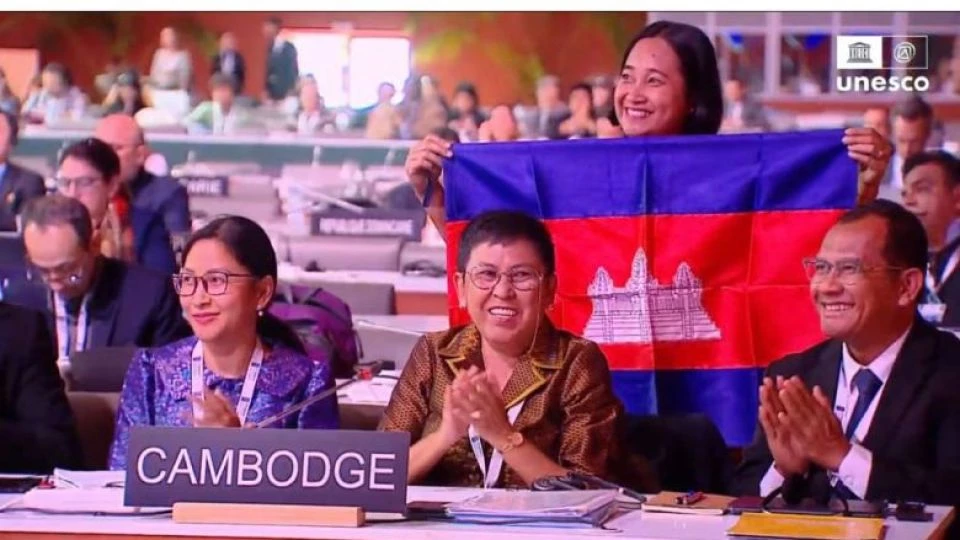
Cambodian martial art added to World Heritage List
WEDNESDAY, NOVEMBER 30, 2022
Unesco has officially added the Cambodian martial art “Kun Lbokator”, more commonly referred to as “Bokator”, to its World Heritage List, according to Minister of Culture and Fine Arts Phoeurng Sackona.
The minister updated Prime Minister Hun Sen about the decision by Unesco Tuesday night and he subsequently made her report public. Phoeurng Sackona’s report says that the decision to inscribe “Kun Lbokator” on the list was made during the 17th session of the Intergovernmental Committee for the Safeguarding of the Intangible Cultural Heritage held in Rabat, Morocco, on Tuesday.
The inscription, made at 10:31pm Cambodian time, is for the Representative List of the Intangible Cultural Heritage of Humanity.
Bokator is a martial art that was created by the ancient Khmer people to defend themselves. The term “Bokator” is derived from the words “bok”, meaning “to pound”, and “tao”, which refers to a lion.
Historical evidence of early Bokator techniques can be seen carved on the walls of ancient temples. Many examples can be found at the 7th-century Sambor Prei Kuk temple complex. Later, in the 11th-century Angkorian period, many movements of Bokator martial arts were carved on the walls of temples, especially Angkor Wat.
Cambodia prepared documents to apply for the inclusion of Bokator as a Unesco Intangible Cultural Heritage of Humanity in Need of Urgent Safeguarding in 2008. The application was changed in 2017 to the Representative List of the Intangible Cultural Heritage of Humanity.
The third application was made in 2019, but due to the pandemic, the documentation was delayed until 2021.
Thousands of pelicans die in Peru after bird flu outbreak
WEDNESDAY, NOVEMBER 30, 2022
More than 13,000 birds, mainly pelicans, have died on Peruvian coasts in recent weeks following an outbreak of avian influenza in the Andean country.
Authorities have reported dead pelicans affected by avian influenza on the shores of beaches in northern and central Peru for the past two weeks.
Videos provided by authorities and local media showed clean-up workers removing dozens of pelican carcasses scattered on the sand on Monday (November 28).
The National Agricultural Health Service (Senasa) declared a health alert last week to prevent the spread of avian influenza type A, subtype H5N1, to farm poultry.
The authorities are concerned that the disease will spread further among commercial and backyard poultry.
After a tough 2022, China seeks to move toward recovery in 2023, amid stagnation in the US and deep recession in the Eurozone.
By Dan Steinbock
Battered by domestic challenges and disruptive external headwinds, Chinese economy has coped with a tough year. The lockdown of Guangzhou’s transportation hub, a rising number of cases in Beijing and other major cities highlight the most recent challenges, along with shifts in Covid strategy.
And if it’s been a hard year for China, it’s been worse elsewhere, thanks to misguided economic policies and ill-advised geopolitics. The risk of recession casts a dark shadow over the US, which remains deeply polarized. The Eurozone is facing a deep recession, Japan’s economy is shrinking, and the United Kingdom is struggling with the worst fall in living standards since records began.
In this dire international landscape, China’s recovery could alleviate global economic prospects.
From headwinds… Until the fall, economic data has reflected challenges. Retail sales and domestic tourism have slumped, mainly because of recurrent lockdowns across first-tier megacities. That’s the net effect of mobility restrictions, which undermine effective demand.
The reverse side of reduced consumption is rising household deposits and falling equity markets. When people feel uneasy about the future, they save rather than consume, while businesses defer investment decisions and investors flee to liquidity.
Industrial production has moderated, due to supply-chain disruptions among the provinces. While automobile production and new electric vehicle production signals progress, the double-digit fall of the semiconductors is the direct result of US-led geopolitics. In turn, the slowing growth of exports reflects recessionary risks in the US and the European Union, two of China’s major trading partners.
Following several years of adverse liquidity in the real estate sector, the new property market support measures, particularly the government’s 16-point recovery plan, will contribute to stabilization.
While default risks remain elevated with weaker developers, larger-quality developers will benefit from consolidation.
Throughout the year, investment, fueled mainly by the public sector, has offset effective demand, as evidenced by higher output in steel and new renewable projects. That will add to debt pressures, particularly at the local level. Meanwhile, the Fed’s aggressive tightening has complicated efforts at monetary easing at the People’s Bank of China.
… to recovery Yet, the real story of 2023 is likely to be the impending recovery of the Chinese economy. A central determinant in unleashing the Chinese consumption potential, private sector investment and investor confidence hinges on the fine-tuning of the dynamic clearing policy to Covid-19 cases and the consequent broad-based recovery.
Though gradual, the implementation of new rules to better balance the pandemic fight and economic development could result in a surge of pent-up demand by the second quarter of 2023. Such progress would strengthen economic data. Retail sales would climb. Consumer confidence, even domestic tourism, would pick up with rising consumption, including (costlier) consumer durables, while household deposits would decrease accordingly.
Businesses would invest more, including foreign multinationals as their home markets in the West will stagnate. Property markets would gradually normalize and also benefit from pent-up demand. Chinese investors would return to equity markets, which would also be attractive to overseas investors seeking diversification. The MSCI China Index heralds the turnaround; it was 24% up in November, compared to only 2% for the S&P 500 Index.
Industrial production would pick up. Despite demand destruction in the West, the Belt and Road Initiative (BRIA) will promote steady progress on the back of recovery in Southeast Asia, which China is both driving and benefiting from. Less fixed asset investment by the public sector would reduce local governments’ debt pressures.
Downside risks, upside realities In a downside scenario, domestic woes would prove more adverse because China would shun reforms and opening-up policies. This nightmare scenario is aggressively propagated by neoconservatives in the West, although it has nothing to do with facts.
In reality, both reforms and opening-up policies will continue in China.
Certainly, domestic challenges will remain tough. The population is ageing. The economy needs to move from investment toward consumption. Despite decelerating economic growth, per capita incomes must continue to rise. Worse, these challenges must be met amid the West’s purposeful efforts to undermine such efforts. Yet, in each case, policymakers have shown a willingness to rely on reforms to overcome challenges. The ageing-related reduction of the labour force will be significantly smaller than expected, as the new UN projections attest.
Furthermore, the share of investment to GDP likely peaked at 42 % in the past half a decade, with a gradual decline set to ensue.
And thanks to continued reforms and “common prosperity” policies, Chinese catch-up in productivity and per capita incomes has climbed to more than a third of the US level, even as secular growth is decelerating to 4% in the late 2020s.
A brighter 2023 outlook In 2022, analysts and multilateral banks estimate China’s GDP growth at 3 to 3.3%. Then again, the growth rates of all major economies have been downgraded for 2022.
The real story is that, thanks to the expected rebound, China’s growth could climb to 4.5 % to 5.0 % in 2023. The precondition is that prevention and control policies will continue to be refined to make them more agile and flexible and the global landscape remains manageable, as indicated by the easing of Sino-US tensions after the recent meeting between President Joe Biden and President Xi Jinping.
With the recovery in 2023, China’s long-term development goals – primary modernization by 2035 and comprehensive modernization by 2050 – remain within schedule.
Dan Steinbock is an internationally recognized strategist of the multipolar world and the founder of Difference Group. He has served at the India, China and America Institute (USA), Shanghai Institutes for International Studies (China) and the EU Center (Singapore). For more, see https://www.differencegroup.net
Beautiful camels eclipse beautiful game at Qatar World Cup
WEDNESDAY, NOVEMBER 30, 2022
While the FIFA World Cup is in full swing in Qatar, camels from different Gulf countries are having a tournament of their own at the Qatar Camel Mzayen Club’s beauty festival.
“The idea is similar to the soccer World Cup, we did a camel beauty World Cup”, said the president of the club, Hamad Jaber al-Athba, underlining the importance of camels in the area, ‘a companion during the beginning of civilization in the Gulf’.
With their heads held high and in a constant chew, participating camels waited in a pen before being paraded in front of an audience seated indoors and enjoying coffee and sweets while gauging the beautiful beasts.
With participants from different Gulf countries, the competition is fierce between camels running in different categories according to their age and type.
“Black camels are judged according to the size of the body and the head and the location of the ears. But with the Maghateer-type camel, we look for proportionality and the ears should be dropping down, not stand straight. In addition to the way the mouth is curved,” Athba said.
To avoid fraud and detect ‘cosmetic surgery’, a medical committee examined the animals before allowing them to participate in the beauty pageant.
According to the medical committee’s president, owners sometimes use fillers, botox or silicon to increase their camel’s chances of winning – a disqualifying foul.
Ahead of declaring the winner of the day’s competing category, other female camels were milked and the owner of the one producing the most was rewarded 20,000 Qatari riyals (about 5,500 USD).
But all eyes were on the competition between Maghateer-type camels over the age of four, the day’s competing category, and whose winner fetched a sum ten times higher.
The Saudi owner of camels who won bronze and gold in the competition, Mohanna Ibrahim al-Anazi, was thrilled after receiving his prize.
“I can’t describe my feelings, because this female has an audience like the audience of the World Cup. Like Real Madrid or Manchester (United). And now, they are all celebrating,” he said.
Slide sandals, which are known as hep sandals in Japan and were popular about 40 years ago, are coming back into vogue. One shoe manufacturer in Nara Prefecture, which was once a major producer of the footwear, is attracting attention for its stylish designs.
Hep sandals were said to be named after Audrey Hepburn, who changed from heels to this style of footwear in the movie “Roman Holiday.”
The backless, easy-to-wear footwear became popular for daily use in Japan at that time, but demand dwindled due to changes in lifestyle.
There were more than 100 hep sandal manufacturers in Nara Prefecture in the early 1980s, but the figure has dropped to about 15 now, according to the Nara Footwear Cooperative Federation.
Munetoki Kawahigashi, the 33-year-old president of Kawahigashi Hakimono Shoten, a shoemaker and retail business in Yamato-Takada in the prefecture, began selling such sandals under his brand, HEP, in spring 2020.
The footwear has both a retro look and the comfort of cushion insoles, making it popular with people across generations despite the fact being priced between around ¥7,000 and ¥18,000, compared to around ¥2,000 to ¥3,000 for conventional hep sandals.
“If I become a leader of this local industry and create jobs, our followers may increase and this local business may be revitalized,” Kawahigashi said.
Blinken: No particular geopolitical aspects to Iran-US World Cup match
TUESDAY, NOVEMBER 29, 2022
US Secretary of State Antony Blinken said that he didn’t see any particular geopolitical aspects in the forthcoming football match between the United States and Iran on Tuesday.
“I’m looking forward to the match between the United States and Iran. I will be cheering our team USA. I will watch the match later tonight,” Blinken said.
Diplomatic foes the United States and Iran face off on the pitch at the World Cup on Tuesday in a match that some Iranians fear may see further run-ins with stadium security or clashes with pro-government fans over raging protests back home.
The contest between the two nations that severed ties over 40 years ago will be held with increased security to prevent a flare-up of tensions over the unrest that has gripped Iran since the death in custody of 22-year-old Mahsa Amini on Sept. 16.
In a show of solidarity ahead of the match, which starts at 1900 GMT, the US Soccer Federation temporarily displayed Iran’s national flag without the emblem of the Islamic Republic, leading Tehran to complain to FIFA, according to state media.
Qatar, which has strong ties with Washington and friendly relations with Tehran, has staked its reputation on delivering a smooth World Cup, beefing up security at Iran games and banning some items deemed inflammatory, like Iran’s pre-Revolution flag.
US-Iranian ties have been especially strained since then-President Donald Trump abandoned Tehran’s nuclear deal with world powers. Efforts to salvage the pact under President Joe Biden’s administration have stalled.
TAT forecasts Thai tourism slump from Q2 next year
WEDNESDAY, NOVEMBER 30, 2022
Thai tourism will likely be challenged by recession, inflation, the cost-of-living crisis and rising travel expenses from the second quarter next year, the Tourism Authority of Thailand (TAT) said on Tuesday.
The industry will also be squeezed by the arrival of low season in March and the decline in travel demand after the Covid-19 pandemic, TAT governor Yuthasak Supasorn said.
“These issues pose challenges to our tourism marketing as Thailand has to compete with countries that have reopened to tourists,” he said.
The TAT aims to attract 20 million foreign arrivals next year to generate 2.38 trillion baht in tourism revenue, or 80% of the 3-trillion-baht revenue in 2019.
Yuthasak said the TAT will ramp up its tourism marketing and road shows in countries around the world.
Meanwhile, the number of flights to Thailand will recover to 80% of 2019 levels.
“Airlines will target a passenger transport rate of 80%,” he said, adding that TAT aims to boost that level to 90%.
It will also launch campaigns to promote seasonal tourist attractions all over Thailand.
Yuthasak expects the return of Chinese and Russian tourists to boost arrivals beyond 20 million next year.
The private sector expects the Chinese government to allow its citizens to travel abroad in March next year, he added.
President Xi Jinping’s remark at the recent Apec summit that China and Thailand are relatives and ready to promote tourism exchanges was well publicised in China and should encourage Chinese tourists to visit the Kingdom, said the TAT chief.
Meanwhile, Russian airlines had recently restored direct Russia-Thailand flights, he added.
Yuthasak said he expects foreign arrivals in December to hit 10 million, as the first high season after the Covid pandemic kicks off.
He forecast tourism revenue of 1.33 trillion baht for the whole of this year, lower than the target of 1.5 trillion baht. He said 731.77 billion baht of this year’s revenue would come from Thai tourists and 600 billion baht from foreign tourists.
He added that Thailand could still hit the 1.5 trillion target if foreign tourists stay longer and spend more cash in the remainder of this year.
Trio appointed to Cabinet as PM prepares for next election
WEDNESDAY, NOVEMBER 30, 2022
Prime Minister Prayut Chan-o-cha has added three new members to his Cabinet, including former government spokesman Thanakorn Wangboonkongchana, according to an announcement in the Royal Gazette on Wednesday.
Thanakorn was appointed as a PM’s Office minister, while Sunthorn Parnsaengthong was appointed deputy agriculture minister and Narit Khamnurak was appointed deputy interior minister.
Filling the three vacant Cabinet seats was seen as a crucial move for the coalition parties to begin preparing for the next general election, which is scheduled tentatively for May 7.
As government spokesman, Thanakorn served as one of Prayut’s most loyal supporters and ardent defenders. He has degrees in mass communications, political science and public administration, the last of which is a doctorate from Western University.
Thanakorn won a party-list House seat under the ruling Palang Pracharth Party’s banner in August. He had been on the waiting list since the March 2019 election. He joined the ruling party in November 2018.
Narit will fill the seat left vacant by the Democrat Party’s deputy interior minister Niphon Bunyamanee since September when he resigned. Niphon resigned to defend himself against court charges of malfeasance from the time he was president of the Songkhla provincial administration organization.
Like Thanakorn, Narit has three degrees: a bachelor’s in agriculture, a master’s in social development and a doctorate in public administration. He received his doctorate from Southwestern University. Narit was elected as a Democrat MP for Phatthalung for the first time in 2001 and was re-elected in 2005, 2007 and 2011.
Sunthorn received his Cabinet seat under the quota allotted to the Samut Prakan group of MPs in the ruling coalition. Previously, he served as vice president of the Samut Prakan provincial administration organisation.
Last election hurdle cleared as Constitutional Court endorses MPs election bill
WEDNESDAY, NOVEMBER 30, 2022
The Constitutional Court on Wednesday unanimously endorsed the constitutionality of the MPs election bill, clearing the last hurdle before the next general election scheduled for 2023.
The court said that the nine judges viewed the MPs election bill as drafted under the provisions of Section 132 of the Constitution and it has no wordings or provisions that would contradict Section 93 and Section 94 of the Constitution of Thailand.
A group of 105 MPs and senators had signed a petition to ask the court to rule whether Section 25 and 26 of the MPs election bill would violate Section 93 and 94 of the Constitution.
The 105 MPs and senators had alleged that the bill had not properly passed the enactment process as required by the Constitution because it had not been vetted by a parliamentary committee.
They argued that Section 25 would violate Section 93 of the charter because it would cancel the prohibition in Section 93 on the counting of votes in constituencies where by-elections need to be held, as votes for sharing party-list House seats.
They also pointed out that Section 26 would violate Section 94 because it would cancel a requirement in Section 94 for recalculating party-list House seats in a year if some constituency MPs are found to have cheated in the election.
But the court disagreed and ruled the bill was valid constitutionally.
On November 9, the court had announced that it had enough information to issue a ruling on Wednesday.
In the next step, the Constitutional Court will inform the Parliament president of its ruling so that the prime minister can be informed to send the bill for a royal command that will officially enact the bill. The prime minister is scheduled to send the bill for a royal command within 20 days.
The MPs election bill — the version of the Election Commission — will use the divisor of 100, which is the total number of party-list MPs, for calculation of party-list House seats.
Small and micro parties prefer the use of the 500 divisor, which is the total number of House seats, because they would stand a much better chance to be allocated one or two House seats from the party-list election.
Earlier, Rawee Maschamadol, leader and party-list MP of the New Palang Dharma Party, said he and 104 other parliamentarians questioned the validity of the election bill and political party bill because they had not been properly vetted. They also suspect that the two bills would violate the intention of the Constitution that would share party-list House seats on the principle that all votes must be taken into account – even votes for failed candidates.
The two bills were taken up for use after the bills that had been vetted failed to clear the third reading in Parliament within the 180-day deadline due to repeated lack of quorum.
Rawee accused major parties of playing games to cause the lack of quorum in order to sink the vetted bill that would use the 500-divisor for party-list House seat calculation.
On November 23, the Constitutional Court voted unanimously to endorse the constitutionality of the political party bill.