Việt Nam pilots initiatives to reduce plastic waste and marine litter #SootinClaimon.Com

#SootinClaimon.Com : ขอบคุณแหล่งข้อมูล : หนังสือพิมพ์ The Nation.

https://www.nationthailand.com/ann/30404772

Việt Nam pilots initiatives to reduce plastic waste and marine litter

Apr 11. 2021A local sorts works in a plastic waste landfill in northern province of Lào Cai. — VNA/VNS Photo Ngọc Hà A local sorts works in a plastic waste landfill in northern province of Lào Cai. — VNA/VNS Photo Ngọc Hà

By Vietnam News / ANN

HÀ NỘI — Vietnamese authorities and international organisations discussed ways to reduce plastic waste and marine litter in Việt Nam at a workshop held in Hà Nội on Friday.

Delegates presented work between the Ministry of Natural Resources and Environment (MONRE), the Delegation of the European Union to Việt Nam and Expertise France on policy development as well as recommendations for four pilot projects in HCM City, Hà Nội and Phú Yên Province, which aim to reduce the amount of plastic that ends up untreated on land and in the oceans.

The initiatives included enhancing plastic packaging collection, sorting and recycling, encouraging fishermen to collect plastic waste caught while fishing, establishing an alliance of supermarkets to reduce the use of single-use plastic bags, and managing waste in ports.

“The Vietnamese Government and the MONRE have shown strong political commitments affirming that we have always given high priority to finding both short and long-term solutions to reduce plastic pollution and foster economic development,” said Director-General of the International Cooperation Department of the MONRE Phạm Phú Bình.

“The circular economy solution to marine plastic litter can be an important contribution to support the implementation of the National Action Plan and helps Việt Nam achieve its goals. Experience and lessons learned from the project and pilot activities will serve as a basis to expand to other localities and aim to inform policy development initiatives,” he said.

The circular economy means markets that give incentives to reusing products, rather than scrapping them and in such an economy, all forms of waste are returned to the economy or used more efficiently, according to the United Nations definition.

Talking about the circular economy, Rui Ludovino, First Counsellor, Climate Action, Environment, Employment and Social Policies at the Delegation of the European Union to Việt Nam, said: “We must move towards a circular economy for plastics, an economy in which resources are used and managed more efficiently and more sustainably. Through the Rethinking Plastics project, we work closely with Việt Nam to prevent marine plastic litter and share regional and European experiences,” he said.

The four pilot activities complement these efforts towards a circular economy with concrete actions and experiences from the local level, involving communities and households, local businesses and administrations, he added.

These activities are run within the ‘Rethinking Plastics – Circular Economy Solutions to Maritime Litter’initiative,  which is implemented by Expertise France with the financial support of the European Union and the German Federal Ministry for Economic Cooperation and Development.

Việt Nam has been confirmed as the world’s fourth-largest marine plastic polluter after China, Indonesia and the Philippines. Each year, the country dumps an estimate of 300,000-700,000 tonnes of plastic waste into the ocean per year, accounting for 6 per cent of the world’s marine plastics.

The country has set the target to have zero disposable plastic waste by 2025.

It has adopted a development strategy to promote the maritime economy in parallel with protecting maritime environment and ecosystems, specifying “preventing, controlling and significantly mitigating marine environmental pollution; being a regional pioneer in reducing ocean plastic waste” among the country’s objectives for 2030. — VNS

USAID to launch $17 million multi-year project to promote clean energy #SootinClaimon.Com

#SootinClaimon.Com : ขอบคุณแหล่งข้อมูล : หนังสือพิมพ์ The Nation.

https://www.nationthailand.com/ann/30404771

USAID to launch $17 million multi-year project to promote clean energy

Apr 11. 2021

By The Daily Star / ANN

USAID will soon launch a multi-year project of up to $17 million to promote clean energy, said the US Embassy in Bangladesh today, a day after US President’s Special Envoy for Climate John Kerry’s visit to Dhaka.

The project titled “Bangladesh Advancing Development and Growth through Energy” will work to expand Bangladeshs’ access to affordable clean energy, support clean energy entrepreneurship, foster transparent and efficient energy markets, and advance innovation.

“It is also critical to curb the country’s carbon emissions, which nearly quadrupled over the past two decades. Not only will it reduce emissions, but will also improve living standards for the people of Bangladesh and will support continued rapid economic growth,” the statement said.

For more than two decades, USAID has helped Bangladesh transform the country’s energy sector as well as protect its natural resources, including more than 2.5 million acres of wetlands and forest areas, which contain habitats for the iconic Bengal tiger in the Sundarbans mangroves, it added.

John Kerry was in Dhaka to invite Prime Minister Sheikh Hasina to attend the Leaders’ Summit on Climate, to be hosted by Joe Biden on April 22-23.

At least 40 world leaders from major economies and climate-vulnerable countries will attend the summit ahead to COP26 to be held in Glasgow in November this year.

US’ return to Paris Agreement, from which the former president Donald Trump pulled out, generated hopes among scientists and world leaders to protect the world from climate change.

John Kerry told reporters in Dhaka on Friday that the US will pay $2 billion to the Green Climate Fund and will play a leadership role in mobilizing $100 billion annually for the fund meant to promote mitigation and adaptation.

China’s top market regulator imposes penalty on Alibaba Group over monopoly conduct #SootinClaimon.Com

#SootinClaimon.Com : ขอบคุณแหล่งข้อมูล : หนังสือพิมพ์ The Nation.

https://www.nationthailand.com/ann/30404748

China’s top market regulator imposes penalty on Alibaba Group over monopoly conduct

Apr 10. 2021The headquarters of e-commerce giant Alibaba Group is in Hangzhou, capital of East China's Zhejiang province. [Photo by Niu Jing/For China Daily] The headquarters of e-commerce giant Alibaba Group is in Hangzhou, capital of East China’s Zhejiang province. [Photo by Niu Jing/For China Daily]

By China Daily/ANN

Chinese regulators on Saturday imposed a 18.23 billion yuan ($2.8 billion) fine in an anti-monopoly investigation of Alibaba Group Holding Ltd.

The State Administration for Market Regulation, which launched the probe into the e-commerce giant in December, charged Alibaba with abusing its market dominance.

The watchdog said its investigation concluded that Alibaba had hindered online retail in China, affected innovation in the platform-based internet economy, hurt the lawful rights of merchants and damaged consumers’ interests.

The fine was equivalent to four percent of Alibaba’s domestic sales in 2019, according to the Saturday statement. The company’s earnings report showed it registered profits of about $12 billion in the last three months of 2020.

“Alibaba accepts the penalty with sincerity and will ensure its compliance with determination,” Alibaba said in a statement soon after the decision was announced. “To serve its responsibility to society, Alibaba will operate in accordance with the law with utmost diligence, continue to strengthen its compliance systems and build on growth through innovation.”

Regulators highlighted the company’s malpractice of forcing collaborating merchants to choose between Alibaba’s online marketplaces and those of its competitors’ for selling their products, which stifled fair market order.

The announcement is the latest development in the government’s increased oversight on internet companies to avoid the “disorderly expansion of capital”.

Shanghai surpasses HK as costliest city for the rich #SootinClaimon.Com

#SootinClaimon.Com : ขอบคุณแหล่งข้อมูล : หนังสือพิมพ์ The Nation.

https://www.nationthailand.com/ann/30404736

Shanghai surpasses HK as costliest city for the rich

Apr 10. 2021This undated photo shows a morning view of the Huangpu River in Shanghai. (CHEN ZHONGQIU / CHINA DAILY)This undated photo shows a morning view of the Huangpu River in Shanghai. (CHEN ZHONGQIU / CHINA DAILY)

By Zeng Xinlan
China Daily/ANN

Shanghai has supplanted the Hong Kong Special Administrative Region (HKSAR) as the most expensive city for well-heeled consumers, as prices of high-end goods and services on the mainland city rose 6 percent year-on-year in 2021, a new Julius Baer Group report said on Friday.

The Swiss private-banking company said that the HKSAR now is the third-priciest city after Shanghai and Tokyo. The HKSAR’s slide was due in part to its relatively flat prices compared with the rising costs in US dollars on the Chinese mainland, the report said.

“Prices in Shanghai rose 6 percent, well above the global average of 1 percent, while prices in Hong Kong were flat,” said Mark Matthews, head of research at Bank Julius Baer Asia Pacific. “In Shanghai, there was ‘quite an anomaly’ where business-class flights went up 82 percent over the last year, and hotel suites rose 15 percent,” he added.

The HKSAR’s luxury goods and services are still significantly more expensive than they are almost elsewhere else, as the city has the world’s second-priciest residential property and legal fees, as well as the third-most expensive automobile and fine-dining expenses. Shanghai led the world in treadmill and lawyer costs in 2021.

Whereas prices in the HKSAR have proved relatively immune to the economic pressure induced by the pandemic, hotel-suite prices in 2020 nose-dived compared to 2019 in US dollar terms. Less-costly items also included women’s’ footwear, whose prices dropped 17 percent year-on-year, while wine and whisky have been a value compared with the international average as no duties are levied in the HKSAR.

“Asia remains the most expensive region partly because of the region’s swift recovery from the global health crisis, currency stability, and price resilience for the index items”, the wealth management company said.

Rajesh Manwani, head of markets and wealth management solutions at Bank Julius Baer Asia Pacific, said, “COVID didn’t become an epidemic quite the same way it unfortunately became in the other cities in the index, so they were able to function more normally than others.”

Julius Baer forecasts Shanghai’s position to be reinforced by the appreciation of the Chinese yuan. “Currency has a huge impact on the index. We are looking for the Chinese yuan to strengthen over the twelve months from 6.55 (yuan per US dollar) today to 6.35, and that could reinforce Shanghai’s position,” he said.

Julius Baer’s Global Wealth and Lifestyle Report analyzed prices and consumer behavior worldwide to gauge the price inflation of a basket of 20 goods and services representative of the high-net-worth individuals in 25 cities across the world. The 2021 edition deleted categories such as personal trainers, wedding banquets, Botox and pianos, replacing them with bikes, treadmills, health insurance and a technology package to reflect the changing world amid the pandemic.

India, Pakistan may stumble into large-scale war, warns US intel report #SootinClaimon.Com

#SootinClaimon.Com : ขอบคุณแหล่งข้อมูล : หนังสือพิมพ์ The Nation.

https://www.nationthailand.com/ann/30404735

India, Pakistan may stumble into large-scale war, warns US intel report

Apr 10. 2021The report warns policymakers in Washington that “a full-scale war could inflict damage that would have economic and political consequences for years.” — White Star/File The report warns policymakers in Washington that “a full-scale war could inflict damage that would have economic and political consequences for years.” — White Star/File

By Anwar Iqbal
DAWN/ANN

India and Pakistan may stumble into a large-scale war neither side wants, warns a US intelligence report while exploring the possibilities of miscalculations leading to a war in South Asia.

The assessment is included in a Global Trends report produced every four years by the US government’s National Intelligence Council, released in Washington. The report, released on Wednesday, focuses on both immediate and distant futures and is designed to help policymakers anticipate the forces likely to shape the world in the next five to 20 years.

“India and Pakistan may stumble into a large-scale war neither side wants, especially following a terrorist attack that the Indian government judges to be significant,” the report warns.

The ability of some militant outfits to conduct attacks, New Delhi’s resolve to retaliate against Islamabad after such an attack, and Islamabad’s determination to defend itself “are likely to persist and may increase” in the next five years, the report adds.

“Miscalculation by both governments could prompt a breakdown in the deterrence that has restricted conflict to levels each side judges it can manage.”

The report warns policymakers in Washington that “a full-scale war could inflict damage that would have economic and political consequences for years.”

The US policy in Afghanistan and its impact on the neighbouring countries is top on a list of key uncertainties in South Asia that are underlined in the report.

“US actions in Afghanistan during the next year will have significant consequences across the region, particularly in Pakistan and India,” the report states.

This would be “especially true” if a security vacuum emerges in Afghanistan that results in a civil war between the Taliban and its Afghan opponents, expanded freedom of manoeuvre for regional terrorist networks, or criminals and refugees flowing out of the country, it adds.

The report predicts that such an outcome would exacerbate political tensions and conflict in western Pakistan and sharpen the India-Pakistan rivalry by strengthening longstanding judgments about covert warfare in Islamabad and New Delhi.

“An abrupt US exit probably would also amplify concerns that the United States will lose interest in South Asia generally,” the document says.

The US intelligence community estimates that India and China may also slip into a conflict that neither government intends, “especially if military forces escalate a conflict quickly to challenge each other on a critical part of the contested border”.

In June 2020, a short military exchange resulted in the deaths of at least 20 Indian soldiers, exacerbated the strategic rivalry between Beijing and New Delhi and sharply affected international perceptions of both countries.

The report puts the prospects for increased regional trade or energy cooperation in South Asia during the next five years as low, “due in part to the high probability of ongoing hostility between India and Pakistan”. Trade within South Asia is already the lowest of any region in the world.

The US intelligence community warns that water insecurity in the region is also an increasing risk. The assessment includes forecasts by the United Nations Development Programme (UNDP) that Pakistan could face absolute water scarcity by 2025, given a combination of poor water conservation practices, rising temperatures, and decreased rainfall.

The report notes that previous extreme weather events, such as the 1970 cyclone in the Bay of Bengal, contributed to state failure in then-East Pakistan and the creation of Bangladesh the next year. It warns that future events could also prompt a regional crisis with enormous humanitarian, political, and security implications to which external powers probably would try to respond.

The report points out that security threats have “undergirded popular support” for nationalist leaders, and these threats are likely to continue or worsen in some cases. For example, “military tensions between India and Pakistan are at their most contentious in many years, strengthening leaders in both capitals.”

The US intelligence community notes that information technology is fuelling authoritarian tendencies by making it easier for South Asian governments to influence their populations. It points out that in 2019, India “led the world in Internet shutdowns by a wide margin” — with several months-long crackdowns to suppress protests, including in occupied Kashmir. Pakistan has deployed Huawei’s Safe Cities technology, raising public fears of increased surveillance.

The report notes that the balancing approach, particularly in relation to China, also affects regional dynamics. Bangladesh, Maldives, Nepal, Pakistan and Sri Lanka probably judge their countries “can more easily deflect New Delhi’s demands or block its regional leadership aspirations by maintaining ties with Beijing”.

For its part, New Delhi probably will look for ways to mitigate Chinese influence given China’s expanding foothold in the Indian Ocean, the report adds. For example, India almost certainly will continue to encourage Japan to offer economic investment and some military cooperation to other South Asian countries to push them to align more closely with New Delhi and Tokyo.

The report predicts that despite their growing interest in China, almost every government in the region will seek to maintain ties with the US as part of their balancing efforts. The United States is the biggest export market for Pakistan, Sri Lanka and Bangladesh, and most South Asian leaders continue to cultivate and publicly tout their relationships with Washington.

US intelligence analysts predict that during the next five years, slowing economic growth and growing polarisation will pose an increasing risk to traditions of democratic and independent governance in several countries in South Asia.

Many countries will strengthen their efforts to hedge and balance their relationships with multiple external powers, including China, Russia, Japan, and the US.

Through 2025, South Asia will have to manage the challenges that internal security problems, the risk of inter-state war, and the effects of climate change and pollution pose to at least some countries’ longer-term democratic and economic development.

The report projects that economic growth in South Asia will remain slow during the next five years and will be insufficient to employ the region’s expanding workforce — especially as the world emerges from the pandemic.

Before the Covid-19 outbreak, unemployment in India had reached a 40-year high until GDP growth slowed markedly in the latter half of 2019, and India’s strict lockdown from March to May 2020 temporarily drove unemployment up to 23 per cent.

The report argues that the region’s economy is hampered by outdated legal systems, severe pollution, water shortages, and highly bureaucratic regulatory environments — all increasing investor uncertainty. “No government in the region is prepared to undertake economic reforms on the scale required to generate robust growth,” the report adds.

It notes that almost all the economies in the region remain focused on agriculture, with the bulk of their workforces dependent on farming. Most countries’ agricultural sectors are underproductive in relation to the large share of government funds and natural resources they consume.

According to the report, this disparity is driven by a variety of factors, including growing water scarcity, environmental damage and climate change effects, and government failure to reform agricultural subsidies that benefit rural constituents at the expense of growing urban populations.

Democracy

US intelligence analysts argue that despite some signs of sustained democratisation, domestic politics in much of the region are likely to continue on the polarising course of the past few years, and this trend may sharpen in some countries.

“Strongperson leaders, even those elected in largely free and fair contests, probably will push majoritarian agendas that widen factional divides — potentially weakening political stability in societies already split along sectarian and ethnic lines,” they warn.

“This political polarisation is rooted in strongly felt nationalist narratives that have become prominent in recent years and met little effective resistance from opposition parties or the courts.”

The report warns that polarising political rule of some leaders in the region will probably increase the inequities or abuses faced by minorities and political opponents of the ruling parties.

“In India and Sri Lanka, Muslims are likely to continue to experience growing political and economic discrimination from Hindu and Sinhalese Buddhist nationalist ruling parties.”

The report notes that Afghanistan too is seeing an intensification of ethnic tensions between Pashtuns and other ethnic groups, a trend that is accelerating as Afghans prepare for the withdrawal of Western troops.

The combination of eroding institutions, mounting security threats, and new digital technologies is likely to enable some South Asian leaders to continue advancing their authoritarian policies, but probably in the face of an uncertain political cost associated with an economic slowdown, the report warns.

It notes that some of these leaders have applied majoritarian political formulae, whereas others have undermined independent judiciaries, election commissions, and politically neutral militaries and bureaucracies, weakening potential future resistance.

Tokyoites brace for another bout of self-restraint #SootinClaimon.Com

#SootinClaimon.Com : ขอบคุณแหล่งข้อมูล : หนังสือพิมพ์ The Nation.

https://www.nationthailand.com/ann/30404734

Tokyoites brace for another bout of self-restraint

Apr 10. 2021A CO2 sensor, left, and a tall plexiglass partition are set up at a bar in Shibuya Ward, Tokyo, on Thursday. (The Yomiuri Shimbun)
A CO2 sensor, left, and a tall plexiglass partition are set up at a bar in Shibuya Ward, Tokyo, on Thursday. (The Yomiuri Shimbun)

By The Japan News/ANN

A resurgence of the novel coronavirus, just two weeks after the last state of emergency expired, has shown that Japan is not quite out of the woods yet. As Tokyo joined the growing list of prefectures to request emergency-level priority measures, a collective sigh of resignation was heard from lockdown-fatigued restaurants and university students whose lives will be thrust back into uncertainty.

■ Flow of people

“We need to remain on high alert against an increase in the number of infections,” said Tokyo Gov. Yuriko Koike at a coronavirus monitoring meeting held on Thursday. “Considering the nature of variants, medical supplies could become tight.”

An uptick in new infections was seen in Tokyo even before the state of emergency ended on March 21. On Wednesday, 555 new infections were confirmed in the capital, exceeding the 500 mark for the first time in about two months.

“What is important is how we go about controlling the flow of people,” Koike said after the meeting.

The Tokyo metropolitan government has urged Tokyoites to refrain from traveling outside the capital, particularly to other big cities where the variants have spread. Universities have also been asked to conduct lectures online as their new freshman class descends upon the city from across Japan.

“We have requested the central government to consider further measures, including a state of emergency, depending on the situation,” Koike added.

■ Preparation

Under the priority measures, Tokyo restaurants and bars will be asked to move up their business hours from 9 p.m. to 8 p.m. and do more to prevent transmission of the virus.

“I’m nothing but anxious,” said the manager of Flora Box 85, a Spanish bar near Shibuya Station.

After the second state of emergency ended in late March, the bar installed CO2 sensors in two locations on its premises. Distributed for free by the Shibuya ward office and other agencies, the sensors can help gauge how crowded a venue is and alert operators to the need for ventilation. A CO2 concentration of 1,000 ppm or less is considered optimal for an occupied room.

“Now that we can visually keep tabs on our air quality, we’ve been ventilating more often,” the manager said.

Even so, the coronavirus has dealt his business a hard blow. During the state of emergency, the bar shortened its hours to 8 p.m. as requested by the government. When the state of emergency ended, it was able to keep its door open until 9 p.m. But its customers never came back. “I’ve kept the business afloat by taking out loans and applying for subsidies, but I don’t know what is going to happen if this keeps up much longer,” said the manager.

■ Lonely students

University students have also voiced concern as they start a new and uncommonly uncertain chapter in their lives, oftentimes far away from home.

“I knew college life would be different [amid the pandemic] from what I had imagined, but my anxiety just keeps getting worse,” said an 18-year-old student who moved from Osaka Prefecture to attend a private university in Tokyo.

A school guidance session remains the only opportunity she has had to meet any classmates.

“I planned on making more friends, but then classes went online and club activities were cancelled,” she said. “I still haven’t made any close friends I can talk to.”

“I finally made a friend, but now we can’t even meet up in person,” said a 19-year-old student who commutes to university in Tokyo from her home in Urawa Ward, Saitama. “It’s been pretty sad.”

When school started last spring, all her classes were being conducted online. She had never set foot on campus until autumn, when she began to visit once a week, but now worries about catching the virus on the train during her commute.

In response to the renewed request for classes to once again be held online, she said, “I guess I’ll just spend time alone at home, as there’s nothing else we can do until the virus is contained.”

Myanmar Military says expects full government operations soon #SootinClaimon.Com

#SootinClaimon.Com : ขอบคุณแหล่งข้อมูล : หนังสือพิมพ์ The Nation.

https://www.nationthailand.com/ann/30404733

Myanmar Military says expects full government operations soon

Apr 10. 2021Photo credit: SNIPER NEWsPhoto credit: SNIPER NEWs

By The Jakarta Post/ANN

Myanmar’s ruling military on Friday said it believed government operations would soon return to normal, as public participation in protests and strikes against the junta was waning.

In a televised news conference, junta spokesman Zaw Min Tun said the military council was working to achieve peace and security in the whole country and there would be full operations of ministries soon, Reuters reported.

He also said international trade continued as normal and reports that the international community did not recognise the military government were fake.

Meanwhile, the UN’s special envoy for Myanmar is to embark on an Asian tour to step up diplomatic efforts to tackle the crisis, as the death toll from the junta’s crackdown on dissent passed 600 on Friday, AFP reported.

The push by Christine Schraner Burgener comes amid mounting international concern at events in Myanmar, rocked by daily protests since the military ousted civilian leader Aung San Suu Kyi and seized power on February 1.

Burgener will start her trip in Thailand and will also visit China, though exact details and timings for her trip have not been confirmed.

At least 614 civilians have been killed in the military’s crackdown on protests and nearly 3,000 arrested, according to the Assistance Association for Political Prisoners, a local monitoring group.

There was more bloodshed early on Friday, with rescue workers reporting at least four people killed when security forces broke up protest barricades in the city of Bago, 65 kilometres (40 miles) northeast of Yangon.

UN rights officials say the military is making increasing use of heavy weaponry including rocket-propelled and fragmentation grenades, heavy machine guns and snipers.

 The violent response has drawn intense international criticism and on Thursday Washington imposed another set of sanctions, this time on Myanmar’s state gem company, as it seeks to deprive the junta of sources of income.

UN envoy Burgener wants face-to-face meetings with the generals but she has not received permission to visit Myanmar. “She, of course, stands ready to resume dialogue with the military to contribute to a return to Myanmar’s democratic path, peace and stability,” UN spokesman Stephane Dujarric said. As well as China — a key player with historical links to the military and which more recently cultivated close relations with Suu Kyi — Burgener also hopes to visit member countries of regional bloc ASEAN.

“As she has highlighted repeatedly, a robust international response to the ongoing crisis in Myanmar requires a unified regional effort involving neighbouring countries who can leverage influence towards stability,” Dujarric said. An ASEAN summit on Myanmar is scheduled for the end of the month, but diplomats say the bloc is deeply divided over the crisis.

“At one end, there are Thailand, Laos and Cambodia, who are in the mode of ‘back off, there’s nothing to see, it’s a question of internal politics,'” one diplomat said, while Singapore, Malaysia and Indonesia are open to a more active role for ASEAN.

The UN Security Council is set to meet informally Friday to hear from Myanmar lawmaker Zin Mar Aung on behalf of the CRPH group, which represents the deposed civilian government.  Earlier this week the CRPH, which says it has amassed nearly 300,000 pieces of evidence showing rights abuses by the junta, began talks with the UN’s Independent Investigative Mechanism for Myanmar.

The military has defended seizing power, pointing to what it said was fraud in November’s election which Suu Kyi’s National League for Democracy won comfortably.

Mini Thailand Week underway in Hai Phong, Vietnam #SootinClaimon.Com

#SootinClaimon.Com : ขอบคุณแหล่งข้อมูล : หนังสือพิมพ์ The Nation.

https://www.nationthailand.com/ann/30404732

Mini Thailand Week underway in Hai Phong, Vietnam

Apr 10. 2021Visitors at the event. — VNA/VNS Photo An ĐăngVisitors at the event. — VNA/VNS Photo An Đăng

By Viet Nam News/ANN

HẢI PHÒNG – A trade fair for Thai products called Mini Thailand Week 2021 was launched in the northern city of Hải Phòng on Thursday, with 60 booths.

The booths belong to 35 importers of Thai products to Việt Nam and showcase a wide range of products, from food to fashion, beauty, and personal care.

It provides a good opportunity for investors and enterprises in the city to exchange experience, expand partnerships, and boost two-way trade between the two countries, said Vice chairman of the municipal People’s Committee Nguyễn Đức Thọ.

Thailand is currently Việt Nam’s largest trade partner in ASEAN while Việt Nam is Thailand’s third-largest. Bilateral trade last year totalled nearly US$16 billion, accounting for 30 per cent of Việt Nam’s trade with ASEAN member states.

Economic activities in Việt Nam have returned to normal thanks to the Government’s success in containing COVID-19, according to Morakot Janemathukorn from the Embassy of Thailand.

The embassy has cooperated with the local Government and enterprises to organise many events to foster cooperation in various areas, and the fair aims to bolster ties, she added.

Mini Thailand Week 2021 runs through Sunday. — VNS

Who will be Singapore’s next PM with Heng Swee Keat stepping aside? #SootinClaimon.Com

#SootinClaimon.Com : ขอบคุณแหล่งข้อมูล : หนังสือพิมพ์ The Nation.

https://www.nationthailand.com/ann/30404701

Who will be Singapore’s next PM with Heng Swee Keat stepping aside?

Apr 09. 20214G ministers (clockwise from top left) Chan Chun Sing, Ong Ye Kung, Lawrence Wong and Desmond Lee. PHOTOS: ST FILE4G ministers (clockwise from top left) Chan Chun Sing, Ong Ye Kung, Lawrence Wong and Desmond Lee. PHOTOS: ST FILE
By Justin Ong
The Straits Times/ANN

SINGAPORE – With Deputy Prime Minister Heng Swee Keat announcing that he is stepping aside as leader of the People’s Action Party’s (PAP) fourth-generation team, the spotlight is now on who is likely to succeed him.

At a press conference on Thursday (April 8), the party’s 4G leaders said they would need more time to select another leader from among them.

Here are four core members of the 4G team whom political analysts consider the likely candidates to replace Mr Heng as the team’s leader, and potentially succeed Mr Lee Hsien Loong as Singapore’s prime minister: Mr Chan Chun Sing, 51, Mr Ong Ye Kung, 51, Mr Lawrence Wong, 48, and Mr Desmond Lee, 44.

All four sit on the PAP’s central executive committee, and were among the 4G leaders who attended the press conference at the Istana on Thursday.

Mr Wong and Mr Desmond Lee were newly elected to the ruling party’s top decision-making body in November last year.

Within the party, Mr Chan ranks highest among the four as second assistant secretary-general. Mr Heng, who is first assistant secretary-general, had chosen Mr Chan as his deputy.

Currently Minister for Trade and Industry and Minister-in-charge of the Public Service, Mr Chan joined politics in 2011 after 24 years in the Singapore Armed Forces, where he rose to become chief of army.

He was elected MP for Tanjong Pagar GRC and appointed Acting Minister for Community Development, Youth and Sports; and Minister of State for Information, Communications and the Arts.

Mr Chan was then promoted to full minister in 2013, and helmed the social and family development portfolio. He was also Second Minister for Defence then.

He has been deputy chairman of the People’s Association since 2015.

Mr Ong contested the 2011 general election as part of the PAP team in Aljunied that lost to the Workers’ Party.

He successfully ran for election in Sembawang GRC in 2015, and was appointed Acting Minister for Education (Higher Education and Skills). He was promoted to full minister the next year and made Second Defence Minister.

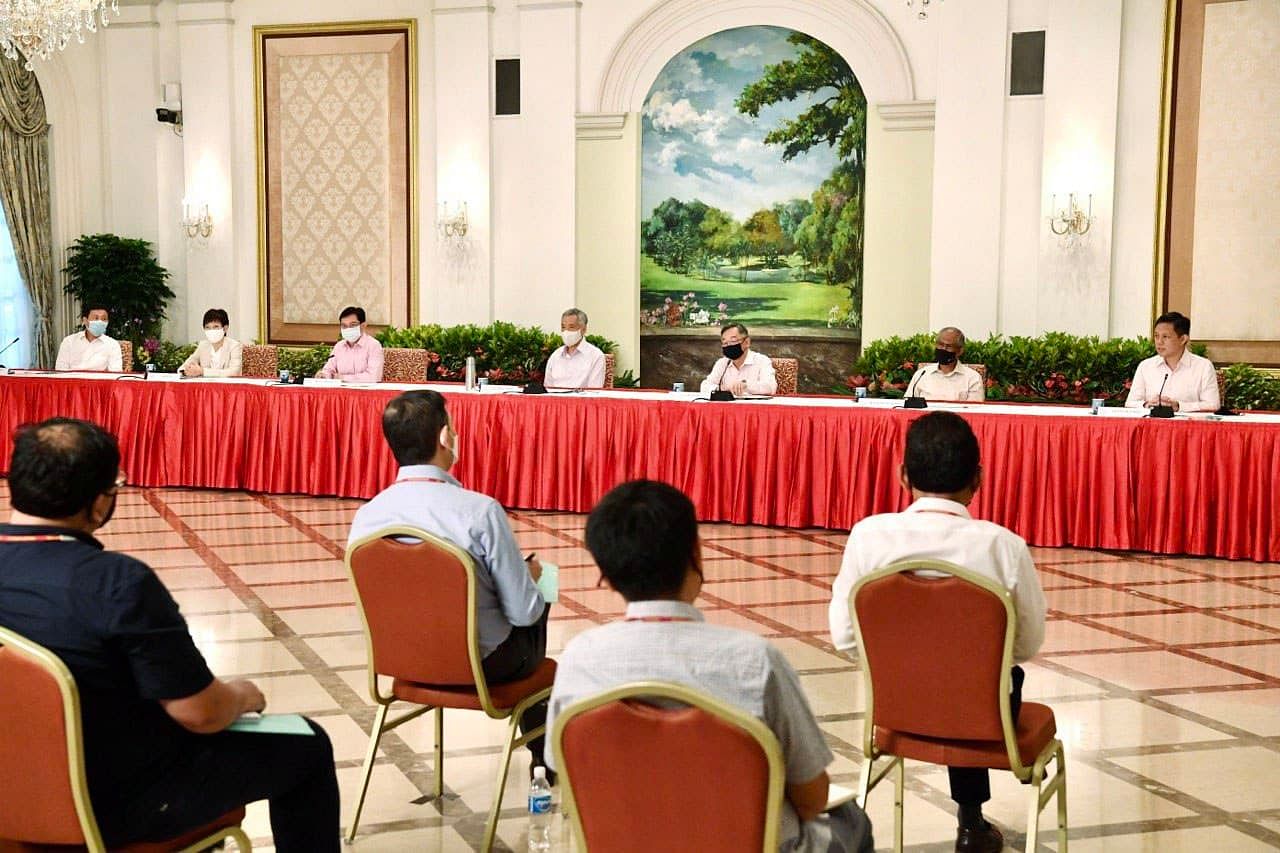
Prime Minister Lee Hsien Loong, Deputy Prime Minister Heng Swee Keat and 4G ministers at a press conference at the Istana on April 8, 2021.ST PHOTO: DESMOND FOO

Mr Ong later helmed the full education portfolio. Now Transport Minister, he is concurrently a board member of the Monetary Authority of Singapore.

Prior to politics, he worked at Keppel Corporation and the National Trades Union Congress, and was chief executive of the Workforce Development Agency. He was principal private secretary to PM Lee from 2003 to 2005, and his press secretary before that.

Mr Wong, 48, is also a former principal private secretary to PM Lee. He then headed the Energy Market Authority before entering politics in 2011.

Now Minister for Education and Second Minister for Finance, he was made full minister in 2014 and has held positions in the defence; communications and information; national development; and culture, community and youth portfolios.

Mr Wong’s profile has risen due to his role in leading the Government’s pandemic response as co-chair of the multi-ministry task force on Covid-19, alongside Health Minister Gan Kim Yong.

He chairs the PAP Community Foundation and Singapore Labour Foundation, and sits on the boards of several organisations, including GIC and the Future Economy Council.

The youngest of the four is Mr Desmond Lee, who is Minister for National Development and Minister-in-Charge of Social Services Integration.

He was elected MP for Jurong GRC in 2011, and in 2017 was appointed Minister in the Prime Minister’s Office, Minister for Social and Family Development, and Second Minister for National Development.

He moved to West Coast GRC for the 2020 general election.

Mr Lee co-chairs the Singapore Together movement that encourages people to partner the Government, as well as the Emerging Stronger task force charting the Republic’s post-pandemic economic recovery.

Before politics, Mr Lee, who is the son of former Cabinet minister Lee Yock Suan, served as a deputy public prosecutor and state counsel in the criminal justice division of the Attorney General’s Chambers. He also previously headed the Ministry of Health’s legal department and was Temasek’s in-house counsel.

Virus variants spreading rapidly in Japan’s Kansai region #SootinClaimon.Com

#SootinClaimon.Com : ขอบคุณแหล่งข้อมูล : หนังสือพิมพ์ The Nation.

https://www.nationthailand.com/ann/30404700

Virus variants spreading rapidly in Japan’s Kansai region

Apr 09. 2021Tsutenkaku Tower is lit up in red in Osaka City on Wednesday after the Osaka prefectural government signaled a “red light,” the emergency level under its own coronavirus warning system. (The Yomiuri Shimbun)Tsutenkaku Tower is lit up in red in Osaka City on Wednesday after the Osaka prefectural government signaled a “red light,” the emergency level under its own coronavirus warning system. (The Yomiuri Shimbun)

By The Japan News/ANN

Novel coronavirus variants are responsible for a growing number of infections in Osaka and Hyogo prefectures, and have spread to neighboring areas as well, an advisory body of the health ministry has warned.

The advisory body to the Health, Labor and Welfare Ministry said Wednesday that infections with the novel coronavirus have spread rapidly in Osaka and Hyogo prefectures, forcing their medical systems into a serious situation. Emergency-level priority measures have been put into effect in the two prefectures.

The advisory body further reported that new types of variants have been on the rise in Tokyo, Miyagi and other areas as well. It called for the public to take caution to prevent the spread of such variants, which are thought to be highly contagious.

According to the health ministry and other sources, as of Monday, Osaka Prefecture had seen 44 new infections per 100,000 people in the past seven days, while Miyagi Prefecture had seen 36 new infections per 100,000 people. This put both prefectures in Stage 4, the most serious level on the nation’s alert scale, as their figures exceeded the threshold of 25 or more infections per 100,000 people.

Kyoto, Nara and Wakayama prefectures also saw their infection numbers rise significantly. In Tokyo, infections increased among young people, raising concerns about a continued rapid spread.

The occupancy rate of hospital beds likewise climbed, with filled beds for seriously ill patients in Hyogo Prefecture reaching 63% of the assumed peak level. The benchmark for Stage 4 is 50% or more.

The increase in the number of variants has contributed to the spread of infections in the Kansai region.