S. Korea to temporarily lift import duties on corn to stabilize prices #SootinClaimon.Com

#SootinClaimon.Com : ขอบคุณแหล่งข้อมูล : หนังสือพิมพ์ The Nation.

https://www.nationthailand.com/ann/30404610

S. Korea to temporarily lift import duties on corn to stabilize prices

Apr 07. 2021This file photo, taken March 18, 2021, shows a citizen looking at vegetables at a discount mart in central Seoul amid a sharp gain in prices of farm products. (Yonhap)This file photo, taken March 18, 2021, shows a citizen looking at vegetables at a discount mart in central Seoul amid a sharp gain in prices of farm products. (Yonhap)

By The Korea Herald/ANN

South Korea plans to temporarily remove tariffs on imported corn in an effort to help ease upward pressure on inflation, the finance minister said Wednesday.

The country plans to import edible corn and some grains without tariffs until the end of this year under the quota tariff system, according to Finance Minister Hong Nam-ki. Currently, duties of 3 percent are levied on imported corn.

“There is a limited chance that annual inflation will exceed (the central bank’s target of) 2 percent, but consumer price growth is expected to temporarily pick up in the second quarter,” Hong said at a meeting on the economy.

Hong said the government will additionally import eggs and release reserves of napa cabbage in a bid to help stabilize prices of agricultural and livestock products.

The country’s consumer prices rose 1.5 percent on-year in March, the fastest gain in 14 months, on higher prices of farm and oil products.

The country’s inflation remained subdued last year due to the fallout of the COVID-19 pandemic.

But consumer prices are under upward pressure as the Korean economy is on a recovery track, and food and oil prices have recently advanced.

Last month, prices of agricultural, livestock and fisheries products advanced 13.7 percent on-year due to a supply shortage and the outbreak of bird flu. Prices of petroleum products rose 1.3 percent on-year as oil prices picked up. (Yonhap)

Indonesian fishermen on alert over China’s coast guard law #SootinClaimon.Com

#SootinClaimon.Com : ขอบคุณแหล่งข้อมูล : หนังสือพิมพ์ The Nation.

https://www.nationthailand.com/ann/30404609

Indonesian fishermen on alert over China’s coast guard law

Apr 07. 2021A fisherman stands on his boat on Great Natuna Island, Indonesia, on March 22. (The Yomiuri Shimbun)
A fisherman stands on his boat on Great Natuna Island, Indonesia, on March 22. (The Yomiuri Shimbun)

By Takeyuki Hitokoto
The Japan News/ANN

GREAT NATUNA ISLAND, Indonesia — At the southern tip of the South China Sea on Indonesia’s Natuna Islands, there is a growing sense of alarm over China’s claim to maritime rights in the seas surrounding the isles.

In February, Beijing enforced a law that allows the China Coast Guard to use weapons, prompting concerns among local fishermen over whether they will be able to continue operating safely in the area.

“Intimidation by Chinese vessels in the area occurs repeatedly. The danger is growing, but we need to fish for our families,” said the 34-year-old skipper of a long line-fishing boat on Great Natuna Island, the largest isle in the Natuna chain.

The area is a rich fishing ground for swordfish and octopus, and is also believed to have natural gas reserves.

Locals say Chinese vessels accompanied by China Coast Guard ships have been operating with impunity and have even rammed the wooden boats of local fishermen.

“When we see a [Chinese] Coast Guard vessel, we have no choice but to flee. How can a country so far away act as if it owns the area?” the skipper said.

The Natuna Islands are located about 1,800 kilometers south of China’s mainland. In an area about 600 kilometers off China’s mainland, Chinese and Vietnamese fishing boats have been involved in several skirmishes, but the Natuna Islands are even further away.

The waters surrounding the archipelago are within the so-called “nine-dash line,” a unilaterally drawn territorial demarcation China uses to show its claims in the South China Sea. In January last year, about 50 Chinese fishing boats operated inside Indonesia’s exclusive economic zone (EEZ) near the islands.

In response to the situation, Indonesian President Joko Widodo ordered the defense ministry to conduct patrols with warships and fighter jets. The Indonesian government sent a letter to the United Nations in May stating that China’s nine-dash line lacks a basis in international laws.

With the enforcement of the coast guard law, threats from China will inevitably increase further.

The wreckage of a Chinese fishing boat that was captured and blown up by the Indonesian government in 2016 remains in a harbor on Great Natuna Island. According to local sources, there are plans to preserve wreckage and it is likely to become a symbol of resistance against China.

The Natuna archipelago has a total population of about 80,000 people and is dotted with fishing villages. Last year, part of the archipelago was used by the Indonesian government as a temporary quarantine site for Indonesian nationals who had returned from Wuhan, China, aboard chartered planes.

Japan has provided economic assistance for the construction of piers where large fishing vessels can dock, refrigeration facilities and a market. The economic assistance totals ¥830 million, according to the Indonesian government, and the aim is to establish a fisheries zone free of Chinese influence.

Japanese and Indonesian foreign and defense ministers also agreed to promote developments in remote islands at a meeting in Tokyo on March 30.

“In the future, we would like to start market auctions like those in Japan,” said the head of a fishing port on Great Natuna Island.

G20 likely to extend debt moratorium for poorest: World Bank chief #SootinClaimon.Com

#SootinClaimon.Com : ขอบคุณแหล่งข้อมูล : หนังสือพิมพ์ The Nation.

https://www.nationthailand.com/ann/30404608

G20 likely to extend debt moratorium for poorest: World Bank chief

Apr 07. 2021File photo taken on Nov 19, 2020 shows the media center of the Group of 20 (G20) in Riyadh, Saudi Arabia. [Photo/Xinhua] File photo taken on Nov 19, 2020 shows the media center of the Group of 20 (G20) in Riyadh, Saudi Arabia. [Photo/Xinhua]
By China Daily/ANN

WASHINGTON – World Bank President David Malpass said Monday he expects G20 countries this week to extend debt payment moratorium for the poorest countries until the end of the year.

G20 finance ministers are due to meet virtually on Wednesday on the sidelines of Spring meetings of the International Monetary Fund and World Bank.

Malpass, who had called for a one-year extension of the Debt Service Suspension Initiative (DSSI), told reporters it looks like the G20 will agree to continue the agreement “through the end of calendar 2021.”

However, that will include “very clear guidance from the G20 that that is likely to be the last or the final extension.”

The program was first implemented last year amid the Covid-19 pandemic, which hit poor countries the hardest, as business and trade shutdowns made it hard for those governments to service their debt and support their people.

The G20 in October agreed to a six-month extension, until June 30.

However, Malpass said poor countries will need actual debt relief in the longer term since even with the temporary moratorium on debt payments, the overall burden in many cases is unsustainable.

Meanwhile, the IMF on Monday approved a third round of debt relief for 28 of the world’s poorest countries amounting to $238 million.

The relief approved under the Catastrophe Containment and Relief Trust (CCRT) “will continue to help free up scarce financial resources for vital emergency health, social, and economic support to mitigate the impact of the COVID-19 pandemic,” the IMF said in a statement.

The current round of debt service relief extends through October 15, but the IMF said it could provide another round through April 13, 2022 amounting to a total of about $964 million.

IMF chief Kristalina Georgieva announced the CCRT fund in March 2020, seeking to raise $1.4 billion, of which there have been commitments for $774 million.

The countries that will receive debt service relief are: Afghanistan, Benin, Burkina Faso, Burundi, Central African Republic, Chad, Comoros, Congo, D.R., Djibouti, Ethiopia, The Gambia, Guinea, Guinea-Bissau, Haiti, Liberia, Madagascar, Malawi, Mali, Mozambique, Nepal, Niger, Rwanda, So Tom and Prncipe, Sierra Leone, Solomon Islands, Tajikistan, Togo, and Yemen.

Myanmar navy to conduct exercise from April 4 to 11 #SootinClaimon.Com

#SootinClaimon.Com : ขอบคุณแหล่งข้อมูล : หนังสือพิมพ์ The Nation.

https://www.nationthailand.com/ann/30404575

Myanmar navy to conduct exercise from April 4 to 11

Apr 06. 2021

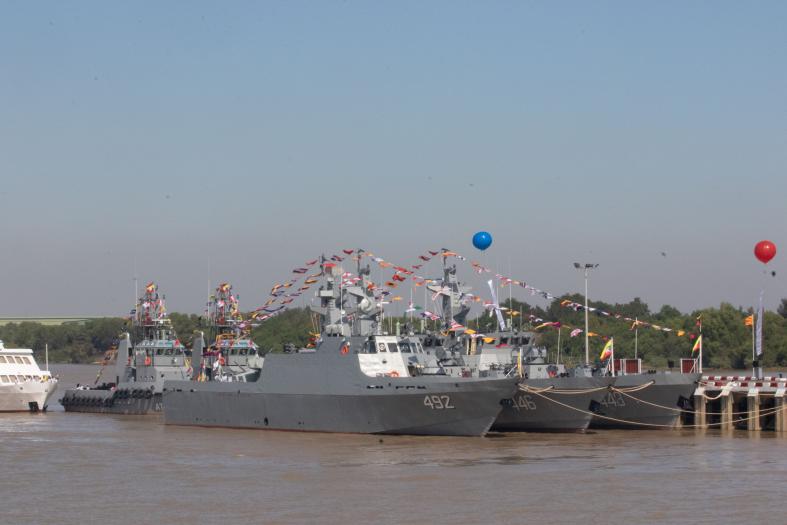
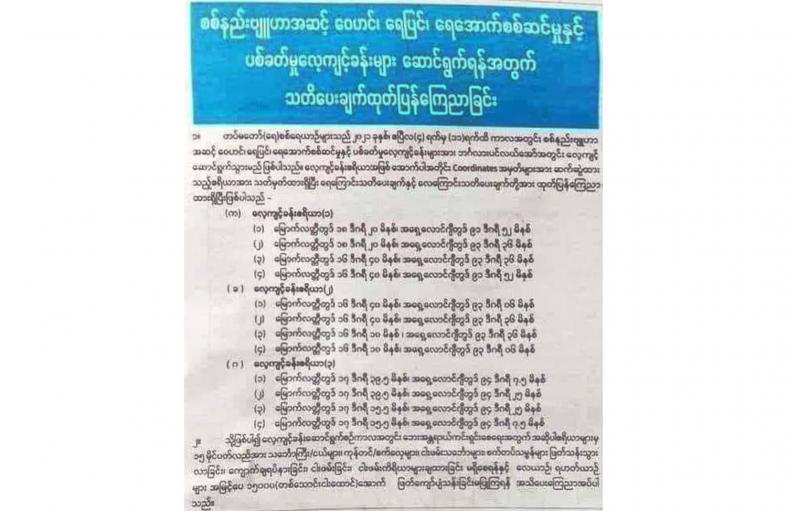
By Eleven/ANNAccording to an announcement, the Tatmadaw (military) will be conducting aerial, on-water and underwater exercises in the Bay of Bengal from April 4 to 11.

It says that coordinates have been announced prior to the exercise for both naval and air, with 3 sections of areas to conduct exercises.

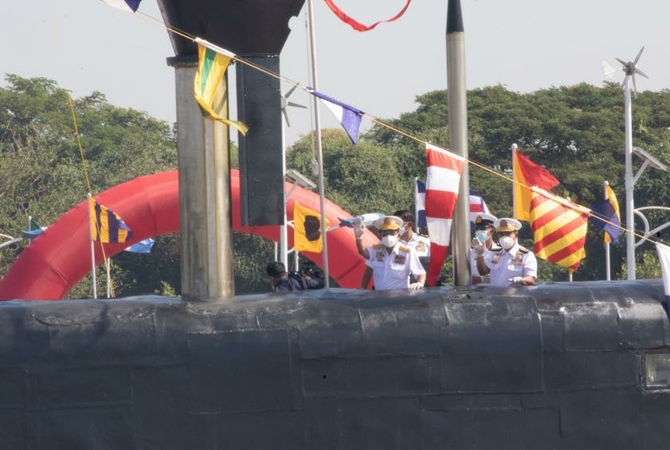
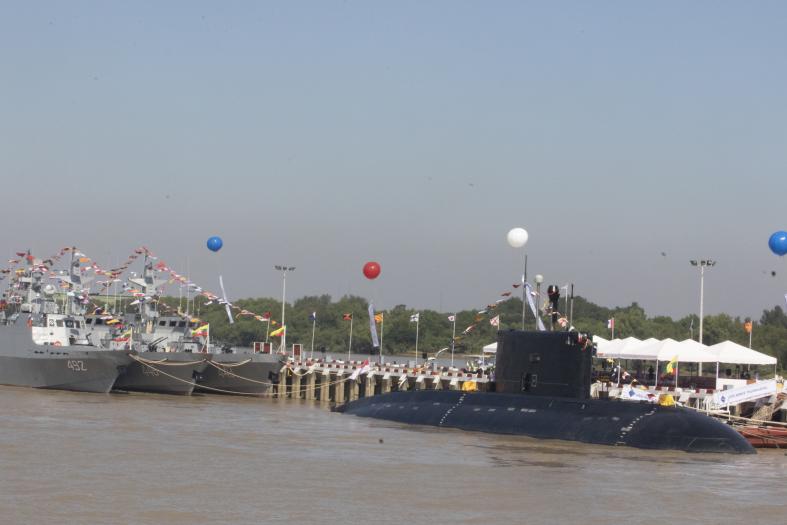
Navy vessels, including the submarine “Min Ye Theikha Thu” seen on the ceremony to officially bring in the vessels on December 24,2020.

The 15 miles area surrounding the exercise-zone is also off-limits to all from both sea and air.

The Times of India has reported in March that the Quad’s “La Pérouse” exercise will also occurr from April 4 until April 7. 

Navy vessels seen on the ceremony to officially bring in the vessels on December 24,2020.

It also reported that the Indian navy will also be conducting regular exercises as part of the Quad and other alliances and its strategic partners.

La Pérouse will include the Quad’s representative navies as well as the French navy.

Rethinking conservation and environmental protection in the Himalayas #SootinClaimon.Com

#SootinClaimon.Com : ขอบคุณแหล่งข้อมูล : หนังสือพิมพ์ The Nation.

https://www.nationthailand.com/ann/30404573

Rethinking conservation and environmental protection in the Himalayas

Apr 06. 2021HimalayasHimalayas

By Kuensel/ANN

Bhutan earned an environmental champion title due to the visionary leadership and strong conservation laws and policies. But the vagaries of global weather and changing climate have had some serious impact on the country’s conservation efforts. Poaching, invasive species, and climate change are some of the emerging issues that are growing at an alarming rate.

So, what is Bhutan’s new conservation narrative in the context of changing socioeconomic settings?

The book assesses conservation priorities for Bhutan and provides sensible solutions. It looks into the country’s conservation laws and policies. At a time when the country needs a radical shift in its development priorities, the book may shed some light on the realities facing the country today.

If the many departments and bureaucrats read and listen, and see for themselves, it may be an opportunity to make necessary changes in the way we look at conservation and its challenges. The book has nine chapters and identifies challenges with policy recommendations.

Bhutan may be a carbon negative country today but it faces serious threats of climate change with a temperature rise of 1.3°C over the last two decades, which is nearing the threshold level of 2°C rise above the preindustrial levels. Threats from increased temperature like glacial lake outburst floods are ever-present, which poses “…uniquely perilous challenges in keeping with its conservation commitments because of its relatively low adaptive capacity and being one of the least “developed” countries in the world.”

The book calls for climate change policy or a climate white paper, which can provide a prudent and holistic approach to tackle climate change impacts in the country.

A major attempt to assess taxonomic bias and the need to include research and studies on other kingdoms, besides plants and animals, for example, is insightful. For that, the book suggests embedding research and policy recommendations to conserve the underrepresented or lesser-known species within Bhutanese conservation strategies.

Among other vital issues, the book talks about human-wildlife conflict, safety approaches and strategies, and innovative approach using immunocontraceptive vaccines (antifertility vaccine) for the population control of street dogs and wild animals for peaceful coexistence between humans and wildlife.

The country needs a human-wildlife conflict policy, the book says, which encompasses preventive and mitigation measures.

The publication is an important addition to environmental research by a local writer, who has worked in the executive and various roles in conservation agencies. The book is aimed at researchers and policymakers. Other readers will find it illuminating and useful too.

Saudi FM on Israel #SootinClaimon.Com

#SootinClaimon.Com : ขอบคุณแหล่งข้อมูล : หนังสือพิมพ์ The Nation.

https://www.nationthailand.com/ann/30404572

Saudi FM on Israel

Apr 06. 2021

By Dawn/ANN

WHEN a number of Arab countries — led by the UAE — established ties with Israel last year under the so-called Abraham Accords, the million-dollar question was (and remains) when Riyadh would establish links with Tel Aviv.

There has been speculation in the media regarding secret meetings, with one report saying that Israeli Prime Minister Benjamin Netanyahu met Saudi Crown Prince Mohammed bin Salman in the northern Saudi region of Neom last November. Riyadh flatly denied the meeting took place, though Saudi officials, including the all-powerful crown prince, have softened their tone towards the Jewish state. In the latest indication that attitudes are changing, Saudi Foreign Minister Prince Faisal bin Farhan recently told CNN that normalisation with Israel would bring “tremendous benefit to the region”. In the same breath he added that Saudi-Israel ties depended on the establishment of a Palestinian state — Riyadh’s standard line.

Clearly, efforts are afoot to establish ties, yet the ‘thorny’ question of Palestine and its people stands in the way. The fact is that there are quite a few common denominators between Saudi Arabia and Israel. Primarily, they are both members of the US-led geopolitical bloc, while both states share great animus towards Iran — a feeling reciprocated by the Islamic Republic. However, while it was relatively easy for the UAE and Bahrain to make public their ties with Israel, Saudi Arabia faces a tougher challenge, as it hosts Islam’s holiest sites. Therefore, if it openly courts Israel, it will be seen as ‘betraying’ the Palestine cause.

The fact is that the Arab states that have rushed to establish ties with Israel had already ditched Palestine. The peace process is practically dead while the two-state solution is in intensive care, repeatedly battered by a rapacious and unforgiving Israeli establishment that is unwilling to see a viable Palestinian state, non-starters like Donald Trump’s ‘deal of the century’ notwithstanding. In such a scenario, any Muslim state that establishes relations with Israel has pretty much abandoned Palestine.

ASEAN summit on Myanmar to be held in Jakarta: Brunei and Malaysia #SootinClaimon.Com

#SootinClaimon.Com : ขอบคุณแหล่งข้อมูล : หนังสือพิมพ์ The Nation.

https://www.nationthailand.com/ann/30404571

ASEAN summit on Myanmar to be held in Jakarta: Brunei and Malaysia

Apr 06. 2021Brunei's Sultan Hassanal Bolkiah salutes during the 34th National Day celebrations in Bandar Seri Begawan, Brunei February 24, 2018. Picture taken February 24, 2018. REUTERS/Ahim Rani (Reuters/Ahim Rani) Brunei’s Sultan Hassanal Bolkiah salutes during the 34th National Day celebrations in Bandar Seri Begawan, Brunei February 24, 2018. Picture taken February 24, 2018. REUTERS/Ahim Rani (Reuters/Ahim Rani)

By The Jakarta Post/ANN

Brunei and Malaysia agreed Monday that ASEAN will hold a special summit in Jakarta to address the Myanmar situation, as harsh crackdowns on anti-coup protesters continue in the member country.

Leaders of Brunei and Malaysia said the meeting will be held at the ASEAN secretariat in the capital of Indonesia in their joint statement, without mentioning when the meeting will take place.

Sultan Hassanal Bolkiah of Brunei, which currently serves as chair of the 10-member Association of Southeast Asian Nations, and Malaysian Prime Minister Muhyiddin Yassin voiced concerns over Myanmar in the joint statement released after their meeting in Bandar Seri Begawan on Monday, Kyodo News reported Monday.

The two leaders expressed “serious concern on the ongoing crisis in Myanmar and the rising number of fatalities” and urged all parties to exercise restraint and seek a peaceful solution, according to the statement.

In the statement, however, the leaders did not mention the Myanmar military that seized power in a Feb. 1 coup and has resorted to deadly force against peaceful protesters.

The ASEAN meeting was first proposed by Indonesian President Joko Widodo in March, as the country has led efforts within ASEAN to seek a peaceful solution to the Myanmar crisis.

Muhyiddin visited Sultan Hassanal Bolkiah in Brunei in the two neighboring countries’ annual meeting where they also discussed strengthening economic and social cooperation.

Since the Myanmar military ousted democratically-elected leader Aung San Suu Kyi’s government in the coup, over 500 people have been killed, according to a rights group monitoring the violence in the country.

ASEAN is the Association of Southeast Asian Nations, grouping Brunei, Cambodia, Indonesia, Laos, Malaysia, Myanmar, the Philippines, Singapore, Thailand and Vietnam.

Reuters meanwhile reported that in a joint statement with Malaysia, Brunei said both countries have asked their ministers and senior officials to undertake “necessary preparations for the meeting that will be held at the ASEAN Secretariat in Jakarta, Indonesia.”

The statement followed a meeting between Malaysian Prime Minister Muhyiddin Yassin and Brunei Sultan Hassanal Bolkiah on Monday.

“Both leaders agreed for ASEAN leaders to meet to discuss the ongoing developments in Myanmar,” they said.

They did not say when the meeting would be held.

Ikee caps stunning comeback with victory in 100 fly, ticket to Tokyo Games #SootinClaimon.Com

#SootinClaimon.Com : ขอบคุณแหล่งข้อมูล : หนังสือพิมพ์ The Nation.

https://www.nationthailand.com/ann/30404549

Ikee caps stunning comeback with victory in 100 fly, ticket to Tokyo Games

Apr 05. 2021Rikako Ikee breaks down in tears during a post-race interview after winning the women’s 100-meter butterfly on Sunday. (The Yomiuri Shimbun)
Rikako Ikee breaks down in tears during a post-race interview after winning the women’s 100-meter butterfly on Sunday. (The Yomiuri Shimbun)

By The Japan News/ANN

Rikako Ikee, who returned to competition only last summer after undergoing treatment for leukemia, earned an unexpected ticket to the Tokyo Olympics when she won the women’s 100-meter butterfly at the Japan swimming championships in Tokyo on Sunday.

Ikee clocked 57.77 seconds in the final at the Tokyo Aquatics Centre, the venue for the Tokyo Olympics, and she will return there this summer after surpassing the Olympic qualifying standard of 57.92 set by the Japan Swimming Federation to secure a place on the 4×100 medley relay team.

It was a result that even she had never considered attainable since being diagnosed with leukemia in 2019.

“Regardless of what place I took, I came with the thought of being just happy to be here,” Ikee said in a tearful post-race interview. “I thought a victory was still far off in the future, but I trained for the purpose of winning, and my efforts paid off.”

Ikee, the national record-holder in the 100 butterfly of 56.08, won three consecutive national titles in the event up to 2018. Her time on Sunday was 1.67 seconds better than the one posted in the first final of her comeback at the Tokyo Open on Feb. 20. 

LG Electronics exits from loss-making mobile biz #SootinClaimon.Com

#SootinClaimon.Com : ขอบคุณแหล่งข้อมูล : หนังสือพิมพ์ The Nation.

https://www.nationthailand.com/ann/30404536

LG Electronics exits from loss-making mobile biz

Apr 05. 2021This composite image from Yonhap News TV shows an office building of LG Electronics Inc. and its rollable smartphone. (Yonhap)This composite image from Yonhap News TV shows an office building of LG Electronics Inc. and its rollable smartphone. (Yonhap)

By The Korea Herald/ANN

LG Electronics Inc. said Monday it will withdraw from the mobile business after years of money-losing performance amid intensifying competition with bigger rivals.

The South Korean tech powerhouse said in a regulatory filing that its mobile communications (MC) unit will no longer produce and sell handsets after July 31, citing its long slump and fierce competition in the industry.

The decision came two months after the company said its MC division is open to “all possibilities” for its future operations.

LG’s mobile business has been in the red since the second quarter of 2015. Its accumulated operating losses reached 5 trillion won ($4.4 billion) last year.

LG, once the world’s third-largest handset maker, reportedly had talks with Vingroup of Vietnam and Volkswagen of Germany to sell the mobile business, but the talks fell through, according to industry insiders.

LG said its exit from the mobile business will lead to a decline in revenue for the company in the short term but will eventually improve its financial status and management efficiency in the longer period.

Analysts said that LG’s operating profit could go up by 1 trillion won this year if it withdraws from the loss-making mobile business.

LG has been striving to make a turnaround in its mobile business in recent years, shifting its smartphone production base to Vietnam while expanding outsourcing deals.

To boost its premium smartphone sales, LG last year launched the Explorer Project, its new mobile category highlighted by a different form factor.

Under the project, the company released the Wing, a dual-screen smartphone with a rotating form factor, but its sales were apparently disappointing.

This year, LG was scheduled to launch a smartphone with a rollable OLED display after it teased the product at the Consumer Electronics Show (CES) 2021. However, the company reportedly scrapped the plan.

Analysts said LG’s efforts were not enough to turn the table as the company was overshadowed by Samsung Electronics Co. and Apple Inc. in the premium segment, while Chinese brands dominated the budget phone sector.

“Its strategic smartphone models like the Velvet and the Wing performed poorly and with the 5G momentum passing its peak, the company has lost ground in the premium smartphone market with little cards left to play,” said Koh Jung-woo, an analyst at NH Investment & Securities.

“Its rollable smartphone brought attention at CES and is enough to boost its technology prowess, but it is not likely to lead to meaningful sales.”

According to market researcher Counterpoint Research, LG was the world’s ninth-largest smartphone vendor with a market share of 2 percent after shipping 24.7 million smartphones last year, down 13 percent from a year earlier. (Yonhap)

China in mind as Japan government plans large-scale deployment of F-35B fighters #SootinClaimon.Com

#SootinClaimon.Com : ขอบคุณแหล่งข้อมูล : หนังสือพิมพ์ The Nation.

https://www.nationthailand.com/ann/30404535

China in mind as Japan government plans large-scale deployment of F-35B fighters

Apr 05. 2021

An F-35B fighter is seen in Iwakuni, Yamaguchi Prefecture. (Yomiuri Shimbun file photo)

By The Japan News/ANN

The government plans to deploy F-35B stealth fighters at the Air Self-Defense Force’s Nyutabaru Base in Shintomi, Miyazaki Prefecture, according to sources, in the first-ever stationing of the fighters at an ASDF base.

Arrangements will be made with local governments around the base, with the aim of starting operations in 2024. The government hopes to strengthen its deterrent capability against China, with a plan to operate the F-35Bs together with the Maritime Self-Defense Force’s Kaga destroyer, which is scheduled to be upgraded to an aircraft carrier, according to the sources.

The cutting-edge F-35B fighter can take off over a short distance and make vertical landings. Even in remote islands where there are no SDF bases, the fighters can be deployed flexibly by making use of civilian airports.

A source close to the Defense Ministry said that as China continues to build up its military strength, the government has positioned the F-35B as a “decisive measure for the defense of remote islands.”

For the operation of the F-35Bs, the government is envisioning situations that include: training using the Kaga destroyer, which is based at the MSDF’s Kure Base in Kure, Hiroshima Prefecture; joint training with other F-35Bs deployed at the U.S. Marine Corps Air Station Iwakuni in Iwakuni, Yamaguchi Prefecture; and takeoff and landing training at an SDF base to be built on Mageshima island in Nishinoomote, Kagoshima Prefecture.

The Nyutabaru Base is located close to these bases and was judged to be the most suitable for deplying the F-35Bs.

The procurement cost is about ¥13 billion per aircraft. The government hopes to introduce 18 F-35Bs by fiscal 2023, with the overall goal of deploying 42, according to its Medium Term Defense Program.

The first step is to deploy 18 such fighters at the Nyutabaru Base to form a squadron. The remaining deployment sites will be considered in the future.

Closing the gap in air power with China is the motivation for the large-scale introduction of F-35Bs. Regarding the latest fourth- and fifth-generation fighter jets, Japan has 309 such fighters, far behind China’s 1080 aircraft. China is making progress in deploying aircraft such as fifth-generation J-20 Chengdu stealth fighters, and Japan hopes to counter with the F-35Bs, which are also fifth-generation.

The government is planning to upgrade the Kaga’s deck to make it more heat-resistant, so that the F-35Bs can take off and land on it, and is considering carrying about 10 of the aircraft. Deploying fighter jets at a land base would make them an easy target for China’s medium-range missiles, so the fighters are to use a mobile naval vessel as a base in case of contingencies, thereby reducing the risk of being attacked.