Seoul eyes bolstering ties with new Biden administration #SootinClaimon.Com

#SootinClaimon.Com : ขอบคุณแหล่งข้อมูล : หนังสือพิมพ์ The Nation.

Seoul eyes bolstering ties with new Biden administration

Nov 09. 2020


President-elect Joe Biden gestures to the crowd after he delivered remarks in Wilmington, Delaware, on Saturday. (AFP-Yonhap)

President-elect Joe Biden gestures to the crowd after he delivered remarks in Wilmington, Delaware, on Saturday. (AFP-Yonhap)

By Ahn Sung-mi
The Korea Herald/ANN

With Democrat Joe Biden’s victory in the US presidential race, South Korea will seek to forge ties with the new administration to further bolster the alliance and make progress toward peace on the Korean Peninsula.

South Korean President Moon Jae-in on Sunday sent a congratulatory message to US President-elect Biden and Vice President-elect Kamala Harris, hours after major media outlets in the US announced Biden’s win over incumbent President Donald Trump.

“Congratulations to @JoeBiden and @KamalaHarris. Our alliance is strong and the bond between our two countries is rock-solid,” Moon wrote via Twitter. “I very much look forward to working with you for our shared values. I have great expectations of advancing and opening up the future development of our bilateral relations,” he said, ending the message with “Katchi Kapshida!” — the catchphrase of the Korea-US alliance, meaning “We go together.”

While Trump had not delivered a customary concession speech as of press time, and it is unsure if he will accept defeat any time soon, Seoul officials are expected to start building rapport behind-the-scenes with officials and experts connected to Biden’s aides and inner circle, to develop channels into an incoming Biden administration.

South Korean Foreign Minister Kang Kyung-wha left to Washington on Sunday to meet with her US counterpart, Secretary of State Mike Pompeo.

“Though it’s a somewhat sensitive period, South Korea and the US have always been communicating, and we, at a ministerial level, discuss the Korean Peninsula situation and pending issues whenever there are opportunities, regardless of the timing,” Kang told reporters at Incheon Airport as she was departing to Washington.

She added that she is planning to meet people working in the US Congress and in academia to create opportunities to further strengthen the Korea-US alliance.

When asked whether she was meeting Biden’s aides during the trip, she declined to provide details, but added she may have to assess the situation while there.

“The Foreign Ministry has been communicating directly and indirectly with key figures in the Biden camp and the Democratic Party,” the ministry said in a statement after Biden’s victory was announced. “Based on the network that we have so far established and through close communication and cooperation, we will continue our efforts to strengthen the Korea-US alliance and make progress in the process for peace on the Korean Peninsula.”

A small group of South Korean lawmakers, led by Song Young-gil, chairman of the parliamentary Foreign Affairs and Unification Committee, is planning to visit Washington next week. During their trip, the lawmakers are expected to meet US congressmen and experts from think tanks that have links to Biden.

The White House in Biden’s presidency would mean a significant shift from the four years under Trump, in regards to critical issues affecting Seoul. Biden is expected to restore and strengthen the alliance with South Korea, while opting for a “step-by-step” approach and push for tighter sanctions on Pyongyang, experts say.

“Biden’s key pledge was to restore multilateralism and improve relationships with traditional allies, including South Korea. This means the alliance relations will likely improve and pending issues like defense cost-sharing talks could be resolved soon,” Park Won-gon, a professor of international politics at Handong Global University, told The Korea Herald. “Biden will also demand an increase on Seoul’s part on cost-sharing, but the difference with Trump is that the amount would be more logical and at a level Seoul could accept.”

Harry Kazianis, the senior director of Korean Studies at a Washington-based think tank Center for the National Interest, echoed a similar view of the ongoing talks on renewal of the Special Measures Agreement, the pact that governs the upkeep of the roughly 28,500 strong US Forces Korea.

“A Biden administration would quickly try to conclude an SMA with Seoul and very quickly — something that should be done in the first one-hundred days of taking office — with Biden also having no issue with handing over OPCON by 2022,” Kazianis wrote on his Twitter.

“The good news is that Biden and his advisers see alliances not in terms of dollars and cents but how they knit important nations to Washington in an international system that has kept the peace broadly between the world’s most powerful nations since the end of World War II,” he said, stressing it is these alliances, according to Biden, that “are what make America a superpower and are Washington’s greatest strength.”

But an enhanced alliance would mean more pressure on Seoul to side with its longtime security ally Washington to counter China, Seoul’s top trading partner.

“Biden said he would work closely with liberal democratic allies to keep China in check,” said Park. “That would mean Seoul’s space to choose between Beijing and Washington could diminish.”

As for dealing with North Korea, Biden will differ greatly from the top-down approach, as President Trump met North Korean leader Kim Jong-un three times during his tenure.

“A Biden administration is more likely to pursue working-level talks with Pyongyang rather than summits and big deals,” said Leif-Eric Easley, a professor at Ewha Womans University in Seoul.

During his campaign, Biden had said he would only meet North’s Kim on the condition that Pyongyang agrees to reduce the country’s nuclear capability. Many observers view that Biden will take a systematic and more traditional approach to deals with North Korea, with tighter sanctions and a focus on coordinated efforts with allies to press Pyongyang to give up its nuclear arsenal.

But this also raises concern for a possible clash with South Korean President Moon Jae-in’s push for summit diplomacy and engagement efforts with Pyongyang.

In the meantime, Pyongyang could provoke with military actions as a way to gain the upper hand in dealing with the new Biden administration, and not wait for Washington’s months of policy review to come up with a strategy on Pyongyang.

“The US and its allies need to coordinate responses to North Korea’s upgraded long-range and submarine-based missiles because Pyongyang’s next move may be to conduct a provocative test as a ‘welcome gift’ to Biden before demanding financial benefits to reduce military tensions,” said Easley.

Alibaba revenue up 30% in Q2 of 2021 fiscal year #SootinClaimon.Com

#SootinClaimon.Com : ขอบคุณแหล่งข้อมูล : หนังสือพิมพ์ The Nation.

Alibaba revenue up 30% in Q2 of 2021 fiscal year

Nov 07. 2020The logo of Alibaba Group is seen at the company's headquarters in Hangzhou, Zhejiang province, July 20, 2018. [Photo/Agencies]The logo of Alibaba Group is seen at the company’s headquarters in Hangzhou, Zhejiang province, July 20, 2018. [Photo/Agencies] 

By China Daily/ANN

HANGZHOU – Chinese e-commerce giant Alibaba said that its revenue surged 30 percent year-on-year to 155 billion yuan ($23 billion) in the second quarter of its 2021 fiscal year.

Revenue from core commerce increased 29 percent year-on-year to 130.9 billion yuan, and revenue from its China commerce retail was up 26 percent to nearly 95.5 billion yuan. Meanwhile, that from cloud computing was nearly 14.9 billion yuan, an increase of 60 percent compared to the same period of the last fiscal year.

According to the company, there were 757 million annual active consumers in its China retail marketplaces, an increase of 15 million from the 12-month period ending on June 30, 2020.

“We remain focused on our three long-term growth engines — domestic consumption, cloud computing and data intelligence, and globalization — to effectively capture opportunities from the ongoing changes in consumer demand and acceleration of digitalization of businesses across our digital economy,” said Daniel Zhang, chairman and CEO of Alibaba Group.

The second quarter of its 2021 fiscal year was from July 1 to Sept 30, 2020.

[Malaysia] Economic Outlook 2021: GDP to expand 6.5%-7.5% #SootinClaimon.Com

#SootinClaimon.Com : ขอบคุณแหล่งข้อมูล : หนังสือพิมพ์ The Nation.

[Malaysia] Economic Outlook 2021: GDP to expand 6.5%-7.5%

Nov 07. 2020

By The Star/ANN

KUALA LUMPUR: The Malaysian economy is projected to rebound between 6.5% and 7.5% in 2021, supported by strong economic fundamentals and well-diversified economy.

In its Economic Report 2020, the Finance Ministry, however, said the favourable outlook hinges on two major factors – the successful containment of the Covid-19 pandemic and sustained recovery in external demand.

The country’s economy contracted by 8.3% in the first half of 2020, with a decline of 17.1% in the second quarter.

The economy is expected to contract at a slower pace in the second half of the year, aided by the speedy implementation of various stimulus packages to support the people and revitalise the economy.

“In 2020, the economy is expected to contract by 4.5%,” it said, adding that the impact of the packages is anticipated to have spill-over effects and provide an additional boost to the economy in 2021.

In 2021, the global economy is projected to recover with a growth of 5.2%. The advanced economies are forecast to rebound by 3.9%.

The government expects the services sector to rebound by 7% in 2021. With the normalisation of economic activities in 2021, all subsectors are projected to record positive growth.

The manufacturing sector, which contracted by 8.7% during the first half of 2020, is expected to rebound by 7% in 2021, driven by steady improvement in both the export and domestic-oriented industries.

The agriculture sector contracted by 3.9% in the first half of 2020 due to lower growth of oil palm and rubber subsectors following supply disruptions. The sector is anticipated to rebound by 1.4% in the second half of the year driven by the recovery in the oil palm subsector.

According to the report, the agriculture sector is expected to turnaround by 4.7% in 2021, supported mainly by higher production of palm oil and rubber.

Meanwhile, the mining sector, which tumbled 11% in the first half of 2020, is expected to rebound by 4.1% in 2021, supported by the recovery in global demand for crude oil and condensate as well as liquified natural gas.

Brent crude oil is expected to improve in 2021 to an average of US$42 per barrel and recover to pre-pandemic level in the medium term.

The construction sector contracted by 25.9% in the first half of 2020 and is expected to shrink by 11.8% in the second half of this year. Overall, for 2020, the sector is projected to contract by 18.7%.

At the same time, prolonged property overhangs continue to weigh down the performance of the sector. However, civil engineering and specialised construction activities subsectors are expected to improve gradually.

The construction sector is expected to rebound by 13.9% in 2021 on account of the acceleration and revival of major infrastructure projects, coupled with affordable housing projects. The civil engineering subsector will continue to be the main driver of the construction sector.

Among the major infrastructure projects include Mass Rapid Transit 2 (MRT2), Light Rail Transit 3 (LRT3), West Coast Expressway (WCE) and Bayan Lepas LRT as well as Pan Borneo and Coastal highways in Sarawak.

Meanwhile, private consumption is projected to record a marginal decrease of 0.7% in 2021 while public consumption is expected to expand by 2% in 2021 with the Government continuing to further improve public services delivery and optimising spending.

In 2021, gross national income (GNI) is projected to rebound by 7.8% to RM1.53 trillion, while gross national savings (GNS) by 2% to RM335bil.

Gross exports are expected to rebound by 2.7% in 2021, benefiting from the recovery in global trade and supply chains.

Gross imports are expected to turnaround by 5.3% in 2021, supported by an increase in all types of imports.

Meanwhile, the consumer price index (CPI) is expected to normalise at 2.5% in 2021 in line with better economic prospects and higher crude prices.

Total employed persons are projected at 15.1 million in 2020 and further expand to 15.3 million in 2021.

Of the 15.3 million employed, 9.7 million, or 63.3% will be recruited in the services sector, 17.4% in the manufacturing and 10.2% in the agriculture sectors.

S. Korea to maintain least strict social distancing rules next week #SootinClaimon.Com

#SootinClaimon.Com : ขอบคุณแหล่งข้อมูล : หนังสือพิมพ์ The Nation.

S. Korea to maintain least strict social distancing rules next week

Nov 07. 2020An infrared thermal camera is installed at an office in Seoul on Thursday. (Yonhap)An infrared thermal camera is installed at an office in Seoul on Thursday. (Yonhap) 
By Ock Hyun-ju
The Korea Herald/ANN

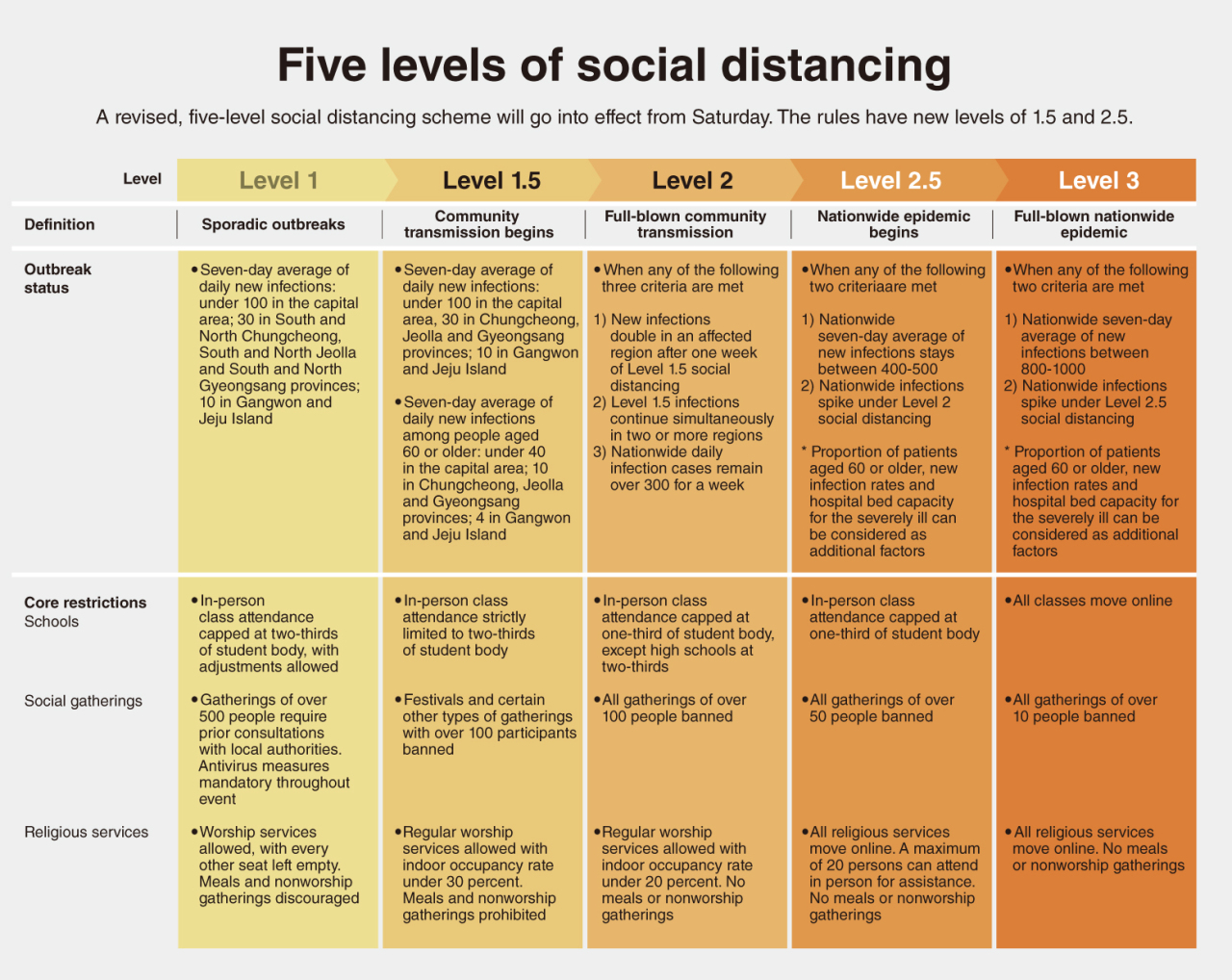
South Korea will maintain the lowest level of social distancing rules across the country as the daily average of new cases from the previous week remained below 100, health authorities said Friday, with the new five-tier social distancing system to take effect starting Saturday.

Korea reported 145 new coronavirus cases – 117 locally transmitted and 28 imported from overseas — in the 24 hours ending Thursday at midnight, according to the Korea Disease Control and Prevention Agency.

“We will maintain the Level 1 social distancing rules nationwide under the new social distancing system. But in regions with many COVID-19 cases linked to clusters of infections, municipalities can adjust the social distancing level after consulting the central disease control headquarters,” said Sohn Young-are, a senior official from the Central Disease Control Headquarters.

Exceptions are Cheonan and Asan in South Chungcheong Province that raised the level of social distancing to Level 1.5 on Thursday due to a recent flare-up in virus cases linked to a call center.

The decision came as the average number of new coronavirus cases for the past week stood at 92.1, he said.

Starting Saturday, the government will analyze the virus situation every week and adjust the social distancing level if necessary according to the new five-tier social distancing system.

The system was introduced last Sunday to make the country’s virus response more effective and sustainable by breaking away from a nationally unified approach and tailoring anti-virus measures to circumstances of each region.

The new social distancing system breaks the current three levels into five — 1, 1.5, 2, 2.5 and 3 — based on several key indicators including the seven-day average number of infections, and divides the country into seven zones.

Municipalities in each region are allowed to decide on the level of social distancing depending on the scale of the virus transmission without being tied to the central government’s decision.

The lowest level is imposed when the daily case count remains below 100 for a week for the Seoul metropolitan area and 30 for other regions. Exceeding the bar, the levels are elevated to the Level 1.5 or further.

Under the loosest Level 1 social distancing rules, there are nearly no restrictions on size of social gatherings, business operations and school openings, though mask-wearing indoors and outdoors are mandatory.

Korea saw three-digit gains in new daily COVID-19 cases for the third consecutive day Friday due to clusters of infections that are not limited to high-risk facilities. New cases are being traced to workplaces, social gatherings, public sauna and indoor sports facilities.

A transmission route for 12.3 percent of the cases reported for the past two weeks remained unknown as of Friday, according to the KDCA.

Of Friday’s locally transmitted cases, the majority were in Greater Seoul — 38 in Seoul and 34 in Gyeonggi Province, which surrounds the capital. Twenty-five cases were reported in South Chungcheong Province, 13 cases in South Gyeongsang Province and seven in Gangwon Province.

Korea reported 28 imported cases. Among them, 17 were identified while the individuals were under mandatory self-quarantine in Korea, with the other 11 detected during the screening process at the border. Twelve cases were from the US, nine from elsewhere in Asia, four from Europe, two from Australia and one from Tunisia. Twenty-three of those cases involved foreign nationals.

The number of COVID-19 patients in serious or critical condition here was 50.

One more person has died from the virus, bringing the death toll to 476. The overall fatality rate is now 1.75 percent.

So far, of the 27,195 people confirmed to have contracted the new coronavirus here, 24,821 have been released from quarantine upon making a full recovery, up 86 from a day earlier. Some 1,898 people are receiving medical treatment under quarantine. 

The country carried out 12,608 tests in the past day. A total of 25,629 people were awaiting results as of Monday.

SE Asia yearns to fly high again on tourism #SootinClaimon.Com

#SootinClaimon.Com : ขอบคุณแหล่งข้อมูล : หนังสือพิมพ์ The Nation.

SE Asia yearns to fly high again on tourism

Nov 07. 2020

By Zhao Ruinan
China Daily/ANN

While some Southeast Asian countries have gradually reopened their borders to foreign travelers, many feel that the region’s tourism industry has a way to go before it dispels the gloom brought by the COVID-19 pandemic on “a bumpy road” to recovery.

As part of encouraging moves in the region, Singapore is lifting border restrictions for visitors from the Chinese mainland from Friday, the city state’s authorities announced late last week. Visitors must take a COVID-19 test upon arrival and will not need to quarantine if they record a negative result.

Singapore’s move comes on the heels of Thailand welcoming the first batch of Chinese tourists under a special tourist visa program in late October. They were the first foreign arrivals in the tourism-reliant country in seven months.

The visa program was devised by the Thai authorities to restore, incrementally, a sector that by some estimates accounts for more than 10 percent of the country’s GDP, with almost 40 million visitors last year.

In Southeast Asia, Thailand is far from alone in having its tourism industry ravaged by the pandemic.

In Indonesia, the number of foreign visitors plunged more than 70 percent from January to September compared with the same period last year.

Cambodia also saw a huge slump in the number of foreign tourists during the first half of this year. The country welcomed just 1.18 million visitors for the six months, down 64 percent from the same period last year, Xinhua reported.

A strategy of gradual reopenings to foreign visitors is a good start for countries in Southeast Asia, and China stands out as a target source market for tourists with its record on coronavirus control, said Xu Liping, director of Southeast Asian studies at the Chinese Academy of Social Sciences.

Boosting cooperation

More importantly, Xu said the relaxations in travel restrictions for Chinese visitors represent a “gesture of regional cooperation with ASEAN countries amid the threat from COVID-19”.

Thailand was one of the top overseas destinations for Chinese tourists last year, accounting for by far the largest number of visitors by nationality. Some 11 million Chinese visitors put about US$17 billion into the economy.

In a bid to lift its tourism industry out of the doldrums, Thailand plans further moves to open up.

Yuthasak Supasorn, governor of the Tourism Authority of Thailand, said the first phase of reopening will be limited to 1,200 people, a far cry from a monthly figure of around 3 million before the pandemic. The country is also mulling a cut in the mandatory quarantine to 10 days, from 14 days.

For Wang Min, a 32-year-old office worker in Beijing, word about Thailand’s special tourist visa comes as welcome news. Like many others who have not been able to travel abroad, she’s been looking forward to do so once tourism resumes.

“I planned to spend Spring Festival holiday in Thailand in January this year but didn’t make it because of the pandemic. I can’t help dreaming of strolling the streets and devouring the tasty food there.”

But for Wang, who loves to travel, the cost of a 14-day quarantine is not affordable-in money and time. It’s also a risk to travel abroad when the world is still in the grip of COVID-19, Wang said.

There is another difficulty-the limited number of flights to Thailand, with just a few from China every week, and only one nonstop flight from Shanghai to Bangkok.

A full revival of tourism in Southeast Asian nations is some way off, Xu said. “Southeast Asia’s tourism sector is still facing a bumpy road ahead. It all depends on the situation with the epidemic,” he said.

Vietnam and Australia signs strategic partnership action plan #SootinClaimon.Com

#SootinClaimon.Com : ขอบคุณแหล่งข้อมูล : หนังสือพิมพ์ The Nation.

Vietnam and Australia signs strategic partnership action plan

Nov 07. 2020Việt Nam and Australia signed an action plan to implement the Strategic Partnership between the two countries for the 2020-23 period on Thursday. — Photo from the Ministry of Foreign Affairs of Việt Nam Việt Nam and Australia signed an action plan to implement the Strategic Partnership between the two countries for the 2020-23 period on Thursday. — Photo from the Ministry of Foreign Affairs of Việt Nam 

By Viet Nam News/ANN

HÀ NỘI — Việt Nam and Australia on Thursday signed an action plan to implement the Strategic Partnership between the two countries for 2020-23 period.

The plan was signed by Deputy Prime Minister and Foreign Minister Phạm Bình Minh and Australian Foreign Minister Marise Payne at their annual foreign ministers’ meeting which was held online on Thursday.

The action plan focuses on three pillars, including strengthening economic connectivity; deepening strategic co-operation, national defence and security; and building an intellectual and innovative strategic partnership.

At the meeting, the two sides discussed measures and mechanisms to soon connect flights between the two countries when possible, ensuring complete safety amid the COVID-19 pandemic.

The two ministers agreed to increase co-operation and support at regional and international forums.

Regarding the East Sea issue, the two sides affirmed the importance of increasing co-operation and maintaining peace, stability, security and safety and freedom of navigation and aviation and peacefully tackling with disputes based on international laws.

Payne said the Australian government gives high priority to Việt Nam in its foreign policy and considers Việt Nam a key partner in the Asia-Pacific region and wished that the two countries would soon lift the bilateral relationship to a comprehensive strategic partnership.

She congratulated Việt Nam for successfully keeping COVID-19 under control while at the same time striving for socio-economic development.  

She agreed with her Vietnamese counterpart’s suggestion to increase co-operation efforts in important fields to recover the economy after the pandemic.

She said Australia will provide technical support in agriculture and market access and encourage Australian businesses to increase investment in fields of mutual concern like telecommunications, infrastructure, high-tech agriculture, finance-banking and energy.

The Australian Foreign Minister also congratulated Việt Nam on its achievements as the chair of ASEAN since the beginning of this year, affirmed that Australia will actively participate and work closely with Việt Nam to ensure the success of the East Asia Summit, the ASEAN-Australia Summit and the Regional Comprehensive Economic Partnership (RCEP) Summit.

Australia committed to increasing official development assistance for Việt Nam, she said.

Minh proposed the two ministries continue working closely with each other to maintain their relationship through exchanges of visits and implementation of co-operation mechanisms.

He appreciated Australia’s commitment to supporting Việt Nam in all fields, including natural disasters and disease prevention and control; and in increasing economic co-operation and development assistance. — VNS

White House race continues to intrigue Malaysians #SootinClaimon.Com

#SootinClaimon.Com : ขอบคุณแหล่งข้อมูล : หนังสือพิมพ์ The Nation.

White House race continues to intrigue Malaysians

Nov 06. 2020

By MICHELLE TAM
The Star/ANN

PETALING JAYA: Two days after the 2020 US presidential polls, Malaysians remain on the edge of their seats while the results of the tightly-contested race to the White House are still being confirmed.

On The Star’s official Facebook Page, the comment sections of US-related articles and videos have attracted lively debates between those firmly in Joe Biden’s camp and those eager to see President Donald Trump re-elected.

One commenter, Aminah Sapawi, said US politics were “not for the weak-hearted”, while Angie KST confessed to watching American TV channel CNN till the wee hours of the morning.

Following claims by the Trump campaign on possible postal voting fraud in key swing states, Alvis Thong said: “This is why in the beginning Trump was against postal voting. People can cheat. Now it’s happening.”

Similarly, “stop the count” protests at certain vote-tallying centres, spurred by the prolonged counting of a huge number of mail-in votes this year, caught the attention of Henry Chin.

“Nobody cheat. Please let them complete the counting and be a gentleman, ” he pleaded.

Lianli Li wondered if the state of Nevada could be the kingmaker, while Mohamad Azmin applauded two key swing states that backed Biden: “Good job Michigan and Wisconsin.”

With Biden leading at press time, Chee Sang Kwan hoped the incoming US president would prioritise healing the country’s relationship with China, while Choon Ted Thian wished that the new president could keep the Middle East peaceful.

[Vietnam] Labour ministry proposed delaying raise in minimum wage til Q3 2021 #SootinClaimon.Com

#SootinClaimon.Com : ขอบคุณแหล่งข้อมูล : หนังสือพิมพ์ The Nation.

[Vietnam] Labour ministry proposed delaying raise in minimum wage til Q3 2021

Nov 06. 2020Workers at South Korean-invested Daeil Tech company in Quế Võ industrial park, Bắc Ninh Province. — VNA/VNS Photo Thanh ThươngWorkers at South Korean-invested Daeil Tech company in Quế Võ industrial park, Bắc Ninh Province. — VNA/VNS Photo Thanh Thương 

By Viet Nam News/ANN

HÀ NỘI — The labour ministry has proposed the Government delay increasing minimum wage next year due to economic hardship caused by the COVID-19 pandemic.

The Ministry of Labour, Invalids and Social Affairs, representing the National Wage Council – a panel of 15 members split evenly between the labour ministry who represents the State, Việt Nam Chamber of Commerce and Industry (VCCI) that represents the employers, and the Việt Nam General Confederation of Labour representing the employees – has reported the proposal to Prime Minister Nguyễn Xuân Phúc.

The ministry was tasked with raising monthly and hourly minimum wage rate for contracted workers to come into effect in 2021 – but this was when the coronavirus pandemic has not made much impact globally and socio-economic performance was still strong.

However with the economic toll from the pandemic becoming more evident for both workers and businesses alike coupled with an uncertain future outlook, an increase is infeasible.

The wage council has met twice to discuss the matter and has agreed to keep the 2020 rate.

Minimum monthly wages in the four regions will be kept the same as 2020 – VNĐ4.42 million (US$190.4) for workers in Region 1 comprising most districts of major urban centres Hà Nội, Hải Phòng or HCM City; VNĐ3.92 million ($169) for workers in Region 2, covering areas like Đà Nẵng, Cần Thơ, or Bến Tre.

In Region 3, covering areas such as Bắc Ninh, Bắc Giang and Hải Dương provinces, the rate is set at VNĐ3.43 million ($148) a month, while employees in the remaining parts of the country receive a minimum wage of VNĐ3.07 million ($133).

The labour ministry said it agreed with the proposal from the council, and expected further discussions on increasing the wage in the third quarter of 2021.

In another related development, the Việt Nam General Confederation of Labour asked the trade unions to closely grasp the situation of struggling enterprises, or enterprises that go broke, ones with fleeing owners or owners who have failed to pay the workers their salary and bonus before the coming Tết (traditional Lunar New Year) holiday which falls in February. — VNS

Celltrion presents COVID-19 antibody pipeline’s phase 1 trial results to Korean doctors #SootinClaimon.Com

#SootinClaimon.Com : ขอบคุณแหล่งข้อมูล : หนังสือพิมพ์ The Nation.

Celltrion presents COVID-19 antibody pipeline’s phase 1 trial results to Korean doctors

Nov 06. 2020Korean biologic firm Celltiron’s COVID-19 antibody treatment pipeline CT-P59 (Celltrion)Korean biologic firm Celltiron’s COVID-19 antibody treatment pipeline CT-P59 (Celltrion) 

By Lim Jeong-yeo
The Korea Herald/ANN

Celltrion reaffirmed positive findings from the phase 1 clinical trial of its COVID-19 antibody treatment CT-P59 at the annual autumn conference of Korean societies of infectious diseases and antimicrobial therapy, the company said Friday.

Celltrion saw antiviral efficacy of CT-P59 and its safety in human body through the phase 1 trial targeting 18 COVID-19 patients displaying light symptoms.

These patients were recruited in Korea and Europe, Celltrion said.

Kim Jin-yong, doctor of infectious disease at Incheon Medical Center in Incheon, delivered the presentation in an oral session. Kim was a participating researcher in the phase 1 trial that took place at three medical instiutes in Korea and in Europe.

In clinical phase 1 trial, CT-P59 showed no particular side effects in the human body, while cutting down the average time taken for recovery by 44 percent against the placebo group.

Those who were administered CT-P59 recuperated in full, while those who were given placebos have partially deteriorated in condition, Celltrion said.

Most of the participating patients were seniors.

“We were able to provide proof to our hypothesis that early administration of antibody treatment leads to faster recovery from COVID-19. However, due to the small pool of patients in the phase 1 trial, there are limits to taking in the findings in a definitive sense,” said a Celltrion official.

“We will endeavor to our best ability to derive sufficient data from the ongoing clinical phase 2 trial for a speedy distribution of CT-P59,” the official said.

Celltrion is currently undergoing phase 2 and 3 trials, and plans to derive mid-term data by the end of 2020. According to the plan, the company will apply for global authorization for the drug‘s use by mid-2021.

In an preemptive move for the case of successful development, Celltrion began manufacturing batches in September.

Hun Sen in quarantine, cancels planned meet #SootinClaimon.Com

#SootinClaimon.Com : ขอบคุณแหล่งข้อมูล : หนังสือพิมพ์ The Nation.

Hun Sen in quarantine, cancels planned meet

Nov 06. 2020Hungarian Minister of Foreign Affairs and Trade Peter Szijjarto met Prime Minister Hun Sen and other senior officials during his one-day visit in Cambodia on Tuesday. SPMHungarian Minister of Foreign Affairs and Trade Peter Szijjarto met Prime Minister Hun Sen and other senior officials during his one-day visit in Cambodia on Tuesday. SPM 

By Long Kimmarita
The Phnom Penh Post/ANN

Prime Minister Hun Sen has cancelled his visits and postponed joining several planned programmes to continue his quarantine.

The cancellation came after Hungarian Minister of Foreign Affairs and Trade Peter Szijjarto, who met Hun Sen and other senior officials during his one-day visit in Cambodia on Tuesday, tested positive for Covid-19 in the Thai capital Bangkok.

In a Facebook post on November 4, the prime minister said even though he did not contract Covid-19, for the safety of all, doctors required him to live in isolation for 14 days. He made apologies to the King and Queen Mother, flood victims, as well as heads of states for the cancellation.

“So, the King and Queen Mother, please forgive me for not escorting you when you return from the People’s Republic of China and celebrate Independence Day on November 9,” he said.

“Brothers and sisters in the provinces of Pursat, Battambang and Banteay Meanchey, please forgive me for not joining in distributing rice seeds and relief donations. I will assign my representatives to distribute them instead.

“Please postpone the groundbreaking ceremony of the 38-road renovation project in Siem Reap province, which had originally been scheduled for November 16 to a later date.

“The heads of states, ASEAN governments and all relevant partners, please forgive me for not joining the [planned] meeting. I will assign representatives to join it from November 12-15, 2020. Though I can’t leave my house, I will still carry out work to examine, approve and sign various documents for the government,” he said.

The prime minister added he would take time during quarantine to exercise at a residence compound and not allow people to visit. He said he had instructed government officials, provincial governors and commanders of the armed forces to report to him and ask his opinion on state affairs.

“This is the best way for safety and health for all. I would like to thank compatriots at home and abroad for feeling concerned about my health and sending well wishes to me,” he said.

In an announcement on November 5, the Cambodian Ministry of Health said upon receiving information that Szijjarto tested positive for Covid-19 in Thailand, it had carried out contact tracing of people who had been in contact with him during his visit to Cambodia.

“As of 11pm on November 4, a total of 628 people, who were in contact with the Hungarian minister, had their samples tested at Institut Pasteur du Cambodge. Their tests proved negative for Covid-19.

“The ministry is identifying the contacts and informing the public when it gets a series of results of analytic samples,” it said.

Meanwhile, the Ministry of Education, Youth and Sport announced on November 4 that educational establishments whose individuals or students had been in contact with the Hungarian delegates had to delay studying for 14 days. They also have to self-quarantine for 14 days.

Online learning programmes of those establishments still proceed as normal, it said.

“The schools’ boards of management, staff, students, parents and guardians at the above-mentioned educational establishments have to exercise heightened caution and continue to monitor their health.

“In the case that any of them is suspected of having the virus, they have to contact the health ministry,” the ministry said.

According to the health ministry, as of November 5, Cambodia had not detected new Covid-19 cases. The country has recorded 292 Covid-19 patients in total, 286 of whom have been discharged from hospitals.