Restoring law, order a ‘must’ to end chaos

ศาสตร์เกษตรดินปุ๋ย : ขอบคุณแหล่งข้อมูล : หนังสือพิมพ์ The Nation

https://www.nationthailand.com/ann/30374383

Restoring law, order a ‘must’ to end chaos

Aug 07. 2019

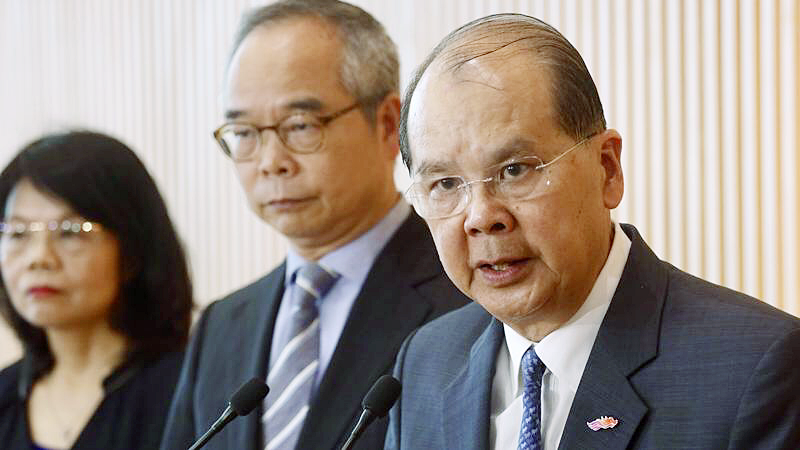
Hong Kong Chief Secretary for Administration Matthew Cheung Kin-chung (right), Secretary for Home Affairs Lau Kong-wah (center) meet the media at the Central Government Offices, Hong Kong, July 25, 2019. (EDMOND TANG / CHINA DAILY)

Hong Kong Chief Secretary for Administration Matthew Cheung Kin-chung (right), Secretary for Home Affairs Lau Kong-wah (center) meet the media at the Central Government Offices, Hong Kong, July 25, 2019. (EDMOND TANG / CHINA DAILY)
By China Daily Hong Kong
Asia News Network
89 Viewed

To restore law and order is Hong Kong’s most urgent task because a stable and peaceful social environment is the foundation for any rational discussion to save the city from chaos, said Chief Secretary for Administration Matthew Cheung Kin-chung on Tuesday.

Cheung made the remarks in an interdepartmental press conference to brief about the impact of the strike and violent protests across the city on Monday.

Quoting Chief Executive Carrie Lam Cheng Yuet-ngor, Cheung said the organized and premeditated violent acts are neither peaceful nor have anything to do with the now-suspended extradition bill. He reiterated that the special administrative region government has put a full stop to the extradition law amendments.

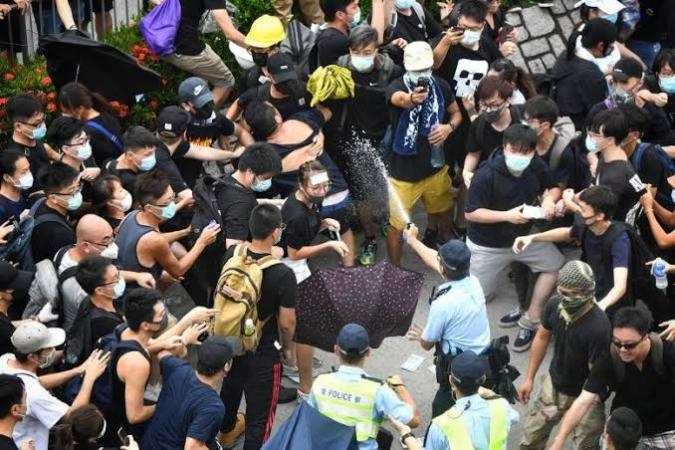
Noting that radical protesters clashed violently with the police in eight districts on Monday, and besieged over 15 police stations, Cheung said the violence would only push Hong Kong into a more dangerous situation.

Saddened by the escalating violence, Cheung urged protesters to stop undermining Hong Kong’s stability.

He also called on society to reject violence, safeguard the city’s rule of law, and ensure that what the city has achieved would not be destroyed.

Cheung noted that the Independent Police Complaints Council has started a comprehensive review of the protests since June 9.

Also at the briefing, Secretary for Security John Lee Ka-chiu said the spate of violent acts on Monday were unprecedented in Hong Kong since its return to the motherland. They were “most widespread, most damaging and most serious,” he said.

Noting that police have suffered from intense pressure, Li thanked them for their efforts to restore the city’s law and order, and said the government will continue to support the police in bringing offenders to justice.

Li stressed that the police will comprehensively evaluate the situation of each public assembly before taking actions.

He called on the public to understand that police officers are obliged to safeguard the rule of law in these difficult times.

There were 21 cases of arson during the protests on Monday and about 200 sets of traffic lights were damaged.

Due to protesters’ obstruction, 36 roads and the Cross Harbour Tunnel at Hung Hom were temporarily blocked, while 96 bus routes had to be diverted or suspended.

The Hong Kong Police Force, in a press conference on Monday, stressed that the escalated violence was “a total disregard for the rule of law”.

Tse Chun-chung, chief superintendent of police public relations, said rioters assaulted police officers, vandalized police stations, and wreaked vehicles with the attempt to paralyze police services.

The Hong Kong Police Force is capable of and determined to control the unrest, and both the police and the public have a role to play in restoring safety and stability in Hong Kong, said Tse.

During Monday’s unrest, police arrested 148 people for taking part in riots, unlawful assembly, assaulting police officer, obstructing police officers in executing their duties and possession of offensive weapons.

The police fired around 20 sponge bullets, 140 rubber bullets, and 800 tear gas grenades on Monday to disperse protesters in various locations.

Meanwhile, police officers were attacked by metal marbles and fl uid potentially corrosive. Some protesters threw gasoline bombs at police headquarters, said Tse.

Seven police officers were injured, according to the police.

Demo uses snow for air-conditioning in Japan

ศาสตร์เกษตรดินปุ๋ย : ขอบคุณแหล่งข้อมูล : หนังสือพิมพ์ The Nation

https://www.nationthailand.com/ann/30374366

Demo uses snow for air-conditioning in Japan

Aug 07. 2019

People walk through a tent-like covered passage that is cooled by an air-conditioning system using snow in front of Saitama Stadium in Saitama./The Japan News Photo

People walk through a tent-like covered passage that is cooled by an air-conditioning system using snow in front of Saitama Stadium in Saitama./The Japan News Photo
By The Japan News/Asia News Network202 Viewed

Saitama and its friendship city Minami-Uonuma, Niigata Prefecture, launched a demonstration of an air-conditioning system using snow.

The system uses icy water made from natural snow saved in Minami-Uonuma. The cold air from the water is blown by fans to circulate in a 9-meter-long tent-like covered passage that arches up to about 2.5 meters tall.

The system was set up in front of Saitama Stadium, one of the soccer venues for the 2020 Tokyo Games, in Midori Ward, Saitama.

City officials were busy making icy water outside the tent. People inside the tent exclaimed that it felt cool and comfortable.

The temperature outside was almost 40 C, but inside the tent the temperature was kept at 30 C or below, according to the organizer.

“Beating the heat with snow will be the perfect omotenashi hospitality for visitors from overseas,” a Saitama city official said.

Both cities will examine the results of the demonstration before deciding whether to introduce this natural air-conditioning system for the Tokyo Games.

Seven missing after Huaphan landslide

ศาสตร์เกษตรดินปุ๋ย : ขอบคุณแหล่งข้อมูล : หนังสือพิมพ์ The Nation

https://www.nationthailand.com/ann/30374317

Seven missing after Huaphan landslide

Aug 06. 2019

Officials and soldiers search for people still missing after a landslide hit two houses in Viengxay district, Huaphan province on Saturday. - Photo by Vientiane Times

Officials and soldiers search for people still missing after a landslide hit two houses in Viengxay district, Huaphan province on Saturday. – Photo by Vientiane Times
By Vientiane Times
Asia News Network
117 Viewed

Seven people are missing and two children were injured in the early hours of Saturday when a landslide struck in Viengxay district, Huaphan province, after more than two days of rain. District Governor Phonsouk Inthavong told Vientiane Times on Monday  that the landslide took place in Hindam village at 3 am on Saturday, engulfing two houses and sending them into a river below.

“Seven people, three of them women, are still missing. Two boys aged 5-7 were injured. We are now working with over 60 soldiers and police to find the missing persons but it’s difficult because power to the village has been cut and the road is blocked,” he said.

Some social media reports claim that 11 people are missing, but the official number is seven.

“Six villages in Viengxay district have also been affected by flash floods but no houses were damaged and no one was injured or killed. We are continuing our inspections and assessing the damage to farmland,” Mr Phonsouk said.

Flooding has struck more areas after the recent heavy rain. Two villages in Paek district, Xieng Khuang province, were affected by flooding. Most landslides and flash floods have occurred in the north, in mountainous regions. Motorists travelling to the northern provinces are advised to be on the alert for landslides along mountainous routes, especially on Road No. 4C between Kasy district in Vientiane province and Nan district in Luang Prabang province.

Several roads winding through mountainous terrain are now affected by landslides following two to three days of rain across the country.

Authorities in Nan district are continuing to mobilise emergency supplies to help those in need after 1,722 people were affected by floods last week.

Damage to property in the district has been estimated at over 8.4 billion kip after the Nan River overflowed on July 30 and flooded the villages of Nafai, Paphai, Simoungkhoun, Nalao, Phonhin, Sibounheuang, That and Nakhern. Fortunately, no one was injured or killed.

It has been calculated that 14.44 hectares of crops and 52.58 hectares of rice were submerged, 638 bags of rice were damaged and 2,794 poultry and 23 pigs were lost. Two roads, four bridges, five irrigation systems and 28 houses were damaged.

Local authorities provided some food, rice, drinking water, clothing, and other daily necessities to those whose homes were flooded but it wasn’t enough. Now more cash and construction equipment is needed to help people repair their houses and infrastructure.

Those interested in helping or donating household items are invited to call local authorities at the district office on 020 22350209 or 020 59205507.

Typhoon Francisco to hit Korea on Tuesday afternoon

ศาสตร์เกษตรดินปุ๋ย : ขอบคุณแหล่งข้อมูล : หนังสือพิมพ์ The Nation

https://www.nationthailand.com/ann/30374302

Typhoon Francisco to hit Korea on Tuesday afternoon

Aug 06. 2019

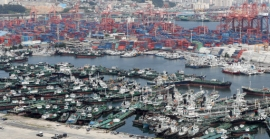
Ships are docked at Pier 5 at Busan Port in preparation for the arrival of Typhoon Francisco, which is expected to land on the Korean Peninsula on Tuesday night. (Yonhap)

Ships are docked at Pier 5 at Busan Port in preparation for the arrival of Typhoon Francisco, which is expected to land on the Korean Peninsula on Tuesday night. (Yonhap)
By The Korea Herald
Asia News Network
158 Viewed

Typhoon Francisco, the season’s eighth typhoon, will hit Korea from Tuesday afternoon through Wednesday, with heavy rains expected across the country, the weather agency said Monday.

The typhoon was moving northwest at a speed of 36 kilometers per hour from about 470 km south of Osaka, Japan, as of 9 a.m. Monday. It is expected to land on the country’s south coast between Tuesday night and Wednesday morning, according to the Korea Meteorological Administration.

Francisco is expected to reach 90 kilometers west of Andong, North Gyeongsang Province, at about 9 a.m. Wednesday morning and exit the peninsula toward the East Sea that night, according to the weather agency.

Rain is expected along the coast in South Gyeongsang Province and on Jeju Island from Tuesday noon. Rain is forecast for all parts of the country, except Jeju, starting Wednesday midnight.

Coastal areas in South Gyeongsang Province and Gangwon Province are expected to see more than 200 millimeters of rain. The rest of Gyeongsang province and North Chungcheong Province are expected to receive between 50 to 150 millimeters of rain.

Up to 60 millimeters of rain is expected in Seoul, Gyeonggi Province, South Chungcheong Province and Jeolla Province.

Francisco was classified as “small” with a central pressure of 985 hectopascals. The maximum sustained wind speed near its center was 27 meters per second. Its power may be weakened by relatively low water temperatures in the ocean and friction from land areas in Japan and South Korea.

The seasons’ ninth typhoon, Lekima, is also traveling at a speed of 34 kilometers per hour from 860 kilometers south-southeast of Okinawa, Japan. It is expected to move to the western part of Okinawa on Friday. For now, it is likely to veer to Japan or Taiwan, according to the KMA.

A scorching heat wave began to grip South Korea last week as the monsoon season ended, with daytime high temperatures of around 29 C to 37 C. Heat wave advisories or warnings were issued in most parts of the country Monday.

Korean won dips further amid looming currency war

ศาสตร์เกษตรดินปุ๋ย : ขอบคุณแหล่งข้อมูล : หนังสือพิมพ์ The Nation

https://www.nationthailand.com/ann/30374300

Korean won dips further amid looming currency war

Aug 06. 2019
By The Korea Herald
Asia News Network
165 Viewed

The South Korean won continued to sink to new lows against the US dollar Tuesday amid escalating trade tensions between the world’s two largest economies that now appear to be set to include a currency war, according to Yonhap news agency reported.

After opening at 1,220.00 won, the local currency was changing hands at 1,217.45 won with the US dollar as of 9:37 a.m., down 2.15 won from the previous session’s close.

On Monday, the won closed at 1,215.30 to the dollar, the lowest in over three years.

The won’s continued decline came after Beijing let its yuan slip through its long-guarded line of 7 per dollar for the first time in 11 years, in an apparent response to Washington’s escalation of their trade dispute with additional tariffs.

The United States is set to begin imposing 10 percent tariffs on $300 billion worth of Chinese imports, in addition to the 25 percent tariffs on $250 billion worth of Chinese goods it has levied since early June.

Washington further escalated its ongoing tension with Beijing on Monday (Washington time), labeling China as a currency manipulator.

A weaker yuan could easily translate into increased exports and profits for the world’s second-largest economy, but the opposite for other countries, possibly forcing them to weaken their own currencies in an attempt to defend their own economies.

South Korea has already seen its exports steadily drop for eight consecutive months since December, while its own trade conflict with Japan is expected to add more downward pressure on its outbound shipments down the road.

“The trade tensions between the US and China are entering the phase of a currency war with the yuan breaching the 7 per dollar level and the US designating China as a currency manipulator,” Jeon Seung-ji, an analyst at Samsung Futures, said.

“The won-dollar rate is expected to test the 1,220 won level as the conflict between the two countries will likely prompt market fears for some time, forcing investors to avoid risk assets,” Jeon added.

The Bank of Korea said it has called for an emergency meeting of its top officials, including Gov. Lee Ju-yeol, to discuss possible fallout from the latest developments.

Nuclear power efforts gather speed

ศาสตร์เกษตรดินปุ๋ย : ขอบคุณแหล่งข้อมูล : หนังสือพิมพ์ The Nation

https://www.nationthailand.com/ann/30374286

Nuclear power efforts gather speed

Aug 06. 2019

Technicians check data at the main control room of the Fuqing Nuclear Power Plant in Fuzhou, Fujian province. [Photo/Xinhua]

Technicians check data at the main control room of the Fuqing Nuclear Power Plant in Fuzhou, Fujian province. [Photo/Xinhua]
By China Daily
Asia News Network
224 Viewed

Third-generation technologies set to keep industry on even keel in nation, say experts

China’s growing clean power demand has boosted the rapid development of nuclear power in the country, making it among the few in the world to have independently developed third-generation nuclear power technology, with a complete industry chain, industry experts said.

The first two reactor units using China’s homegrown third-generation nuclear reactor technology Hualong One, or the No 5 and 6 reactors in Fuqing Nuclear Power Plant in Fuzhou, Fujian province, are expected to avoid time overruns, creating a record in the construction of the first reactor in a nuclear power project.

Currently, key goals in the construction of the No 5 reactor have all been fulfilled on or ahead of schedule, while devices necessary for the No 6 reactor have been prepared as per schedule, said Zhou Saijun, deputy chief engineer of the power plant affiliated to China National Nuclear Corp, or CNNC.

Hualong One technology, jointly designed by CNNC and China General Nuclear Power Group, adopts a double-layered containment system that can withstand large aircraft attacks, and has a water tank above the reactor that can be gravity-fed to keep the reactor cool.

Fuqing’s No 5 reactor will start hot functional tests before Oct 16 and is expected to go into commercial operation in July next year. The No 6 reactor is scheduled to start cold functional tests next April and slated to commence commercial operations in 2021, Zhou said.

Cold functional tests are carried out to confirm whether the circuit system and its supporting facilities are properly installed and ready to operate under high-pressure conditions. A hot functional test is a critical pre-operational test that simulates the temperatures and pressures the reactor systems will be subjected to during normal operation.

The No 2 and 3 nuclear reactors in Karachi, Pakistan, using Hualong One technology, are also making construction progress as per schedule.

Zhu Hongwei, deputy Party chief of the nuclear power plant, said the four reactors are the world’s first-ever third-generation pressurized water reactors that are being built without any time overruns.

Zheng Mingguang, president of Shanghai Nuclear Engineering Research and Design Institute Co Ltd, an affiliate of the State Power Investment Corp, said China has accumulated precious experiences and capabilities in nuclear power project design, construction, and operation over the past few decades.

By the end of June, China had 47 reactors in operation with a capacity of about 48.73 million kW, and the nuclear power plants produced about 160 billion kWh of electricity in the first half of 2019, up 23.09 percent year-on-year and accounted for 4.75 percent of the total electricity generated in China, according to the China Nuclear Energy Association.

“We used to lag behind, but thanks to efforts of several generations of researchers, China is now among the few countries in the world to have a comprehensive third-generation nuclear power industrial chain,” said Zheng, who is also chief engineer of CAP1400, a third-generation nuclear reactor technology developed by the institute.

China is among the best in the world’s nuclear power industry, with distinct competitive advantages to export nuclear power projects, he said.

CAP1400 utilizes proven technologies and takes advantage of superior design features to reduce costs and meet high safety requirements, he said, adding China is able to design and manufacture key equipment and materials.

Over 85 percent of components and devices of CAP1400, including key ones such as steam generators, pressure vessels, accumulators, and squib valves, can be domestically manufactured, thanks to efforts and innovations from both State-owned and private Chinese companies, while the rest can be sourced from multiple foreign suppliers, according to Zheng.

He Yanqing, Party secretary of Shanghai Electric Nuclear Power Group, a leading Chinese nuclear power equipment producer, said huge market demand is the main driving force for the development of nuclear power technologies in China.

Both Zheng and He believe nuclear power will play a larger role in China’s green energy mix, as China is committed to reducing carbon emissions and increasing energy accessibility.

Zheng said nuclear energy is the only form of energy that can provide carbon-free and large-scale stable power, compared with other forms of clean energy, such as wind and solar power.

He said nuclear energy could also be a disrupter for energy services in heating, hydrogen, desalination and other new applications in China beyond electricity.

The institute is also working on application of digital technologies within the whole life cycle of a nuclear power plant, combined with artificial intelligence, to maintain and ensure safety and reliability.

ANN: Dollars and sense

ศาสตร์เกษตรดินปุ๋ย : ขอบคุณแหล่งข้อมูล : หนังสือพิมพ์ The Nation

https://www.nationthailand.com/ann/30374257

ANN: Dollars and sense

Aug 06. 2019
By Andrew Sheng
Asia News Network
208 Viewed

Last Wednesday, US Federal Reserve Chairman Jerome Powell announced a cut in the Fed Funds rate by 25 basis points, citing slower global growth and muted inflation. This was evidently insufficient to appease either the markets or President Donald Trump, who openly asked for a “large cut” just before the Federal Open Market Committee (FOMC) meeting.

Andrew Sheng

Andrew Sheng

After the announcement, he tweeted, “As usual, Powell let us down.” Perhaps reflecting Trump’s sentiment, US markets fell by 1 per cent and the dollar actually strengthened slightly against other currencies.

How do we make sense of what is happening to the dollar, the most important reserve currency in the world?

The dollar is important, because it accounts for 44 per cent of daily global foreign exchange trading and roughly 60 per cent of total official foreign exchange reserves. Because the dollar has a very liquid market both on-shore and offshore, companies and governments like to borrow in dollars, especially when the interest rates are low. As the BIS reported, there are now $11 trillion (Bt337 trillion) in dollar debt that are booked offshore. In addition, the US has a net international investment position (debt) of $9.5 trillion or 47.4 per cent of GDP at the end of 2018.

Noting that the US federal budget deficit is running at more than $1 trillion annually, bringing gross debt to an estimated 113.2 per cent of GDP and net investment deficit of 51.4 per cent of GDP by 2024, the International Monetary Fund has warned bluntly that “US public debt is on an unsustainable path”.

The same June 2019 IMF report card on the US economy (technically called the Article IV consultation report) also says: “The US economy is in the longest expansion in recorded history. Unemployment is at levels not seen since the 1960s, real wages are rising, and inflationary pressures remain subdued.” That doesn’t sound like an economy in trouble.

We all know what worries Mr Trump. If the economy, and especially the stock market, tanks in the run up to the November 2020 elections, then his re-election would be in trouble. But why should the financial markets be worried?

The answer lies in the fact that there is a very close relationship between the stock market and central bank balance sheets. Since 2015, when the Fed started to “normalise” interest rates (by raising them) and reversing quantitative easing (expanding its balance sheets), the S&P500 stock market index roughly topped and moved sideways.

Everything is relative. During this period, both the European Central Bank and Bank of Japan have been easing, concerned about the slow growth of their economies. The People’s Bank of China has eased to relieve liquidity during a period of deleveraging, in order not to over-tighten during a period of trade tensions. Hence, if the world is slowing down overall faster than expected, monetary policy cannot be too tight to push the economies into recession territory.

But the US has now begun to politicise the dollar by increasing the rhetoric on currency manipulation, excessive surpluses and threats on using tariffs and sanctions on trading partners and rivals to try and contain its unsustainable trade deficits and debt trajectory. This is because Trump and some in his administration think that the dollar is overvalued, and wants lower interest rates to help alleviate the upward valuation pressure.

But the US administration may be boxed in by its own asymmetric dollar trap. The Fed is in charge of monetary policy (the main tool that affects the external price of the dollar), but responsibility for the exchange rate lies with the US Treasury. If the Treasury ramps up sanctions, threats of currency manipulation and/or tariff increases, the major trading partners could easily negate these by either easier monetary policy or allowing their exchange rates to depreciate.

Exchange rates are by nature bilateral. Given the massive size of global foreign exchange markets, the US cannot unilaterally depreciate its dollar without the help of concerted cooperation of major reserve currency central banks. Today they may or may not cooperate since the US has threatened almost all of them for “unfair trade”, currency manipulation and the like.

The last time the dollar successfully depreciated through intervention was through the Plaza Accord of 1985, when Japan, Germany, France, the UK and the US jointly intervened in the foreign exchange markets to depreciate the dollar.

This time around, the US would not be able to convene another Plaza Accord because Europe, Japan, and China may not want to cooperate. Indeed, fundamental disagreements over sanctions using the dollar on trading with Iran and other countries have caused the Europeans, China, India, Russia, and others to consider non-dollar alternative payment mechanisms. Furthermore, going forward, the growing trade surplus countries are more in Europe (particularly Germany and Netherlands) than in Japan or China, as the IMF External Sector Report 2019 showed.

Much will depend on whether the Germans or the Dutch are willing to reflate fiscally, but based on the bad experience of Chinese reflation in 2009, these fiscally conservative countries are likely to push the deficit nations (mainly the US) to address their structural imbalances rather than bear the costs of getting their own economies out of whack.

Even though the US has considerable “exhorbitant privileges” in enjoying the benefits of the dollar as the dominant reserve currency, in the long run, this cannot be sustainable unless the US is willing to take tough pain to correct its structural savings deficit. Even though Trump may want America First, the other global players will play for the long haul and wait for the US to plead for mutual cooperation and assistance.

There is no such thing as a free lunch. The US must work within the global financial system through cooperation rather than coercion. To go it alone, as what happened with Smoot-Hawley protectionist moves in the 1930s, risks sending the world into another global recession.

In this highly interconnected world, no country, not even the US, can go it alone – for long.

Andrew Sheng writes on global issues with an Asian perspective. The views expressed here are solely his own.

Hong Kong protesters take over key roads

ศาสตร์เกษตรดินปุ๋ย : ขอบคุณแหล่งข้อมูล : หนังสือพิมพ์ The Nation

https://www.nationthailand.com/ann/30374234

Hong Kong protesters take over key roads

Aug 05. 2019
By The Straits Times/ANN213 Viewed

HONG KONG — Protests escalated again in Hong Kong on Sunday (Aug 4) with riot police firing tear gas to disperse demonstrators on Queen’s Road West near Beijing’s Liaison Office in the Western district and later at major shopping area Causeway Bay.

After firing several rounds of tear gas, the police managed to clear some protesters off Percival Street in Causeway Bay. They were in a standoff on the street, about 50m apart. The air was heavy with the smell of tear gas and many diners from nearby restaurants were coughing and covering their faces.

Buses and traffic were earlier forced to reroute near Hennessy Road in Causeway Bay after the demonstrators spilled out by the hundreds from the MTR station to take over the area, which hosts high-end department stores and upscale restaurants. Many started chanting and calling on passers-by to join a planned city-wide strike on Monday.

By 9.30pm, protesters blockaded Hennessy Road all the way down Wanchai, using a combination of traffic cones, fluorescent tape and cling film, in a bid to slow police advances, if any. Sogo department store also shut early, as did most shops around the area.

On Hennessy Road near Tim Lok Drive, at least six trams were stationary.

In a statement, a Hong Kong government spokesman said some protesters were “maliciously damaging traffic lights” on Hennessy Road and vandalising government properties. It also said the police strongly condemned the “illegal acts” of the protesters and warned them to leave immediately. They also advised drivers to avoid travelling to the area.

Some of the protesters moved on towards Cross-Harbour Tunnel and temporarily blocked the all lanes on the roads with makeshift barricades, causing a massive traffic standstill.

Another group moved towards Bauhinia Square and vandalised the giant statue of a golden Bauhinia blakeana at the centre of the area.

A video posted on the Hong Kong Police’s Facebook page said the officers would be introducing a new method of identifying protesters by spraying them with liquid dye, adding that the spray is edible and harmless, but will stay on skin and clothes as a way of marking demonstrators.

Earlier in the evening, a group of black-clad protesters hurled rocks, bricks and eggs at Tseung Kwan O Police Station while taunting officers to come out, breaking several windows and leaving dents on the exterior of the building. Others threw objects into the station compound and sprayed graffiti on the building’s walls.

Large water-filled barriers set up earlier outside the station did not stop the protesters from attacking the building.

Separately, another group of protesters removed railings from the kerbside and set up barricades near the Metro City housing estate and shopping centre in Tseung Kwan O.

The police said in a statement that the illegal acts on Mau Yip Road near Po Lam MTR Station had affected traffic in the area, warning the protesters to stop the obstruction.

Referring to the vandalism at the police station, the police warned the protesters to “stop their illegal acts at once and to leave peacefully”. It added in a statement issued at 6.13pm that it would conduct a dispersal operation very soon, condemning the violent acts by the protesters.

Soon after, the protesters left the area outside the police station.

The attacks by the protesters came after a largely peaceful march against a controversial extradition Bill ended on Sunday afternoon.

Meanwhile, a second rally at Hong Kong Island’s Kennedy Town, an expat-friendly residential neighbourhood, started with talks by organisers and guest speakers at Belcher Bay Park. The rally was planned to end at Sun Yat Sen Memorial Park in Sai Ying Pun, near China’s liaison office in the city.

Earlier in the day, thousands of Hong Kongers had marched off from a park in the Tseung Kwan O district, a quiet area east of Kowloon.

Braving warm and humid weather, the mostly black-clad protesters packed into Po Tsui Park, waiting for the march to start at 2.30pm as they shouted slogans such as “Hong Kong people, ga yau” or “Hong Kong people, keep it up” in Cantonese.

Organisers said the march, postponed from early last month, was meant to “give a voice” to the people of Tseung Kwan O.

The march had been planned to end at the Hong Kong Velodrome Park and marchers were supposed to disperse from there.

Participants of the march said they were out in force to protect their neighbourhood and to make sure that the government hears them.

“You look at the photos from last night, what if that (tear gas) happens to us here?” Tseung Kwan O resident T. K. Cheung told The Straits Times, referring to the clashes between protesters and police in Wong Tai Sin on Saturday night.

During the clashes between protesters and police in the residential area of Wong Tai Sin, a big group of angry residents who were upset by the firing of tear gas in their neighbourhood came out to shout at the riot police. Some of them also clashed with the officers.

Mr Cheung, a retired technician, said it was encouraging to see people in Wong Tai Sin stand up for their neighbourhood.

“Of course, I’m also here to support the youth, they’re very brave. And we need to make sure that the government hears us,” he added.

Housewife Inez Lam, in her 30s, who was marching with her two sons aged four and six in Tseung Kwan O on Sunday, said: “This is a good way to show my boys that marches can be very peaceful. We have a right to protest and we need to stand up to protect it.”

The rally was slightly more muted than previous outings as protesters marched under a slight drizzle.

Many were holding up signs and banners with the five demands that protesters have been calling for: to completely withdraw the extradition Bill; to withdraw the characterisation of the June 12 events as a “riot”; for an independent commission to be set up investigating police actions; for charges to be dropped against arrested protesters; and for universal suffrage.

About two hours after the start of the march, the first batch of participants reached Velodrome Park, the end of the planned march. Organisers said 150,000 people turned up for the march, while police pegged the number at 27,000 at the peak of the march on the approved route.

Many of the younger protesters in Tseung Kwan O said they would be heading to the second rally in Kennedy Town in the western end of Sai Wan on Hong Kong Island.

In view of the planned rally, several leisure and sports facilities in the Central and Western District were closed at 3pm on Sunday.

Sunday’s rallies follow violent clashes between protesters and police in Mongkok, Tsim Sha Tsui and Wong Tai Sin the previous night, where more than 20 were arrested for various offences including unlawful assembly and assault.

It is the ninth consecutive weekend of demonstrations over a contentious extradition Bill which would allow for the handover of fugitives to several jurisdictions including mainland China.

Following mass rallies that brought millions onto the streets over two weekends, the Bill has since been indefinitely shelved. But public anger is still raging and many are calling for electoral reforms while protesting the police’s heavy-handed tactics when dealing with protesters.

For the past two Sundays, police have been in pitched street battles with a small group of protesters, volleying tear gas and rubber bullets to disperse a defiant crowd massed close to Beijing’s liaison office.

MONGKOK VIOLENCE

On Saturday, tens of thousands deviated from an approved protest route in Mongkok and spilled onto Nathan Road, the main thoroughfare running through several districts on the Kowloon Peninsula popular with tourists.

Black-clad protesters were locked in a stand-off with police after surrounding police stations in the Tsim Sha Tsui and Mongkok districts, vandalising station exteriors and lobbing rocks and flaming objects into the stations.

They had also briefly occupied the Cross Harbour Tunnel, a key passage running under Victoria Harbour connecting Kowloon to Hong Kong Island.

After police fired tear gas and pepper spray to disperse the crowd, some protesters hurled petrol bombs, bricks, glass bottles and a large amount of miscellaneous objects at police officers, the police said in a statement on Sunday morning.

The protesters also directed high-power lasers at the officers, committed arson at various locations and pushed a burning rubbish bin towards the officers.

Another group of protesters were also locked in a stand-off with police at a bus station at Wong Tai Sin, a residential area, throwing objects such as umbrellas at the officers. Some attacked the police with fire extinguishers, the police said.

When officers were trying to retreat from the scene to their police vehicles, some protesters surrounded them and vandalised the vehicles.

A group of protesters subsequently surrounded Wong Tai Sin Disciplined Services Quarters and hurled fireworks and objects into the building, breaking the glass windows of lower-floor residential units.

“Police strongly condemn the radical protesters who disregarded law and order. Resolute enforcement actions will be taken against all illegal and violent acts,” the police said in the statement. “Police are capable and determined to maintain law and order and will not tolerate any violence.”

China’s official Xinhua News Agency said in a commentary on Sunday that the central government would not sit back and let the situation continue, while reiterating that it is sticking to the “one country, two systems” regime.

The commentary warned that “evil forces which are trying to challenge the central government’s authority, to destroy the one country, two systems bottom line” will be judged by history.

Saturday’s unrest began with a police-approved march in Kowloon, a broad peninsula that sits across a harbour from Hong Kong’s main island. The march drew people of all ages, including young families and elderly people.

Police estimated some 4,200 people took part in the march in Mongkok, while organisers pegged the number at 120,000.

In a statement on Sunday, the government condemned the violent protesters who disregarded law and order and blatantly breached the public peace.

“The police will strictly enforce the law. Violent protesters who breached the law should also be brought to justice,” the statement said.

Hong Kong has been mired in its most serious political crisis since its handover from Britain to China 22 years ago with millions taking to the streets. What initially began as opposition to the extradition Bill has now escalated to people calling for political reforms and the resignation of embattled Chief Executive Carrie Lam.

Labour-related difficulties lie ahead for Vietnamese textile firms

ศาสตร์เกษตรดินปุ๋ย : ขอบคุณแหล่งข้อมูล : หนังสือพิมพ์ The Nation

https://www.nationthailand.com/ann/30374218

Labour-related difficulties lie ahead for Vietnamese textile firms

Aug 05. 2019
Coats are made at Duc Giang Co Ltd for exort to Europe. Vietnamese textile companies must be aware of origin and traceability regulations to increase their market shares in the EU amid the ratification of the EVFTA.  (Photo: VNA/VNS Photo Tran Viet)

Coats are made at Duc Giang Co Ltd for exort to Europe. Vietnamese textile companies must be aware of origin and traceability regulations to increase their market shares in the EU amid the ratification of the EVFTA. (Photo: VNA/VNS Photo Tran Viet)
By VIET NAM NEWS
ASIA NEWS NETWORK

69 Viewed

Vietnamese textile and apparel firms are facing tough times expanding their businesses, especially in terms of human resource development, experts said on Friday.

The main problem stems from low productivity by Vietnamese workers despite better pay conditions in recent years, Nguyen Thị Thu Trang, director of the WTO Integration Centre at the Vietnam Chamber of Commerce and Industry (VCCI), said.

Vietnamese labour productivity is low compared to other Southeast Asian economies such as Thailand and Singapore, she explained, adding that the population is ageing and the number of workers is growing at a slow pace.

In recent years, Vietnam has faced stronger competition from Myanmar, Bangladesh and Laos in terms of labour costs, according to the Vietnam Textile and Apparel Association (Vinatex) chairman Vu Duc Giang.

There are three million workers and around 7,000 companies in the textile and apparel sector. Training facilities can only meet 1 per cent of the sector’s demand for skilled employees.

Most of the workers are trained by businesses and it takes a company between six and 12 months with salaries and financial assistance to produce one skilled worker.

Local companies may also lose workers to foreign direct investment (FDI) firms because they are willing to pay higher salaries.

In addition, the lack of a Government-level development plan for the textile and apparel sector has allowed local authorities to call for investment, resulting in the density of companies in the same location, Giang added.

Workers are free to move from a company to one another, making the structure of the firms unstable, he said.

The ongoing Fourth Industrial Revolution would make Vietnam less dependent on the low cost of labour as the manual stages would be handled by machines in the near future, Trang said.

However, Vietnam has an advantage over China in terms of lower labour costs, Vu Duc Giang noted.

The average salary of Chinese workers in the industry is US$700-800 (Bt21,500-Bt24,300) per month, double that of the Vietnamese, making China less competitive to Vietnam when luring investment for apparel production, Giang said during an online conference on the EU-Vietnam Free Trade Agreement and its impact on Vietam’s textile and garment sector.

All textile factories in China’s coastal areas have now closed and moved to the western region. They were forced to move business offshore and China has begun buying Vietnamese textile and apparel products, he added.

Working conditions have remained one of the key requirements set by strict markets such as Europe and Japan towards Vietnamese exporters.

According to Nguyen Thị Thu Trang, Vietnamese companies are also facing harder requirements in labour conditions in some markets such as Europe and Japan.

In the past, European consumers boycotted Bangladesh’s apparel exports because labourers were not treated well enough. This has not occurred in Vietnam.

Estate market expects positive growth by year-end

ศาสตร์เกษตรดินปุ๋ย : ขอบคุณแหล่งข้อมูล : หนังสือพิมพ์ The Nation

https://www.nationthailand.com/ann/30374217

Estate market expects positive growth by year-end

Aug 05. 2019
Apartment housing projects in HCM City (Photo: congthuong.vn)

Apartment housing projects in HCM City (Photo: congthuong.vn)
By VIET NAM NEWS
ASIA NEWS NETWORK
HCM CITY

74 Viewed

More positive signs will be seen in HCM City’s property market in the second semester of 2019 despite difficulties in the first half of the year, Chairman of the HCM City Real Estate Association Le Hoang Chau said last week.

Speaking at a seminar, Chau noted the lack of a rosy picture in the property market. Since March 7, 2017, when the Prime Minister requested the projects using State-owned land to be reviewed, the market has faced considerable challenges and difficulties.

In 2017, the real estate market grew 4.07 per cent from the previous year but began to decline in 2018.

In the first seven months of 2019, the whole market shrank 34 per cent in size, including a 29-per cent fall in project numbers and a 34-per cent decrease in apartment supply. Supply dropped 44 per cent in the high-end segment and 34 per cent in the pocket-sized segment. No low-end property projects were put up for sale.

Between January and July, the Construction Department of HCM City submitted only three new projects to the municipal People’s Committee for consideration, down more than 80 per cent. State budget revenue from real estate also nosedived more than 60 per cent, he noted.

“Every cloud has its own silver lining and the estate market has brighter prospects from now until the end of this year, including the implementation of projects in the eastern and southern areas,” he added.

Some experts are concerned about the draft that will replace Circular 36/2014/TT-NHNN, saying it could have adverse impacts on the real estate market as it would see the State Bank of Vietnam reducing the ratio of short-term capital for medium- and long-term loans. Under the three-phase roadmap lasting until 2022, the maximum ratio of short-term funds used for medium- and long-term loans will be reduced to 30 per cent by July 1, 2020.

The draft circular also sets the risk weight ratio for home purchasing loans worth VND3 billion (Bt3.96 million) and above at 150 per cent and the rate for loans worth VND1.5-3 billion at 100 per cent. [The current ratio for both loans is 50 per cent.]

For loans worth less than VND1.5 billion and loans to buy property in social and Government-supported housing projects, the rate is set at 50 per cent.

The revision was expected to tighten credit for the property market, especially luxury housing projects.

However, figures from the central bank showed that credit outstanding in the first half of the year increased by 7.33 per cent compared to the end of 2018. Particularly in the real estate sector, credit outstanding reached nearly VND1.4 quadrillion, a 6.5 per cent year-on-year increase.

Lawyer Bui Quang Tin said the policies tightening credit for the property market were being applied for some projects and investors, but not for all. At the end of the year, there would be many bright spots including capital inflows, especially in the real estate market.

Although the total volume of real estate transactions in the first six months of the year decreased by 34 per cent, prices did not go down. This difficult phase of the property market was not the same as the previous downward waves. Vietnam had a good macro-base as a development opportunity of the stock market, real estate and growth of all sectors, he added.