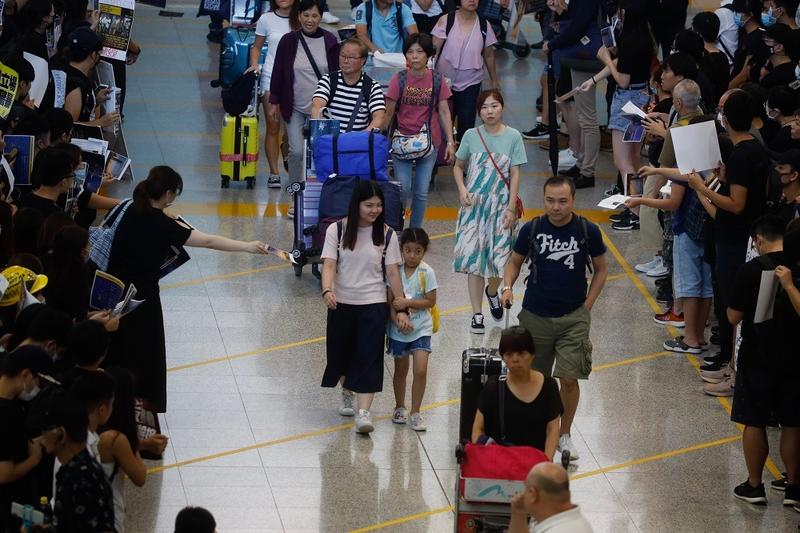
ANN: Thousands of protesters flood Hong Kong airport in latest protest campaign

ศาสตร์เกษตรดินปุ๋ย : ขอบคุณแหล่งข้อมูล : หนังสือพิมพ์ The Nation

https://www.nationthailand.com/ann/30373753

ANN: Thousands of protesters flood Hong Kong airport in latest protest campaign

Jul 26. 2019
By Story/photos: China Daily Kong Kong

468 Viewed

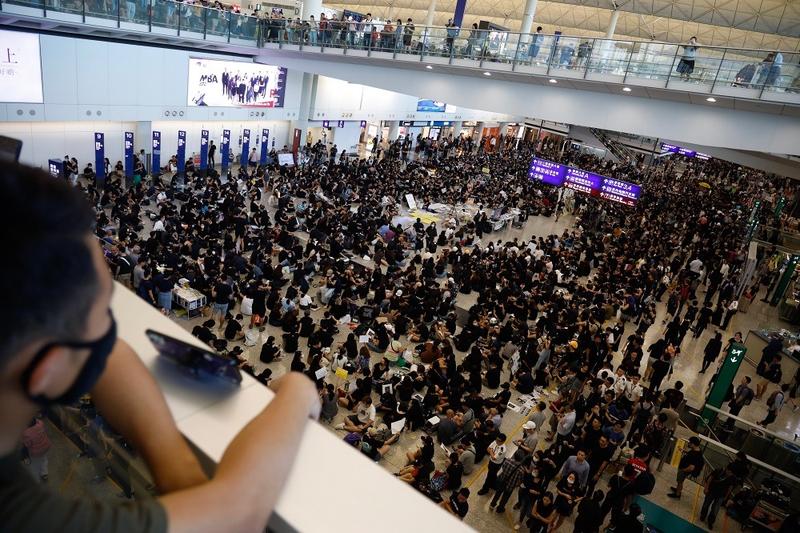
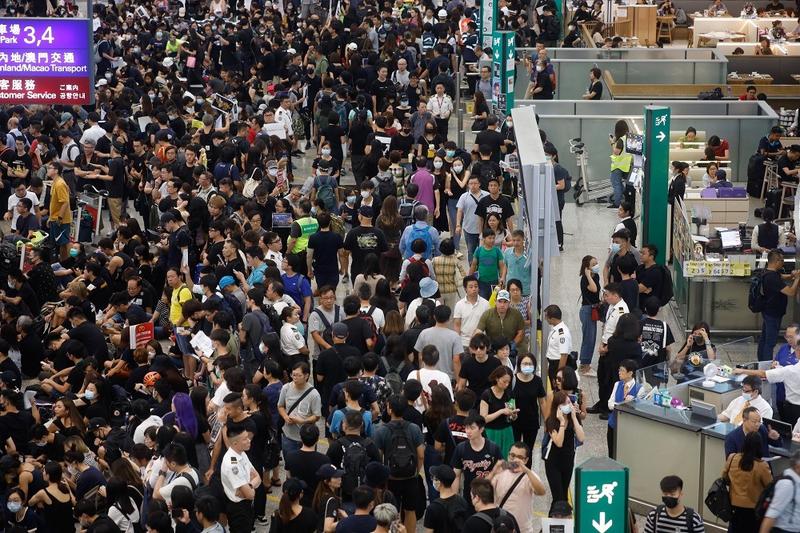
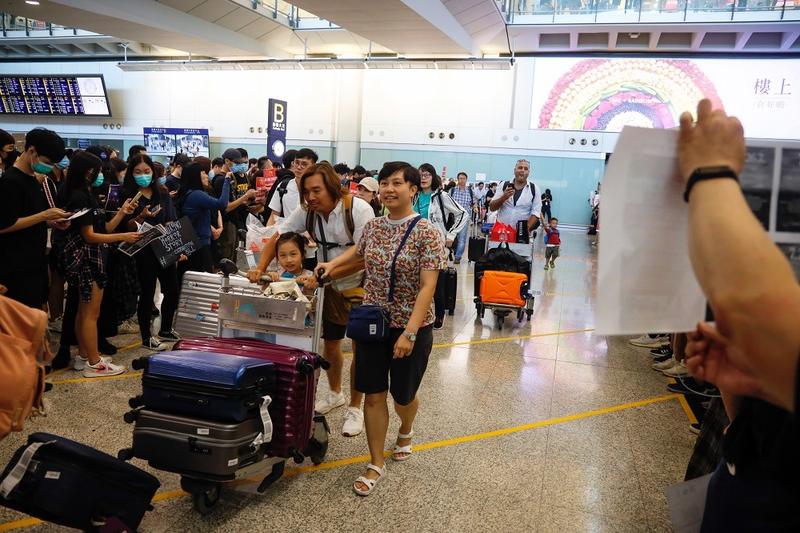
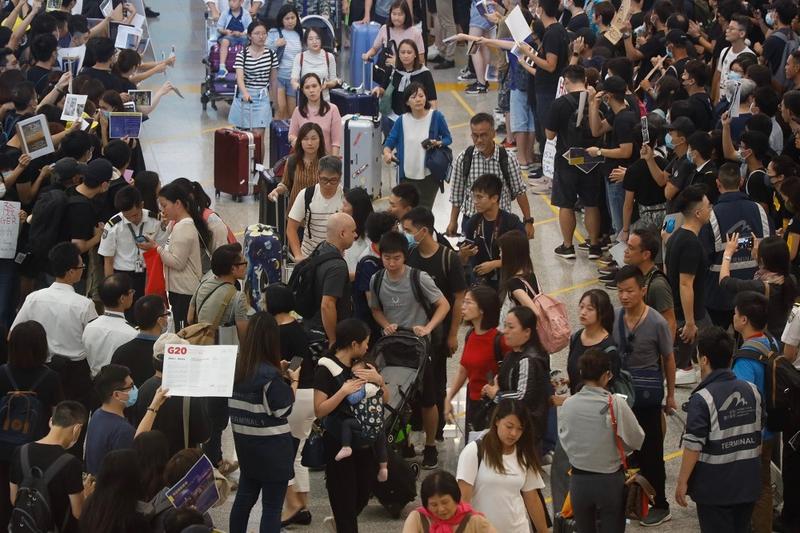
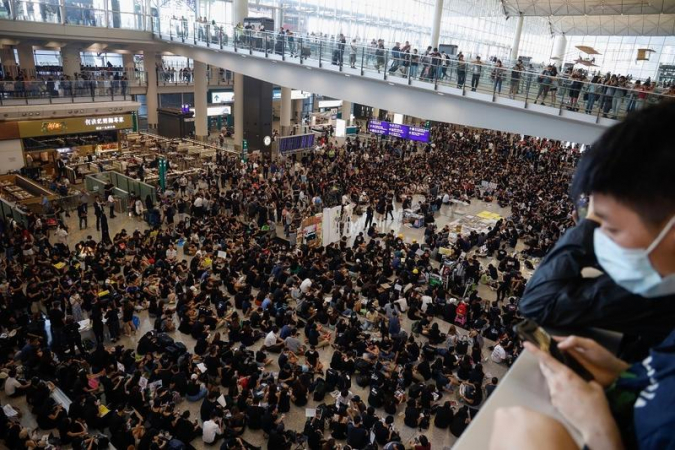
HONG KONG – An estimated 2,500 protesters staged a demonstration at the Hong Kong International Airport on Friday, trying to pressure the government to meet their demands. Passengers found their way blocked as they reached the arrival hall.

The Airport Authority said the rally was held in a designated area, and airport operations are not affected.

The authority said it has activated the emergency response center and deployed additional staff to handle the incident. It added that measures are in place at the terminal building to maintain smooth operation of the airport

In Beijing, responding to a question about the Civil Human Rights Front’s move to ask foreign consulates in Hong Kong to issue travel warnings for the city, Hua Chunying, spokeswoman of the Ministry of Foreign Affairs, said the move was an attempt to incite external forces to intervene in Hong Kong affairs and to put pressure on the SAR government and the central government.

Singapore has advised its nationals to stay away from the Hong Kong airports, and Britain also warned that the demonstration could affect journeys to and from the airport.

ANN: Unemployment rises in Singapore as employers grow cautious

ศาสตร์เกษตรดินปุ๋ย : ขอบคุณแหล่งข้อมูล : หนังสือพิมพ์ The Nation

https://www.nationthailand.com/ann/30373743

ANN: Unemployment rises in Singapore as employers grow cautious

Jul 26. 2019
The unemployment rate for Singaporeans rose for the third consecutive quarter to 3.3 per cent in June. (Photo: ST FILE)

The unemployment rate for Singaporeans rose for the third consecutive quarter to 3.3 per cent in June. (Photo: ST FILE)
By THE STRAITS TIMES
ASIA NEWS NETWORK
SINGAPORE

241 Viewed

Unemployment among Singapore continued to rise as the pace of job growth slowed in the second quarter of this year, amid trade tensions and global uncertainties.

However, retrenchments dipped, according to preliminary data released by the Ministry of Manpower today (July 26).

The unemployment rate for Singaporeans rose for the third consecutive quarter to 3.3 per cent in June, up from 3.2 per cent in March, after seasonal variations were taken into account.

The rate for Singaporeans and permanent residents combined rose to 3.1 per cent, up from 3 per cent, while the overall unemployment rate was unchanged at 2.2 per cent.

Layoffs fell to 2,300 in the three months from April to June, down from 3,230 in the second quarter and 3,030 in the same period last year.

The ministry said the figures “suggest that most employers are not laying off existing workers, but exercising greater caution in hiring even when they have unfilled vacancies”, leading to data showing

employment growth slowed in the second quarter. Total employment, excluding maids, grew by 4,000, lower than the growth of 10,700 in the preceding quarter and 6,500 in the second quarter of last year.

The gains last quarter were mainly in sectors such as information and communications, professional services, financial services and community, social and personal services. But these were offset by the decline in employment in retail trade.

Construction continued to add workers as a result of more activities in the public sector. Employment growth in the sector turned positive for the sector this year, after 11 consecutive quarters of contraction.

But manufacturing continued to shed workers for the third consecutive quarter as output declined.

Carpio: Panelo’s remark weakens PH in sea row

ศาสตร์เกษตรดินปุ๋ย : ขอบคุณแหล่งข้อมูล : หนังสือพิมพ์ The Nation

https://www.nationthailand.com/ann/30373701

Carpio: Panelo’s remark weakens PH in sea row

Jul 26. 2019
Supreme Court Senior Associate Justice Antonio Carpio. INQUIRER file photo

Supreme Court Senior Associate Justice Antonio Carpio. INQUIRER file photo
By Philippine Daily Inquirer
Asia News Network

83 Viewed

Supreme Court Senior Associate Justice Antonio Carpio has warned of a serious repercussion on the Philippines’ position unless presidential spokesperson Salvador Panelo takes back his statement that China is in “legal possession” of the Philippines’ exclusive economic zone (EEZ) in the South China Sea.

“I think this is a very serious matter,” Carpio, who has done an extensive study of the Philippines’ territorial dispute with China in the South China Sea, said in an interview on television on Thursday.

Carpio said China would harp on Panelo’s statement to claim that the Philippines had abandoned its 2016 victory over China in the UN-backed Permanent Court of Arbitration in The Hague.

Ruling on the Philippine challenge to China’s claim over nearly all of the South China Sea, the arbitral court said China’s claim had no basis in international law and that it had violated the Philippines’ sovereign right to fish and explore resources in the West Philippine Sea, the country’s 370-kilometer EEZ in the heavily disputed waterway.

‘Illegal possession’

The ruling means that even if China occupies or controls Philippine reefs in the West Philippine Sea, it cannot acquire lawful possession of them.

“Assuming China is in possession, which they are not, but assuming they are, that is illegal possession, not legal possession,” Carpio said.

“Now the moment you say that China is in legal possession, you abandon the ruling, you contradict the ruling and you give China ammunition to demolish our [victory],” he added.

Carpio said Panelo, who is also the chief presidential legal counsel, should take back his statement or pass it off as a joke.

“It’s very serious because China will always cite this statement by the chief presidential legal counsel that the Philippines has admitted that [China is] in legal possession and therefore that ruling will not apply anymore,” he said.

‘Analogy’

Panelo defended his statement, saying he was merely making an “analogy” and that Carpio “was not listening.”

“As far as they (China) are concerned, it’s theirs, it’s theirs. Why can’t we understand that? The President has repeatedly said, ‘According to them, they own it,’” he said.

“As far as they are concerned, legally it’s theirs. For us, as far as we are concerned, it’s also legally ours,” he added.

His and the President’s stance is that China is in “constructive possession” of the West Philippine Sea “because of their military hardwares there,” he said.

In his State of the Nation address to the opening session of the 18th Congress on Monday, Mr. Duterte said that while the West Philippine Sea belonged to the Philippines, “China is in possession” of those waters.

He meant ‘in position’

On Tuesday, National Security Adviser Hermogenes Esperon Jr. and Defense Secretary Delfin Lorenzana told reporters that what the President meant was that China was “in position” in the South China Sea because of its presence on artificial islands it had built and developed into military outposts there.

Panelo countered that there was no contradiction between Mr. Duterte’s “in possession” and the two security officials’ “in position,” and threw in his own “constructive possession” interpretation of China’s presence in the West Philippine Sea.

Carpio, in his television interview on Thursday, said the President or Foreign Secretary Teodoro Locsin Jr. should “disown” Panelo’s statement.

“Otherwise, we will be bound by this statement and China will keep on citing this in the future. Every time we assert the [arbitral] ruling, they will say, ‘Oh, you already admitted we are in legal possession,’” he said.

Carpio, who was part of the legal team that won the arbitral award for the Philippines, thanked Esperon and Lorenzana for correcting the President.

“I’m happy that Secretary Lorenzana and Secretary Esperon have taken the position of clarifying that it is not possession, it’s position, because they understand the consequence,” he said.

Totally wrong

He said it was “totally inaccurate, totally wrong” to say that China is in possession of the West Philippine Sea since it is in possession, albeit illegally, only of seven Philippine reefs in the Spratlys and of Panatag (Scarborough) Shoal and Sandy Cay.

He said the total area of these geologic features was less than 7 percent of the West Philippine Sea.

“Just because they occupy it doesn’t mean they own it because we are still disputing it. We are not conceding those features to China. They are disputed, they are territorial disputes,” Carpio stressed.

Lorenzana denied on Thursday that Sandy Cay was occupied by China.

“It is still there. Nobody is occupying it,” he told reporters.

He said Sandy Cay was within sight from Pag-asa, the largest Philippine-occupied island in the Spratly archipelago that the government was considering developing into a tourist destination.

Hotel on Pag-asa

Lorenzana said it was possible to build a hotel on Pag-asa as long as the airstrip on the island was also developed.

“We just want to follow what the Chinese have been doing [on] Subi Reef,” he said, referring to the Philippine-claimed Zamora Reef in the Spratlys that China had seized and developed into a military outpost.

“They have big buildings there. I think we have the right also to put up our facilities so that Filipinos can also go there and visit Pag-asa because it belongs to us,” he said.

Read more: https://globalnation.inquirer.net/178324/carpio-panelos-remark-weakens-ph-in-sea-row#ixzz5uk4j1wMX

Follow us: @inquirerdotnet on Twitter | inquirerdotnet on Facebook

Rupiah, regional currencies barely unchanged, shares gain ground

ศาสตร์เกษตรดินปุ๋ย : ขอบคุณแหล่งข้อมูล : หนังสือพิมพ์ The Nation

https://www.nationthailand.com/ann/30373699

Rupiah, regional currencies barely unchanged, shares gain ground

Jul 26. 2019
Photo by: The Jakarta Post

Photo by: The Jakarta Post
By The Jakarta Post
Asia News Network

142 Viewed

The rupiah strengthened further on Thursday to the 13,000 level against the US dollar on the spot market as most Asian currencies traded inside a tight range ahead of the European Central Bank (ECB) meeting latter on Thursday.

Based on Bank Indonesia’s Jakarta Interbank Spot Dollar Rate (JISDOR), the rupiah gained 0.18 percent to end the day at Rp 13,986 per dollar from Rp 14,011 on Wednesday.

Financial markets were keenly awaiting the ECB’s policy decision and assessment of global economic health, possibly opening the door for monetary easing, Reuters reported.

The Indian rupee, Thai baht and Malaysian ringgit barely changed.  The South Korean won weakened as much as 0.2 percent after the country’s military said that North Korea had fired two short-range missiles early on Thursday from its east coast, raising the temperature on the political front.

The Philippine peso tacked on up to 0.2 percent, making it the region’s top gainer for the day.

Meanwhile, the Jakarta Composite Index (JCI) and other price benchmarks in other Southeast Asian countries also slightly increased, except the Philippine stock index, which slipped 0.6 percent.

The JCI rose 0.2 percent to close at 6,401,while the main price indexes in Singapore and Thailand rose  0.3 percent and 0.2 percent, respectively.

In Indonesia, telcom and financial stocks were among the top gainers, with state-owned network services provider Telekomunikasi Indonesia and lender Bank Rakyat Indonesia rising 0.7 percent each. (hen)

Govt takes steps to tackle six urgent issues

ศาสตร์เกษตรดินปุ๋ย : ขอบคุณแหล่งข้อมูล : หนังสือพิมพ์ The Nation

https://www.nationthailand.com/ann/30373695

Govt takes steps to tackle six urgent issues

Jul 26. 2019
By Vientiane Times
Asia News Network

186 Viewed

The government has called for the sectors responsible to shoulder more responsibility in finding solutions to six pressing issues that are affecting socio-economic development.

The issues were tabled at the government’s monthly meeting held in Vientiane on July 23-24 when cabinet members discussed possible measures to address them.

The two-day meeting was chaired by Prime Minister Thongloun Sisoulith.

The first major issue was the current outbreak of dengue fever, which has claimed 37 lives and sickened at least 16,690 people.

The second topic was the epidemic of African swine fever. The deadly pig virus was first detected in Saravan province before spreading to other parts of the country including Savannakhet province and Vientiane.

Third on the list was the infestation of sweetcorn crops by the fall armyworm (Spodoptera frugiperda) in Xayaboury province, which has destroyed 30 percent of 35,000 hectares of maize. The government has intensified efforts to contain the plague of caterpillars.

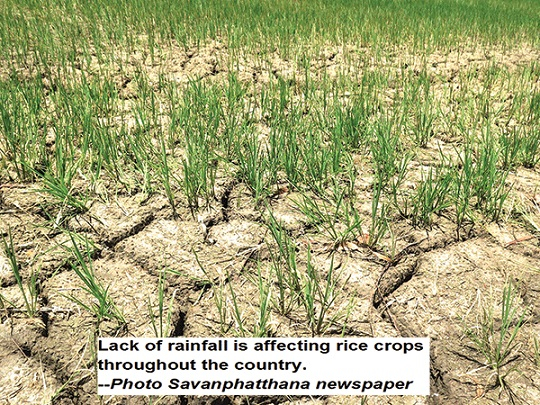
The fourth issue concerned the persistent drought, which has resulted in low river levels and affected rice and other crops. According to the Ministry of Agriculture and Forestry, only 40 percent of the country’s 800,000 hectares of wet-season rice has been transplanted.

The fifth matter of concern was the fluctuating exchange rate, the falling value of the kip in relation to foreign currencies and the depletion of foreign-exchange reserves, which has driven up product prices and is hindering economic growth.

The sectors responsible were instructed to boost productivity so there would be more goods for export, to facilitate business operators, and to attract more foreign tourists, as these would all boost economic growth.

The sixth issue related to posts on social media by members of the public commenting on state administration and management, which gave rise to discussions by the cabinet about the regulation of information posted on social media.

Prime Minister Thongloun Sisoulith urged all government sectors to put in place effective measures to address these problems.

All sectors must do more to ensure they fulfil the tasks assigned to them by the government.

Government members were requested to act upon the outcomes of the meeting and to ensure the sectors in their area of responsibility carried out essential projects and dealt with the matters planned for August. This work should be reported on to the Prime Minister’s Office on August 15.

Other issues debated at the meeting included the development and management of special and specific economic zones, preparations for the 2019 Roundtable Meeting, a draft decree on the policy for economic development in Xaysomboun province, and a draft decree relating to climate change.

The government is expected to hold an extraordinary meeting on August 5 and to convene its next regular monthly meeting on August 21-22.

Korea to raise tax credit rate for corporate facility investments, R&D

ศาสตร์เกษตรดินปุ๋ย : ขอบคุณแหล่งข้อมูล : หนังสือพิมพ์ The Nation

https://www.nationthailand.com/ann/30373693

Korea to raise tax credit rate for corporate facility investments, R&D

Jul 26. 2019
By The Korea Herald
Asia News Network

82 Viewed

The South Korean government announced Thursday that it plans to raise the tax credit rate for corporate facility investment and research and development in an effort to stimulate the economy by lifting the tax burden on firms.

The government’s announcement of its 2019 tax code revision bill, comes amid an escalating trade row between Korea and Japan, after Tokyo placed export restrictions on key materials needed for semiconductors and display screens, as well as a slew of pessimistic economic indices including a slashed economic growth outlook of 2.2 percent for this year by the central bank.

In its tax code revision bill, the Ministry of Economy and Finance said it plans to temporarily raise the tax credit rate for facility investment from the current 1 percent to 2 percent. The hike will be effective next year, if the parliament passes the bill by the end of 2019.

The rate for small and medium-sized businesses will also be raised to 10 percent from the current 7 percent.

The tax credit rate for facility investment was lowered in 2017 from the previous 3 percent to 1 percent for conglomerates or large businesses, but it has only resulted in lackluster corporate investments, which the current administration aims to revitalize.

Regarding research and development, it has added system semiconductors and biobetters — drugs that have improved over the original — to the list of technologies eligible for tax support.

The revised law will also allow firms to receive tax benefits in overseas outsourcing of experiments, especially clinical trials for local and pharmaceutical companies. Only projects carried out with local companies or laboratories are currently eligible for tax support.

The government plans to cut the surtax tied to the inheritance tax, when largest shareholders of large businesses decide to transfer their stocks to family members. For large businesses, the surtax rate will be adjusted to 20 percent from the current 30 percent, while the rate for SMEs will be abolished.

At the moment, the country charges a 50 percent inheritance tax for assets worth more than 3 billion won ($2.5 million), but an additional 30 percent is levied when the largest shareholder with more than 50 percent stake in a large company inherits the assets, which pushes up the total tax rate to a maximum of 65 percent.

For SMEs, the extra rate currently amounts to 15 percent.

The current death tax rates are the highest among the Organization for Economic Cooperation and Development member countries.

But the corporate tax will be left untouched, according to the ministry, saying only 101 large Korean companies here pay the highest rate of 25 percent.

Experts showed mixed reactions to the government’s new tax plans, saying that while the bill may be “appropriate” for the current state of the economy, stronger steps still need to be taken.

“It is an appropriate measure to expand support for corporate and R&D investment, invigoration of export and domestic demand, along with alleviation of pressure stemming from current laws surrounding corporate succession,” said Lee Kyung-sang, director of economic research at the Korea Chamber of Commerce and Industry.

But mentioning Japan’s latest export restrictions, he added, “There are, however, hopes for stronger measures regarding tax support for research and development that could help the production of domestic materials.”

Korea Enterprises Federation, a business lobbying group here, also called the latest bill a “positive move,” but “insufficient for economic agents to actually be aware of its effects.” It added that the government must address and revise corporate tax laws in order to invigorate the economy.

The ministry is slated to submit the tax revision bill to parliament on Sept. 3 for approval.

Nationwide #boycottJapan campaign puts Korean workers in tight spot

ศาสตร์เกษตรดินปุ๋ย : ขอบคุณแหล่งข้อมูล : หนังสือพิมพ์ The Nation

https://www.nationthailand.com/ann/30373692

Nationwide #boycottJapan campaign puts Korean workers in tight spot

Jul 26. 2019
Citizens protest in front of a Uniqlo store. (Yonhap)

Citizens protest in front of a Uniqlo store. (Yonhap)
By The Korea Herald
Asia News Network

162 Viewed

These days, Kim Hyun-jin feels uneasy telling others where he works.

“I have been working at Uniqlo for two years as a part-timer. I am proud of my workplace. It is a fun place to work, with nice people and relatively a good amount of pay,” said the 25-year-old student majoring in fashion at a university, who agreed to speak under a pseudonym.

“But now, when I say I work at Uniqlo, people think I’m doing something very wrong and it makes me feel very uncomfortable. I hope everything goes back to normal soon,” he told The Korea Herald, adding that the ultimate responsibility of taking issue with Japan should lie with the government.

Since Japan restricted exports to Korea of hi-tech materials used as key components in semiconductors and display panels, consumers here have been joining moves to boycott Japanese goods or anything related to the neighboring country.

Citizens protest in front of a Uniqlo store. (Yonhap)

According to the country’s largest discount chain E-mart, sales of Japanese beer brands such as Asahi from July 1 to 18 saw a 30.1 percent drop compared to June, while sales of Japanese instant noodles and condiments fell by 31.4 percent and 29.7 percent, respectively, in the same period.

“I do know that boycotting Japanese products would only dent Japanese companies, if it does anything at all. But the boycott is not specifically about making a specific company suffer, but about at least finding a way to show (the Japanese goverment) that we don’t forget,” said 43-year-old Kim Jeong-seol, who says he has stopped buying what he called “overtly Japanese brands.”

#boycottJapan’s impact

Cautious voices of concern have also been rising here over the efficacy of the wide-spreading boycott at the expense of Korean employees and other domestic firms closely associated with the Japanese brands.

Some 5,000 employees who work at 200 Uniqlo stores are among them, with some now worrying about their job security.

Uniqlo, which entered Korea in 2004 with a 51 percent investment from Japan’s Fast Retailing and the rest from Korea’s Lotte Shopping, is undoubtedly a Japanese brand. But more than 99 percent of workers here are Korean. Market rumors have circulated that Uniqlo is considering encouraging employees to take leave and reviewing restructuring, although the company has since denied it.

An employee working for a Japanese automotive brand in Korea said morale inside the company has been significantly affected by the ongoing trade conflict and boycott movement.

“After some Japanese companies here canceled or reduced the scale of their planned promotional events amid intense sentiment here, staff morale is extremely low, and we do not really know what to do except wait and see,” he told The Korea Herald.

With worsening consumer sentiment toward Japanese companies, some Korean companies have mistakenly been identified by some as being Japanese have even released statements explaining they are not.

E-commerce retailer Coupang recently released a statement explaining why it is not a Japanese firm, but rather “a proud Korean company.”

“We operate 99 percent of our business in Korea and have significantly attributed to creating jobs in Korea by hiring 25,000 employees and spending some 1 trillion won ($846 million) in wages,” Coupang said in a statement.

“We really do not know who spread such rumors, maybe someone who wants to hinder Coupang’s business growth and minimize the quality service that customers can get,” Coupang added.

Daiso, which is invariably mentioned in any boycott of Japanese products, also expressed its regret and said that Daiso Industries in Japan is the second largest shareholder of Asung Daiso in Korea with a 34 percent share, not the largest, and that the company does not pay royalties.

According to the company, 12,200 Korean employees work at 1,300 Daiso stores across the country, while about 70 percent of or 680 products sold at Daiso are manufactured through small and medium-sized companies here.

Industry insiders said that although there are understandable grounds for Koreans to boycott Japanese goods, they hoped the cause of the boycott could be resolved soon, considering the innocent parties caught in the crossfire.

“If the boycott continues, the movement can negatively impact the livelihoods and job security of employees, subcontractors and manufacturers who are all Koreans,” said one industry insider, wishing to remain anonymous.

What is a successful boycott?

Experts share similar views, citing how boycotts often lead to very little incentives or benefits to those participating in them.

“Many times, the benefit of a boycott, such as changing the unethical behavior of the target firm, is not in the hands of consumers,” said Kim Bang-hee, a columnist and chief of Kim Bang-hee Life and Economy Research Center.

“Lotte is also viewed as a Japanese company, but it is hard to consider it as a boycott target due to its impact on Koreans and their livelihoods here. That is why the most effective boycott which directly impacts Japan’s economy would be simply not traveling to Japan. Boycotting Uniqlo has less impact,” Kim said.

Observers also pointed to the asymmetry in trade between Korea and Japan that weakens the power of a boycott of Japanese products, particularly in this case where a country as a whole is targeted rather than a specific company.

“When you compare Korea and Japan’s bilateral trade, it is noticeable that what Japan imports from Korea can be substituted, while Korea cannot,” said Cho Kyung-yeob, a senior researcher at the Korea Economic Research Institute, during a seminar held at the National Assembly last week.

In this context, others pinpointed that the cause of the boycott — trade restrictions believed to be connected to historical issues — can and should be resolved through trade, diplomatic measures and government-level actions.

“(A boycott of Japanese goods) is understandable based on the sentiments of Koreans, but the impact is uncertain and such a movement can provide justification for Japan retaliate further,” said Huh Yoon, a professor of international studies at Sogang University.

“Those who run business related to a Japanese brands and (who are) hired by Japanese companies here are Koreans. We need to consider the possible damage that follows,” he added.

For a boycott campaign to thrive in the long term, some experts also pointed to consumers’ understanding of “responsible consumption” as key to leaving a lasting impact.

“Boycotts are collective endeavors and actions, but in their voluntary will. When the boycott becomes a long-term movement, consumers may feel tempted to let others make the sacrifice,” said Lee Eun-hee, a professor of consumer studies at Inha University.

Despite the hope of citizens joining the boycott to “teach Japan a lesson” through their collective action, some voiced concerns that the boycott itself could be politicized.

“It is utterly wrong for (Japan) to have brought in businesses in the political confrontation. However, the dichotomous way of depicting those buying Japanese goods as traitors and those boycotting as patriots also concerns me, especially if it is instigated on a government level,” said Lee Min-hee, a Korean worker based in Japan.

Unions call on civil servants to fulfill duties

ศาสตร์เกษตรดินปุ๋ย : ขอบคุณแหล่งข้อมูล : หนังสือพิมพ์ The Nation

https://www.nationthailand.com/ann/30373691

Unions call on civil servants to fulfill duties

Jul 26. 2019
Photo by: China Daily Hong Kong

Photo by: China Daily Hong Kong
By China Daily Hong Kong
Asia News Network

69 Viewed

HONG KONG-Three civil service unions in Hong Kong issued a joint statement on July 25, calling on their members at all levels of the administration to stay committed to their duties in these trying times.

The statement reminded the civil servants of their duty to support the special administrative region government in exercising law-based governance.

The unions which together represent more than 60,000 civil servants, are the Government Employees Association, Hong Kong Civil Servants General Union, and Chinese Academy of Governance Hong Kong Alumni Association.

The statement is widely seen as a response to several open letters from different groups of government employees expressing disappointment at the way in which Chief Executive Carrie Lam Cheng Yuet-ngor and other senior officials handled the escalating protests against the now-suspended extradition bill.

In the most widely reported letter, some 400 executive officers urged the government to respond to demands by the protesters. Another letter, from 200 civil servants, threatened to call a strike if the government “continues to ignore public opinions”.

In their joint statement, the unions made a plea to protesters and opposition politicians to stop demonstrations and show a willingness to talk rationally with the government to settle the differences.

Secretary for the Civil Service Joshua Law Chi-kong also issued a statement on Thursday, appealing to civil servants to continue serving the community with dedication and professionalism during this “difficult time”.

Law said he understands that fellow civil servants might have different opinions regarding recent events, but hopes they will not let such differences stand in the way of their work.

In recent weeks, violent street clashes and “non-cooperation campaigns” related to anti-extradition bill protests have caused great disruption to businesses and people’s daily lives.

Activists disrupted the services of the underground railway during the morning rush hour on Wednesday, resulting in delays and endangering the safety of passengers.

A group of aviation industry employees planned a rally on July 26 afternoon at Terminal 1 of Hong Kong International Airport. The Airport Authority Hong Kong, a government body responsible for the operation of the airport, has called on participants to avoid affecting passengers and airport operations.

Toyota plans to invest $600m in Didi Chuxing

ศาสตร์เกษตรดินปุ๋ย : ขอบคุณแหล่งข้อมูล : หนังสือพิมพ์ The Nation

https://www.nationthailand.com/ann/30373688

Toyota plans to invest $600m in Didi Chuxing

Jul 26. 2019
A Didi self-driving car on display during an industry expo in Beijing. [Provided to China Daily]

A Didi self-driving car on display during an industry expo in Beijing. [Provided to China Daily]
By China Daily
Asia News Network

67 Viewed

Didi Chuxing announced on Thursday that Japanese carmaker Toyota Motor Corp will invest $600 million in it, a move which is expected to fund the loss-making Chinese ride-hailing company’s further expansion in the transportation sector.

Under the partnership, the two sides will establish a joint venture to provide vehicle-related services, including car rental and maintenance, for ride-hailing drivers on Didi’s platform. The move came as Didi strives to ensure an adequate supply of cars and drivers to improve its services.

Stephen Zhu, senior vice-president of Didi, said: “We look forward to combining Didi’s expertise in artificial intelligence-based large-scale mobility operations and Toyota’s leading connected vehicle technology to build a next-generation intelligent transportation framework for sustainable cities.”

According to him, the Beijing-based company is committed to helping cities achieve new energy and smart transportation goals with partners from home and abroad.

Shigeki Tomoyama, Toyota executive vice-president responsible for connected areas, said: “I am delighted that we are strengthening our collaboration-which utilizes Toyota’s connected technologies and next-generation energy-with Didi, China’s mobility service market leader. Looking ahead, we will work with Didi to develop services that are more attractive, safe and secure for our customers in China.”

The move also marks an extension of Didi’s mobility plus automotive industry alliance strategy. Last April, Didi launched a cross-sector alliance with top Chinese and international carmakers, including FAW, Dongfeng, BAIC, Geely, BYD, Toyota, Volkswagen and Renault-Nissan-Mitsubishi.

The alliance is aimed to create an open platform for automobile solutions, as new energy, artificial intelligence technology and shared mobility are expected to reshape the transportation sector.

Jia Xinguang, former chief analyst of China Automobile Industry Consulting, said the global automobile industry is very anxious to catch up with new technological trends, with Chinese carmakers particularly afraid of falling behind.

“Befriending tech companies including Didi can help them know the pioneering applications of AI in the automobile sector,” Jia said. “For Didi, it is a good way to find enough supply of cars at lower costs.”

Didi has been putting safety at the top of its agenda for more than a year after two female passengers were killed while using its “hitch” service. The two incidents triggered the suspension of some of its most lucrative businesses.

As some worry over whether Didi can make a profit, the seven-year-old company is now stepping up its push to seize new growth opportunities including car financing and more partnerships with carmakers.

Didi and Toyota, which announced their cooperation last January, have piloted vehicle-related services for Didi ride-hailing drivers, utilizing Toyota Mobility Services Platform’s intelligent analysis capabilities to provide drivers with quality automobile maintenance support and safe driving guidance.

Korea to join RCEP talks in China this week

ศาสตร์เกษตรดินปุ๋ย : ขอบคุณแหล่งข้อมูล : หนังสือพิมพ์ The Nation

https://www.nationthailand.com/ann/30373626

Korea to join RCEP talks in China this week

Jul 25. 2019
Yeo Han-koo (center), head of trade negation bureau of the Trade Ministry, attends the 26th official negotiations for RCEP on June 28 in Australia. (MOTIE)

Yeo Han-koo (center), head of trade negation bureau of the Trade Ministry, attends the 26th official negotiations for RCEP on June 28 in Australia. (MOTIE)
By The Korea Herald
Asia News Network

67 Viewed

South Korea is slated to participate in the 27th official negotiations this week to discuss the implementation of an Asia-Pacific mega trade deal possibly this year.

The upcoming talks for a Regional Comprehensive Economic Partnership will be held in Zhengzhou, China, from Friday.

RCEP is, in essence, a massive regional trade deal between the 10 members of the Association of Southeast Asian Nations and the six countries with which ASEAN has free trade agreements — Korea, China, Japan, India, Australia and New Zealand.

The negotiations were launched in 2012 and are expected to be completed by the end of this year.

The six-day talks will be attended by the Korean delegation led by Yeo Han-koo, head of trade negation bureau of the Trade Ministry, with around 45 officials from related ministries.

The participating nations are expected to make efforts to accelerate the negotiations on market access in products, services and investments with the aim of closing the deal within this year.

Amid escalating trade tension between Korea and Japan, the Korean delegation also plans to seek cooperation from the participating nations, explaining Japan’s export curbs may seriously disrupt the international trade order also in RCEP nations.