Duterte may tackle drug war, sea policy

ศาสตร์เกษตรดินปุ๋ย : ขอบคุณแหล่งข้อมูล : หนังสือพิมพ์ The Nation

https://www.nationthailand.com/ann/30373397

Duterte may tackle drug war, sea policy

Jul 22. 2019
Photo by: Philippines Daily Inquirer

Photo by: Philippines Daily Inquirer
By Philippines Daily Inquirer

Asia News Network

53 Viewed

MANILA, Philippines — Buoyed by his high ratings, President Rodrigo Duterte may continue to defend his controversial stand in the Philippines’ territorial dispute with China in the South China Sea and his brutal war on drugs in his speech at the opening of the 18th Congress on Monday.

Thousands of protesters plan to march on the legislative complex in Quezon City to denounce the President’s policies while the Senate and the House of Representatives, sitting in a joint session, listen to the President detail his plans for the second half of his term.

The police and the military have gone on full alert, although no threat to public safety has been monitored.

The annual presidential address to Congress, a borrowing from an American tradition, is a gala affair in the Philippines, with legislators and their spouses coming in formal attire — the traditional barong tagalog for men and the terno for women.

School has been called off at all levels in Quezon City to ease vehicular congestion on the road to the legislative complex.

The joint session starts at 4 p.m.

Maria Ela Atienza, a political science professor at the University of the Philippines, on Saturday said the President’s first three State of the Nation addresses were consistent attacks on his critics and his speech on Monday could be no different.

Atienza noted that the President enjoyed a “renewed mandate” as a result of his allies’ victory in May’s midterm elections and high popularity ratings in opinion polls.

In the latest Pulse Asia poll, the President scored approval and trust ratings of 85 percent.

In the most recent Social Weather Stations poll, his net satisfaction rating was +68 percent.

The President, Atienza said, can be expected to continue defending his war on drugs, especially with the United Nations Human Rights Council’s recent decision to investigate the thousands of alleged extrajudicial killings in his crackdown on narcotics.

He can also be expected to continue attacking Western countries for interfering in Philippine domestic affairs and imposing their own standards on the Philippines “without understanding actual conditions” in the country, she said.

And as in the past, the President may also “continue attacking [his] local critics, particularly institutions like the [Catholic] Church and opposition groups that claim human rights have been sacrificed in the war on drugs,” Atienza said.

Fishing deal with Xi

The President, she said, can also be expected to “lecture” on the constitutionality of his verbal agreement with Chinese President Xi Jinping allowing Chinese to fish in Philippine waters in exchange for China’s allowing Filipinos to fish at Panatag Shoal, a traditional fishing ground for Filipinos that China seized in 2012.

He may also continue to defend his policy of greater cooperation with China amid widespread criticism of his handling of the June 9 sinking of a Philippine fishing boat in the South China Sea after being hit by a Chinese trawler, which then abandoned the boat’s crew in the open sea.

Press Secretary Martin Andanar, speaking in a radio interview on Sunday, said the President could mention the South China Sea territorial dispute in his speech, but whether he would lecture on the legality of his fishing deal with Xi depended on his mood.

Duterte may tackle drug war, sea policy

“It is highly possible that he will mention the West Philippine Sea and his stand,” Andanar said, using the local name for the waters within the Philippines’ 370-kilometer exclusive economic zone in the South China Sea.

“If he will deliver a lecture, off the script, I don’t know. That will depend on the prerogative and mood of the President,” Andanar said.

He said the President cut his speech from 28 pages to 19 pages during a rehearsal at the Palace with film and television director Joyce Bernal.

The speech may run for 45 minutes to an hour, depending on  Duterte’s reading speed and on his veering off the script, as he is wont to do, Andanar said.

“I don’t know what else he is going to say,” he said.

Real state of the nation

Senators on Sunday urged Mr. Duterte to speak about the real state of the nation.

Senate President Vicente Sotto said he wanted to hear the President focus on bringing down the number of drug dependents through a “demand-reduction strategy.”

“I want the demand-reduction strategy to be given more efforts. We have a strong and good supply-reduction strategy, but we have to do better in reducing the demand [for narcotics] as part of prevention,” Sotto said on radio.

“The day we stop [people] from buying [illegal drugs] is the day they (drug dealers) stop selling,” he added.

Detained Sen. Leila de Lima said she hoped  Duterte would dispense with his usual “crude jokes” and just discuss the realities in the country.

She said  Duterte should explain to the public his defeatist stance in the country’s territorial dispute with China and the government’s failure to stem the proliferation of illegal drugs despite his bloody crackdown on narcotics.

“Duterte should admit to the Filipino people that his war on drugs achieved nothing but spill the blood of his countrymen,” De Lima said in a statement.

Gut issues

Sen. Nancy Binay said the President should “extensively tackle the gut issues,” including unemployment, rising prices of basic goods, and low pay for workers.

“The Senate will be listening. Even with a giant list of legislative priorities, we are ready to help craft necessary laws that will benefit the people,” Binay said.

Environmental groups last week said they hoped the President would talk about the destruction of the country’ patrimony in China’s aggressive encroachment on the West Philippine Sea.

According to the Kalikasan People’s Network for the Environment, the Duterte administration has sold at least P773 billion worth of sovereign resources since coming to office.

It said the figure was the estimated total value of marine resources destroyed by Chinese vessels in the West Philippine Sea since 2016 and the value of land and water resources promised as guarantees for the loans for the Kaliwa Dam and Chico River irrigation projects.

Plastic waste: The blame is on us, convenience-minded consumers

ศาสตร์เกษตรดินปุ๋ย : ขอบคุณแหล่งข้อมูล : หนังสือพิมพ์ The Nation

https://www.nationthailand.com/ann/30373395

Plastic waste: The blame is on us, convenience-minded consumers

Jul 22. 2019
A 3-year-old boy is helping his parents sorting the waste. (JP/Sigit Pamungkas)

A 3-year-old boy is helping his parents sorting the waste. (JP/Sigit Pamungkas)
By The Jakarta Post
Asia News Network

53 Viewed

Indonesia’s problem of plastic waste pollution is not the result of the occasional rogue foreign shipment. It is caused mainly by each one of us, the hundreds of millions of convenience-minded consumers who have become so used to buying cosmetics, household detergents, water, eggs in boxes and packaged food in single-use packaging.

When buying such products we don’t give a thought to what will happen to the plastic after we discard it. Unless sorted and collected such packaging will end up in a landfill where it will degrade only after 450 years, experts say, or, worse, find its way to the sea.

Recently, a few Asian governments intercepted imported shipments of allegedly hazardous waste comprising household garbage, municipal waste, hospital waste and electronic scrap. Indonesia itself has shipped five containers of plastic wastes back from Tanjung Perak Port in Surabaya, East Java, to the exporters in the countries of origin, mostly Western industrialized nations.

Some of this waste had been misleadingly declared recyclable plastic scrap and there is a likely connection between the sudden increase of such shipments and the notification given by China to the World Trade Organization in July 2017 that it would no longer import various kinds of recyclable scrap. Since the early 1990’s China eagerly consumed 60 percent of the world’s recyclable scrap to fuel its manufacturing boom and this sudden decision left scrap exporters scrambling to look for new markets.

According to research by the United Kingdom-based Financial Times, the countries that immediately stepped in to fill the gap left by China were, in order of size, Malaysia, Vietnam, Thailand, Hong Kong, India, Taiwan, the Netherlands, Turkey and Indonesia.

Politicians have found it fashionable to describe Asia as having become the “dumping ground” for the waste of Western countries. However, every shipment of recyclable plastic involves a buyer and seller.

No reputable recycling company wants to import scrap that has been contaminated and no foreign government wants the embarrassment of being forced to take back its own garbage.

However, in international trade there will always be rogue elements all too ready to make a quick profit through fraudulent declarations. Until recently the export of plastic scrap was not even covered by the Basel Convention, so such exporters could not be prosecuted by their own governments.

The main reason that China gave to the WTO for its decision to stop importing scrap was because many shipments had been mixed with “dirty waste” that could not be used as raw material and contaminated the environment.

Fortunately this problem was recently addressed by the Basel Action Network and in May 2019 the Basel Convention was amended to include mixed and contaminated plastic scrap as “hazardous waste”. Indonesia also signed the amendment that will come into force in January 2021.

Unfortunately the isolated cases of waste imports have resulted in an unfair backlash against the import of plastic and other scrap needed as raw material for the legitimate local recycling industry. The call for a total ban on transboundary plastic scrap is a throwaway phrase that does not acknowledge this important local industry.

In Indonesia a well-established reputable recycling industry employs thousands of people. The Industry Ministry estimates Indonesia needs 600,000 tons of imported scrap a year and can potentially enjoy a healthy trade surplus by exporting back recycled plastic pellets, flakes, plastic chips and geotextiles for road construction.

Reputable foreign investors have entered this sector such as the recent bottle-to-bottle recycling plant in East Java. At least one of Indonesia’s largest producers of bottled water can now claim to use bottles made out of 100 percent recycled local plastic.

However, the local recycling industry presently has no choice but to continue to import plastic scrap because it is simply not able to utilize the plastic waste produced by Indonesian consumers, owing to the absence of efficient municipal waste collection, sorting and cleaning systems.

Unless there is a demand from the consumer for biodegradable containers, or for a reuse model in which all bottled liquids have to be sold together with refills, the amount of single use packaging will not decrease in the short-term. Indonesia should instead immediately implement less challenging strategies.

We cannot expect consumers to sort their household waste or desist from throwing it into the river for love of the environment. Even Singapore, a model of urban cleanliness, has yet to convince residents to sort their household waste. However, if householders are paid to sort their waste as in the commendable Indonesian bank sampah (app-based garbage collection bank) scheme, already comprising over 7,000 banks, then they will do so.

Similarly, we cannot expect municipalities to find the funds for recycling facilities. However, such funds would be readily available if there was a regulation on a national program of extended producer responsibility (EPR) in which the producer who delivers a product in a single-use container must take responsibility for its end of life, and make a small contribution to an ecofund for recycling infrastructure. Such a program could also be extended to the less visible but more serious problem of electric and electronic waste.

The EPR regulation could be part of a wider effort under Law No. 18/2008 on waste management to cut Indonesia’s waste output; it would oblige producers and retailers to redesign their product packaging to have a higher proportion of recyclable material. It will also require that they take greater responsibility for the waste management of their products.

S. Korea gears up for financial market contingency plan amid Japan factor

ศาสตร์เกษตรดินปุ๋ย : ขอบคุณแหล่งข้อมูล : หนังสือพิมพ์ The Nation

https://www.nationthailand.com/ann/30373394

S. Korea gears up for financial market contingency plan amid Japan factor

Jul 22. 2019
Photo by: The Korea Herald

Photo by: The Korea Herald
By The Korea Herald
Asia News Network

85 Viewed

In response to the escalating economic conflict between South Korea and Japan, financial authorities here are establishing a contingency plan in case Tokyo expands its trade restrictions to the financial sector, officials said Monday.

The preemptive gesture came out of concern about the apparent dependency of local financial companies on Japanese lenders, which have been offering a low interest rate for years.

The total amount of Japanese money circulating in Korea’s financial market was estimated at 52.9 trillion won ($44.9 billion) as of end-June, according to data compiled by Rep. Jeon Hae-cheol of the ruling Democratic Party.

This tentative total included 13 trillion won worth of stocks and 1.6 trillion worth of bonds held by Japanese investors as of end-June, as well as 24.7 trillion won worth of loan credit by Japanese banks operating in Korea as of end-May.

What has especially put Seoul’s market regulators on guard was the $17.56 billion that Korean banks and credit card operators borrowed from Japanese lenders.

Of the amount, banks accounted for 53 percent or $9.26 billion. While credit card operators accounted for less than half, they are seen as facing higher volatility due to their heavy dependence on low-interest Japanese loans.

The policy regulator Financial Services Commission and market watchdog Financial Supervisory Service, along with major banks, are currently operating a special task force to check on the credit maturity of Japanese loans and to draft a contingency plan, officials said.

As for the FSC, officials are carrying out an extensive stress test, including the possibility of a 100 percent withdrawal of Japanese money from the local market, in which case regulators may provide an emergency injection of liquidity into individual financial companies.

However, observers claimed that Seoul’s financial market will remain resilient, even if Japanese lenders choose to take extreme actions.

“Based on the experience of the 1997 Asian financial crisis and the 2008 global financial crisis, we are fully ready to come up with an extensive (contingency) plan right away when necessary, but there is no need to distort reality and overreact,” said an FSC official.

“The possibility of Japan’s retaliation in the financial sector is relatively low, and also (Korea’s financial market) has sufficient capacities of contingency actions.”

Financial policymakers have already set up plans to provide liquidity to companies directly hurt by Japan’s export curbs.

The government earlier vowed to inject some 10 trillion won in policy financing during the latter half of the year. This amount, along with an additional 7.5 trillion won of trade financing funds, will be used to support local companies amid the bilateral trade tension, according to officials.

Boycott of Japanese goods, services spreads rapidly

ศาสตร์เกษตรดินปุ๋ย : ขอบคุณแหล่งข้อมูล : หนังสือพิมพ์ The Nation

https://www.nationthailand.com/ann/30373393

Boycott of Japanese goods, services spreads rapidly

Jul 22. 2019
Shelves allocated for Japanese condiments remain empty after the products were taken off the shelves earlier in the month at Nonghyup Hanaro Mart’s Chang-dong branch. (Kim Bo-gyung/ The Korea Herald)

Shelves allocated for Japanese condiments remain empty after the products were taken off the shelves earlier in the month at Nonghyup Hanaro Mart’s Chang-dong branch. (Kim Bo-gyung/ The Korea Herald)
By The Korea Herald

Asia News Network

118 Viewed

The campaign to boycott Japanese products and services here is gaining steam as bilateral relations continue to be tense following Japan’s export curbs on key hi-tech materials crucial for South Korean tech firms.

Japanese condiments and beer brands have been removed from store shelves, even as a substantial number of travel reservations to Japan are being canceled and inquiries for Japanese passenger vehicles have halved.

As more Koreans quietly join the boycott, a website called NoNo Japan that provides information on Japanese products as well as local alternatives experienced a server crash last week due to a sudden spike in traffic.

“I’ve consciously tried to avoid using Japanese products. But ever since the news broadcast (of NoNo Japan) I have been more attentive of my purchases,” a woman in her 50s surnamed Kim, buying groceries at Nonghyup Hanaro Mart’s Chang-dong branch in Seoul, on Sunday, told The Korea Herald.

“I have told my kids to stop shopping at Uniqlo (a Japanese casual wear retailer). Our family members often purchase clothes there. Also I have switched from using Japanese curry to Baeksae curry (a local brand) and stopped drinking Japanese beer,” Kim said.

At the heart of the quiet, yet widespread boycott, is the deep-rooted historical conflicts between Korea and Japan surrounding the latter’s wartime atrocities, including military sexual slavery and forced labor.

Though Tokyo claims to have settled all issues in the1965 treaty on normalization of relations, the absence of an official and sincere apology remains an unresolved matter for Koreans.

The creator and operator of NoNo Japan, Kim Byung-kyu, said in an interview with local media that the long-overdue reparation to 95-year-old Lee Chun-sik, who was taken into forced labor at 17, propelled him to launch the website earlier this month.

“Japan has crossed the line. Tokyo’s swipe at Korean businesses — Samsung Electronics and SK hynix — because of a ruling by Korea’s top court on forced labor has sparked public outrage,” said Sul Dong-hoon, sociology professor at Jeonbuk National University.

“The boycott is spreading online and people are voluntarily participating. This is a clear contrast to movements stirred by elite groups and China’s government-led boycott during the THAAD row.”

According to local pollster Realmeter, 54.6 percent of the 503 adults survey last week said they were participating in the boycott, showing a 6.6 percent hike from the previous week.

Nonghyup Hanaro Mart’s Chang-dong branch was the first large supermarket chain to pull Japanese products from sales earlier this month.

Banners reading “Nonghyup Hanaro Mart Chang-dong branch does not sell Japanese products!!” have been placed where Japanese goods were once on display.

“The Chang-dong branch was established with 100 percent Korean capital. We are joining the nationwide boycott to protest against the unfair export regulations. The economic retaliation has spilled over from political problems, such as the forced labor issue,” the banners read.

The outrage against Japan’s economic retaliation is resonating across all age groups.

“It is effecting me when I shop for clothes and pen,” Park Jung-woo, 19, told The Korea Herald.

“I opt for Spao instead of Uniqlo, and pens made by Monami rather than Signo. … The boycott campaign is frequently a topic of discussion with friends these days,” Park added.

Shin Dong-yeop, a retiree in his 60s, said he “deeply agrees” with the refusal to sell and buy Japanese products.

“It’s necessary for us to show that we can stand up and give a big response,” Shin said.

As NoNo Japan developer Kim mentioned, the boycott may not last long. But for the time being, Japan’s business, culture and tourism sectors will feel the heat.

Sales of Japanese beer at local retail giant E-mart plummeted 30.1 percent from July 1-18 compared to the same period in June, according to industry figures.

Sales of Japanese ramen at the largest retail chain in Korea dropped 31.4 percent, Japanese sauces and condiments fell 29.7 percent and Japanese natto slipped 9.9 percent in the cited period.

Ahead of the summer vacation season, a rising number of Koreans are also canceling their booked trips to Japan despite the cancellation fees.

Hana Tour, Korea’s largest travel agency, has registered a daily average of 500 people for trips to Japan since July 8, less than half the 1,200 daily average it recorded previously.

This trend, if it continues, should worry the Japanese government that has sought to capitalize on Korean tourists during the Tokyo Summer Olympics 2020.

Some 7.3 million Koreans traveled to Japan in 2018, making it the second-largest group of tourists after Chinese, according to official data.

“The trade regulations have fundamentally distorted basic trust in free trade and the international division of production,” said Rhyu Si-min, a popular liberal politician-turned-writer, in a YouTube webcast.

“Japan took advantage of Korea’s economic weakness and slapped a one-point (regulation) over discontent that should not have been a reason for export curbs. Regardless of the degree of repercussions, psychologically it is inevitable for us to feel angered. It is natural and within the constitutional rights to express (anger) by boycotting Japanese products,” Rhyu added.

Boycott notifications that have replaced Japanese items at the Nonghyup Hanaro Mart Chang-dong branch state: “We hope for the prompt normalization of trade between Korea and Japan.”

Until then the public-backed quiet protest is likely to persist.

“I don’t consider myself an active participant in the boycott. But I’ve made small changes by leaving out Japanese products from the shopping cart since the economic retaliation. I’ll continue to do so until Japan retracts the trade regulations,” a freelance worker in her 40s surnamed Lim said.

Radicals deal new blow to peaceful city

ศาสตร์เกษตรดินปุ๋ย : ขอบคุณแหล่งข้อมูล : หนังสือพิมพ์ The Nation

https://www.nationthailand.com/ann/30373376

Radicals deal new blow to peaceful city

Jul 22. 2019
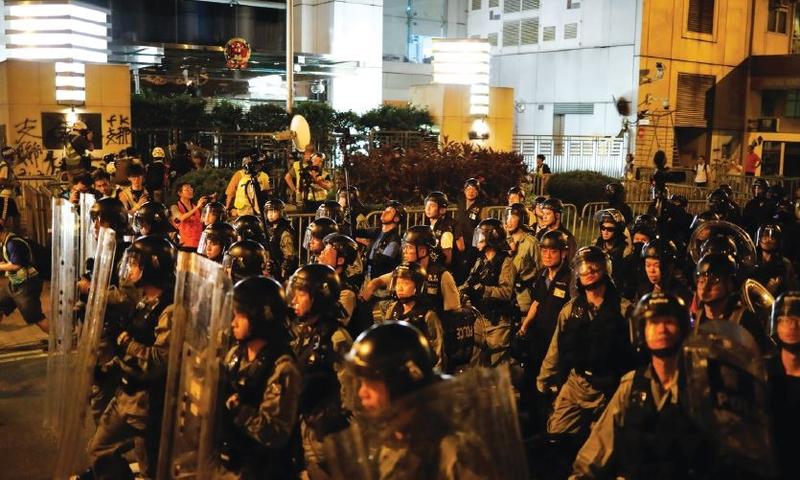
After repeated calls to protesters to leave were ignored, police were forced to fire tear gas in Sheung Wan on Sunday night to disperse violent demonstrators who responded by hurling missiles, including bricks and umbrellas, and lit fires on the roads. (PHOTO / CHINA DAILY)

After repeated calls to protesters to leave were ignored, police were forced to fire tear gas in Sheung Wan on Sunday night to disperse violent demonstrators who responded by hurling missiles, including bricks and umbrellas, and lit fires on the roads. (PHOTO / CHINA DAILY)
By  China Daily Hong Kong
Asia News Network

130 Viewed

Hong Kong was dealt another blow to its reputation as a city that’s run by the rule of law when radical protesters again resorted to violence on Sunday — clashing with police and besieging the liaison office, one of the central government’s key institutions in the special administrative region.

A China Daily cameraman captured some of violent heart-wrenching moments outside the liaison office and in Sheung Wan

A peaceful march against the now-suspended extradition bill earlier in the day turned ugly when radical protesters marched to the Liaison Office of the Central People’s Government in the HKSAR in Sai Wan, Hong Kong Island, to vent their anger.

READ MORE: Central authorities: Siege of liaison office unacceptable

Wearing goggles and face masks, the demonstrators besieged the liaison office with metal barricades, daubed offensive graffiti on the complex’s walls and defaced the national emblem mounted at the building’s entrance with black liquid.

After learning that the police were about to mount a clearance operation at around 8 pm, the protesters fled east to Sheung Wan, and refused to leave despite repeated calls by the police.

ALSO READ: Liaison office attack ‘defiance of nation’s sovereignty’

Police were forced to act at about 9 pm, firing tear gas in a bid to disperse the hundreds of protesters who responded by hurling missiles, including bricks and umbrellas, and lit fires on the roads.

A China Daily cameraman captured some of violent heart-wrenching moments outside the liaison office and in Sheung Wan.


While besieging Western Police Station, protesters use umbrellas to block the CCTV cameras and spray graffiti on the wall with black paint. (PHOTO / CHINA DAILY)


Masked demonstrators pry bricks from a road near Western Police Station to use them as missiles in battling with the police. (PHOTO / CHINA DAILY)


Riot police mount a clearance operation outside the Liaison Office of the Central People’s Government in the HKSAR that had earlier been vandalized by protesters. (PHOTO / CHINA DAILY)

Residents slam vandalism at liaison office

ศาสตร์เกษตรดินปุ๋ย : ขอบคุณแหล่งข้อมูล : หนังสือพิมพ์ The Nation

https://www.nationthailand.com/ann/30373374

Residents slam vandalism at liaison office

Jul 22. 2019
The plaque outside the Liaison Office of the Central People's Government in the HKSAR is defaced by protesters. (PHOTO / CHINA DAILY)

The plaque outside the Liaison Office of the Central People’s Government in the HKSAR is defaced by protesters. (PHOTO / CHINA DAILY)
By China Daily Hong Kong
Asia News Network

89 Viewed

HONG KONG – Residents and shop owners on Monday blasted the violent and hostile besiege of the Liaison Office of the Central People’s Government in the Hong Kong Special Administrative Region in Sai Wan by masked protesters the day before.

Protesters should express their views in a peaceful manner instead of vandalizing public property funded by taxpayers’ money, a lady said.

An 81-year-old lady who lives in an adjacent building strongly condemned radical protesters’ vandalism of sidewalks.

READ MORE: HK community condemns violent siege of liaison office

Pried bricks and damaged barrier railing were seen in the vicinity of the building.

She said protesters should express their views in a peaceful manner instead of vandalizing public property funded by taxpayers’ money.

The protesters also defaced the national emblem at the office’s facade, threw eggs at and painted graffiti on the office’s outer wall .

ALSO READ: Liaison office attack ‘defiance of nation’s sovereignty’

An owner of a laundry store nearby said he was worried about the tension in the society.

The 70-year-old retired civil servant said he hoped the deadlock could be solved through dialogue as soon as possible so that the Hong Kong government can return its focus to livelihood issues.

The traffic outside the Liaison Office was disrupted Sunday evening and has since resumed normal on Monday. Yet some shops in the area remained closed.

The defaced national emblem has been replaced with a new one at around 11 pm on Sunday.

ANN: Mekong levels set to rise soon

ศาสตร์เกษตรดินปุ๋ย : ขอบคุณแหล่งข้อมูล : หนังสือพิมพ์ The Nation

https://www.nationthailand.com/ann/30373367

ANN: Mekong levels set to rise soon

Jul 22. 2019
Hong Menea/Phnom Penh Post

Hong Menea/Phnom Penh Post
By Phnom Penh Post, through The Nation

151 Viewed

Despite a series of reports of Mekong River going dry, Phnom Penh Post offers a positive on the issue

The Mekong River water levels during the early rainy season in June, were among the lowest on record, according to the Mekong River Commission (MRC). But, the situation is expected to improve at the end of this month.

“From the upper reaches of the lower Mekong basin in Thailand’s Chiang Saen district to Cambodia’s Neak Luong [commune in Prey Veng province’s Peamro district], the water levels are below those that occurred in 1992, which was by far the year with the lowest flow on record.

“The water in Kratie, at 9.31m, is about 5.4m below its long-term average but is about 0.16m higher than the lowest level ever recorded. Between June 10 and July 18, there was a drop of about 0.38m at the station,” an MRC press release said.

MRC press communications officer Meas Sopheak told The Post on Sunday that people who depend on the river for their livelihoods would be impacted most. “The lower water level also makes navigation on the river difficult,” he said.

Mok Ponlok, Kratie provincial Fisheries Administration deputy chief and head of the Irrawaddy dolphin conservation group, declined to comment on Sunday.

The MRC’s analysis and available information said some key factors have contributed to the current state of what is described as the “regional low flow” of the Mekong river basin.”There has been very deficient rainfall over the Mekong basin since the beginning of this year.

“The average lower-than-normal rain volume in the lower Mekong basin during June and July could also cause deficient groundwater in the region, meaning there is insufficient groundwater contributing to the Mekong mainstream.

“The amount of water flowing from the upper part of the basin could also be a potential contribution to the low flow,” the MRC said.

A notification from China previously said that from July 5-19, the amount of water flowing out of the Jinghong dam in Yunnan province would be fluctuating from 1,050-1,250 to 504-600 cubic metres per second due to “grid maintenance”.

But the MRC said that with rain forecasted at the end of this month, the current state of the lower water in the basin is expected to improve.

Ministry of Water Resources and Meteorology spokesperson Chan Yutha told The Post on Sunday that all areas along the Mekong have been affected, not only Kratie.

“Other provinces have also suffered from low water levels, including Phnom Penh. Cambodia has not experienced such low water levels for many years.

“Our region is always affected by the El Nino phenomenon, which causes extreme heat and insufficient rain.

“So, as can be seen across the Kingdom, there was almost no unexpected rain during the dry season, and the rainfall during the early raining season is also interrupted,” he said.

Farmland has been affected, Yutha said, but the effect of El Nino would soon weaken and the water level will increase.

Last Wednesday, China agreed to continue sharing hydrological data with the MRC, which the MRC said would contribute to better river monitoring and flood forecasting in the Mekong countries.

MRC secretariat CEO Dr An Pich Hatda said on Friday: “This agreement is another milestone in China-MRC cooperation.

“Not only does it demonstrate the significance of enhanced information sharing between China and the MRC, but also their commitment to continue and increase cooperation.”

Sopheak told The Post on Sunday: “For more than 16 years, the Chinese data have proven to be very helpful to downstream countries for better planning, river monitoring and flood forecasting.

“Without the data from China, we would have incomplete information on the state of water levels in the Mekong basin,” he said.

https://www.phnompenhpost.com/national/mekong-levels-set-rise-soon

Promoting renewable energy an urgent requirement: Experts

ศาสตร์เกษตรดินปุ๋ย : ขอบคุณแหล่งข้อมูล : หนังสือพิมพ์ The Nation

https://www.nationthailand.com/ann/30373352

Promoting renewable energy an urgent requirement: Experts

Jul 22. 2019
A solar power plant in Tay Ninh Province. With demand for energy increasing, the efficient use of energy and promoting renewable energy have become urgent requirements. — Photo courtesy of TTC

A solar power plant in Tay Ninh Province. With demand for energy increasing, the efficient use of energy and promoting renewable energy have become urgent requirements. — Photo courtesy of TTC
By Vietnam News
Asia News Network
HCM CITY

57 Viewed

Along with its rapid economic growth, Vietnam’s electricity demand is also increasing fast, at around 10 per cent a year, causing huge pressure on the energy sector, according to the Ministry of Industry and Trade.

Truong Thanh Hoai, director general of the ministry’s industry department, said the country’s total electricity capacity reached nearly 50,000 MW last year to more or less meet demand.

Vietnam’s power capacity is the second highest among Southeast Asian countries and 30th in the world, he said.

Speaking at a conference on Vietnam’s strategy for developing green energy and energy saving until 2020 in HCM City last Wednesday, Nguyen Phuong Dong, deputy director of the city Department of Industry and Trade, said the growth in energy demand in the country was much higher than in places like Japan and Europe.

“This requires Vietnam to have efficient solutions for energy saving and develop new sources of energy and renewables.”

“The Government has issued policies to encourage the development of renewable energy such as wind, solar and biomass to reduce adverse impacts on the environment and encourage production of energy-efficient devices,” Hoai added.

Nguyen Anh Tuan of the Institute of Energy said: “Vietnam has diverse fossil energy resources like oil, gas and coal as well as renewable energy sources such as biomass, solar and wind.”

Currently hydropower and coal are the largest sources and would remain so in the short term, he told the conference.

Tuan said the Government revised the Power Development Plan for a seventh time in 2016 to increase the share of renewables like biomass, solar and wind to reduce the gap between demand and supply, and is now preparing for an eighth revision.

“The power generation structure has changed with greater reliance on renewable energy.”

As a country with a tropical monsoon, and sun and wind all year round, Vietnam has great potential for developing renewable energy.

Talking about the advantages and challenges related to solar energy generation in HCM City, Nguyen Ngoc Tuong Vi, acting director of the HCM City Power Corporation’s sales department, said the city has great potential for solar power, especially rooftop solar while the Government and the city have policies in place to develop rooftop solar and strong support from the public and businesses.

But the high cost of installing solar rooftop panels discourages people and there are a range of products in terms of origin, quality and warranty, confusing them, she said.

There are no national technical standards or standard specifications related to rooftop solar systems, and no guidelines on dealing with used solar panels and other issues, she said.

She said the Government should soon announce prices for solar power.

To encourage solar power generation, the Government announced that projects connected to the national grid by June 30, 2019, could sell electricity to EVN at 9.35 US cents per kWh, but no information on how much had been revealed, she said.

The Government should also promulgate regulations for recycling used solar panels and national technical standards for rooftop solar, she said.

The conference was held on the sidelines of the International Exhibition on Electrical Technology and Equipment and the International Exhibition on Products, Technologies for Energy Saving and Green Power, which took place in HCM City from July 17 to 20.

US opposes China’s acts to hamper oil, gas activities in East Sea

ศาสตร์เกษตรดินปุ๋ย : ขอบคุณแหล่งข้อมูล : หนังสือพิมพ์ The Nation

https://www.nationthailand.com/ann/30373348

US opposes China’s acts to hamper oil, gas activities in East Sea

Jul 22. 2019
A Vietnamese Coast Guard vessel on active duty. The Vietnamese foreign ministry on Friday demanded that China end its flagrant violations of Vietnam’s exclusive economic zone and continental shelf in the south of the East Sea. — VNA/VNS File Photo

A Vietnamese Coast Guard vessel on active duty. The Vietnamese foreign ministry on Friday demanded that China end its flagrant violations of Vietnam’s exclusive economic zone and continental shelf in the south of the East Sea. — VNA/VNS File Photo
By 
Vietnam News
Asia News Network

207 Viewed

HANOI — The US Department of State has expressed concern over reports that China is hampering other countries’ oil and gas activities in the South China Sea and said its acts threaten regional peace and security.

DoS spokeswoman Morgan Ortagus said in a statement on Saturday that China’s reclamation and militarisation of disputed outposts in the South China Sea or East Sea as it is known in Vietnam, along with other efforts to assert its unlawful maritime claims including the use of maritime militia to intimidate, coerce and threaten other nations, undermine the peace and security of the region.

“By blocking development through coercive means, China prevents ASEAN members from accessing more than US$2.5 trillion (Bt75 trillion) in recoverable energy reserves,” she said, citing an earlier statement by US Secretary of State Mike Pompeo.

These acts by China are interfering in particular with Vietnamese oil and gas exploration and production, she stated.

“The United States firmly opposes coercion and intimidation by any claimant to assert its territorial or maritime claims,” Ortagus added.

“China should cease its bullying behaviour and refrain from engaging in this type of provocative and destabilising activity.”

Earlier on Friday, Vietnam voiced its protests against China’s illegal deployment of its geological survey vessel group Haiyang Dizhi 8 near the Tu Chính reef (internationally known as Vanguard Bank) since early July.

Vietnamese foreign ministry’s spokesperson Le Thi Thu Hang demanded that China end its flagrant violations of Vietnam’s exclusive economic zone and continental shelf in the south of the South China Sea, which belongs to Vietnam in line with the 1982 United Nations Convention on the Law of the Sea (UNCLOS), to which both Vietnam and China are signatories..

She also noted that Vietnam has made several communications via different channels to make known its objections to China, and that Vietnam’s law enforcement is “adopting proper measures to uphold the nation’s sovereignty and jurisdiction in a peaceful manner and in line with international law.”

China claims the reef bank as part of its expansive “nine-dash line” which covers a large part of the South China Sea, but its claim has been resolutely rejected in an arbitration tribunal ruling by the Hague-based Permanent Court of Arbitration three years ago in the dispute brought by the Philippines against China.

Mekong falls to critically low level

ศาสตร์เกษตรดินปุ๋ย : ขอบคุณแหล่งข้อมูล : หนังสือพิมพ์ The Nation

https://www.nationthailand.com/ann/30373342

Mekong falls to critically low level

Jul 22. 2019
Photo by: Vientiane Times

Photo by: Vientiane Times
By Vientiane Times
Asia News Network

382 Viewed

The Mekong, one of the largest rivers in South East Asia, is experiencing a historically low level, and Vientiane residents whose livelihoods depend on the river are struggling to sustain their businesses.

Mr Xaysana Bounyalath, who has been fishing in the river near Vat Chan since 1975, said yesterday he had never known the water level be so low at this time of the year.

“As far as I am aware, the river is at a record low this rainy season,” he said, adding that the situation was making it hard for him to earn a living as a fisherman.

He said fish stocks in the Mekong were declining, and he believed that the abnormal water level was the cause of the problem.

A senior official at the Vientiane Water Supply Enterprise told Vientiane Times last week that the low level of the river would disrupt the supply of water in Vientiane because the pumps that are stationed along the riverbank could not pump up water at their full capacity.

The Mekong River Commission (MRC), which monitors the flow of the Mekong, announced last week that the level had fallen below the historical minimum.

The Commission reported that the water level in the Mekong during the early flood season from June to July was lower than that recorded in 1992, which saw the lowest flow on record.

“From the upper reaches of the lower Mekong basin in Thailand’s Chiang Saen to the Lao PDR’s Luang Prabang and Vientiane and further down to Thailand’s Nong Khai and Cambodia’s Neak Luong, the water levels are all below those that occurred in 1992, which was by far the year with the lowest flow on record,” the MRC said in a media statement.

The MRC claimed that there were a number of factors which may contribute to the low water level, saying data shows that the contribution of water from Mekong’s tributaries and upper reaches was abnormally low in June and July compared to previous years.

The Commission, which is a water diplomacy platform representing Cambodia, Laos, Thailand and Vietnam, also observed that rainfall has been very deficient in the Mekong basin since the beginning of this year.

In the upper reaches of the lower Mekong basin, Chiang Saen had the lowest rainfall in June compared to other areas downstream, the MRC said, adding that the average rainfall in the Thai town in June was only about 67 percent of the total amount of monthly rainfall in June 2006-2018.

The average lower-than-normal rain volume in the lower Mekong basin during June-July could also cause deficient groundwater in the region. This means there is insufficient groundwater contributing to the Mekong mainstream, the MRC said.

The Commission said last week that China had renewed its commitment to share hydrological data with the MRC, adding that this agreement would enable it to keep a close watch on water fluctuations in the Mekong.