Asean cities to ‘GET SMART’

ศาสตร์เกษตรดินปุ๋ย : ขอบคุณแหล่งข้อมูล : หนังสือพิมพ์ The Nation

http://www.nationmultimedia.com/detail/asean-plus/30360025

Nation Graphics
Nation Graphics

Asean cities to ‘GET SMART’

national December 08, 2018 01:00

By ASINA PORNWASIN
SUPALAK GANJANAKHUNDE
THE NATION WEEKEND

Thailand to lead smart-city project with Bangkok, Phuket and Chonburi featuring prominently in cross-border y in cross-border partnership.

Thailand will play a leading role in implementing the smart-city network covering 26 cities in the 10 Asean countries as the Kingdom takes over as the bloc’s chair next year, Digital Economy and Society Minister Pichet Durongkaveroj said this week. Bangkok, Phuket and Chon Buri will feature prominently in the smart-city programme, with a focus on advancing cross-border partnerships for sustainability in seven key areas – the economy, governance, people, living, mobility, the environment and energy.

The 10-country initiative was adopted at last month’s Asean summit in Singapore to help member-nations work together to achieve the goal of smart and sustainable development. Initiated by Singapore as Asean chair this year, the Asean Smart Cities Network (ASCN) in aimed at improving people’s lives across the region.

The pilot project includes 26 cities, with Thailand proposing Bangkok, the resort-island of Phuket and Chon Buri, the home province of Pattaya. All are well-known tourist destinations, a Foreign Ministry official noted. Cities such as Chiang Mai will be added to the list later, he said.

Other member-countries proposed their capitals and tourist destinations, among them Luang Prabang, Mandalay, Siem Reap, Da Nang and Kota Kinabalu, which could also one day be developed as smart cities. The adopted framework is a non-binding guide to facilitating smart-city development in a manner that is specific to each city’s needs and potential, as well as its local and cultural context.

The key point is that a smart city harnesses technological and digital solutions as well as innovative non-technological means to address urban issues, continuously improving people’s lives and creating new opportunities.

“A smart city is equivalent to a ‘smart sustainable city’, promoting economic and social development alongside environmental protection through effective mechanisms to meet the current and future challenges of its people, while leaving no one behind,” the framework reads.

To achieve such goals, Asean members are urged to focus on having an integrated masterplan for development as well as dynamic and adaptive urban governance, it says.

Pichet said the smart-city programme has three objectives:  Improving quality of life,  Creating new economic and business opportunities, and  Adopting innovations. In the first objective, member-countries and the 26 pilot projects will ensure that people have equal access to technology and other infrastructure.

For the second objective, the project will boost economic competitiveness and work on a “no-one-left-behind” concept, so small and medium-sized enterprises (SMEs) and startups get a push. This will help redistribute income in both urban and rural communities and will promote economic growth via both traditional and creative activities.

As for the third objective, the project will focus on sustainability and environmental protection, covering water resources and management of disasters and the effects of climate change. Pichet said Thailand would host a regional summit next year at which member-countries can exchange ideas and share experiences for planning the smart-city development.

He said the project would first address the problem of traffic jams in Bangkok and other big cities, coming up with innovative solutions using real-time data, sensors, IoT (Internet of Things), artificial intelligence and predictive analytics. In Phuket, technology will be used to ensure the safety of tourists, hastened by the recent boat accident in which many Chinese tourists died.

The smart-city project also aims to offer solutions in the agriculture sector, with farmers using sensors, IoT, real-time information on weather and market rates in order to improve their productivity as well as sales.

In the tourism sector, augmented reality and virtual reality can be used to enhance visitors’ experiences. Besides Bangkok, Phuket and Chon Buri, Deputy Prime Minister ACM Prajin Junthong has proposed Chiang Mai, Khon Kaen, Chachoengsao and Rayong for the smart-city project.

Prajin heads a working group of officials from the Digital Economy and Society, Energy and Transport ministries. These three ministries will be the key drivers of the smart-city network development.

Rohingya sent back to Myanmar camps hungry and in debt

ศาสตร์เกษตรดินปุ๋ย : ขอบคุณแหล่งข้อมูล : หนังสือพิมพ์ The Nation

http://www.nationmultimedia.com/detail/asean-plus/30360012

(FILES) This file photo taken on November 30, 2018 shows Myanmar Navy personnel escorting a group of Rohingya Muslims back to their camp in Sittwe, Rakhine state after they were caught fleeing on a boat. // AFP PHOTO

Rohingya sent back to Myanmar camps hungry and in debt

ASEAN+ December 07, 2018 19:24

By Agence France-Presse
Yangon

Fleeing Rohingya Muslims sold ration books to help pay hundreds of dollars to traffickers in order to flee squalid Myanmar camps by boat, only to be stopped at sea and forced back destitute, the refugees told AFP on Friday.

Suspected Rohingya people have their breakfast after arriving in Idi Rayeuk, East Aceh on December 4, 2018. // AFP PHOTO

Images of hungry and thirsty refugees huddled on boats have stirred memories of a 2015 crisis, when thousands of fleeing Rohingya were stuck at sea as a trafficking trail south collapsed.

Some 120,000 of the stateless Muslim minority have languished in camps in central Rakhine for six years since a bloody bout of intercommunal violence with ethnic Rakhine Buddhists.

The end of the monsoon brings more favourable, if still treacherous, sailing conditions for those desperate to escape the camps that are branded as “open-air prisons” by rights groups and where the refugees have little access to work, education or healthcare.

One Rohingya boat this week made it to Aceh on the northern tip of the Indonesian island of Sumatra but several others have been picked up in Myanmar waters and those on board sent back to the camps.

Journalists are not allowed to enter the camps except on brief government-chaperoned tours, but one young Rohingya in Thechaung camp told AFP by phone how he had sold his food ration book to help pay the 600,000 kyat ($385) fee to traffickers.

He had hoped to reach Malaysia, but after 15 days at sea his boat was seized south of Yangon and authorities sent him and his fellow detainees back to the camps.

“I need to get my ration book back,” he said.

“I can only earn 1000 kyat per day on a fishing boat, which isn’t enough to eat.”

AFP has withheld his identity to protect him.

UN refugee agency spokeswoman Aoife McDonnell said many of the Rohingya had sold or lost all their possessions, including their shelters, to pay people smugglers.

They are in “acute need of support” now they are back in the camps, she said.

File photo: Rohingya refugees walk back to their tent during dusk at the Kutupalong refugee camp on November 18, 2018. // AFP PHOTO


– ‘No future here’ –

A leader in nearby Dapaing camp confirmed that some escapees had paid up to $700 for their places on the flimsy fishing boats, often in the hope of reaching Malaysia or Indonesia.

So far five boatloads are known to have set off from central Rakhine, including the group of 20 men who made it to Aceh.

The four other boats were picked up in Myanmar waters between November 16 and 29 and carried between them a further 356 people, who have since been sent back to the camps.

There have also been rumours of sightings of several other vessels.

But fears that the number could escalate to 2015 levels are for now overstated, said Chris Lewa from the Arakan Project.

The circumstances are “completely different” now, she said, pointing out that the boats are much smaller and the Bangladeshi authorities have also managed to prevent any mass departures from the camps there.

Rakhine State police chief Colonel Kyi Linn told AFP that six traffickers so far have been detained.

“These places are big and we can’t control everywhere,” he added.

The young Rohingya from Thechaung camp told AFP he was already thinking about how to escape again.

“What is my future here?” he asked. “If I get another chance to go to Malaysia, I will take it.”

Hot : China furious at Huawei executive’s arrest in Canada

ศาสตร์เกษตรดินปุ๋ย : ขอบคุณแหล่งข้อมูล : หนังสือพิมพ์ The Nation

http://www.nationmultimedia.com/detail/asean-plus/30359939

  • File photo : Meng Wanzhou, Chief Financial Officer of Huawei//EPA-EFE
  • File photo:AFP

Hot : China furious at Huawei executive’s arrest in Canada

ASEAN+ December 06, 2018 16:13

By AFP

Beijing – China reacted furiously Thursday after a top executive and daughter of the founder of Chinese telecom giant Huawei was arrested in Canada following a US extradition request, threatening to rattle a trade war truce with the United States.

    The detention of Meng Wanzhou, Huawei’s chief financial officer, comes after American authorities reportedly launched an investigation into suspected Iran sanctions violations by Huawei, which was already under scrutiny by US intelligence officials who deemed the company a national security threat.

The arrest stirred tensions just as the United States and China agreed to a ceasefire in their trade spat while negotiators seek a deal within three months.

“We have made solemn representations to Canada and the US, demanding that both parties immediately clarify the reasons for the detention, and immediately release the detainee to protect the person’s legal rights,” Chinese foreign ministry spokesman Geng Shuang told a regular press briefing in Beijing.

    Meng was arrested in the western city of Vancouver on December 1, Canada’s ministry of justice said in a statement on Wednesday, prompting China’s embassy to say it had “seriously harmed the human rights of the victim”.

The ministry said the US is seeking her extradition and she faces a bail hearing on Friday, adding it could not provide further details due to a publication ban that was sought by Meng, whose father, Huawei founder Ren Zhengfei, is a former Chinese People’s Liberation Army engineer.

Huawei, which overtook Apple as the world’s number two smartphone maker this year, said it was unaware of any wrongdoing by Meng and was provided “very little information” about the charges.

“Huawei complies with all applicable laws and regulations where it operates, including applicable export control and sanction laws and regulations of the UN, US and EU,” the company said in a statement.

The Wall Street Journal reported in April that the US Department of Justice had opened an investigation into suspected violations of Iran sanctions by Huawei.

The New York Times said the company had been subpoenaed by the US Commerce and Treasury Departments over alleged violations of Iran and North Korea sanctions.

“China is working creatively to undermine our national security interests, and the United States and our allies can’t sit on the sidelines,” said US Senator Ben Sasse in a statement linking the arrest to US sanctions against Iran.

The arrest occurred on the same day that US President Donald Trump and Xi struck the trade war truce at a summit in Argentina.

Ye Tan, an independent Chinese economist, said Meng’s arrest could be used as a “bargaining chip” in the trade talks.

“The talks will continue but it’s going to be a lot more tense with higher stakes,” Ye told AFP.

But Geng, the foreign ministry spokesman, said both countries will follow the agreement reached by Trump and Xi to “increase consultations, and work towards an earliest possible mutually beneficial agreement”.

The commerce ministry said separately it will “immediately implement” measures reached under the trade truce, which includes agricultural products, energy and autos, and was “confident” a deal could be reached in the coming 90 days.

 – ZTE case –

News of her detention rippled through Asian stock markets, with Shanghai and Hong Kong falling and tech firms among the worst hit.

Huawei is not the first Chinese telecoms equipment firm to face the ire of US authorities.

Earlier this year, the US imposed a seven-year ban on the sale of crucial US components to Chinese smartphone maker ZTE after finding it had failed to take action against staff who were responsible for violating trade sanctions against Iran and North Korea.

The ban nearly destroyed the Chinese tech company, forcing it to cease major operations in May.

A month later, Washington and Beijing reached a deal that would strike ZTE from the sanctions list — just days after China reportedly offered to ramp up purchases of American goods to reduce the trade imbalance with the US. American officials denied any connection between the two.

In exchange, ZTE agreed to pay a hefty $1 billion fine and put an additional $400 million in escrow in case of future violations. It was also ordered to replace its board of directors and retain outside monitors.

The case showed that China is highly dependent on imports of US-made semiconductors or computer chips and reinforced Beijing’s need to become self-reliant on this key technology.

– Espionage worries –

Huawei is one of the world’s largest telecommunications equipment and services providers.

But its US business has been tightly constrained by worries it could undermine American competitors and that its cellphones and networking equipment, used widely in other countries, could provide Beijing with avenues for espionage.

In May, the Pentagon said that devices from Huawei and ZTE posed an “unacceptable” security risk. Personnel on US military bases are banned from buying ZTE and Huawei equipment.

Over the summer, Australia barred Huawei from providing 5G technology for wireless networks in the country over espionage fears.

New Zealand followed suit in November, but said the issue was a technological one.

Britain’s largest mobile provider BT announced Wednesday it was removing Huawei’s telecommunications equipment from its 4G cellular network, after the MI6 foreign intelligence service chief singled out the company as a potential security risk.

Urgent : Top Huawei executive detained in Canada, angering China

ศาสตร์เกษตรดินปุ๋ย : ขอบคุณแหล่งข้อมูล : หนังสือพิมพ์ The Nation

http://www.nationmultimedia.com/detail/asean-plus/30359935

File photo : Meng Wanzhou//EPA-EFE

Urgent : Top Huawei executive detained in Canada, angering China

Breaking News December 06, 2018 15:42

By AFP

Ottawa – A top executive and daughter of the founder of Chinese telecom giant Huawei has been arrested in Canada and faces extradition to the United States, officials said Thursday, angering Beijing days into a trade war truce with the US.

The detention of Meng Wanzhou, Huawei’s chief financial officer, comes after American authorities reportedly launched an investigation into suspected Iran sanctions violations by Huawei, which was already under scrutiny by US intelligence officials who deemed the company a national security threat.

The arrest stirred tensions just as the United States and China agreed to a ceasefire in their trade spat while negotiators seek a deal within three months.

News of her detention rippled through stock markets in Asia, particularly Shanghai and Hong Kong, with tech firms among the worst hit. By lunch Shanghai was 1.3 percent lower while Hong Kong was 2.6 percent off.

    “China is working creatively to undermine our national security interests, and the United States and our allies can’t sit on the sidelines,” US Senator Ben Sasse in a statement linking the arrest to US sanctions against Iran.

“Sometimes Chinese aggression is explicitly state-sponsored and sometimes it’s laundered through many of Beijing’s so-called ‘private’ sector entities that are in bed with (President) Xi (Jinping)’s communist party,” he added.

Meng was arrested in the western city of Vancouver on December 1, Canada’s ministry of justice said in a statement.

The ministry said the US is seeking her extradition and she faces a bail hearing on Friday, adding it could not provide further details due to a publication ban that was sought by Meng, whose father, Huawei founder Ren Zhengfei, is a former Chinese People’s Liberation Army engineer.

The arrest occurred on the same day that US President Donald Trump and Xi struck the trade war truce at a summit in Argentina.

China’s embassy in Ottawa demanded Meng’s release.

“The Chinese side firmly opposes and strongly protests over such kind of actions which seriously harmed the human rights of the victim,” the embassy said in a statement.

“The Chinese side has lodged stern representations with the US and Canadian side, and urged them to immediately correct the wrongdoing and restore the personal freedom of Ms Meng Wanzhou.”

Huawei said it was unaware of any wrongdoing by Meng and was provided “very little information” about the charges.

“Huawei complies with all applicable laws and regulations where it operates, including applicable export control and sanction laws and regulations of the UN, US and EU,” the company said in a statement.

The Wall Street Journal reported in April that US Department of Justice had opened an investigation into suspected violations of Iran sanctions by Huawei.

The New York Times said the company had been subpoenaed by the Commerce and Treasury Departments over alleged violations of Iran and North Korea sanctions.


– ZTE case –


Huawei is not the first Chinese telecoms equipment firm to face the ire of US authorities.

Earlier this year, the US imposed a seven-year ban on the sale of crucial US components to Chinese smartphone maker ZTE after finding it had failed to take action against staff who were responsible for violating trade sanctions against Iran and North Korea.

The ban nearly killed the Chinese tech company, which said it was forced to cease major operations in May.

A month later, Washington and Beijing reached a deal that would strike ZTE from the sanctions list — just days after China reportedly offered to ramp up purchases of American goods to help cut the yawning trade imbalance with the US. American officials denied any connection between the two.

In exchange, ZTE agreed to pay a hefty $1 billion fine and put an additional $400 million in escrow in case of future violations. It was also ordered to replace its board of directors and retain outside monitors.

The case showed that China is highly dependent on imports of US-made semiconductors or computer chips and reinforced Beijing’s need to become self-reliant on this key technology.


– Espionage worries –


Huawei is one of the world’s largest telecommunications equipment and services providers.

But despite global success, its US business has been tightly constrained by worries it could undermine American competitors and that its cellphones and networking equipment, used widely in other countries, could provide Beijing with avenues for espionage.

In May, the Pentagon said that devices from Huawei and ZTE posed an “unacceptable” security risk. Personnel on US military bases are banned from buying equipment manufactured by the Chinese tech firms.

Over the summer, Australia barred Huawei from providing 5G technology for wireless networks in the country over espionage fears.

New Zealand followed suit in November, but said the issue was a technological one.

Britain’s largest mobile provider too has joined the global ban on Huawei.

On Wednesday, BT announced it was removing Huawei’s telecommunications equipment from its 4G cellular network, following a warning from the head of MI6 foreign intelligence service that singled out the Chinese company as a potential security risk.

Despite being essentially barred from the critical US market, Huawei surpassed Apple to become the world’s number two smartphone maker in the second quarter of this year.

From dream to nightmare: Afghan ‘Little Messi’ forced to flee

ศาสตร์เกษตรดินปุ๋ย : ขอบคุณแหล่งข้อมูล : หนังสือพิมพ์ The Nation

http://www.nationmultimedia.com/detail/asean-plus/30359934

  • This picture taken on December 3, 2018 shows Murtaza Ahmadi sitting next to his mother inside their home in Kabul. – Murtaza Ahmadi moved the world with his love for footballer Lionel Messi in 2016. //AFP
  • Bratin Ghosh (@globobratin) | Twitter
  • Murtaza Ahmadi//AFP

From dream to nightmare: Afghan ‘Little Messi’ forced to flee

sports December 06, 2018 15:03

By AFP

Kabul – Murtaza Ahmadi moved the world with his love for footballer Lionel Messi in 2016. His dream of meeting the Argentinian came true, but now the seven-year-old boy is living a nightmare as one of thousands of Afghans displaced by war.

Murtaza and his family abandoned their home in southeastern Ghazni province in November, along with hundreds of others fleeing intense fighting after the Taliban launched an offensive in the previously safe area.

Now they are among the thousands of similarly uprooted people struggling to get by in Kabul, and also living with the fear that the Taliban are hunting for their famous son.

The image of Murtaza sporting a makeshift Messi jersey — made of a blue and white striped plastic bag and with Messi’s name and famous number 10 written carefully on the back in felt-tip pen — flooded media and social networks in 2016.

    The media hype drew the football superstar’s attention, and that year Murtaza met his idol in Qatar, where he walked out onto the pitch clutching Messi’s hand as a mascot for a Barcelona friendly.

Messi, a UNICEF goodwill ambassador, also gave his tiny fan an autographed jersey and a football.

But the moment of happiness has quickly dissipated.

AFP met with the family recently in the cramped room in Kabul they are renting from another impoverished family, where Murtaza’s mother Shafiqa told how they had fled their home district of Jaghori in the night after hearing gunshots.

“We couldn’t take any of our belongings, we left only with our lives,” she said, her face half hidden by a scarf.

The family belongs to the Shiite-denominated Hazara ethnic group, who were targeted by the Sunni Taliban in their November operation in Ghazni.

The UN says up to 4,000 families fled, with witnesses describing “absolute terror” to AFP. Hundreds of civilians, soldiers, and insurgents were killed in the fighting.

The fear felt by the Ahmadi family was ratcheted up when they learned that the Taliban were searching for the small Murtaza by name.

“(They) said if they capture him, they will cut him into pieces,” Shafiqa said, her eyes horrified.

Sports were rarely tolerated under the 1996-2001 Taliban regime, and the Kabul football stadium was a well-known venue for stonings and executions.

Shafiqa said she hid her famous son’s face with a scarf to prevent him from being recognised as they fled.

They took refuge first in a mosque in Bamiyan, before arriving in Kabul six days later. Among their belongings left behind are the football and jersey signed by Messi.


– ‘I miss Messi’ –


Although Afghan security forces have beaten back the Taliban in Jaghori, the family says it no longer feels safe.

“The danger of the Taliban coming back is high, going back is not an option,” Shafiqa said.

The attention they received as a result of Murtaza’s fame has added to their fears, she continued.

“Local strongmen were calling and saying, ‘You have become rich, pay the money you have received from Messi or we will take your son’,” she said.

“At night we would sometimes see unknown men, watching and checking our house, and then the calls. During the days, we wouldn’t dare let him outside home to play with other children.”

The family have already fled once before, to Pakistan in 2016, where they sought asylum in “any safe country”.

They returned reluctantly to Jaghori after their money ran out, Shafiqa said.

Murtaza’s father Arif remains in Jaghori working as a farmer while his family lives in Kabul under precarious conditions, with inadequate shelter, food, water or sanitation available to the refugees.

They are among the more than 300,000 Afghans — 58 percent of whom are under the age of 18 — who have fled their homes due to violence since the beginning of this year alone, according to the most recent tally by the UN’s agency for humanitarian affairs.

Homayoun, Murtaza’s eldest brother who made him his plastic jersey, says that even in Kabul he is afraid. “We are worried something bad will happen if they know who Murtaza is,” he said.

Little Murtaza, meanwhile, says he misses his football and his jersey from Messi.

“I want them back so I can play,” he told AFP.

“I miss Messi,” he added.

“When I meet him, I will say, ‘Salaam’ and ‘How are you?’ Then he will reply saying thank you and be safe, and I will go with him to the pitch where he will play and I will watch him.”

Hot : Citizens to sue govt for ‘doing nothing’ about Jakarta’s air pollution

ศาสตร์เกษตรดินปุ๋ย : ขอบคุณแหล่งข้อมูล : หนังสือพิมพ์ The Nation

http://www.nationmultimedia.com/detail/asean-plus/30359932

Environmental activists demand that the Jakarta administration and the central government do something about Jakarta's air pollution on Dec. 5.//JP
Environmental activists demand that the Jakarta administration and the central government do something about Jakarta’s air pollution on Dec. 5.//JP

Hot : Citizens to sue govt for ‘doing nothing’ about Jakarta’s air pollution

Breaking News December 06, 2018 14:19

By The Jakarta Post
Asia News Network

Dozens of bicyclists entered City Hall on Wednesday morning to send a warning to the Jakarta administration and the central government that, if they do not do something about Jakarta’s air pollution within 60 days, they will file a citizen lawsuit.

Three of them wore orange jumpsuits and respirator masks while yelling: “Clean the air of the capital city!”

The citizens, who are grouped under Gerakan Inisiatif Bersihkan Udara Koalisi Semesta (Coalition for the Clean Air Initiative), or Gerakan Ibu Kota for short, plan to sue the President, the Jakarta governor and other officials because they were seen as “doing nothing” to reduce the city’s air pollution.

Nineteen citizens, including Inayah Wahid, Melanie Subono and Sandyawan Sumardi, are prepared to become plaintiffs should the government fail to deliver in 60 days.

Inayah said she was worried about the level of air pollution in Jakarta. “We are concerned about this. That’s why we ask the government to be really serious about reducing the pollution to prevent [people from becoming] victims, especially those from the most vulnerable groups,” she said. Musician Melanie said breathing clean air was a citizen’s right.

They demanded better governance and law enforcement to tackle air pollution problems stemming from factories, coal-fired power plants and vehicle emissions.

“We are notifying the related officials that, if they do not make any significant moves to reduce air pollution in Jakarta within 60 working days, we are going to take this case to the Central Jakarta District Court in the form of a citizen lawsuit,” Nelson Nikodemus Simamora, a member of the movement and advocate from the Jakarta Legal Aid Institute, told The Jakarta Post.

“We send the message not only to the Jakarta governor, but also to the governors of Banten and West Java, because factories and coal-fired power plants in those provinces have spread pollution to Jakarta as well.’’

According to a 2017 Greenpeace report titled Jakarta’s Silent Killer, eight coal-fired power plants operate within 100 kilometers of Jakarta, producing hazardous pollutants that affect the capital city.

“This bad governance affects more than 10 million people living and working in Jakarta. We can obtain cheap energy from the coal-powered electric plants, yes, but we should think about the excessive price we have to pay if this many people have bad health due to the bad air quality,” Nelson said.

Committee for the Phasing Out of Leaded Fuel (KPBB) executive director Ahmad Safrudin, who is part of the movement, said this was not the first time citizens planned to sue the Jakarta administration over poor air quality.

“In May this year, we went to see Jakarta Governor Anies Baswedan and urged him to take real action to reduce air pollution,” Ahmad told the Post. Ahmad said the air quality in Jakarta was far below the ambient air quality standards set by the government.

“If we see the data from the last five years, the Jakarta air quality is far below the ambient air quality standards set by the government. The comparison is worse if we see the ambient air quality standards set by the World Health Organization,” he said.

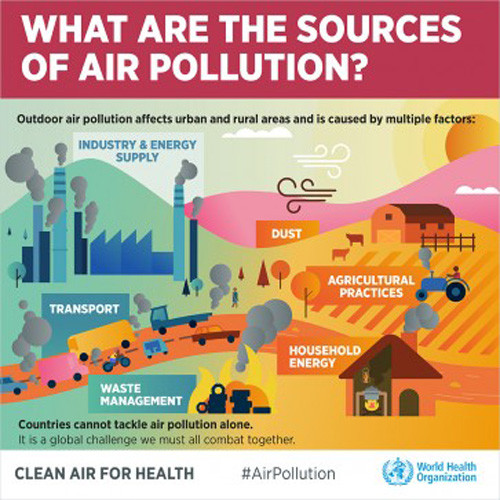
Data shows that Jakarta’s air is contaminated by various pollutants, including PM 10, PM 2.5, SO2, O3, CO, NOx and Pb. From the list of the contaminators, activists have singled out PM 2.5, warning citizens that its particles are microscopic, meaning surgical masks cannot prevent them from entering human lungs. The pollutant can cause serious respiratory problems if one is exposed to it over a long period of time.

The sources of air pollution, according to the World Health Organization.

The sources of air pollution, according to the World Health Organization. (Courtesy of WHO/-)

According to a Gerakan Ibu Kota release, the amount of PM 2.5 in Jakarta had been always above 38 μm/m3 and often went above 100 μm/m3 on busy days. Meanwhile, the safety limit set by WHO is 25 μm/m3.

Ahmad said there were 36 regulations at various government levels that could help reduce air pollution, including ones on emissions tests, gas-powered public vehicles and regional administrations’ obligation to provide green spaces for citizens.

However, the government and regional administrations do not enforce them seriously.

“There are even regulations that say we are not allowed to burn our household waste because it can pollute the air,” Ahmad said.

“But the government never cares if our neighbors burn their trash and pollute the air. The law is never enforced.”

Turn your dearly departed’s shirts into pillows to hold them close

ศาสตร์เกษตรดินปุ๋ย : ขอบคุณแหล่งข้อมูล : หนังสือพิมพ์ The Nation

http://www.nationmultimedia.com/detail/asean-plus/30359931

Tito Alcala with a Love Pillow, seated on his donated Silya rocking chair.

Turn your dearly departed’s shirts into pillows to hold them close

Breaking News December 06, 2018 13:59

By Philippine Daily Inquirer
Asia News Network

Have you ever wondered what to do with the favourite clothes of your loved ones who have passed on?

Soaked with memories, the garments may be too precious to give away, but too frail to keep in closets where mildew and moths are bound to ruin them.

How about turning them into pillows you can hug at night, or lean on while watching television on the couch? Wouldn’t it be like having the beloved still sharing good moments with you?

“We call them Silya Love Pillows,” said Tito Lorete Alcala, retired managing director and founder of The Artistshop Company, the advertising design company behind the rocking chairs for the elderly ubiquitous in malls and other public spaces.

The pillows are an extension of Alcala’s original advocacy—making sure that the elderly have a place to catch their breath amid the milling crowd in commercial establishments.

Silya, which stands for “Sa Iyo Lolo, Lola, Yantok Aming Alay,” (To You Grandpa, Grandma, Our Offerings) was an initiative born seven years ago when Alcala noticed how the lack of chairs for the elderly in public places often spoiled what should have been bonding moments with his elderly parents every time they go to the shopping mall.

“The old get tired easily and, unable to find enough chairs to rest, they’d ask to be taken back home posthaste,” he recalled.

His solution was to donate rocking chairs to establishments who would have them—two each, whose cost he underwrites. So far, he has donated almost 600 rocking chairs all over the country since the program started in 2011.

But the wooden rocking chairs may not be that comfortable for creaky old bones, Alcala said, so pillows were added to the chairs—with unexpected results.


Stolen

“The pillows were promptly stolen, even when we took to tying them to the chairs,” Alcala said, shaking his head. He added that CCTV footage revealed that some elderly themselves cut the pillows tied to the chairs using scissors they have in their bags.

“Not wanting to embarrass them, we’d ask them tactfully about the scissors. And they’d say, “We need this to cut open the packets of our medication.”

Well, suggested some bright boys from Artistshop, how about merging the seemingly irresistible appeal of pillows with the design company’s program of promoting love and respect for the elderly?

And so, the idea for Love Pillows was born.

Said Alcala: “Artistshop wants to establish that loving the elderly should continue even after they’re gone. We have to cherish the memories we’ve shared with them, this time through the Love Pillows made from clothing they’ve left behind.”

The pillows can be personalized with a dab of their favorite scent or a smell that reminds people of them – the perfume they loved, tobacco or coffee.

“The pillows can also carry personalized messages,” Alcala said. “Something like, ‘This is a shirt I used to wear. Know that when you hug it, I am there.’”

While the pillows are a fitting token of comfort on the 40th day of the departed’s demise, it would also be appreciated as a Christmas gift, especially for overseas Filipino workers (OFWs) who can then take physical memories of their loved ones, he added.


Two-week process

That’s why Artistshop has pegged at two weeks the time it takes to process an order—the usual length of an OFW’s or balikbayan’s Christmas vacation.

“You only have to give Artistshop the favourite shirt or clothing of your beloved and, if you want, their favorite scent, and you’ll get back a pillow that reminds you of them,” Alcala said.

Artistshop will also invest in Silya Love Pillows to be placed on rocking chairs in “pre-qualified places,” Alcala said.

These are hotel lobbies, the Manila Polo Club, the Aquino Museum and other “managed and controlled environments” where the pillows can showcase Silya’s advocacy without filching.

In the meantime, the rocking chair project continues. So far, and because even youngsters insist on occupying the donated rocking chairs, Silya now donates a set of two rocking chairs and one mini-me chair.

In some malls, the initiative has evolved into a corporate social responsibility project, with employees painting the mini-me chairs for the kids.

This gives Alcala an idea to hold a “Paint a Silya” event where his fellow artists from the University of Santo Tomas College of Fine Arts, among them Pancho Piano, Lydia Velasco and Tessa Alindogan, can turn the chairs into their personal canvases and put them up for sale. A share of the proceeds goes to the artist, and the rest to worthwhile projects.

Silya is an advocacy and nonprofit venture. With the Love Pillows, it has also become a way of remembering.

Moldy mouse food postpones SpaceX launch

ศาสตร์เกษตรดินปุ๋ย : ขอบคุณแหล่งข้อมูล : หนังสือพิมพ์ The Nation

http://www.nationmultimedia.com/detail/asean-plus/30359886

This artist's illustration courtesy of SpaceX obtained November 20, shows the SpaceX BFR (Big Falcon Rocket) rocket passenger spacecraft at stage separation.
This artist’s illustration courtesy of SpaceX obtained November 20, shows the SpaceX BFR (Big Falcon Rocket) rocket passenger spacecraft at stage separation.

Moldy mouse food postpones SpaceX launch

ASEAN+ December 05, 2018 15:08

By AFP

2,377 Viewed

SpaceX has postponed its cargo launch to the International Space Station until Wednesday after mold was found on food bars for a mouse experiment bound for the orbiting outpost, NASA said.

The launch was initially set for Tuesday. The new time is 1:16 pm (1816 GMT) Wednesday.

“The launch was moved to Wednesday after mold was found on food bars for a rodent investigation prior to handover to SpaceX,” NASA said in a statement late Monday.

“Teams will use the extra day to replace the food bars.”

Some 40 mice are part of the experiment aimed at studying the effects of microgravity in the immune system.

The launch will be the 16th for SpaceX, as part of an ongoing contract with NASA to send supplies to the astronauts living at the space station.

Some 5,600 pounds (2,500 kilograms) of food, experiments and other gear is packed onto the unmanned Dragon cargo ship, which will blast off on a Falcon 9 rocket from Cape Canaveral, Florida.

Urgent : S Korean leader to visit Thailand after Feb elections: adviser

ศาสตร์เกษตรดินปุ๋ย : ขอบคุณแหล่งข้อมูล : หนังสือพิมพ์ The Nation

http://www.nationmultimedia.com/detail/asean-plus/30359884

Photo : Kim Hyun-chul, presidential economic adviser and chairman of the special committee on Korea’s New Southern Policy

Urgent : S Korean leader to visit Thailand after Feb elections: adviser

ASEAN+ December 05, 2018 13:52

By MARISA CHIMPRABHA
THE NATION

3,859 Viewed

Seoul – SOUTH KOREAN President Moon Jae-in plans to visit Thailand next year in a move to boost ties and cooperation, the president’s top economic adviser said recently.

Kim Hyun-chul, presidential economic adviser and chairman of the special committee on Korea’s New Southern Policy, chose not to reveal the date of the likely visit, saying it will be after Thailand’s election in February. This will be Moon’s first visit to Thailand since he came into power in May last year.

The presidential adviser was speaking at a press briefing late last month, which was attended by journalists from Asia News Network member newspapers. The journalists were in Seoul at the invitation of the Asean-Korea Centre.

Kim told The Nation that Thailand was among 15 countries that had invited Moon to visit when their leaders met last month at the latest Asean Summit in Singapore.

“We selected three countries – Thailand, United Kingdom and Germany,” he said. “We think the relationship with Thailand is important, which is why we accepted the request.”

Thailand will be taking over as Asean chair next year, and Bangkok will be hosting the next Asean Summit and related meetings.

South Korea has been among the dialogue partners of the 10-member grouping that comprises Brunei, Cambodia, Indonesia, Laos, Malaysia, Myanmar, Philippines, Singapore, Thailand and Vietnam.

“With President Moon’s visit next year, we think Thailand and South Korea will have closer ties,” Kim said.

However, he chose not to comment when asked to elaborate on bilateral relations over the past four years, since the military-led government took power after the 2014 coup.

Commitment to prosper

At the Asean Summit, President Moon had said that next year will mark 30 years of dialogue between Asean and South Korea, and his New Southern Policy represented a strong commitment to prospering alongside Asean.

Moon’s policy is aimed at reducing South Korea’s reliance on the United States, China, Japan and Russia by expanding ties with Asean and India.

South Korea is expected to host a Korea-Asean Summit, as well as the first Korea-Mekong summit that will be attended by Laos, Cambodia, Myanmar, Vietnam and Thailand.

Kim also pointed out that many Koreans regularly visited Thailand and there were many Thais living in South Korea.

Thailand is the second most popular country after Vietnam (2.4 million), with 1.7 million Koreans visiting the Kingdom last year.

South Korea, however, had the most Thai tourists (498,511), followed by Filipinos (448,702) and Vietnamese (324,740).

Urgent : Fresh 6.6 earthquake hits off New Caledonia: monitors

ศาสตร์เกษตรดินปุ๋ย : ขอบคุณแหล่งข้อมูล : หนังสือพิมพ์ The Nation

http://www.nationmultimedia.com/detail/asean-plus/30359882

Urgent : Fresh 6.6 earthquake hits off New Caledonia: monitors

ASEAN+ December 05, 2018 12:57

By AFP

2,973 Viewed

Noumea – A powerful new earthquake hit off New Caledonia Wednesday just hours after a strong tremor hit the Pacific region, but there was no new tsunami alert, authorities said.

The quake struck at 5:43pm local time (0643 GMT) at a depth of 10 kilometres (6.2 miles) some 192 kilometres east-southeast of Tadine in New Caledonia, an overseas French territory north of New Zealand.

The US Geological Survey revised it to magnitude 6.6 from an initial measurement of 7.0.

Residents of New Caledonia received an urgent text message directing them to go to refuges immediately after the earlier and also shallow 7.5-magnitude earthquake struck two-and-a-half hours earlier.

There were no immediate reports of damage from the earlier earthquake, but the Pacific Tsunami Warning Centre said that waves had been “observed” and could reach up to three metres in height.

Residents of New Caledonia, which lies north of New Zealand, received an urgent text message directing them to go to refuges immediately.

“We activated the alert sirens… along the east coast and all the Loyalty Islands,” Eric Backes, director of the islands’ civil defence authority, told local radio.

“People should move away from the coastline and to higher ground or go to the evacuation points set up in each commune.”

Basile Citre, a municipal official on the Loyalty Island of Mare, said the situation there was so far under control.

“I was in a meeting at the town hall and we felt a small tremor then a bigger one,” he told AFP.

“The building shook, but there was no damage. When the sirens sounded, the population headed for higher ground for safety. For now, nothing serious has happened.”

Geoscience Australia seismologists monitoring the event said a tide gauge on Mare Island, the second-largest of the Loyalty Islands, had registered a signal for a 43 centimetre wave height.

“Based on that, we can say that this earthquake has generated a tsunami, but we don’t know the impact and how far it could go onshore,” seismologist Spiro Spiliopoulos told AFP.

Tsunami sirens were not immediately activated in Vanuatu — or in Fiji where they tested the tsunami warning system earlier this week and some coastal communities could be brushed by tsunami waves.

A spokesman for the Vanuatu geohazards observatory said the sparsely populated island of Tanna was expected to be most affected but no evacuations had been ordered.

“There are no sirens on Tanna but the people on the island are familiar with these situations and they will have taken precautions and gone to higher ground,” he told AFP.

The epicentre of the quake was some 300 kilometres east of the New Caledonia capital Noumea, but such was the force of the shock that experts said small tsunami waves may be observed as far away as Antarctica and Russia.

“Hazardous tsunami waves are forecast for some coasts,” the Pacific Tsunami Warning Center said, after earlier warning that the danger zone included “coasts located within 1000 kilometres of the earthquake epicentre.”

There were no immediate reports of deaths related to the initial earthquake and according to the US Geological Survey modelling, damage from the quake is expected to be minimal in terms of loss of life.

As multiple aftershocks of up to 5.9 were felt, CCTV footage showed bathers still frolicking in crystalline sea off Noumea, seemingly unaware of the seriousness of the threat on the other coast, just 50 kilometres away.

Meanwhile Australia’s department of foreign affairs warned its citizens in New Caledonia to seek safety.

New Caledonia, with a population of 269,000 people, is a French Pacific territory.

Its citizens last month rejected independence in a referendum, though the vote revealed lower-then-expected support for remaining part of France.

The island is home to a quarter of the world’s known supplies of nickel — a vital electronics component — and is a foothold for France in the Pacific, with French troops stationed on the island.