The baht opened at 35.45 to the US dollar on Monday, strengthening from Friday’s close of 35.49.
The Thai currency is expected to move between 35.35 and 35.55 against the greenback during the day and between 35.20 and 35.65 during the week, Krungthai market strategist Poon Panichpibool predicted.
He said the baht will test its resistance level at 35.50 to 35.65 to the dollar, especially if foreign transactions flow out of the country while the market is in a risk-off state.
However, the weakening might be slowed down by exporters waiting to sell their dollars.
Poon also believes the baht will strengthen if the price of gold rebounds and investors start trading in the precious metal.
The baht may also not weaken to the new resistance level of 36 to the dollar unless China enforces a new lockdown, forcing investors to dump bonds and stocks in emerging Asian markets.
The dollar, however, may weaken if the US economic data is worse than expected and the US Federal Reserve does not support boosting the interest at a high rate again.
Poon added that the dollar will remain stable if the economic data from Europe and Asia is worse than expected.
The strategist has advised investors to use hedging tools like options to manage their risks in the highly volatile currency market.
The demand for personnel in digital, care and green industries has surged thanks to the role creative economy is playing in the post-Covid era, the Thailand Development Research Institute (TDRI) said on Sunday.
The creative economy is an evolving concept that builds on the interplay between human creativity, ideas, intellectual property, knowledge and technology.
TDRI director Dr Saowaruj Rattanakhamfu said creative economy played an important role in stimulating the economy, generating revenue and creating well-paying jobs.
She said the demand for workers in the digital economy, such as artificial intelligence specialists, data scientists and big data developers is rising and businesses are ready to offer high salaries for them.
“For instance, the monthly salary of a social media assistant starts at between 25,000 and 28,000 baht,” she said.
Saowaruj also said that a variety of skills and knowledge are necessary for some jobs in the digital economy industry. For instance, digital marketing specialists need to be literate in marketing, data analysis, website design and English, she said.
“If we want to develop a creative economy, we have to pay attention to training personnel for this field,” she said.
Meanwhile, in the care industry, Saowaruj said personnel like behavioural health technicians, physical therapist aides and personal care aides are playing a key role in helping people maintain their physical and mental health in the post-Covid era.
These positions too, she said, require a variety of skills and qualifications. For instance, musical therapists need knowledge in music, psychology and basic IT literacy, she said.
Similarly, personnel in the green economy, such as green marketers and sustainability specialists, also require additional skills, such as knowledge of environmental materials, laws and basic IT literacy.
“In the post-Covid era, deep knowledge in one subject is not enough. People need to integrate their know-how and be able to address different issues to survive in the new era,” she added.
The metaverse, cryptocurrency, non-fungible tokens (NFTs) and e-sports are now driving the digital era, female business leaders at the Global Summit of Women 2022 declared on Saturday.
The three-day international summit wraps up at Bangkok Convention Centre in CentralWorld today (Saturday).
Patama Chantaruck, country managing director of management consultancy Accenture Thailand, said the pace of change has accelerated over the past three decades – from the internet of data era in 1990s to the internet of people in the 2000s, internet of things in the 2010s and internet of place and ownership in the 2020s.
She said the latest change is powered by blockchain, which is driving the metaverse, NFTs, cryptocurrency and e-sports with its transparency, immutable transactions, security and smart contracts.
“Lots of people want to spend not just cash but also cryptocurrency,” she pointed out. She also noted that more men were investing in crypto than women.
The metaverse, meanwhile, was being popularised by leading business figures and celebrities such as Tesla and SpaceX CEO Elon Musk and boxing great Mike Tyson.
Even car manufacturers are getting in on the act.
“For example, famous German automaker BMW is allowing customers to see production from beginning to end by working at the [metaverse] factory then bringing in e-sport to ensure they are in touch with potential customers,” said Patama.
The global e-sports audience is expected to reach 532 million this year, up 8.7 per cent from 2021.
She also advised entrepreneurs to build a growth mindset across their organisation, create investment roadmaps, define their metaverse strategy and establish new ecosystem partnerships in order to benefit from the metaverse era.
Thanks to modern technologies such as virtual reality (VR) and augmented reality (AR), the metaverse closely resembles our real lives, said Maria J Alonso, founder and CEO of Qaleon, a software company in Spain.
She said the metaverse was a shared platform of virtual products and digital experiences that are highly immersive and interactive.
“Metaverse is a shared world because you see it as real and unreal at the same time,” she explained
She said metaverse helps create virtual products with real, not hypothetical, value – including everything from bags, hotel rooms, experiences, and luxury cars to education.
She highlighted new tech that would power the metaverse era, including 5G and 6G networks, Cloud, Edge infrastructure, chips, processors, VR headsets, AR glasses, high-res graphics, and artificial intelligence (AI).
“When you wear glasses or goggles, and you can handle things in your hand, you’ll be completely immersed in the [metaverse] situation,” she said.
The metaverse can be used for a variety of activities, such as entertainment, commerce, education, health treatment, safer training, accident prevention, operations and infrastructure testing, she added.
She also pointed out that sectors facing metaverse disruption are fashion, retail, gaming, sports, fitness, real estate, financial services, cybersecurity, advertising, workplaces and collaboration tools, education, events and law.
“In fashion, start-ups are selling hi-res virtual-only fashion to be overlayed on to buyer’s photos and videos.”
Alonso said the final stage of the metaverse is still uncertain and in the hands of consumer trends such as digital identities.
“The metaverse is a vision, not a specific technology, and there’s still much more to come.”
Meanwhile NFTs are not as complicated as you might think, said Monica Jimenez, chief metaverse officer of Chameleon 3.0, an organisation in Mexico that creates tools for digital disruptive communities.
She explained that NFTs can take the form of vehicle registries, land registries, patent ownership databases, copyright registries, property titles, degree certificates, voting rights, carbon credits, painted canvasses, baseball cards, trademark lists, concert tickets and club memberships.
She said a basic NFT contract comes in the form of a two-column list, similar to a Microsoft Excel spreadsheet, with identity details tagging the token and its owner, represented by a blockchain public address.
NFT contracts also have a “transfer” function to change the ownership, “minting” to add the number of owners, “metadata” to make NFT more meaningful, and royalties which give a percentage of the income from secondary sales to authors.
“Everything that can be digitalised will be digitalised,” she predicted. “It’s the meaning we decide to give NFT that actually provides the value.”
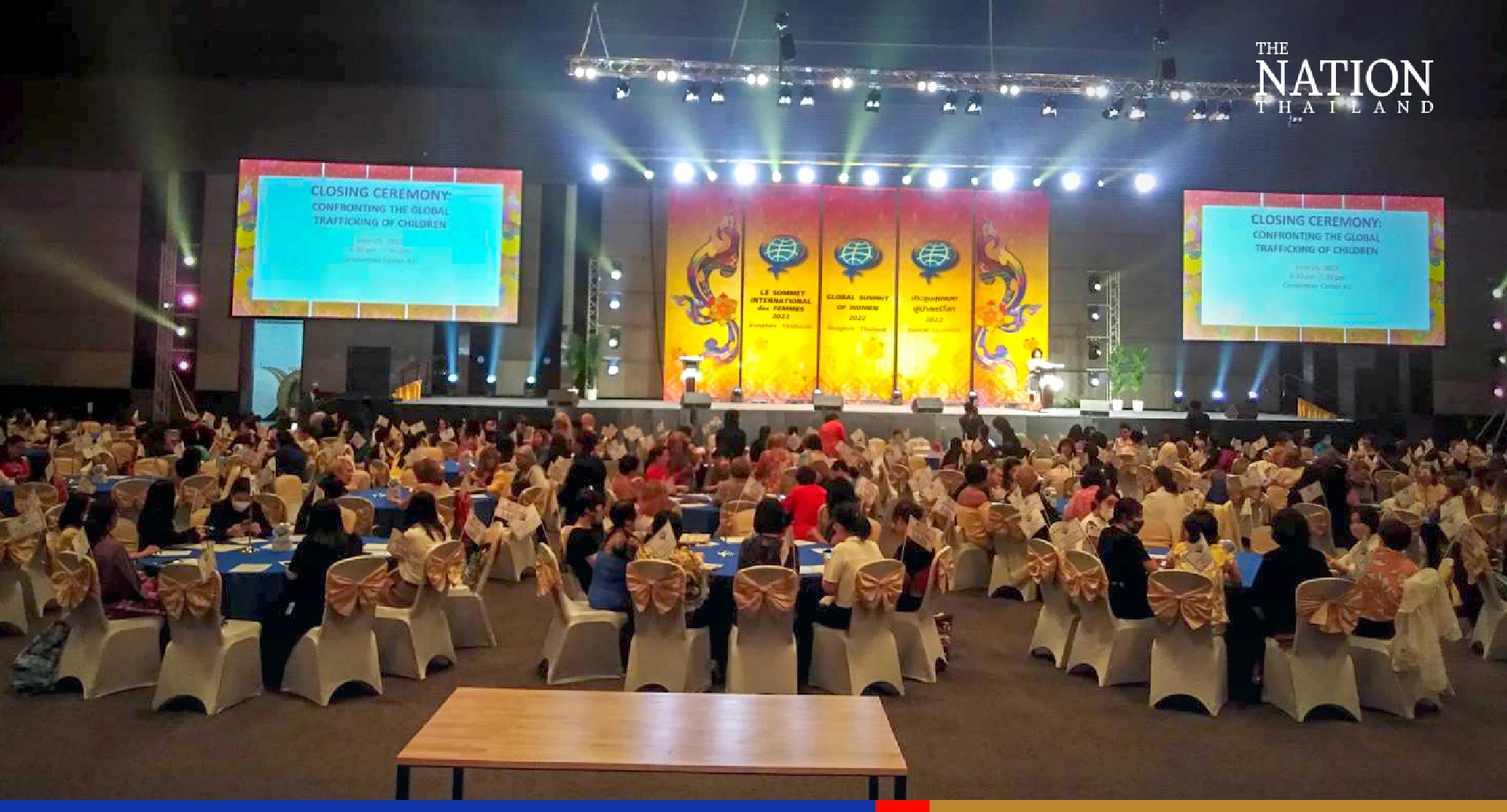
More than 600 female business leaders from 52 countries wrapped up the 32nd Global Summit of Women on Saturday with a firm final message of commitment to protecting children from human trafficking and cybercrime.
Irene Natividad, president of this year’s summit, also lauded Thailand for hosting the event with warm hospitality and professional management.
She said the three-day summit offered a lifetime experience for everybody to hear and learn from global women influencers and opinion leaders.
She also hoped this summit will inspire other women to improve their business and career, as well as their own lives and those of others.
Natividad added that though this summit is over, it is not the last because there is a lot more work to be done.
Shifting focus on child protection The summit’s closing ceremony focused on raising awareness of child trafficking and online abuse and pleading for support in strengthening prevention measures and punishment for the crime.
Suriyon Sriorathaikul, the vice-chair of SafeguardKids Foundation Thailand, said that though law-enforcement agencies and related organisations worldwide are focusing on protecting children, crimes against them continue and are escalating during these troubled times.
Child trafficking and online abuse, especially sexual exploitation, have no borders, he said. Many countries, including Thailand, may already have legal processes in place, but efforts to protect children must continue as criminals always find ways to harm the young, Suriyon added.
The women business leaders, all dressed in beautiful colours, stood up to applaud Suriyon and offer their firm commitment to protecting children.
The event wrapped up with Natividad announcing that the next summit will be hosted by Dubai.
Lessons to learn, partnerships to continue Over the past three days, women from both public and private sectors have learned from each other and shared invaluable experiences. They have also allowed others to expand their business prospects, build partnerships and highlight women’s role in economic development.
The summit also offered guidelines to women entrepreneurs on how to apply technology and innovation such as social media, e-commerce, cryptocurrency and the metaverse to groom and grow their business.
They learned to become part of a global community and employ environmental solutions, gender diversity and global political participation.
Founded in 1990, the Global Summit of Women is a Washington-based non-governmental organisation conceived as a forum for all sectors – public, private and non-profit – to gather under the common vision of expanding opportunities for women.
A stellar group of women CEOs shared their companies’ approach to incorporating ESG to drive growth during Saturday’s morning session of the Global Summit of Women in Bangkok.
Under the topic “How ESG Informs Business Strategy”, the CEOs agreed the pandemic has spurred people worldwide to demand social responsibility from companies that exploit resources from nature and advantages from society.
However, ESG is not the same as CSR (Corporate Social Responsibility), said Kattiya Indaravijaya, CEO Kasikorn Bank (Thailand). She explained that ESG provides a company with more advantages to boost profits and competitiveness while CSR is used to build image and brand awareness.
She insisted that ESG is no longer a choice but a necessity as companies adapt to big changes in consumers’ behaviour and mindsets over the past two years. A recent study showed that 74 per cent of consumers are willing to spend on goods and services that comply with the ESG strategy.
Sharon Dayoan, chair and CEO, KPMG RG Manabat & Co (Philippines), added that there is a price to pay for adopting an ESG strategy. The ESG process may not be profitable in the beginning, she said, but it would reward companies with accountability and sustainability.
ESG or Environmental, Social, and Governance standards have received growing attention in the past few years as people and communities become more aware and concerned about the environment and society. ESG is now being applied by analysts and investors across the world as a non-financial factor to assess a company’s risk and growth opportunities.
Irene Natividad, president of this year’s Global Summit of Women, said even though ESG was not required by law, companies are adopting it in response to the ever-growing demands of investors, millennials and regulators to recognise consumer concerns on climate change, sexual harassment, discrimination and local fair trade.
She pointed out there is an increasing trend away from an emphasis on bottom-line success to a company’s value being assessed on how well it has performed on ESG metrics.
Elena Butarova, Asia-region head for Russian insurer MetLife, noted that most companies are focusing only on the E (Environment) rather than the S and G (Social and Governance). She suggested this was because environmental impacts are often obvious and work to protect the environment can be easily measured and assessed.
She said companies could correct this imbalance by adopting practices to support gender equality, respect diversity, and improve their local community’s quality of life.
Chadatip Chutrakul, CEO of real estate developer Siam Piwat (Thailand), said one of the most challenging elements of adopting ESG strategy was dealing with differences of behaviour and mindset among staff. Companies need to find ways of motivating staff to accept the ESG concept, which includes mutual respect for other’s rights.
Sustainability, meanwhile, did not apply to the company’s operations alone but to the whole surrounding community. Chadatip said this means that the company is responsible for creating a support system that allows both it and the local community to grow together.
She cited the example of Siam Piwat’s “Sook Siam” (Thailand Happiness) project that offers low-rent pitches for small vendors to sell OTOP products at the luxury ICON Siam mall. She said the project has earned US$50 million in revenue over three years, with more than 100,000 visitors per day.
Dian Siswarini, CEO of Indonesia’s leading telecoms firm, PT XL Axiata, said ESG has been part of the company’s vision since the beginning. As such, she said her company had continued investing to improve infrastructure since its founding, believing that infrastructure drives long-term growth of the country.
The ESG practices may be tough and some companies may feel exhausted but it should never stop. It is because ESG facilitates top-line growth in the long run, attracts talent, reduces costs, and forges a sense of trust amongst consumers. Dian added.
MedPark Hospital on Saturday (June 25) opened the Emerging Infectious Diseases & Acute Respiratory Infection Clinic (EIDARIC) to provide high-quality treatment to patients with Covid-19 as well as other emerging respiratory diseases, in compliance with the government’s plan of reopening the country and making Thailand a destination for medical tourism.
The opening ceremony on Saturday was held at the hospital which is located on Rama IV Road in Bangkok’s Khlong Toei district and was presided over by the Public Health Ministry’s permanent secretary Dr Kiattiphum Wongrajit, with the presence of the Department of Health Service Support’s director-general Dr Thares Krainairawiwong and Department of Disease Control’s deputy director-general Dr Sopon Iamsirithaworn.
“It is a good sign that private hospitals are improving their treatment standard to cope with Covid-19 and emerging diseases,” said Kiattiphum in the opening ceremony speech. “The government is ready to cooperate with the private sector to increase the country’s readiness for infectious diseases and improve our public health standard to welcome medical tourists after Thailand is fully reopened, as well as to treat the general public with proper disease control measures, to make sure that hospitals are a truly safe place from infectious diseases.”
Medpark Hospital managing director Dr Pongpat Patanavanich said that as Thailand is easing disease control measures, hospitals are still serving as a shelter for patients and those at risk of contracting Covid-19 and future diseases. “That’s why MedPark is employing a dual system in patient treatment which separates high-risk patients from general patients,” he said. “The EIDARIC is located outside the hospital’s building and has the negative pressure setting to reduce the risk of germs spreading to ease the concerns of patients and people visiting the hospital.”
Pongpat added that EIDARIC will provide one-stop services for Covid-19 and respiratory patients by specialized physicians, including a fast and accurate laboratory for RT-PCR tests and chest x-ray. “The clinic is fully air-conditioned for patient comfort and all air ducts are fitted with HEPA (high-efficiency particulate air) filters to ensure that the air from the clinic is properly filtered before releasing to the environment,” he said.
Creative Talk Conference 2022 (CTC2022), featuring the theme “The Future of Everything” is being held at BITEC Bangna during June 25-26 to share knowledge on creativity, innovation, marketing, entrepreneurship, and people skills.
Held by AP Thailand in collaboration with Creative Talk, the two-day conference will be packed with panel discussions, debates and workshops on more than 60 topics by leading speakers with expertise in various fields covering creativity, marketing, innovation, entrepreneurship and people skill.
Founder Sittipong Sirimaskasem: 109 speakers, 61 sessions, and five stages are set for the two-day conference.
Creative Talk founder Sittipong Sirimaskasem said that CTC is not an event, but a community-oriented meeting to bring like-minded people who want to look into the future together.
The event also offered Creative Business Awards for the years 2021 and 2022 for the following brands: 2021, 1. Wendays 2. Laika 3. Moreloop; 2022, 1. Vulcan Coalition 2. Qualy 3. Jones Salad 4. Nanyang Marketing.
Apichat Khanthavithi, Managing Director, QGEN Consultant, an HR practice provider, gave a speech on ‘Diversity, Equity, Inclusion, and Belonging Are the Future of Work Environment.’
A panel discussion on creative with Darisa Karnpoj (Riety) and Damisa Ongsiriwatana of SOUR Bangkok explored the topic of ‘Being Creative is for Everyone.’
On entrepreneurship, Pitchayen Hongpakdee of Samart ID Group and Dhazzaphak Lertsavetpong of The Trade Co. jointly talked about understanding ourselves and consumers need to clarify your purpose.
Bangkok, Thailand. June 24, 2022 — Cloudsec Asia today announced its partnership with BlueVoyant, a Silicon Valley-based developer of an industry-leading defense platform against internal and external cyberattacks.
This partnership in advanced technology is aimed at empowering any business enterprise in Thailand with third-party risk management (TPRM), an intelligent solution purpose-built to identify, manage, and mitigate cybercrime risks arising in supply chains from trade partners, contractors, and service providers. TPRM reinforces an organization’s security posture and provides proactive defense against cyber threats in the age of data-driven business.
BlueVoyant delivers cybersecurity services and platforms purpose-built to proactively defend business ecosystems of all sizes against threats by leveraging large, real-time datasets with industry-leading analytics and technologies. The company also specializes in third-party cybersecurity, which involves detecting and mitigating risks to which the computer network of a client is exposed through its connection with supply chains. BlueVoyant’s threat intelligence data detects an organization’s most potent cybersecurity risks, while intuitive automations mitigate threats against its attack surface effectively and efficiently, providing the business and technical outcomes it needs to stay secure and support business objectives.
Cloudsec Asia is a leading provider of comprehensive cybersecurity services, and driven to democratize cybersecurity for all organizations and people. As a cloud-security company, our services cover all aspects of cybersecurity for both public and private cloud, with three service divisions: Cloud Security Solution, Managed Detection and Response (MDR) SOC, and Cyber Security Services.
E-commerce is coming to the rescue of millions of small merchants and entrepreneurs struggling to survive during Thailand’s Covid-19 crisis. That was the hopeful message delivered by female digital business leaders at the “Global Summit of Women 2022” on Friday.
The international forum is being held at Bangkok Convention Centre in CentralWorld until Saturday.
Jackie Wang, country director for Google Thailand, said Southeast Asia has entered its “digital decade”, with 60 million new digital consumers since the beginning of the Covid-19 pandemic in 2020. According to Google’s annual study of Southeast Asia’s internet economy, 34 per cent of digital merchants in Thailand said they would not have survived the pandemic without e-commerce platforms. These include the Kingdom’s vast army of street-food merchants, about 80 per cent of whom are female, according to the Thai street vendors network.
Meanwhile, Wang estimates that the value of the internet economy in Southeast Asia will reach US$1 trillion by 2030.
She said Google Thailand was continuing to empower Thai business operators with digital skills, so they could harness the power of digital disruption and maintain sustainable growth.
Maneerat Anulomsombut, CEO of Sea Thailand, the operator of the e-commerce platform Shopee, said Covid-19 has accelerated Thailand’s online shopping trend as merchants adopt the new technology.
She said 81 per cent of Thai small and medium enterprises (SMEs) are using the e-commerce ecosystem to overcome Covid-19 by reaching more customers outside their local areas.
“Thai SMEs have also witnessed increases of up to 370 per cent in total sales after shifting to e-commerce, while 82 per cent of SMEs reported an increase in household income due to e-commerce,” she said.
She added that Sea Thailand is supporting micro, small and medium enterprises (MSMEs) via Shopee in three ways:
First by helping them set up on the e-commerce platform, then by handing them the Shopee tools and technology to grow their business, and finally by opening doors to new markets in Shopee’s Southeast Asia network.
Jamie Brennan, head of Amazon Global Selling Thailand, said e-commerce offered entrepreneurs short cuts for exporting their products.
She also had four pieces of advice for Thais who want to use e-commerce to reach foreign markets:
Understand the overseas market and evaluate the potential of product categories.
Evaluate the competition via the current top brands.
Monitor dynamic changes of brands to seek the key factors for success and failure of leading brands so as to replicate their success and avoid pitfalls.
Observe changes in consumers’ preference through trending products.
Apart from large corporations, young entrepreneurs also play an important role in stimulating the global economy, the Global Summit of Women 2022 learned on Friday.
The international forum, which wraps up on Saturday, is being held at the Bangkok Convention Centre in CentralWorld.
Yada Piyajomkwan, co-founder and CEO of investment platform AJAIB (Thailand and Indonesia), said she decided to start a business while studying about trade at school.
She said passion was key to running a business because it motivates people to do what they want to do or want to be. She said she prefers hiring employees who are passionate about their work.
Meanwhile, Ponglada Paniangwet, co-founder and CEO of food supplies platform Freshket (Thailand), said she strived to learn as much as she can to keep up with the fast-moving world.
She added that being a CEO is not easy, because a CEO must make snap decisions and ensure that all decisions go toward building the business.
Karla Huerta, founder and CEO of APB Sistemas (Mexico) – the country’s largest auto car-parking management company – said she built her business by learning how to work with others, respect others and conduct business ethically. At just 26, Huerta was the youngest participant in the forum. She said apart from keeping up with changes, her advice is for young entrepreneurs to be disciplined and take responsibility to achieve success.
Nguyen Ngoc My, CEO of Alphanam Real Estate ISC (Vietnam), said there were many factors necessary to build a business, such as intelligence to run the show, balanced emotions to manage people, respect in diversity and a mindset to think out of the box.
She said her company overcame the Covid-19 crisis by finding a way of reconnecting the industry, controlling costs and motivating people to return.
She said for the sake of survival, entrepreneurs should learn to forgive themselves for the mistakes they make because they are only human.









 Founder Sittipong Sirimaskasem: 109 speakers, 61 sessions, and five stages are set for the two-day conference.