The baht opened at 33.62 to the US dollar on Tuesday, weakening from Monday’s close of 33.54 to its lowest level in two months.
Krungthai Bank market strategist Poon Panichpibool said he expected the Thai currency to move between 33.50 and 33.75 during the day.
Poon predicted the baht would weaken and swing sideways in a wide range as investors shun risk and the market anticipates a rate hike from the US Federal Reserve.
He recommended speculating on foreign transactions as overseas investors are selling Thai stocks and bonds.
However, sales of short-term bonds are slowing so there was unlikely to be a large quantity available for purchase, Poon said. Foreign investors might return to purchasing short-term bonds if the Russia-Ukraine conflict situation improves, he added.
In the short term, he predicted a baht resistance level of 33.60 to 33.75, when exporters might offload the dollar, and a key support level at 33 to 33.20, which would spur importers to purchase the greenback.
The Stock Exchange of Thailand (SET) Index is expected to fluctuate between 1,665 and 1,685 points on Tuesday after the price of crude oil rose above US$110 per barrel in response to news of European Union sanctions against Russia, Krungsri Securities said.
It also predicted the index would be under pressure due to uncertainty over rising US inflation and Russia-Ukraine peace talks.
“The US Federal Reserve will have to raise the interest rate more than 0.25 per cent to deal with rising inflation,” Krungsri Securities said.
It also advised investors to follow Thursday’s meeting between the US, EU, the North Atlantic Treaty Organisation (Nato) and Group of 7 (G7) on sanctions against Russia.
It recommends the purchase of the following as an investment strategy:
• PTTEP, TOP, IVL, SPRC and BCP would benefit from the rising price of crude oil and gross refining margin.
• KBANK, BBL, TTB, and KTB would benefit from news of the US interest rate hike and Thailand’s economic recovery.
• AOT, AAV, MINT, CENTEL, ERW, BH and BDMS would benefit from Covid-19 restrictions easing.
The SET Index closed at 1,673.87 on Monday, down 4.64 points or 0.28 per cent. Transactions totalled Bt73.65 billion with an index high of 1,685.78 and a low of 1,671.08.
The Securities and Exchange Commission (SEC) held an online conference on Monday to discuss regulations for ready-to-use utility tokens.
SEC assistant secretary-general Jomkwan Kongsakul explained that utility tokens are for exchanging goods and services and the SEC would not focus on regulating tokens used for consumption.
Jomkwan said token-issuers are trying to get them listed in the market. However, there was a problem regarding their valuation. She said traders should have enough information on them regarding buying and selling price.
She said issuers have to reveal information on their tokens for the SEC to be able to regulate them. The SEC will be able to take action only if issuers conceal or reveal false information.
She assured that the SEC is not trying to block innovations and only wants traders to have enough information for consideration.
The SEC explained that it has exempted unlisted utility tokens, but utility tokens that would like to be listed have to apply for authorisation.
She said the best way to regulate information is through authorisation. Without authorisation, the SEC will not be able to regulate listed tokens.
The SEC would separate the authorisation process into two types.
The fast track route will be available for simple utility tokens for consumption, as they should have available products to exchange and an expiry date. The value should be fixed and appropriate while the number should be limited because the tokens should not be used for speculation. Also, the tokens should be burnt after use so that they cannot be reused.
The normal track process is longer and more expensive. For other more complicated tokens, the SEC added that it has tried to make the process inexpensive to help issuers save costs.
The next process will be a filing to reveal information before they are sold on ICO portals.
However, these regulations have not been finalised pending the SEC’s discussions with stakeholders in every related sector.
The number of logistics businesses in Thailand grew by 39.6 per cent in January with room for greater growth following the implementation of the Regional Comprehensive Economic Partnership (RCEP), the Trade Policy and Strategy Office said on Monday.
The office director, Ronnarong Poonpipat, said 444 new logistics firms had registered with the Business Development Department in January, an increase of 39.6 per cent from the same month of the previous year.
He said the top three categories of registered logistics businesses are goods transportation and transhipment (244 firms), road transportation (68 firms) and goods transportation representatives (33 firms).
Ronnarong said the businesses that have high growth potential are those related to the management of transportation and warehouses for supporting the distribution of goods and raw materials. He said these businesses have expanded by 22.4 per cent in 2020.
He said there are now 1,276 transportation and warehouse management firms and most of them have been registered in Bangkok and surrounding provinces.
He said border provinces, which are gateways to neighbouring countries, have a low number of these logistic companies operating. The border provinces with low registration of warehouse management firms are Chiang Rai, Nong Khai, Bueng Kan, Mukdahan and Nakhon Phanom.
“Warehouse management businesses will offer opportunities to new entrepreneurs, but they must look for good locations to help reduce the cost of goods transportation,” Ronnarong said.
Ronnarong said the RCEP, which took effect on January 1, would facilitate exports so logistic firms should expand their businesses to support exports to RCEP member nations.
For example, they should make preparations to expand their services to make use of the China-Laos speed railway to transport goods for Thai exporters and importers, Ronnarong said.
The international sanctions against Russia and fewer flights to the country have severely affected Thai export of fresh vegetables and fruit to Russia, Thailand’s commerce envoy in Moscow said.
Kittinan Yingcharoen, the director of the International Trade Promotion Office in Moscow, said the imports of vegetables and fruit from Thailand were affected after Aeroflot and other Russian airlines, including S7 Airlines, Ural Airlines and other freighter airlines, stopped their services since March 8 because of the international sanctions.
Kittinan explained that the sanctions following Russia’s invasion into Ukraine had prompted plane lease companies in western countries to cancel their contracts with Russian airlines. Most planes of Russian airlines were leased from these companies.
Moreover, Boeing and Airbus have halted their technical support for planes of Russian airlines and stopped selling parts to the airlines. The measures forced the airlines to halt their services because they could not buy the required spare parts.
“These measures had severely affected the export of fresh vegetables and fruit to Russia because these products rot easily. They need to be shipped on direct flights from Thailand to Russia to save shipping time,” Kittinan said.
He said only airlines of a few nonpartisan nations are still flying to Russia, including Emirates Airlines, Qatar Airlines and Ethihad Airlines. But these airlines have to make transit flights to their country, where the temperature is high and the fresh vegetables and fruit could be damaged by the heat.
Kittinan said his office has surveyed the importers of Thai vegetables and fruit in Russia and found that they had to suspend their businesses because of several negative factors, including a 50 per cent rouble depreciation against the US dollar, 10 per cent inflation and difficulty in making money transfers.
He added that some importers were now testing the use of services of Middle East airlines although the shipping cost was higher and some 15 per cent of the products could go rotten.
According to information from the Commerce Ministry, the value of Russia’s import of fruit from Thailand in 2021 was US$5.9 million and the import value of fresh and frozen vegetables was US$2.83 million.
Kittinan advised Thai exporters to decline orders from Russia for fruit and vegetables until direct flights between Thailand Russia are resumed.
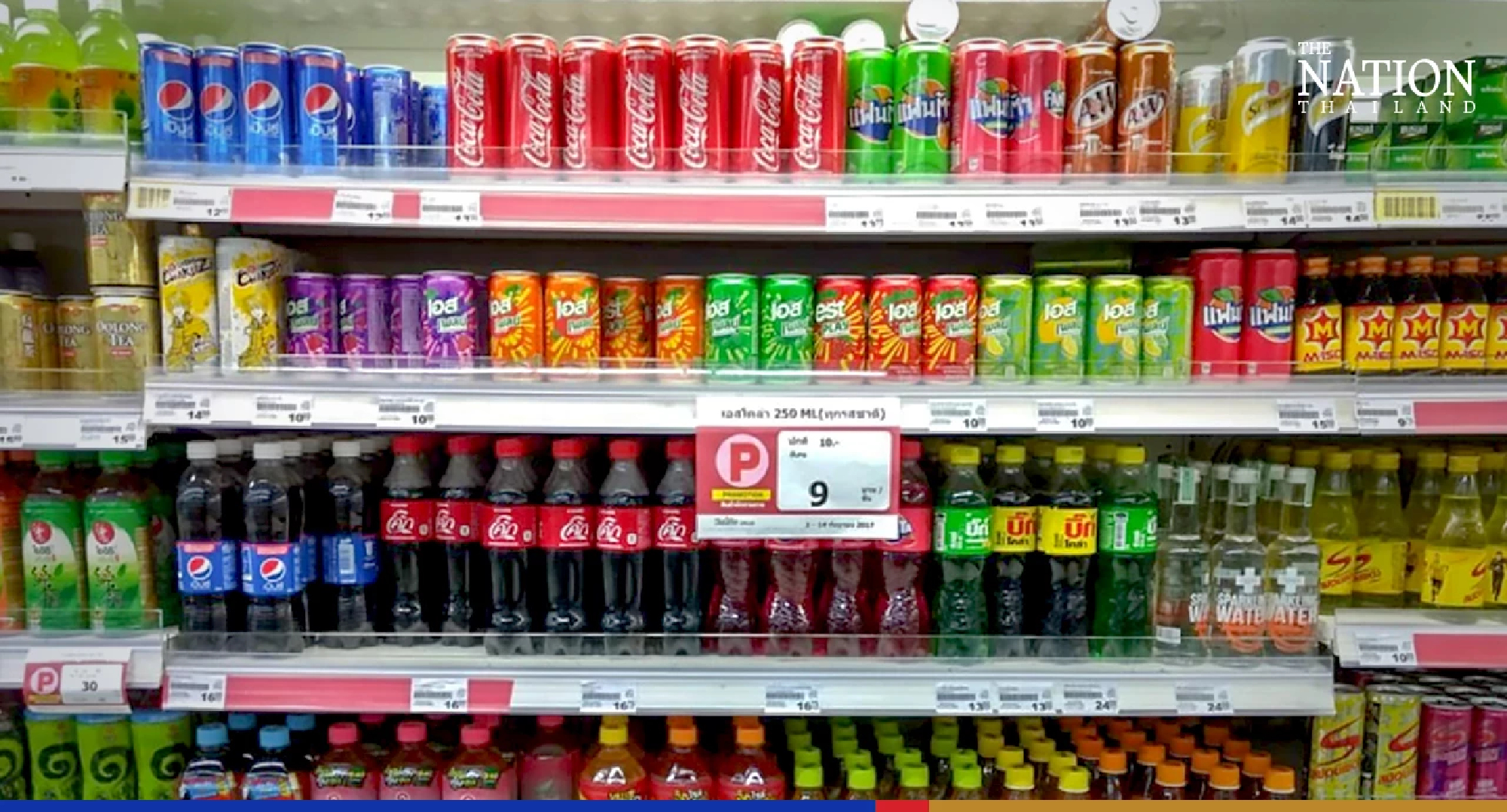
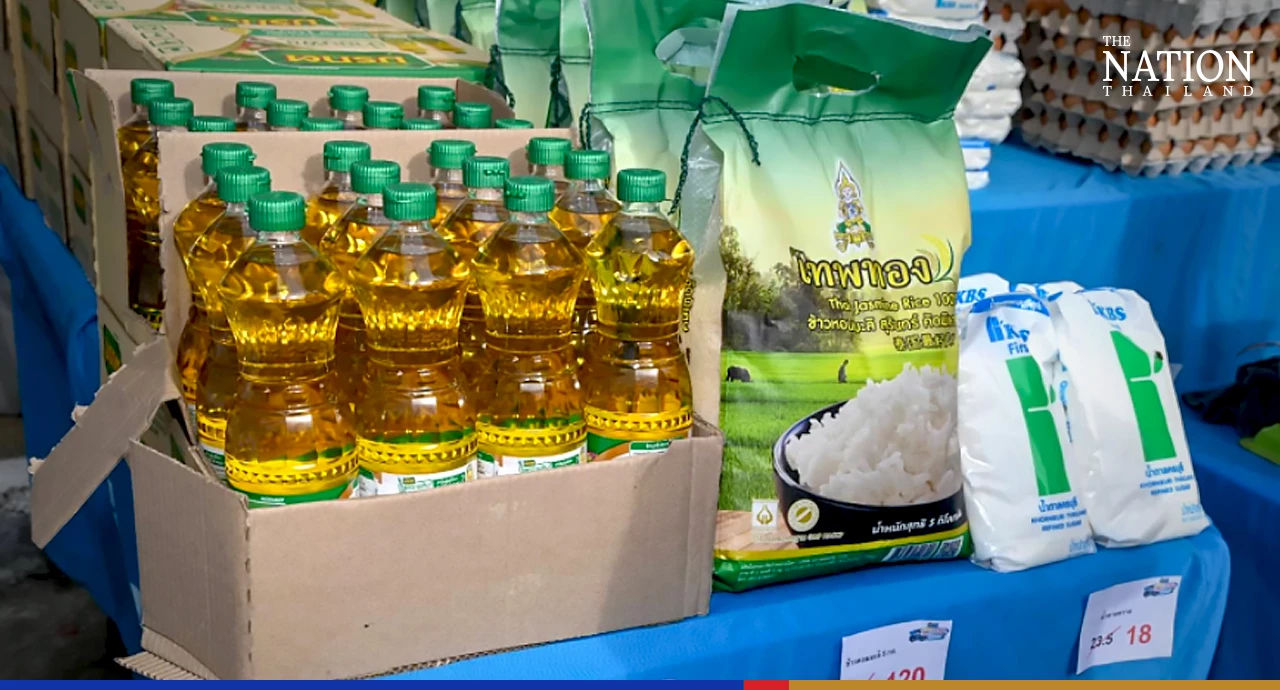
The global energy crisis sparked by the Russia-Ukraine war has forced Thai retailers to raise the price of some consumer goods.
Thansetthakij newspaper surveyed markets in Bangkok and adjacent provinces last week and learned that several items have become more expensive.
For instance:
• 5kg bag of rice is now 100 baht, up by 5 baht
• 15kg bag of rice is 330 baht, up by 10 baht
• Can of sardines in tomato sauce is 25 baht, up by 2 baht
• Can of condensed milk is 25 baht, up by 2 baht
However, the price of canned fruit, canned beverages and canned milk has remained unchanged.
Next month, however, the price of Mama instant noodles is expected to go up from 6 baht to 7 baht per packet. The distributor Sahapattanapibul announced on Saturday that it is seeking government approval to adjust the retail price due to the rising cost of logistics.
According to the Commerce Ministry’s stipulations, manufacturers cannot raise the prices of 18 consumer goods and services. They are: instant noodles, eggs and meat, canned foods, bagged rice, seasoning, vegetable oil, carbonated drinks, milk and dairy products, electrical appliances, cleaning products, fertilisers, insecticides, animal feed, iron, cement, paper, drugs and medical equipment and services of wholesale and retail shops.
Commerce Minister Jurin Laksanawisit said last week that he has not approved any price increase for basic consumer products despite requests from manufacturers.
The Stock Exchange of Thailand (SET) Index is expected to fluctuate between 1,670 and 1,690 points on Monday despite the price of crude oil rising above US$100 per barrel, Krungsri Securities said.
However, it predicted that uncertainty over Russia-Ukraine negotiations and foreign fund flow volatility would pressure the index.
It recommends the purchase of the following as an investment strategy:
• PTTEP, TOP, IVL, SPRC and BCP would benefit from the rising price of crude oil and gross refining margin.
• KBANK, BBL, TTB, and KTB would benefit from news of the US interest rate hike and Thailand’s economic recovery.
• AOT, AAV, MINT, CENTEL, ERW, BH and BDMS would benefit from Covid-19 restrictions easing.
The SET Index closed at 1,678.51 on Friday, down 3.25 points or 0.19 per cent. Transactions totalled Bt98.13 billion with an index high of 1,685.68 and a low of 1,677.16.
The baht opened at 33.32 to the US dollar on Monday, weakening from Friday’s close of 33.30.
The Thai currency is expected to move between 33.25 and 33.40 during the day and between 33.10 and 33.60 during the week, Krungthai market strategist Poon Panichpibool said.
The baht might fluctuate in a wide range, he added. He suggested speculating on foreign investors returning to Thai stocks.
However, he warned the baht could come under downward pressure due to concern about domestic economic recovery if the oil price surges or the Covid-19 situation in China worsens.
Poon forecast a baht resistance level at 33.40 to 33.50, which would see exporters selling the dollar. He saw its key support level as 33.00 to 33.20, when importers would buy dollars.
Poon added that the dollar might strengthen if ongoing negotiations between Ukraine and Russia fail and the situation worsens. Moreover, worry over stagflation if the price of crude oil rises might support dollar possession, he said.
Distribution company Sahapattanapibul said on Saturday that it reckons the price of Mama instant noodles will be increased to 7 baht a packet due to the rising cost of production.
The company’s president Vethit Chokwatana, however, admitted that the final decision would depend on the government.
A source from Sahapattanapibul, meanwhile, said the company is hoping the retail price of Mama noodles will be increased, though there is no guarantee that this will help the company overcome the crisis of rising costs.
The price of Mama noodles has been maintained at 6 baht per packet since 2014.
However, the manufacturer Thai President Foods said the price of wheat flour has surged from 200 baht per 22.5-kilogram bag to 500 baht, while the price of palm oil has risen from 19 baht per kilo to 59 baht.
Based on statistics, Thailand ranks 5th globally in the consumption of instant noodles, with each Thai consuming an average of 53.2 packets of instant noodles annually. Thailand is the 9th biggest exporter of instant noodles, averaging at 3.9 billion packets annually.
Separately, Thai Preserved Food Factory raised the price of WaiWai instant noodles from 5.50 baht to 6 baht at the beginning of this month. However, the content has been adjusted from 55 grams to 57g, with sodium rising from 710mg to 1,020mg and fat from 10g to 12g.
Member countries at the latest meeting of the Asia Pacific Economic Cooperation (Apec) expressed concern that the fluctuating price of oil will worsen the inflation crisis.
The concern over inflation was voiced at the Finance and Central Bank Deputies’ Meeting (FCBDM) of Apec nations held on Wednesday and Thursday last week, said Krisada Chinavicharana, permanent secretary of the Finance Ministry, which hosted the meeting. Thailand holds the rotating chair of the Apec trade bloc this year.
During the meeting, participants expressed worry that the rising oil price would add more pressure to inflation and fiscal policies of Apec members’ governments.
Participants agreed to keep a close watch on oil price volatility to gauge how long it would impact inflation in their countries.
“The meeting discussed and expressed concern at the oil price, which was still fluctuating. The price rose just before the meeting started but then gradually dropped during the talks. We will monitor how long the impact will pressure inflation and fiscal policies,” Krisada said.
The meeting also discussed the global and regional economic situation and economic trends, added. The Apec Policy Support Unit (PSU) presented analysis of the regional economic trend and estimated that the global economy would grow by 4.4 per cent this year and 3.8 per cent next year.
The Apec PSU also forecast that the Apec economy would expand 4.2 per cent this year and 3.8 per cent next year. But he policy unit Was concerned that the global economy could be affected by risks and instability of geopolitics and oil prices, Krisada said.
He said the Fiscal Policy Office informed the meeting that the Thai economy would expand by 4 per cent this year despite the affect of the Covid-19 situation, rising oil price and geopolitical tensions .
The Fiscal Policy Office told delegates the government was confident the economy is recovering well from Covid-19 thanks to supportive fiscal policies and revival of the tourism sector.





 “Warehouse management businesses will offer opportunities to new entrepreneurs, but they must look for good locations to help reduce the cost of goods transportation,” Ronnarong said.




 The Apec PSU also forecast that the Apec economy would expand 4.2 per cent this year and 3.8 per cent next year. But he policy unit Was concerned that the global economy could be affected by risks and instability of geopolitics and oil prices, Krisada said.
