The baht opened at 32.85 to the US dollar on Thursday, weakening from Wednesday’s closing rate of 32.84
The Thai currency is likely to move between 32.75 and 32.90 during the day, Krungthai Bank market strategist Poon Panichpibool said.
He said the baht would not strengthen soon due to the dire Covid-19 situation in the country, causing foreign investors to offload their assets such as stocks in Thailand.
However, Poon believed the Thai currency would not weaken below 33 per US dollar if investors felt safe from the worldwide Covid-19 situation and hence did not need to hold onto safe-haven assets.
Gold price in downtrend due to rising US bond yield
The price of gold in Thailand dropped by THB100 per baht weight in morning trade on Thursday.
AGold Traders Association report at 9.29am showed the buying price of a gold bar at THB27,900 per baht weight and selling price at THB28,000, while gold ornaments cost THB27,394.12 and THB28,500, respectively.
At close on Wednesday, the buying price of a gold bar was THB28,000 per baht weight and selling price THB28,100, while gold ornaments cost THB27,500.24 and THB28,600, respectively.
ADVERTISEMENTx
The spot gold price on Thursday was US$1,800 (THB59,101) per ounce after Comex gold on Wednesday dropped by $8 to $1,803.40 per ounce due to a rise in the US bond yield.
The Hong Kong gold price meanwhile dropped by HK$10 to $16,710 (THB70,587) per tael, the Chinese Gold and Silver Exchange Society reported.
Fan-free Olympics leaves hotels facing 1 million cancellations
From bellboys and receptionists to chefs and concierges, hotel staff in Japan are likely to find they have more time to watch the Olympics than they ever expected.
Afourth Covid emergency in Tokyo and a decision to bar spectators from the main athletics events have triggered a wave of hotel room cancellations. This latest setback puts further pressure on a hotel industry that bet big on the summer games serving as a springboard for Japan’s wider economic goal of attracting 40 million overseas visitors a year.
While large hotel chains with deep cash reserves can pace themselves for the long run and a post-Covid upturn in fortunes, for smaller operators the pandemic-hit Olympic dream is already testing their business stamina as bankruptcies in the sector pick up.
“We had big hopes and expectations for the Olympics,” said Makiko Furusato, who runs a tiny Japanese-style ryokan hotel within a 15-minute drive of four of the major venues for the games. “We opened in October 2019 and right away we got hit by the pandemic. Now this, just as we were hoping to get some money coming in.”
Furusato and her husband previously helped run a hotel in a resort town west of Tokyo. They saw the games as a once-in-a-lifetime opportunity to relocate and start their own boutique inn. They picked their new neighborhood specifically with the Olympics in mind.
But instead of a hotel full of guests during the games, Furusato says she’s dealing with cancellations and competition from other hotels that have dropped prices to a third of the going rate during the Olympic period.
“Bars and restaurants are also in terrible trouble, but at least they’re getting some compensation from the government,” she says, voicing frustration that Prime Minister Yoshihide Suga hasn’t done more to help people like her. “The spotlight just isn’t focused on our industry.”
ADVERTISEMENTx
Fan-free Olympics leaves hotels facing 1 million cancellations
The decision to bar spectators from the games could lead to more than a million canceled reservations or plans to stay in hotels. That figure is based on 30% of ticket holders for the games coming from outside the greater Tokyo area, as indicated by Olympic minister Seiko Hashimoto, and each of them planning to stay at least one night in a hotel.
“This latest hit will very likely trigger more bankruptcies,” said economist Hideo Kumano at Dai-Ichi Life Research Institute. “And you can’t dismiss the impact on the national mood of making the Olympics spectator-less.”
That hit to sentiment is at least partially behind the drop in support for the Suga government, with recent polls showing approval rates sinking to record lows.
“The government has been too late every step of the way,” said 49-year-old Kanako Miyake, who held tickets for a football event on the day of the opening ceremony. “They really should have vaccinated most people before the Olympics kicked off. They could’ve made vaccine passports so that inoculated people could actually watch.”
ADVERTISEMENT
Kumano sees hotel room cancellations closer to 700,000 and the initial economic impact of the decision for hotels coming in at around 50 billion yen ($456 million), with hotels getting little in the form of extra assistance from the government for now.
Takahide Kiuchi, an economist at Nomura Research Institute and a former Bank of Japan board member, factors in the refunding of tickets and lost travel spending into his calculation that 134 billion yen will be lost as a result of the no-spectator decision.
Kiuchi points out that there’s a high political hurdle to help hotels when some of them are losing out on projected gains in profits.
Things looked very different in the run-up to 2020. A record 31.9 million visitors from abroad put Japan within striking distance of its 40 million target in 2020 with the help of an Olympic vault.
The hotel industry spent 1.5 trillion yen ($13.7 billion) on upgrading and adding to their facilities in the three years to 2019, a 50% increase on similar outlays in 2014-2016, according to Bloomberg Economics, citing finance ministry data.
ADVERTISEMENT
Then the pandemic hit.
Covid-19 contributed to a 57% jump in hotel bankruptcies in 2020 to the highest level since 2011, the year of the tsunami and nuclear disaster, according to data tracked by Tokyo Shoko Research. The situation is likely worse since many smaller business owners in Japan prefer to wind down operations before racking up debts big enough to register in statistics.
Current occupancy rates for member hotels at the Japan Hotel Association remain below 30%, according to Representative Director Koichiro Kakee. That’s a far cry from around 80% before the pandemic.
For the hotel industry, Kakee says continued government support for its special furlough program remains vital, as would any moves to lighten property taxes.
“The hotel industry has suffered throughout the pandemic, but the additional hit of these cancellations increases the pain,” Kakee said.
Still, for those hotels that can keep running beyond the Olympics, economists say there is light at the end of the tunnel as the vaccination rate picks up. About 21.7% of Japan’s population has been fully vaccinated so far, according to Bloomberg’s Covid-19 vaccine tracker.
Kumano expects more than half the population should be inoculated by the end of September.
Another key development may be the issuance of vaccine passports, with local governments starting to accept applications starting next week, according to Chief Cabinet Secretary Katsunobu Kato.
“If the private sector can make good use of vaccine passports, that could stoke demand,” said Kumano, noting that retirees, who already have high vaccination rates, are ready to travel again.
The government also has as much as 1.3 trillion yen in unused funds for its “Go To” domestic travel discount campaign that proved popular last year until it was seen contributing to the spread of the virus.
The program probably won’t be reinstated until after the fall because of the inconsistent message it would send, according to Nomura’s Kiuchi, but the travel industry is banking on its eventual return.
“An Olympics with no spectators is a real pity,” said Fumiko Motoya, president of major chain operator APA Hotel Ltd, in an email. “But once Covid-19 has been brought under control, we hope Go To travel will resume, and we’ll see a surge in domestic travel demand again.”
Published : July 22, 2021
By : Syndication Washington Post, Bloomberg · Yuko Takeo, Tamayo Muto
Asian exporters show recovery still has legs amid virus fears
Japan and South Korea continued to rack up solid export gains in a sign that the impact of virus variants has yet to have a major impact on global demand even as the recovery in world trade inches closer to its peak.
Exports out of Japan, the world’s third-largest economy, jumped 49% in June from the dismal level of a year earlier, while the value of Korea’s overseas shipments in the first three weeks of July gained by a third.
While both figures point to a peaking of gains compared with last year’s very weak performance amid the pandemic crisis, exports continued to gain on a month-over-month basis, an indication that the recovery in global trade still has legs. Japan’s shipments were up nearly 10% from two years earlier, the biggest gain from 2019 this year.
Still, economists cautioned that monthly export gains were also close to plateauing and would be offering less help to global growth in the second half of the year, with the impact of virus variants still difficult to fully assess.
“The recovery in the global economy is starting to look more like a swoosh than a V,” said Cho Chuel, an analyst at the Korea Institute for Industrial Economics & Trade. “The virus variants will weigh on global commerce and temper the views of optimists who had raised their growth forecasts until recently.”
The Japanese and Korean data showed that exports to China and shipments of cars and semiconductors continue to pile up gains. China already released figures showing its exports increased 32% in June, a slight acceleration from the previous month.
Continued growth in China, the region’s economic mothership, will be necessary to keep fueling the recovery. Second-quarter growth data suggest Beijing can meet its growth target of more than 6% for the year, and continue to drive global demand for commodities and industrial goods.
“Markets have started to get jittery over concerns of further outbreaks, but the economic data isn’t showing a lot of impact from people refraining from activity,” said economist Hiroaki Muto at Sumitomo Life Insurance Co. “The hard data from June shows the recovery is holding up.”
ADVERTISEMENTx
Korea expects record exports this year to drive economic growth to at least 4%, a bullish view that has supported Bank of Korea plans to forge ahead with policy normalization this year and to lead rate hikes in Asia. But that outlook is becoming less certain as the spread of the more contagious variant thwarts plans to lift restrictions in many economies, including Korea itself.
In Japan, even with an acceleration of vaccinations, an uptick in infections has landed Tokyo in its fourth state of emergency and barred fans from the Olympics. A spectator-less games has subdued the mood for an event that was earlier hoped to serve as a psychological turning point for the world in the fight against Covid-19.
“Asia overall is getting roiled by the new variant, and it’s been difficult for the region to return to where it was before the pandemic,” said economist Harumi Taguchi at IHS Markit. “Both in and outside Japan, the recovery pace is dependent on the vaccination pace.”
Published : July 22, 2021
By : Syndication Washington Post, Bloomberg · Sam Kim, Yuko Takeo
Stocks climbed as a slew of solid corporate profits took the focus off concerns about the economic impact of coronavirus flareups around the globe. The dollar fell, while Bitcoin surged.
After a bruising selloff driven by worries over a peak in earnings and a slowdown in growth momentum, the S&P 500 marched toward its biggest back-to-back rally in two months. Once again, the advance was led by companies that stand to benefit the most from a reopening of the economy, such as commodity, financial and industrial shares. A gauge of small caps gained almost 2%.
Bitcoin is back above the $30,000 level that some traders view as a key support. Elon Musk, chief executive officer of Tesla Inc., said the electric-car maker will “most likely” accept the world’s largest cryptocurrency again. Ark Investment Management’s Cathie Wood called the digital asset a “hedge against deflation.” They both spoke at the “B Word” conference, hosted by the Crypto Council for Innovation.
Giants Verizon Communications Inc. and Coca-Cola Co. rose after better-than-estimated quarterly results. Despite investor jitters on whether Covid-19 infections will upend a travel resurgence, United Airlines Holdings Inc. predicted profits ahead. Meantime, Netflix Inc. retreated on a disappointing subscriber forecast.
Traders are rewarding companies with better-than-expected results amid bets that the second quarter’s expected 70% earnings growth will mark the pinnacle of this expansion cycle. More than 85% of the S&P 500 firms reporting results so far have beaten analysts predictions, according to data compiled by Bloomberg. For Michael Purves, chief executive officer at Tallbacken Capital Advisors, earnings forecasts for the benchmark have surged because of a “huge explosion” in profits at economically sensitive firms.
“We may be getting back to a point where earnings matter a little bit more than they had,” said Matt Forester, chief investment officer of BNY Mellon’s Lockwood Advisors. “Company guidance is going to be very important as well.”
Strategists from JPMorgan Chase & Co. and UBS Global Wealth Management urged clients to buy cyclicals as the economic recovery is just getting started.
The “reopening of the economy is not an event but rather a process, which in our opinion is still not priced-in, and especially not now given recent market moves,” wrote JPMorgan strategists led by Dubravko Lakos-Bujas. “This does not signal the beginning of a down cycle.”
ADVERTISEMENTx
Other corporate highlights:
– Johnson & Johnson raised its annual adjusted earnings and revenue forecast as quarterly sales rebounded strongly from a year ago.
– Chipotle Mexican Grill Inc. climbed after better-than-expected results and sales guidance.
– Harley-Davidson Inc. tumbled after the motorcycle maker reported sales that slumped in every region but its home market.
Some key events to watch this week:
– European Central Bank rate decision Thursday
– Bank Indonesia rate decision Thursday
– U.S. existing home sales Thursday
– The Tokyo Summer Olympics begin Friday
Here are some of the main market moves:
– – –
– The S&P 500 rose 0.7% as of 2:52 p.m. New York time
– The Nasdaq 100 rose 0.5%
– The Dow Jones Industrial Average rose 0.8%
– The MSCI World index rose 0.9%
– The Russell 2000 Index rose 1.8%
– – –
– The Bloomberg Dollar Spot Index fell 0.2%
– The euro rose 0.1% to $1.1798
– The British pound rose 0.6% to $1.3712
– The Japanese yen fell 0.4% to 110.28 per dollar
– – –
– The yield on 10-year Treasuries advanced six basis points to 1.28%
– Germany’s 10-year yield advanced two basis points to -0.39%
– Britain’s 10-year yield advanced four basis points to 0.60%
– – –
– West Texas Intermediate crude rose 4.5% to $70.20 a barrel
– Gold futures fell 0.4% to $1,804.20 an ounce
Published : July 22, 2021
By : Syndication Washington Post, Bloomberg · Rita Nazareth, Claire Ballentine
Thai stocks rebound despite another day of record Covid cases
The Stock Exchange of Thailand (SET) Index closed at 1,540.88 on Wednesday, up 2.02 points or 0.13 per cent. Transactions totalled THB73.68 billion with an index high of 1,545.39 and a low of 1,532.34.
The SET rebounded after dropping more than 1 per cent on both Monday and Tuesday.
In the morning session, Krungsri Securities predicted Wednesday’s index would fluctuate between 1,530 and 1,555 points over concern that outbreaks of Delta variant in the US and Europe would hit global economic recovery.
The SET Index would also come under pressure from rising domestic Covid-19 cases after daily figures reached a new high on Wednesday with 13,002 infections and 108 deaths, Krungsri Securities said.
ADVERTISEMENTx
The 10 stocks with the highest trade value today were KBANK, PTT, AOT, GPSC, ADVANC, BANPU, SCC, SCB, BBL and GUNKUL.
Other Asian indices were mixed:
Japan’s Nikkei Index closed at 27,548.00, up 159.84 points or 0.58 per cent.
China’s Shanghai SE Composite Index closed at 3,562.66, up 25.87 points or 0.73 per cent, while the Shenzhen SE Component Index closed at 15,212.60, up 201.24 points or 1.34 per cent.
Hong Kong’s Hang Seng Index closed at 27,224.58, down 34.67 points or 0.13 per cent.
South Korea’s KOSPI closed at 3,215.91, down 16.79 points or 0.52 per cent.
Taiwan’s TAIEX closed at 17,458.79, down 69.95 points or 0.40 per cent.
Gulf “Free Meals to Spark Community Strength” continues campaign for second year
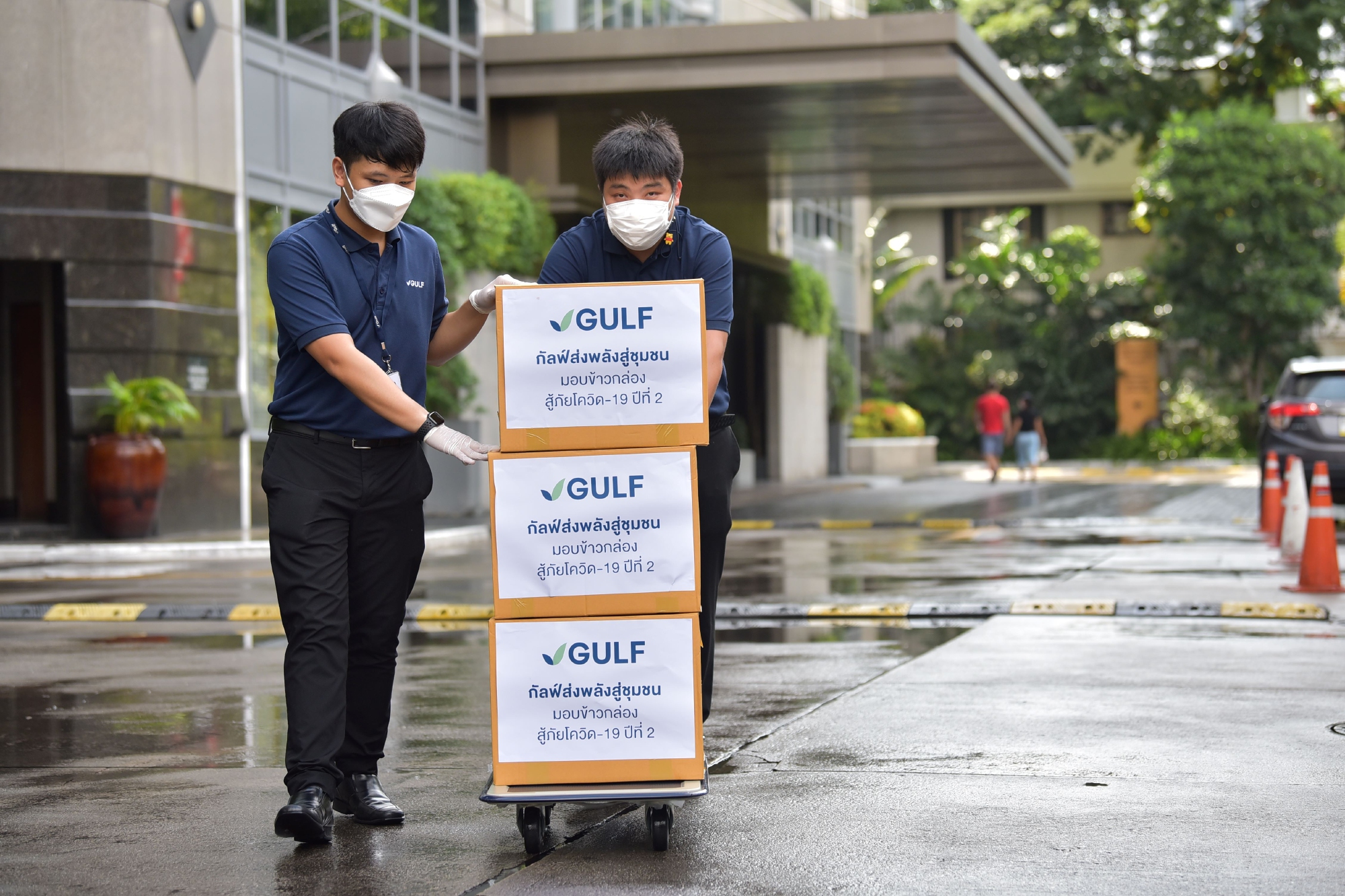
Gulf Energy Development Plc. or GULF, continues its free meals campaign, pledging a total of 120,000 meals in 60 days, as part of its efforts to support field hospitals, isolation facilities, and communities affected by the outbreak of COVID-19.
Gulf Energy Development Plc. or GULF continues its “Free Meals to Spark Community Strength” campaign for the second consecutive year, expanding on the success and positive feedback from last year with a pledge to provide over 120,000 meals in 60 days. The pre-packed meal boxes have been distributed to field hospitals, isolation facilities, and communities across Bangkok. This time, members of the public can help nominate communities they want to see helped by commenting under the post on the Gulf Spark Facebook fanpage at https://www.facebook.com/GulfSPARK.TH/
ADVERTISEMENTx
Gulf “Free Meals to Spark Community Strength” continues campaign for second yearMr. Sitamon Ratanavadi, on behalf of Mr. Sarath Ratanavadi, Chief Executive Officer of Gulf Energy Development PCL, stated, “After our working team distributed meal boxes last year, we saw first-hand that these meals actually reached people in the communities that were experiencing difficulties. Especially now when there are still many families who are unemployed with little to no income, a single meal box can help ease the burden of finding the money to buy food. Therefore, we would like to carry on this project for the second year with food being distributed by community representatives to reduce the risk from crowding.”
“In addition, distributing meals to local communities is a way to indirectly boost the economy because the production of 2,000 meal boxes per day requires lots of ingredients. It will also help provide income for restaurant staff, farmers, logistics providers, as well as the taxi drivers and motorcycle taxis who help distribute the meals to the community,” Mr. Sitamon added.
Gulf “Free Meals to Spark Community Strength” continues campaign for second yearThis campaign is part of GULF’s main campaign, “Gulf Sparks Smiles”, which was initiated to support various groups such as people in communities experiencing difficulties, patients and medical staff at the field hospitals, as well as Covid-19 patients with mild symptoms who are in home isolation or community isolation.
From the beginning of the pandemic, GULF has supported a range of different sectors in the fight against COVID-19, including recently providing essential goods to 1,800 families in Bangkok, sponsoring disinfecting equipment and basic medical equipment to all 50 districts in Bangkok, and donating 10 million baht to the Faculty of Medicine Ramathibodi Hospital to fund the procurement of medical equipment and expenses to cover the ‘hospitel’ which accommodates Covid-19 patients.
Esso (Thailand) and Esso Smiles Card Members donates 300,000 baht worth of Esso Fuels cards to the National Institute for Emergency Medicine
Customers have made the donations through redemption of Esso Smiles points from June 1st to 15th, 2021, accumulating to the 300,000 baht donation value of Esso Fuel cards.
Esso (Thailand) Public Company Limited and Esso Smiles Card members donated Esso Fuel Cards worth 300,000 baht to the National Institute for Emergency Medicine. Esso has increased the value of Esso Smiles points, allowing members to redeem points at double of their values. This is part of a special campaign by Esso Smiles Card in joint efforts with its members to provide assistance to the National Institute for Emergency Medicine in transporting Covid-19 patients.
Customers have made the donations through redemption of Esso Smiles points from June 1st to 15th, 2021, accumulating to the 300,000 baht donation value of Esso Fuel cards.
ADVERTISEMENTx
On this occasion, Esso (Thailand) represented by Director and Retail Sales Manager Mr. Jesada Chancherngkij (4th from left), and Director Dr. Taweesak Bunluesin (3rd from left), including the working team presented the Esso Fuel Cards to Dr. Chiyaporn Suchartsunthorn, M.D. (3rd from right), Assistant Secretary-General of the National Institute for Emergency Medicine, and his team at the National Institute for Emergency Medicine office, Nonthaburi province.
Esso Director and Retail Sales Manager Mr. Jesada said, “I am always impressed with the willingness to help among Thai people particularly in the time of crisis. I am so glad that members of Esso Smiles Card have joined in our efforts to provide fuel cards to support the National Institute for Emergency Medicine activities in transporting Covid-19 patients which are increasingly needed. It is my honor to present this donation to the National Institute for Emergency Medicine.”
With the increasing high number of Covid-19 infection, the National Institute for Emergency Medicine has played an important role in actively transporting COVID-19 patients in order for them to receive timely treatment.
Operator of posh downtown malls does its best to help partners survive crisis
Covid-19 first arrived in Thailand 16 months ago, the company launched the “Siam Ruam Chai, Thai Chuay Thai” (Siam in Harmony, Thais Help Thais) campaign.
Siam Piwat, the owner and operator of Bangkok’s Siam Paragon and Siam Discovery shopping complexes, has been helping partners and allies pull through the Covid-19 crisis.
Chadatip Chutrakul, Siam Piwat’s chief executive officer, said her company and allies have been challenged by the pandemic, which has affected the global supply chain of both production and service sectors.
“Virus outbreaks are unpredictable, and several sectors have to adapt themselves to the rapidly changing situation,” she said. “Siam Piwat has tried its best to help all tenants and allies who were affected by the crisis. We have also collaborated with the authorities and the public, helping those suffering from several aspects.”
When Covid-19 first arrived in Thailand 16 months ago, the company launched the “Siam Ruam Chai, Thai Chuay Thai” (Siam in Harmony, Thais Help Thais) campaign.
ADVERTISEMENTx
Operator of posh downtown malls does its best to help partners survive crisisMost recently, Siam Piwat joined hands with the Bank of Thailand and Krungthai Bank to hold a seminar on financial management during the crisis.
Kanoklada Rerkasem, Siam Piwat’s president for finance business development, said the company has been helping its trade partners to continue running their businesses via Call&Shop and Click&Shop services, or through delivery applications like Robinhood or True Food.
“The crisis has prevented us from expanding our sales to foreign customers. However, Siam Piwat still wants to promote Thai brands overseas,” she said.
The company will sell handicrafts through its own shop “Iconcraft” and those of partners in China, Vietnam and Malaysia. The products will be sold via both online and offline channels, she added.
VGI Partners up with Fanslink to create new opportunities across O2O ecosystem through the booming of e-Commerce market
The rise of e-Commerce market is fueling enormous growth in this new business opportunities. In 2020, Thailand’s e-Commerce market grew remarkably by 81% YoY.
VGI Plc (VGI), the leading O2O solutions provider, through its subsidiary BSS Holdings Co., Ltd (trading under “Rabbit”), invests a 51% equity stake into Fanslink Communication Co. Ltd (trading under “Pando”), a leading importer of Chinese electronics and e-Commerce enablers. This broadens VGI’s ability to create new strategic opportunities across its core pillars: Advertising, Payment, Logistics, and newly added e-Commerce.
The rise of e-Commerce market is fueling enormous growth in this new business opportunities. In 2020, Thailand’s e-Commerce market grew remarkably by 81% YoY. Meanwhile, the number of product input in e-Commerce marketplace increased significantly by 32% of which domestic product contributed 37% and international product contributed 63%. Chinese’s product and shop were the most interested by consumers due to its reasonable and affordable price. With the booming of e-Commerce market where Pando will be benefited from this trend.
ADVERTISEMENTx
VGI Partners up with Fanslink to create new opportunities across O2O ecosystem through the booming of e-Commerce marketThis investment supplements VGI’s overall businesses capabilities, with its diverse merchant network online and offline, e-payment, digital lending, insuretech platforms, and its loyalty and big data programs, and adds a further milestone in building its e-Commerce ecosystem; Pando is also able to leverage from VGI’s e-logistics arm Kerry’s express fulfillment and logistics services.
Nelson Leung, CEO of VGI Plc views “The partnership as a major opportunity for both businesses, where VGI supports Pando with pouring end-to-end performance-driven services and total marketing solutions. Moreover, the addition of Pando opens up many cross synergetic opportunities, we will be able to provide quality products to the Rabbit customer base at an affordable price, and will be able to implement several value-added services, including points, buy-now-pay-later, and insurance cover for any purchases, seamlessly whether offline or online”.
Pando was founded in 2017 by a serial e-commerce entrepreneur and company Chief Executive, Frank Guo, and in a short period has established itself to be the leading importer of world-class Chinese consumer electronic brands, such as Xiaomi, Amazfit, Haier, amongst many others. In addition, the company also offers to consumers its in-house premium quality brand “Pando Selection”, with products ranging from electronic gadgets, wearables to household hardware.
Pando uses advanced data analytics and machine learning to make a recommendation on trending product and demand forecasting. Key distribution channels include all major marketplaces, and B2B2C platforms, and can be found in leading home improvement hypermarkets across the country.
“We are very excited to be part of the VGI family, and working very closely with Rabbit. The company has many exciting services in the pipeline, including the introduction of its mobile application, consisting of features like live streaming, auction, social commerce, etc. We know with the support of the VGI media, and Rabbit ecosystem we will be able to bring big things to the Thai consumer.” States Frank Guo.




 Fan-free Olympics leaves hotels facing 1 million cancellations



 Gulf “Free Meals to Spark Community Strength” continues campaign for second yearMr. Sitamon Ratanavadi, on behalf of Mr. Sarath Ratanavadi, Chief Executive Officer of Gulf Energy Development PCL, stated, “After our working team distributed meal boxes last year, we saw first-hand that these meals actually reached people in the communities that were experiencing difficulties. Especially now when there are still many families who are unemployed with little to no income, a single meal box can help ease the burden of finding the money to buy food. Therefore, we would like to carry on this project for the second year with food being distributed by community representatives to reduce the risk from crowding.”
 Gulf “Free Meals to Spark Community Strength” continues campaign for second yearThis campaign is part of GULF’s main campaign, “Gulf Sparks Smiles”, which was initiated to support various groups such as people in communities experiencing difficulties, patients and medical staff at the field hospitals, as well as Covid-19 patients with mild symptoms who are in home isolation or community isolation.

 Operator of posh downtown malls does its best to help partners survive crisisMost recently, Siam Piwat joined hands with the Bank of Thailand and Krungthai Bank to hold a seminar on financial management during the crisis.
 VGI Partners up with Fanslink to create new opportunities across O2O ecosystem through the booming of e-Commerce marketThis investment supplements VGI’s overall businesses capabilities, with its diverse merchant network online and offline, e-payment, digital lending, insuretech platforms, and its loyalty and big data programs, and adds a further milestone in building its e-Commerce ecosystem; Pando is also able to leverage from VGI’s e-logistics arm Kerry’s express fulfillment and logistics services.
