Govt plans new two-month Covid-relief package for 40 million people #SootinClaimon.Com

#SootinClaimon.Com : ขอบคุณแหล่งข้อมูล : หนังสือพิมพ์ The Nation.

Govt plans new two-month Covid-relief package for 40 million people

EconJan 06. 2021
By The Nation

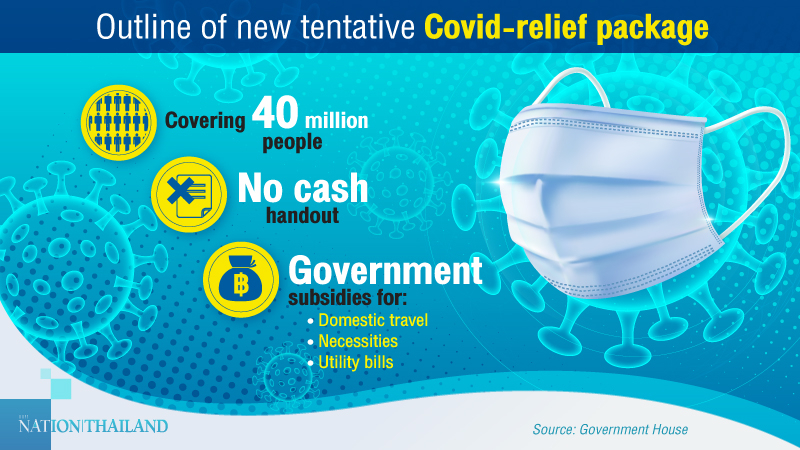
Prime Minister Prayut Chan-o-cha on Tuesday pledged to support 40 million people who have been affected adversely by the new surge of Covid-19 infections.

The authorities have implemented restrictions in many provinces that have been hit by the virus, which is impacting businesses and the daily life of people nationwide. 

Prayut said he has told Deputy Prime Minister Supattanapong Panmeechao, Finance Minister Apisak Tanitvorawong and senior officials at the National Economic and Social Development Council to come with additional measures to support the public for the next two months. 

The new relief measures, aiming to cover some 40 million people, will require large sums of money, but “we have adequate funds to deal with the issue”, the premier promised. 

Some existing measures such as domestic travel subsidy will be extended, with hotels being asked to allow people who have booked rooms to delay their travel plans until the situation gets better. The prime minister was speaking after the Cabinet meeting on Tuesday. 

Meanwhile, government spokesman Anucha Burapachaisri said the new measures will be different from previous ones because the government has not imposed strict lockdown restrictions this time. The Cabinet has also not discussed the option of cash handouts this time around, after the government gave people affected by the first round of Covid-19 outbreak last year Bt5,000 each for three months. 

Government agencies have been asked to see if existing measures such as the subsidy for daily necessities and discounts for domestic travel should be extended, he said.

Other potential measures include subsidising utilities to reduce the cost of living for people during Covid-control measures. Details of this will be discussed by the government’s Centre for Economic Situation Administration, he added.

Officials had earlier said the government still has Bt400 billion left from the Bt1-trillion emergency loan launched last year. 

Under this new wave of Covid-19 outbreak, the authorities have ordered the temporary closure of many venues including boxing rings, sports centres, gyms, pubs and bars. Restaurants, meanwhile, are only allowed to serve until 9pm and owners are required to impose social-distancing rules. 

Inter-provincial travel is still allowed and transportation services are in full operation, unlike last year when inter-provincial land and air transport was suspended.

Separately, the Cabinet has also approved the framework of the Bt3.1 trillion budget bill for fiscal 2022, which is 5.66 per cent lower than the budget for the current fiscal year. Current spending (including official salaries) has been set at Bt2.4 trillion, accounting for 75.95 per cent of the total budget and capital spending at Bt620 billion, or 20 per cent of the total budget. The government has earmarked Bt100 billion for principal debt payment, accounting for 3.22 per cent of total expenditure.

The Finance Ministry projects tax revenue worth Bt2.4 trillion, resulting in a budget deficit of Bt700 billion, which is equivalent to 4.04 per cent of the GDP. The ministry has forecast an economic expansion of between 3 to 4 per cent next year with inflation coming in at between 0.7 and 1.17 per cent. 

The new fiscal year starts in October this year and ends next September. The budget bill needs to be approved by Parliament before it becomes law.


SET climbs over zoned lockdown, fund inflows #SootinClaimon.Com

#SootinClaimon.Com : ขอบคุณแหล่งข้อมูล : หนังสือพิมพ์ The Nation.

SET climbs over zoned lockdown, fund inflows

EconJan 05. 2021

By The Nation

The Stock Exchange of Thailand (SET) Index closed at 1,506.65 on Tuesday, up 38.41 points or 2.62 per cent, while total transactions stood at Bt115.29 billion with an index high of 1,506.66 and a low of 1,466.05.

In the morning session, an analyst at Krungsri Securities expected the day’s index to fluctuate between 1,460 and 1,480 amid uncertainty over the coronavirus mutation and US President-elect Joe Biden’s bid to increase taxes.

“However, the inflow of funds and the Thai government’s zoning lockdown will help boost the SET,” he said.

The top 10 stocks with the highest trade value today were EA, GPSC, DELTA, GULF, PTT, CPALL, CPF, BGRIM, KCE and IVL.

As of 4.30pm, the price of oil rose by US$0.06 or 0.13 per cent to $47.68 per barrel, while gold dropped by $1 or 0.05 per cent, to $1,945.60 per ounce.

Other Asian indices were mixed:

Japan’s Nikkei Index closed at 27,158.63, down 99.75 points or 0.37 per cent.

China’s Shanghai SE Composite Index closed at 3,528.68, up 25.72 points or 0.73 per cent, while Shenzhen SE Component Index closed at 15,147.57, up 320.10 points or 2.16 per cent.

Hong Kong’s Hang Seng Index closed at 27,649.86, up 177.05 points or 0.64 per cent.

South Korea’s KOSPI Index closed at 2,990.57, up 46.12 points or 1.57 per cent.

Taiwan’s TAIEX Index closed at 15,000.03, up 98.00 points or 0.66 per cent.

Investors eye power plant stocks for safety’s sake #SootinClaimon.Com

#SootinClaimon.Com : ขอบคุณแหล่งข้อมูล : หนังสือพิมพ์ The Nation.

Investors eye power plant stocks for safety’s sake

EconJan 05. 2021

By The Nation

Stocks of power plants rose sharply on Monday as the new wave of Covid-19 infections has triggered investors to opt for safe stocks, experts said.

At closing on Monday, the share price of Energy Absolute (EA) had risen by 8.63 per cent to Bt53.50, Global Power Synergy (GPSC) rose by 7.12 per cent to Bt79, B Grimm Power (BGRIM) rose by 5.15 per cent to Bt51 and Gulf Energy Development (GULF) rose by 3.65 per cent to Bt35.50.

Sorrabhol Virameteekul, Kasikorn Securities senior vice-president, said power plant stocks have risen sharply due to investors’ move to seek safe stocks that can generate regular revenue amid worries over the Covid-19 outbreak.

He added that the price of power plant stocks have risen beyond 30 per cent since the start of the Covid era in March last year.

“We recommend investing in power plant shares, but investors should pick shares that are not higher than the fundamentals and are likely to rise, such as GPSC and EGCO,” he said.

Yuanta Securities investment analyst Piyapat Patarapuvadol said investors were seeking stocks that are cheap but whose performance has improved.

He added that power plant shares also gained positive sentiment from the trend of electric vehicles and appreciation of the baht.

“Many investors placed their hopes on GPSC shares in response to the news of PTT Exploration and Production [PTTEP] seeking power plant partners,” he added.

SET expected to gain from funds inflows and partial lockdown #SootinClaimon.Com

#SootinClaimon.Com : ขอบคุณแหล่งข้อมูล : หนังสือพิมพ์ The Nation.

SET expected to gain from funds inflows and partial lockdown

EconJan 05. 2021

By The Nation

The Stock Exchange of Thailand (SET) Index rose by 9.44 points, or 0.64 per cent, to 1,477.68 in the morning session on Tuesday.

An analyst at Krungsri Securities expected the day’s index to fluctuate between 1,460 and 1,480 amid uncertainty over the coronavirus mutation and US President-elect Joe Biden’s measure to increase the tax rate.

“However, the inflow of funds and the Thai government’s zoning lockdown would help boost the SET,” he said.

He recommended that investors buy:

▪︎ PTTEP, PTTGC, TOP and IVL, which benefit from rising oil price and improved fourth-quarter performance.

▪︎ PSL, TTA and RCL, which would benefit from the rise in the Baltic Dry Index.

▪︎ TQM, BLA, STGT, AJ, PTL, SYNEX and COM7, which benefit from the Covid-19 outbreak.

The SET Index closed at 1,468.24 on Monday, up 18.89 points or 1.30 per cent. Total transactions amounted to Bt89.20 billion with an index high of 1,468.27 and a low of 1,425.48.

Gold price goes up #SootinClaimon.Com

#SootinClaimon.Com : ขอบคุณแหล่งข้อมูล : หนังสือพิมพ์ The Nation.

Gold price goes up

EconJan 05. 2021

By The Nation

The price of gold rose by Bt100 per baht weight in morning trade on Tuesday, the Gold Traders Association reported.

As of 9.26am, the buying price of a gold bar was Bt27,300 per baht weight and selling price Bt27,400 while gold ornaments were priced at Bt26,802.88 and Bt27,900, respectively.

At close on Monday, the buying price of a gold bar was Bt27,200 per baht weight and selling price Bt27,300 while gold ornaments were Bt26,711.92 and Bt27,800, respectively.

The Comex (Commodity Exchange) gold price to be delivered in February rose by US$51.25, or 2.72 per cent, closing at $1,946.6 (Bt59,702) per ounce on Monday, the highest since November 6 last year and the highest single-day rise since April 22 last year.

Erawan Group buys back some shares despite suffering losses in the new normal #SootinClaimon.Com

#SootinClaimon.Com : ขอบคุณแหล่งข้อมูล : หนังสือพิมพ์ The Nation.

Erawan Group buys back some shares despite suffering losses in the new normal

CorporateJan 05. 2021

By The Nation

Hotelier Erawan Group (ERW) has bought back 182,000 of its shares worth a total of Bt651,560 or Bt3.58 per share, the Stock Exchange of Thailand reported on Monday.

ERW shares have been rising gradually over the past two months. In December, the ERW shares were going for Bt3.60 apiece, up 3.44 per cent from Bt3.48. The ERW shares hit the highest point at Bt4.04 apiece and lowest at Bt3.36 apiece in December.

Yuanta Securities said it expects ERW to suffer losses of Bt1.5 million and Bt184 million in 2020 and 2021 respectively, before making profits worth Bt188 million in 2022.

The securities firm also expects ERW revenue per available room (RevPAR) to be at -70 per cent in 2020, +67 per cent in 2021 and +68 per cent in 2022.

Meanwhile, the group’s selling, general and administrative expense (SG&A) for 2020 is expected to drop by 38 per cent.

“Though ERW shares have risen in response to positive news about the Covid-19 vaccine, we expect the company’s performance to be gloomy until foreign tourists are allowed to travel across the country,” an analyst said, adding that the company’s revenue from domestic tourists cannot compensate the 70 per cent revenue lost from foreign tourists.

The analyst further added that ERW will have to raise capital if it faces consecutive losses.

At the end of the third quarter last year, ERW had Bt1.4 billion in cash and Bt57 billion in loans, though it was able to half its cash burn rate to Bt250 million from Bt500 million in the second quarter.

Dollar stumbles into 2021 as bets on global recovery dominate #SootinClaimon.Com

#SootinClaimon.Com : ขอบคุณแหล่งข้อมูล : หนังสือพิมพ์ The Nation.

Dollar stumbles into 2021 as bets on global recovery dominate

EconJan 05. 2021

By Syndication Washington Post, Bloomberg · Greg Ritchie, Ruth Carson, Tian Chen

The U.S. dollar kicked off the new year with a weak start as expectations for a global economic recovery bolstered demand for riskier assets.

It lost ground against almost every major currency on Monday, pushing a gauge of its strength to the lowest level in nearly three years, after purchasing managers indexes across Europe and Asia showed factory activity gathering pace.

The euro rose as much as 0.7% against the dollar toward a high last seen more than two years ago, while the greenback touched the weakest level against the Chinese yuan since June 2018. Stocks and gold rallied as the market brushed aside concerns over the accelerating spread of the virus.

Investor sentiment is improving as coronavirus vaccines are rolled out and data point to a broad-based up-tick in economic activity. That’s undermining the case for the U.S. currency, the haven currency of choice for most investors. It capped its biggest annual drop since 2017 last year.

“Uncertainty is diminishing and the strong global growth recovery should favor the rest of the world,” said Patrik Schowitz, global multi-asset strategist at JPMorgan Asset Management, which is underweight the dollar. The currency’s weakness is likely to be most notable “against the emerging markets foreign-exchange complex, which should have cyclical upside and is still relatively cheap.”

The Bloomberg Dollar Spot Index fell 0.5% to its lowest level since February 2018. It ended 2020 5.5% weaker. Speculative positions against the currency were at the most in almost a decade, according to data from the Commodity Futures Trading Commission for the second last week of December.

“The markets are following the 2021 buy-everything play book to the tee,” said Stephen Innes, a strategist at Axi. “I would not be surprised if a lot of packed in risk premium continues to come off the curve,” especially if the U.S. Democratic Party wins the Senate election in Georgia on Tuesday.

President Donald Trump on Saturday urged Georgia election officials to “find” thousands of votes and recalculate the election result to flip the state to him as he tries to dispute Joe Biden’s election win.

China’s yuan is likely to be a “standout” beneficiary from a weaker dollar thanks to “yield erosion and twin deficits” that are weighing on the greenback, said Patrick Bennett, strategist at Canadian Imperial Bank of Commerce in Hong Kong. The onshore yuan rose as much as 1.1% on Monday and breached the 6.5 level for the first time since June 2018.

The yuan’s yield advantage over the dollar, which is near the widest on record, is also driving capital inflows. Reserve managers probably increased their holdings of the Japanese yen and the yuan in the third quarter of 2020, according to a Goldman Sachs note, based on an analysis of data from the International Monetary Fund.

“There is still plenty of scope for the global economy to do better than consensus forecasts,” said Kit Juckes, chief foreign-exchange strategist at Societe Generale SA. “Fretting about policy normalization will be a recurrent theme for 2021, but hey, it’s the first working day of the year and for now, those falling U.S. real yields and the positive risk mood can drag the dollar lower for a while yet.”

China delistings threaten $144 billion U.S. fundraising boom #SootinClaimon.Com

#SootinClaimon.Com : ขอบคุณแหล่งข้อมูล : หนังสือพิมพ์ The Nation.

China delistings threaten $144 billion U.S. fundraising boom

EconJan 05. 2021A pedestrian walks past a China Mobile store in Hong Kong on Jan. 4, 2021. MUST CREDIT: Bloomberg photo by Roy Liu.A pedestrian walks past a China Mobile store in Hong Kong on Jan. 4, 2021. MUST CREDIT: Bloomberg photo by Roy Liu.
By Syndication Washington Post, Bloomberg · Gregor Stuart Hunter

For more than two decades Chinese companies have turned to the U.S. stock market for capital and international prestige, raising at least $144 billion from some of the world’s largest investors.

Now this pillar of China’s integration with the global financial system is increasingly under threat.

The latest blow arrived on New Year’s Eve, when the New York Stock Exchange said it would delist three state-owned telecom companies to comply with Donald Trump’s November order barring U.S. investments in Chinese firms determined to be owned or controlled by the military. It’s the first time an American exchange has removed a Chinese company as a direct result of rising geopolitical tensions under the outgoing Trump administration.

While the impact on China Mobile and its two peers is likely to be minimal given the bulk of their shares trade in Hong Kong, the delistings underscore the risks for both Chinese and U.S. companies as tensions between the superpowers simmer. China’s largest offshore oil producer fell in Hong Kong on Monday amid speculation its U.S. shares may enter the cross-hairs next. Trump signed legislation with bipartisan support last month that could kick more Chinese firms off U.S. exchanges unless American regulators can review their financial audits.

“There is bound to be a cost to Chinese companies from being shut out of the U.S. or being delisted,” said George Magnus, a research associate at Oxford University’s China Centre and author of “Red Flags: Why Xi’s China is in Jeopardy.” A listing in the U.S. “looks a less attractive proposition nowadays, particularly if you’re a state-owned enterprise with close links to the People’s Liberation Army or internal security,” Magnus said.

The worry for U.S. companies is that their access to China’s vast economy could be curtailed in any escalation of tit-for-tat sanctions. Wall Street banks are particularly keen to see a ratcheting down of tensions after gaining unprecedented scope to operate in China last year. China’s securities regulator responded to the delistings by calling them groundless and “not a wise move,” though it didn’t outline any plans to retaliate.

NYSE said it will suspend trading in the American depositary shares of China Mobile, China Telecom and China Unicom Hong Kong before Jan. 11. In his executive order, Trump said the companies were among those directly supporting the Chinese military, intelligence and security apparatuses and aiding in their development and modernization.

Read more on the delisting process here.

China Unicom and China Mobile said they’re reviewing ways to protect their “lawful rights.” China Telecom said it’s considering options to “safeguard the legitimate interests of the company.”

The affected shares are worth less than 20 billion yuan ($3.1 billion) and account for at most 2.2% of the total shares in each company, the China Securities Regulatory Commission said in a statement on Jan. 3, adding that the companies are well positioned to handle any fallout.

China Mobile was among the nation’s first major companies to sell shares in the U.S., part of a “red chip” boom in 1997 that fizzled as the Asian financial crisis took hold. The IPO performed poorly on its debut, but nonetheless heralded a flood of Chinese listings in the U.S. over the coming decades.

The combined market value of China-domiciled companies with at least a portion of their shares traded in the U.S. now stands at upwards of $1.9 trillion, a list that includes blue-chip names from Alibaba Group to NetEase and JD.com. Chinese companies raised a record $36 billion from U.S. initial public offerings and follow-on share sales in 2020, data compiled by Bloomberg show. Companies backed by international venture capital firms often prefer U.S. listings to those in China, which are subject to the nation’s capital controls.

While the figures suggest many companies have shrugged off the risk of delistings, others have been making backup plans. Alibaba, JD.com and NetEase are among those that have added secondary listings in Hong Kong since late 2019.

Speculation that more may follow suit sent shares of Hong Kong Exchanges & Clearing up 4% to a record on Monday. Oft-cited candidates for secondary listings include Pinduoduo, a fast-growing e-commerce company that listed in the U.S. in 2018, and Baidu, the search engine operator that debuted on the Nasdaq in 2005.

Chinese President Xi Jinping has also been trying to boost his country’s domestic equity markets in Shanghai and Shenzhen, with a raft of recent reforms to attract tech companies that had historically flocked to New York. Jack Ma’s Ant Group was due to become the highest-profile addition to Shanghai’s much-touted Star board, until the IPO was abruptly shelved by regulators in November. The outlook for further delistings may depend in large part on how U.S.-China relations evolve after president-elect Joe Biden steps into the White House later this month. While Xi said in a congratulatory message to Biden in November that he hopes to “manage differences” and focus on cooperation between the world’s two largest economies, few expect tensions to ease anytime soon.

“We don’t know as to how the Biden administration will pick up the baton that’s been left by the Trump administration,” Oxford University’s Magnus said. “There will certainly be a transition cost to China if the mood in the U.S. remains sour.”

Stocks slump on virus spike before Georgia runoff #SootinClaimon.Com

#SootinClaimon.Com : ขอบคุณแหล่งข้อมูล : หนังสือพิมพ์ The Nation.

Stocks slump on virus spike before Georgia runoff

EconJan 05. 2021

By Syndication Washington Post, Bloomberg · Rita Nazareth, Vildana Hajric

Volatility gripped financial markets, spurring a stock sell-off amid concern that a surge in global coronavirus cases could crimp the nascent economic recovery. Traders were also jittery ahead of Tuesday’s runoff elections in Georgia, which could determine whether Democrats have control of Congress to push President-elect Joe Biden’s agenda.

While equities pared a slide that drove major U.S. benchmarks down more than 2% earlier Monday, the S&P 500 was still on track for its biggest slump in almost 10 weeks. Giants Apple Inc. and Amazon.com Inc. sank at least 2.4%, Boeing Co. weighed on the Dow Jones industrial average after an analyst downgrade, and Tesla Inc. climbed after coming close to meeting its vehicle-deliveries goal. The Cboe Volatility Index — a gauge of expected price swings for the S&P 500 known as the VIX — was poised for its biggest surge since September.

Global coronavirus infections topped 85 million, with Prime Minister Boris Johnson imposing a third lockdown across England and Japan considering another state of emergency for the Tokyo area. Daily cases in the U.S. soared to a record of nearly 300,000 following the New Year holiday, and an easier-to-spread variant detected for the first time last week could intensify the surge. Meanwhile, the nonstop political drama of 2020 is bleeding into the first week of 2021 — with a pivotal election in Georgia, promises of protests in the streets and President Donald Trump’s dragged-out fight over the November vote threatening to tear apart the Republican Party.

“Equity markets will remain sensitive to developments tied to the pandemic that have held the U.S. and global economy hostage for nearly a year,” John Stoltzfus, chief investment strategist at Oppenheimer, wrote in a note. “A nearer hurdle for the markets to consider will be the outcome of the runoff elections for two seats in the U.S. Senate taking place in Georgia. Should the Democrats win both seats, we expect the S&P 500 to become vulnerable to a downdraft in the neighborhood of 6% to 10%” from the end of 2020.

For Stoltzfus, it appears that equities have priced in a Republican victory in at least one of the two contests tomorrow. He added that “markets prefer that Washington’s Capitol Hill have enough checks and balances in place to keep political power out of just one party’s hands.”

Elsewhere, traders see U.S. inflation averaging at least 2% per year over the coming decade — the first time expectations have climbed that high since 2018. The move came as real yields plumbed record lows. Bitcoin’s rally fizzled out as the famously volatile cryptocurrency sank as much as 17%. Oil dropped as OPEC+ talks were unexpectedly suspended on Monday after a majority of members, including Saudi Arabia, opposed Russia’s proposal for a February supply hike.

These are some of the main moves in markets:

Stocks

The S&P 500 decreased 1.5% at 4 p.m.EST.

The Stoxx Europe 600 Index climbed 0.7%.

The MSCI Asia Pacific Index advanced 0.5%.

Currencies

The Bloomberg Dollar Spot Index climbed 0.1%.

The euro increased 0.2% to $1.2244.

The Japanese yen was little changed at 103.17 per dollar.

Bonds

The yield on 10-year Treasurys climbed one basis point to 0.92%.

Germany’s 10-year yield declined four basis points to -0.60%.

Britain’s 10-year yield decreased two basis points to 0.173%.

Commodities

The Bloomberg Commodity Index advanced 0.7%.

West Texas Intermediate crude fell 2.5% to $47.31 a barrel.

Gold rose 2.4% to $1,943.38 an ounce.

Govt to launch more relief packages as Covid surges to record high #SootinClaimon.Com

#SootinClaimon.Com : ขอบคุณแหล่งข้อมูล : หนังสือพิมพ์ The Nation.

Govt to launch more relief packages as Covid surges to record high

EconJan 05. 2021 Prime Minister Prayut Chan-o-chaPrime Minister Prayut Chan-o-cha

By The Nation

The government is seeking measures to combat the economic impact of the new Covid-19 outbreak, Prime Minister Prayut Chan-o-cha said on Monday.

Prayut spoke after the daily infection rate rose to 745 cases, the highest since the virus outbreak early last year.

The PM expressed concern over the impact on the 28 provinces under “maximum controls” after being hit by more than 50 cases. Provincial governors would have to decide on what restrictions were appropriate for the Covid-19 situation in their province, said Prayut.

Responding to calls from businesses to extend suspension of debt repayments, Prayut said the existing debt holiday had not yet ended. Many businesses are still struggling from the impact of the first outbreak, though some had resumed repaying debts to banks before the new surge in cases.

The PM said the fresh outbreak called for new measures for which the government would have to find funds. 

“If we can’t find the funding, it will be over,” he added.

Meanwhile the parliamentary committee responsible for monitoring Bt1 trillion of Covid-relief borrowing will convene on Tuesday for a meeting with Finance Ministry, Bank of Thailand and State Council officials.

Committee spokesman Akadet Wongpitakroj said it wants to amend the Covid relief emergency decree to ease conditions attached to Bt500 billion in soft loans to support small businesses. The amendment was needed because businesses have found it difficult to access the loans, he said.

Meanwhile, the Public Debt Management Office (PDMO), said the government has Bt400 billion left of the Bt1 trillion in borrowing to fund Covid-relief projects. The PDMO said the government had borrowed about Bt600 billion so far.

The Cabinet approved borrowing of Bt510 billion for Covid-relief last year. The PDMO received Bt370 billion of that money and used most of it (Bt348 billion) to relieve people’s financial burdens, said PDMO director general Patricia Mongkhonvanit. 

The Cabinet also approved Bt130 million for economic recovery projects in 2020, of which Bt34 billion went to the PDMO, she added