The Transport Ministry will focus on implementing seven new mega-projects next year, including the “southern land bridge” linking the Gulf of Thailand and Andaman Sea, minister Saksayam Chidchob said as he outlined the ministry’s plan for 2021 on Monday.
The Office of Transport and Traffic Policy and Planning has drawn up the terms of reference to hire a private firm to study the feasibility of the project and come up with a suitable design.
Another mega-project is Phase 2 of the double railway track being built by the State Railway of Thailand (SRT).
Saksayam said he has given SRT the job of studying the project, which will be developed on a public-private partnership. Given that the state agency has a huge debt and limited budget, getting the private sector to jointly develop the project is one of the options to help the project take off.
He said work on the double track Denchai-Chiang Rai-Chiang Khong and Ban Pai-Nakon Phanom railway will start next year.
Economic recovery accelerated in November, says Finance Ministry
EconDec 29. 2020Pisit Puapan, left, executive director of the macroeconomic policy bureau at the Fiscal Policy Office (FPO), and Wuttiong Jittungsakul, fiscal policy adviser, report on the state of the economy in November on Monday.
By The Nation
Economic indicators for November suggest Thailand’s recovery from Covid-19 is gathering pace, Wuttipong Jittungsakul, fiscal policy adviser to the Fiscal Policy Office, said on Monday.
Collection of VAT, an indicator of private consumption, rose 2.5 per cent from the previous month while contracting 6.5 per cent year on year (YoY) – a big improvement on the 9.4 per cent contraction in October.
Auto sales in November increased 8.7 per cent from October and contracted 7.2 per cent year on year, significantly improving from the 25.9 per cent YoY contraction in October, he said.
As for private spending, commercial vehicle sales rose 8.2 per cent year on year, for a third consecutive month in growth. However, the growth rate decelerated from 10.4 per cent and 13.5 per cent in October and September respectively.
Imports of capital goods expanded 6.2 per cent month on month, but contracted 3.2 per cent YoY, compared with 17 per cent yearly contraction in October.
Cement sales grew 10.8 per cent from the month before but contracted 1.5 per cent YoY – better than the 9.1 per cent contraction in October.
Government spending, which is a key driver of the economy, increased 100.6 per cent year on year to Bt363.8 billion.
Consumer confidence also grew in November, with the spending sentiment index up 52.4 to reach its highest level in nine months after the second consecutive monthly increase.
Farmers’ real income rose 13.6 per cent, boosting their purchasing power. Covid relief packages have driven rising consumer sentiment and farmer’s income, said Wuttipong.
Meanwhile, Pisit Puapan, executive director of the macroeconomic policy bureau, said most on Thailand’s regional economies also expanded in November on the month before.
The economic situation in the Northeast, Central Region, Greater Bangkok, East and South improved from October. However, economic conditions in the West and North stayed flat in November compared with October.
Energy plan for 2021 targets more than Bt127bn in private investment
EconDec 28. 2020Energy Minister Supattanapong Punmeechaow, centre, outlines policies for 2021.
By The Nation
The Energy Ministry on Monday outlined its 2021 mission to strengthen Thailand’s energy sector.
Minister Supattanapong Punmeechaow said the ministry would ask the Cabinet to approve a national energy plan that sets clear directions for private investment.
The ministry will also set a clear policy to reduce the electricity reserve, as well as further liberalising the natural gas and power sectors.
It will also promote more investment in electric vehicles and prepare a new bidding round for petroleum exploration concessions.
The ministry will stimulate sales of B10 diesel and set E20 gasohol as base-grade fuel.
The plan will also hasten establishment of community power plants with capacity totalling 150 megawatts.
The minister added that energy policies next year are expected to generate investment of Bt127.932 billion.
The Stock Exchange of Thailand (SET) Index closed at 1,452.67 on Monday, down 33.64 points or 2.26 per cent. Total transactions amounted to Bt103.63 billion with an index high of 1,512.99 and a low of 1,452.48.
In the morning session, an analyst at Krungsri Securities expected the day’s index to hit 1,500 points before falling amid the Thai government’s zoning lockdown, and mass buy-ups of Super Savings Funds (SSFs) and Retirement Mutual Funds (RMFs) as part of year-end window dressing by fund managers.
“However, the index will be under pressure from the rise in domestic Covid-19 cases, the tight SET valuation and the decline in foreign fund flows,” he said.
The 10 stocks with the highest trade value today were DELTA, GPSC, AEONTS, IVL, PTT, BAY, KEX, EA, CPALL and KBANK.
As of 4.30pm, the price of oil rose by US$0.40 or 0.83 per cent to $48.63 per barrel, while gold rose by $3.90 or 0.21 per cent, to $1,887.10 per ounce.
Other Asian indices were mixed:
Japan’s Nikkei Index closed at 26,854.03, up 197.42 points or 0.74 per cent.
China’s Shang Hai SE Composite Index closed at 3,397.29, up 0.72 points or 0.021 per cent, while Shenzhen SE Component Index closed at 14,044.10, up 27.04 points or 0.19 per cent.
Hong Kong’s Hang Seng Index closed at 26,314.63, down 71.93 points or 0.27 per cent.
South Korea’s KOSPI Index closed at 2,808.60, up 1.74 points or 0.062 per cent.
Taiwan’s TAIEX Index closed at 14,483.07, up 151.65 points or 1.06 per cent.
Thailand’s six oil refineries have agreed on a new specification for base-grade petrol (G-Base), the Energy Ministry said on Monday.
The ministry’s Department of Energy Business will now discuss the new G-Base specifications with automotive industry operators and manufacturers, as part of a move to promote gasohol E20 as a base-grade petrol.
“If all parties agree, the department will issue a new draft specification for G-Base petrol quality around April 2021 for refineries to prepare for the adjustment to G-Base,” said department director-general Nanthika Tansupanich.
“About three months later, every filling station nationwide should be selling E20 as base fuel. This process will be completed around July-August 2021.”
Meanwhile the Energy Ministry is now rolling out the Thailand Integrated Energy Blueprint (TEIB) to combine all five energy plans into one plan. The blueprint will contain a new fuel plan that incorporates the affect of electric vehicles (EVs) on affect future fuel consumption.
The department has also prepared preliminary safety standards for EV charging stations in consultation with stakeholders, with implementation expected next year.
The Stock Exchange of Thailand (SET) Index rose by 16.74 points, or 1.13 per cent, to 1,503.05 in the morning session on Monday.
An analyst at Krungsri Securities expected the day’s index to hit 1,500 points before falling amid the Thai government’s zoning lockdown, window dressing and mass buy-ups of Super Savings Funds (SSFs) and Retirement Mutual Funds (RMFs) at the end of this year.
“However, the index would be under pressure from the rise in the number of domestic Covid-19 cases, tight SET valuation and the decline in foreign funds flow,” he said.
He recommended that investors buy:
▪︎ PTTEP, PTTGC, TOP and IVL, which benefit from rising oil price.
▪︎ PSL, TTA and RCL, which would benefit from the rise in the Baltic Dry Index.
▪︎ TQM, BLA, STGT, AJ, PTL, SYNEX and COM7, which benefit from the Covid-19 outbreak.
Meanwhile, an analyst at Tisco Securities expected the day’s index to fluctuate due to investors’ short-term speculation, SET’s limited upside and domestic Covid-19 situation.
“However, we do not expect the SET to fall below 1,450 points as we believe that window dressing and mass buy-ups of SSFs and RMFs will help support the index,” he said.
He estimated the index’s support line at between 1,465 and 1,475 and resistance line between 1,495 and 1,500.
He advised investors to sell shares to take profits when the index hits 1,500 and buy back when the index faces volatility.
“Also, we advise investors to stop loss when the SET closes below 1,450 points,” he added.
The SET Index closed at 1,486.31 on Friday, up 34.79 points or 2.40 per cent. Total transactions amounted to Bt88.24 billion with an index high of 1,486.84 and a low of 1,462.77, on the back of news that the European Union and Britain had reached a deal on Brexit.
The price of gold surged by Bt250 per baht weight in morning trade on Monday, the Gold Traders Association reported.
As of 9.27am, the buying price of a gold bar was Bt26,900 per baht weight and selling price Bt27,000, while gold ornaments were priced at Bt26,408.72 and Bt27,500, respectively.
At close on Saturday, the buying price of a gold bar was Bt26,650 per baht weight and selling price Bt26,750, while gold ornaments were Bt26,166.16 and Bt27,250, respectively.
Spot gold price moved to US$1,898 (Bt57,157) per ounce in the morning. However, some important gold markets worldwide were closed for Christmas holidays.
Hong Kong gold price rose by HK$60 to $17,440 (Bt67,750) per tael, the Chinese Gold and Silver Exchange Society reported.
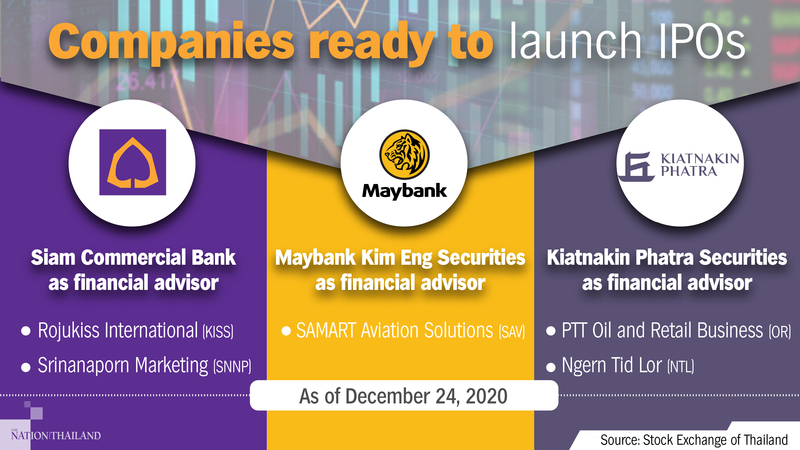
Initial public offerings (IPO) will become more popular with investors next year, experts said recently.
Prasert Tantayawit, managing director of investment banking for Maybank Kim Eng Securities, said investors are paying attention to IPO shares as the stock market is moving into positive territory.
“Businesses related to aviation and retail have postponed plans to launch IPO shares owing to the Covid-19 impact, but we believe they will start raising funds once the pandemic is resolved,” he said.
“Meanwhile, businesses related to healthcare, construction and industrial estate which have been able to escape the Covid-19 fallout are ready to launch their IPO next year.”
He added that many leading Thai firms plan to expand into neighbouring countries next year.
“Recently, Maybank Kim Eng Securities became an adviser for SCG on the acquisition of a Vietnamese company,” he added.
SCB Securities’ director Veena Lertnimitr said companies aiming to launch an IPO next year will attract more investors to the stock market, especially if they are companies related to digital platforms, e-commerce or branding focused food businesses. She added that five such firms will be listed in the stock market next year.
“Most companies that aim to launch an IPO next year have authorised capital of over Bt300 million, while some may need to improve their business plan to deal with the post-Covid-19 era,” she said.
The Thai stock market is expected to face sell-offs in the final week of the year, as new cases of coronavirus infections soar, Anusorn Tamajai, former dean of Rangsit University’s Economics Faculty, has warned.
People who pay respects at the Hindu shrine outside Isetan department store in Bangkok have to stay in the marked space as a precaution against virus infection.
A new round of coronavirus infections globally and the threat of new virus variants may force many countries to impose ban on foreign arrivals, and such restrictions would disrupt recovery of the global economy, he said.
The Stock Exchange of Thailand (SET) may plunge below 1,400 from Friday’s close of 1,486.31, he predicted.
The SET’s new barrier may be at 1,380. The baht will not change much in the final week of the year but it could have a tendency to appreciate in the first quarter of next year due to large contraction in imports, he said.
Investors may shift their funds to more secure asset classes, such as gold and government bonds, as Thailand and other Asian countries are facing a new round of infections which threatens economic recovery. The threat of a US government shutdown could also make global stock markets jittery, as incumbent President Donald Trump has not yet signed the virus relief package into law. That would also adversely affect US stocks and the dollar, said Anusorn.
The Thai government reported 121 new Covid-10 cases on Sunday and authorised partial lockdowns in several provinces.
“The challenge for the government is how to prevent multiple clusters and superspreading events in the next two months,” he said.
If the government can do that, then the virus will be contained as it was in the first round of infection, therefore any large gathering of people must be avoided over the next two months, he noted.
He said the government’s budget of Bt6 billion to buy vaccines is not adequate. The Bt6 billion will buy just 26 million doses of vaccine and only 13 million people will get shots as everyone needs two shots.
Thailand needs to vaccinate at least 53 to 54 million people, including migrant workers, to control the virus and pave the way for reopening of the economy in the third quarter next year, he suggested.
So the government needs Bt18.69 billion more for vaccine sourcing, as the country needs to import at least 107 million vaccine doses, he said.
“If Thailand cannot reopen the economy in the third quarter of next year, more people will lose their jobs, more small businesses will go bankrupt and financial institutions will face serious trouble,” he warned.
The government has to go ahead with its plan to collect land and building tax in order to get more revenue from wealthy people who have the capacity to pay more taxes, he said.
He also urged the government to allow private hospitals to provide vaccinations to high-income groups in order to reduce government spending.
The Bank of Thailand on Wednesday cut its economic growth projection for next year to 3.2 per cent, down from the previous projection of 3.6 per cent, due to the impact of the new round of Covid infections worldwide.
The central bank, however, revised upward its forecast for this year’s growth, predicting a contraction of 6.6 per cent compared with the 7.8 per cent contraction predicted previously.
CP Foods set to launch five series of debentures to finance expansion
Dec 25. 2020
By The Nation
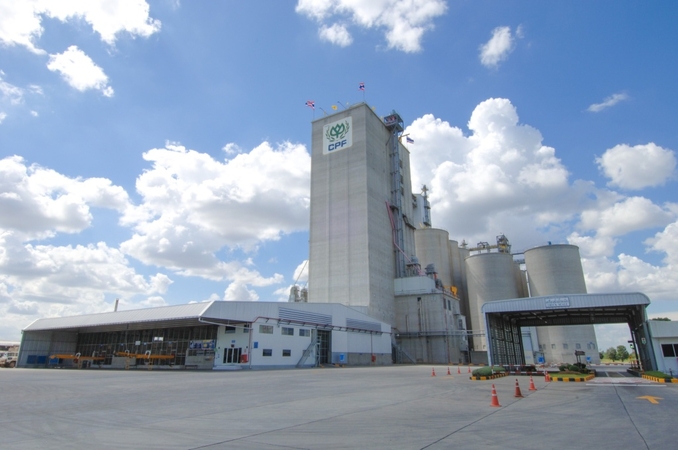
Charoen Pokphand Foods (CP Foods) is getting ready to issue and offer five series of debentures with tenors of two to 12 years to retail and institutional investors as well as high-net worth investors.
The debentures have been assigned an A+ by TRIS ratings and the subscription period is expected to be held throughout January. There are seven financial institutions overseeing the issue, namely
Krungthai Bank, Kasikornbank, Siam Commercial Bank, Government Savings Bank, CIMB Thai Bank, TMB Bank and Kiatnakin Phatra Securities.
Paisan Chirakitcharern, chief financial officer, said CP Foods plans to issue debentures to refinance its existing debts maturing in 2021 and for funding future business expansions.
Retail investors will be offered four series of debentures: a 5-year tenor at a coupon rate of 2.99 per cent per annum, a 7-year tenor with a coupon rate of 3.15 per cent per annum, the 10-year tenor with a coupon rate of 3.60 per cent per annum and a 12-year tenor with a coupon rate of 3.80 per year. Meanwhile, the 2-year tenor will only be offered to institutional investors and/or high-net worth investors.
The final coupon rate of the 2-year tenor debentures will be determined and announced at a later stage, with interest being paid for debentures every six months.
Retail investors and high-net worth investors interested in the debentures can subscribe for a minimum Bt100,000 in multiples of Bt100,000.
More details are available at www.sec.or.th or via the joint lead arrangers.
 Saksayam Chidchob
 Pisit Puapan, left, executive director of the macroeconomic policy bureau at the Fiscal Policy Office (FPO), and Wuttiong Jittungsakul, fiscal policy adviser, report on the state of the economy in November on Monday.
 Energy Minister Supattanapong Punmeechaow, centre, outlines policies for 2021.



 Anusorn Tamajai