CP All continues negotiations for 7-Eleven stores in Cambodia and Laos

ศาสตร์เกษตรดินปุ๋ย : ขอบคุณแหล่งข้อมูล : หนังสือพิมพ์ The Nation

http://www.nationmultimedia.com/detail/Corporate/30372049

x

CP All continues negotiations for 7-Eleven stores in Cambodia and Laos

Breaking News July 01, 2019 12:02

By The Nation

CP All Plc reports to the Stock Exchange of Thailand on Monday on its negotiations for a Master Franchise agreement in relation to the establishment and operation of 7-Eleven Stores in Cambodia and the Lao People’s Democratic Republic.

The company said that the contractual parties are in the process of negotiating the terms of the Master Franchise Agreement and have agreed to an extension of the negotiation period for a period yet to be agreed. This original period was due to expire by the second quarter of 2019.

The Company will inform to the SET of any further progress on the matter, the reports said.

The company’s share price at the start of business on July 1 showed a rise of Bt0.25 and was trading at Bt86.25 per share.

New alliance calls for amendment of law prohibiting recycled PET in food packaging

ศาสตร์เกษตรดินปุ๋ย : ขอบคุณแหล่งข้อมูล : หนังสือพิมพ์ The Nation

http://www.nationmultimedia.com/detail/Corporate/30372048

x

New alliance calls for amendment of law prohibiting recycled PET in food packaging

Corporate July 01, 2019 11:50

By The Nation

The Thai Beverage Industry Association (TBA) partnership with Indorama Ventures Plc have announced their collaboration to further encourage the amendment of a regulation that will allow the use of recycled PET in food and beverage packaging in Thailand.

The partners are also working with the Thailand Risk Assessment Centre: TRAC, the Nutrition Promotion Foundation under the Royal Patronage of HRH Princess Maha Chakri Sirindhorn and Institute of Nutrition, Mahidol University on research to understand consumer behavior in relation to their plastic consumption and specifically their practices after consumption that can render that plastic unsuitable for recycling. The aim of this study is to develop the right protocol and direction for rPET usage, a part of sustainable plastic waste management that also ensures consumer confidence in product safety, Veera Akraputtiporn, Vice Chairman and President of TBA, said.

In its position at the very heart of the cooperation among members of the non-alcohol beverage industry, the Association realises the importance of its role in helping to solve the plastic waste problem. Packaging in particular is a vital component in delivering fresh and quality drinks to consumers safely.

However, packaging can also become a big environmental issue if it is not being disposed of or recycled properly. Today, beverage manufacturers in Thailand have no other options but to use 100-per-cent virgin plastic because the regulations prohibit the use of recycled plastic in food-contact packaging. As a result, our members simply cannot reduce the use of virgin plastic in this regard even if they want to, he added.

Thailand currently prohibits the use of recycled PET in food and beverage packaging even though many sectors and industries have become increasingly aware of the necessity for and benefits of rPET usage in recent years. The Thai Food and Drug Administration (FDA) has already set up a committee to review the Notification of the Ministry of Public Health (No. 295) B.E. 2548 (Y2005), Clause 8, which states: “It is prohibited to use plastic containers made from re-used plastic with the exception of use for packing fruits with peel.” The committee has studied academic research and guidelines from many countries on recycled PET, but suggests an intensive survey be carried out to better understand the issue and Thai consumer behavior. The Thailand Risk Assessment Centre (TRAC), the Nutrition Promotion Foundation under the Royal Patronage of HRH Princess Maha Chakri Sirindhorn and the Institute of Nutrition, Mahidol University were assigned to take the lead in the survey, which is being supported by TBA with funding from its members, namely the Coca-Cola system in Thailand, Suntory PepsiCo Beverage (Thailand) Company Limited and Nestlé (Thai) Ltd. Company along with Indorama Ventures Public Company Limited as a supply partner.

AA+ rating for to PTT Global Chemical’s senior unsecured debentures

ศาสตร์เกษตรดินปุ๋ย : ขอบคุณแหล่งข้อมูล : หนังสือพิมพ์ The Nation

http://www.nationmultimedia.com/detail/Corporate/30372047

x

AA+ rating for to PTT Global Chemical’s senior unsecured debentures

Corporate July 01, 2019 11:42

By The Nation

Fitch Ratings (Thailand) has assigned a ‘AA+(tha)’ National Long-Term Rating to PTT Global Chemical Plc’s (PTTGC, AA+(tha)/Stable) new senior unsecured debentures. The debentures have a five-year tenure and will total up to Bt10 billion.

The debentures are rated at the same level as PTTGC’s National Long-Term Rating as they represent its senior unsecured obligations. Proceeds will be used as working capital, to refinance existing debt and to fund capex.

Panasonic taps robotic engineering for new body massage chair

ศาสตร์เกษตรดินปุ๋ย : ขอบคุณแหล่งข้อมูล : หนังสือพิมพ์ The Nation

http://www.nationmultimedia.com/detail/Corporate/30372027

x

Panasonic taps robotic engineering for new body massage chair

Corporate July 01, 2019 09:17

By The Nation

A massage chair that helps relax the body from the foot to the neck will be launched in Japan from August 1. The new Panasonic massage chair, priced at approximately 500,000 yen (Bt141,000), comes with a user-friendly, touch-type operation panel.

The company said the easy-to-see screen and easy-to-understand operation would make it possible for people of all age groups to operate the massage chair without stress.

The chair comes with airbags for the back of the upper arm, one each on the left and right for the massage of both upper hands. The massage chair offers a new feature: users can select their favourite massage from the touch screen. Massage progress is displayed in real time.

The company said robotic engineering has enabled internal massage heads to provide a total range of massaging motions to replicate the dexterity of the human hand for a more natural, relaxing and effective massage experience.

NTT Corp amalgamates capabilities in tech field, sets up headquarters in London

ศาสตร์เกษตรดินปุ๋ย : ขอบคุณแหล่งข้อมูล : หนังสือพิมพ์ The Nation

http://www.nationmultimedia.com/detail/Corporate/30372022

x

NTT Corp amalgamates capabilities in tech field, sets up headquarters in London

Breaking News July 01, 2019 08:42

By The Nation

Nippon Telegraph and Telephone Corporation (NTT Corporation) on Monday launched NTT Ltd, a global technology services provider that brings together the capabilities of 28 companies including NTT Communications, Dimension Data and NTT Security into one US$11 billion (Bt37.4 billion) business.

Headquartered in London and employing some 40,000 people in offices across 70 countries and regions, the new NTT aims to deliver unparalleled capabilities and is focused on “doing great things for people, businesses, and society”, according to its press release.

President and chief executive of NTT Corporation, Jun Sawada said that this amalgamation serves to create a top-five global technology and business solutions provider with US$20 billion revenues outside of Japan. Going forward, the company will accelerate its execution as one NTT in order to contribute to a smarter and better world through digital transformation.

“We are also excited to confirm that our global headquarters for NTT Ltd will be in London and that our commitment to the UK remains extremely strong. We considered several locations as the headquarters for and made a deliberate decision to choose London. It has many benefits, including a stable economy, wealth of skills and talent, diversity in population and thinking, strong infrastructure, schools, and housing for global talent moving to the city. In short, it’s a great city to live and work in, and we’re excited that we are making it the home for our new business,” he said.

Putting the future in the BASKET

ศาสตร์เกษตรดินปุ๋ย : ขอบคุณแหล่งข้อมูล : หนังสือพิมพ์ The Nation

http://www.nationmultimedia.com/detail/Corporate/30371916

Putting the future in the BASKET

Corporate July 01, 2019 01:00

By   KWANCHAI RUNGFAPAISARN
THE NATION

RETAILERS are gearing up to move into a new phase of the industry over the coming decade amid the disruptive forces of technology that are bringing rapid changes in consumer behaviour and lifestyles, industry experts say.

Sompong Rungnirattisai, chief executive officer of Tesco Lotus, said that while consumers are changing their behaviour, they continue to demand top quality products with value for money, and a convenient and pleasant shopping experience.

“As a result, Tesco Lotus has been focusing on offering great quality products at affordable prices, while working on providing a seamless omni-channel experience, as customers shop and engage with us across multiple platforms from our brick and mortar stores to our online shopping channels, our mobile applications, and our socsial media platforms,” said Sompong.

“As technological advancements continue at warp speed into the next decade and beyond, businesses will need to remain extremely agile in order to cater to these changes in consumer behaviours at a faster pace. For retailers such as Tesco Lotus, our task is to continue to provide great quality products at affordable prices and a great shopping experience anywhere, anytime for our customers.”

Sompong said that another trend that is anticipated by the company – and which will continue to grow over the next decade – is sustainability. More and more consumers will demand that businesses operate responsibly, transparently, and ethically. One important aspect of sustainability for retailers is responsible sourcing of products with respect to the people who work in the value chain, animal welfare and the environment.

“Tesco Lotus is working closely with our suppliers and farmers to enhance the sustainability of key products in our customers’ baskets while maintaining affordability for our customers. Packaging will also continue to be an area of focus,” Sompong said.

Tos Chirathivat, executive chairman and CEO of Central Group, said that the retail industry has undergone significant transformation and it will continue to evolve even faster due to technology, data insights and changing consumer lifestyles. Key trends shaping the retail sector are that customers are “more emotional than functional” and massive transformation and collaboration will have to happen in order to remove the boundaries between the retail, payment and logistics industries.

“Central Group positions ourselves as ‘Central of Life’ for all our stakeholders. We continue to revolutionise our platforms in order to create the ‘Central Experience’ that can offer a unique value proposition with a frictionless experience throughout the customer’s journey,” said Tos.

As what kind of transformation will occur more than 10 years out, Lacia Sherlock, IKEA’s deputy retail manager for Thailand, Singapore and the Philippines, said that she thinks that depends on what part of the world you live in.

“We are here in Southeast Asia. You can’t compare retail habits. We talk of course a lot about this. But we are in Southeast Asia and shopping is like a part time hobby,” she said. “Shopping and seeking out retail destinations are hobbies for the family. So we see that retail will continue to do well in Southeast Asia. But the format will change. It will be a version of brick and click working together. You will see, for example, they were just online, and they’ve gone to a physical presence. So it is the combination of both.

“Brick and click, I believe, is for the future. And our store’s format makes it accessible. We want to show inspiration. So we always want to have a physical platform. And Thailand has a high rate of internet consumption. Thais are also big social media fans. And they like to touch. They want to touch and try before they buy.”

Robert Candelino, CEO of the Unilever Thai Group of Companies, and for Malaysia, Singapore, Myanmar, Laos and Cambodia, said that digitalisation will affect every aspect of life including how we shop in the future. This will likely mean that all retailers will have a digital or e-commerce capability because “it is our expectation that consumers will continue to seek the convenience and efficiency of shopping” – wherever, whenever they want.

“The change in retail landscape will be a challenge for everyone, not just one industry or sector. All of us need to recognise the inevitability of a digital future and as such we all have to figure out how to evolve from our legacy models to future-proof models,” Candelino said.

“At Unilever, we are approaching this evolution similar to how we have done for all major changes throughout our long history – by focusing on being the best partner to all our customers, by having great products that are purposeful and add value to people’s lives and by remaining the most preferred employer in Thailand by attracting leaders who want to help shape the future in a positive way.”

Punyapon Tepprasit, chief executive officer of MVP Consultant and a lecturer in MBA industrial management at Ramkhamhaeng University, said that the continuously developed technologies like the Internet of things has changed the world of retail dramatically. This is especially so in the use of online channels to support trade and customer service. Trading through e-commerce has become familiar to consumers over the past years. The volume of purchases from e-commerce has grown steadily.

“In the near future, we will see many retail formats, including for e-commerce subscription services. As the consumers need products that match their preferences, they will want direct-to-door service and e-commerce subscriptions are likely to grow significantly. These businesses will deliver the products that consumers or regular customers need every month, or according to the agreed timeframe.

“For example, in the razor business in the United States, marketing is conducted by creating knowledge and understanding about American consumers who have to change their razors every month for cleanliness and safety.”

Punyapon said that e-commerce with a subscription format is growing in the US market, which is the reference market of many countries and is the major retail trend leader in the world. A report by McKinsey & Company found that from 2010, the sales made at such businesses amounted to US$57 million.

Larry Chao, managing director of Chao Group Limited, a consulting agency specialising on organisation change, said that when he thinks about what the retail landscape might look like 10 years from now, he first thinks about how things have changed in the past 10 years.

“I know that extrapolating the future from the past is hardly perfect, as certain technologies advance exponentially and new trends emerge, but keeping this perspective does provide a dose of reality on what might really change the industry, rather than the hyped-up changes promised by exciting digital breakthroughs,” Chao said. “To understand future possibilities, we also have to factor in Thai consumer shopping habits.

“I envision five changes: the first is industry consolidation, followed by gravitation of consumers to either value for money private label or brands and experiences that mean something; the disappearance of plastics and concern for sustainability; outstanding customer service as a real competitive weapon; and lastly, digital disruptions, primarily in operations.”

Regarding consolidation, he said that over the past 10 years, there has been unbridled growth in shopping venues.

“This seems counterintuitive, given that in other markets such as the US, shopping malls have contracted or gone bankrupt, as e-commerce gobbled up market share. But in Thailand, people love their brick-and-motor shopping experience and while they might not always buy in stores, they have not migrated online – yet.

“But the laws of supply and demand will eventually prevail. We will reach a saturation point where having a Starbucks on every street corner is simply unprofitable. At that point, there will be a culling of retail outlets, and those in the fittest locations and/or those having the most desirable product portfolios will survive.”

Chao said that regarding the gravitation of consumers to either value for money private label or brands and experiences that mean something, consumers are confronted by so many choices,

“They are already beginning to allocate their spending money into two buckets: commodity items and value-added brands. To meet demand for commodity items, retailer will expand their private label business whilst offering consumers exciting brands that mean something. Brands that are sharply targeted and offer consumer value they cherish, not just bells and whistles, will thrive. Brands caught in the middle will be squeezed out by value-added brands and private labels.”

When considering the disappearance of plastics and the concern for sustainability, he said this change is likely to gain momentum as people become more aware of the real damage plastics have caused on the environment.

“At places like Central Chidlom’s Tops Supermarket, cashiers use paper bags to pack groceries every Tuesday. At Central Embassy’s Eathai, sticky rice is now packed in banana leaves instead of small plastic bags. But this is only the tip of the iceberg,” he said.

“There are huge opportunities to eliminate or replace plastics in packaging including shrink wrap. I would not be surprised to see more biodegradable innovative packaging take off within the next 10 years.”

On the customer service front, retailers could seek to make this a competitive weapon, Chao said.

“Today, in Thailand, human labour is relatively inexpensive, so it is easy to hire 10 less skilled people to do the work that three skilled people could do. This is unsustainable and normally delivers only average service. With wages increasing, retailers will be forced either to automate or, if service is important, hire fewer, better people,” he said.

“Retail companies will learn that having a lot of inexpensive staff on the floor to interact with customers is not as effective, and often worse, than having a few outstanding salespeople who are knowledgeable, responsible and care about service. Successful retailers will be able to attract and develop really talented professional service people, who know how to deliver outstanding experiences and reduce operating costs at the same time.”

Chao said that, when it comes to digital disruptions in operations, there is no doubt that consumers will continue to be inundated with digital technologies and experiences.

“But if you think about it, how much has digital technology really changed the way you shop? We are flooded with exciting stories of how digital technologies are increasing consumer loyalty, and sales from other countries, but I’m not sure whether they are transferrable to our shopping culture here in Thailand,” he said.

“Yes, in other countries, Amazon and Alibaba have disrupted the industry with online shopping. There is Tesco Homeplus Virtual Subway Store in South Korea. But as long as factors such as a lack of trust with online transactions or unreliable delivery exist, it will be challenging for digital shopping to gain traction here in Thailand.”

Chao said that one area where technology will continue to have the biggest impact in retail is with the customer experience, particularly in making this as frictionless and as fast as possible.

“For example, retailers will be able to track customers as they move through the store, recording what products they pick up and what they put back on the shelves,” he said. “When they have finished shopping, customers will be able to scan their mobile phones to make the payment on the final basket of goods they have selected. Grabbing customer attention might also become fancier and more exciting.”

Sojitz appointed sales agent for Saha’s industrial parks

ศาสตร์เกษตรดินปุ๋ย : ขอบคุณแหล่งข้อมูล : หนังสือพิมพ์ The Nation

http://www.nationmultimedia.com/detail/Corporate/30372008

Sojitz appointed sales agent for Saha’s industrial parks

Corporate July 01, 2019 00:26

By THE NATION

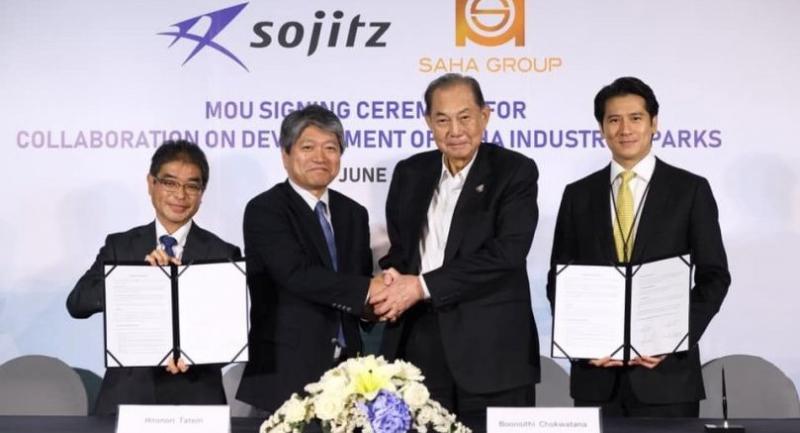
Saha Pathana Inter-Holding Public Co Ltd (Saha), the corporate arm of Thai conglomerate Saha Group, has signed an agreement with Sojitz (Thailand) Co Ltd, the local subsidiary of Sojitz Corporation (Sojitz), appointing the latter as sales agent for Saha’s industrial parks.

Sojitz is also in talks with Saha regarding a memorandum of understanding which would see the parties jointly developing industrial parks and other businesses, strengthening the partnership between the two companies.

Thailand’s long-term socioeconomic vision for the country—”Thailand 4.0”— aims to achieve greater industry sophistication and higher value in the country’s products and services.

In the Bank for International Cooperation (JBIC)’s annual survey of foreign direct investment by Japan’s manufacturing sector in FY2018, Thailand came third behind China and India among the most promising countries in the medium-term (next three years).

The study predicted that more Japanese manufacturers would look to Thailand to set up or expand their production facilities.

Saha has developed four industrial parks in the country since 1974, headed by the first in Sri Racha and three more in Kabin Buri, Lamphun, and Mae Sot. This means that Sojitz can offer prospective investors a suitable site for their operations.

Furthermore, Sojitz’s support network—both in Japan and Thailand—will provide detail-oriented backup to companies considering inroads into Thailand.

Sojitz will use its experience gained from work on industrial parks in Vietnam, Indonesia, India, and the Philippines in its offers to Japanese companies looking to establish production bases in Saha’s industrial parks in Thailand and other countries in the region.

GC forges alliances to push circular living

ศาสตร์เกษตรดินปุ๋ย : ขอบคุณแหล่งข้อมูล : หนังสือพิมพ์ The Nation

http://www.nationmultimedia.com/detail/Corporate/30372004

GC forges alliances to push circular living

Corporate June 30, 2019 19:24

By The Nation

PTT Global Chemical Pcl (GC), is reinforcing its circular living concept with partners to support the environment and drive sustainable and efficient use of resources.

GC will join with ALPLA Group, a global recycler and high-quality plastic packaging solutions provider, to study the feasibility of jointly building a plastic recycling plant to deliver innovation-driven, high-quality plastic solutions.

GC had recently organised the “Circular Living Symposium 2019: Upcycling Our Planet” to highlight how the circular economy is effective in helping to make the world a better place.

Chief executive officer and president of GC Supattanapong Panmeechao said the company, as a leading provider of chemical innovations, was focused on improving the quality of life. It has long recognised the importance of the resource revolution in line with the principles of the circular economy, which aims to conserve natural resources, he said.

The company organised the “Circular Living Symposium 2019: Upcycling Our Planet” in partnership with National Geographic, a global non-profit organisation committed to exploring and protecting the planet, to share ideas that contribute to a better future for the world through the principles of the circular economy and by adopting GC’s circular living lifestyle.

Many leading domestic and international thinkers and experts shared their insights and ideas at the symposium. It also offered opportunities to network with partners from diverse sectors to truly develop a circular economy in line with the Thai government’s policy.

“GC’s internal and external operational practices have applied the principles of the circular economy to optimise resource efficiency,” said Supattanapong. “For example, we are committed to waste management by following the 5Rs throughout our organisation, which are: reduce, reuse, recycle, renewable, and refuse.”

He said GC is also developing bioplastics, a material that is biodegradable and an alternative to single-use plastics, as part of a strategy to end the production of single-use plastic resins within five years, by 2024.

This coincides with GC’s increasing cooperation with several partners to implement effective waste management approaches through several projects and activities. They include “Upcycling the Oceans, Thailand” project in partnership with the Tourism Authority of Thailand, and Ecoalf Foundation, in which a collection of fashionable products were made from upcycled plastic waste collected from the seas around Thailand. The project was important in demonstrating how recycled materials could go through the upcycling process to create value-added products. GC also set up a joint venture with Sarn Palung Social Enterprise Co Ltd to launch the “Upcycling SE” project, which works with communities to conduct effective waste management by transforming recycled plastic bottles using innovative technology to produce value-added fashionable products for sale under the “Upcycling by GC” trademark.

“In addition, GC is focused on developing suitable plastic packaging, along with its proper use and management, as well as reuse in line with the principles of the circular economy to ensure maximum benefits. GC is seeking a variety of partners to research and produce integrated quality circular plastic resin,” Supattanapong said.

GC has been working with ALPLA, a global expert in the development and production of food-grade plastic packaging solutions, to conduct a study on joint investing in the first high-quality circular plastic recycling plant in Thailand, including materials, namely rPET and rHDPE. “We will review the results of the study to make the final investment decision in the third quarter of this year,” added Supattanapong.

Bernd Wachter, regional managing director of ALPLA Southeast Asia, said, ALPLA has been “a world leader in the development and production of plastic packaging solutions” over the past 60 years, with operations in 176 manufacturing locations worldwide across 45 countries including Thailand. He said the company is expanding its business to PET recycling. “With our considerable experience and advanced technology, ALPLA will support GC’s integrated plastic recycling plant, which will have the capability to produce quality recycled plastic resin and will serve as a model for the country and region.”

GC wants everyone to take part in protecting the environment by adopting a circular living lifestyle that supports the efficient use of resources, Supattanapong said. “This can easily be done by reducing and separating waste, as well as maximising the use of plastic by reusing, recycling, and upcycling through creativity and innovation, and also choosing eco-friendly products,” he added.

VGI joins hands with Saha for more Lawson 108 outlets at BTS stations

ศาสตร์เกษตรดินปุ๋ย : ขอบคุณแหล่งข้อมูล : หนังสือพิมพ์ The Nation

http://www.nationmultimedia.com/detail/Corporate/30372002

VGI joins hands with Saha for more Lawson 108 outlets at BTS stations

Corporate June 30, 2019 17:32

By The Nation

VGI Global Media PCL on Friday signed a deal for a joint venture company with Saha Lawson Co Ltd and Saha Pathana Inter-Holding Plc to open Lawson 108 stores at its mass-transit platforms, including BTS stations.

The move is part of its plan to boost its offline-to-online (O2O) ecosystem through strategic retail spaces, offering Rabbit Line Pay as an option for cashless payments.

“Lawson 108 is now open at four BTS stations, and the number of customers purchasing products and services via Rabbit Line Pay at Lawson 108 outlets has been constantly growing,” said Kavin Kanjanapas, chairman, executive committee, VGI Global Media PCL.

“Through this strategic collaboration, companies under the Saha Group have also tied over 3,000 of their staff ID cards to Rabbit cards, allowing VGI access to a greater customer database, which in turn will help us tailor and refine our advertising solutions to boost customer engagement.” He said the alliance will enable them to develop “smarter marketing solutions”, including customised reward programmes. “Consumers can access great benefits, for instance through the Rabbit Rewards loyalty programme and other promotional offers from our partners. They underscore the strength and capabilities of our O2O ecosystem,” Kavin said.

“We are delighted to collaborate with such a prominent partner as VGI, with its wide-ranging marketing platforms. We plan to open Lawson 108 stores in 30 BTS stations. We have already opened our outlets at four stations: Thong Lor, Saphan Khwai, Ploenchit and Victory Monument. The planned expansion at the rest of the stations is expected to be completed within the next two to three years,” said Koichi Hirose, managing director, Saha Lawson Co Ltd.

“Saha Group has a wide range of products and services covering various businesses. We welcome this alliance as we recognise great potential for growth… Together with VGI, we hope to combine our experiences and strengths to forge a long-lasting partnership,” added Vichai Kulsomphob, president, Saha Pathana Inter-Holding Pcl.

New Crystal production line up and running in Lampang

ศาสตร์เกษตรดินปุ๋ย : ขอบคุณแหล่งข้อมูล : หนังสือพิมพ์ The Nation

http://www.nationmultimedia.com/detail/Corporate/30372000

New Crystal production line up and running in Lampang

Breaking News June 30, 2019 16:44

By THE NATION

Sermsuk Public Co Ltd, the producer of Crystal, has started up a new production line for the popular drinking water brand in Lampang province to better serve consumers in northern Thailand.

With an annual production of 100 million litres, the state-of-the art facility will speed up product deliveries in the region.

Meanwhile, the company remains focused on social contributions. “Nine Napat,” the brand’s ambassador, has called for increased awareness in communities and among the younger generation of the importance of protecting the environment. To stress its concern, Sermsuk has delivered an “upcycling station” to the community in Lampang for waste recycling.

Prangnee Chaipidej, Sermsuk’s marketing director, said: “The expansion of Crystal’s production line is part of our commitment to consistently meet the demands of Thai consumers. We will extend our distribution network to cover the entire country. In 2019, the overall drinking water market in Thailand is estimated to grow 16 per cent, of which the northern region will account for 14 per cent. Crystal posted a 18 per cent growth in the north last year, and the upward is expected to continue”.

The 30-rai facility in Koh Ka district of Lampang province, operated by Thai Drinks Co under Sermsuk, uses the latest eco-friendly technology from Germany with less pollution and helps to sustain the use of natural resource.

The production line features innovations developed by robotics and machinery engineers at Bevtech, a division of Thai Beverage. Workers at the new facility have been re-skilled in modern technology,

leading to increased productivity and improvement to Crystal’s’ operations and service.

“This new production line offers synergies with our Nakhon Sawan and Kampang Phet factories to address growth in the drinking water market in the northern region. This factory will also be a strategic location for distributing products to modern trade outlets and local department stores. Lampang is well-connected with the upper northern region comprising Chiang Mai, Chiang Rai, Lamphun, Phrae, Phayo, Sukhothai, and Tak provinces. This expansion will boost transportation efficiency, lower costs while improving the distribution of Crystal throughout the northern region,” added Prangnee.