Four TFG factories become completely solar powered
Jan 13. 2021
By The Nation
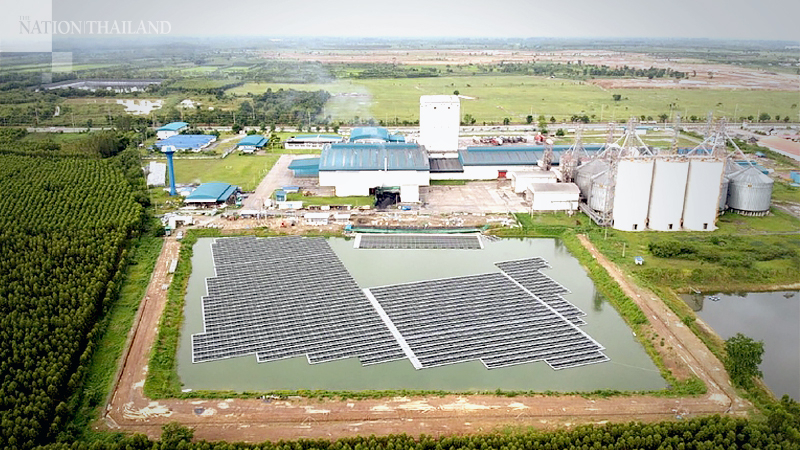
Floating solar farm distributor TF Tech has kicked off the commercial operation of its floating solar systems in four factories owned by Thaifoods Group (TFG), providing a total of 13.78 megawatts, Energy Absolute (EA) deputy chief executive officer Amorn Sapthaweekul said.
EA’s subsidiary, EA Renewable, owns a 40 per cent stake in TF Tech, an associate of TFG.
The four TFG factories in the project include two feed plants, one each in Suphanburi and Prachinburi, and one chicken slaughterhouse in Prachinburi. The solar systems began operating in these three sites in November last year.
The fourth site is a chicken slaughterhouse in Kanchanaburi, where the solar system began operating in December.
JLL, a global real-estate consultancy, has appointed Michael Glancy as country head for Thailand, replacing Suphin Mechuchep, who will become chairperson for operations in Thailand.
The company has also appointed Chris Archibold as country head for Singapore.
These changes, effective from January, come as part of the company’s plan to strengthen its capabilities and align with its growth ambitions in the region. All three executives will report to Chris Fossick, who is CEO of Southeast Asia operations.
In Thailand, Glancy will oversee the company’s business growth. Having worked at JLL Hong Kong since 2019, he relocated to Bangkok in February 2020 and has been leading the transaction business since. He will partner closely with regional and local business lines to generate new leads and opportunities.
Meanwhile, as chair of operations in Thailand, Suphin has successfully managed and expanded the company over the past 17 years. An experienced real-estate veteran, she will continue driving key business priorities and nurture the strong client networks she has built over her career spanning more than three decades.
Archibold has worked with JLL in Singapore for 17 years and spearheaded the office-leasing business before taking over as head of leasing for Singapore in 2018.
In his new role, he will drive Singapore’s sales strategy and business development by connecting local and regional business functions as well as leading markets advisory.
AP condo projects enrolled in Elite Card programme
Jan 12. 2021Vittakarn Chandavimol, right, chief of corporate strategy and creation, AP (Thailand) Pcl, and Somchai Soongswang, president of Thailand Privilege Card Co Ltd, recently signed a memorandum of understanding.
By The Nation
Real estate developer AP (Thailand) Pcl and Thailand Privilege Card Co Ltd, operator of Thailand Elite membership card, recently signed a memorandum of understanding for a special collaboration on the Elite Flexible One programme.
Under the agreement, AP Thailand will enroll 8 condominium projects into the programme to cater to foreign investors interested in property investment in Thailand where they will enjoy a number of privileges from this special programme.
The company will enroll ready to move in projects into the programme which are: Life Ladprao, Life Asoke – Rama 9, Life One Wireless, Aspire Sukhumvit – Onnut, Aspire Asoke – Ratchada, Aspire Rattanathibet 2 as well as two projects that will join the programme soon, namely Life Asoke – Hype and Life0 Ladprao Valley.
PTT Global Chemical Plc (PTTGC) is developing a merger-and-acquisition plan with a focus on businesses where it still has production lines, said chief executive officer Kongkrapan Intarajang.
The M&A plan will become clearer as the year progresses, he added.
He explained that the Covid-19 fallout meant some companies were now considering selling businesses at low prices, opening opportunities for M&A deals.
PTTGC is expected to invest between Bt30 billion and Bt50 billion this year on business development. However, this amount does not include the M&A budget.
Coca-Cola severs longtime ties with pro-sugar industry group
CorporateJan 14. 2021Delivery trucks sit parked outside a Coca-Cola Co. bottling plant in Lexington, Ky., on Feb. 10, 2020. MUST CREDIT: Bloomberg photo by Luke Sharrett.
By Syndication Washington Post, Bloomberg · Brett Pulley
Coca-Cola Co. has ended its long association with the International Life Sciences Institute, a blow to the powerful food organization known for its pro-sugar research and policies.
The beverage giant ended its membership at the “global, regional and country level” as of this month, Coke said in a statement in response to inquiries from Bloomberg News. The decision was made after a routine review, the company said without offering additional details.
The departure is a major setback for ILSI at a time when health-conscious consumers are increasingly turning away from sugar-laden beverages. The group, which was created in 1978 by a former Coke executive, still lists companies such as PepsiCo, Kellogg and McDonald’s as members, but Coke had been a prominent supporter and financial backer.
Those companies didn’t immediately respond to a request for comment on whether the group’s membership list is up to date. ILSI didn’t respond to requests for comment.
ILSI has come under fire in recent years for its role in influencing government health and nutrition policy around the world, acting as what some scientists and health experts have called an advocacy-oriented front group for its corporate members. The group has promoted the industry-friendly idea that physical exercise, not a change in diet, is how to combat obesity, according to a 2015 New York Times report. It has exerted influence around the world, including in a multidecade effort in China that was detailed in the Journal of Health, Politics, Policy and Law, as well as in India and Brazil.
Citing the growing criticism, candy maker Mars left the organization in 2018, and Nestle exited at the regional and country levels in January of last year.
Coke made the decision last year to sever ties, Mark Preisinger, the company’s director of corporate governance, said in an October letter viewed by Bloomberg that was sent to the Park Foundation, a non-profit organization that has been critical of ILSI.
Corporate Accountability, a watchdog group that also has called out ILSI, said the move suggests Coke now sees “more risk than reward” in sticking with the organization.
“For decades, ILSI has been Coca-Cola’s accomplice interfering in and blocking policies that aimed to safeguard people’s health and wellbeing across the world,” Ashka Naik, research director at Corporate Accountability, said in a statement.
Coke’s shares were little changed at 11:25 a.m. in New York. The stock fell 0.9% last year amid pandemic-driven closures of sporting arenas, amusement parks and other venues, and the company has cut jobs.
CorporateJan 13. 2021Acting THAI president Chansin Treenuchagron
By The Nation
Thai Airways International (THAI) on Wednesday insisted its rehabilitation plan is progressing without interruption under Bankruptcy Court supervision.
The announcement came after the court granted THAI’s request to extend the deadline for submission of the plan from January 2 to February 4.
Acting THAI president Chansin Treenuchagron explained the rehab plan involved many creditors and complex issues that required consultation from experts and professional advisers before its submission.
The court approved the airline’s rehabilitation petition on September 14 last year and appointed seven rehab planners nominated by the airline.
Chansin said the planners were making good progress, while THAI management and staff were cooperating towards their efforts.
The Stock Exchange of Thailand (SET) Index fell by 0.78 points, or 0.05 per cent, to 1,546.53 in the morning session on Thursday.
An analyst at Krungsri Securities expected the day’s index to fluctuate between 1,535 and 1,560 points as investors keep an eye on US President-elect Joe Biden’s economic stimulus proposals, the US political situation after the House of Representatives impeached President Donald Trump and banks’ 2020 turnover results set to be announced.
“Besides, the decline in foreign fund flows would cause index volatility,” he said.
He recommended investors buy:
> Shares related to green energy and electric vehicles, such as EA, GPSC and KCE.
> PTTEP, PTTGC, Top and IVL, which benefit from a rising oil price and improved fourth-quarter performance.
> PSL, TTA and RCL, which would benefit from a rise in the freight rate.
The SET Index closed at 1,547.31 on Wednesday, up 7.46 points, or 0.48 per cent. Total transactions amounted to Bt106.7 billion, with an index high of 1,561.66 points and a low of 1,542.42.
The price of gold dropped by Bt100 per baht weight in morning trade on Thursday, the Gold Traders Association reported.
As of 9.23am, the buying price of a gold bar was Bt26,150 per baht weight and selling price Bt26,250 while gold ornaments cost Bt25,681.04 and Bt26,750, respectively.
At close on Wednesday, the buying price of a gold bar was Bt26,250 per baht weight and selling price Bt26,350 while gold ornaments cost Bt25,772 and Bt26,850, respectively.
The spot gold price moved to US$1,845 (Bt55,403) per ounce in the morning, while the Comex (Commodity Exchange) gold price to be delivered in February rose by $10.70 to $1,854.90 per ounce on Wednesday, thanks to mass buy-ups of safe-haven assets to deal with inflation after the US Consumer Price Index increased in December.
Also, gold gained positive sentiment from hopes of a rollout of fresh US economic stimulus measures.
The Hong Kong gold price meanwhile dropped by HK$70 to $17,090 (Bt66,188) per tael, the Chinese Gold and Silver Exchange Society reported.
Oil fluctuates with fuel build up dimming tighter crude supply
EconJan 14. 2021An oil pumping jack in an oilfield near Neftekamsk, in the Republic of Bashkortostan, Russia, on Nov. 19, 2020. MUST CREDIT: Bloomberg photo by Andrey Rudakov.
By Syndication Washington Post, Bloomberg · Andres Guerra Luz, Alex Longley
Oil clawed back some of its earlier losses as shrinking U.S. crude supplies added to an already tightening global supply outlook, though a stronger dollar and rising refined products supplies exerted downward pressure.
Futures were little changed in New York after falling as much as 1.2% earlier in the session. An Energy Information Administration report showed U.S. crude inventories fell by 3.248 million barrels last week, its fifth drop in a row. However, the EIA report also showed builds in gasoline and distillate stockpiles. The Bloomberg Dollar Spot Index strengthened as much as 0.3%, reducing the appeal for commodities priced in the greenback.
“It’s good to see another crude draw” and the remainder of the year should “continue to have drawdowns in overall inventories, especially if OPEC compliance remains pretty strong,” said Brian Kessens, a portfolio manager at Tortoise, a firm that manages roughly $8 billion in energy-related assets. Still, “the refined products side was a little bit disappointing for those people who wanted to be more bullish.”
Prices earlier were boosted by expectations for cold weather to buoy demand at a time when the supply outlook has already been tightening, with Goldman Sachs seeing demand getting a boost of at least 1 million barrels a day. In Japan, power generators have been buying cargoes of low-sulfur fuel oil for the purpose of direct burning, according to traders. Meanwhile, Saudi Arabia trimmed February supplies to at least 11 refiners in Asia and Europe after announcing surprise production curbs last week.
Following recent covid-19 vaccine breakthroughs and Saudi Arabia’s pledge to deepen cuts, oil markets still face a precarious demand picture as the world tries to emerge from the pandemic. U.K. road vehicle use was down 42% on pre-covid levels last week, while aircraft tracking in early 2021 shows little sign of any meaningful rebound in flight numbers. However, the market’s been looking ahead of the near-term virus risks and toward demand returning in the longer term.
“We have a positive outlook,” Russell Hardy, chief executive officer of trading house Vitol Group, said in a Bloomberg Television interview. “The market as usual is racing ahead and factoring in that positive news of a vaccine and the expectation of a better summer and a better second half of 2021.”
A trading executive at Total also said Wednesday that by the northern hemisphere’s summer, oil-product demand should be back at 2019 levels, excluding jet fuel. Use of aviation fuel is unlikely to recover until the third quarter, Mike Muller, Vitol’s head of Asia, said Wednesday.
While crude prices should continue “trading higher over the coming months, investors need to be mindful that the road to higher oil demand and prices will remain bumpy,” said Giovanni Staunovo, a commodity analyst at UBS Group.
EconJan 14. 2021A pedestrian stands against an electronic stock board outside a securities firm in Tokyo on Jan. 4, 2021. MUST CREDIT: Bloomberg photo by Noriko Hayashi.
By Syndication Washington Post, Bloomberg · Claire Ballentine, Vildana Hajric
Stocks rose and benchmark Treasury yields retreated for a second day amid optimism the economy will continue to benefit from government support.
Technology shares led gains, with the Nasdaq 100 outperforming the benchmark S&P 500. Intel jumped 7% after the chipmaker named a new chief executive. Treasurys received strong demand for a second consecutive day at a government debt sale, helping to send yields down from the highest levels since March.
“Investors continue to focus on growing expectations for increased fiscal spending and promising economic prospects as the vaccine rolls out later this year,” said Ryan Nauman, market strategist at Informa Financial Intelligence’s Zephyr. “It’s all about resiliency here right now and equity markets continue to overlook and not be phased by all the chaos that’s out there.”
In Washington, the House of Representatives is voting to impeach President Donald Trump for a second time. A Senate trial for Trump probably will not begin before his term ends Jan. 20.
European Central Bank council member Francois Villeroy de Galhau said the ECB will keep an easy stance for as long as needed, and U.S. investors took comfort from remarks by two Federal Reserve officials that pushed back on the possibility of tapering bond purchases anytime soon.
“Coordinated comments from Fed governors” are helping to deflate bond yields, said Deutsche Bank strategists including Jim Reid in a note to clients. “We’ve only had seven business days this year, and we’ve already had a full 360-degree tapering debate played out by the Fed.”
Europe’s Stoxx 600 was flat, with losses in banks and travel shares outweighing M&A announcements. Among the day’s winners, French grocer Carrefour rallied after Alimentation Couche-Tard, the convenience-store giant that owns the Circle K chain, said it’s exploring a transaction.
In Japan, the Nikkei 225 outperformed, reaching a record in dollar terms. Equities also ticked up in South Korea, while Hong Kong shares were flat.
Oil fell as a stronger dollar and rising refined products supplies offset shrinking U.S. crude supplies, capping the price under a key technical indicator.
Here are some key events coming up:
– JPMorgan Chase & Co., Citigroup and Wells Fargo are among firms due to report earnings.
– President-elect Joe Biden plans to lay out proposals for fiscal support Thursday.
– Federal Reserve Chairman Jerome Powell takes part in a webinar Thursday.
– U.S. initial jobless claims data is due Thursday.
– U.S. retail sales, industrial production, business inventories and consumer sentiment figures are due Friday.
These are some of the main moves in markets:
Stocks
– The S&P 500 index climbed 0.3%, to 3,809.84, as of 4:02 p.m. New York time.
– The Dow Jones industrial average increased 0.1%, to 31,060.47.
– The Nasdaq Composite index jumped 0.5%, to 13,128.95.
– The Stoxx Europe 600 index rose 0.1%, to 409.07.
– The MSCI All-Country index rose 0.3%, to 661.44.
Currencies
– The Bloomberg Dollar Spot Index rose 0.2%, to 1,122.79.
– The euro decreased 0.4%, to $1.2157.
– The British pound fell 0.3%, to $1.3634.
– The Japanese yen weakened 0.1%, to 103.87 per dollar.
Bonds
– The yield on 10-year Treasurys dipped four basis points, to 1.09%, the biggest decrease in five weeks.
– Germany’s 10-year yield decreased five basis points, to -0.52%, the largest dip in seven months.
– Britain’s 10-year yield fell five basis points, to 0.307%, the first retreat in more than a week and the biggest drop in more than a month.
Commodities
– West Texas Intermediate crude fell 0.6%, to $52.88 a barrel, the first retreat in more than a week and the largest fall in a week.


 Vittakarn Chandavimol, right, chief of corporate strategy and creation, AP (Thailand) Pcl, and Somchai Soongswang, president of Thailand Privilege Card Co Ltd, recently signed a memorandum of understanding.
 Delivery trucks sit parked outside a Coca-Cola Co. bottling plant in Lexington, Ky., on Feb. 10, 2020. MUST CREDIT: Bloomberg photo by Luke Sharrett.
 Acting THAI president Chansin Treenuchagron

 An oil pumping jack in an oilfield near Neftekamsk, in the Republic of Bashkortostan, Russia, on Nov. 19, 2020. MUST CREDIT: Bloomberg photo by Andrey Rudakov.
 A pedestrian stands against an electronic stock board outside a securities firm in Tokyo on Jan. 4, 2021. MUST CREDIT: Bloomberg photo by Noriko Hayashi.
