Jamie Dimon, other CEOs meet with President Biden at White House as relief plan advances #SootinClaimon.Com

#SootinClaimon.Com : ขอบคุณแหล่งข้อมูล : หนังสือพิมพ์ The Nation.

Jamie Dimon, other CEOs meet with President Biden at White House as relief plan advances

InternationalFeb 10. 2021Jamie Dimon, Chair and CEO of JP Morgan Chase, testifies before the House Financial Services Commitee in Washington on April 10, 2019. MUST CREDIT: photo for The Washington Post by J. Lawler Duggan.Jamie Dimon, Chair and CEO of JP Morgan Chase, testifies before the House Financial Services Commitee in Washington on April 10, 2019. MUST CREDIT: photo for The Washington Post by J. Lawler Duggan.

By The Washington Post · Tom Hamburger, Jeff Stein, Erica Werner

WASHINGTON – President Joe Biden met at the White House on Tuesday with JPMorgan Chase Chief Executive Officer Jamie Dimon and other leading business executives to discuss the administration’s $1.9 trillion economic relief package, as Democrats work to speed the plan through Congress.

The meeting also included Doug McMillon, CEO of Walmart; Sonia Syngal from GAP; Marvin Ellison, CEO of Lowe’s; and Tom Donohue, of the U.S. Chamber of Commerce. Vice President Kamala Harris and Treasury Secretary Janet Yellen also took part.

The meeting with the business executives comes as the White House accelerates its push for Biden’s $1.9 trillion relief proposal amid increasing opposition from congressional Republicans. House Democrats have unveiled key portions of the legislation and on Tuesday began holding what will be a lengthy series of committee meetings this week to vote on various portions of the package, leading up to final House passage later this month.

The developments coincided with the start of the Senate’s impeachment trial of former president Donald Trump, but Biden told reporters he wasn’t watching the trial.

“I have a job. My job is to help people. We have already lost over 450,000 people and we could lose a whole lot more if we don’t act and act decisively,” Biden said as his meeting with the business leaders got underway. “A lot of people, as I have said before, children are going to bed hungry. A lot of families are food insecure. They are in trouble. That’s my job.”

The meeting of the business executives also comes amid an intensifying fight over Democrats’ proposal to hike the minimum wage to $15 per hour. McMillon, who is also the chairman of the influential Business Roundtable, said last month that he supports a boost to the minimum wage. Dimon has also previously backed a minimum wage hike.

But the U.S. Chamber of Commerce has urged lawmakers not to use the “current crisis . . . as an opportunity to enact long-sought permanent policy changes, like raising the minimum wage.” The Chamber also called existing $1 trillion annual deficits a “real cause for concern.”

The business leaders are expected to bring up the minimum wage proposal at the White House, two people familiar with the matter said, speaking on condition of anonymity to discuss the private meeting.

Biden’s plan to raise the federal minimum wage has become a particularly contentious element of his relief package, which also includes hundreds of billions of dollars for cities, states and schools; rental assistance and eviction relief; and $160 billion for a national vaccine program, increased testing and other assistance for the health care system.

Additionally, Biden’s proposal includes a new round of $1,400 stimulus checks to individuals. Democrats have been debating who should be eligible to receive those checks, and considered lowering the income threshold for individuals to $50,000 from the $75,000 Biden initially proposed, which had applied to previous stimulus payments — including $600 checks Congress agreed to in December.

However, the Ways and Means Committee on Monday released legislation keeping the $75,000 income limit for individuals and $150,000 for couples, but adding a faster phaseout period so that no money goes to individuals with incomes over $100,000 or couples with incomes over $200,000.

Asked Tuesday whether he supported the structure of the checks as proposed by House Democrats, Biden responded: “Yes.”

Many lawmakers are concerned that the minimum wage increase will not be accepted by the Senate parliamentarian under the special budget rules Democrats are using to push the relief bill through Congress without GOP votes.

Asked about that issue Tuesday, Senate Majority Leader Chuck Schumer, D-N.Y., said: “We’re trying to work as well as we can with the parliamentarian to get minimum wage to happen. That’s all I’m going to say.”

House Democrats debated internally whether to incorporate the minimum wage increase in their bill but the proposal is strongly supported by members of the Congressional Progressive Caucus and was ultimately included.

The U.S. Chamber of Commerce has also said it opposes Biden’s proposal to raise federal unemployment benefits from $300 per week to $400, saying the measure “distorts the labor market and deters individuals from returning to work.”

This is not the first time Biden has met with officials who have criticized elements of his relief plan. Earlier this month, Biden hosted 10 Senate Republicans to discuss the next relief package – although he has appeared to reject their pleas to seek a bipartisan bill.

“As you know I met a long time with my Republican colleagues, have been exchanging correspondence and telephone calls as well to see if there’s any way we can follow-up beyond where we are,” Biden said. “I think we’re in a position to think big and move big and move in a direction that cannot only get the economy back on its feet, but we have to get people well.”

Biden also said he was anxious to hear how the business executives felt about the relief package and expressed optimism they could find “common ground,” just as he had sought with Senate Republicans.

JPMorgan Chase has previously called for another round of pandemic relief for poorer families as well as the renewal of support for unemployed Americans, among other measures.

Russian big business steps in to speed coronavirus vaccine roll out #SootinClaimon.Com

#SootinClaimon.Com : ขอบคุณแหล่งข้อมูล : หนังสือพิมพ์ The Nation.

Russian big business steps in to speed coronavirus vaccine roll out

InternationalFeb 10. 2021Workers arrive for their shifts at the main office at the Dneprovsky Iron & Steel Works, operated by Evraz Group, in Dnipro, Ukraine, on Jan. 25, 2017. MUST CREDIT: Bloomberg photo by Vincent MundyWorkers arrive for their shifts at the main office at the Dneprovsky Iron & Steel Works, operated by Evraz Group, in Dnipro, Ukraine, on Jan. 25, 2017. MUST CREDIT: Bloomberg photo by Vincent Mundy

By Syndication Washington Post, Bloomberg · Yuliya Fedorinova

Russia is turning to its industrial giants, many of which operate in far-flung locations spread across the world’s biggest country, to help ramp up its covid-19 vaccination campaign after a slow start.

Companies from the biggest gold miner Polyus PJSC to the largest iron ore producer Metalloinvest Holding are trying to procure the shots and offer logistical support to get supplies of the domestically produced Sputnik V vaccine to the often remote areas where they work.

Russia is dominated by big business, with small and medium enterprises making up just a fifth of the economy compared with as much as 40% in other emerging economies, according to the World Bank. Getting the country’s factories and natural resources companies to pitch in could be key to stemming the pandemic as authorities seek to vaccinate 60% of adults in the first half of the year.

Polyus aims to make the vaccine available to all employees and contractors, according to a statement Tuesday. The company, whose main assets are in the Siberian wilderness far from cities or airports, started offering on-site inoculations this month and has shipped 1,100 doses to its Olimpiada and Blagodatnoye mines to date, it said.

Metalloinvest is helping local health officials track its employees who want to receive the vaccine and has made the shots available at some work sites, a spokesman said.

Steelmaker Evraz Plc seeks to vaccinate 50% to 70% of employees, with billionaire Chief Executive Officer Alexander Frolov among the first to get inoculated, according to a spokesman. Magnitogorsk Iron and Steel PJSC lets workers apply for a vaccine appointment via a corporate mobile app, it said in a statement Monday.

The corporate push comes after covid-19 disrupted operations throughout Russia, one of the hardest hit countries worldwide. Russia had the third-highest number of covid-19 deaths last year, after the U.S. and Brazil.

Even so, the public remains wary of Sputnik V, which was authorized for use before large-scale testing had begun. Only 38% of Russians said they would take it, according to a December poll.

Interim research published last week in The Lancet medical journal indicates Sputnik V is highly effective against covid-19, spurring hopes that more people will seek the shot. Alternatives are also becoming available, and on Monday President Vladimir Putin boasted Russia is the only country with three domestically developed coronavirus vaccines.

“covid-19 is still a risk for industrial companies, while vaccines are available mostly in big cities,” Kirill Chuyko, head of research at BCS Global Markets, said by phone. “There’s a deficit in the regions, so it makes perfect scene for companies to facilitate their employees getting the shots.”

After Wuhan mission on pandemic origins, WHO team dismisses lab leak theory #SootinClaimon.Com

#SootinClaimon.Com : ขอบคุณแหล่งข้อมูล : หนังสือพิมพ์ The Nation.

After Wuhan mission on pandemic origins, WHO team dismisses lab leak theory

InternationalFeb 10. 2021Peter Ben Embarek, the Danish food safety expert leading the WHO teamPeter Ben Embarek, the Danish food safety expert leading the WHO team

By The Washington Post · Gerry Shih, Emily Rauhala

TAIPEI, Taiwan – After a 12-day visit, a World Health Organization mission to Wuhan appeared no closer Tuesday to solving the mystery of the pandemic’s origins, reiterating that the coronavirus likely spread to humans from an animal and casting doubt on theories it leaked from a lab.

The group’s findings – more than a year after the initial outbreak and after months wrangling between China and the U.N. health agency – could be a small step toward understanding the roots of a global crisis.

But the update is unlikely to satisfy U.S. officials and others around the world calling for greater transparency from China – or to silence questions about whether the Geneva-based WHO is equipped to investigate at all.

At a news conference, the team of Chinese and international researchers said they found that the virus was spreading in Wuhan during December 2019 both inside and outside the Huanan Seafood Market. That suggested the market was not necessarily the original source of the outbreak, the scientists said.

The team also left open the possibility that the virus may have been transmitted to humans through frozen food – a once fringe theory that Chinese officials have been touting as part of broader push to claim that covid-19, the disease caused by the coronavirus, did not come from China.

Notably, the WHO team dismissed as “extremely unlikely” another theory that the virus leaked from laboratories at the local Wuhan Institute of Virology (WIV). Peter Ben Embarek, the Danish food safety expert leading the WHO team, said his group was satisfied with answers about safety at the WIV and will not recommend further investigation into the possible links to the lab.

“Just saying that they have really good safety protocols is not an answer in my view,” said Marc Lipsitch, a professor of epidemiology at Harvard’s T.H. Chan School of Public Health, who was not among the scientists on the trip. “That alone does not put my mind at rest.”

It was never likely that the team would reach a definitive conclusion after two weeks in quarantine and less than two weeks of on-site investigation. But the dismissal of the lab theory, in particular, is likely to draw scrutiny.

Most researchers believe the virus passed through an intermediary animal host – such as pangolins – and evolved into a form that is easily transmissible among humans.

A smaller circle of experts says the possibility cannot be ruled out that the virus slipped out of the WIV, an institution that conducts work on coronaviruses sampled from bats.

The mission was composed of Chinese and international researchers. The lead Chinese scientist, Liang Wannian, told reporters that none of the labs in Wuhan had worked with SARS-Cov-2 strain, as the coronavirus is officially called, but on the virus’s distant relatives.

Instead, Liang pointed to the possibility that the virus jumped across species in nature through intermediary hosts such as pangolins, cats or minks. Ben Embarek agreed that it was “most likely” the virus evolved in nature and spread to humans through an intermediary host.

Ben Embarek told reporters that the judgment was based on “long, frank, open discussions with researchers and management” at institutions including the WIV. The institute provided “detailed descriptions of the center’s research both present and past on all projects involving bats and coronaviruses and more advanced projects,” he said.

He added that he questioned WIV officials extensively about what they thought of the lab leak hypothesis. “They’re the best ones to dismiss the claims and provide answers to all the questions,” the WHO team leader said.

But that line of reasoning that drew skepticism from outside experts.

“If the only information you’re allowing to be weighed is provided by the very people who have everything to lose by revealing such evidence, that just doesn’t come close to passing the sniff test,” said David Relman, a microbiologist at Stanford University.

Relman suggested that the WHO team should have sought complete, detailed records from the laboratories about their experiments and the raw genomic sequence data of their research going back a decade.

Raina MacIntyre, professor of biosecurity at the University of New South Wales in Australia, was also surprised to see the idea of a lab accident ruled out so quickly.

Without exploring all leads, she suggested, “We may never know the origins of this virus.”

The search for answers about the source of the pandemic had been fraught from the start.

It is clear now that China withheld critical information about the outbreak in Wuhan in the early days. The WHO, for its part, has faced criticism for failing to call them out.

In February 2020, WHO researchers traveled to China to study the novel coronavirus. The team’s enthusiastic praise for Chinese officials led many to wonder whether the agency was up to the task of holding Beijing to account.

As the crisis in the U.S. worsened, the Trump administration seized on the critique and used it to shift blame, with top U.S. officials floating unproven claims about the origin of the virus – and Chinese officials firing back with unproven claims of their own.

In the months since, the U.N. health agency has been caught in the middle. China, however, is already trying to move on.

On Tuesday, Liang and an official from China’s National Health Commission declared the China leg of the WHO probe complete and called for its scope to be expanded globally to answer the origin question.

In recent days, Chinese state media have preempted Tuesday’s news conference with reports declaring Wuhan has been “cleared of guilt” as the suspected origin of the pandemic, with some echoing the Chinese Foreign Ministry in calling for an investigation into U.S. labs.

A key question going forward will be whether the WHO team is allowed to return to China. In a pre-trip interview with The Washington Post, Ben Embarek said he believed the search would require trips to different places in China.

It remains to be seen, however, whether China will grant the WHO access, said Yanzhong Huang, a senior fellow for global health at the Council on Foreign Relations.

“There will be more pressure to do more work in China,” Huang said. “I hope this going to be the starting point of a more in-depth, more comprehensive investigation.”

Xi pitches vaccine to Eastern Europe in bid to revive ties #SootinClaimon.Com

#SootinClaimon.Com : ขอบคุณแหล่งข้อมูล : หนังสือพิมพ์ The Nation.

Xi pitches vaccine to Eastern Europe in bid to revive ties

InternationalFeb 10. 2021President Xi JinpingPresident Xi Jinping

By Syndication Washington Post, Bloomberg

President Xi Jinping said China stands ready to provide Eastern Europe with coronavirus vaccines, part of efforts to reboot relations harmed by the failure of the government in Beijing to deliver on investment promises.

The comments come amid tensions within the European Union over the bloc’s procurement of shots to combat covid-19, with member states unable to match the pace of other Western nations in inoculating their citizens. Chinese companies have already provided 1 million vaccine doses to Serbia, an EU aspirant that’s also using Russia’s Sputnik injection.

Addressing leaders and other high-level representatives at an online summit on Tuesday, Xi revealed that China plans to import more than $170 billion of goods from the continent’s former communist east in the next five years, during which time it will also double agricultural imports. Other initiatives include deepening ties on the green economy, e-commerce and health care.

Tuesday’s meeting of the China and Central and Eastern European Countries forum — more commonly referred to as the CEE, or 17+1 — comes shortly after Beijing concluded a landmark investment deal with the EU following seven years of negotiation. There’s been a lack of regular dialogue of late because of the pandemic.

“We maintain mutual respect,” Xi said, according to the official readout from the state news agency Xinhua. “Cooperation doesn’t have political strings attached.”

China is working to rebuild diplomatic ties in Europe as it faces growing criticism from mainly Western countries over issues ranging from its handling of information on covid-19 to its crackdown on Muslim Uighurs in Xinjiang and a controversial national-security law for Hong Kong that could spark an exodus to the U.K.

It also wants to reset its relationship with the U.S. under Joe Biden after the Trump administration fueled global skepticism over China’s intentions.

The CEE format took shape in 2012 as a way for China to forge ties with 16 eastern European countries, many EU members that felt overlooked by Brussels. Greece joined the group in 2019. Trade between China and these countries reached $103 billion last year, up 8.4% year on year, China’s Commerce Ministry Spokesman Gao Feng said Feb. 4.

While supplying Serbia — and Hungary, which will get its first doses next week — with coronavirus vaccines developed by China’s Sinopharm is seen as a success, a lack of investment has disappointed the region. Enthusiasm for the 17+1 is waning as some countries bristle at widening trade balances with China, despite the Asian country pointing to growing volumes with Eastern Europe, according to a European diplomat in Beijing who asked not to be identified.

“Beijing is eager to portray the summit as a victory for China and a signal that ties between China and the region are supposedly close and could remain so also under the Biden presidency,” said Grzegorz Stec, an analyst with Berlin-based think tank Merics.

But the summit “can’t avert the economic disillusionment of CEE countries, which are also increasingly mindful of security and geostrategic implications of cooperating with China,” Stec said.

The cancellation of an in-person summit planned for April 2020 further weakened ties, and — in an apparent snub — Lithuania and Estonia said neither their president nor prime minister would attend Tuesday’s event, sending lower-level officials in their stead, Politico reported.

China is hoping to carry out cooperation with Eastern Europe in areas in line with the European Union’s interests, said Wang Yiwei, director of the Institute of International Affairs at Renmin University in Beijing and a former Chinese diplomat.

“The 17 countries are rather marginalized in the EU, yet they’re at the center of the Eurasian continent,” said Wang. “They therefore have geographical significance for China’s aspirations to boost interconnectivity.”

Leica ‘witnesses the world’ in first brand campaign in decade #SootinClaimon.Com

#SootinClaimon.Com : ขอบคุณแหล่งข้อมูล : หนังสือพิมพ์ The Nation.

Leica ‘witnesses the world’ in first brand campaign in decade

InternationalFeb 09. 2021

By The Nation

For the first time in more than a decade, German camera maker Leica has launched a global brand campaign that pays homage to professional photography under the theme “world needs witnesses”.

Created by advertising company TBWA/Paris, the ad shows how the camera can capture the world’s beauty, pivotal moments of history or mankind’s fragility.

None of the images in this campaign had been made, staged, retouched or changed – they are all pure expression of a personal way of seeing.

The vision, being aired online, was captured by more than 30 photographers from all walks of lie.

Internationally recognised American lensman Joel Meyerowitz says: “I had goose bumps when I first saw the video. It was astonishing! It was more human and inspiring than anything any camera company has ever done! No doubt about it.”

“I think the new campaign – and we at Leica do this only every 10 years or so – reflects our photographic, artistic, and humanistic approach beautifully. All I can say: Let us all together be witnesses for all the facets of our common world!” said Dr Andreas Kaufmann, chairman of the supervisory board and major shareholder of Leica Camera.

The video can be watched at https://youtu.be/tjuQ3fuGD2Q

House Democrats reject plan to sharply curtail $1,400 stimulus payments in new stimulus proposal #SootinClaimon.Com

#SootinClaimon.Com : ขอบคุณแหล่งข้อมูล : หนังสือพิมพ์ The Nation.

House Democrats reject plan to sharply curtail $1,400 stimulus payments in new stimulus proposal

InternationalFeb 09. 2021U.S. Sen. Bernie Sanders, I-Vt., and Sen. Ron Wyden, D-Ore., make their way to the Senate floor on the U.S. Capitol Hill on Tuesday, January 26, 2021 in Washington, D.C. MUST CREDIT: Washington Post photo by Salwan GeorgesU.S. Sen. Bernie Sanders, I-Vt., and Sen. Ron Wyden, D-Ore., make their way to the Senate floor on the U.S. Capitol Hill on Tuesday, January 26, 2021 in Washington, D.C. MUST CREDIT: Washington Post photo by Salwan Georges
By The Washington Post · Jeff Stein, Erica Werner

WASHINGTON – Senior House Democrats on Monday night proposed sending full $1,400 stimulus payments to Americans with up to $75,000 in annual income, rejecting an early plan to sharply curtail the benefits.

House Ways and Means Chairman Richard Neal, D-Mass., released legislation that would send the full benefit to singles earning $75,000 pear year and couples earning $150,000 per year. Congressional Democrats had explored curtailing that benefit to $50,000 for individuals and $100,000 for married couples, a position embraced by Sen. Joe Manchin, D-W.Va., the most conservative Democrat.

Compared to prior plans, Democrats are accelerating the rate at which the benefit declines for higher-earners, a move intended to prevent wealthy Americans from receiving stimulus payments. The phase-out diminishes at the point at which singles earning $100,000 and couples earning $200,000 would receive no stimulus payments.

The proposal comes amid days of internal disagreements among Democrats over how to structure the next round of stimulus payments, a core component of President Biden’s $1.9 trillion stimulus plan currently moving through Congress. The legislation still must be passed through the House and Senate, and it is unclear whether Manchin or other conservative Senate Democrats will object to the proposal.

“There’s a discussion right now about what that threshold will look like,” White House press secretary Jen Psaki said Monday. “It’s still being negotiated at this point.”

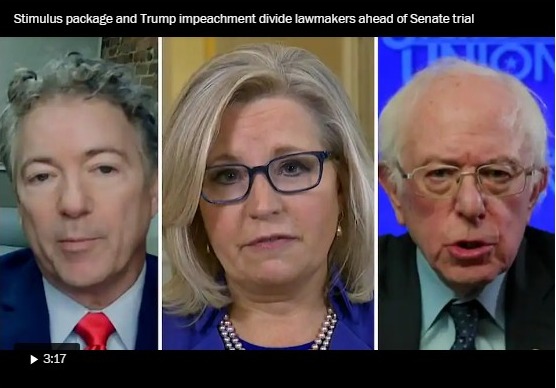
Centrist lawmakers such as Manchin have called for targeting the payments to prevent them from going to high-earning Americans, arguing that those who have not lost their jobs do not need help. That idea has been met with increasing resistance from other members of the party, including Senate Finance Chairman Ron Wyden, D-Ore., and Senate Budget Chairman Bernie Sanders, I-Vt., as well as House lawmakers in the Congressional Progressive Caucus.

Wyden and Sanders have publicly criticized the proposals to lower the income thresholds to $50,000, saying middle-class families have suffered pay cuts and other economic shocks and need relief, too. Sen. Jon Ossoff, D-Ga., whose election victory in January helped seal Democrats’ Senate majority, also opposes lowering the threshold on the checks, according to a spokeswoman.

The White House has said it is willing to compromise on the thresholds, with Psaki repeatedly saying the administration is open to negotiations with Congress on the matter. On Sunday, Treasury Secretary Janet Yellen suggested that the administration was not on board with Democrats’ plans for lower income thresholds.

“The exact details of how it should be targeted are to be determined, but struggling middle-class families need help, too,” Yellen said on CNN. Asked whether she supports a phaseout higher than $50,000 per person, but not necessarily as high as $75,000, Yellen responded: “Yes, I – I think the details can be worked out. And the president is certainly willing to work with Congress to find a good structure for these payments.”

Biden gave similar remarks in an interview with CBS Evening News, saying he was “wide open” on the precise levels of the income threshold.

The dispute comes as House committees prepare to take up the legislation this week. It is uncertain how the matter will get resolved.

White House senior economist Jared Bernstein floated a compromise during a news briefing Friday, suggesting that lawmakers could design the benefit to diminish faster for higher earners. Under prior proposals, the size of the stimulus check diminished by 5% as incomes rose. Bernstein suggested that the phaseout of checks for those at upper incomes could be sped up, meaning that those at higher income levels would receive less.

“If you look at the distribution of who gets the checks . . . virtually none of it goes to the very top of the scale, and the vast majority goes to the middle and the bottom,” Bernstein said, citing research by the Institute for Taxation and Economic Policy, a left-leaning think tank. “What’s important to the president is that we don’t lose sight of people in the middle of the income scale who continue to struggle.”

The debate about the check thresholds represents one of many disputes Democrats may face as they try to pass Biden’s $1.9 trillion stimulus package through Congress. There is a wide ideological gulf between the party’s moderate and liberal wings, which is likely to produce numerous policy fights – over the $15-an-hour minimum wage; the scale of unemployment assistance; and the overall cost of the bill, among other things – on the way to passing their first major piece of legislation under Biden.

The split within the party appeared to intensify over the weekend. Manchin told WV News last week that he supported the next round of payments not going to individuals earning more than $50,000 or couples earning more than $100,00.

“An individual of $40,000 income or $50,000 income would receive it. . . . And a family who is making $80,000 or $100,000, not to exceed $100,000, would receive it,” Manchin said. “Anything over that would not be eligible, because they are the people who really are hurting right now and need the help the most.”

Manchin has great influence over the issue because the Senate is split 50-50 between Republicans and Democrats, so Democrats need his vote as they aim to push the legislation forward without GOP support.

But on Twitter and on CNN this weekend, Sanders slammed Democrats for embracing a plan that would cut out individuals earning $52,000. He also pointed out the potential political downside for the new Democratic administration of sending fewer payments than Trump had. Wyden has also said in a statement that families that had received the first two payments would expect a third.

“Unbelievable . . . working class people who got checks from Trump would not get them from Biden. Brilliant!,” Sanders said on Twitter.

The push among senior Democrats to lower the threshold to $50,000 was designed to appease Manchin, which elicited pushback from other lawmakers. Rep. Pramila Jayapal, D-Wash., chair of the Congressional Progressive Caucus, said Monday she is in “nonstop” conversations with White House officials about “why this makes no sense, politically or policy-wise.”

“The idea we should cave to one Democrat in the Senate does not make any sense to me,” Jayapal said.

While passing a budget resolution through Congress earlier this month that set the stage for approval of the broader relief bill, Sens. Susan Collins, R-Maine, and Manchin co-sponsored an amendment to exclude affluent families from the stimulus checks. The plan did not define an income amount, leaving that open to interpretation. Sanders and all Democrats voted for the proposal.

Under the lower threshold, about 71% of Americans would receive the full benefits and an additional 17% would get the partial benefit, said Kyle Pomerleau, a fellow at the American Enterprise Institute who specializes in tax policy. That compares with about 85% of families under the initial plan.

Psaki on Friday said that a family earning $300,000 a year may not need a stimulus payment. She also noted the payments would phase out, meaning a nurse earning $60,000 could still get a partial benefit if not the full check.

Protest art covered shuttered businesses for months at Washington’s Black Lives Matter Plaza. Now it has a new home. #SootinClaimon.Com

#SootinClaimon.Com : ขอบคุณแหล่งข้อมูล : หนังสือพิมพ์ The Nation.

Protest art covered shuttered businesses for months at Washington’s Black Lives Matter Plaza. Now it has a new home.

InternationalFeb 09. 2021A prized panel is wheeled into the former Aveda Institute. MUST CREDIT: Washington Post photo by Bill O'LearyA prized panel is wheeled into the former Aveda Institute. MUST CREDIT: Washington Post photo by Bill O’Leary
By The Washington Post · Marissa J. Lang

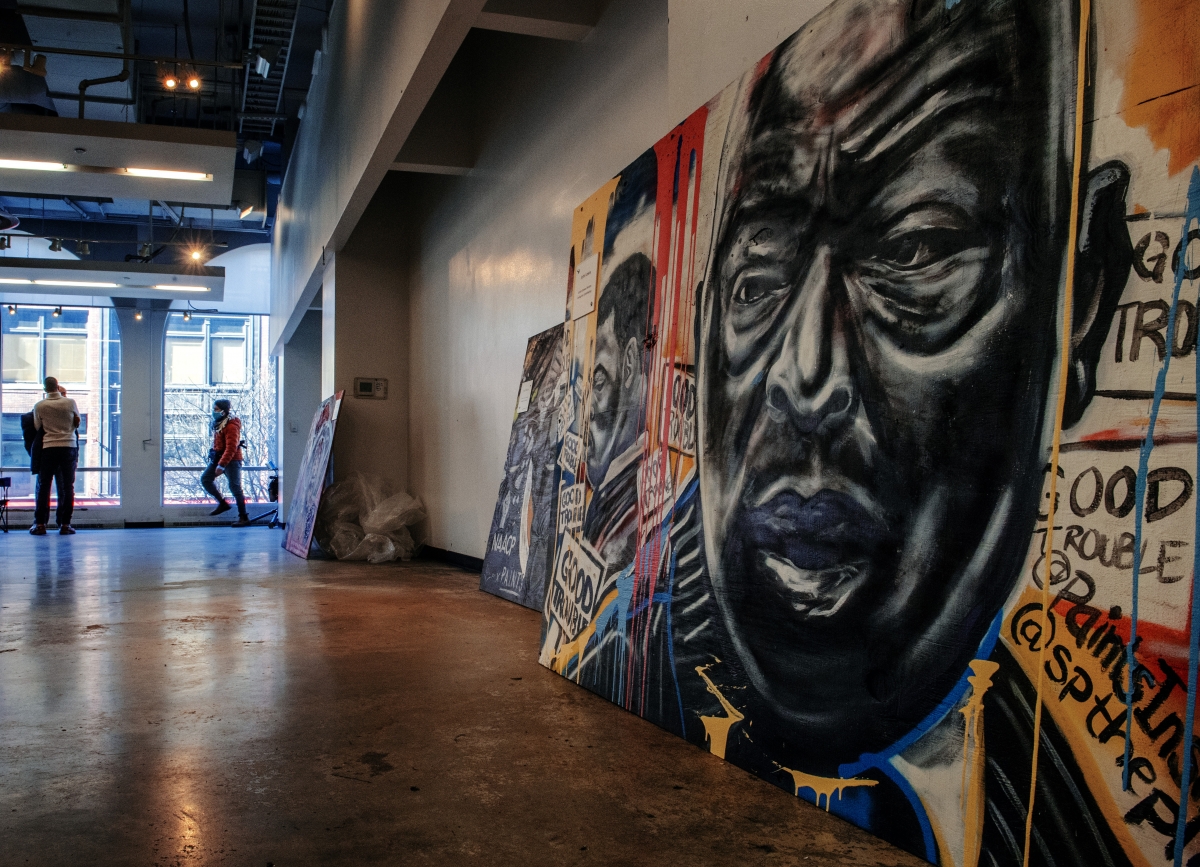
WASHINGTON – Months spent in the sun and rain has warped the wooden works of art. They’ve been tagged and scrawled on, disassembled and pulled down from the windows that sat boarded up for months.

But as the painted pieces appeared last week, rolled on dollies into the empty showroom where they will soon be displayed, it felt to the artists who created them as if virtually no time had passed.

“Oh man, look at that,” artist Dez Zambrano said, his voice hushed in wonder. “I can almost hear the chanting.”

All at once, he said, memories came flooding back. Of the summer heat on his face as he painted the plywood canvas. Of the chanting crowds, marching through the square with their fists raised, signs lifted, their hands held up in surrender.

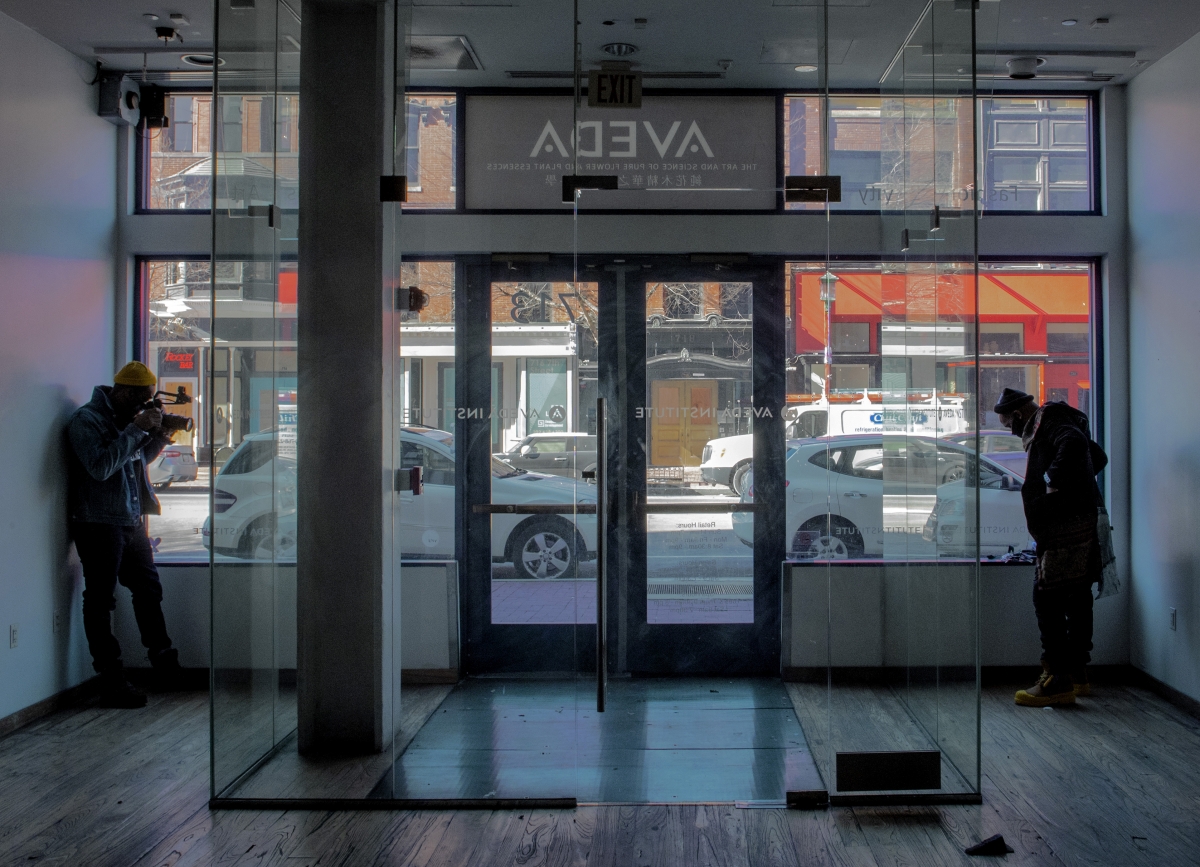
After more than six months of acting as shields over windows in and around Black Lives Matter Plaza, the plywood pieces were transported Thursday to a vacant storefront – formerly the site of an Aveda Institute training facility near a downtown Metro station. The works will serve as a centerpiece for an unfolding gallery space created by a unique partnership between a real estate giant and community nonprofit that officials hope will revitalize a commercial district decimated by the still-raging coronavirus pandemic.

Oxford Properties, a multinational corporation that manages more than 100 million square feet of property space across four continents, has rented out 16,000 feet of space to the PAINTS Institute, a community nonprofit that seeks to provide education, training and job opportunities to at-risk youths and seniors in the District of Columbia.

The price tag? Zero dollars.

Art removed from BLM Plaza will find a new home in in the former Aveda studio in Washington, D.C. MUST CREDIT: Washington Post photo by Bill O'Leary

Art removed from BLM Plaza will find a new home in in the former Aveda studio in Washington, D.C. MUST CREDIT: Washington Post photo by Bill O’Leary

Outside the floor-to-ceiling windows, for-lease signs and papered-over and vacant storefronts line the street. Big brand names, like Chipotle, have been shuttered, the block letters that once hung from the building’s facade plucked from their place.

The movie theater is closed. The Clyde’s restaurant is bringing in a fraction of its normal business. Capital One Arena has largely been shut down for months with no end in sight. Foot traffic along the once-bustling corridor has slowed to a trickle.

“It’s difficult. Many of these restaurants are closing, and they won’t reopen,” said Oxford Properties General Manager Josh Turnbull. “Realistically, we don’t know how long the recovery will take. If this can help us get some foot traffic and channel business into some of the places, restaurants that are really hurting, that’s worth it to me.”

As he spoke, the occasional passerby paused to peer inside the empty building at its bare white walls and stripped wood floor.

To some, like Turnbull, the vacant space initially didn’t look like much. He imagined having to tear down walls to make the space marketable to a new tenant, he said. But to John Chisholm, executive director of the PAINTS Institute, the space is filled with potential.

“I want this to be an emotional space for people,” Chisholm said. “This is about community stewardship, about doing good while trying to support local art and local artists.”

What once were classrooms could be transformed into studio space for up-and-coming artists, Chisholm said. The tall streetside windows and glass-paneled walls would allow onlookers to catch a glimpse of artists and their work while maintaining safe pandemic protocols. Large looming portraits of cosmetic models could be transformed into larger-than-life displays, visible from great distances.

There could be pop-ups and retail on the horizon – ways to provide on-the-job training to at-risk youths, Chisholm said – or virtual residency programs and apprenticeship opportunities for artists.

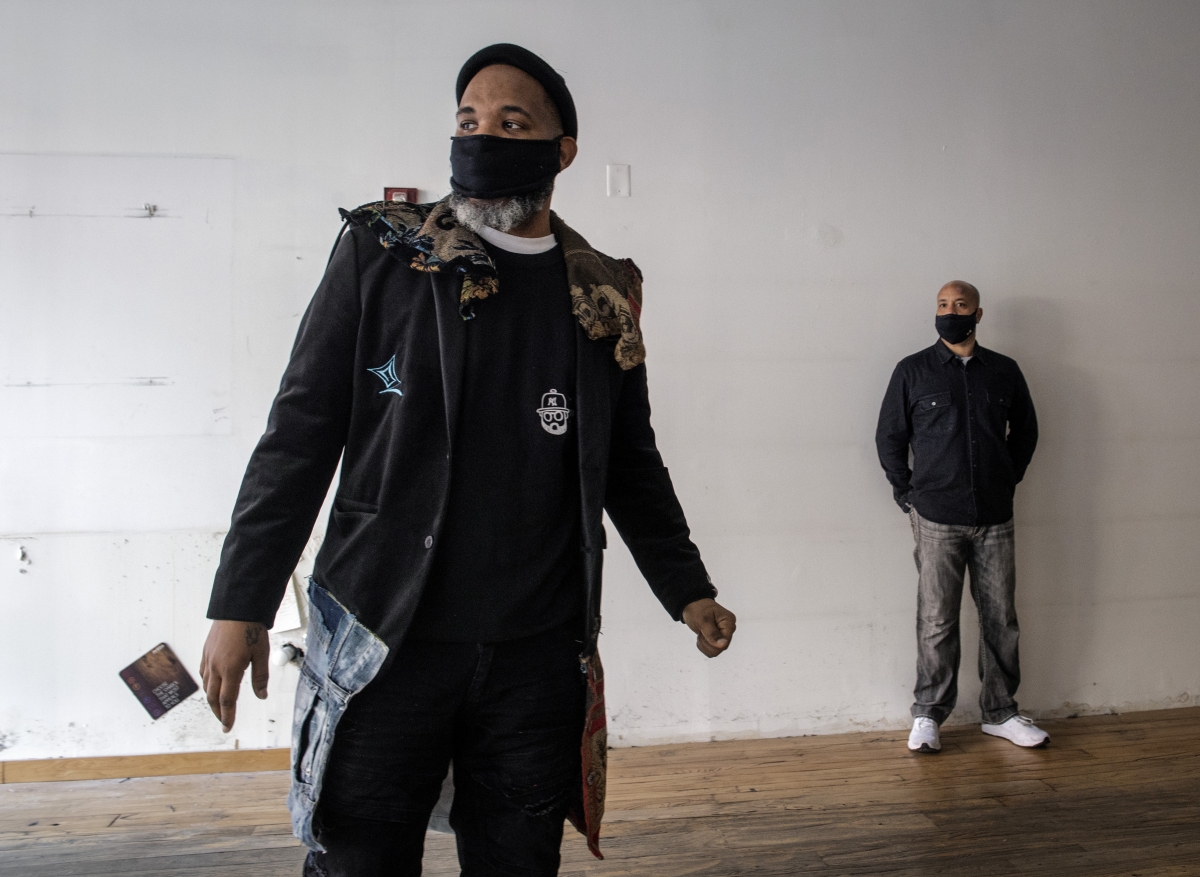
The gallery’s first display will be created by Demont Pinder, an artist known for his portraits of the famous – Prince, Aretha Franklin, John Lewis – as well as his work memorializing Black people killed by law enforcement and youths who died in senseless violence.

He’s painted live onstage during hip-hop concerts and produced a portrait of Washington Mayor Muriel Bowser. He’s painted those whose name recognition came only after their deaths: Trayvon Martin, Eric Garner, Philando Castile, Stephon Clark.

He’s also painted people whose names are not nationally recognized, such as young D.C. residents killed by gun violence. There was Steve Slaughter, a 14-year-old killed by a would-be robber as he returned from buying snacks with his friends; Makiyah Wilson, a 10-year-old gunned down as she walked toward an ice cream truck; and Maurice Scott, a 15-year-old killed blocks from his school.

Artist Demont Pinder, left, and PAINTS Institute Executive Director John Chisholm examine the space inside the former Aveda Institute. MUST CREDIT: Washington Post photo by Bill O'Leary

Artist Demont Pinder, left, and PAINTS Institute Executive Director John Chisholm examine the space inside the former Aveda Institute. MUST CREDIT: Washington Post photo by Bill O’Leary

This month, Pinder said, he will transform the downstairs of the studio into a baseball stadium to showcase Black history past and present – an art piece that draws a line from Jackie Robinson’s history-making debut in the major leagues in 1947 to the Washington Nationals of today.

“This is how we celebrate art and Black history in a covid-safe environment until we can open up the doors again,” Pinder said. “I hope we can create something that gets everyone to leave inspired and forces them to look at blank, empty spaces differently – because we have so much of that in the times we’re living in right now.”

Upstairs, Pinder’s portrait of Martin Luther King Jr. that hung for months outside the National Building Museum will be displayed alongside artists’ renderings of street medics and countless demonstrators who marched for months in the nation’s capital demanding criminal justice reform and racial equality.

The murals came down last month, as D.C. officials and members of the media gathered around Black Lives Matter Plaza to watch the rebirth of a street that has been paralyzed by months of protests, civil unrest, a public health crisis, a suffering economy and, most recently, a heavily patrolled downtown militarized zone that followed a siege at the U.S. Capitol.

Removing the plywood boards – and the paintings on them that have come to define the area around the plaza – was a step in the right direction for businesses there, officials said, but they worried about losing pieces of history, artifacts that for months overlooked the heart of D.C.’s protest scene.

The first floor of the former Aveda Institute in Washington, D.C. MUST CREDIT: Washington Post photo by Bill O'Leary

The first floor of the former Aveda Institute in Washington, D.C. MUST CREDIT: Washington Post photo by Bill O’Leary

Turnbull had space to offer. The Aveda Institute announced that it was vacating the downtown D.C. studio space before the pandemic hit, he said, and with retail stores struggling to keep the lights on, he doubted he could fill the space with a new tenant.

The arrangement, he said, is technically month-to-month. But, he added, he expects the art will be able to remain in the space for most of 2021 – if not longer.

Already, Chisholm has plans for the summer.

Near the first anniversary of the racial justice uprisings that followed the police killing of George Floyd on May 25, Chisholm said, he envisions re-creating the experience through art, sound, multimedia displays and the murals plucked from door frames and windows in Black Lives Matter Plaza.

Maybe by then, he said, people will be able to walk through the space safely, to fully immerse themselves in the not-so-distant past.

Maybe by then, Zambrano said, he’ll really be able to relive the chanting. Maybe through art, he said, everyone will.

Myanmar deploys martial law in cities as youth stare down army #SootinClaimon.Com

#SootinClaimon.Com : ขอบคุณแหล่งข้อมูล : หนังสือพิมพ์ The Nation.

Myanmar deploys martial law in cities as youth stare down army

InternationalFeb 09. 2021

By Syndication Washington Post, Bloomberg

Myanmar imposed martial law in its biggest cities following a third day of massive street protests, banning all gatherings of more than five people in an effort to stem widespread opposition to its Feb. 1 coup.

Tens of thousands of demonstrators swarmed streets across the Southeast Asian nation on Monday, using social media to quickly mobilize supporters with three clear demands: the release of civilian leaders including Aung San Suu Kyi, a recognition of the 2020 election results won by her party and a withdrawal of the military from the country’s politics. Aung Kyaw Soe, chair of Taikkyi Township Administration Council, confirmed the order of martial law in Yangon.

Ahead of the announcement, the military regime showed signs of cracking down on the protesters, using a water cannon on crowds in Naypyidaw before later issuing the threat of using live ammunition. The army also posted a statement on state-owned Myanmar Radio and Television saying “democracy and human rights” were being exploited by certain groups and any act that hurts the stability of the country would be prosecuted.

“We urge all people who want justice, freedom, equality and peace not only to reject the perpetrators but also to work together for the good of the nation and the people,” the statement said.

The youths flooding Myanmar’s streets are the latest members of Asia’s so-called Milk Tea Alliance fighting for democracy in places like Hong Kong and Thailand. The question is whether they’ll have any more success in pressuring authoritarians to back down.

Myanmar’s biggest protests in more than a decade began with an online call for “civil disobedience” in Yangon and quickly spread to other cities, prompting the military regime to shut off the internet and block platforms like Facebook, Twitter and Instagram. Activists in the traditionally conservative country have held up expletive-laden placards taunting a military that has violently suppressed dissent during similar protests in 1988 and 2007.

Many of the protesters were too young or not around to remember those deadly crackdowns: A United Nations report found 31 people were killed in 2007, while hundreds or possibly thousands were killed in 1988. The demonstrators now on the streets say they aren’t scared of the military, and hope to convince soldiers to join their fight against coup leader Min Aung Hlaing — even as authorities in Naypyidaw, the capital, warned protesters they would be shot with real bullets if they breached police lines.

“We respect those who lost their lives for the fight against democracy in Myanmar — they are our heroes too, so we are not afraid of potential military crackdowns,” Aung Ko Min, a 20-year-old student at Dagon University in Yangon, said as he marched in the protests on Monday. “We expect some police and soldiers to join our peaceful protests in the end.”

Myanmar’s peaceful protests are similar to those in Thailand seeking to reform the monarchy, and many protesters in Yangon have adopted the three-finger salute made popular by their neighbors in Bangkok. Both of those movements have used social media in a similar way to demonstrators in Hong Kong, where protests turned more violent. In Hong Kong and Thailand, authorities haven’t yielded to demands and stacked legal charges on key protest leaders.

Since the 2007 protests, Myanmar has opened the economy, allowing foreign participation in industries such as energy exploration and banking while liberalizing the telecom sector to allow millions of people to access mobile phones and internet for the first time. It also lifted tight censorship rules and accepted a landslide victory by Suu Kyi’s National League for Democracy party in 2015 elections.

Now young people know they have a better option and want the generals out of politics for good by demanding the repeal of the 2008 constitution that cements the military’s role in governing the country, said Sebastian Strangio, author of “In the Dragon’s Shadow: Southeast Asia in the Chinese Century.”

“It’s hard to see the military backing down,” he said. “All this puts the two sides on a collision course.”

A confidential U.K. foreign office assessment seen by Bloomberg suggested army chief Min Aung Hlaing will seek to crush Suu Kyi’s pro-democracy party and install himself as president. While Myanmar’s history indicates the military will use force, the generals might exercise caution this time around given the protests are being widely broadcast on social media despite the internet curbs, according to Hunter Marston, a Canberra-based political analyst.

“The absence of bloodshed — a hallmark of military reactions to past protests — would represent a noteworthy success,” said Marston, who added that the demonstrations may also prompt the military to negotiate a political settlement with Suu Kyi.

Suu Kyi, who is now being held along with other senior leaders of her NLD party and the civilian-led government, has called on supporters to resist the generals. With demonstrations growing throughout the country, citizens appear determined to fulfill her wishes.

“We want to be the last generation that lived under the military rule in Myanmar,” said shopkeeper Zaw Phyo Wai, 45. “This is not the fight between the NLD and the military. This is the fight between democracy and dictatorship.”

U.S. rejoins U.N. Human Rights Council, reversing Trump-era policy #SootinClaimon.Com

#SootinClaimon.Com : ขอบคุณแหล่งข้อมูล : หนังสือพิมพ์ The Nation.

U.S. rejoins U.N. Human Rights Council, reversing Trump-era policy

InternationalFeb 09. 2021U.S. Secretary of State Antony Blinken speaks at the State Department on Thursday. (Tom Brenner/ Reuters)U.S. Secretary of State Antony Blinken speaks at the State Department on Thursday. (Tom Brenner/ Reuters)

By The Washington Post · John Hudson

WASHINGTON – President Joe Biden instructed the State Department on Monday to reengage with the United Nations Human Rights Council, reversing a decision by the Trump administration to withdraw from it nearly three years ago due to frustrations that the council repeatedly criticized Israel.

In explaining the decision, Secretary of State Antony Blinken said Trump’s withdrawal from the U.N. body in June of 2018 “did nothing to encourage meaningful change, but instead created a vacuum of U.S. leadership, which countries with authoritarian agendas have used to their advantage.”

“When it works well, the Human Rights Council shines a spotlight on countries with the worst human rights records and can serve as an important forum for those fighting injustice and tyranny,” Blinken said in a statement Monday.

The decision fulfills a promise Biden made during his presidential campaign to rejoin the council and return U.S. influence to important international institutions that the Trump administration ceded to other major powers.

The move is expected to face criticism from Republican lawmakers and pro-Israel activists who have long complained that the council disproportionately criticizes the Jewish state’s occupation of Palestinian territory in comparison to human rights issues in other countries.

“If Biden rejoins the council whose membership includes dictatorial regimes & some of the world’s worst human rights violators, it will fly in the face of our fight for human rights,” former Trump administration ambassador to the U.N. Nikki Haley tweeted last month.

Haley and other critics hoped that withdrawing from the body would delegitimize its criticisms of Israel.

Human rights organizations and liberal groups have argued that by pulling out, the United States relinquished its influence over a host of global issues at the expense of just one issue seized on by politically influential pressure groups.

“The Human Rights Council gets a lot of flak, but it plays an important if sometimes tragic role tracking abuses in countries like Syria and Venezuela,” said Richard Gowan, U.N. director at the International Crisis Group. “At a time when big power politics is snarling up the Security Council, the Human Rights Council offers the U.S. another platform to spotlight how nasty regimes are mistreating their citizens. Its immediate impact can be limited, but it is an important accountability mechanism.”

The Trump move also left the United States more exposed to criticism of its own internal actions. Following the May killing of George Floyd, a 46-year-old black man in Minneapolis, a number of African states came close to forcing through an unprecedented Human Rights Council resolution that demanded an investigation of racism in the United States. The countries ended up settling for a broader study of systemic racism after strenuous U.S. pushback, but the affair suggested a weakened U.S. hand after it left the council, the first time any country had left the body voluntarily.

Members of the council are elected for three year terms and can’t serve consecutively for more than two terms. Trump withdrew from the body when the United States was halfway through its term. The U.N. General Assembly is set to elect new members later this year.

It is unclear if the United States will run for full membership this year – an effort that may face resistance from China, which won a seat despite a campaign by the United States to stop it last year.

In a preview of the Biden administration’s priorities for the council, Blinken said the body can ” help to promote fundamental freedoms around the globe, including freedoms of expression, association and assembly, and religion or belief as well as the fundamental rights of women, girls, LGBTQI+ persons, and other marginalized communities.”

Blinken said the council was in need of reform, “including its disproportionate focus on Israel,” but said that “to address the Council’s deficiencies and ensure it lives up to its mandate, the United States must be at the table using the full weight of our diplomatic leadership.”

Chinese ditch travel despite upcoming Lunar New Year #SootinClaimon.Com

#SootinClaimon.Com : ขอบคุณแหล่งข้อมูล : หนังสือพิมพ์ The Nation.

Chinese ditch travel despite upcoming Lunar New Year

InternationalFeb 09. 2021A traveler at the Beijing Capital International Airport ahead of Lunar New Year on Feb. 2. Airlines are offering dirt-cheap fares to stoke some demand, despite the general aversion to travel. Photographer: Yan Cong/BloombergA traveler at the Beijing Capital International Airport ahead of Lunar New Year on Feb. 2. Airlines are offering dirt-cheap fares to stoke some demand, despite the general aversion to travel. Photographer: Yan Cong/Bloomberg

By Syndication Washington Post, Bloomberg

Lunar New Year is usually a bonanza for Chinese airlines crisscrossing the country fully loaded with passengers. Not this year though, after the government took the rare step of encouraging people to stay at home as it tries to stamp out the coronavirus.

Chunyun, as the Lunar New Year travel season in China is known, is regarded as the world’s biggest annual human migration and can account for as much as a quarter of airlines’ annual profits, according to BloombergNEF analyst Luxi Hong.

The holiday this year falls on Feb. 11-17, but the travel period in China started in late January and runs to March. On Jan. 28, passenger traffic was 71% lower than the first official travel day in 2020, according to the Civil Aviation Authority of China. Ticket bookings for trains, normally packed, are almost 60% lower than usual, the railway authority said.

Like so many others in the country of 1.4 billion people, Beijing resident Jack Zhang, 27, isn’t going anywhere. It’s a big decision for those who typically return home to see friends and family at this time of year, though there is one positive.

“It is difficult to adjust to the change of plan, but luckily the bright side is that I don’t need to go for any blind dates my parents tend to put me on during the holiday,” he said. “I don’t see any better and safer option than staying put.”

This will be the first time he has spent the holiday away from his parents, who live in the southern province of Guangxi. The accountant was put off by the testing and tracing requirements and subsequent limits on activities for people coming into Beijing.

About 10% of flights have been canceled over the coming two weeks, according to a BNEF report dated Feb. 3, which said China Southern Airlines Co. appears most affected with almost one-third of flights scrapped.

Jefferies expects China’s domestic travel market to rebound if infections remain below 100 per day. New daily cases numbered around 30 last week. The recovery should initially feature a reintroduction of capacity, followed by improving load factors and then higher ticket prices, analyst Andrew Lee wrote in a note last month.

For now, airlines are offering dirt-cheap fares to stoke some demand, despite the general aversion to travel. Tickets for a two-hour Hainan Airlines flight from Beijing to Hangzhou on Feb. 12 have been available on travel website Ctrip.com for as little as $15 (100 yuan). That’s a third of the cost of a roast duck at popular restaurant chain Da Dong. A second-class fare on the high-speed train between the two cities is six times more expensive.