By The Washington Post · Juliet Eilperin, Dino Grandoni
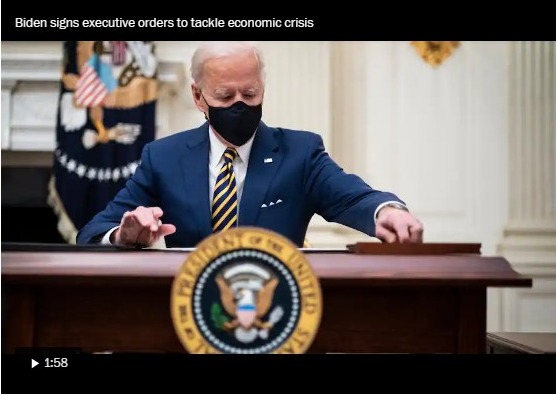
WASHINGTON – President Joe Biden is poised to impose a moratorium on new federal oil, gas and coal leasing Wednesday, according two individuals briefed on the matter who spoke on the condition of anonymity because the plan was still being finalized. The move will deliver on one of Biden’s boldest climate campaign pledges but will encounter stiff resistance from the fossil fuel industry.
The White House has prepared documents that would halt new oil and gas auctions on federal lands and waters for one year, these individuals said, and coal leasing for three years.The moratorium would not affect existing leases, meaning drilling would continue on public land in the West as well as in the Gulf of Mexico.
The memo remains a draft subject to final approval, said one individual close to the White House who spoke on the condition of anonymity because it had not been formally announced. It was unclear whether the new administration will exclude metallurgical coal, which is primarily used to make steel, as opposed to thermal coal, which is basically burned to produce electricity. Metallurgical coal was excluded from an Obama-era coal moratorium on the grounds that steel was required for infrastructure projects.
Biden plans to outline steps Wednesday aimed at curbing greenhouse gas emissions and elevating the role of science in federal decision-making. Asked about the matter, both the White House and the Interior Department declined to comment.
During the campaign, Biden pledged to ban “new oil and gas permitting on public lands and waters,” without specifying exactly what such a ban would entail.
Fossil fuel leasing on federal and tribal lands accounts for nearly a quarter of the country’s annual carbon output. It also generated $11.7 billion in tax revenue for the federal, state, local and tribal governments last year, according to the Interior Department’s Office of Natural Resources Revenue.
Environmentalists say the pause will allow the new administration to assess whether taxpayers are being adequately compensated for the minerals extracted from lands they own.
“By pausing the broken leasing system and halting the giveaways to oil and gas executives, President Biden has an opportunity to meaningfully fix the leasing system for the first time in nearly four decades with solutions that work for the public and which incorporate ambitious conservation, taxpayer fairness, and climate goals,” Jenny Rowland-Shea, senior policy analyst for public lands at the Center for American Progress, a liberal think tank, wrote in an email. “We can make sure our public lands and coasts are preserved, accessible and beneficial to everyone – not abused by oil and gas corporations.”
But oil and gas groups, including the American Petroleum Institute, counter that freezing new leasing will deprive state and local governments, as well as the U.S. Treasury, of needed revenue. Last week, the industry criticized the Interior Department when it dictated that any new leases or permits issued during the next 60 days needed the approval of a top-ranking Biden appointee before they could be finalized.
API President Mike Sommers said that move alone will damage domestic energy producers while benefiting ones abroad.
“Restricting development on federal lands and waters is nothing more than an ‘import more oil’ policy,” Sommers said. “Energy demand will continue to rise – especially as the economy recovers – and we can choose to produce that energy here in the United States or rely on foreign countries hostile to American interests.”
About 22 percent of U.S. oil production and 12 percent of natural gas production takes place on federal lands and waters, according to API.
A moratorium would have contrasting effects on different oil-producing regions, hamstringing drillers in New Mexico, where the federal government controls huge swaths of land, while leaving those producing on state or private land across the border in Texas unscathed.
“It feels a little bit unfair,” said Raye Miller, head of a small, nine-well oil-producing operation called Regeneration Energy in southeastern New Mexico. “We’re very concerned with the direction things are headed.”
But drilling on public lands will continue even with a moratorium on new leasing, since industry operators hold plenty of undeveloped leases in their portfolios. Only about half of the nearly 20,000 applications to drill approved between 2014 and 2019 are actually in use, according to a recent Government Accountability Office report. More than 13 million acres of land leased for oil and gas were not producing during fiscal year 2019.
While the oil and gas lobby gears up for a fight, environmental advocates are sustaining pressure on Biden to keep his commitment to end leasing and permitting on federal acreage. Among them is Oceana, a marine conservation group, which is set to release a report Tuesday detailing how reversing the Trump administration’s plan to open up nearly all U.S. coastal waters to drilling would prevent more than 19 billion tons of greenhouse gas emissions.
So far, activists are pleased with Biden’s quick climate actions. “At this point, I’m excited about the president’s agenda,” said Diane Hoskins, a campaign director at Oceana.
The coronavirus pandemic has killed more than 416,000 Americans and recently pulled the U.S. economic recovery into reverse. Some states have shut down again to get a handle on surging caseloads. And critics have blamed those states’ governors, typically Democrats, for job losses.
But pandemic-related economic research shows the shutdowns aren’t killing jobs; the virus is.
In the first outbreaks last spring, people stayed home to avoid contracting the deadly novel coronavirus, regardless of what their governor said.
Indiana University economists Sumedha Gupta, Kosali Simon and Coady Wing reviewed more than 60 pandemic and social-distancing studies for a review article forthcoming in the Brookings Papers on Economic Activity. With the input of those economists and other experts, we’ve reviewed the basic data and some of the strongest research. Four facts emerged from the spring shutdowns.
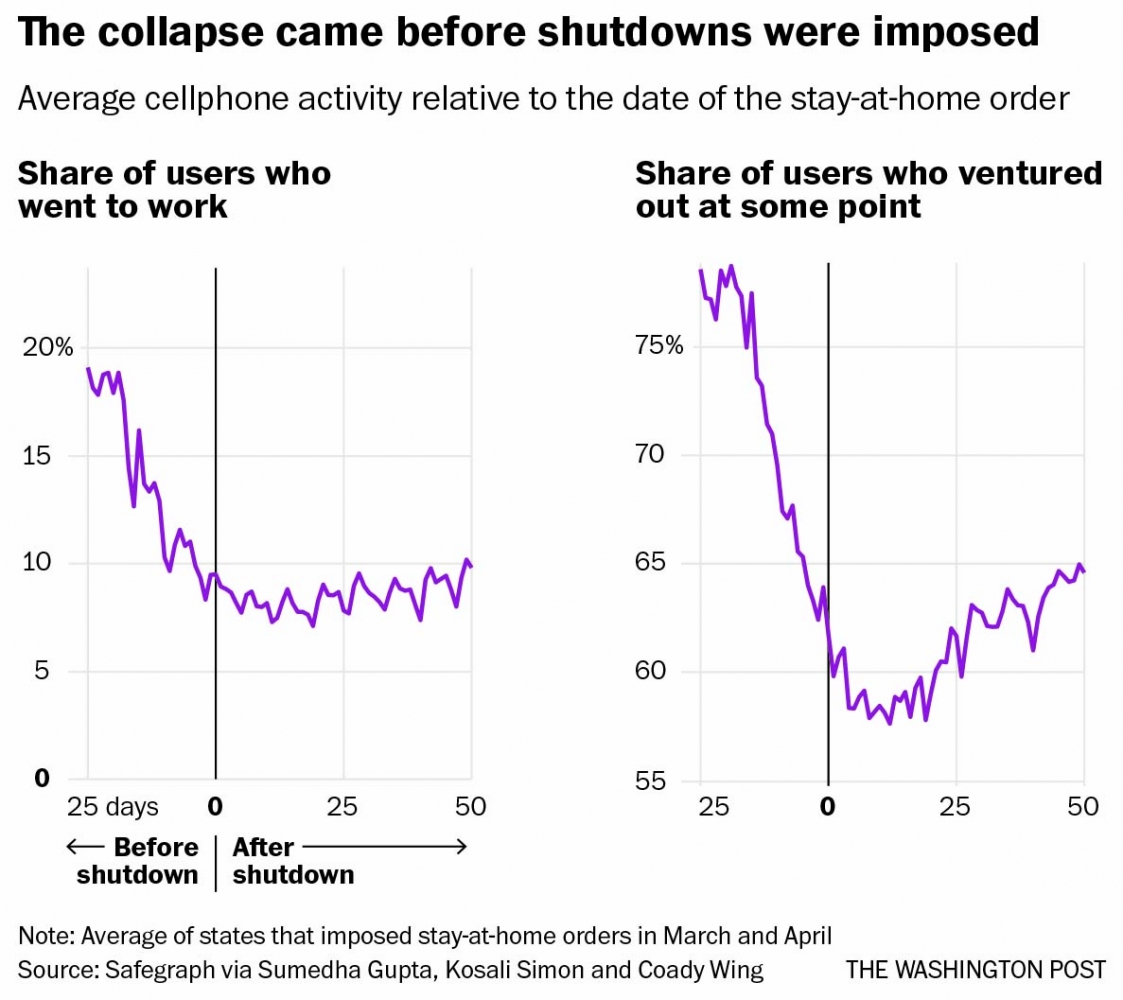
If stay-at-home orders poisoned an otherwise healthy economy, business should have crumpled the moment they kicked in. But cellphone activity data analyzed by Gupta, Simon and Wing show a different trend: People started to stay home well before states imposed shutdowns.
In the chaotic early days of the pandemic, most people didn’t wait for official stay-at-home orders, Simon said. In every state, they stopped going to work around the weekend of March 14, as uncertainty soared, stock markets collapsed and the World Health Organization officially declared the coronavirus outbreak to be a pandemic.
Typically, economic data is measured in months, quarters and years. But when dealing with a pandemic that spreads so fast that it creates an exponential curve of runaway devastation, economists needed to measure changes in a matter of days. To do so, they harnessed a new generation of indicators based on cellphone activity and other alternative data sets from the private sector.
“Most of the economic damage we’ve seen is produced by people’s reaction to the virus,” Wing said. “Social distancing policies mattered, too, but they were layered on top of a major change in personal behavior.”
Business collapsed so quickly in mid-March that it’s tough to disentangle correlation and causation. But several high-profile teams of economists, armed with that high-frequency data and sophisticated statistical methods, arrived at similar conclusions.
In one such study, economists Chad Syverson and Austan Goolsbee of the University of Chicago Booth School of Business used anonymized cellphone tracking data to compare traffic at businesses in shutdown areas with similar businesses in the same metro area (really, commuting zone) that weren’t shut down.
Business fell by more than half (53%) regardless of whether a place shut down, as people everywhere were trying not to leave their homes. In shutdown areas, activity fell another 7%, meaning shutdowns caused less than an eighth of the drop in business.
“If pandemic concern or fear leads both to people staying home and policymakers imposing lockdowns, then the fear is the true driving force,” Syverson said. “Economic declines and lockdowns happen to be correlated because they’re pushed by the same thing, even though one isn’t necessarily causing the other.”
Goolsbee and Syverson found that business activity declined even more in areas with more covid-19 deaths, which emphasizes the role that the fear of the virus played in keeping people at home. (Goolsbee chaired President Barack Obama’s Council of Economic Advisers during the Great Recession before returning to the University of Chicago.)
One other piece of supporting evidence? The economists found that businesses that drew the largest crowds before the pandemic were the same ones that saw the sharpest declines, relative to their size. That indicates consumers were spooked by the virus and sought out stores they knew were likely to have few customers. That trend was especially pronounced in areas with worse coronavirus outbreaks.
If the shutdowns had been the major obstacle to business activity, consumer spending built up during the shutdown period would have been unleashed in a torrent of pent-up demand when the shutdown was lifted.
Instead, Goolsbee and Syverson found, economic activity returned about 5% faster in places that lifted their shutdowns compared with those areas not shut down.
When business didn’t return appreciably faster in areas that lifted their shutdowns, it was clear that shutdowns couldn’t be the primary reason people were staying away from businesses, Goolsbee said.
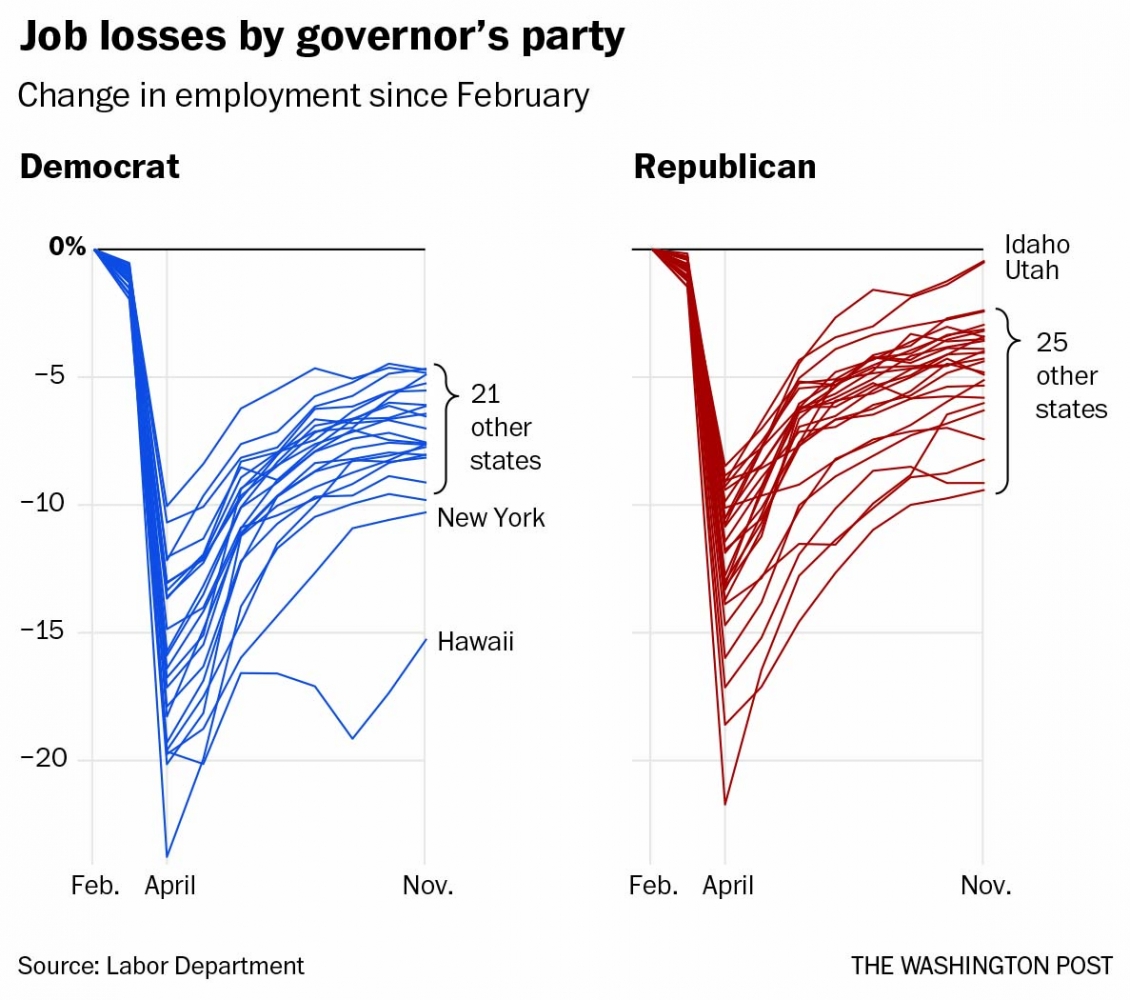
The Washington Post often hears from readers who blame job losses on Democratic governors who have often imposed shutdowns when coronavirus cases surge. If Democrats are really responsible for job losses, we would expect to see employment fall off the cliff in blue states while employment in red states sail on untouched. But even the simplest analysis shows job losses don’t depend solely on the governor’s party. Some red states struggled; some blue states thrived.
Gupta notes that readers are oversimplifying when they equate “Democrat” and “shut down.” A large majority of Republican-led states also shut down. But a trend emerges in the chart below. Red states, on average, have recovered slightly faster than blue states.
Ohio State University economist Bruce Weinberg warns that charts like this can obscure an obvious truth: “The states that have Democratic governors differ in many ways from the states that have Republican governors.”
For example, Republican states tend to have lower population density, and states with lower population density have added jobs more rapidly. To tease apart that correlation, compare the jobs recovery in counties of similar population density within red and blue states.
When we looked at job losses by the governor’s party, rural and suburban areas of red and blue states lost jobs and began to recover at almost exactly the same pace, regardless of which party was in charge. It was only the densest counties in states with Republican governors that saw slightly faster recoveries than those with Democratic governors. To take two extreme examples, compare the Ohio county containing Cincinnati, which has seen almost a complete recovery from the crisis under Republican Mike DeWine, to the boroughs of New York City. Under Democrat Andrew Cuomo, the five boroughs are still missing about 1 in 7 jobs lost in the crisis, Labor Department data shows.
Economists are reluctant to attribute the gap entirely to additional rounds of shutdowns in the densest urban areas, such as the counties containing New York City, Los Angeles and Chicago. They caution that some of the largest cities in Democratic-led states were hit harder and faster by the virus, and may host more workers and industries that are vulnerable to the pandemic.
For example, New York City was hit so hard with the coronavirus last spring and it remains so incredibly dense, with tens of thousands of people living in apartment buildings on small city blocks, that even when the shutdown eased, people tended not to go out.
(We’re looking at jobs here – indicators such as the unemployment and labor-force participation rates show a smaller gap between states led by Republican or Democratic governors.)
When we step back, the most striking thing about this data is that, as the first wave of shutdown research would predict, there’s little difference in employment between red and blue states despite some variation in policy. After all, regardless of politics, American states all had one enormous thing in common in 2020: the coronavirus.
The coronavirus vaccine developed by Moderna triggers an immune response that protected against two variants of the virus first detected in Britain and South Africa in laboratory tests, the company said Monday.
But the reassuring news that vaccine-elicited antibodies remained effective against concerning new variants was tempered by an ominous finding. Those antibodies were less efficient at neutralizing the South African variant in a laboratory dish – a sixfold reduction in response foreshadowed by a small, but mounting body of evidence that has trickled out recently showing that the variant may have the potential to elude parts of the immune response.
As a precaution, Moderna announced it will launch two new studies. The company will test adding a third shot of its current vaccine to boost its two-dose regimen. Scientists have already designed an all-new vaccine specific to the South African variant that could be used as a booster to prime the immune system to the new strain, and plan to test it in the coming months.
“The virus is changing its stripes, and we will change to make sure we can beat the virus where it’s going,” Stephen Hoge, president of Moderna, said in an interview. “The unknown is would we feel it’s necessary to do that, would public health officials want this at that point or would they still be comfortable? What we’re trying to do is create an option.”
The detection of both variants late last year triggered immediate concern, first because of evidence they were spreading far more easily. But many of the mutations in each variant – eight of those found in the British variant and 10 of those in the South African variant – drew special concern because they sit in the spiky proteins that dot the outside of the coronavirus and have been the key target for vaccines and therapeutics. That raised the specter that the current generation of vaccines might be rendered obsolete before they have even been rolled out.
The company’s announcement puts some of those fears to rest, suggesting the vaccines will still work against both variants.
Antibody-containing blood serum taken from people and monkeys who received the vaccine was just as effective at blocking the British variant as the original strain of virus in the study, and remained above the threshold for efficacy for the South African variant, despite the diminution in effectiveness. The work has been submitted to a preprint server, but has not been peer-reviewed and was not available for review before publication.
The company reported a sixfold decrease in the ability of antibodies to block the virus – a drop that Hoge said was concerning but not alarming – underscoring the need to remain vigilant.
The report comes after similar news from Pfizer-BioNTech, which released data last week, also not yet peer-reviewed, showing that antibody-rich blood serum samples from 16 vaccinated people showed that vaccine was equally as effective at blocking the British variant as it was against the original version of the virus that took hold in Wuhan, China, a year ago. That publication did not address the South African variant, which has been of most concern and shares many mutations with a concerning variant detected in Brazil.
Laboratories across the world have been scrambling to study whether vaccines and treatments, particularly monoclonal antibodies, are likely to be as effective against the new variants. So far, such tests have mainly relied on one part of the multifaceted immune response and found evidence the vaccines are likely to be effective – but have underscored the need to track changes in the virus and prepare for the eventuality that, like flu shots, a coronavirus vaccine might need to be updated and administered on a regular basis.
Biden to push Congress on stimulus after senators question cost
InternationalJan 25. 2021Senator Mitt Romney, a Republican from Utah, center, departs the Senate Chamber at the U.S. Capitol in Washington, on Jan. 22, 2021. MUST CREDIT: Bloomberg photo by Stefani Reynolds.
By Syndication Washington Post, Bloomberg · Jordan Fabian
President Joe Biden will escalate appeals for Congress to back his top priority, $1.9 trillion in pandemic relief, seeking to overcome Republican opposition to the plan as he enters his first full week in office.
Biden’s top economic adviser, Brian Deese, spent more than an hour on Sunday discussing the proposal with a bipartisan group of lawmakers. Some asked the White House to further justify what would be the second-largest emergency spending measure in U.S. history and expressed interest in a much narrower bill focused on accelerating coronavirus vaccine distribution, according to Senator Angus King of Maine and people familiar with the matter.
Deese and other officials provided details and context in response to the senators’ questions, according to an administration official. Senior White House aides plan to keep talking with lawmakers in both parties this week to hear their concerns but also press for urgent action, the official said.
As the president’s team began its work with key lawmakers, Biden is moving forward with another round of executive actions, following on a series of orders signed soon after he took office. On Monday, he will sign an order directing federal agencies to buy more American-made products and is expected to take other actions on criminal justice, climate, health care and immigration.
The new orders will add to roughly two dozen actions Biden has signed since Inauguration Day in an effort to address the coronavirus pandemic, reverse former President Donald Trump’s agenda and point the nation in a new direction.
While girding for what may be prolonged negotiations with Republicans, Biden received welcome news with the Senate’s decision to delay the start of Trump’s second impeachment trial. The president had urged lawmakers to spend more time filling Cabinet posts and working on his agenda. The Senate this week is expected to take up the nomination of Janet Yellen to lead the Treasury Department, which would fill a key vacancy at a critical moment for the economy.
But agreement has been hard to come by in the 50-50 Senate, where Democratic and Republican leaders have yet to reach a power-sharing deal — much less come to terms on the White House’s stimulus proposal.
Taken together, the developments show the honeymoon period of Biden’s presidency could be coming to a close mere days after he took office. The challenges raise questions about whether Biden can keep his pledge to unify the country while pushing forward with an ambitious policy agenda that addresses thorny issues. Biden’s aides have expressed optimism.
“By and large, we’ve seen a lot of progress on this front,” White House Chief of Staff Ron Klain said on NBC’s “Meet the Press.”
The coming days will also test Biden’s personal relationships with members of Congress, which his team said would help him get big things done in a divided Washington. For now, his lieutenants are taking the lead in trying to build some support for his stimulus and immigration bills.
Deese on Sunday spoke to a bipartisan group of 16 senators, including moderate Republican Senators Mitt Romney, Lisa Murkowski and Susan Collins, all of whom have expressed reservations about the price tag for Biden’s virus relief proposal.
Before the call, Romney described the $1.9 trillion cost “shocking,” considering a $900 billion stimulus Congress passed in late December. Speaking on “Fox News Sunday,” Romney called for targeted relief measures focused on ending the pandemic rather than another major stimulus package.
King, a Maine independent who caucuses with Democrats, said the White House should provide hard figures to show why such a large package is needed on the heels of December’s stimulus law.
“Part of what we’re asking for is more data — where did you get the number?” said King, who participated in Deese’s call.
A Democrat on the call, Senator Mark Warner of Virginia, said that lawmakers need more information on how the last stimulus was used.
“I think that case can be better made when we get more transparency and better numbers about how the last $900 billion – much of which has started to go out – but I think the administration needs to be very transparent about how those dollars have been delivered,” Warner said in an interview on NPR.
Facing pressure from liberals for quick action, the White House has brushed aside the idea of cutting off bipartisan talks by using a maneuver called “budget reconciliation,” which would conceivably allow much of the legislation to pass through the Senate with only Democratic votes. Under normal rules, major legislation often needs 60 votes to pass the Senate, meaning Democrats would need at least 10 Republicans to advance Biden’s relief plan.
Yet Biden’s team has also resisted making changes favored by Republicans, such as reducing the package’s size, breaking it into smaller pieces or removing controversial items like a minimum wage increase.
“We were going to move fast and we’re going to move bipartisan,” Klain said. “I don’t think bipartisanship and speed are enemies of one another. The need is urgent. Americans, both Democrats and Republicans, are dying. Kids’ schools that take care of both Democratic and Republican kids are closed. People are on unemployment. People are in food lines. That’s not a party issue.”
In the meantime, the president plans to spend part of each day next week signing executive actions. Monday’s order will start the process of strengthening requirements for federal agencies to buy U.S.-made goods and services, according to administration officials. It will also tighten standards for how much of a product needs to be manufactured in the U.S. in order to be considered American-made.
Another batch of orders are expected to be aimed at racial justice. Among them are directives to create a federal commission on police reform, limit the transfer of military equipment to police and wind down the use of private prisons.
Biden also plans to sign actions that elevate climate change as a national security and regulatory priority and convene a summit of world leaders on April 22 to discuss the issue.
The president is also expected to rescind a controversial rule blocking U.S. funding for foreign groups that provide abortions, known as the Mexico City policy, and sign an order bolstering Medicaid and Obamacare.
On immigration, Biden plans to sign actions that restore the U.S. asylum and refugee systems that largely ground to a halt under Trump. He’s expected to direct a review of a Trump-era rule that tightened criteria for refusing entry to potential immigrants on the grounds they would become dependent on government assistance. Biden also plans to form a task force to reunite migrant children with guardians separated from them under Trump’s border policies.
Dutch rioters who attacked police and destroyed property over the weekend while protesting new coronavirus measures are “criminals,” Prime Minister Mark Rutte said Monday, as law enforcement warned that the violence could last for weeks.
The unrest across the Netherlands, some of the worst in decades, had “nothing to do with protest,” Rutte told reporters outside his office in The Hague, news agencies reported.
“This is criminal violence and we will treat as such,” he said.
Protesters had gathered in defiance of lockdown orders in at least 10 towns and cities Sunday, looting stores and clashing with police after authorities imposed a new nighttime curfew – the first in the Netherlands since World War II.
The curfew, from 9:00 p.m. to 4:30 a.m., tightens an already strict lockdown aimed at curbing coronavirus infections and comes amid fears that a new, more contagious variant, first identified in Britain, will cause a surge in cases.
Bars and restaurants have been closed in the Netherlands since October and schools and shops were shuttered in December. The government has recorded some 944,000 coronavirus infections and more than 13,500 deaths.
On Sunday, police deployed dogs, a water cannon and mounted officers to disperse a demonstration in central Amsterdam, arresting nearly 200 people, the Reuters news agency reported. In the fishing village of Urk Saturday, youth torched a coronavirus testing center and clashed with local media and police.
Some of the worst violence flared in Eindhoven in the south, where rioters threw stones, knives and fireworks at police and damaged the local railway station, Dutch media reported.
A far-right, anti-immigration group, Pegida, had previously called a demonstration in the city and said they would use the protest to burn copies of the Quran. The protest in Amsterdam was also organized by anti-lockdown groups on the messaging app Telegram, according to local media.
“My city is crying, and so am I,” Eindhoven Mayor John Jorritsma told media Sunday night, the Associated Press reported. He called the rioters “the scum of the earth,” adding that he was afraid the country was headed toward “civil war.”
On Monday, a spokesperson for the national police union said that law enforcement was preparing for more unrest.
“I hope it was a one-off,” Koen Simmers said of the unrest this weekend, in an interview with the Dutch program Nieuwsuur. “But I’m afraid it was a harbinger for the coming days and weeks.”
“The police are well prepared,” he said. “But I hope that it is not necessary.”
By The Washington Post · Mary Beth Sheridan, Kevin Sieff
MEXICO CITY – Mexican President Andrés Manuel López Obrador announced Sunday night that he had tested positive for the coronavirus and was experiencing “light” symptoms. He said he would step away from his daily news conferences while being treated for the illness.
López Obrador has frequently minimized the severity of the pandemic, and he has rarely worn a mask, even as covid-19, the illness the novel coronavirus can cause, has claimed nearly 150,000 lives in Mexico. That’s the fourth-highest total in the world, and the 19th-highest as a percentage of the population, according to figures compiled by Johns Hopkins University.
After Mexico’s 70-day shutdown at the beginning of the pandemic, the president resumed his frequent travels through the country. He has been criticized for appearing in selfies with his supporters.
“I am sorry to inform you that I am infected with COVID-19,” the president said in a tweet. “The symptoms are light, but I am getting medical treatment. As always, I am optimistic. We will carry on.”
He added that he would remain in his living quarters at the National Palace and would have a telephone conversation as scheduled on Monday with Russian President Vladimir Putin to discuss shipments to Mexico of the Sputnik vaccine.
At 67, and with hypertension, López Obrador could be at risk of developing complications from the virus. He had a heart attack in 2013. Mexico has administered about 600,000 doses of the Pfizer vaccine, but the president has said he would wait for his shot until after front-line medical personnel and older citizens received theirs.
Mexican authorities on Sunday reported 10,872 more confirmed cases of the novel coronavirus and 530 deaths. The government has tallied more than 1.7 million cases. But the real total is considered higher: A recent government study based on antibody tests estimated that one-quarter of the population of about 126 million people has been infected.
The president has been regularly tested for the virus, and he insists that he keeps strict social-distancing rules in his office.
López Obrador, a folksy icon of the left, took office in December 2018. He has remained popular, with approval ratings of about 60%, despite the mounting death toll from covid-19 and a severe economic crisis linked to the pandemic.
But the president’s decisions to rarely wear a mask in public, and his statements minimizing the pandemic, have frustrated many in Mexico.
“In a country where government and president are often the same thing, and where the president is a continuous presence both in social and traditional media, his minimizing of the pandemic and his refusal to wear a mask have definitely encouraged people to downplay the dangers of this deadly virus,” said Esteban Illades, a prominent Mexican journalist.
“Hopefully, the president’s covid diagnosis will show the general population that not wearing a mask makes it easier to become infected.”
Several cabinet members previously tested positive for the coronavirus. The president was in the state of San Luis Potosí over the weekend and was photographed without a mask.
López Obrador has been in close contact with a range of senior Mexican officials over the weekend, including the secretary of defense and the secretary of foreign relations, along with a number of well-known Mexican business leaders. There is now concern that the virus could spread widely within those circles.
Jaime Rodríguez Calderón, the governor of Nuevo León, met with López Obrador on Saturday and said he would “watch my symptoms so that if any appear, I’ll take a test.”
Carlos Bravo Regidor, a political analyst, said: “It is kind of surprising that [López Obrador] didn’t catch it before, particularly given his reluctance to wear a mask and his insistence on still having plenty of meetings with officials and even traveling, most recently to Guerrero, San Luis Potosí and Nuevo León.”
He noted that many public servants who frequently wear masks take them off in his presence – “probably as a very screwed-up sign of discipline or deference.”
Early in the pandemic, López Obrador was mocked for saying he could ward off the virus with religious amulets. His tone has since become more serious. The Mexico City region went into another shutdown in mid-December as cases soared during a period of holiday parties and shopping.
Critics have assailed the government for its handling of the pandemic, noting that the country has among the lowest percentage of testing of any in the hemisphere. López Obrador has defended his record, noting that Mexico scaled up its hospital capacity considerably and ordered more than 100,000 doses of vaccine.
Contributing to the country’s death toll are many factors, including widespread comorbidities such as obesity and diabetes, and Mexicans’ reluctance to go to the hospital until their cases are advanced. Nearly 60% of the population works in the informal sector, and many have needed to go to work despite the pandemic precautions. López Obrador has been criticized for not approving a major stimulus program to help such people stay home.
The news of the president’s diagnosis ignited an outpouring of good wishes from critics and supporters.
“You’re going to be fine President. I’m sure of that. Your strength, conviction and love for life and for what you represent give us this certainty,” tweeted Claudia Sheinbaum, the mayor of Mexico City, an ally of the president’s. She survived the coronavirus last year.
A Thai resident in the small town of Chippubetsu in Hokkaido prefecture shared notes and photographs of this year’s snow festival on her Facebook page “Hokkaido Diary”.
Photo credit: Hokkaido Diary 北海道ソーグッド
She said she helped local residents build a snow sculpture of the popular Japanese cartoon character Doraemon, complete with a face mask, and that later she was asked to carve out a Thai version of the message “don’t give up”.
Photo credit: Hokkaido Diary 北海道ソーグッド
The Facebook user said the sculpture took two days of hard work to complete, adding that she was impressed by people’s unity and teamwork. She said even people above the age of 60 gave them a helping hand.
Photo credit: Hokkaido Diary 北海道ソーグッド
The sculpture will stand tall outside city hall until February 7, when it will be torn down, she said.
InternationalJan 25. 2021Vice President Kamala Harris being sworn in last Wednesday by Supreme Court Justice Sonia Sotomayor. MUST CREDIT: Washington Post photo by Jonathan Newton
By The Washington Post · Cleve R. Wootson Jr.
For a moment, everyone on the Zoom call was crying.
The women of color had gathered Thursday to strategize for the first 100 days of Joe Biden’s presidency. But Melanie Campbell, president and CEO of the National Coalition on Black Civic Participation, which helped organize the conference, “started my ugly cry” as she spoke of the first female vice president taking the oath of office, and the tears spread from there. Panelists muted microphones, looked away, dabbed their eyes.
But they quickly admonished each other to quell their emotions: Too much focus on the moment might distract from the pressure they needed to exert on President Joe Biden and his administration – including Vice President Kamala Harris.
The important thing, stressed Clayola Brown, president of the A. Philip Randolph Institute, was “not to do what we did with Barack Obama, which is sit back and think now we have it fixed. It’s not fixed. Or to sit back and think that the work has been done. It’s only started.”
Others agreed. “I want us to make sure that (Biden) delivers,” said another attendee, Cora Masters Barry, chief executive of the Recreation Wish List Committee, which pushes to create places for youth to play. If the president does not deliver, she warned, “he’s going to have hell on his hands.”
Days after Harris became the first Black and south Asian woman to win a national election, racial justice activists are trying to balance their elation over having representation at the highest levels of government with a determination to press the administration on racial issues that have festered for decades and spilled protesters into American streets last year.
They say Biden’s emphasis on having a diverse administration will not deflect their demand for action on everything from fair policing to economic inequity to environmental justice. Some worry the White House will seek to use Harris’s seat at the table to justify delay as it grapples with competing crises – chief among them the pandemic, whose U.S. death toll could reach 500,000 next month.
Symone Sanders, a spokeswoman for the vice president, said Harris’s job will not be solely to address issues of racial inequity or listen to the concerns of civil rights groups. Rather, she said, Harris will help Biden tackle the range of crises facing the country, from the pandemic to the economic collapse to climate change.
“The approach the administration is taking to address each of these crises is a whole-of-government approach,” Sanders said in an emailed statement. “Racial equity work is a part of every single thing the Biden-Harris administration does. … The president and vice president have been very intentional when it comes to the racial equity piece, being clear that this is a priority for them.”
Campbell said she understands the importance of addressing covid-19 as well as anyone. Several people in her family contracted the disease, including her; at one point her doctors were close to putting her on a ventilator. But she said the pandemic is tied to racial justice, with its outsize effect on people of color, and in any case systemic racism continues to fester elsewhere in society.
“I understand there’s covid,” Campbell said. “But we’ve still been fighting because George Floyd was killed, Ahmaud Arbery was killed – and all these things that happened, they are still happening every day. Our justice issues weren’t going to go away because of covid.”
Campbell and her group have joined others in personally urging Biden to deliver on the racial justice agenda he campaigned on. She was among those advocating for Rep. Marcia Fudge, D-Ohio, the former chair of the Congressional Black Caucus, to receive a cabinet appointment; Biden nominated Fudge to be secretary of housing and urban development.
Still, many considered that a partial victory. Fudge would be the second Black woman to lead HUD in its 40-year history, but some Black leaders wanted Biden instead to put her at the helm of the Agriculture Department, where they say change is more urgently needed.
Campbell was also in a briefing where Biden and Harris discussed their legislative priorities with civil rights activists. Those include the John Lewis Voting Rights Advancement Act, which would restore voter protections weakened by the courts, and the George Floyd Justice in Policing Act, which among other things would make it easier to prosecute police for misconduct.
Civil rights groups are pressing Biden to take action on a range of issues. Criminal justice and policing reform is at the top of many lists, as well as fighting voter suppression. Beyond that, many activists say they want Biden to put resources toward reducing disparities in educational and economic opportunities.
Floyd’s killing by Minneapolis police sparked protests across the country and prompted a national reckoning on racism. Floyd family members spoke at the Democratic National Convention, and Black voters favored Biden over Trump by large margins, after resuscitating his primary campaign in South Carolina and propelling him to victories in Super Tuesday states.
That, some civil rights leaders suggested, created an informal pact: Black voters would get Biden to the White House, and in return he would break the frequent pattern in which politicians court African Americans during the campaign but forget them once they’ve won.
Biden’s selection of Harris as a running mate, and his naming of several African Americans to his cabinet, has signaled that minority voices will be elevated in a Biden administration. But it remains to be seen what Harris’s role will look like and whether it will be enough for activists focused on racial justice, especially given that it is the president who determines role of his second-in-command.
Harris’s ascent, these activists say, is the beginning of real change, not the end. “As much as I participated in the pomp and circumstance (of Inauguration Day), today I am still thinking about what we need to do to keep the pressure on,” said Alicia Garza, an activist and organizer who co-founded Black Lives Matter.
“I don’t expect that Kamala does, or really should, feel a mandate from Black people to do right by Black people,” Garza said. “Black people have to keep that mandate strong and have to apply it across the board.”
People with knowledge of the Biden administration, who spoke on the condition of anonymity to discuss internal dynamics, said it’s too early to know exactly what Harris’s role will be, but that advancing racial equity will not be the job of any one person within the administration.
In most of Harris’s events so far, she has flanked Biden, looking on as he signs executive orders and joining him for the President’s Daily Brief on national security matters. On Friday, Harris met with business leaders hurt by the coronavirus pandemic, stressing the need to pass Biden’s pandemic relief bill.
Harris could be deployed to lobby her former colleagues in the Senate, said a Biden aide who spoke on the condition of anonymity to discuss internal deliberations. Biden served in the Senate from 1973 to 2009 and has connections with longer-serving Senators, while Harris was elected in 2016 so she has fresher connections with younger members.
As the president of the Senate, Harris will break any tie votes in the chamber, and since it is split 50-50 between the parties, she is likely to exercise that role more than most of her predecessors.
Sanders said that during her first days on the job, Harris previewed Biden’s American Rescue Plan for mayors of both parties, spoke to labor leaders and addressed small business representatives.
As Harris emerged as a front-runner to be Biden’s running mate over the summer, she met with numerous activists, including some who were suspicious of her previous role as a prosecutor. Among other meetings, Harris spent more than an hour with Garza, who said she now has the vice president’s cellphone number.
Garza said supporting Harris does not have to be at odds with keeping her accountable. “On my mind is, how do we strengthen her to be the best advocate that she can possibly be,” Garza said. “And in the case where she fails to meet expectations, how does she come to realize, right, that that’s not acceptable?”
Rashad Robinson, president of Color of Change, a civil rights advocacy organization founded in the wake of Hurricane Katrina, said he has been working with the Biden administration.
Along with other activists, he met with Biden’s nominee for Treasury Secretary, Janet Yellen. Last summer Robinson spoke extensively with Harris, who has appeared on his podcast. Robinson said he’s waiting to see if those conversations yield significant action and if he will continue to be consulted, adding, “We’re not just looking to be brought in at the end of something, to cheer.”
“I think that there are going to be signs along the way that will tell us if racial justice is showing up in more places than just speeches,” Robinson added. A central question, he said, is whether the administration will allocate significant resources for racial justice initiatives.
“It’s one thing to say you’re for racial justice – and not showing up in terms of what budget you request from Congress,” Robinson said, citing the Departments of Justice, Agriculture, Transportation, and Housing and Urban Development, as critical agencies.
Robinson’s organization has urged the Biden administration to take steps on racial justice “in the early days of the administration,” including holding law enforcement agencies responsible for discriminatory practices, strengthening voting protections and creating civil rights regulations for big tech companies.
Robinson said he has already had more interaction with Biden than with his predecessor, which is a positive step. He was careful to note that the administration is moving in the right direction – for now.
“I want to acknowledge the weight of everything that’s been taken on,” Robinson said, “and be clear that when we do have something to say – when we are in a position where we are raising our voices, pushing back – (they) will know that I didn’t start off that way.”
Democratic, GOP lawmakers lobby White House for a more targeted relief bill
InternationalJan 25. 2021National Economic Council Director Brian Deese speaks during a briefing at the White House on Friday, Jan. 22, 2021. MUST CREDIT: Washington Post photo by Jabin Botsford
By The Washington Post · Erica Werner, Seung Min Kim
WASHINGTON – Lawmakers from both major political parties lobbied White House officials Sunday for a more targeted relief bill as they questioned the need for some of the items included in President Joe Biden’s $1.9 trillion coronavirus plan.
The discussion came on a private Zoom call involving some key centrist lawmakers in both parties and Biden administration officials led by National Economic Council Director Brian Deese. It was an early test for whether Biden’s relief plan has a chance of getting the kind of support it would need to pass Congress with bipartisan backing.
Lawmakers on the call raised questions including whether a new round of $1,400 checks included in the proposal could be more narrowly targeted to those who need them the most, according to several people familiar with the call who spoke on the condition of anonymity because the meeting was private.
Participants also asked administration officials to justify the need for hundreds of billions of dollars allocated toward other purposes, including for schools, given that Congress has already spent about $4 trillion on the coronavirus relief effort, including $900 billion approved in December.
There was more widespread support among the lawmakers on the call for spending on vaccine production and distribution, the people said.
They said the call, which lasted more than an hour, was cordial, and Deese and other officials promised to get back to them with answers.
A White House official declined to comment on specifics of the call.
The call came with the stimulus package facing criticism from Republicans who say it’s too costly, making prospects tough for the kind of bipartisan deal Biden promised to deliver as president. The lawmakers involved were part of the group that broke through a partisan logjam late last year and helped ensure passage of the $900 billion relief bill in December.
The group includes 16 senators, eight from each party, among them Sens. Joe Manchin, D-W.Va., Susan Collins, R-Maine, and Mitt Romney, R-Utah. The leaders of the Problem Solvers Caucus in the House also joined Sunday’s call.
Before the call, Deese told reporters that he intended to impress upon lawmakers that “we’re at a precarious moment for the virus and the economy. Without decisive action, we risk falling into a very serious economic hole, even more serious than the crisis we find ourselves in.”
Republicans have been lukewarm to such arguments thus far.
In an interview on “Fox News Sunday” before the call with Deese, Romney called the nearly $2 trillion cost of Biden’s plan “pretty shocking,” while saying he could support individual elements of it.
In addition to a new round of $1,400 stimulus checks, the proposal includes an increase in and extension of emergency unemployment benefits set to expire in mid-March, and an increase in the federal minimum wage to $15 an hour – an item Republicans have pointed to as problematic and unrelated to the coronavirus. It also includes hundreds of billions of dollars to assist schools in reopening safely and to boost testing capacity and vaccine manufacturing and distribution.
Biden faces a difficult balancing act in pushing the proposal into law. The types of concessions that might be necessary to win support from Republicans such as Romney probably would make the proposal smaller and less palatable to liberal lawmakers. Liberals are pushing for Biden to use special Senate rules to force through the package with only Democratic votes, but doing that would undercut Biden’s pledges to seek unity and bipartisan outcomes.
The path ahead for the legislation is also complicated by unrelated disputes happening in the Senate, including the impending impeachment trial of former president Donald Trump. The Senate is split 50-50 between Democrats and Republicans, giving Democrats control because Vice President Kamala Harris can break ties – but giving Biden little room to maneuver.
InternationalJan 25. 2021President Joe Biden has asked for the resignation of Surgeon General Jerome Adams, who had been nominated by President Donald Trump in 2017 to a four-year term set to expire in September. MUST CREDIT: Washington Post photo by Jabin Botsford
By The Washington Post · Lisa Rein, Anne Gearan
WASHINGTON – President Joe Biden is trying to shake a Trump hangover in the federal government by acting to remove some holdovers and install his own appointees, but a quiet push to salt federal agencies with Trump loyalists is complicating the new president’s effort to turn the page.
The Biden team, showing a willingness to cut tenures short, moved quickly last week to dump several high-profile, Senate-confirmed Trump appointees whose terms extended beyond Inauguration Day – in some cases by several years.
They include the surgeon general, the National Labor Relations Board’s powerful general counsel, and the heads of the Consumer Financial Protection Bureau and the U.S. Agency for Global Media.
But other, lower-profile Trump loyalists, some of whom helped carry out his administration’s most controversial policies, are scattered throughout Biden’s government in permanent, senior positions. And identifying them, let alone dislodging them, could be difficult for the new leadership.
The Jan. 16 appointment of Michael Ellis, a former GOP operative who served in the Trump White House, as the National Security Agency’s top lawyer caused such a furor that he was placed on paid leave within hours of taking office.
And in the former president’s final months and weeks, dozens of other political appointees had their status similarly converted to permanent civil service roles that will allow them to stay in government for years to come. These new career officials are protected from partisan removal unless the new administration discovers that they got their jobs illegally – without competition and because of their political affiliation.
As Biden tries to reset the government to match his priorities, Democrats fear the Trump holdovers, who served in partisan roles, could undermine the new administration as they move into the civil service, which is supposed to operate free of partisanship.
The practice of shifting employees from appointee to career status, informally called burrowing, occurs at the end of every presidency – and it is controversial. Trump aides and their GOP allies in Congress, for example, threatened at the start of Trump’s term to remove any Obama-era political appointees who had been replanted in the civil service, and dozens were, records show.
But the just-departed president is on track to exceed the number of Democrats the Obama administration rewarded with permanent roles. In his final year, President Barack Obama moved 29 political appointees into career jobs. As of November, Trump had installed almost that many, 26, in the first 10 months of 2020, according to data provided to Congress by the Office of Personnel Management.
Nine more requests await review by personnel officials. More are expected. Congress has not received data covering December and the first 20 days of January, when outgoing administrations tend to move quickly to reward appointees who want to stay in government.
Burrowing is frowned upon by good-government groups – and by members of the party that is out of power – even when it is carried out legally, which means the appointee competed for the position and was the top candidate on the basis of merit and work experience, with no nod to political affiliation or loyalty.
The hiring of a political appointee for a career job must be scrutinized by the federal personnel office for five years after the person left the partisan job.
Such conversions also can violate civil service laws, as occurred during the George W. Bush administration, when a young Justice Department lawyer from the Republican National Committee, Monica Goodling, was found to have broken the law by using politics to guide hiring decisions for a range of critical jobs.
Goodling was granted immunity from prosecution in exchange for her testimony, and was reprimanded by the Virginia Bar. She acknowledged during a House hearing that she “crossed the line” and broke civil service hiring rules.
“There’s a great irony here,” said Rep. Gerald Connolly, D-Va., who leads a House oversight panel on federal government operations, referring to Trump’s efforts to place his appointees in government. “The crowd that didn’t believe in government and called its agencies the deep state now wants to work for them.”
Connolly has asked the Government Accountability Office, Congress’s research arm, to tally all of Trump’s conversions over four years.
Many of the new hires were not announced by their agencies, which may have presented a challenge for Biden’s transition teams to discover them.
“The incoming Biden-Harris administration is keenly aware of last minute efforts by the outgoing administration to convert political appointees into civil service positions,” a transition official said in a statement.
“We anticipate learning more in the weeks ahead as our work to restore trust and accountability across the federal government begins, including reviewing personnel actions during the Trump administration,” the official said.
Trump partisans work in Biden’s government at a range of agencies, including the Justice Department, the Department of Homeland Security and the Occupational Safety and Health Administration. Many are serving in senior executive roles, the highest echelon of career leaders. They work as assistant U.S. attorneys, general counsel, intelligence leaders, immigration judges.
Some got significant raises when they joined the permanent bureaucracy. Jordan Von Bokern, who clerked for Amy Coney Barrett when she was on the U.S. Court of Appeals for the 7th Circuit, went in April from counsel in Justice’s Office of Legal Policy, making $93,642, to a career trial attorney in the agency’s civil division making $109,366, records show. Von Bokern did not return a call seeking comment.
At the Energy Department, there’s Brandon Middleton, a lawyer who fought the Endangered Species Act for the conservative Pacific Legal Foundation before joining the staff of then-Sen. Jeff Sessions, R-Ala. When he was Trump’s first attorney general, Sessions hired Middleton to work in the Justice Department’s environmental division. Then Middleton held a deputy solicitor job at the Interior Department before his permanent appointment as Energy’s chief counsel in the office that manages contracts for cleaning up toxic waste. He got a $10,000 raise to $172,508, records show.
“If I was at Energy, I would be looking at Mr. Middleton very warily,” said Nick Schwellenbach, a senior investigator at the nonprofit Project on Government Oversight.
Middleton declined to comment.
In June, then-Attorney General William Barr hired Tracy Short as the chief immigration judge at Justice, after he served three years in a political role as senior adviser and legal adviser to the leadership at Immigration and Customs Enforcement at Homeland Security. ICE was responsible for carrying out Trump’s hard-line immigration policies, which Biden is moving to reverse. Short also got a $10,000 raise, to $185,368.
Short did not return a call seeking comment.
About that time, Lawrence Connell, a senior executive who was chief of staff in the Veterans Health Administration, a political appointment with a $179,700 salary, was hired to a permanent job leading the Department of Veterans Affairs’ health-care system in Rhode Island, which provides care to more than 35,000 veterans. His new salary is $190,400. Connell did not respond to an email seeking comment.
These hires were approved by the Office of Personnel Management, which reviews requests from federal agencies. Some requests are rejected, when personnel experts conclude that political considerations played a role. The OPM declined 14 of the Trump administration’s requests during the first 11 months of 2020, compared with 10 during the final year of Obama’s second term, data shows.
Recently denied conversions include Charles Cowan, an appointee in the Office of Administration at the Department of Housing and Urban Development, hired in 2017 as a senior executive. Cowan applied to be senior adviser for public affairs.
“We could not conclude appointment was free of political influence and complied with merit system principles and applicable civil service laws and regulations,” the reviewing official wrote.
Ellis’s hiring at the NSA was not made available to the personnel agency, which recently told Democrats in Congress that it does not review requests from the intelligence community, sealing those decisions off from the public and Congress.
Ellis is on leave pending an inquiry by the Pentagon inspector general into the circumstances of his selection. NSA Director Paul Nakasone put Ellis on paid administrative leave four days after then-acting defense secretary Christopher Miller was ordered by the outgoing administration to install Ellis in the job.
But if Ellis and the others who burrowed were hired properly, firing them outright will be hard for Biden to accomplish. At most agencies, career officials serve a year on probation – that period is two years at the Defense Department – during which they can be fired without cause. If some of the Trump loyalists already have made it through probation, they can be reassigned to other roles or given little to do. Like all career employees, they have rights to due process, experts said.
Incoming officials at the Energy Department are weighing whether they can remove at least two Trump appointees who just landed postings as foreign attaches to support international energy cooperation, according to people familiar with the appointments who spoke on the condition of anonymity because they were not authorized to speak publicly.
Michael Brown, a former coal executive who was national political director for Republican Ben Carson’s campaign in 2016 for president, had been deputy general counsel at Energy. Brown was recently approved for a job representing the agency in Riyadh, Saudi Arabia.
Kyle Nicholas, a political appointee with a health-care background who served as an adviser in Energy’s international affairs offices under Trump, was just posted to a similar job in Brussels. The appointments were first reported by E&E News.
The moves were made possible after the Trump administration stacked a little-known panel called the Overseas Presence Advisory Board with political officials, removing some career appointees. The board then facilitated the appointments, which last up to three years and do not have to be reported to the Office of Personnel Management.
Obama’s Energy Department prohibited political appointees from taking overseas posts. The Biden Energy Department did not respond to a request for comment.
Biden has more control over political appointees. He has asked for the resignation of Surgeon General Jerome Adams, who had been nominated by Trump in 2017 to a four-year term set to expire in September. The new president has moved to install new leadership at health agencies that will be crucial to fighting the coronavirus pandemic, after accusing the Trump team of muzzling federal scientists and pursuing a political agenda at the cost of public health and lives.
In other cases, Biden has sought to get rid of people installed by Trump in what the new president considers bad faith.
For example, Biden quickly forced out Michael Pack, the controversial head of the agency that oversees the Voice of America and four other networks that broadcast news to millions of people abroad, amid complaints of censorship and political interference by Pack. Biden also removed the VOA’s director and deputy director after they had been on the job only a few weeks, and the head of the Office of Cuba Broadcasting resigned.
Andrew Saul, a Trump appointee whose six-year term as Social Security commissioner officially ends in 2025, had a curious new “acting” title on a list of temporary government leaders distributed by the new White House last week. Saul announced Thursday that several high-ranking deputies on his team, who had pushed for stricter eligibility for benefits, had been replaced – with labor-friendly Democrats. The Social Security Administration did not respond to a request for comment about the acting title.
In firing the National Labor Relations Board’s general counsel, Peter Robb, Biden broke with precedent to end the tenure of a figure seen as a foe by worker advocates and labor unions.
Robb had refused to resign when asked to do so just hours into the new presidency. The request was a departure from the norm that presidents of both parties have followed to allow the general counsel to serve out their term. Robb’s term was scheduled to run another 10 months.
White House press secretary Jen Psaki was asked last week whether Biden is pursuing a political purge.
“That’s an individual who was not carrying out … the objectives of the NLRB, and so they were, they are, no longer in their position,” she said. “We’ll make those decisions as needed.”

 President Joe Biden


 Senator Mitt Romney, a Republican from Utah, center, departs the Senate Chamber at the U.S. Capitol in Washington, on Jan. 22, 2021. MUST CREDIT: Bloomberg photo by Stefani Reynolds.


 Photo credit: Hokkaido Diary 北海道ソーグッド



 Vice President Kamala Harris being sworn in last Wednesday by Supreme Court Justice Sonia Sotomayor. MUST CREDIT: Washington Post photo by Jonathan Newton
 National Economic Council Director Brian Deese speaks during a briefing at the White House on Friday, Jan. 22, 2021. MUST CREDIT: Washington Post photo by Jabin Botsford
 President Joe Biden has asked for the resignation of Surgeon General Jerome Adams, who had been nominated by President Donald Trump in 2017 to a four-year term set to expire in September. MUST CREDIT: Washington Post photo by Jabin Botsford