U.K. running high-stakes, real-world vaccine experiment #SootinClaimon.Com

#SootinClaimon.Com : ขอบคุณแหล่งข้อมูล : หนังสือพิมพ์ The Nation.

U.K. running high-stakes, real-world vaccine experiment

InternationalJan 27. 2021

By The Washington Post · William Booth, Karla Adam

LONDON – Britain is now, essentially, one big, high-stakes science experiment.

It is putting vaccines to the test amid one of the world’s worst coronavirus outbreaks, propelled by a variant of the virus that is more contagious and possibly more deadly than the original.

Britain is ahead of most countries in the vaccination race, but it is gambling that it can extend the interval between two doses to stretch limited supplies.

And while those vaccinations are underway, Britain is trying to determine how rigid and long a lockdown may be necessary to inhibit the virus as it has evolved. The variant now dominant here has been found in at least 50 other countries, including the United States.

So, pay attention, world. The findings that emerge from here in the coming weeks and months will have critical implications for you, too.

As of Monday, almost 6.6 million people in the United Kingdom had gotten the first of two doses of a coronavirus vaccine – either Pfizer-BioNTech or the homegrown Oxford-AstraZeneca jab – and another 470,000 have gotten the second booster shot, according to the government’s daily summary. That’s more inoculations per capita than the United States or any country in Europe. (Moderna is authorized here, too, but it will not arrive until March).

At the same time, Britain is fast approaching 100,000 dead, and on many days it records the highest per capita death toll from covid-19, the illness the novel coronavirus can cause, on the planet as it desperately tries to keep its hospitals from being overwhelmed.

Prime Minister Boris Johnson said at a Tuesday evening news briefing: “I’m deeply sorry for every life that has been lost, and, of course, as prime minister, I take full responsibility for everything the government has done. What I can tell you is that we truly did everything we could and continue to do everything that we can.”

The entire country is now in its third week of its third national lockdown, with no idea when strict stay-home orders and school closures will be eased – and by how much.

April may be overly optimistic, scientists warn.

Yet even as it struggles, Britain remains a scientific powerhouse, with some of the best infectious-disease surveillance and modeling in the world, coupled with a cutting-edge consortium tracking the emergence of new variants. It also has a well-run national health-care system, which is collecting reams of data available to researchers.

British scientists reasonably expect to be among the first to answer some of the big outstanding questions of the pandemic: How well do vaccines, shown to be safe and effective in clinical trials, work in the real world? Do they save lives? Lessen disease? Block transmission? Will vaccines alone be enough to end lockdowns?

– – –

Britain’s vaccination campaign began on Dec. 8, and scientists say they should soon be able to begin to measure how well at least the first jabs are protecting the population.

Early results from Israel, which is also moving quickly to vaccinate, suggests that a first dose of the Pfizer-BioNTech vaccine reduced positive tests for coronavirus by a third.

The vaccination rollout in Britain has gone smoothly despite the government’s failure to launch a “world-beating” test-and-trace program and its stumbles getting personal protective equipment into hospitals in the early days of the pandemic.

Britain’s vaccinations are now taking place at more than 1,300 sites, including hospitals, doctors’ offices, pharmacies, horse racing courses, town halls, cathedrals, arenas, a shuttered cinema and a mosque.

Experts say that while there have been problems – London Mayor Sadiq Khan complained that the hard-hit capital has not gotten its fair share of doses yet – the country has been able to scale up quickly, in part because of its centralized, top-down National Health Service system.

“If you tell 30,000 GP doctors to do something, they will do it, and you can make it happen relatively quickly,” said Nigel Edwards, chief executive of the Nuffield Trust, a London-based health think tank.

Officials aim by mid-February to have given a first round to 15 million people, including nursing home residents and caregivers, front-line health-care workers, those with other illnesses that put them at extreme risk, and everyone 70 and above.

But to get a shot to as many people as possible, the government is delaying second doses – administering boosters up to 12 weeks out, rather than the recommended three to four weeks.

AstraZeneca’s trials included some doses scheduled as far as 12 weeks apart. Pfizer, though, has warned that it does not have evidence to support such a long delay, and the British Medical Association on Sunday said the second doses of the Pfizer vaccine should be delayed no more than six weeks.

Other countries are watching the British experiment, hoping success here will mean they, too, can spread available doses further while waiting for additional shipments.

– – –

Pfizer and Moderna have said laboratory testing showed that their vaccines would be effective against the virus variant that has emerged in Britain. But researchers caution that the hopeful results must be seen in the real world.

The variant, first detected in London and southeastern England, may be 30% to 70% more transmissible, having evolved to bind more tightly to human cells, easing entry and replication, virologists have found. It may also be more deadly.

“It’s really a serious turn for the worse, unfortunately,” said John Edmunds, a professor of disease modeling at the London School of Hygiene & Tropical Medicine.

England’s chief scientific adviser, Patrick Vallance, said that among 1,000 men age 60 or older who get infected, the original virus would kill 10. The new variant, he said, would kill 13 or 14 – an increase of at least 30%.

Understanding of the variant is still in its early stages. Preliminary research suggesting that it might spread more effectively in children than the original virus is being reexamined. But the early data sets, examining the fates of 50,000 patients here, appear robust, said Edmunds, who led one of the studies that prompted a government announcement about higher mortality on Friday.

Because the variant appears to spread more easily through the population, it leads to more infections, which send more people to the hospital, where more of them might die.

Edmunds said the variant appears to be more lethal. He and other disease modelers said they were careful to screen out other possible causes for higher mortality, such as how busy a hospital might be.

The scientists said they must await larger data sets to see whether younger people also face higher mortalities.

– – –

Prime Minister Boris Johnson ordered a third national lockdown on Jan. 4, after it was clear that regional restrictions were not sufficient to contain the spread of the variant.

People are supposed to stay in their homes except in special circumstances. Mixing between households is banned. Schools are closed, as are all but essential shops.

Three weeks in, the lockdown has begun to reduce the increase in new infections, even as the numbers of hospitalizations and deaths continue to soar.

There is growing pressure on Johnson to lift restrictions as soon as possible. But British health experts warn that getting through this wave of infections, especially against new variants, may be much harder, and take much more time, than previous spikes.

They advise that even with a mass vaccine rollout, mask use, social distancing and other restrictions should continue through spring and into the summer. They caution that some measures may need to be kept in place until the fall, when Britain promises to have all adults vaccinated.

Matt Keeling, a modeler at the University of Warwick and member of the government’s science advisory team, said there is 100 times more virus circulating now than in the summer, making more people more vulnerable, despite the deployment of vaccines.

“Vaccines are not a panacea,” said Keeling, who added that scientists still do not know how protective the jabs will be after the first and second doses and whether the vaccines can stop the chains of transmission.

Mark Woolhouse, a professor of infectious-disease epidemiology at University of Edinburgh, who also advises the British government, said a quick release from lockdown in April could lead to “a huge wave of infections.”

Woolhouse said that if even 90% of Britain’s 10 million most vulnerable people receive an effective vaccine, that would leave 1 million without immunity.

Researchers assume that as more and more people are protected against the virus by immune responses generated by vaccines or past infections, herd immunity will begin to offer some respite by blocking the virus’s ability to move from person to person freely.

When that threshold will be reached for the coronavirus is unknown.

Germany hunts for new virus strains using 100,000 donated tests #SootinClaimon.Com

#SootinClaimon.Com : ขอบคุณแหล่งข้อมูล : หนังสือพิมพ์ The Nation.

Germany hunts for new virus strains using 100,000 donated tests

InternationalJan 27. 2021

By Syndication Washington Post, Bloomberg · Stefan Nicola

Germany has embarked on a push to find out how prevalent the more contagious covid-19 strains are among those infected, relying on a new test that promises quicker results than genome sequencing.

About two-dozen laboratories in Europe’s biggest economy will re-test thousands of confirmed coronavirus samples this week to scour for the variants that have caused surging infections in the U.K., South Africa and Brazil.

They’re using some 100,000 specially designed PCR tests donated by TIB Molbiol Syntheselabor, a Berlin-based biotech firm that last year was among the first worldwide to develop kits to detect the coronavirus. The company’s new test, which is also based on the polymerase chain reaction diagnostic method, has been tweaked to identify certain mutations on the virus’s spike protein and can produce results within a couple hours, rather than the couple of days it takes for sequencing.

“The goal is to identify these cases and possibly isolate them more strictly,” said Olfert Landt, TIB’s managing director, who has developed tests for ailments ranging from swine flu to SARS. “It’s meant to give an accurate state of the nation.”

Europe has emerged as a global hot spot for the virus, with the EU urging member states to do more to track dangerous mutations with genome sequencing.

German authorities last week ratcheted up rules for wearing face masks, becoming the first major European country to require medical-grade protection in shops and on public transit in the hopes of controlling faster-spreading strains. They also quarantined a Berlin hospital after at least 20 staff and patients tested positive for the U.K. variant. Chancellor Angela Merkel’s chief of staff, Helge Braun, on Sunday warned that faster-spreading mutations will inevitably “get the upper hand” in the country.

Germany still lacks more comprehensive data on the prevalence of the new variants in the country, checking only individual probes by paying laboratories roughly 200 euros ($243) per sequencing. TIB’s updated PCR test, developed in late December, costs roughly 3 euros, Landt said. The company has sold about 250,000 of the tests to dozens of labs in countries from Switzerland to Sweden.

Landt said he’s already bracing for the next mutation of the virus. If that happens, his company can come up with a new PCR test to detect that within 24 hours, he said.

Vaccine scepticism indicates slower route to normality: survey #SootinClaimon.Com

#SootinClaimon.Com : ขอบคุณแหล่งข้อมูล : หนังสือพิมพ์ The Nation.

Vaccine scepticism indicates slower route to normality: survey

InternationalJan 26. 2021

By The Nation

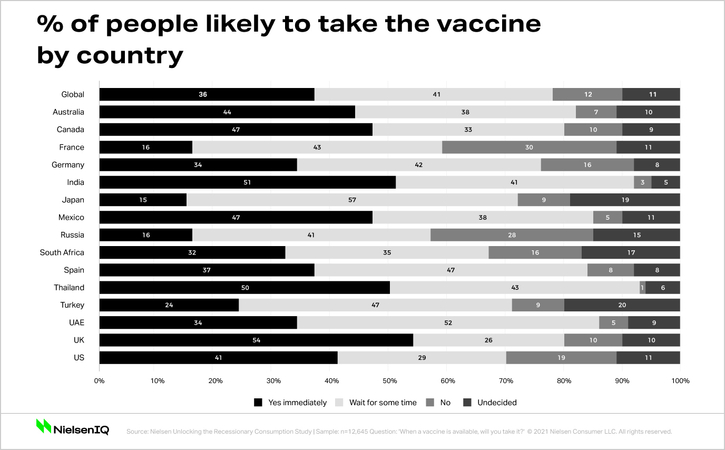
Economies have been hit hard by Covid-19 and vaccines have been touted as a fix to return to pre-pandemic economic stability. However, nearly two-thirds or 64 per cent of consumers surveyed said they will not take a vaccination immediately, a survey from NielsenIQ showed.

Released on Tuesday, this survey also highlights people’s hesitation in changing their spending habits even as the vaccine rollout gains ground.

The vaccines also bring hope that many consumers will drop their deeply cautious approach toward spending during the pandemic.

Of those surveyed, 16 per cent said they will spend more on groceries, compared to 12 per cent who said they will spend less and the vast majority who said they will spend the same after the vaccine is made widely available.

To date, 72 per cent of consumers have been careful with their spending habits due to the impact of Covid-19, which suggests it will take a long time to reverse consumer habits and attitudes.

“The conversation surrounding the vaccine has been dominated by logistics: drug administration approvals, speed of production rates, countries vying to secure enough doses to vaccinate their populations, and most recent concerns around scaling and speeding up the rollout in countries around the world,” said Scott McKenzie, NielsenIQ’s global intelligence chief.

“Confidence levels around the vaccines and desire to take the vaccines certainly may change as countries begin more concerted rollouts and deliver education campaigns. But clear signals indicate that the arrival of vaccines won’t automatically flip a switch to put the world back on its pre-Covid path.”

Health concerns remain prominent even when vaccines become available, as more than half of consumers lack confidence in dining out (58 per cent), attending live sporting events (65 per cent) or travelling overseas (70 per cent) even upon confirmation of the timing when they could be inoculated.

Financial worries still loom large, with half of consumers (52 per cent) saying they won’t be confident in their personal finances despite being vaccinated.

During the earlier months of the pandemic, NielsenIQ analysis dissected how the pandemic forced many consumers to reset their shopping baskets, rationale, affordability gauge and homebody approach.

And now, as private and government forces reckon with the task of producing and rolling out vaccine doses, this latest survey conducted across 15 countries, provides context on challenges to returning to pre-pandemic economic stability.

Of the consumers who don’t plan to take the vaccine immediately, 41 per cent said they will wait for some time, while 12 said they won’t take it at all. Just over a third (36 per cent) indicated that they will take it right away, while 11 per cent remain undecided.

Thai consumers appear to be positive as more than half, or 53 per cent of those surveyed said they were confident of returning to work once vaccines are rolled out. Also, 32 per cent said they will spend more on saving and investment and 29 per cent would spend on out-of-home dining once the vaccine becomes widely available.

Conducted in December 2020, NielsenIQ surveyed more than 11,000 consumers across 15 countries, including Australia, Canada, France, Germany, India, Japan, Mexico, Russia, South Africa, Spain, Thailand, Turkey, UAE, UK and the US.

NielsenIQ provides manufacturers and retailers with insights on the changing marketplace.

Biden increases vaccine goal to 1.5 million shots a day #SootinClaimon.Com

#SootinClaimon.Com : ขอบคุณแหล่งข้อมูล : หนังสือพิมพ์ The Nation.

Biden increases vaccine goal to 1.5 million shots a day

InternationalJan 26. 2021President Joe Biden speaks at a news conference Monday, Jan. 25, 2021. MUST CREDIT: Washington Post photo by Jabin BotsfordPresident Joe Biden speaks at a news conference Monday, Jan. 25, 2021. MUST CREDIT: Washington Post photo by Jabin Botsford

By The Washington Post · Annie Linskey

WASHINGTON – For weeks President Joe Biden has emphasized that his goal for rolling out the coronavirus vaccine was an easy-to-remember 1 million shots a day, or 100 million vaccinations in his first 100 days. On Monday, he suggested a much faster clip, saying he could envision 1.5 million vaccinations per day.

https://www.washingtonpost.com/video/c/embed/6f0381f8-3a23-41b8-aa3d-08bd3cbffe9d?ptvads=block&playthrough=false

“I think with the grace of God . . . we’ll be able to get that to 1.5 million a day,” Biden told reporters.

A million a day is his minimum goal, Biden said, but “I hope we’ll be able to increase as we go along so we’ll get to 1.5 million. That’s my hope.”

The recalibration reflects the reality that the country is already close to the million-a-day pace, using procedures put in place by the Trump administration. Over the past few days, Biden’s nascent administration has faced criticism for setting an artificially low goal – though when it first made the pledge, circumstances were different and it seemed potentially hard to meet.

Overall, Biden on Monday projected a relatively optimistic timeline while acknowledging that the death toll from the pandemic could reach 660,000. By spring, he said, everyone who wants a vaccine should be able to get one.

“It’s going to be a logistical challenge that exceeds anything we’ve ever tried in this country, but I think we can do that,” he said. “I feel confident that by summer we’re going to be well on our way to heading toward herd immunity. I feel good about where we’re going, and I think we can get it done.”

Curbing the virus, and improving distribution of the vaccine, was a cornerstone of Biden’s presidential campaign, while President Donald Trump’s mishandling of the pandemic was a major reason for his election loss. Democrats hammered the idea that Trump, who contracted the coronavirus, had not been able to keep himself safe, let alone other Americans.

Now, Biden’s aides say his ability to deliver on the promise of containing the pandemic will be critical to his success and the only way to revive the struggling economy. Since taking office last week, Biden has sought to find a balance between promising that the virus can be vanquished and warning that dark days lie ahead.

His Monday comments came during the first formal question-and-answer session of his presidency with reporters. Because of pandemic restrictions few journalists, including one from The Washington Post, were allowed in the room with him. And rather than taking questions in the White House itself, the event took place in an auditorium in the adjacent Eisenhower Executive Office Building.

Biden also sought to define what he means by urging “unity,” a longtime slogan that has come under growing scrutiny since he’s taken office. Republicans say it must include more concessions on Biden’s part, while Democrats question the notion of unifying with those who they say attacked democracy.

The president sought to provide a somewhat nuanced definition, describing a need to “eliminate the vitriol” in political discourse and suggesting that unity means respectful debate, not total agreement.

“We’re going to argue like hell – believe me, I know that,” Biden said. “But I think we can do it in a way that benefits the American people.”

For now, much of the political debate surrounds the pandemic and how best to address it and soften its economic consequences. Last week, as Biden was settling into the White House, critics said he was underpromising on his vaccination schedule, perhaps to make it easier to declare victory later.

Even with vaccine shortages and bottlenecks in delivery, the pace needed to meet the Biden’s goal – 1 million doses administered per day – was achieved Friday and on four other days of the previous eight, according to Washington Post data. The accelerating speed of the program also arguably undercut assertions by some Biden advisers that they were left no plan at all by the Trump administration.

When reporters noted this disparity last week, Biden pushed back, noting that when he first announced the million-a-day goal some experts said it was unrealistic. “When I announced it, you all said it’s not possible,” Biden said. “Come on, give me a break, man. It’s a good start.”

Scientists are studying the virus’s herd immunity threshold for humans – that is, the percentage of the population that needs to be immune for the spread of the virus to slow and eventually stop. Estimates range from about 40% to 80% of the population.

Biden noted that over the weekend he’d directed the Federal Emergency Management Agency to help with some aspects of vaccine distribution in West Virginia. The new administration has promised to stand up 100 FEMA centers across the country where vaccinations will be available.

Separately, Biden said he will extend a ban on travelers from Brazil, the United Kingdom, Ireland and 26 other European countries that had been set to expire Tuesday under a proclamation signed by Trump shortly before he left office.

And he plans to impose new restrictions on those coming from countries where a new variant of the virus is spreading. He added travelers from South Africa to the list of those barred from entering the United States, a change set to take effect Saturday.

“With the pandemic worsening and more contagious variants spreading, this isn’t the time to be lifting restrictions on international travel,” White House spokeswoman Jen Psaki said during a news briefing Monday. She said the decision was part of the administration’s “science-driven response” to the coronavirus.

The administration is also taking steps to require travelers to quarantine after their arrival in the United States and to be tested a second time. Details on how those measures will be implemented are expected in the coming days.

In an interview on “CBS This Morning,” Anthony Fauci, the government’s top infectious-disease expert, said extending the ban and including South Africa “clearly will be helpful.” He said it is prudent to restrict travel of non-U. S. citizens.

“We have concern about the mutation that’s in South Africa,” Fauci said. “It is clearly different and more ominous than the one in the U.K.”

Biden brushed aside predictions that his proposed $1.9 trillion pandemic relief package would be torpedoed by Republican objections, saying it is too early in the process to tell whether the two sides can come together.

He said it will take several more weeks to determine whether Democrats will resort to a parliamentary process called reconciliation, which allows bills to pass the Senate with a simple majority instead of 60 votes.

“No one wants to give up on their position until there is no alternative,” Biden said. “I think we’re far from that point right now. The decision on reconciliation will depend on how this negotiation goes.”

In his early days, the president has been seeking to convey two ideas that may be difficult to reconcile – that his administration is wholly focused on the pandemic and throwing every resource at it, and also that it will take a long time to defeat it.

“I’m going to shut down the virus, but I never said I’d do it in two months,” Biden said Monday. “It took a long time to get here. It’s going take a long time to beat it.”

He noted that Monday deaths from covid-19, the illness that can be caused by the novel coronavirus, have ticked down in the past few days. Still, he said he believes the country will see as many as 660,000 deaths “before we begin to turn the corner in a major way.”

“We will still be talking about this into the summer,” Biden said. “We’re still going to be dealing with this issue in the early fall.”

As he frequently does, Biden also took the opportunity to remind Americans to wear masks. He has requested that masks be worn for his first 100 days in office and ordered that everyone on federal land and federally controlled property be required to wear them.

House Democrats plan to focus trial on how rioters reacted to Trump’s remarks #SootinClaimon.Com

#SootinClaimon.Com : ขอบคุณแหล่งข้อมูล : หนังสือพิมพ์ The Nation.

House Democrats plan to focus trial on how rioters reacted to Trump’s remarks

InternationalJan 26. 2021The U.S. Capitol on Monday, Jan. 25, 2021. MUST CREDIT: Washington Post photo by Salwan GeorgesThe U.S. Capitol on Monday, Jan. 25, 2021. MUST CREDIT: Washington Post photo by Salwan Georges
By The Washington Post

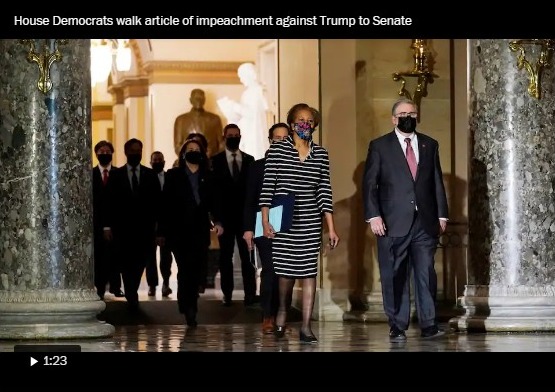
WASHINGTON – The House on Monday formally delivered an article of impeachment charging former president Donald Trump with inciting the deadly insurrection at the Capitol, and Democrats prepared to use his own words as evidence against him in his Senate trial next month.

With solemn looks on their mask-covered faces, the nine House impeachment managers walked over to the Senate shortly after 7 p.m. Monday to deliver the article against Trump, setting in motion his second Senate impeachment trial.

While no final decisions on trial strategy have been made, House managers are concentrating on building their case around Trump personally – what he said in the run-up to the Jan. 6 attack and at a rally that day, and how his words were interpreted in the White House and outside it, according to people familiar with the deliberations.

The impeachment managers and their advisers have been meeting daily, scouring hundreds of hours of evidence – including footage scraped from the conservative Parler and other social media sites – to build an elaborate timeline that is being constantly updated, according to the people, who spoke on the condition of anonymity to describe the internal discussions.

One idea under consideration: to produce a video that highlights how the rioters reacted to Trump’s remarks that day and that shows footage of the violent mob inside the building.

At the same time, allies of Trump are growing bullish that as more time passes since the fatal siege, the momentum in favor of convicting the former president and permanently barring him from public office is fading.

“There are only a handful of Republicans and shrinking who will vote against him,” said Sen. Lindsey Graham, R-S.C., who has been advising Trump on the upcoming proceedings.

Trump’s coming Senate trial, which is not set to begin in earnest until Feb. 9, has ensured that the remnants of the Trump presidency are hanging over the first days of President Joe Biden’s tenure, complicating his immediate agenda on Capitol Hill such as confirmation of his Cabinet and passage of a massive pandemic relief package.

Biden and his aides have assiduously avoided getting involved in the political morass of impeachment surrounding his predecessor, though the trial is likely to consume all of the oxygen in Washington once opening arguments begin next month.

Senators will be sworn in as jurors on Tuesday, when Trump will receive the official summons. But the official trial proceedings will be delayed until the week of Feb. 8 under a delayed timeline first proposed by Senate Minority Leader Mitch McConnell, R-Ky., and later approved by Biden.

Several Republican senators, including McConnell, have made it clear that they would consider voting to convict Trump. But it is improbable that at least 17 GOP senators would favor doing so.

Sen. Ron Johnson, R-Wis., said Monday that Democrats, in pursuing impeachment against Trump, were being “sore winners” and that there were not enough Republicans who would vote to convict him.

“Why are we doing this?” he added.

Three Republicans were on the Senate floor Monday evening when the House managers arrived to deliver the article of impeachment: McConnell, Sen. Mitt Romney of Utah and Sen. Roger Marshall of Kansas.

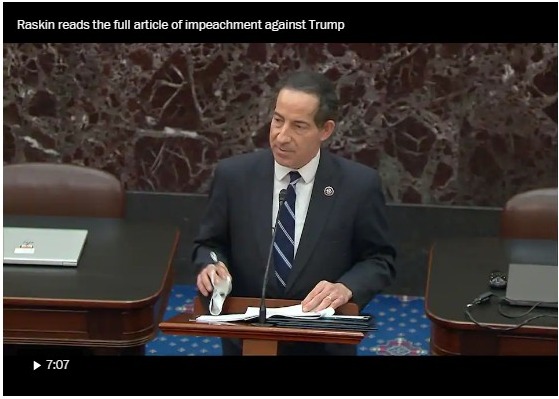
“President Trump gravely endangered the security of the United States and its institutions of government,” Rep. Jamie Raskin, D-Md., the lead impeachment manager, said on the Senate floor, reading the article. “He threatened the integrity of the Democratic system, interfered with the peaceful transition of power and imperiled a coequal branch of government.”

Senior GOP officials said they expected at least one Senate Republican to move to dismiss the charge against Trump quickly, though such a vote would serve primarily as an early litmus test of how receptive GOP senators would be to arguments that Trump fomented the riot at the Capitol and that he should be permanently barred from public office because of it.

The party remains split over how fiercely to back Trump during the impeachment, with Republican Party committee members debating whether to pass a resolution on the former president’s behalf over a long email thread throughout the weekend. A number of them have been pushing for a formal resolution of support of the former president.

The debate over whether to back the president and the resolution ended when Henry Barbour, a GOP committee member from Mississippi, asked that the conversation be taken offline, according to people familiar with the emails.

The next two weeks will give the president’s lawyers, led by South Carolina attorney Butch Bowers, and the nine House impeachment managers time to prepare briefs and their legal arguments.

House Democrats have pulled together an extensive outline of the case and the constitutional arguments intended to rebut arguments from some Republicans that a former president cannot be impeached, according to the people familiar with the discussions.

One item of particular interest to impeachment managers is a 10-minute video released Monday by Just Security, an online forum hosted by the Reiss Center on Law and Security at New York University’s law school, which shows how Trump’s words were heard and interpreted by those who ransacked the Capitol, according to people familiar with the managers’ trial preparations.

The House managers say visuals are central in prosecuting the case against Trump because the evidence is in plain sight and will remind senators of what they experienced that day, when the rioters got perilously close to lawmakers and then-Vice President Mike Pence.

Democrats are collecting clips of the siege and probably will work with an outside firm that will weave together the images as evidence to be presented to senators, according to the people with knowledge of the plan.

Any rules regarding whether videos can be submitted during the impeachment trial probably will be handled in an agreement between Senate Democrats and Republicans, setting up the parameters of the proceedings. If not, senators can later vote whether to admit video evidence and witnesses.

The House managers are operating under the expectation that there will be an opportunity for video presentations, the people said.

They are also deliberating the issue of presenting witnesses, including those who were caught up in the Capitol attack and those who may have interacted with Trump during the Jan. 6 riot and the days leading to it. House Democrats have informally discussed with their Senate counterparts their desire to call witnesses during the trial, though – as with the video evidence – nothing has been finalized.

The prospect that footage of Trump could be used as evidence against him is a marked contrast to his first impeachment trial, when Democrats called a parade of witnesses to testify before a House committee – then featured clips of their public testimony in the Senate.

In that trial, the case they sought to make that Trump abused his power and obstructed Congress in pressuring Ukrainian President Volodymyr Zelensky to investigate Biden and his family hinged on testimony about actions that occurred largely behind the scenes.

But this time, much of the evidence is in the public sphere, and Democrats say the senators themselves are effectively witnesses, having lived through the violent siege at the Capitol.

Raskin, an expert in constitutional law and the lead impeachment manager, will also make the Democrats’ case to senators that it is constitutional to impeach a president even if he is no longer in office, according to a person briefed on the strategy.

Democrats and some Republicans, such as Romney, have said a former president can be impeached. Other GOP senators who were infuriated by Trump’s conduct but nonetheless are not compelled to convict a president who is no longer in office have suggested the move may not be constitutional.

“It makes no sense whatsoever that a president or any official could commit a heinous crime against our country and then defeat Congress’s impeachment powers by simply resigning so as to avoid accountability and a vote to disqualify them from future office,” said Senate Majority Leader Chuck Schumer, D-N.Y.

John Bolton, the former Trump national security adviser who emerged as a vocal critic of Trump, savagely criticized the idea of a Senate impeachment trial Monday in a piece in the National Review, saying the exercise was ultimately impractical and would benefit Trump, not those who wish to see him banished from the national political stage.

“Like Impeachment 1.0, the 2021 edition is badly conceived, poorly executed, and likely to produce precisely what the first round did: results 180 degrees contrary to the objectives that impeachment supporters say they want,” Bolton wrote in the conservative publication.

Now ensconced at his private club in South Florida, the former president is continuing to cobble together his legal and public relations team, which will differ significantly from the formal White House apparatus that surrounded him in his first impeachment trial last year. Trump is expected to stay in Florida during the trial, according to an adviser.

Jason Miller, who has served as a Trump senior adviser in both his presidential bids, is handling much of the communications work for impeachment, and the former president has asked a coterie of House Freedom Caucus members to flood the airwaves to defend him.

Trump’s team is planning to circulate additional polling in the coming days, paid for by his PAC, to warn Republican senators of the political consequences of voting to convict him.

Graham said he has reassured Trump that he would not be convicted and that it was a simple case.

“He’s thinking about the trial and decompressing,” Graham said. “I think he appreciates having some of the extra time he didn’t have in the past.”

Bowers, a longtime South Carolina GOP lawyer whom Graham connected with Trump, did not respond to requests for comment.

Graham and others said the president was likely to expand his legal team, but many of his longtime attorneys, including Jay Sekulow, Pat Cipollone and Rudy Giuliani, are either uninterested or not involved.

Sekulow, Cipollone and Giuliani did not respond to requests for comment.

In another difference from last year’s trial, Chief Justice John Roberts is not expected to preside in next month’s proceedings and in his place will be Sen. Patrick Leahy, D-Vt., the president pro tempore and the most senior Democrat in the chamber, according to an official familiar with the matter.

The Constitution calls for the chief justice of the United States to president over an impeachment trial for a sitting president of the United States. Otherwise, senators preside over proceedings for any official who is not in the White House, said the official, who spoke on the condition of anonymity.

Leahy’s role, first reported by CNN, began sparking some pushback from some of Trump’s conservative allies who argued that not having the chief justice preside delegitimizes the trial, though he does not appear to be constitutionally required to do so because Trump is not the current president.

“If Chief Justice Roberts can’t be bothered to come over for the so-called impeachment, makes you wonder if this exercise is constitutional at all,” tweeted Sen. Rand Paul, R-Ky.

A Supreme Court spokeswoman said Roberts had no comment on whether he declined entreaties to preside over Trump’s second impeachment trial. Leahy defended his ability to be impartial in his presiding duties, which are largely ceremonial anyway.

“I’m not presenting the evidence. I am making sure that procedures are followed,” Leahy told reporters on Monday. “I don’t think there’s any senator who – over the 40-plus years I’ve been here – that would say that I am anything but impartial in voting on procedure.”

Supreme Court ends lawsuits alleging that Trump illegally profited from business interests #SootinClaimon.Com

#SootinClaimon.Com : ขอบคุณแหล่งข้อมูล : หนังสือพิมพ์ The Nation.

Supreme Court ends lawsuits alleging that Trump illegally profited from business interests

InternationalJan 26. 2021Associate Justice Neil Gorsuch, center left, is accompanied by Chief Justice John Roberts as they walk to the steps of the U.S. Supreme Court on June 15, 2017, in Washington, D.C. MUST CREDIT: Washington Post photo by Ricky Carioti.Associate Justice Neil Gorsuch, center left, is accompanied by Chief Justice John Roberts as they walk to the steps of the U.S. Supreme Court on June 15, 2017, in Washington, D.C. MUST CREDIT: Washington Post photo by Ricky Carioti.

By The Washington Post · Robert Barnes, Ann E. Marimow

WASHINGTON – The Supreme Court on Monday put an end to lawsuits alleging that former president Donald Trump violated a constitutional anti-corruption prohibition by profiting from his business empire while president.

The justices, without comment or noted dissent, declined to hear Trump’s request to consider lower court orders that said lawsuits could go forward, agreeing with those on both sides of the issue that the cases became moot with Trump no longer in office.

The justices also vacated the lower court judgments in the cases, one of which was filed by the attorneys general of Maryland and the District of Columbia.

It means that there is no definitive answer after years of legal wrangling over the Constitution’s emoluments clauses, which prohibit presidents and others from accepting gifts or payments from foreign governments without congressional approval.

The question has rarely been presented because presidents rarely maintain active business interests in office, as Trump did. Much of the litigation turned on the president’s interest in the Trump International Hotel on Pennsylvania Avenue, near the White House, which became a magnet for foreign dignitaries and others doing business with the government.

The litigation was consumed with questions about who had the right to bring such a suit, and legal questions without precedent.

“We are proud that because of our case, a court ruled on the meaning of ’emoluments’ for the first time in American history, finding that the Constitution prohibits federal officials from accepting almost anything of value from foreign or domestic governments,” District of Columbia Attorney General Karl A. Racine and Maryland Attorney General Brian E. Frosh said in a joint statement.

They added: “History will note that at every step of this case, President Trump and political appointees at the Department of Justice went to extreme lengths to prevent us from uncovering the true extent of his corruption. He attempted to short-circuit the rules of legal procedure to have our case dismissed and avoid discovery into his finances, arguing that the law did not apply to him.”

Their case was one of three testing for the first time the Constitution’s ban on the country’s leaders engaging in private business relationships with foreign governments.

The Supreme Court declined in October to take up a case brought by Democratic members of Congress led by Sen. Richard Blumenthal, D-Conn., and Rep. Jerrold Nadler, D-N.Y. The lawmakers had appealed a Washington D.C. Circuit ruling that blocked individual members of Congress from trying to enforce the foreign emoluments clause.

In a third case in New York, brought by the nonprofit watchdog group Citizens for Responsibility and Ethics in Washington (CREW) on behalf of Trump’s hospitality industry competitors, a three-judge panel of the U.S. Court of Appeals for the 2nd Circuit said a lower-court judge had improperly thrown out the case in late 2017.

The lawsuit alleged that Trump was illegally profiting from his hotels and restaurants in New York and the District. The full appeals court declined to rehear the case this summer and Trump asked the high court to intervene.

Xi signals no change in China’s course, warns against cold war #SootinClaimon.Com

#SootinClaimon.Com : ขอบคุณแหล่งข้อมูล : หนังสือพิมพ์ The Nation.

Xi signals no change in China’s course, warns against cold war

InternationalJan 26. 2021

By Syndication Washington Post, Bloomberg

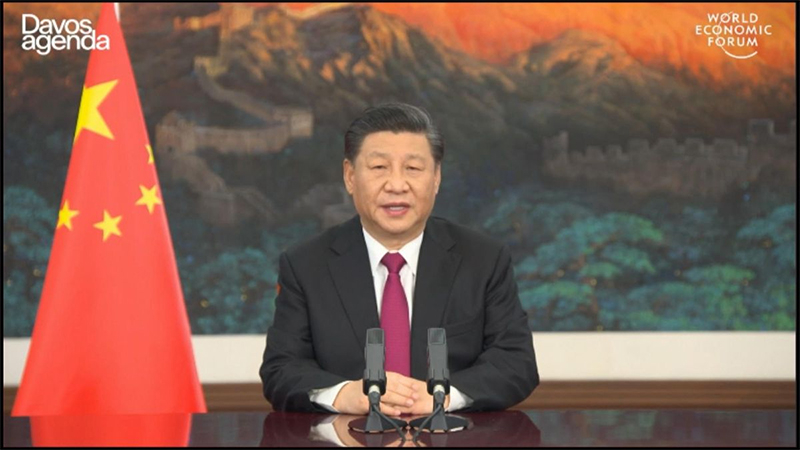
President Xi Jinping called on the world to abandon “ideological prejudice” and shun an “outdated Cold-War mentality” as he signaled that China will continue to forge its own path regardless of western criticism.

It’s vital to stay committed to international law and international rules “instead of staying committed to supremacy,” Xi told the Davos Agenda event on Monday, in his first address since Joe Biden entered the White House. “Confrontation will lead us to a dead end,” he said, and urged a return to mutual respect to help the recovery from the pandemic.

“To build small circles and start a new Cold War, to reject, threaten or intimate others, to willfully impose decoupling, supply disruptions, or sanctions, or to create isolation or estrangement, will only push the world into division and even confrontation,” he said.

Xi’s speech had been widely anticipated for the tone it would set for relations between the world’s biggest economies over the next four years. Though Xi did not name Biden by name, many of his comments were clearly targeted at the new U.S. administration.

Xi repeated many of the same talking points about multilateralism and “win-win” outcomes that he deployed in his last address to Davos four years ago, days before Donald Trump’s inauguration, but he also signaled that he does not intend to change course in the face of U.S. pressure.

“Each country is unique with its own history, culture and social system, and none is superior to the other,” Xi said, warning against imposing a “hierarchy on human civilization” or forcing one’s own systems onto others.

China’s leaders have long embraced Davos as a forum to showcase economic reforms while sidestepping difficult questions about politics. Former Premier Li Peng visited in 1992 as China sought to attract foreign investors in the wake of the 1989 Tiananmen massacre.

Xi signaled his desire to put aside political issues which have helped drive a deterioration in ties with Western countries, including his abolition of term limits and use of “re-education” camps in the far western region of Xinjiang. “No two leaves are identical,” Xi told his online audience.

Xi’s desire to set aside political differences won’t be an easy sell. On the campaign trail, Biden said China’s policies in Xinjiang were “unconscionable” and even branded Xi a “thug.” The European Union also officially labeled China as a “systemic rival” in 2019, although it went on to sign an investment deal with the Asian nation in the final days of 2020.

During the address, Xi hinted at his desire to reestablish high-level dialogue with the incoming administration, calling for countries to “enhance political trust through strategic communication.” The Chinese leader succeeded in building a cordial personal relationship with Trump even as the two powers descended into a trade war. That effort began with a trip to the former president’s Mar-a-Lago estate in April 2017 and led to the development of official dialogue tracks which eventually disintegrated over the course of Trump’s presidency.

By the time Biden was sworn in, more than 100 officially organized exchange forums had been disbanded, companies like Huawei Technologies have been hit with export curbs and tariffs imposed on almost $500 billion of products. While Biden hasn’t given many specifics on how he’ll deal with these and other flashpoints, he has signaled a shift from confrontation to competition.

In his speech, Xi steered clear of the triumphal tone evident in some of his domestic addresses in recent years. In a speech last September, Xi said China’s pandemic response demonstrated the “superiority” of China’s political system. In others, he has argued that “China is moving closer to the center of the world stage.”

Still, the president spoke from a position of strength: China has been the only major economy to report growth amid the pandemic last year, and economists are forecasting an expansion of 8.3% this year, compared with 4.1% in the U.S.

Pandemic destroyed 225 million jobs worldwide, but billionaires got richer, reports find #SootinClaimon.Com

#SootinClaimon.Com : ขอบคุณแหล่งข้อมูล : หนังสือพิมพ์ The Nation.

Pandemic destroyed 225 million jobs worldwide, but billionaires got richer, reports find

InternationalJan 26. 2021

By The Washington Post · Jennifer Hassan

LONDON – At least 225 million full-time jobs disappeared worldwide last year because of the coronavirus pandemic, according to a report published Monday by the International Labor Organization, losses four times worse than those from the global financial crisis in 2009. But the ultrarich have seen their wealth soar.

According to another report released Monday, by the anti-poverty nonprofit group Oxfam, the combined wealth of the world’s 10 richest men has risen by more than $500 billion since the crisis began – enough to vaccinate the entire planet and then some, according to the organization.

Both sets of findings identify rising inequity as one of the pandemic’s principal outcomes. “Job destruction has disproportionately affected low-paid and low-skilled jobs,” which “points to the risk of an uneven recovery, leading to still greater inequality in the coming years,” the ILO found. That unevenness is already apparent: Global poverty could take 14 times longer to return to pre-pandemic levels than the recovery of the world’s wealthiest, according to Oxfam.

Last year, 8.8% of global working hours were lost, according to the report by the ILO, a U.N. agency. It found “unprecedented disruption” among global labor markets, and that women and young people have felt the worst impact. Globally, women saw 5% employment loss in 2020, as opposed to 3.9% for men.

“In line with the focus of Oxfam’s report on inequality, ILO’s estimates confirm that the crisis has resulted in relatively larger employment and income losses for women and young people, along with the low-paid and low-skilled,” Sher Verick, head of the ILO’s employment strategies for inclusive transformation unit, told The Washington Post. “Certain sectors have been hit harder, such as accommodation and food services.”

Employment loss among people ages 15 to 24 stood at 8.7%. The data “highlights the all too real risk of a lost generation,” according to the report.

Guy Ryder, the director general of the ILO, said during a news briefing that the effect of the pandemic had been greater than not only that of the financial crisis but also that of the Great Depression of the 1930s. Job losses, he said, were likely to continue through 2021 – although he noted that battered economies could begin to rebuild once vaccination efforts start to take effect.

“I am pleased to say that there is some relatively good news in all of this, that we do see tentative signs of recovery,” he said. “These signs are fragile, they are uncertain, and the prospects are notably uneven.”

The Oxfam findings also suggest a slow path to economic recovery: It could take at least a decade for the world’s poorest to recover from the health crisis, while the 1,000 richest people already have made back their losses and the wealthiest 10 have earned more than $500 billion during the pandemic.

Authors of the report said the pandemic could trigger a simultaneous rise in inequality nearly everywhere, for the first time since records began.

“The virus has exposed, fed off and increased existing inequalities of wealth, gender and race,” the report said.

British lawmaker David Lammy of the Labour Party called the Oxfam findings “truly staggering.”

“The wealth of ten of the world’s richest men has increased by more than £400bn during the pandemic – more than enough to vaccinate every person in the world,” he tweeted.

Lawmaker Claudia Webbe, also of the Labour Party, branded Oxfam’s findings “obscene” and called for a wealth tax to be placed on the ultrarich – a proposal that some experts say could be the answer to the United Kingdom’s financial recovery after the government was forced to spend billions of pounds in borrowed money to save jobs and lives during the coronavirus pandemic.

Britain’s Wealth Tax Commission says taxing the rich would be a more equitable solution to helping the country’s recovery as opposed to increasing taxes on goods or incomes, political decisions they argue would damage those who need the money to survive.

“It is morally repugnant to allow the poorest people to continue to pay the price for the crisis, when it is clear that a fair tax on the richest could make such a difference,” Rebecca Gowland, Oxfam’s head of inequality, said last month, the BBC reported.

Biden to reimpose travel ban on European countries, add South Africa in effort to contain coronavirus #SootinClaimon.Com

#SootinClaimon.Com : ขอบคุณแหล่งข้อมูล : หนังสือพิมพ์ The Nation.

Biden to reimpose travel ban on European countries, add South Africa in effort to contain coronavirus

InternationalJan 26. 2021

By The Washington Post · Lori Aratani

WASHINGTON – President Joe Biden on Monday added travelers from South Africa to the list of those barred from entering to the United States – the latest step in an effort to help contain the spread of the coronavirus and fast-moving variants that have surfaced in that country and others in recent weeks.

The move also extends a ban on travelers from Brazil, the United Kingdom, Ireland and 26 other European countries that had been set to expire Tuesday under a proclamation signed by former president Donald Trump shortly before he left office.

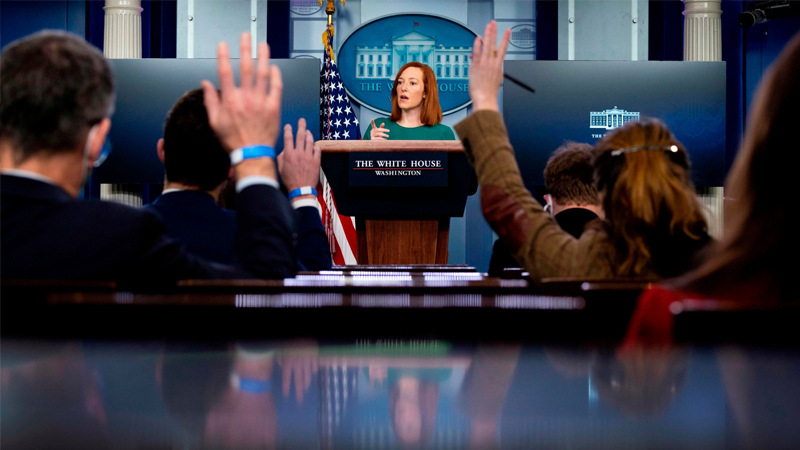
“With the pandemic worsening and more contagious variants spreading, this isn’t the time to be lifting restrictions on international travel,” White House spokeswoman Jen Psaki said during a Monday news conference. She said the move was part of the administration’s “science-driven response” to the coronavirus.

The restrictions on travelers from South Africa are set to take effect Saturday.

In an interview on “CBS This Morning,” Anthony Fauci, the government’s top infectious-disease expert, said extending the ban and including South Africa “clearly will be helpful.” Fauci said it is prudent to restrict travel of non-U. S. citizens.

“We have concern about the mutation that’s in South Africa,” he said. “It is clearly different and more ominous than the one in the U.K.”

While some have questioned the value of travel bans, Fauci said one important difference this time around is that the ban dovetails with a requirement that all international travelers to the U.S. show proof of a negative coronavirus test.

Earlier this month, the Centers for Disease Control and Prevention warned that the variant of the coronavirus first seen in the United Kingdom would become the dominant strain in the U.S. within about two months. The South African variant, however, has not yet been identified in the U.S.

On Monday, Moderna said its vaccine will protect people from both the U.K. and South African variants of the virus. However, the vaccines’ response to the South African variant was slightly diminished, officials said. As a result, the company said it work to develop a new vaccine that can be added to the current two-dose regimen.

The Biden administration is also taking steps to require travelers to quarantine after their arrival in the United States and to be tested a second time. Details on how those measures will be implemented are expected in the coming days.

Restrictions on travelers from 26 countries in Europe have been in place since mid-March, while Brazil was added to the list in May.

Under the ban, most non-U. S. citizens who have been in those countries in the past 14 days are barred from entering the United States. However, some exceptions are in place.

The extension of the ban comes as a new testing requirement for international travelers is set to take effect Tuesday.

Under the requirement announced earlier this month by the Centers for Disease Control and Prevention, all international travelers to the U.S. will be required to show proof of a negative coronavirus test before boarding a flight. PCR and antigen tests will be acceptable.

Those who refuse to be tested will not be allowed to fly. Travelers must be tested within three days before boarding their flights and airlines will be required to review travelers’ documentation.

“As variants of the SARS-CoV-2 virus continue to emerge in countries around the world, there is growing evidence of increased transmissibility of some of these variants, as well as unknown health and vaccine implications,” the CDC said in a statement. “Testing before and after travel is a critical layer to slow the introduction and spread of COVID-19 and emerging variants.”

However, the agency said it would no longer issue waivers to countries with a limited ability to test travelers. The CDC had previously said it would allow carriers to apply for two-week waivers from the requirement.

“With the U.S. already in surge status, the testing requirement for all air passengers will help slow the spread of the virus as we work to vaccinate the American public,” the agency said.

In addition to requiring proof of a negative test, Biden also has directed officials to explore the feasibility of requiring international travelers to quarantine or self-isolate once they arrive in the U.S.

The reinstatement of the ban is a blow to airlines that had hoped testing could replace bans and quarantines. Industry surveys have shown that people are more reluctant to travel if they must quarantine.

Since taking office, Biden has acted quickly to impose rules intended to reduce the spread of the virus as the administration seeks to ramp up efforts to vaccinate as many people as possible.

Last week, he signed an order mandating masks in airports and on many planes, trains, ships and intercity buses. The order followed one the president signed Wednesday, requiring that people wear masks on federal property.

Biden signs order pushing federal government to buy more American-made products #SootinClaimon.Com

#SootinClaimon.Com : ขอบคุณแหล่งข้อมูล : หนังสือพิมพ์ The Nation.

Biden signs order pushing federal government to buy more American-made products

InternationalJan 26. 2021President Joe Biden signs executive orders at the White House on Friday, Jan 22, 2021. MUST CREDIT: Washington Post photo by Jabin BotsfordPresident Joe Biden signs executive orders at the White House on Friday, Jan 22, 2021. MUST CREDIT: Washington Post photo by Jabin Botsford

By The Washington Post · David J. Lynch, Jeff Stein, Ashley Parker

WASHINGTON – President Joe Biden on Monday signed an order aimed at forcing the federal government to buy more goods produced in the United States, a key part of his campaign pledge to revive domestic manufacturing.

President Joe Biden signs executive orders at the White House on Friday, Jan 22, 2021. MUST CREDIT: Washington Post photo by Jabin Botsford

https://www.washingtonpost.com/video/c/embed/50d51baa-5388-4322-bed7-bc0f02244fc5?ptvads=block&playthrough=false

Standing in front of a blue backdrop reading “The Future Will Be Made in America,” the president said he was directing regulators to tighten the definition of American-made products and creating a new position in the Office of Management and Budget to oversee purchases of domestic goods.

The president’s order also will make it harder for federal agencies to issue waivers allowing the government to purchase some products made overseas. Under the new rules, agency officials will be required to justify such choices to the White House.

Biden acknowledged that efforts to promote domestic content have been a familiar part of previous presidents’ agendas. President Donald Trump issued new regulations increasing the share of a product’s components that must be produced domestically to qualify as made-in-the-USA one day before he left office.

“This is different and not the same,” Biden insisted.

The executive order will create a website where American businesses can see what contracts are being awarded to foreign vendors, allowing them to alert the government to the availability of a domestic alternative, Biden said.

The order reflects the shifting consensus in American politics away from free trade and toward direct government intervention to promote U.S. manufacturers, a position Trump embraced. The pandemic has intensified calls for the United States to shore up its domestic manufacturing capabilities, given gaps last year in the medical supply chain that left U.S. medical workers scrambling for personal protective equipment.

“We’re going to make sure that they buy American and are made in America,” Biden said Friday.

The measure drew labor union plaudits, with AFL-CIO President Richard Trumka calling it “a good first step in revitalizing U.S. manufacturing.” But the U.S. Chamber of Commerce said the initiative probably would not bring home lost manufacturing jobs and would boost the cost of government projects.

Turning Biden’s aspirations for reviving domestic manufacturing into reality may be difficult. Trump’s top trade adviser, Peter Navarro, pushed aggressively for similar provisions but was often rebuffed by other officials who argued that his proposals risked backlash from foreign nations as well as higher costs for U.S. taxpayers.

Trump’s last-minute regulations, which take effect Feb. 22, give American companies the edge over foreign rivals even if their products cost 20% to 30% more.

Major U.S. allies oppose such efforts, fearing the loss of lucrative contracts. Canadian Prime Minister Justin Trudeau raised his concerns in a phone call with Biden last week, officials in Ottawa said.

An aggressive Buy America campaign also may complicate Biden’s hopes of securing a united allied front to meet rising Chinese influence.

“The Biden administration is sending a clear signal that it intends to aggressively protect U.S. commercial and trade interests, belying the hopes of U.S. trading partners anticipating a softer touch from the new government,” said Eswar Prasad, a former International Monetary Fund official now teaching at Cornell University. “It is clear that the Biden administration is hardly rushing to usher in a new era of global trade and economic cooperation.”

The administration is determined to move beyond the traditional single-minded focus on price and efficiency in its approach to trade policy.

“As we sort out what globalization is going to look like in the future, we’re headed toward a more thoughtful policy,” said one trade specialist advising the administration, who spoke on the condition of anonymity because the person was not authorized to speak to the press.

The federal government spends as much as $600 billion annually on contracts, but a meaningful portion of that money goes to foreign businesses, said Lori Wallach, a trade expert at Public Citizen, a nonprofit watchdog organization.

It is unclear how much federal contracting money goes abroad, Wallach said. The U.S. Chamber of Commerce says 97% of federal procurement funds go to “U.S. firms.” But that figure includes the foreign subsidiaries of American corporations, meaning the purchases could support workers in Vietnamese or Mexican factories rather than Americans.

Under a World Trade Organization accord on government procurement, the U.S. generally has been more receptive to foreign firms bidding on contracts than other countries have.

In 2010, the most recent year such data is available, the U.S. opened $837 billion in government contract competitions to foreign firms, more than twice the combined figure of the next five countries – the European Union, Japan, South Korea, Norway and Canada, according to the Government Accountability Office.

The U.S. that year allowed foreign companies to bid on about 48% of its $1.7 trillion government procurement market while those five nations put out to bid 16% of their combined $2.4 trillion market.

William Reinsch, a trade specialist at the Center for Strategic and International Studies, said Monday’s White House announcement would have little immediate impact. But by raising domestic content requirements, the administration could affect corporate supply chain decisions.

“This is going to be a long-term play, not a short-term play,” said Reinsch, a Commerce Department official in the Clinton administration.

Biden has the power to reduce the list of 60 countries whose companies are granted waivers from Buy America regulations, meaning their products are treated as if they were made-in-America for purposes of government contracting. Those waivers, which he said Monday have been issued “with impunity,” will be permitted only under “very limited circumstances,” such as to meet national security requirements.

Loopholes in government procurement regulations must be closed before Biden launches other major initiatives, according to Scott Paul, president of the Alliance for American Manufacturing.

“Biden is envisioning this massive new federal investment in infrastructure, in clean energy, in economic recovery, so getting the updated statutes in place ahead of this spending is going to be key to its success,” he said.

Pentagon spending also could be ripe for a greater Buy America focus, according to a trade specialist advising the Biden administration. A 2018 Defense Department study found “a surprising level” on foreign suppliers, including the Chinese and recommended that the government mitigate it by expanding taxpayer investment in low-level defense manufacturers.

Most economists have panned Buy American provisions, saying they raise costs for the U.S. government.

“Neither protectionism nor purposefully raising the cost of the federal government will help the economy grow any faster,” said Adam Ozimek, an economist at the freelancing site Upwork, adding that he had not been briefed on the details of the Biden plan.