By The Washington Post · Paul Schemm, Emily Rauhala
Going forward, the United States will work with – not against – the World Health Organization. That was the message delivered Thursday by President Joe Biden’s chief medical adviser.
In remarks to the U.N. health agency’s executive board, Anthony S. Fauci confirmed that the United States will halt its withdrawal from the WHO and work cooperatively to fight the coronavirus pandemic.
That will mean opting into Covax, a multilateral plan to distribute coronavirus vaccines that has drawn support from more than 170 nations but was spurned by President Donald Trump during his feud with the WHO.
Fauci’s remarks, delivered on Biden’s first full day in office, signaled the new administration’s desire to restore the United States’ relationship with an organization it helped found and shape after months of WHO-bashing and threats.
“The United States stands ready to work in partnership and solidarity to support the international covid-19 response, mitigate its impact on the world, strengthen our institutions, advance epidemic preparedness for the future, and improve the health and well-being of all people throughout the world,” Fauci said.
Mending ties with the WHO is part of a broader push to restore U.S. leadership in global public health and reengage with traditional allies after four years of Trump’s “America First” foreign policy.
The Biden administration’s national covid-19 strategy, for instance, promises that the country will “rebuild health security alliances, elevate U.S. efforts to support the Global Health Security Agenda, and revitalize U.S. leadership.”
Fauci’s address represented a striking reversal of tone.
“I join my fellow representatives in thanking the World Health Organization for its role in leading the global response to this pandemic,” he said. “Under trying circumstances, this organization has rallied the scientific and research community to accelerate vaccines, therapies and diagnostics.”
The agency’s director general, Tedros Adhanom Ghebreyesus, thanked Fauci for his remarks and for recommitting to the covid-19 fight, calling it “a good day for the WHO and a good day for global health.”
“We have a lot of work to do, and lessons to learn, to end the pandemic and meet the long list of global health challenges we face – the world will be better able to meet them with you,” Tedros said.
The last year has been anything but easy for the WHO, which has been at the heart of a complex global health crisis as well as an acrimonious political conflict.
Trump was highly critical of the organization and its director general, accusing them of mishandling the initial outbreak and being too subservient to China.
In July, after months of threats, Trump issued a letter announcing the U.S. withdrawal from the WHO after a year. In September, the Trump administration announced it would not participate in Covax because of its link to the WHO.
Some elements of Trump’s critique have resonated beyond the White House. The WHO’s actions in the early days of the pandemic have also been criticized by an independent panel, for instance, and reform measures are under discussion.
But few supported the Trump administration’s undermining of the agency mid-pandemic, and Biden promised as a presidential candidate to reverse course. Hours after taking office, the new president signed directives to reengage with the WHO.
Questions about China are likely to remain front and center in the days ahead. Fauci on Thursday expressed support for WHO-led efforts to determine the origins of the pandemic with a mission sent to China, amid fears that Beijing will obstruct the agency’s efforts.
“The international investigation must be robust and clear,” he said, “And we look forward to evaluating it.”
NEW DELHI – India only started vaccinating its own population against the coronavirus a few days ago, but it is already using its manufacturing heft to generate goodwill with its neighbors.
India’s government has made the calculation that it has enough vaccines to share. The result is a form of vaccine diplomacy that appears to be unlike any other in the world.
Since Wednesday, the Indian government has sent free vaccines to Bangladesh, Nepal, Bhutan and Maldives – more than 3.2 million doses in total. Donations to Mauritius, Myanmar and Seychelles are set to follow. Sri Lanka and Afghanistan are next on the list.
The shipments reflect one of India’s unique strengths: It is home to a robust vaccine industry, including Serum Institute of India, one of the world’s largest vaccine makers.
Early in the pandemic, Serum Institute formed a partnership to produce the Oxford-AstraZeneca vaccine. By this year, the company had already stockpiled 80 million doses. Some of that production will be delivered this month to the Covax initiative backed by the World Health Organization to distribute vaccines to poorer countries.
On Thursday, a fire broke out at a building under construction at Serum Institute’s headquarters in which five people died, reported New Delhi Television. The company said the blaze would not impact its production of the AstraZeneca vaccine.
In the race to combat the pandemic, several countries are using vaccine production as a route to enhance their global influence. But the Indian government seems to be the first to deliver multiple gifts to neighboring countries.
China has made a concerted push to sell its vaccines to countries around the globe for months but only recently announced donations to Myanmar, Cambodia and the Philippines. It is not clear if the free vaccines have been shipped.
On Thursday, Pakistan’s foreign minister had a call with his Chinese counterpart and announced that China would donate 500,000 vaccine doses by Jan. 31.
India’s diplomatic initiative has its own hashtag – #VaccineMaitri, or vaccine friendship – and received a high-profile plug from Prime Minister Narendra Modi. India is “deeply honoured to be a long-trusted partner in meeting the healthcare needs of the global community,” he wrote on Twitter.
The push comes at a time when the virus is in retreat in India. The country is a distant second to the United States in terms of coronavirus cases, with about 10.6 million in total. Daily cases have dropped significantly since last fall.
India launched its nationwide vaccination drive, one of the world’s largest, on Jan. 16. The country is aiming to vaccinate 300 million people by the summer, starting with 10 million health-care personnel. Regulators fast-tracked the approval of two vaccines – the AstraZeneca vaccine and, more controversially, a vaccine called Covaxin developed in India that does not yet have efficacy data.
So far India is providing the AstraZeneca vaccine to its neighbors. Some analysts questioned whether the donations would have a lasting impact on existing sources of tension, such as a boundary dispute with Nepal.
“You have neighbors who resent India’s overweening ways as it is,” said Manoj Joshi, a foreign-policy analyst and senior fellow at the Observer Research Foundation in New Delhi. “I don’t think they’re going to be so terribly grateful that they forget all that.”
Conspicuously absent from the list of countries receiving free vaccines is Pakistan, India’s rival and neighbor to the west. The relationship between the two countries hit a recent nadir in 2019 when they engaged in their first aerial dogfight in nearly 50 years following a terrorist attack in Kashmir.
Pakistan recently approved the AstraZeneca vaccine. It has not approached India about a potential shipment, said two Indian officials who spoke on the condition of anonymity because they were not authorized to discuss the matter. “We’ll cross that bridge when we come to it,” one of the officials said.
A spokesman for Pakistan’s foreign ministry referred queries to the health ministry, which did not respond.
India is monitoring the supply of vaccines on a weekly basis to make sure it can meet both domestic needs and demands from other countries, one of Indian officials said. Commercial exports of the AstraZeneca vaccine – including to Brazil and Morocco – will begin within days.
Countries that received the free vaccines this week expressed their thanks. On Wednesday, an Indian military transport plane landed at the only international airport in Bhutan, a tiny Himalayan nation wedged between India and China. It carried 150,000 doses of the AstraZeneca vaccine, enough to vaccinate more than one-tenth of the total population targeted for immunization.
Lotay Tshering, Bhutan’s prime minister, said in a statement that the Bhutanese people were “immensely grateful” for the vaccines. “It is of unimaginable value when precious commodities are shared even before meeting your own needs.”
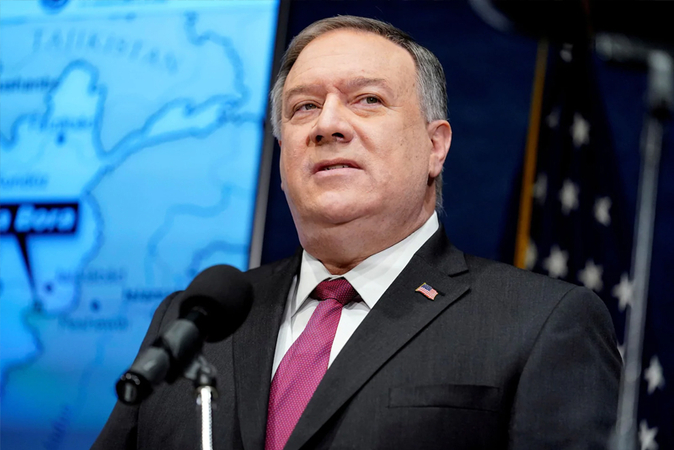
TAIPEI, Taiwan – China on Thursday fired a parting shot at the Trump administration by announcing unprecedented sanctions against outgoing Cabinet officials and advisers, including former secretary of state Mike Pompeo, as it extended a rhetorical olive branch to newly installed President Joe Biden.
But whether – or how – Biden would respond and seek to repair relations between the world’s two leading powers remains a key unknown in Beijing, where commentators and state media greeted the new U.S. presidency with tepid optimism and some concern.
Referring to Biden’s inauguration as a “new day” for America, Hua Chunying, a Foreign Ministry spokeswoman, called on the Democratic administration to turn a page from the “particularly difficult” past four years and renounce the all-fronts pressure campaign that defined Trump’s China policy.
“The Trump government, particularly Pompeo, buried too many mines that need to be removed, burned too many bridges that need to be rebuilt,” Hua said in lengthy remarks on Thursday as she appealed for a reset. “With joint hard work from both sides, the better angels of U.S.-China relations can defeat evil forces.”
But China’s first act of the Biden era, announcing sanctions against Republicans while Biden’s inauguration ceremony was in full swing at the U.S. Capitol, immediately fell flat. Minutes after Biden became president, the Foreign Ministry announced sanctions against Pompeo, former national security aides Robert O’Brien and Matthew Pottinger and 25 other Americans and their families who would be prohibited from traveling to China – including Hong Kong and Macao – or conducting business with the country.
The Biden White House criticized the sanctions and called for American unity to compete against China.
“Imposing these sanctions on Inauguration Day is seemingly an attempt to play to partisan divides,” Emily Horne, Biden’s National Security Council spokeswoman, said in a statement Wednesday. “Americans of both parties should criticize this unproductive and cynical move. President Biden looks forward to working with leaders in both parties to position America to out-compete China.”
The tough response follows high-level appointments and statements in recent days that have raised concerns in Beijing about whether the Biden team would in fact reverse course on China policy, as some have hoped.
At his Senate confirmation hearing this week, Antony Blinken, Biden’s nominee for secretary of state, said he agreed with Pompeo’s assessment that Chinese government abuses in the Xinjiang region amounted to “genocide” and added that he believed China poses the greatest threat of any foreign nation to the United States. Avril Haines, Biden’s director of national intelligence, said she supported a “more aggressive stance” toward Beijing compared with the period under President Barack Obama.
The Communist Party-controlled Global Times newspaper noted after the inauguration that Biden did not mention China in his speech, nor did he offer signals about whether and how he would seek a thaw with Beijing. In a commentary, the paper expressed concerns about Blinken’s remarks in his confirmation hearing and pointed out that the Biden team invited Taiwan’s envoy to Washington to attend a presidential inauguration for the first time. China claims Taiwan as its territory and objects strenuously to diplomatic interactions between Washington and Taipei.
“American society’s favorable views toward China have indeed declined in the past four years,” the commentary noted as it asked Biden to not succumb to growing anti-China popular sentiment.
Wang Huiyao, president of the Center for China and Globalization and an adviser to China’s State Council, said “structural challenges” between Beijing and Washington will continue, and Chinese officials were still reeling from Pompeo’s pressure campaign.
“The contradictions will continue to exist, and they will not disappear, but the Biden administration will not be as crazy and irrationally play cards like Trump,” he said. Wang added that it would take time for the distrust to melt away. “If the Biden administration sends more goodwill, then China would also respond more actively.”
Before departing office this month, Pompeo announced a range of measures against China, including the Xinjiang genocide designation and sanctions against Chinese and Hong Kong officials involved in Hong Kong’s national security crackdown. He also lifted State Department restrictions that prevented meetings between U.S. and Taiwanese diplomats.
In its parting shot, China said Thursday its sanctions would also target Peter Navarro, the economic adviser who advocated for Trump’s trade war, as well as three former senior officials who expressed support for Taiwan over the past eight months: Health and Human Services Secretary Alex Azar; Keith Krach, an undersecretary of state; and the ambassador to the United Nations, Kelly Craft. Azar and Krach flew to Taiwan on official visits; Craft was scheduled to visit but her flight turned around in midair and she conducted meetings by videoconference instead.
Former president Donald Trump and his family members were not named in the ministry’s statement, but it did name former national security adviser John Bolton, who left the White House amid acrimony in 2019, and former White House strategist Stephen Bannon, who was pardoned by Trump this week after being charged with defrauding political donors. The Chinese government declined to disclose most of the 28 names.
Chinese banks are not as central to the global financial system as U.S. banks, so the effects of the Chinese sanctions are probably not as far-reaching as those levied by Washington against Chinese or Beijing-backed officials over Hong Kong and Xinjiang. But Beijing’s announcement could impose real costs on former officials who return to the business world, and they present travel hurdles if any returned to government service.
Bull Piano, an online column associated with the official Xinhua News Agency, said the sanctions were meant to send a signal to future U.S. politicians who might have business dealings in China.
“Don’t think about playing the China card while in power if you want to eat Chinese food after you step down,” the columnist wrote. “If you mess around, there will be payback.”
By The Washington Post · Louisa Loveluck, Mustafa Salim
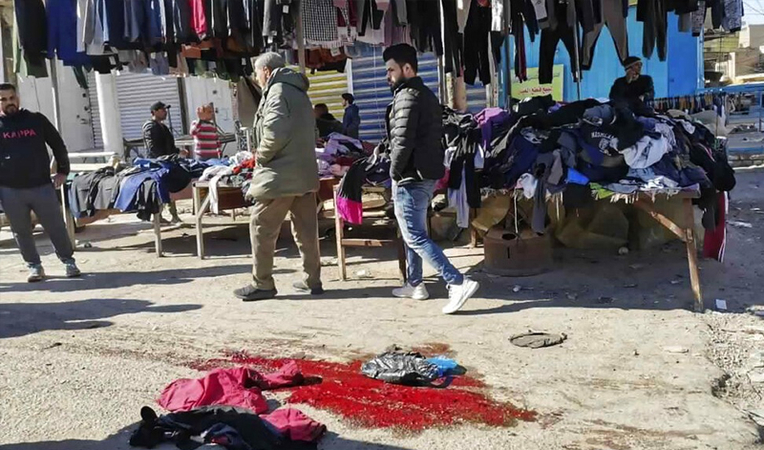
BAGHDAD – Rare twin suicide bombings struck a market Thursday in central Baghdad, killing at least 32 people and injuring 110 more, according to Iraq’s Health Ministry.
The blasts came midmorning as people were shopping for secondhand clothes at a market in Tayaran Square. Video footage showed the second explosion ripping through the air as sirens blared and casualties were raced away in motorized rickshaws. Other images from the scene showed bodies strewn on the ground amid upturned tables and piles of unsold jackets.
There was no immediate claim of responsibility for the attack. Although security forces continue to fight ragtag bands of Islamic State militants in Iraq’s peripheral regions, major security incidents in the capital are rare. Thursday’s attack was the deadliest to strike the capital in years. The last mass-casualty attack, striking the same square, took place in January 2018 and killed 27 people.
Khalid al-Mahna, a spokesman for the Interior Ministry, said the suicide bomber detonated his explosives after attracting a crowd by feigning sickness in the middle of the market.
When shoppers came to help those injured by the first blast, he said, someone else detonated a second bomb.
Thursday’s attack shattered a sense of relative security in the capital, raising questions about the Iraqi security forces’ preparedness in the face of a militant threat that has been diminished but by no means erased. Army units and special forces continue to arrest alleged Islamic State members at their homes in urban centers and say that sleeper cells remain prepared to mount strikes.
In a statement, an Iraqi military spokesman, Yahya Rasool, said the bombers detonated their explosives as they were pursued by security forces. Rasool said his unit had received information suggesting that an attack was coming. No uniformed security forces appeared to be visible in the surveillance video footage that showed the first blast.
Although a security breach in the heart of Baghdad is rare, experts cautioned that Thursday’s attack underscored the challenge of ending militant violence without far-reaching changes to how the country is governed.
“This is not to say that this is the beginning of extreme conflict in Iraq, or violence, but it is a reminder that there is yet to be a sustainable solution to govern the socio-economy and politics of Iraq,” said Renad Mansour, a senior research fellow at Chatham House’s Middle East and North Africa Program. “As long as there’s that incoherence, I think we expect, sadly, for these attacks to continue and increase in time because we’re just looking back as to what happened before under a similar context.”
The attack occurred at a time when life for ordinary Iraqis is becoming harder. The coronavirus pandemic has tanked global energy prices, plunging Iraq’s oil-dependent economy into crisis and forcing a devaluation of the currency. Unemployment has increased. The price of basic goods is rising, too.
While street cleaners swept blood from scene, families combed the site for relatives last seen there. Ahmed Qassim, 32, showed street vendors a photograph of his 20-year-old cousin, Abdullah, who was last seen peddling T-shirts. They said he had been taken away in an ambulance.
An elderly man with gray hair and spectacles wandered confused and distraught along a street leading to the marketplace. “Where is my son?” he shouted. “He’s just a kid who sells sunglasses and wants to live. Where is he?”
As he walked, young men were sifting through piles of clothes for body parts. For a moment, a teenager crouched to lay out candles for the dead. “We’re still looking for bodies, man,” a friend chided him. The teenager was stone-faced. “We got used to death,” he replied, as he lit the wicks one by one.
Compounding Iraq’s multiple crises, the country has also emerged again as a stage for geopolitical tensions, with Iran-backed Shiite militias launching rockets at U.S. diplomatic and military-linked targets and U.S. forces responding with airstrikes.
Three Americans and one Briton have been killed in those attacks. But for the most part, the dead and injured have been Iraqis caught in the crossfire.
After the Islamic State’s battlefield defeat here in 2017, the United States is reducing its troop presence to 2,500, with most of those performing advisory functions as the Iraqi military takes the lead in what remains of the fight.
“ISIS will be trying to make this part of a campaign to disrupt daily life and show it is still relevant and able to carry out extreme violence despite its territorial defeat,” said Sajad Jiyad, an Iraq-based fellow at the Century Foundation.
“Attacks hark back to painful memories when attacks on civilians were common. The government needs to restore confidence quickly and show it will not allow ISIS bombings to become a regular occurrence again.”
As the winter sun set Thursday, the funerals began. In a narrow alleyway by Tayaran Square, shock and anger were palpable. Young men held coffins aloft. Among the dead was a 32-year-old named Maher al-Swerawi, who died in the first explosion. His friend Hani Sabri ran out to reach his body, friends said. Sabri, who was 30, was killed in the second blast.
As the crowd moved along, one voice rang out above the din. It was Sabri’s mother.
“Hani, I told you not to go. Why did you go there?” she cried, her voice breaking.
European leaders, struggling with a slow vaccination effort and fearful that highly contagious coronavirus variants could rapidly overwhelm their medical systems, moved Thursday to begin reimposing border restrictions and to speed the distribution of vaccines – even those not yet been approved for use.
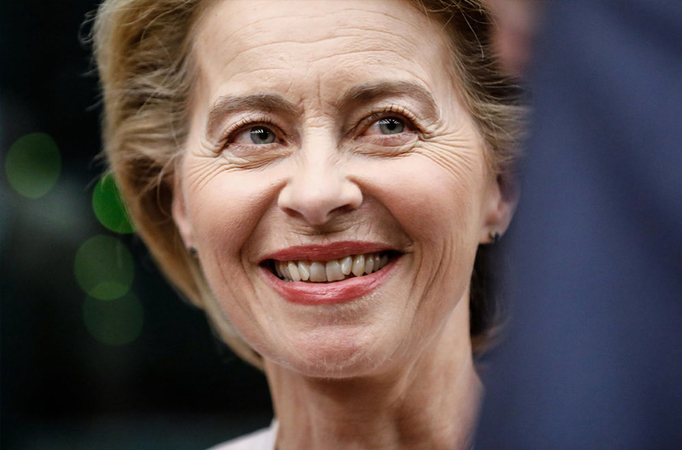
“We are increasingly concerned about different variants of the virus,” European Commission President Ursula von der Leyen told reporters after a virtual summit of European Union leaders, saying that though the bloc intends to keep borders open for trade, it may restrict nonessential travel.
The leaders held back from endorsing a specific plan for borders. But Germany – which as the richest and most populous EU member often drives its discussions – proposed strict, temporary bans on travel to the EU from countries where mutated forms of the coronavirus are already prevalent, including Britain. The proposal would restrict EU citizens from returning to their home countries if they are currently in an affected country, and would therefore be more stringent than previous border measures.
German Chancellor Angela Merkel said Thursday that sharp action was necessary in the face of more transmissible strain first identified in Britain.
“I can’t stress this strongly enough: We need to slow down the spread of this mutant virus, we mustn’t wait until this virus flares up here and is reflected in explosive new numbers,” she told reporters before the EU discussion. “We’d have a stronger wave of the virus, probably stronger than anything we’ve seen so far.”
The leaders also agreed to begin distributing doses of AstraZeneca’s coronavirus vaccine across Europe, so rollout can start as soon as that vaccine is approved, possibly around mid-February. Though Britain is already administering AstraZeneca inoculations, European and U.S. regulators have questioned whether there is enough data to show they are effective among older people.
Until now, the EU has focused on a rapid but by-the-book medical authorization process to build public confidence in the safety of the vaccines. But some countries are pushing the bloc’s medical regulator to move faster.
“We are working with other EU countries for the fastest possible, unbureaucratic approval of @AstraZeneca and other vaccines,” wrote Austrian Chancellor Sebastian Kurz, on Twitter, during the leaders’ summit.
The European Commission earlier this week set a goal that 70% of EU residents would be vaccinated by the summer – an ambitious effort that, despite efforts to remain united, may ultimately highlight disparities among member countries.
The pace of vaccinations already has varied sharply among countries, even though they all got access to the Pfizer and Moderna vaccines simultaneously. Denmark has administered 3.2 doses for every 100 residents. The Netherlands has only given out 0.6 doses for the same number.
The 70% goal struck some public health experts as overly aspirational.
In France, “we would need to vaccinate at least twice as fast as now,” said Odile Launay, an infectious diseases specialist at the University of Paris and a member of the committee advising French authorities on vaccine strategy. “And the other question: will 70 percent of the population want to get vaccinated?”
Hours before Thursday’s meeting, Hungary announced it was breaking with the other 26 members of the EU to authorize both the AstraZeneca and Russian-made Sputnik vaccines within its borders. The country’s national regulator said that it would maintain careful testing of the Sputnik vaccine, but that because the AstraZeneca inoculation was already approved in Britain, no further tests for that one were necessary.
The EU approves vaccines as a bloc, but individual countries can offer emergency authorizations. The Hungarian move may create pressure on other countries to follow suit, although many EU leaders have said that a unified strategy will be the most effective, because it will build the most confidence across the union of 450 million people.
By Syndication Washington Post, Bloomberg · Kurt Wagner, Peter Martin
Twitter has locked the official account for the Chinese Embassy to the U.S. after a post that defended the Beijing government’s policies in the western region of Xinjiang, where critics say China is engaged in the forced sterilization of minority Uighur women.
The tweet, which said Uighur women were no longer “baby-making machines,” was originally shared on Jan. 7, but wasn’t removed by Twitter until more than 24 hours later. It has been replaced by a label saying, “This tweet is no longer available.” Even though Twitter hides tweets that violate its rules, it still requires the account owner to manually delete the post in order to regain access to the account.
The account is still locked, a Twitter spokesman confirmed, meaning the Chinese Embassy has not deleted the tweet. The Chinese Embassy account, @ChineseEmbinUS, has not posted since Jan. 8, having published at least a dozen more tweets after the one breaking Twitter’s rules.
“We have taken action on this Tweet for violating our policy against dehumanization,” a Twitter spokesman said in a statement. Twitter prohibits the “dehumanization of a group of people based on their religion, caste, age, disability, serious disease, national origin, race, or ethnicity.”
Chinese Foreign Ministry spokeswoman Hua Chunying on Thursday said authorities were “puzzled” about why Twitter restricted the account, calling it the embassy’s responsibility to correct “fake reports and information related to Xinjiang.”
“We hope Twitter can adhere to objective and fair principles and not display double standards on this issue,” she said at a briefing in Beijing.
The move is the latest in a series of escalating steps Twitter has taken in recent weeks to enforce its policies. The suspension of the Chinese Embassy account came shortly after Twitter permanently banned Donald Trump’s account for repeated rules violations, and potentially complicates Beijing’s efforts to reset relations with the U.S. under President Joe Biden.
On Tuesday, then-acting U.S. Secretary of State Mike Pompeo said that China’s actions against Uighur minorities amounted to “genocide,” a label that his successor Antony Blinken agreed with during his confirmation hearings this week. China has maintained that it is fighting separatism and extremism in the region, where the United Nations has estimated up to 1 million Uighurs may be held in camps.
The decision to suspend the Chinese Embassy account also adds to an already complicated relationship between U.S. tech companies and China. Large social platforms like Twitter, Facebook Inc. and Alphabet Inc.’s Google and YouTube are all banned in China, which has some of the world’s strictest controls on the internet. Trump, meanwhile, had previously demanded that Chinese startup ByteDance Ltd. spin off its successful video service TikTok in the U.S.
China’s embassy in Washington joined Twitter in 2019 in the midst of heated trade talks between the countries, as more Chinese officials started using the platform to aggressively defend Beijing across the world in what has become known as “Wolf Warrior” diplomacy. Chinese officials and state-run media have used Twitter to accuse the U.S. of hypocrisy, particularly after a deadly riot at the Capitol earlier this month.
After the Chinese Embassy in Sri Lanka’s account was suspended last year, it argued its “freedom of speech” must be honored, even though Twitter posts are blocked in the mainland.
Last month, Australian Prime Minister Scott Morrison demanded an apology after Foreign Ministry spokesman Zhao Lijian tweeted a fake photo depicting one of his nation’s troops holding a bloody knife to an Afghan child’s throat. Chinese social media platform WeChat subsequently deleted a post by Morrison after he made a direct appeal to the Chinese community promoting Australia as a “free, democratic, liberal country.”
In recent months China has moved to rein its own big tech companies, proposing antitrust policies in November that would give the Communist Party sweeping powers over some of the country’s most biggest corporations.
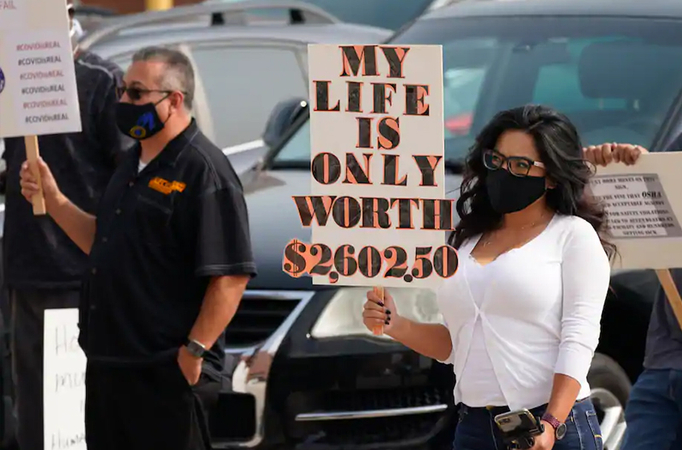
Jimena Peterson waves a sign during a protest outside the offices of the Occupational Safety and Health Administration in downtown Denver in September. The protest was staged by the union representing employees at a Colorado meatpacking plant where six workers died of covid-19 and hundreds more were infected this past spring. (David Zalubowski/ AP)
By The Washington Post · Eli Rosenberg
WASHINGTON – President Joe Biden signed an executive order Thursday to direct federal regulators to issue stronger safety guidance for workplaces operating in the midst of the pandemic.
The executive order on “Protecting Worker Health and Safety” seeks to reorient worker safety guidelines and enforcement at the Labor Department’s workplace safety division – the Occupational Safety and Health Administration.
It directs OSHA to update covid safety recommendations for businesses within the next two weeks, review its enforcement efforts, which have been sharply criticized during the pandemic, and study whether an emergency temporary standard, which businesses would have to comply with under the threat of penalties, is necessary. The agency must issued the emergency standard by mid-March, if so.
Such a standard could mandate mask-wearing and other requirements, including social distancing, hand-washing breaks and communication with workers during outbreaks.
The order marks an abrupt shift from the Trump administration’s more business and industry friendly approach, and signals a new emphasis on the plight of workers, including a focus on issues of race and equity, in the Biden administration.
“Ensuring the health and safety of workers is a national priority and a moral imperative,” Biden wrote in the order. “Healthcare workers and other essential workers, many of whom are people of color and immigrants, have put their lives on the line during the coronavirus disease 2019 (COVID-19) pandemic….The Federal Government must take swift action to reduce the risk that workers may contract COVID-19 in the workplace.”
Worker advocates hailed the executive order, saying it was the first step in reorienting OSHA toward more stringent safety protections.
“It will precipitate a 180,” said Debbie Berkowitz, an OSHA official during the Obama years who has been pushing for the agency to more actively monitor workplaces for coronavirus-related safety issues during the pandemic.
Under President Donald Trump, OSHA’s relatively lax enforcement of workplace safety guidance during the pandemic was a constant source of frustration for unions and worker advocates, as workplaces proved to be a significant source of outbreaks.
The agency declined to issue an enforceable standard for workplaces, and instead issued guidance weakened by phrases including “if feasible” and “when possible.” OSHA was slow to issue penalties for violations under its existing statutes – and when it did, some of those penalties amounted to little more than a slap on the wrist.
JBS, a multibillion-dollar meatpacking company, was given a $15,600 fine in September after 290 workers tested positive for the virus and six died at a plant in Colorado, for example. Smithfield, another large meat processing company, was given a $13,500 fine after 1,294 workers at a plant in Sioux Falls, S.D., tested positive for the coronavirus and four died.
Biden’s executive order also calls for OSHA to train its enforcement apparatus on outbreaks like those – calling for a “national program to focus OSHA enforcement efforts related to COVID-19 on violations that put the largest number of workers at serious risk or are contrary to anti-retaliation principles.” It also directs the Department of Labor to conduct a multilingual outreach program about the efforts, to better publicize them, seeking to address another long-standing complaint about the Trump administration’s response.
Labor law experts had expected the Biden administration to move forward with an emergency temporary standard for workplaces during the pandemic as part of its work combating the public health crisis, while using the executive branch to give workers more power.
During his campaign, Biden called for worker protections ranging from a $15 minimum wage, more leeway to organize and collectively bargain, and the classification of gig workers as employees.
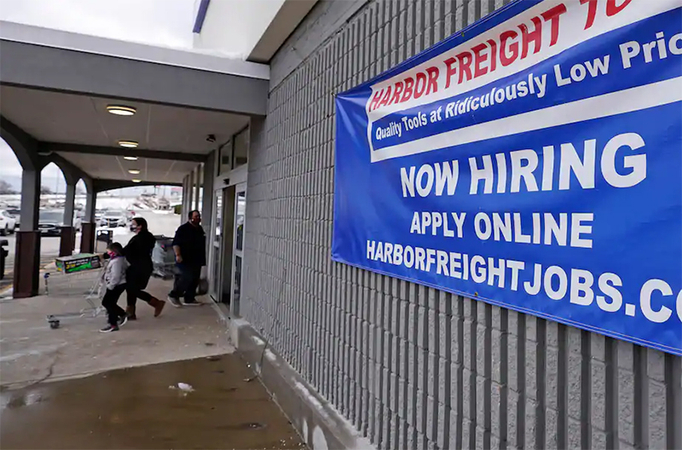
A “now hiring” sign hangs on the front wall of a Harbor Freight Tools store in Manchester, N.H., in December. (Charles Krupa/ AP)
By The Washington Post · Eli Rosenberg
Another 900,000 people filed new unemployment claims last week, President Donald Trump’s last in office, a snapshot of the significant labor market challenges facing President Joe Biden.
An additional 423,000 people in 47 states filed new claims for Pandemic Unemployment Assistance, the program created to help gig and self-employed workers.
Altogether, nearly 16 million people were claiming benefits as of Jan. 2, the last week available for that measurement. That number is expected to increase in the coming weeks as people who were dropped from the unemployment rolls after their benefits expired file new claims to take advantage of the extension passed by Congress at the last minute in December.
The number of new unemployment claims filed each week has remained above the pre-pandemic record of 695,000 since coronavirus cases starting rising in March. Jobless claims have also risen in recent weeks.
Economists have cautioned about reading too deeply into the weekly fluctuations of the statistic, noting that issues with data processing and duplicate claims have at times inflated the numbers.
Still, the benchmark paints a dire portrait. Weekly jobless claims are now near what they were at the beginning of September. It’s the 44th straight week that initial claims remain higher than the worst week of the Great Recession.
Biden inherits one of the worst job markets of any modern president, with the country’s unemployment rate at 6.7 percent and nearly 10 million fewer people with jobs than at the beginning of last year, as the pandemic has wreaked havoc on industries like tourism, hospitality and food service.
Biden is calling for a $1.9 trillion stimulus measure that would extend unemployment payments and benefits beyond March, give out $1,400 checks and provide hundreds of millions of dollars to small businesses as well as state and local governments that are struggling.
Biden’s unity plea is met with reminders that divisions run deep
InternationalJan 21. 2021Danny Meehan holds a protest sign as he and Pamela Meehan walk past members of the news media outside the Arizona Capitol in Phoenix on Wednesday, Jan. 20, 2021. MUST CREDIT: Photo for The Washington Post by Courtney Pedroza
By The Washington Post · Eva Ruth Moravec, Christine Spolar, Austyn Gaffney, Carissa Wolf, Griff Witte · NATIONAL, POLITICS
AUSTIN, Texas – They had lost a sister to covid-19 and watched in horror as the Capitol of the nation their father had immigrated to was trashed by white supremacist rioters.
A supporter of Donald Trump protests outside the Arizona Capitol in Phoenix on Wednesday, Jan. 20, 2021. MUST CREDIT: Photo for The Washington Post by Courtney Pedroza
So when Norma and Sylvia Luna – both Texas teachers – heard Kamala Harris take the oath of office to become America’s vice president on Wednesday, the tears flowed.
“It brings me hope, just watching this. It makes me proud to be an American again,” said Norma Luna, 49, who wore a Biden/Harris mask, Converse sneakers and a string of pearls as she watched the inauguration festivities on a smartphone at the Texas Capitol.
“We feel like we can breathe again,” added Sylvia Luna, 43.
Yet their cause for celebration was a source of angst elsewhere on the Texas Capitol grounds. To Jacob, who came sporting a “TRUMP THAT” baseball cap, the presidency had just been handed to the wrong man after a fraudulent election. “There were just too many inconsistencies,” said the 33-year-old, who declined to give his last name.
The theme of Joe Biden’s inauguration was “America united.” But in the nation’s 50 state capitals – the laboratories of American democracy – there were ample reminders that divisions run deep.
Victoria Walker attends an Inauguration Day event at Manuel’s Tavern in Atlanta on Wednesday, Jan. 20, 2021. MUST CREDIT: Photo for The Washington Post by Kevin D. Liles
The attitudes of those who showed up – either to joyously celebrate or to bitterly protest – were not the only evidence. The National Guard troops, armored Humvees and chain-link fences that surrounded many capitol complexes were added proof that toxic America’s partisanship has recently bled into violence – and could do so again.
“There is a general threat to all 50 state capitols,” said Colorado Gov. Jared Polis, a Democrat, on inauguration eve as he became the latest state leader to activate National Guard troops. Thousands had been deployed to capitals across the country late last week, ahead of a weekend in which potentially violent demonstrations were predicted by the FBI – but never materialized.
Once again on Wednesday, security officials’ worst fears were not borne out: In some states, it was close to business as usual. In others, demonstrations were small and peaceful, with occasionally tense moments.
At Colorado’s Capitol complex in Denver, dozens of “anti-fascist” demonstrators burned an American flag and yelled epithets at police, forcing officers to temporarily withdraw. In Portland, police used smoke bombs during a confrontation with far-left activists. And in Tallahassee, Fla., a Trump supporter and a Biden backer screamed at each other.
“It shouldn’t be like that,” said Molly Siddall, 18, after verbally sparring with a Trump supporter who yelled discredited conspiracy theories about Democrats and pedophilia. “That’s the problem with this country.”
Yet in a nation where the national Capitol was ransacked two weeks ago, the lack of significant strife Wednesday counted as an important step as Biden attempts to turn down the national temperature.
“His aim is to unify us,” said Willy Stokman, a lone demonstrator on an otherwise deserted Utah Capitol lawn in Salt Lake City on Wednesday. “I am hopeful that people and politicians take him up on that, because it doesn’t have to be so divisive.”
In one of the nation’s most evenly split states – Pennsylvania, which voted narrowly for Biden in 2020 after Trump eked out a victory four years earlier – security was tight Wednesday at the Capitol in Harrisburg. But the scene was calm.
Police on horseback and National Guard troops were positioned around the perimeter of the 10-block complex. On the Capitol steps, several Biden supporters waved U.S. flags and signs as a smattering of passing vehicles honked their approval. A lone Trump supporter wore a robe with the words “Impeach China Joe” affixed to it.
Matt Convery, 41, of Wallingford, said he had hoped to take his family to Washington for the inauguration but scrapped that plan after the insurrection on Jan. 6. He said he came out in the bitter cold with his sign reading “Biden” and “Truth over lies” because he watched the video of the Capitol siege and felt he needed to do something.
“I’ve never done anything like this, but wanted to do something for democracy,” he said. “It feels good.”
Across the street, Liz Albayero, 26, was behind the barista counter of the Fix Café, topping lattes with small, foamy pictures of Kamala Harris that she had found on Instagram. It was her own little way to celebrate.
“It’s so amazing to see a woman there,” said Albayero, who came to Harrisburg from her native El Salvador as a student five years ago. “I feel a part of it with her.”
Albayero, who watched on the shop’s television as the inauguration played out, said she is studying for her citizenship test and plans to vote in the next presidential race. She said she is a Harris fan – but Biden’s history is an inspiration, too. “He never gave up – no matter what happened in his life,” she said.
When Jennifer Lopez broke out in Spanish, she laughed, and when Garth Brooks sang “Amazing Grace,” she hummed along.
“This kind of represents the opposite of the last administration,” Albayero said. “I’m a minority and the last administration made me feel like I didn’t matter. It didn’t represent me.”
In Kentucky’s capital, Frankfort, Roger Abner was narrating a different experience. The candidate he had backed, Trump, was jetting to Florida after leaving the White House. And Abner was wondering why there were not more of the 45th president’s fans around to show their support.
“We feel like we don’t have a voice anywhere else since they closed off social media,” said Abner, a 29-year-old construction worker, as he stood outside a heavily guarded Capitol complex. “We actually expected a lot more people like us to be up here,”
Instead there were a few, including Abner and his childhood friend, Curtis Pavlik, 27.
Pavlik, a truck driver, wore a green T-shirt with the letters LGBT – which in this context, the shirt made clear, stood for Liberty, Guns, Beer and Trump. He carried a long steel pole with an American flag obscured by a yellow “Don’t tread on me” Gadsden-flag insignia. The response to the Jan. 6 riot – including attempts to shut down far-right social media networks – had, he said, “instilled fear into quite a few people and that’s why you don’t see a big crowd here.”
Both men had voted for Trump each time he ran, but neither approved of the Capitol riot. “There’s nothing to gain there. You have no plan to take over the government. You couldn’t if you wanted to,” Abner said.
And Pavlik said he will be rooting for Biden’s success.
“I’m not going to wish for him to fail,” he said. “I want him to do what’s good for the country. Do I think that’s what’s going to happen? Absolutely not. Do I want that to happen? Of course.”
Other Trump supporters appeared less interested in conciliation.
At Georgia’s Capitol, Rhonda Beach watched on a smartphone as a president she regards as illegitimate was sworn in.
“All of it was compromised. Every bit of it,” said the 50-year-old. “They didn’t even try to hide that they were stealing it.”
As she spoke, hundreds of police and National Guard members stood watch, having shut down streets for several blocks.
At other capitols, the security presence was barely visible. In Boise, Idaho, normal legislative work went on, undisturbed by any threats to the democratic order.
Steve Ellefson was determined to keep it that way.
“I’ve got to ring this bell!” Ellefson, 70, said as he tried to put all of his weight behind a large bell inscribed with the word “liberty.”
Ellefson sat alone near the Idaho Capitol when the clock struck noon, Eastern time. He could not quite push the bell hard enough to make it ring, but he still celebrated for a moment with praise for the Bidens. He also stood ready to serve his country.
“I am here to protect the Capitol from insurrectionists,” he said.
He had watched the Jan. 6 riot with tears in his eyes, and decided he could help protect Idaho’s legislature from a similar fate. With no threats – or even other people – to be seen, the retired bail bondsman concluded Wednesday that he probably would not be needed. But he was ready, he insisted as he thumbed the pages of a book, any time that changed.
“I’ve got a flashlight, an apple, potato and three cans of pop,” he said, “so if I have to fight, I’ll fight.”
By Syndication Washington Post, Bloomberg · Naomi Kresge, Janice Kew
Pfizer and BioNTech built the case that their Covid-19 vaccine will protect against the new variant of the coronavirus that emerged in the U.K. with results of another lab trial.
Like previous work out of the University of Texas Medical Branch, the results published on Wednesday showed that antibodies in the blood of people who had been vaccinated were able to neutralize a version of the mutant virus that was created in the lab. The study was published on preprint server BioRxiv prior to peer review.
Unlike the earlier study, which focused on one crucial mutation, the new research tested all 10 mutations located on the virus’s spike protein, which helps it bind to cells in the host.
Antibodies in the blood of 16 volunteers in a previous German trial of the vaccine were just as effective against the lab-created mutant strain as they were against the original virus. The result “makes it very unlikely that the U.K. variant viruses will escape” protection from the vaccine, wrote the research team, led by BioNTech Chief Executive Officer Ugur Sahin.
The BioNTech team is nevertheless ready to adapt the vaccine if needed in the future, it said. That could become necessary to protect against other strains amid evidence another variant that emerged in South Africa may be harder to check.
A separate study on that strain raised concern. Scientists found that half of the blood samples from a handful of patients who already had Covid-19 don’t have the antibodies needed to protect against the South African variant, which is spreading around the globe.
The findings, from South Africa’s National Institute for Communicable Diseases, suggest that those individuals may no longer be protected from re-infection. In the other half, antibody levels were reduced and the risk of re-infection couldn’t be determined, according to the institute. The findings weren’t peer-reviewed and were based on a small sample size.


 Danny Meehan holds a protest sign as he and Pamela Meehan walk past members of the news media outside the Arizona Capitol in Phoenix on Wednesday, Jan. 20, 2021. MUST CREDIT: Photo for The Washington Post by Courtney Pedroza