Jack Ma emerges for first time since Ant, Alibaba crackdown
InternationalJan 21. 2021A livestream of Jack Ma, co-founder of Alibaba Group, addressing teachers at an annual event he hosts to recognize rural educators, is recorded from a laptop computer in Hong Kong, on Jan. 20, 2021. MUST CREDIT: Bloomberg photo by Justin Chin.
By Syndication Washington Post, Bloomberg · Lulu Yilun Chen, Coco Liu
Jack Ma resurfaced for the first time since China’s government began clamping down on his business empire nearly three months ago, appearing in a live-streamed video that sent Alibaba Group’s stock soaring but left plenty of unanswered questions about the billionaire’s fate.
Ma spoke briefly on Wednesday during an annual event he hosts to recognize rural teachers. In one video of the event circulated online, China’s most famous entrepreneur can be seen touring a primary school in his hometown of Hangzhou. Ma, who had stayed out of public view since regulators suspended the initial public offering of his fintech company Ant Group, told the teachers he’ll spend more time on philanthropy. He didn’t mention his run-ins with Beijing.
Ant confirmed the authenticity of the video, first posted on an online blog, but declined to comment further.
Speculation about Ma’s whereabouts and his standing with President Xi Jinping’s government had reached a fever pitch in recent weeks, after regulators ordered Ant to overhaul its business and began an antitrust investigation of Alibaba. Beijing’s crackdown followed an October speech by Ma in which he infamously rebuked “pawn shop” Chinese lenders, regulators who don’t get the internet, and the “old men” of the global banking community.
Ma’s comments on Wednesday struck a much different tone, echoing themes espoused by the ruling Communist Party. A former English schoolteacher, he spoke about the importance of reviving China’s countryside and narrowing income disparities by encouraging the return of younger talent to rural areas.
“Recently, my colleagues and I have been studying and thinking. We made a firmer resolution to devote ourselves to education philanthropy,” Ma said during the event. “Working hard for rural revitalization and common prosperity is the responsibility for our generation of businessmen.”
While Ma’s exact whereabouts remain unclear, his emergence in a public forum may help quell some of the more dire rumors about his fate in a country where media coverage is often tightly choreographed. Among the earliest outlets to report on his video address was an online news outlet backed by the Zhejiang provincial government.
Ma had kept out of public view since regulators in November scuttled Ant’s $35 billion IPO, tightened fintech regulations and launched a separate probe into Alibaba — all in a span of weeks.
“Jack Ma’s unexpected re-emergence — just as sudden as his earlier disappearance — is likely a sign that his relationship with Beijing’s regulatory authorities has stabilized,” said Brock Silvers, a managing director at private equity fund Kaiyuan Capital in Hong Kong.
But Ma probably isn’t out of the woods, Silvers added. “A path acceptable to all parties may have been identified, but Ant Group still looks likely to be dis-aggregated and regulatory restrictions will almost surely take a significant bite out of Ant’s former valuation.”
The clampdown on Ma’s empire is part of a broader campaign to rein in a generation of Chinese tech giants that Beijing views as wielding too much control over the world’s second-largest economy.
The government has increasingly sought to exert influence over the extent to which companies from Tencent Holdings to ByteDance amass data and direct commerce and media. The same month Ant’s IPO was scuttled, the nation’s top antitrust watchdog published new guidelines warning tech giants against monopolistic practices from forced exclusive arrangements to collusion on data. While Ant and Alibaba have borne the brunt of that assault since November, investors have since sold off peers from Tencent to Meituan. Both stocks rallied more than 3% on Wednesday.
While Alibaba’s surge added about $58 billion to the company’s market value, Ma’s standing with Beijing remains unclear. As of early December, the man most closely identified with the meteoric rise of China Inc. was advised by the government to stay in the country, a person familiar with the matter has said. Debate about his whereabouts arose because Beijing has in the past quietly detained billionaires that have run afoul of the law, without immediate trial.
U.S. homebuilder confidence fell to a four-month low in January
InternationalJan 21. 2021Contractors install floor beams on the foundation of a house under construction in Lehi, Utah, U.S., on Dec. 16, 2020. MUST CREDIT: Bloomberg photo by George Frey.
By Syndication Washington Post, Bloomberg · Julia Fanzeres
U.S. homebuilder confidence slipped to a four-month low in January as firms became slightly less optimistic about sales against a backdrop of higher house prices and construction costs.
A gauge of builder sentiment fell to 83 from December’s reading of 86, National Association of Home Builders data showed Wednesday. The figure was weaker than the median forecast of 86 in Bloomberg’s survey of economists.
The second-straight decline in confidence shows the extent to which higher building materials costs, particularly lumber, and rising home prices tied to lean inventory are slowing momentum. Builders continue to face pandemic-related supply-chain challenges at the same time elevated asking prices hinder affordability, with many homes priced above what prospective buyers are willing to pay.
“While housing continues to help lead the economy forward, limited inventory is constraining more robust growth,” Robert Dietz, NAHB chief economist, said in a statement. “A shortage of buildable lots is making it difficult to meet strong demand and rising material prices are far outpacing increases in home prices, which in turn is harming housing affordability.”
A gauge of current sales fell to a three-month low, while measures of sales expectations in the next six months and prospective homebuyer traffic both declined to the lowest since August.
Confidence measures decreased across all four regions across the U.S.
InternationalJan 21. 2021The last few customers are seen on Saturday in Game Spot 21 in Shinjuku Ward, Tokyo. The arcade had been outfitted with plastic sheets as a preventive measure against the coronavirus. MUST CREDIT: Japan News-Yomiuri
By The Japan News-Yomiuri · Tomoki Masuda
Game arcades in Tokyo have been falling like dominoes amid the coronavirus pandemic, left no choice but to close after what for some have been decades in operation.
Despite growing demand for videogames now that the world has moved indoors, social distancing measures have caused foot traffic to plummet at brick-and-mortar “game centers,” commonly located in the city’s once-bustling downtown entertainment districts.
Arcade operators have been requested to shorten their business hours after the second state of emergency was declared for Tokyo and 10 other prefectures. Yet even if they comply with the request, arcades remain ineligible to apply for financial assistance, such as the government subsidies available to restaurants and bars.
Taking stock of the rapid succession of closures, regular customers lamented the loss of their favorite gaming haunts.
For over four decades, Game Spot 21 could be found a short walk from the west exit of JR Shinjuku Station. Nestled among a hodgepodge of multitenant buildings jostling for space along a cramped side street, the arcade was always announced by the frenzied chirping of claw crane games that lined its entrance.
But in recent months, a profusion of plastic partitions had joined the nearly 50 mahjong and fighter game machines in the dimly lit interior as a sign of the times.
On Saturday afternoon, a dozen regular customers who were undeterred by the pandemic peered intently at their monitors. The well-known arcade beloved by generations of gamers was to close at midnight on Wednesday.
“Given the circumstances, we had no other choice,” said Naoki Ichiki, 42, the arcade’s manager and longtime employee of nearly 20 years.
In the 1990s, Game Spot 21 would have been packed with enthusiasts trying their hand at Sega’s popular “Virtua Fighter” title. During the arcade’s heyday, it had around 100 machines, and drew over 500 patrons daily.
Hit hard by the pandemic, attendance dropped to 10%. As sales also fell by 70%, the operator decided it was finally time to pull the plug for good.
“After the first state of emergency was declared, we closed the arcade for about two months as a temporary step. But our customers never came back,” Ichiki said. He added that the extra scrutiny placed on Shinjuku during the pandemic as a “nightlife district” likely also had an adverse impact on business.
Yasuhiro Tsuji, 55, who runs a real estate company in Shibuya Ward, Tokyo, said he had been a frequent customer of the arcade from his teenage years, and expressed his disappointment about the closure.
“I’ve been coming here ever since the Space Invaders days and always felt a zing of excitement on each visit. This arcade was somewhere I could relieve stress and reset whenever I needed a breather. It’s a shock to see this place go.”
Takashi Noguchi, a self-employed 43-year-old from Shinjuku Ward, was similarly a regular presence for over 20 years. “I enjoyed chatting with the other regulars here between games. This place was like a candy store for adults,” he said.
Ineligible for financial support
Game arcades have felt a pinch in recent years, threatened by the unabated march of home video consoles, online gaming and smartphones. According to the Japan Amusement Industry Association, there were 21,688 game arcades nationwide in fiscal 2008. That number was nearly halved to 12,167 in fiscal 2018.
The coronavirus has only exacerbated the ailing industry’s woes. Since last spring, a sizable chunk of the population has elected to stay at home, drastically reducing foot traffic.
Now that a new state of emergency was declared this month, certain businesses including game arcades and pachinko parlors have been asked to shorten their hours and close by 8 p.m., although they do not qualify for the up to ¥60,000 a day in “cooperation funds” promised to restaurants and other establishments.
Across town, a void opened in front of Akihabara Station last year with the successive closures of the Sega Akihabara 2nd store in August and the Adores Akihabara outlet in November. Later that month, Shinjuku Playland Carnival closed in the Kabukicho district, marking the end of nearly half a century of business.
Japan aims to vaccinate most of country before Olympics, report says
InternationalJan 21. 2021A pedestrian wearing a protective mask walks past an advertisement for the now-postponed Tokyo 2020 Olympic Games in Tokyo on Jan. 14, 2021. MUST CREDIT: Bloomberg photo by Toru Hanai.
By Syndication Washington Post, Bloomberg · Gearoid Reidy
Japan aims to vaccinate the majority of its population against covid-19 by July, according to a report, meaning most of its more than 125 million residents could be inoculated by the time the Tokyo Olympics are scheduled to begin.
The country plans to complete vaccination of 50 million people in high-priority tiers, including the elderly and health-care workers, by April, according to the Yomiuri newspaper, citing multiple unidentified people. Japan then plans to begin inoculation of the general public as early as May, depending on the availability of doses, the report said.
The Health Ministry could not confirm the report when contacted by Bloomberg News. Chief Cabinet Secretary Katsunobu Kato, the government’s top spokesman, said Wednesday that the government couldn’t announce a schedule before the country had approved a vaccine.
Taro Kono, who was appointed by Prime Minister Yoshihide Suga on Monday as minister in charge of the vaccine rollout, took to Twitter to pour cold water on the reports.
“The newspapers are all citing ‘government officials’ but they’re completely unfounded, and just guessing,” he wrote. “You’re better off not trusting them.”
Still, the Yomiuri report is an early indication of how Japan, which is facing its biggest wave of infections, may roll out vaccines to the general population. Suga has said he aims to begin the country’s vaccination program in late February starting with frontline medical workers.
The government has emphasized that vaccination is not a prerequisite for holding the Tokyo Olympics, which are scheduled to start in July following a year’s delay. Surging cases in Japan and elsewhere and new strains of the virus have cast doubt on the country’s ability to hold the games as planned.
The rollout laid out in the Yomiuri report would represent a hugely ambitious plan. Completing vaccination of the 50 million in the high priority tiers, including the elderly, medical workers and those with underlying conditions, would require more than 800,000 doses to be administered each day.
Such a plan would keep pace with an aggressive program in China, which in December set out to inoculate 50 million people against the virus in about a two-month span ahead of the annual Lunar New Year holiday. Other countries have also set goals to reach herd immunity, which occurs when a large portion of a community becomes immune to a disease.
South Korea’s president said this week the country may reach herd immunity by November at the latest. In the U.S., Anthony Fauci has said that level will likely happen during the summer, with a return to normality by the end of the year.
Japan, which has plans to provide vaccines free of charge, is working to approve Pfizer Inc.’s shot in the middle of February, Health Minister Norihisa Tamura said last week. Vaccines will not be given to the more than 18 million children under 16 until more trial data on that age group is available, according to the Yomiuri.
Japan has sealed a contract for about 144 million doses of the Pfizer/BioNTech vaccine this year, and will request the company to provide much of that supply by June, Tamura told reporters in Tokyo late Wednesday. Pfizer is the only company so far to have applied for emergency approval for its vaccine in Japan, but the country also has contracts with Moderna Inc., AstraZeneca Plc and Novavax Inc.
Japan’s plan faces many potential obstacles, among them a public cautious about receiving a vaccine so soon. An NNN/Yomiuri poll in December found that while most wanted to get the vaccine eventually, only 15% wanted to take it “soon,” with a further 15% responding they didn’t want it at all.
Biden to mend World Health Organization ties, Fauci to speak
InternationalJan 21. 2021The World Health Organization regional office for the Americas in Washington, D.C., on Aug. 26, 2020. MUST CREDIT: Bloomberg photo by Stefani Reynolds.
By Syndication Washington Post, Bloomberg · David Wainer, John Lauerman, Mario Parker
President-elect Joe Biden plans to take immediate steps Wednesday after he is inaugurated to re-engage with the World Health Organization and send top U.S. medical expert Anthony Fauci to speak to the group in a strong repudiation of Donald Trump’s snubs during the coronavirus pandemic.
The incoming administration plans to participate in the WHO executive board meeting this week, with Fauci, the top U.S. infectious disease expert, heading the delegation and speaking. Once the U.S. resumes its engagement with the WHO, the new administration will work with the body to strengthen and reform the group, according to a fact sheet released by the Biden transition team.
Trump announced in May that the U.S. would exit the WHO because of what he said was its undue deference to China and failure to provide accurate information about the coronavirus. He often blasted the organization and also has publicly belittled Fauci and diminished his role in past months.
In announcing these changes, Biden is underscoring that he intends to set a new science-based tone in seeking to reverse Trump’s dismissal of virus mitigation strategies and international cooperation in addressing the pandemic.
The U.S. had been the WHO’s largest contributor, providing $400 million to $500 million in mandatory and voluntary contributions, and Trump’s decision last year drew sharp criticism in Congress, as well as from allies in Europe. The WHO has been heavily involved in the fight against the coronavirus, especially in poor countries. The Geneva-based group said it looks forward to the participation of the U.S. delegation at Thursday’s executive board meeting.
Meanwhile, the president-elect said he would sign an executive order requiring masks and physical distancing in all federal buildings — including government office buildings — as well as on federal lands and by federal employees and contractors in an attempt to help stem the spread of the surging coronavirus. He said this will be part of a “100 days masking challenge” to get Americans to wear masks in public.
“This is not a political statement; this is about the health of our families and the economic recovery of our nation,” said Jeff Zients, who will be the new administration’s covid response coordinator.
Biden is expected to sign another order in coming days requiring masks on trains and planes, which also fall under federal jurisdiction.
The approach represents a reversal of the stance taken by Trump, who clashed with public health officials by at times casting doubt on the benefits of wearing masks and generally refusing to wear them himself.
During the campaign, Biden suggested he’d impose a national mask mandate, citing face coverings’ ability to slow the spread of the virus. But there’s no clear authority for a presidential order outside of areas controlled by the federal government. Biden later revised his approach to focus on federal property and interstate travel.
Biden faces a challenge in persuading Americans to wear masks after Trump and Republican officials across the country politicized their use.
On Tuesday, as U.S. deaths topped 400,000 in the world’s worst covid-19 death toll, Antony Blinken, Biden’s choice for secretary of state, signaled that a U.S. rift with WHO may be healing and that the U.S. would join Covax, the 92-nation collaboration seeking to deploy Covid-19 vaccines around the world. While the Trump administration has given some $18 billion to vaccine and drug development through Operation Warp Speed, it declined to participate in Covax.
“The combination of rejoining, taking part in Covax and looking at how we can help make sure the vaccine is equitably distributed is something we’re going to take on,” Blinken told the Senate Foreign Relations Committee during his confirmation hearing on Tuesday.
The program plans to distribute some 2 billion doses around the world by the end of 2021. WHO Director-General Tedros Adhanom Ghebreyesus, whose agency leads Covax along with the Coalition for Epidemic Preparedness Initiatives and Gavi, the Vaccine Alliance, has expressed concern that drugmakers are prioritizing wealthier countries for vaccine clearances and distribution. That could delay distribution through Covax.
U.S. participation could help shore up the vaccine-equity program. China is one of the partner nations, and although its vaccines are not among those procured by Covax, Chinese drugmaker Sinovac Biotech said it has submitted data on its shot for pre-qualification. The EU is also supporting the plan.
Biden instructs Education Department to extend pause on federal student loan payments through September
InternationalJan 21. 2021Joe Biden, then the presumptive Democratic nominee, appears in August with running mate Kamala D. Harris in Wilmington, Del. MUST CREDIT: Washington Post photo by Toni L. Sandys
By The Washington Post · Danielle Douglas-Gabriel
WASHINGTON – On his first day in office, President Joe Biden is asking the Education Department to extend the suspension of federal student loan payments through Sept. 30.
The move arrives days before the moratorium is set to expire at the end of this month. It makes good on Biden’s pledge to give borrowers some breathing room as the economy struggles to find its footing.
On a call with reporters Tuesday, Brian Deese, the incoming director of the National Economic Council, spoke of the struggles of many households, particularly Black and Latino families, to pay basic expenses and said that student loan debt is often weighed against the costs of food and housing.
“In this moment of economic hardship, we want to reduce the burden of these financial trade-offs,” Deese said.
To that end, consumer advocates and liberal lawmakers had hoped Biden would use executive authority to cancel some portion of the $1.6 trillion in outstanding student debt. Deese said the administration supports forgiving up to $10,000 in debt per person through congressional action.
The Democratic-controlled House passed legislation last year affording cancellation to borrowers through a stimulus package shelved by Senate Majority Leader Mitch McConnell, R-Ky.
Sen. Chuck Schumer, D-N.Y., the incoming majority leader, has been unwavering in his support for debt cancellation and could clear a path forward. That would be a formidable challenge given the slim majority Democrats will have in the Senate, but advocates say it’s not impossible.
In the meantime, about 41 million Americans will continue to benefit from the federal government’s pause of student loan payments.
“This is really important,” said Jessica Thompson, policy and research director at the Institute for College Access & Success. “It allows borrowers to take a sigh of relief, (and) get out of this cycle of being reliant on the current politics of the day determining whether they’re going to have to start paying again.”
When the Education Department approves Biden’s request, all borrowers with student loans held by the Education Department will see their payments automatically suspended until Sept. 30 without penalty or accrual of interest. Each month until then will still count toward loan forgiveness for borrowers in public-service jobs. It will also count toward student loan rehabilitation, a federal program that erases a default from a person’s credit report after nine consecutive payments.
Collections on defaulted, federally held loans are still halted, and any borrower with defaulted federal loans whose wages are being garnished will receive a refund. However, the directive still excludes more than 7 million borrowers whose federal loans are held by private companies or universities.
The Trump administration in March gave borrowers the option of postponing payments for at least 60 days as the coronavirus pandemic battered the economy. Congress later codified the reprieve in the stimulus package, known as the Cares Act, and made it automatic. The Trump administration twice extended the moratorium before leaving office.
Thompson said the latest extension will give the Education Department, the administration and Congress time to figure out how to successfully transition millions of borrowers back into repayment.
“It’s going to take a fair amount of thought to do this well, to do it carefully and to make sure we aren’t setting people up for failure or default when we try to kick-start payments,” Thompson said.
While many borrowers might have an easy time resuming payments, some will struggle to get back on track with their payments. Consistent and accurate information from the department and its contractors about options for people facing hardships will be essential to avoid a wave of defaults, Thompson said.
The Education Department reported a spike in people defaulting on their federal student loans in 2019 after exiting forbearance provided in the wake of natural disasters such as Hurricane Harvey and the California wildfires.
MOSCOW – Russian opposition leader Alexei Navalny wasted no time showing why the Kremlin finds him such a threat: From behind bars in a coronavirus isolation cell, he released a bombshell video accusing President Vladimir Putin of colossal corruption.
The YouTube video – released Tuesday less than 48 hours after Navalny returned to Russia in a direct challenge to Putin and his security services – crossed all Putin’s red lines.
It also underscores that Navalny and his supporters appear united and organized five months after the opposition leader suffered a near-fatal nerve agent poisoning he claims was ordered by Putin. The Kremlin denies the claim.
Protests by Navalny’s backers are planned across Russia on Saturday.
But videos and social media – anchored by his network of 40 offices across Russia – remain the core of Navalny’s opposition power, pointing out alleged abuses and indulgences by Russia’s leaders under Putin. Navalny’s election efforts back candidates with the best chances of ousting members of Putin’s party.
This time, the video pointed directly at Putin. It included a photo of teenager Elizaveta Krivonogikh, whom it claimed was the secret daughter Putin fathered with a lover. Navalny’s video also published an architectural plan and drone footage of a gigantic palace near Gelendzhik on the Black Sea, including a cellar winery, an indoor ice rink and a casino. The video alleged it was built for Putin using a complex “slush fund.”
“Putin’s palace: History of the world’s largest bribe,” viewed more than 25 million times, also named former gymnast Alina Kabaeva as another woman who allegedly received benefits such as apartments for herself and her family through Putin. Neither Kabaeva nor Krivonogikh has commented publicly.
Putin’s spokesman Dmitry Peskov said the video was “a con,” and “pure nonsense,” denying the palace was related to Putin, but he gave no details on who they say is the owner. Peskov also has rejected a November report by a Russian outlet, Proekt media, that Krivonogikh was related to Putin as “unfounded and unconvincing.”
Releasing such an explosive video while in the clutches of a judicial system notorious for its politicized decisions is a risk for Navalny.
He was detained Sunday upon his return from Berlin and faces at least two and a half years on charges he violated a suspended sentence. He also is looking at possible lengthy prison terms in two other criminal cases for alleged fraud and embezzlement. Navalny says the charges are political.
After surviving poisoning by a Novichok group nerve agent in August during a trip to Siberia, he directly confronted the domestic intelligence service, or FSB. Navalny phoned a member of the hit team that investigative reporting group Bellingcat linked to the crime, tricking him into revealing details of the poisoning last month.
Navalny, 44, is seen by the Kremlin and securocrats as an enemy of the state, according to political analyst Tatiana Stanovaya of R. Politik analytical firm. Bringing down Navalny was now seen as “a matter of honor” by the FSB, she said.
“They want to see Navalny destroyed in prison, physically and mentally weak and vulnerable,” she said. “They don’t care about protests or elections. They would like to see the West increase sanctions because it gives them more arguments to insist on this harsh line in Russian policy.”
Leonid Volkov, head of Navalny’s network of 40 regional offices, believes Navalny’s life remains in danger.
“The situation is very dangerous indeed because, technically and practically, Alexei Navalny is now in the custody of the very people who tried to poison him,” said Volkov, who is organizing the protests planned for Saturday. The Kremlin denies any link to the poisoning.
“The Russian Orwellian reality actually demands a lot of bravery now,” he added.
Navalny’s poisoning sent the message that serious opposition rivals to Putin would not be tolerated. Since then, authorities have passed a raft of laws aimed at Navalny and other dissidents, making it harder to protest, oppose the regime or to expose corruption by security officials and others.
“There were some unwritten rules about what you could do and not do to be on the safe side, but this has changed,” Volkov said. “So what really makes practical sense is to do what you have to do and that’s it.”
Navalny was still in intensive care in Berlin after his poisoning when he conceived the video as what he sees as the definitive account of Putin’s corrupt regime. He called it “psychological portrait” of a man he says was an unexceptional former KGB agent who became obsessed with amassing unlimited wealth and staying in power.
The video’s visualizations of luxury palace interiors with ornate Italian furniture are based on drawings that Navalny said were leaked by a contractor “stunned and enraged by the luxurious decorations and the insane prices of the furnishings.”
There were details: a wine-production cellar with classical musical piped 24 hours a day to help the vintages mature; a hookah room with a pole-dancing stage; a tunnel to a sea lookout; an underground ice hockey rink, a two-story theater, a casino and an “aquadiscoteque.” There were custom-made sofas for $27,000, and tables costing up to $56,000.
Businessman Sergei Kolesnikov revealed some details in 2010, saying he had been involved in the project to build a residence for Putin. Photographs of the lavish interiors were posted online by workers in 2011.
On Navalny’s first day in Moscow’s Matrosskaya Tishina detention center on Tuesday, Vladimir Ashurkov, London-based executive director of Navalny’s Anti-Corruption Foundation, called on Western governments to issue sanctions against a list of eight Russians with links to Putin. The roster includes billionaires Roman Abramovich, owner of Chelsea soccer club in Britain, and Health Minister Mikhail Murashko for “covering up Alexei’s poisoning and hindering efforts to evacuate him to Germany for medical treatment.”
“People on the short list are some of the key architects of the system of corruption, restriction of political freedom and oppression that Putin’s regime has built over years in Russia,” Ashurkov said in an interview.
“It will be a deterrent to other people not on this list,” he added. “The message is that there will be consequences to the support of Putin’s regime and to the oppression that these people bring to Russia.”
There has been no immediate reaction to the sanctions appeal.
Ashurkov said Navalny knew he might be jailed, but “will find a way to have his voice heard.” At the same time, Putin’s popularity has been ebbing, real incomes declining and the Kremlin is struggling to ignite a sense of national momentum and pride amid the crippling pandemic.
“People are depressed,” said Dmitry Gudkov, an opposition figure unaffiliated with Navalny, adding that many people were angered by Navalny’s detention but afraid to heed his call for street protests. “Many people are threatened by the regime because people were sent to prison for just participating in actions and meetings.”
“Putin is losing popularity, and law enforcement and the FSB and repression will be the key instruments to sustain power,” Gudkov said. “If you can’t buy loyalty, you can trade on fears. You can intimidate people and threaten people to prevent them from participating in actions. That’s the trend in our country.”
At the end of the video, Navalny urges people to “believe in our strength” and take to the streets.
“All we have to do is stop being patient. Stop wasting your life and your taxes enriching these people,” he said. “Our future is in our hands.”
‘We will be back in some form,’ Trump tells crowd as he leaves Washington
InternationalJan 21. 2021President Donald Trump and First Lady Melania Trump wave as they board Air Force One at Joint Base Andrews in Suitland, Md., on January 20, 2021. MUST CREDIT: Photo for The Washington Post by Will Newton
By The Washington Post · Anne Gearan, Philip Rucker
WASHINGTON – President Donald Trump departed Washington for the final time Wednesday morning with a melancholy farewell – and a vow to return to the political arena – though he still did not directly acknowledge that voters had turned him away.
Trump had imagined a showy military send-off that more resembled authoritarian pageantry than the placid rituals of American electoral democracy. In the end, a military band played “Hail to the Chief” and cannons fired in salute after a modest crowd of a few hundred aides and other loyalists showed up at Joint Base Andrews to see him off.
“This is a great, great country. It is my greatest honor and privilege to have been your president,” Trump said as his audience chanted, “Thank you, Trump!”
“I will always fight for you,” Trump said. “I will be watching. I will be listening. And I will tell you that the future of this country has never been better. I wish the new administration great luck and great success. I think they’ll have great success. They have the foundation to do something really spectacular.”
As Trump concluded his remarks, he vowed, “We will be back in some form,” and he told his supporters, “Have a good life.”
Trump and first lady Melania Trump boarded Air Force One shortly before 9 a.m. for their final flight on the presidential aircraft, arriving at Palm Beach International Airport in South Florida just before 11 a.m. They will take up residence in Palm Beach at Trump’s private Mar-a-Lago Club.
Trump modeled his send-off event on the martial-themed arrival and departure ceremonies for foreign dignitaries. With a stiff wind whipping the American flags behind him, the outgoing president spoke from a stage lined with campaign-style bunting, with Air Force One in the background.
But for all Trump’s love of a spectacle, the event had more of a feel of a county fair than a big-budget extravaganza. In a Trumpian twist, the music that played as he ended his remarks was the Village People’s “YMCA,” a sing-along staple from his boisterous political rallies. Then, as Air Force One began to roll on the tarmac, Frank Sinatra’s “I Did It My Way” blared from the loudspeakers.
Guests included outgoing White House chief of staff Mark Meadows, senior policy adviser Stephen Miller, former White House physician and now Rep. Ronny Jackson, R-Texas, and other current and former aides, including former press secretary Sean Spicer. The Trumps also were joined by members of his family, including daughter Ivanka Trump and son-in-law Jared Kushner, both senior White House advisers.
Noticably absent from Trump’s send-off were the three elected Republicans who had worked most closely with him – Vice President Mike Pence, Senate Majority Leader Mitch McConnell, Ky., and House Minority Leader Kevin McCarthy, R-Calif. All three instead attended Biden’s inauguration, which Trump decided not to attend, bucking the traditional transfer of power.
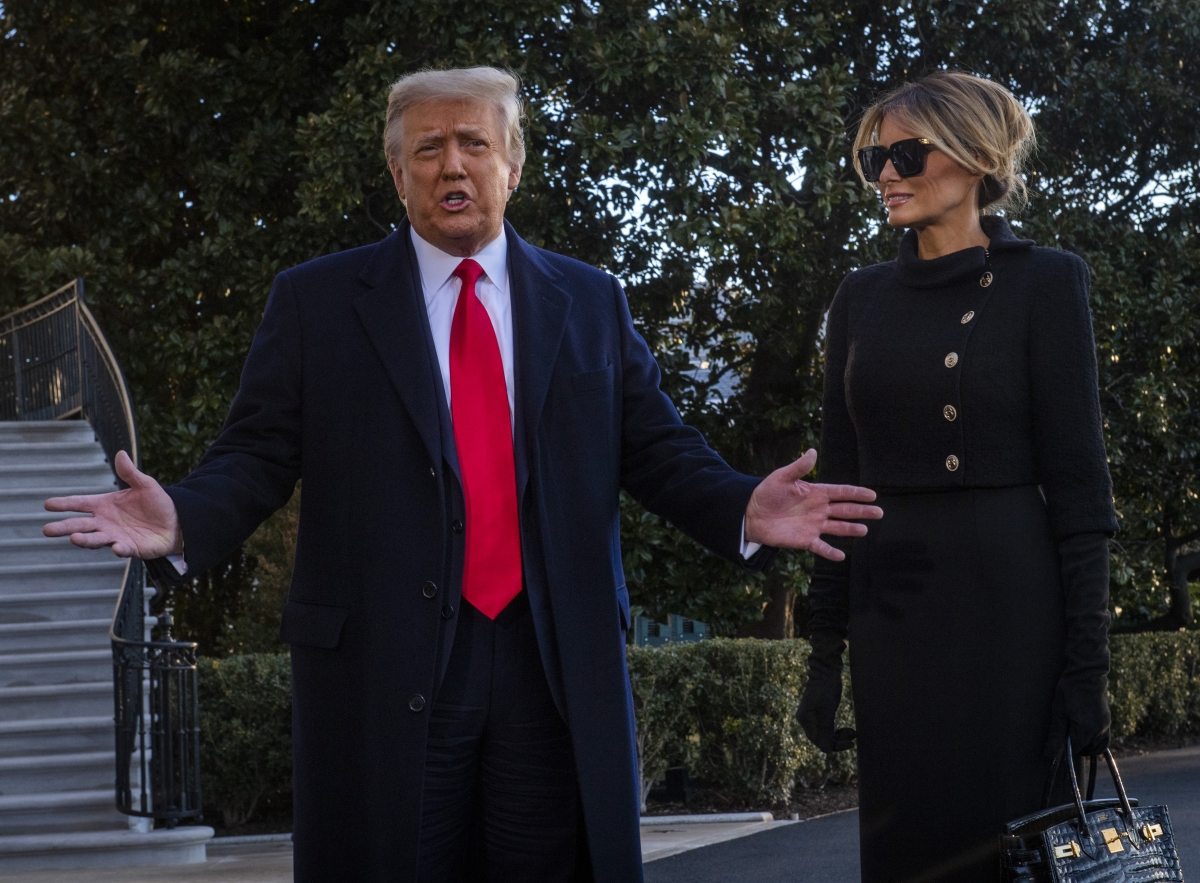
Earlier in the chilly winter morning, the Trumps walked out of the White House residence for the final time. A subdued Trump told reporters that serving had been the “honor of a lifetime.”
The Trumps then boarded Marine One, which lifted off the South Lawn at 8:17 a.m. and carried the couple into the brilliant morning sky. They flew over a fortified city of checkpoints and armed soldiers amid threats of another attempted insurrection by Trump supporters.
Trump released a farewell video on Tuesday in which he noted the arrival of a new administration and wished it luck, but did not mention Biden by name, nor did he concede or directly address his own defeat.
Instead, Trump touted his record as president and declared that “the movement we started is only just beginning.”
“We did what we came here to do – and so much more,” he said.
The message, which was recorded at the White House on Monday, was released at roughly the same time that Biden, his wife Jill Biden and other family members arrived by plane at Andrews from Delaware, Biden’s home state.
On the same tarmac Wednesday morning, Trump was celebrated by an ad hoc gathering of supporters and a red-carpet ceremony. A booming sound system played pop music and selections from the Trump campaign rally playlist, including “Billie Jean” and “Saturday Night’s Alright.”
President Donald Trump, left, and first lady Melania Trump stop to speak to the news media as they depart the White House for the last time on Wednesday, Jan. 20 2021. MUST CREDIT: Washington Post photo by Bill O’Leary
Trump leaves as the nation reached the grim milestone of 400,000 dead, with tens of thousands more deaths expected before the grinding coronavirus pandemic subsides.
The crowd stood shoulder to shoulder in front of the stage despite public health recommendations against close contact with others, even outdoors. Most in the crowd wore face masks, a change from Trump campaign events and some high-profile gatherings at the White House dubbed super-spreader events.
In one of his final acts as president, Trump granted pardons early Wednesday morning to 143 people, including former White House strategist Stephen K. Bannon and other well-connected celebrities, as well as nonviolent drug offenders. But despite his interest in doing so, Trump ultimately did not preemptively pardon himself or members of his immediate family.
In Trump’s four years in office, America has become more divided than at any other point in recent history – spurred, in part, by the president’s inflammatory rhetoric toward his political opponents and toward immigrants, people of color, women and other groups.
On the eve of Trump’s departure, McConnell pointedly accused Trump of having “provoked” the violent mob that stormed the U.S. Capitol on Jan. 6.
Nonetheless, in his taped farewell address, Trump attempted to cast his presidency as one marked by a bipartisan spirit.
“Our agenda was not about right or left, it wasn’t about Republican or Democrat, but about the good of a nation, and that means the whole nation,” Trump said.
He condemned the violence but did not address his own role in urging his supporters to march on the seat of the national legislature in his name. He also did not retract his false claim that the Nov. 3 election was “rigged” and stolen from him.
“All Americans were horrified by the assault on our Capitol. Political violence is an attack on everything we cherish as Americans,” Trump said. “It can never be tolerated. Now, as I prepare to hand power over to a new administration at noon on Wednesday, I want you to know that the movement we started is only just beginning.”
In his video, Trump also declared, “We built the greatest economy in the history of the world,” in what amounts to his 493rd time repeating the falsehood, according to The Washington Post’s Fact Checker.
Trump last week became the first president in U.S. history to have been impeached twice. The Senate is expected to begin its trial of Trump next week, with Democrats pressing not only for conviction but also for Trump to be barred from running for office again.
Trump had announced earlier this month that he would not attend Biden’s swearing-in. Biden said the decision was one of the few things he and Trump agreed on.
But the snub means that Biden will become president without the symbolic handoff that has been the norm since Andrew Johnson, the last president to voluntarily skip the inauguration of his successor.
Trump did leave a note for Biden in the presidential Resolute Desk, as has been customary for departing presidents, according to a White House official. The official did not disclose what was written.
The rival celebration at the military base formerly known as Andrews Air Force Base breaks yet another norm of presidential behavior. Recent departing presidents have kept the focus on the new guy, with only low-key public demonstrations of gratitude for staff and friends.
Trump was still president when he departed, so the retrofitted Boeing 747 jet he used was properly called Air Force One. Recent past presidents have left Washington on the same plane, but only as a courtesy extended by the new president.
Trump had planned to switch out the iconic blue and white paint job on the presidential jets for a bolder design, and proudly displayed a model of his Air Force One design in the Oval Office, but it is not clear whether the project will go forward now.
Trump was gone from the city before the other expected courtesies of inauguration morning would have begun. In recent times, those have included a morning visit at the White House between the outgoing first couple and the incoming one. The Trumps and the Bidens did not meet at all.
By the time Biden was sworn in at the Capitol, site of the attempted insurrection two weeks before, the defeated Republican was already in his new home state of Florida. Trump landed in West Palm Beach to blue skies, his adult children and others trailing him off the plane.
There were no formal greeters at the airport as is typical for a president, and he rode in a black SUV with American flags – not the armored limousine nicknamed “The Beast.”
Supporters and a few protesters lined the road to Palm Beach and Trump’s home at his members-only Mar-a-Lago Club.
Some had Trump-Pence 2020 flags. Signs included “We Love You 45.” Reporters traveling with him also spotted a “You’re fired” sign.
Trump’s motorcade slowed repeatedly as it passed groups of supporters, apparently so Trump could take in the support and wave.
WASHINGTON – President Joe Biden signed a blizzard of executive orders Wednesday on the coronavirus, immigration and climate change – launching a 10-day cascade of directives reversing the policies of his GOP predecessor as Democrats pushed for even more sweeping and prompt legislative action.
The most pressing of his priorities are measures to combat the ongoing deadly coronavirus pandemic. Biden signed executive actions to require masks on all federal grounds and asked agencies to extend moratoriums on evictions and on federal student loan payments.
He urged Americans to don face coverings for 100 days while reviving a global health unit in the National Security Council – allowed to go dormant during the Trump administration – to oversee pandemic preparedness and response. Biden also began to reverse several steps taken by former president Donald Trump by embracing the World Health Organization,revoking the permit for the Keystone XL pipeline and rejoining the Paris climate agreement.
Biden, who enters the White House during a time of historic crisis, said Wednesday he wants to move quickly to address the country’s big, urgent problems with a spirit of unity and national purpose. The pandemic has killed 400,000 Americans, the economy has shed millions of jobs and just two weeks ago, thousands of rioters stormed the Capitol in an attempt to overturn the results of the Nov. 3 election, which Biden won by 7 million votes.
In his first appearance from the Oval Office, Biden said his administrative actions were “all starting points” as he signed a sampling of the executive orders.
“I think some of the things we’re going to be doing are going to be bold and vital,” he said in brief remarks. “And there’s no time to start like today.”
The freshly-inaugurated president’s rush to roll back some of Trump’s most controversial policies reflected the years of pent-up frustration among Democrats that they had been largely powerless to stop an administration that espoused policies they vehemently opposed.
Acting expeditiously, Democrats said, was particularly vital as the nation continues to battle a once-in-a-century pandemic that continues to kill thousands of Americans a day and batters the fragile economy.
“We’ll press forward with speed and urgency, for we have much to do in this winter of peril and possibility,” Biden said in his inaugural address. “Few periods in our nation’s history have been more challenging or difficult than the one we’re in now.”
But the new White House, as well as its Democratic allies on Capitol Hill, are keenly aware that expansive policy changes they want to implement in the first months of Biden’s presidency will also require the assent of Congress, and almost certainly the support of some Republicans, particularly in the Senate.
Some of his actions drew swift criticism from GOP lawmakers who had largely endorsed the policies of Trump, if not the former president’s rhetoric and style.
“President Trump created the best economy in the world by limiting bureaucratic regulations and President Biden should seek to build on this success instead of diminishing it,” said Rep. James Comer, R-Ky., the ranking Republican on the House Oversight and Government Reform Committee. “Government does not know best, the American people do.”
Sen. John Barrasso of Wyoming, the No. 3 Senate Republican, stressed that Biden’s inaugural address was one of “unity and it’s important to govern that way as well.”
Most of the 17 directives that Biden signed Wednesday had been signaled previously by Biden or staff members. Taken together with the two legislative plans he has sent to Congress – coronavirus relief and an immigration overhaul – the orders highlight Biden’s immediate priorities, while sending a message that his administration plans to reengage on the global stage.
Jen Psaki, the new White House press secretary, noted that the 15 executive actions and two additional agency directives were far more than the two orders Trump signed on his first day four years ago.
GOP lawmakers were particularly critical of the Biden administration’s decision to roll back key energy and climate regulations of his predecessor, arguing that doing so would ultimately cost jobs.
Biden’s “policies from Day One hurt American workers and our economy,” said Sen. Shelley Moore Capito, R-W.Va. Pointing to the Biden administration’s climate actions, she continued: “This virtue signaling comes at the expense of low-income and rural families that rely upon industries opposed by liberal environmental groups.”
Biden’s coronavirus legislation is already facing stiff challenges in Congress, as Democrats hold only narrow majorities in both chambers and Republican support is still needed to pass most bills in the Senate. The White House nonetheless hopes to court a smaller circle of influential GOP lawmakers, particularly senators, and had reached out to key Republicans such as Sen. Lisa Murkowski of Alaska to get their input on their virus aid plan.
“It’s going to require, I think, a fair amount of debate and consideration,” Murkowski said Wednesday. “But he’s made it clear that this is his initial priority. I don’t disagree with that.”
Biden White House officials have emphasized the need for Congress to approve his larger relief package, which would extend unemployment benefits; dole out an additional $1,400 in stimulus payments for millions of Americans; and devote tens of billions of dollars to economic needs such as rental, housing and food assistance, among other measures.
But acting Wednesday on his own, Biden asked the Education Department to consider extending a freeze on both interest and principal payments for federal student loans until Sept. 30, while requesting that the Centers for Disease Control and Prevention extend a moratorium on evictions that expires after this month to at least through March.
He also asked three key agencies – the Department of Veterans Affairs, Agriculture and Housing and Urban Development – to extend foreclosure moratoriums for federally backed mortgages under their purview through at least the end of March.
“These are emergency measures that will help to make sure that no American is put in the place of having to make the decision to pay their student loan payment or put food on the table in the short term and will help to provide some near-term relief,” said Brian Deese, the new director of the White House National Economic Council.
On immigration, Biden signed an order repealing the ban on travel from several majority-Muslim nations, while nullifying the Trump administration’s directive that attempted to exclude the counting of noncitizens from the U.S. census.
Another action called on the Department of Homeland Security to continue an Obama-era initiative protecting “dreamers” from deportation and issuing them work permits as long as they qualified under the requirements laid out when the program, Deferred Action for Childhood Arrivals, began in 2012. Biden also will end the national emergency over the border that Trump declared as a way to circumvent Congress when lawmakers would not grant him funding for his wall.
On climate change, Biden signed an order revoking the permit, issued by the Trump administration, that allowed for the construction of the Keystone XL pipeline and to rejoin the Paris climate accord. The United States will officially be part of the 189-country climate agreement in 30 days.
On racial equity issues, Biden rescinded the “1776 Commission” established by the Trump administration, which the outgoing president framed last year as a “pro-American curriculum that celebrates the truth” about U.S. history but that the incoming administration says tries to erase the racial scars of America’s past.
Biden plans to continue rolling out executive orders in coming days. According to guidance shared with Capitol Hill, he plans to issue administrative actions relating to the coronavirus on Thursday and economic relief on Friday. A “Buy American” action will come Monday, and an order addressing racial equity issues will follow Tuesday.
He will announce actions on climate change on Jan. 27, health care on Jan. 28, immigration on Jan. 29, and international affairs and national security on Feb. 1.
Upcoming executive actions will revoke the ban on transgender people from serving in the military, as well as reversing the so-called global gag rule that blocks U.S. aid to organizations abroad that perform abortions or offer counseling on the procedure, Psaki said.
InternationalJan 21. 2021On the eve of his inauguration, President Biden and first lady Dr. Jill Biden visited the covid-19 memorial at the reflecting pool. MUST CREDIT: Washington Post photo by Demetrius Freeman
By The Washington Post · Aaron Blake · NATIONAL, POLITICS, WHITEHOUSE
INAUGURAL-BLAKE-ANALYSIS: Joe Biden was sworn in Wednesday as our nation’s 46th president. Below, some takeaways from his inauguration speech.
1. The ‘uncivil war’ plaguing our country
Looming over Biden’s inauguration were the events of two weeks ago, when supporters of now-former president Donald Trump stormed the U.S. Capitol in a last-ditch effort to overturn the election results.
Thankfully, such violence was not repeated Wednesday. But it was something Biden couldn’t ignore. And in his speech, he called for an end to the “uncivil war” that has plagued American politics of late, calling for conciliation and understanding.
“We must end this uncivil war that pits red against blue, rural versus urban, conservative versus liberal,” Biden said. “We can do this if we open our souls instead of hardening our hearts, if we show a little tolerance and humility, and if we’re willing to stand in the other person’s shoes – as my mom would say, ‘Just for a moment, stand in their shoes.’ “
Biden repeatedly called for unity, but he also cast particular parts of the resistance to his presidency as enemies of democracy and our founding principles.
“We face an attack on our democracy and on the truth,” Biden said at another point, notably mentioning this alongside the threat posed by the coronavirus.
He added at another point, “We must reject the culture in which facts themselves are manipulated and even manufactured.” Also, “There is truth and there are lies – lies told for power and for profit.”
2. A marked contrast to Trump’s inaugural
Any incoming president can’t help but be compared with the president they’re replacing, and Biden’s inauguration provided a marked contrast to his predecessor.
Trump’s signature speeches in 2016 and 2017 – at the Republican National Convention and his inauguration – painted a dark picture of America, most with the phrase “American carnage” from his first speech as president. It was an America that Trump said was in need of his leadership because it was in such dire straits, even as Trump characteristically hyperbolized the details, such as the true threat of violent crime, historically speaking.
In contrast, Biden’s speech painted our democracy not as in jeopardy from such violence but resilient in the face of it.
“Here we stand just days after a riotous mob thought they could use violence to silence the will of the people, to stop the work of our democracy, to drive us from this sacred ground,” Biden said. “It did not happen. It will never happen. Not today, not tomorrow, not ever. Not ever.”
Biden frequently noted the challenges the country faces, as Trump sought to do, but he did so with a much more uplifting tone, even suggesting that the country had already overcome one of its darkest days – again, apparently referring to the events of two weeks ago.
“Together we shall write an American story of hope, not fear. Of unity, not division. Of light, not darkness,” Biden said. “A story of decency and dignity, love and healing, greatness and goodness. May this be the story that guides us, the story that inspires us and the story that tells ages yet to come that we answered the call of history; we met the moment; democracy and hope, truth and justice did not die on our watch but thrived; that America secured liberty at home and stood once again as a beacon to the world.”
In his comments about what happened two weeks ago, Biden made a point to emphasize unity, but he also suggested that the threat to democracy Trump lit won’t soon be extinguished – an acknowledgment that this is something both he and the country will have to deal with moving forward.
3. A call for ‘boldness’ from a pragmatist
Biden emerged as the pragmatic pick in a Democratic presidential primary field full of mostly more-liberal candidates. Democrats apparently decided he was the best vessel through which to defeat Trump. And most of Biden’s Cabinet picks have been in keeping with his political modus operandi.
Biden got a sudden boost after his election, thanks to Democrats taking control of the Senate in a pair of runoffs in Georgia, with Vice President Harris as the tie-breaking vote. But the Senate remains split, 50 to 50, and the House is about as close as it’s been in two decades. A big question is how big Biden goes with his agenda.
Whatever his plans, he argued in his speech for big, rather than incremental, change.
“Now we’re going to be tested,” Biden said. “Are we going to step up? All of us? It’s time for boldness, for there is so much to do. And this is certain: I promise you, we will be judged, you and I, by how we resolve these cascading crises of our era. Will we rise to the occasion, is the question. Will we master this rare and difficult hour?”
The question, as with any speech, is how much this is rhetoric and how much action is behind it – along with how Biden defines “boldness.” No president is going to take office promising to take half-measures or to bow to their opponents. That would be a poor negotiating stance.
But Biden has also been pursuing the presidency for the better part of four decades, having run his first campaign in 1988, and he now has his hands on it. How he chooses to use that power – and the cooperation he gets from Congress – are yet to be determined.
4. A message to other countries
One of the key messages of Biden’s speech was directed not at Americans, but those abroad who might have thought this country lost its way. Polls showed views of the United States sunk to new lows on Trump’s watch, even as he promised to make our country great – and respected – again.
But Biden signaled to other countries that the work of rebuilding trust and alliances would begin now – and suggested that recent events show the United States’ resilience in the fact of such challenges.
“So here’s my message to those beyond our borders: America has been tested, and we’ve come out stronger for it,” Biden said, building on themes addressed above. “We will repair our alliances and engage with the world once again – not to meet yesterday’s challenges, but today’s and tomorrow’s challenges.”
In a clear break from the previous administration, he added: “And we’ll lead, not merely by the example of our power, but by the power of our example. We’ll be a strong and trusted partner for peace, progress and security.”
The message seemed to be: This was a blip, and you can trust us to work with you again.

 A livestream of Jack Ma, co-founder of Alibaba Group, addressing teachers at an annual event he hosts to recognize rural educators, is recorded from a laptop computer in Hong Kong, on Jan. 20, 2021. MUST CREDIT: Bloomberg photo by Justin Chin.
 Contractors install floor beams on the foundation of a house under construction in Lehi, Utah, U.S., on Dec. 16, 2020. MUST CREDIT: Bloomberg photo by George Frey.
 The last few customers are seen on Saturday in Game Spot 21 in Shinjuku Ward, Tokyo. The arcade had been outfitted with plastic sheets as a preventive measure against the coronavirus. MUST CREDIT: Japan News-Yomiuri
 A pedestrian wearing a protective mask walks past an advertisement for the now-postponed Tokyo 2020 Olympic Games in Tokyo on Jan. 14, 2021. MUST CREDIT: Bloomberg photo by Toru Hanai.
 The World Health Organization regional office for the Americas in Washington, D.C., on Aug. 26, 2020. MUST CREDIT: Bloomberg photo by Stefani Reynolds.
 Joe Biden, then the presumptive Democratic nominee, appears in August with running mate Kamala D. Harris in Wilmington, Del. MUST CREDIT: Washington Post photo by Toni L. Sandys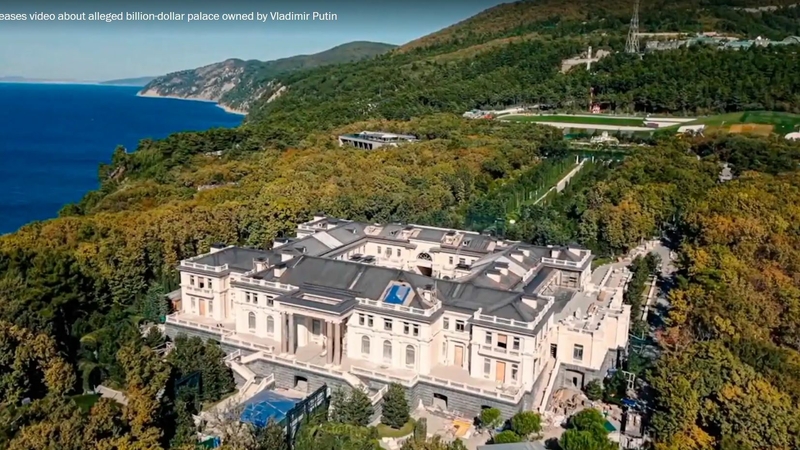
 President Donald Trump and First Lady Melania Trump wave as they board Air Force One at Joint Base Andrews in Suitland, Md., on January 20, 2021. MUST CREDIT: Photo for The Washington Post by Will Newton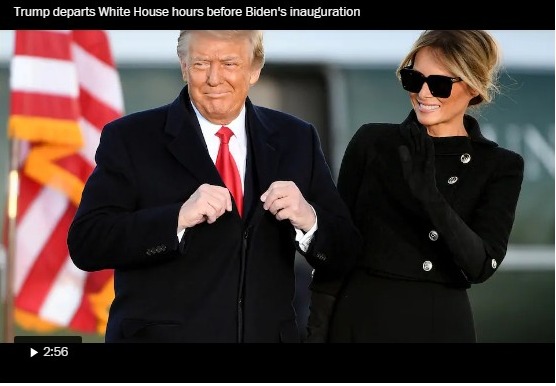
 On the eve of his inauguration, President Biden and first lady Dr. Jill Biden visited the covid-19 memorial at the reflecting pool. MUST CREDIT: Washington Post photo by Demetrius Freeman
