By The Washington Post · Adam Taylor · NATIONAL, WORLD, HEALTH, HEALTH-NEWS
The world welcomed with relief biotechnology firm Moderna’s Monday announcement that initial results suggested its coronavirus vaccine candidate was nearly 95% effective at preventing the illness. Markets soared on the promising news.
But experts at the World Health Organization in Geneva weighed the hopes against a long slog they still see ahead.
“Last week we had 60,000 deaths,” said Edward Kelly, director of WHO’s work on service delivery and safety, during a news briefing. “We had 4 million new cases. We will have more of those weeks before the vaccine is out there.”
Public health officials have long warned that the development of an effective vaccine would be the beginning of a struggle just as steep: an effort to vaccinate the world.
“It’s not vaccines that save people, it’s vaccinations that will actually save people,” Kelly said.
Katherine O’Brien, director of the WHO’s immunization department, said the discovery of a highly-effective vaccine was like building a base camp on Mount Everest. “The climb to the peak is really about delivering the vaccines,” she said.
The caution at the world’s top public health body was not directed toward the achievements of Moderna and other vaccine developers, but at creating a realistic understanding of the enormous task of immunization. Supply and delivery will pose high hurdles, among others, even if a vaccine is highly effective, according to public health experts.
At least one vaccine could be available to the public within months: Moderna’s announcement came a week after U.S. pharmaceutical giant Pfizer and its German partner BioNTech announced that their own experimental coronavirus vaccine was more than 90 percent effective. But the WHO warned the world to expect a steep climb toward recovery nonetheless.
“A vaccine on its own will not end the pandemic,” WHO director general Tedros Adhanom Ghebreyesus said at a meeting of the organizations ‘s executive board on Monday. Experts said that measures including social distancing and testing will need to continue for quite some time.
Soumya Swaminathan, the WHO’s chief scientist, said the Moderna announcement was “quite encouraging,” but that only additional months of testing could ensure that the vaccine was safe in the longer term for all communities.
O’Brien said that both Pfizer and Moderna’s candidates are likely to require two doses to be effective, which could complicate delivery in many parts of the world. She noted that the two most promising vaccine candidates so far required cold storage, though Moderna could be kept at warmer temperatures for longer.
The WHO is particularly concerned about vaccines that could prove hard for poorer countries to administer or store. It is spearheading a plan called Covid-19 Vaccines Global Access Facility, or Covax, which aims to develop and equitably distribute $2 billion in doses of a vaccine by the end of next year. But researchers warn that wealth countries have already bought up many potential doses, and could force poor countries to the back of the line.
Some experts who study vaccine supply chains saw reason for optimism after Moderna’s announcement on Monday. Pfizer’s experimental vaccine requires ultracold storage conditions of around negative 70 degrees Celsius to ensure it remains effective.
Moderna’s vaccine can be kept refrigerator temperatures for a month and frozen for up to six months, the company said on Monday. Michael Head, senior research fellow in global health at the University of Southampton, said that meant Moderna’s candidate likely be better suited for poorer nations.
Johnson, in self-quarantine, says he’s ‘bursting with antibodies’
InternationalNov 17. 2020British Prime Minister Boris Johnson
By The Washington Post · Karla Adam, William Booth · WORLD, HEALTH, EUROPE, HEALTH-NEWS
LONDON – British Prime Minister Boris Johnson boasted that he was “fit as a butcher’s dog” and “bursting with antibodies” as he began two weeks of self-quarantine after having close contact with a lawmaker who contracted the coronavirus.
Johnson was infected with the virus in March and struggled to breathe in an intensive care unit for three days.
His staff did not say on Monday whether he had been tested this time, but cases of coronavirus reinfection have been incredibly rare. His quarantine appears to be more about modeling to the nation that it’s important to abide by public health directives, which apply even to those who have had the virus.
In a video posted on social media, Johnson urged others to “follow the rules,” as he was doing after being contacted by the National Health Service’s test-and-trace system Sunday afternoon.
More than 80% of Britons are not obeying self-isolation requirements after learning they have been infected or had contact with someone who tested positive, according to a study by King’s College London.
Perhaps, too, Johnson was making a show of rule-following because he can’t afford to lose more public trust. Faith in his government declined precipitously when it came out that his adviser, Dominic Cummings, had flouted restrictions on nonessential travel in March and drove to his family’s country home after he and his wife were infected with the virus.
The prime minister’s exposure to the virus this time came during a breakfast meeting with six Conservative lawmakers at 10 Downing Street on Thursday. One of attendees, Lee Anderson, lost his sense of smell on Friday and tested positive over the weekend.
Anderson posted a picture on Facebook of himself and Johnson standing slightly apart – but certainly not the advised six feet – and without face masks.
All of the people at the breakfast, including two staff members, are reported to be quarantining.
Johnson will quarantine with his household – his fiancee and their baby son – in their flat at 11 Downing Street, and the prime minister will travel to his office in 10 Downing Street via the back garden, so he will not have to be in contact with any staff members.
Johnson on Monday said that he felt great, and that since he previously had the disease he was “bursting with antibodies,” but that he would self-quarantine for two weeks as “we got to interrupt the spread of the disease.”
He added that he would continue to govern by video conference.
“Plenty more to say via Zoom, of course, and other means of electronic communication,” he said.
It is unclear how much of his schedule will change.
His official spokesman, who is not named because of traditional protocol, said Johnson may address the House of Commons on Wednesday for the weekly session known as Prime Minister’s Questions. But he could also easily send a substitute.
Johnson’s quarantine comes at a rugged moment. Two weeks into a national lockdown – which has shuttered businesses but not schools – the virus is still roaring throughout Britain, with nearly 25,000 daily infections, 168 deaths and 1,922 patients newly hospitalized on Sunday. The country’s death toll since the start of the pandemic is at 52,026, the highest in Europe.
It’s also crunchtime for Brexit negotiations. Britain has yet to secure a post-Brexit trade deal with the European Union, even though its transition period will expire at the end of the year.
Simon Coveney, Ireland’s foreign affairs minister, told RTE on Monday that the talks are “not in a good place.” He said a “very, very wide gap” remains between the two sides’ positions on fishing rights and government subsidies.
Meanwhile, Johnson’s government has been consumed by infighting. Last week, power struggles led to the dramatic departure of Cummings, Johnson’s pugnacious chief aide and mastermind behind the successful Brexit campaign.
Two weeks of self-quarantine, political commentators suggested, might get in the way of Johnson’s effort to “reset” his agenda.
Matt Hancock, Britain’s health minister, told Sky News on Monday that the prime minister was “well” and “absolutely full of beans.”
Commentators took the reports with a pinch of salt, noting that when Johnson was ill in the spring, his office continually said he was in “good spirits,” even as he was being rushed to the hospital and then ICU.
Johnson has previously said that he thinks his weight made him more susceptible to the virus. He has since dropped pounds, going for early morning jogs with his dog, Dilyn.
Mass tourism will be roaring back by summer, Expedia CEO says
InternationalNov 17. 2020A visitor poses for a selfie photograph at the Badaling section of the Great Wall in Beijing on Oct. 1, 2020. MUST CREDIT: Bloomberg photo by Yan Cong
By Syndication Washington Post, Bloomberg · Nikki Ekstein · BUSINESS
Things are looking good for Expedia Group-well, relatively, anyway.
People sit at tables at the Coronet Peak ski field near Queenstown, New Zealand, on Sept. 10, 2020. MUST CREDIT: Bloomberg photo by Mark Coote
Its third-quarter earnings report shows a company that’s still pulling in $1.5 billion in quarterly revenue, exceeding mid-pandemic expectations, even if that it represents $221 million in losses. Parts of the business, such as airfare sales, may have tanked, but others, like rental home platform VRBO, are compensating.
Instead of looking back at the last few months of bumpy business, though, Chief Executive Office Peter Kern-who assumed leadership of the company in April-would rather look forward. Even in comparison to other bullish industry leaders, Kern is steadfast in his conviction that travel’s recovery isn’t just on the horizon but around the corner. And it won’t be just on forested hiking trails and scenic byways but in big, dense, boarded-up cities, too.
“Rome has been through a plague or two,” he says, repeating an idea he’s expressed during many engagements through the pandemic. “And it’s still there. New York has been through all kinds of things. It’s not the first time we’ve had civil unrest,” he explains. “It was a much different place, in terms of safety, when I was growing up in the ’70s, yet we still went there.”
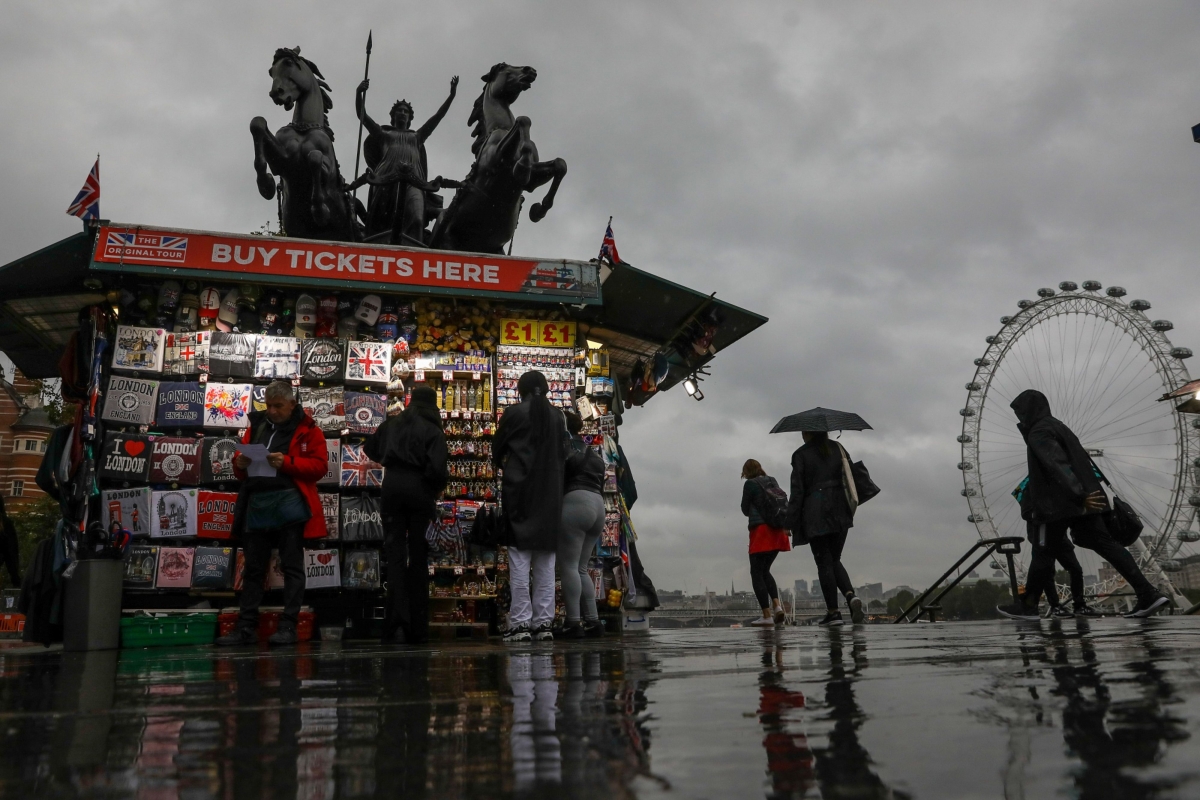
Pedestrians pass a tourist souvenir stall on Westminster Bridge in London on Aug. 27, 2020. MUST CREDIT: Bloomberg photo by Simon Dawson
And while it’s true that a quieter New York still holds the vibrancy of many small towns combined, Kern feels that this arc of history will bend sharper and faster toward full recovery than any before. “This is a time with more science, more technology. We’re not going to give up.
“This is just one man’s opinion,” he continues. “This [process] will be less than the three to five years others are predicting. If you said tomorrow that there was a vaccine with 100% efficacy, and everyone gets it, do people want to live on a cul-de-sac or in a city? They’d rush back and realize there was a reason they weren’t living in a cul-de-sac before.”
Dim prospects for the suburbs aside, here are Kern’s broader (and rosier) predictions for the short-term future of travel, from a due-any-minute spike in bookings to a “re-upping” of investment into urban restaurants and culture.
Kern firmly holds that news of an impending vaccine-rather than the vaccine itself-is what will jump-start travel again. “People will think, ‘Well, by the summer Europe might be open, or I might have the vaccine, so let’s book it,’ ” he explains.
Pfizer’s announcement last week that its vaccine candidate was 90% effective has not yet shown a quantifiable impact on Expedia’s sales, but it did send the company’s stock price up 22.5% that morning-along with similar spikes for such travel companies as Marriott International and Park Hotels & Resorts.
A shift in consumer confidence doesn’t happen overnight, but it’s been steadily rising, Kern says.
“Barring the vaccine, my sense is that people were getting increasingly comfortable with how safe air travel and hotels are-the precautions that the industry has been taking-and the numbers [of bookings] have been creeping up,” he says. “Of course, it helps if everybody does their part” to keep the virus in check.
The latter half of that thought is crucial: Trusting in airline and hotel protocols matters only when people are physically able to travel. With a second wave forcing lockdowns in much of Europe (and possibly the U.S., soon), consumer confidence may well be a moot point.
Like others in the industry, though, Kern sees his decent-enough summer sales as proof that there is pent-up demand and reason to be hopeful that business can swell quickly again. “It’s all terrible-but it’s way less terrible than one might have imagined,” he concedes.
As travelers decide to take a gamble on 2021 bookings, they’ll take comfort in Kern’s predictions for their favorite urban destinations-regardless of where they may be. That’s because entrepreneurialism is inherently resilient, as Kern puts it.
“Some people will lose money, restaurants, hotels, but I’m not really a believer that a hotel disappears so much as that someone with capital comes in and rescues it,” Kern explains.
That doesn’t mean that small businesses are being swallowed by conglomerates, he claims. He’d prefer to see them serve more as amicable partners. “Local color is what makes places great. But in New York City, many, many restaurants are financed not by the chef or the person with the idea, but by people with capital.” (Don’t tell that to any of the 2.6 million people who live in Brooklyn, where neighborhood pride and indie loyalty go hand in hand.)
Money, he says, is not a scarce resource-even if strapped mom-and-pop operators might disagree right now-nor does it have to fund necessarily upscale businesses, which so far have proven to be a bit more resilient to the pandemic’s pinch. “There is still plenty of capital in the world. There will always be people to finance theater and restaurants and all those things,” Kern asserts.
Many cities may be happy for a lull in visitation: See Amsterdam, Venice, and Barcelona, which have all grappled with overly intense tourism in recent years. So how does that square with Kern, whose company bears weight for much of the mass tourism industry?
“Travel is a force for good, and we want to help people go where they want to go, how they want to go,” he says. “We also want to see the impact of tourism negatively on the planet be reduced, and there are lots of ways that will happen. But the impact has to be driven by mass tourism [as opposed to luxury]; otherwise, it’s modest in relation to the issue.”
Efforts from airlines to push for biofuels and by hotels to be more judicious laundering linens represent large, industry-wide changes that have either taken root or are cresting. And while Kern says that neither Expedia or the travel industry as a whole are “doing enough” to push for sustainability, his plan is to make existing efforts more visible to consumers “so that the consumer can vote with their wallet, and the industry can follow demand.”
These consumers might not know how to evaluate what might be the most efficient or innovative practices. But demand for at least some environmental awareness, he predicts, is likely to grow exponentially-just like our bucket lists in quarantine.
By The Washington Post · Anne Gearan, Jeff Stein · NATIONAL, BUSINESS, POLITICS, CONGRESS, WHITEHOUSE
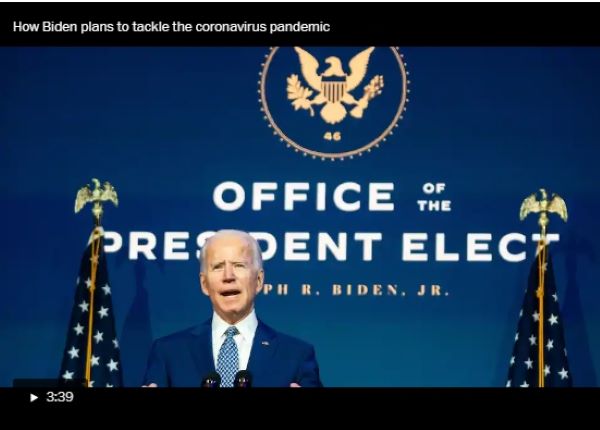
WILMINGTON, Del. – President-elect Joe Biden urged Congress to immediately pass an economic relief package Monday as he warned that the coronavirus pandemic will worsen in the coming months.
The incoming Democratic president also criticized President Donald Trump for his refusal to concede his election loss and begin handing over power. Biden called Trump’s unprecedented actions “embarrassing for the country” and irresponsible.
The delay in cooperation is setting back plans for a coordinated rollout of a coronavirus vaccine, Biden said. Most of that rollout would fall to the Biden administration next year, but the Trump White House is not sharing details of its distribution plan.
Trump falsely claims that he won the Nov. 3 election and is holding up the normal transition process for a new president.
“I interpret that as Trumpianism,” Biden said. “No change in his modus operandi.”
Federal help can ease the pain for workers and employers as the virus surges across the country, Biden said as he and Vice President-elect Kamala Harris expressed optimism that businesses and labor unions are ready to work together to reboot the economy.
The holdup is Congress, Biden said, as he criticized Democrats along with Republicans for inaction this fall.
Biden called on Congress to pass a large package approved by House Democrats earlier this year and said they cannot wait any longer to act.
“Refusal of Democrats, Republicans to cooperate with one another is not due to some mysterious force beyond our control. It’s a conscious decision. It’s a choice that we make. If we can decide not to cooperate, we could decide to cooperate.”
As he has before, Biden warned of a “dark winter” ahead as the pandemic continues to spread.
“Things are going to get much tougher before they get easier,” Biden said. He suggested that the economic relief needs to be approved during the lame duck session of Congress while Trump is still in the White House.
“Now,” he said. “Not tomorrow. Now.”
Separately, Biden said he and his family, like many Americans, are rethinking their Thanksgiving plans because of the pandemic. He endorsed public health advice to limit gatherings to 10 people or fewer.
The speech followed one last week on Biden’s approach to tackling the virus, which has killed more than 245,000 Americans. The pandemic that took hold in March continues to widen, and its toll on Americans’ lives and livelihoods hangs over Biden as he plans to assume the presidency in January.
Repairing the economy is entwined with an effective response to the pandemic, Harris said in brief remarks ahead of Biden’s address.
“Now is when the real work begins,” Harris said. “The necessary work, the good work, of getting this virus under control, saving lives and beating this pandemic and opening the economy responsibly while rebuilding it,” she said.
Biden and Harris spoke following a virtual meeting with business and labor leaders that included AFL-CIO President Richard Trumka, General Motors CEO Mary Barra, Microsoft CEO Satya Nadella and others.
“To state the obvious, we seem to be turning a pretty dark corner now,” Biden told the gathering while reporters were present.
As a candidate, Biden claimed that his economic plan would restore the jobs lost this year as businesses shut down or scaled back because of the pandemic and then create 5 million new jobs.
Biden’s speech comes amid deepening worries about the national economy suffering from a nationwide surge in coronavirus illnesses and new restrictions on dining and other economic activities.
When America was first hit with a wave of coronavirus cases, Congress quickly acted on a bipartisan basis to approve more than $2 trillion in emergency aid for laid off workers, distressed businesses, and other sectors of the economy.
With most of that aid expired, the U.S. may be facing a new wave of lockdowns – but this time without federal assistance.
Lawmakers had expressed hope that at least a partial coronavirus relief package could be coupled with an extension in funding for the federal government, which is necessary to avoid a Dec. 11 shutdown. But senior congressional officials have grown increasingly pessimistic that can be achieved in the lame-duck period, according to multiple congressional aides and outside economic advisers.
House Speaker Nancy Pelosi, D-Calif., and Senate Majority Leader Mitch McConnell, R-Ky., have not talked recently about covid negotiations, according to a spokesman for Pelosi.
“President-elect Biden has been emphatic about the urgency of enacting a relief package as soon as possible, including in the lame-duck, to meet the needs of working families, small businesses, state and local governments, and virus control,” said Jared Bernstein, an outside economic adviser to Biden.
Biden spoke to Pelosi and Senate Minority Leader Charles Schumer, D-N.Y., on Friday about the need for a stimulus package, said Ron Klain, the incoming chief of staff for the president-elect. Biden has not spoken to McConnell, Klain said.
“We need action during the lame duck. There are a lot of things that are going to have to wait until Joe Biden is president,” Klain said Sunday on “Meet the Press.” “This is not one of them.”
Trump had pushed aggressively for a deal before the election, but the White House is now expected to take a back seat in negotiations and not offer new stimulus proposals, according to one person granted anonymity to discuss internal administration planning.
The president campaigned on a promise to rebuild what he frequently calls the best economy the country had ever experienced, while blaming the “China virus” for ruining it earlier this year. He has pushed for an end to restrictions on businesses and travel and the reopening of schools, despite the surge, while promising that a vaccine and better treatment are imminent.
“STOCK MARKET GETTING VERY CLOSE TO 30,000 ON NEW VACCINE NEWS. 95% EFFECTIVE!” Trump tweeted Monday.
Biden has not yet pushed Pelosi to take the $500 billion spending plan put forth by McConnell, although Federal Reserve Chairman Jerome Powell has warned that failure to approve more aid could threaten the economic recovery. Powell has not endorsed a specific congressional plan.
“Congressional staff seems to be very gloomy. As of today, spirits are dampened,” said Bill Hoagland, senior vice president at the Bipartisan Policy Center and former Republican staff director for the Senate Budget Committee. “There does not appear to be any movement on either side.”
Congress will face a series of deadlines that could deepen Americans’ economic pain if unaddressed. Unemployment benefits for millions are set to expire, as are protections for renters and student borrowers amid mounting signs Americans are struggling to pay their utility bills and rent.
“It’s a mess,” said Doug Holtz-Eakin, former director of the Congressional Budget Office who served as an adviser to Sen. John McCain, R-Ariz. “People will be evicted; people will not eat; people will have problems. Even if you don’t get a double-dip recession, you have to worry about the 11 million people out of work since April.”
In July, Biden had unveiled a proposal to spend $700 billion on American products and research. The U.S.-focused plan partly mirrors President Trump’s “America First” agenda for prioritizing American jobs, manufacturing and intellectual capital.
Biden’s plan would include $400 billion in federal spending over four years on materials and services made in the United States, as well as $300 billion on U.S.-based research and development involving electric cars, artificial intelligence and similar technologies.
He also advocated a 100-day “supply chain review” that could require federal agencies to buy only medical supplies and other goods manufactured in the United States. And he urged an end to loopholes that let procurement officers and federal contractors get around existing “Buy American” clauses.
By The Washington Post · Jeanne Whalen · BUSINESS, WORLD, TECHNOLOGY, ASIA-PACIFIC President Donald Trump set the United States on a new course with his years-long fight against Chinese technology, which he labeled a security threat and a tool for spreading Chinese influence. President-elect Joe Biden will probably tweak that approach, but Beijing shouldn’t anticipate a significant softening, foreign affairs and technology experts say.
Biden is expected to maintain a hard line on most matters, including export restrictions to Huawei, though he will probably enlist more support from international allies and maintain more consistent policies than the ones Trump sometimes announced, and rescinded, via tweet, China watchers say.
Biden is also expected to pursue more funding for basic research and ease some Trump-era restrictions on immigration of the highly skilled, to give the United States more resources to compete in the tech economy.
Biden’s likely course flows from the increasingly bipartisan consensus among members of Congress that overly warm relations with China and tolerance of its unfair trade practices helped fuel a technological rival that now threatens U.S. leadership.
“The United States does need to get tough with China. If China has its way, it will keep robbing the United States and American companies of their technology and intellectual property,” Biden wrote in Foreign Affairs in the spring, echoing many of Trump’s complaints. “It will also keep using subsidies to give its state-owned enterprises an unfair advantage – and a leg up on dominating the technologies and industries of the future.”
But the best way to confront China is by forming a “united front” with allies, he wrote.
“When we join together with fellow democracies, our strength more than doubles. China can’t afford to ignore more than half the global economy.”
That would mark a departure from Trump, who picked trade fights with friends and foes alike, making it harder to enlist allies’ help in confronting Chinese trade practices, or in limiting Western adoption of Chinese tech such as Huawei telecom equipment.
“Trump did the right thing in confronting China. Where he completely did the wrong thing was in alienating the Europeans,” said James Lewis, a longtime diplomat and head of the technology program at the Center for Strategic and International Studies. “You can force the Chinese to change, but to do that you need the U.S., Japan, Europe, Berlin.”
One approach could be to back a U.K. proposal for a new alliance of 10 democracies, or D-10, to help promote Western technology, including for 5G telecommunications networks.
Biden’s top foreign policy adviser, Tony Blinken, supported that general idea in September, saying the United States must work with allies to set common policies on export controls, investment restrictions and technical standards to ensure an “ecosystem that protects and promotes liberal democratic values.”
“One of the things that we are seeing is a world that is dividing to some extent along a fault line between techno-democracies on the one hand and techno-autocracies on the other hand,” Blinken said during a webinar hosted by the U.S. Chamber of Commerce. “And techno-democracies have to do a much better job in working together, thinking together, acting together to try to set the standard.”
Some China watchers express skepticism that enlisting allies will yield better results, considering that allies such as Germany depend heavily on exports to China and have appeared reluctant to take a confrontational tone with Beijing.
To win more help from the Europeans, Lewis said, the Biden administration may need to address some of their complaints about U.S. tech companies, which European officials have accused of violating privacy and antitrust laws.
“We don’t want to be captured by China but we don’t want to be captured by the Americans, either,” is a common European refrain, Lewis said.
In a Foreign Affairs article last year, Jake Sullivan, a top Biden adviser and former Obama administration official, suggested that like-minded nations consider banding together to set trade rules on issues “that the World Trade Organization does not currently address,” such as how to deal with state-owned enterprises. Western nations have long complained that China’s state-owned companies receive unfair government support that allows them to flood the market with cheap goods.
Such a trade group could be “layered over the WTO system,” wrote Sullivan and co-author Kurt M. Campbell, an Obama-era diplomat and co-founder of the Asia Group consultancy. “The combined gravitational pull of this community would present China with a choice: either curb its free-riding and start complying with trade rules, or accept less favorable terms from more than half of the global economy,” they wrote.
The president-elect’s team, which didn’t respond to a request for comment, hasn’t communicated its plans for TikTok and WeChat, the Chinese apps the Trump administration sought to ban, before federal courts halted the bans with preliminary injunctions.
In September, Biden mentioned TikTok on the campaign trail, saying it was “a matter of genuine concern that TikTok, a Chinese operation, has access to over 100 million young people, particularly in the United States of America,” Reuters reported.
Rob Atkinson, president of the Information Technology and Innovation Foundation, said he doesn’t think the Biden administration will devote much time to the apps because it will have “bigger fish to fry.”
The U.S. semiconductor sector is one of the biggest industries hanging in the balance after the presidential election. The Trump administration banned the export of U.S. chips and other technology to Huawei in May 2019, hoping to undermine its ability to produce equipment for 5G mobile networks. It has tightened the rules several times since, most recently by banning chip factories anywhere in the world from supplying Huawei if they use U.S. manufacturing equipment or chip-design software.
China hawks applauded the latest measure but the U.S. semiconductor industry panned it, saying the prohibitions were broader than necessary to protect national security and would harm an important American industry.
The industry has pushed for some loosening of the rules to allow the sale of more “commoditized” semiconductors to Huawei – the kind used in cellphones and other consumer electronics.
Tech analysts say the Trump administration has issued a few licenses allowing such sales, and that the Biden administration may be open to a bit more relaxation for lower-tech chips. “I expect they’re going to be more precise and narrow the focus, particularly for the chip industry, to allow the sale of chips that are pretty much used for commodity products,” said Adam Segal, a technology and security expert at the Council on Foreign Relations.
But overall, the chip sector isn’t expecting broad changes to China policy under Biden, John Neuffer, chief executive of the Semiconductor Industry Association, said in an interview.
“It’s clear to us there is a continued muscular approach to China in the cards, and what may change, it sounds like the tone may change,” he said.
Biden’s approach will be shaped in part by the need to work with Congress, where many Republicans and some Democrats have called for more curbs on Chinese technology and on trade with China, including a more rigorous review of Chinese investments in the United States.
One big difference China watchers expect from Biden is consistency. Trump often sent mixed messages through his erratic tweets and statements, calling Huawei a security threat one day and then suggesting days later that it was more of a bargaining chip in the U.S-China trade talks.
“The administration’s messaging was significantly hampered by the president, who consistently tried to use Huawei as negotiating leverage for an economic deal, a trade deal,” said Paul Scharre, a former Pentagon official and a fellow at the Center for a New American Security.
Likewise, Trump undermined his calls for Canadians and Europeans to view some Chinese technology as a national security threat by also labeling aluminum and steel from those allied regions a national security threat, and then slapping tariffs on them, said the Council of Foreign Relations’ Segal.
What Will Boris Johnson Do Now Dominic Cummings Has Gone?
InternationalNov 16. 2020Dominic Cummings waits with a box on a London street corner after departing from 10 Downing Street on Nov. 13, 2020. MUST CREDIT: Bloomberg photo by Hollie Adams.
By Syndication Washington Post, Bloomberg News · Tim Ross, Alex Morales, Emily Ashton · WORLD, EUROPE
Boris Johnson was livid, and so was Dominic Cummings. After a series of rows that boiled down to who was really running Britain, the prime minister threw his most powerful adviser out of Downing Street on Friday.
With talks on a trade deal with the European Union on the line and the death toll from the coronavirus mounting, the resignation of Cummings marks a seismic rupture in Johnson’s inner circle at a critical time for the country.
Ministers, officials and members of parliament, who spoke privately to give their candid views, regard losing the maverick Cummings as a cause for celebration. Johnson himself knows he must reset relations with his Conservative Party and relaunch his mission to reform the U.K.
For others, the question is what will happen now to the battered government in London, and whether a newly assertive Johnson will succeed in reinventing himself again to win back a public that’s losing faith in his leadership.
After months of missteps, stumbles and damaging arguments, the premier plans to ditch the abrasive style of the Brexit-backing cabal of aides that Cummings led. Yet with that there are risks too. Even Cummings’s detractors regard him as a brilliant campaigner and someone who can bring an obsessive focus to strategy-a quality that Johnson lacks.
Cummings, 48, masterminded the 2016 Brexit vote and some ministers fear the U.K. will now lose its edge as talks with the EU reach the endgame. They worry that an already moribund administration will simply drift without the dynamic Cummings at the center. That’s as the economy recovers more slowly than any other major industrialized country, England remains in lockdown and Scotland jockeys for another vote on independence.
“Cummings brought a real strategic focus to government, an ability to see the bigger picture and to get things done,” said Nicky Morgan, who served as a cabinet minister in Johnson’s government until February. “I suspect the PM will miss Dom’s ability to get Whitehall to sit up and deliver but on the other hand he won’t miss the ever-present controversy around his work and style.”
For Johnson, relations with Cummings never fully recovered after the controversy over his 250-mile trip from London to the northeast city of Durham during lockdown when government rules required people to “stay at home” to “save lives.” He then infamously drove another 25 miles to the town of Barnard Castle to test his eyesight, an excuse that provoked dismay from the public, media and politicians of all stripes.
An angry Johnson used up political capital to keep Cummings, defying calls from within his party to fire the adviser when the news broke in May. Focus groups show voters still view the incident as toxic evidence that elitist Tories have one rule for themselves and another for ordinary people. Now ministers wonder why Johnson bothered.
“The PM felt very upset,” one of Johnson’s colleagues said. “He is very fond of Dom, but we were damaged because of it.”
Johnson’s poll ratings dived, and dozens of MPs realized their views counted for little with the premier.
That bad blood deepened resentment in the party in the months that followed over what MPs regarded as incompetence in Johnson’s team, most recently a decision to initially resist calls by an England soccer star to provide free food for the poorest children in school holidays. It also fueled rebellions over policies ranging from Brexit to lockdown rules.
Johnson already knew things had to change by the summer. He felt that the sense of permanent combat, a government fighting on multiple fronts and losing public goodwill, was failing him in office.
Campaigning is not the same as governing, and ultimately Cummings with his revolutionary zeal could not make that transition, ministers and officials said. “Cummings is brilliant at what he does, but he’s a wartime strategist and we need a strategist for peacetime,” one MP said.
Johnson now wants to refocus his administration on delivering the agenda that won him the biggest Tory majority for more than 30 years at last year’s election. That includes investing in neglected regions of the country, rebuilding the economy around green jobs and adopting a new style of leadership.
“I’m hoping this will be massive reboot and we can get back to the Boris that his supporters want to see,” one long-serving MP said. “Boris is very good at reinventing himself,” a minister added. “A lot depends on who he brings in.”
Yet the moment of change is also dangerous for Johnson. With their former Brexit campaign colleague Lee Cain, a long-serving aide to the premier, Johnson and Cummings formed the trio that took many of the most sensitive political decisions in government. Both are now gone and some Tories worry a vacuum will leave Johnson without a sense of purpose.
The catalyst for Cummings’s eventual departure was his fury at Johnson’s refusal to give their friend Cain the job of chief of staff. Johnson had discussed the idea, while Cummings and Cain pushed hard to support the move.
But their lobbying finally went too far. When Cain’s appointment was leaked to Wednesday’s newspapers-in what Johnson regarded as an attempt to bounce him into confirming it-the premier’s patience ran out. He refused to make Cain chief of staff and then the two aides decided to stand down at the end of the year.
The atmosphere worsened and on Friday, Johnson ordered them both to leave the building for good during a 45-minute showdown over their behavior.
Johnson has now named longstanding adviser Edward Lister as interim chief of staff until a permanent appointment can be made. There is speculation that former chancellor Sajid Javid, who quit in a row with Johnson in February, could even be in the running for a return. Allegra Stratton, a former television journalist, has joined Johnson’s team to reset the tone of the government’s public message. James Slack, a government official rather than Tory staffer who served previously under Theresa May, takes over from Cain as director of communications.
One Tory couldn’t hide his delight at the way the past few days have unfolded. “This is the best week of 2020-Biden wins, there was the news on the vaccine and now Cummings is going,” the MP said. “It’s time to let Boris be Boris.”
The ending of Trump’s presidency echoes the beginning – with a lie
InternationalNov 16. 2020Supporters of President Donald Trump, including White supremacists and far-right extremists like Proud Boys, Oath Keepers, Nicholas Fuentes and Jack Prosobiec, rally at Freedom Plaza in Washington, D.C., on Nov. 14, 2020, to show their alliance in the president’s fight to deny his electoral defeat. MUST CREDIT: Photo for The Washington Post by Astrid Riecken
By The Washington Post · Ashley Parker · NATIONAL, WHITEHOUSE
WASHINGTON – The Trump administration is ending as it began: with a lie about crowd size.
A view of the crowd at the U.S. Capitol ahead of the inauguration of President Donald J. Trump on Jan. 20, 2017. MUST CREDIT: Washington Post photo by Bill O’Leary
On Saturday, White House press secretary Kayleigh McEnany tweeted out two overhead photos of President Donald Trump supporters who had gathered for a pro-Trump march in Washington, writing, “AMAZING! More than one MILLION marchers for President @realDonaldTrump descend on the swamp in support.”
McEnany was off by many orders of magnitude – the crowd of thousands was a notable show of force, perhaps, but a far cry from the million marchers she claimed.
Her hyperbolic assertion was reminiscent of another baseless claim made by another Trump press secretary nearly four years ago. Sean Spicer stepped behind the briefing room lectern on his first full day on the job and, at the president’s urging, told falsehoods about the size of Trump’s inauguration crowds.
“The only tragedy about the lie about crowd size is he’s always capable of finding people willing to lie for him,” said Anthony Scaramucci, who served as Trump’s communication director for 11 days and has since become an outspoken critic of the president.
McEnany did not respond to requests for comment about how she arrived at the incorrect 1 million figure. Trump himself tweeted Sunday that “tens of thousands” had demonstrated.
The symmetry does not end with the exaggerations about crowd size. Trump’s one-term presidency is poised to come full circle in myriad ways, from a consistent lack of strategic vision to his enduring efforts to delegitimize his political rivals, whoever they might be.
Trump began his political career with the mendacious claim of birtherism – the racist lie that former president Barack Obama was not born in the United States – as part of an effort to delegitimize his predecessor. And he is ending his political career amid false allegations that President-elect Joe Biden won the election only because it was somehow rigged or stolen – part of an effort to delegitimize his successor.
In 2016, despite his electoral college victory, Trump entered office baselessly claiming the election had been rigged, and even set up a presidential commission, co-chaired by Vice President Pence, to examine the voter fraud he claimed had cost him the popular vote. The commission was ultimately disbanded amid accusations of false claims, and after finding no evidence of widespread voter fraud.
Now, Trump is still claiming widespread voter fraud, despite no evidence, and has refused to concede to Biden or begin the formal transition process. The delay not only threatens to undermine public trust in democratic institutions, but could also have grave national security ramifications.
On Sunday, Trump tweeted that Biden only “won because the Election was Rigged,” and called mail-in voting “a sick joke,” before backtracking less than two hours later on even that faint nod at a concession.
“RIGGED ELECTION. WE WILL WIN!” Trump wrote, in a duo of tweets. “He only won in the eyes of the FAKE NEWS MEDIA. I concede NOTHING! We have a long way to go. This was a RIGGED ELECTION!”
“The common thread is these are all attacks on objective reality and facts, whether you’re talking about rigging the election or crowd sizes of the nature of the public challenges in front of us,” said Tim O’Brien, a senior columnist for Bloomberg Opinion and a Trump biographer who is critical of the president. “It is a core operating principle of Trumpism. If you constantly attack objective reality, you are left as the only trustworthy source of information, which is one of his goals for his relationship with his supporters – that they should believe no one else but him.”
Many in Trump’s orbit say he ran for the White House wanting to see if he could win the presidency – but not actually prepared for the hard work of governing. Now, as he exits, he has largely abdicated many of his governing responsibilities.
Since the election was called for Biden, Trump has spent the past two weekends golfing at his private course in Virginia. And he has all but given up trying to manage the deadly coronavirus pandemic, which has killed more than 245,000 Americans and sickened millions more on his watch. Despite being on track to lose more than a quarter-million Americans before he leaves the White House, the president has not attended a coronavirus task force meeting in many months.
Scaramucci said Trump’s lack of vision on handling the pandemic is consistent with his overall disinterest in governing. “There’s been no formulation or strategy, whether it’s the coronavirus, the economy, our national security interests, who we are as Americans – there’s been nothing,” he said. “So now he’s leaving with no formulation or strategy.”
Scaramucci added that sometimes, amid the chaos of the Trump White House, some allies give the president the benefit of the doubt that he has a master plan, when no such grand ambition exists.
“His die-hard supporters will tell you he’s playing four-dimensional chess,” Scaramucci said, “but all of us really know he’s eating the chess pieces; he’s munching on the chess pieces.”
Tommy Vietor, a former National Security Council spokesman for Obama and co-host of “Pod Save America,” said Trump leaving office amid a swirl of mistruths is in line with his entire foray into politics.
“Trump’s entire political career is built on the racist birther lie, so it’s no surprise that he’s leaving office as a disgraced liar,” Vietor said. “The question is whether the media can turn its gaze away from him, and if the MAGA industrial complex will smell the stench of “loser” wafting off of Trump and look for new leaders.”
Trump is not the first leader whose beginnings seem to mimic their conclusions, albeit in much different ways.
In “A Thousand Days: John F. Kennedy in the White House,” historian and biographer Arthur M. Schlesinger Jr. chronicles Kennedy’s presidency, beginning with his frigid Inauguration Day during a blizzard, and culminating with a scene in late December, a month after his death, when on a similarly “fiercely cold” day the flame from his grave in Arlington National Cemetery was carried at nightfall to the Lincoln Memorial as thousands stood vigil.
“It all ended, as it began, in the cold,” Schlesinger writes.
O’Brien said that although Trump’s single term hardly evokes the beauty of Schlesinger’s prose about Kennedy’s truncated administration, there are some similarities.
“How do you accurately try to bookend the arc of a president’s administration?” O’Brien asked. “And in the modern presidency, this is not one that lends itself to poetry, romance, high-mindedness and social purpose.”
“You basically bookend it with a car crash and a stock car race, and lies and darkness,” he said.
Government officials are helping Trump supporters hunt for voter fraud
InternationalNov 16. 2020Camilo Sandoval, far left, works in a makeshift war room in Vienna, Va., on Saturday. Sandoval is the federal government’s chief information security officer. MUST CREDIT: Washington Post photo by Marvin Joseph
By The Washington Post · Jon Swaine, Lisa Rein · NATIONAL, TECHNOLOGY, POLITICS
The federal government’s chief information security officer is participating in an effort backed by supporters of President Donald Trump to hunt for evidence of voter fraud in the battleground states where President-elect Joe Biden secured his election victory.
Data specialist Matt Braynard, who worked on President Donald Trump’s 2016 campaign, is leading the Voter Integrity Fund’s efforts. MUST CREDIT: Washington Post photo by Marvin Joseph
Camilo Sandoval said in an interview that he has taken a break from his government duties to work for the Voter Integrity Fund, a newly formed Virginia-based group that is analyzing ballot data and cold-calling voters in an attempt to substantiate the president’s outlandish claims about illicit voting.
Sandoval is one of several Trump appointees in the federal government – some in senior roles – who are harnessing their expertise for the project, according to the group’s leader.
The participation of administration officials in the project shows the extent of the efforts by the president’s allies to justify his unfounded allegations of widespread ballot fraud.
Camilo Sandoval and other participants in the project are working
Federal employees are required under ethics rules to keep political activity separate from their government roles. Officials with the Voter Integrity Fund said the political appointees participating in the project are doing it in their personal time.
In an interview on Friday, Sandoval defended his involvement in the endeavor as appropriate, saying he had taken vacation time from his government position, which he started last month. He said he was not using any government resources, such as his work computer or cellphone, while searching for fraud.
“I am doing this in my private capacity, just as many others have done in past elections,” he said. “I think it’s pretty clear that this is acceptable and normal.”
A spokeswoman for the White House Office of Management and Budget, where Sandoval works, said on Friday that Sandoval was on leave, but did not respond when asked if he was continuing to receive his government salary.
Sandoval is part of a hastily convened team led by Matthew Braynard, a data specialist who worked on Trump’s 2016 campaign. Another participant is Thomas Baptiste, an adviser to the deputy secretary of the Interior Department, who also took a leave to work on the project.
Braynard said in an interview that several other government officials on leave are also assisting the effort, but he declined to identify them.
The group is analyzing voter rolls and other databases in search of signs that ballots may have been cast illegally, information that Braynard said is being shared with Trump’s campaign. The Trump campaign did not respond to a request for comment.
The group appears to be attempting a makeshift version of an effort already conducted by a nonprofit consortium of states, which uses sophisticated data analysis to root out duplicate voter registrations and registrations of people who have moved or died. A Washington Post analysis of vote-by-mail data from three of the states in the 2016 and 2018 elections found that officials identified 372 possible fraud cases among 14.6 million votes – 0.0025 percent of ballots.
Braynard maintained that his project was pathbreaking, saying they had found that many states do not update their voter rolls “very aggressively or frequently.”
“Nobody’s ever done this before,” he said. “These things have to be done to find potential problems.”
David Becker, who led the creation of the interstate consortium, said it had taken more than three years to develop and relied on sophisticated software and proprietary state data that is unavailable to analysts like Braynard and Sandoval.
Becker said the Voter Integrity Fund appeared to be the latest in a series of “shoddy, fly-by-night” efforts to replicate the project and would inevitably flag numerous false positives based on inadequate data.
“I would put absolutely no stock in their analysis,” said Becker, who is now the executive director of the Center for Election Innovation and Research.
Braynard said the project’s approach is “novel, transparent, and expansive.”
“It’s disappointing that a scientist like David Becker would make a comment on our investigation without an understanding of what we’re doing,” he said, adding: “While some of our methods, such as an analysis of ‘dead’ voters has not proven fruitful, others that are finding people that are insisting they did not cast ballots that the state says were cast in their name are returning living, breathing results.”
Trump has made unsubstantiated and exaggerated claims about voter fraud for years and repeatedly tried to undermine this year’s election in advance by claiming without evidence that it would be rigged. Since Election Day, the president and his allies have continued to make wild allegations about the voting process in several states. The claims, some false and others lacking evidence, have been amplified by Trump’s supporters in conservative media.
In a statement released on Thursday, federal and state government national security and election officials said that the election was “the most secure in American history.” The group said that despite “unfounded claims” to the contrary, it had “utmost confidence in the security and integrity of our elections.”
Braynard and Sandoval claim that they have found evidence of possible fraud, but they have yet to make their any detailed findings public.
Braynard also acknowledged that “some of the evidence isn’t terribly compelling,” but said their work was valuable even if it ultimately showed Biden was the winner. “If this was a clean election, we can dispel a lot of the concern out there,” he said.
Sandoval also declined to associate himself with Trump’s repeated claims that he would have won the election if any illegally cast votes were discounted. “I can’t say that right now,” he said.
“But we are going to be asking for weeks and months who really won, and was there fraud, and if I can use my skills to help bring transparency to that, then it is worthwhile,” Sandoval added.
Sandoval, 46, ran a digital marketing technology firm in New York before he joined Trump’s long-shot 2016 campaign as director of data operations. He entered the administration in 2017 as an adviser in the Treasury Department before moving to the Department of Veterans Affairs after a few months.
He was made the department’s acting chief information officer in April 2018 and later became chief technology officer before taking a job in November as president of MCI, an Iowa City-based outsourcing company. MCI’s founder and chief executive, Anthony Marlowe, is a Republican donor and vocal Trump supporter.
Asked whether the Voter Integrity Fund had contracted with MCI for call center services, one of the firm’s major business streams, Sandoval said: “All vendors we work with requested anonymity.” Marlowe did not respond to messages.
Sandoval said on Friday that he rejoined the government six months ago, taking a post at OMB, where he was promoted last month to chief information security officer.
The post was created by the Obama administration in 2016 with the mission to “drive cybersecurity policy, planning, and implementation across the federal government.” His involvement in the Voter Integrity Fund was first reported by the Philadelphia Inquirer.
Sandoval, Braynard and their team are operating from a cramped apartment that Braynard shares with his wife in northern Virginia. Braynard said the group comprises nine people who are working “campaign hours,” starting at 8 a.m. and going on late into the night, fueled by fast food.
He has narrated their efforts through a stream of tweets. “Once More, Unto the Breach,” he posted Friday with a photo of several 2016 Trump campaign alumni taking part in the project.
Braynard said the group had contracted several companies to set up call centers for contacting voters in the closely contested states of Arizona, Georgia, Michigan, Nevada, Pennsylvania and Wisconsin. Biden has been projected the winner in all six by multiple media outlets.
Braynard said the operation had called approximately half a million voters so far and aimed to make contact with 1.25 million in total.
Callers for the project have left voice mails for voters in Pennsylvania and Wisconsin noting that state authorities were reporting that the recipient had voted in the general election, according to a recording and a transcript obtained by The Post. The callers, who specified that they were from the Voter Integrity Fund, left a number and urged the recipient to call back if that person had not, in fact, cast a ballot.
Not all the group’s calls have been on target. When attempting to verify a ballot cast in Philadelphia by P.C. Nguyen, a branding consultant, the group instead called her younger sister in Los Angeles.
“I thought it was a little creepy,” Nguyen, 43, said in an interview. “They are an official-sounding organization, and I worry people could call back and say something that is misinterpreted.”
Braynard said the group is “specifically asking for the voter of record before we try to identify whether or not they cast a vote.”
According to its fundraising page, the group has raised more than $630,000 in donations using GiveSendGo, which describes itself as the “#1 Free Christian Crowdfunding Site.” Sandoval said the average donation was $75 and the highest was $10,000, but declined to identify the biggest contributor. Braynard said one donor had loaned the group $60,000 to buy data.
After speaking with The Post on Friday, Braynard said in a series of tweets that the group had raised enough money and was not asking for more. The group’s fundraising page says Braynard “will personally receive zero dollars.”
Braynard began raising money last week on GoFundMe, but his fundraising page was taken down by the platform. GoFundMe did not respond to a request for comment. Politico previously reported that GoFundMe said Braynard’s project “attempts to spread misleading information about the election and has been removed from the platform.”
Braynard said his group had obtained from state authorities publicly available lists of people who requested early or absentee ballots, and had also obtained data on who eventually voted. He said the group had paid commercial vendors to provide additional data on these people, such as their dates of birth and telephone numbers. This data was then compared against other databases such as the Social Security Death Index and the U.S. Postal Service’s change-of-address records.
In its hunt for fraud, the group has prioritized calling several distinct groups it has identified in its data, according to Braynard: voters who appear to be deceased, voters who appear to have changed their address to another state, people recorded as having requested a ballot but then not recorded as having voted, and people who cast a ballot despite being rated a “low/inactive voter.”
Braynard said that operatives for the group are following up with people who have disputed records stating they had voted and asking them to sign written accounts of their cases that could potentially be used in legal proceedings.
“The only things I think that will make a difference are affidavits and death certificates,” he said in a video that he posted online to explain the group’s work.
Like other federal employees, Sandoval and the other government officials who have signed on to the voter fraud project are prohibited under the Hatch Act from taking part in political activity while working in their official capacity.
A guidance document published the day after Election Day by the Office of Special Counsel, which monitors compliance with the Hatch Act, noted that federal officials were barred from using their official authority or government agency resources “for the purpose of interfering with or affecting the result of an election.”
The rules mean that officials working for Braynard’s group may not invoke their government titles while they work on the voter fraud investigation and must work on the project only in their personal capacity.
“All it would take is a slip of a few words,” said Nick Schwellenbach, a senior investigator at the nonprofit watchdog group Project on Government Oversight and an Obama-era spokesman for the Office of Special Counsel. “Even if they stay on the right side of the law, they could be treading in dangerous territory.”
Multiple Trump appointees have been accused by ethics watchdog groups of violating the Hatch Act. In June 2019, the Office of Special Counsel recommended the removal of White House counselor Kellyanne Conway for repeated violations of the Hatch Act after she disparaged Democratic candidates while speaking in her official capacity on social media and in television interviews.
Since Election Day, White House press secretary Kayleigh McEnany has made politically charged remarks in numerous media appearances, while stating that she is speaking in her capacity as an adviser to Trump’s campaign rather than as part of her government role.
Police say groups arrived in D.C. ‘intent on clashing’ as they assess violent end to Trump rallies
InternationalNov 16. 2020Members of Proud Boys march at the Washington Monument on Nov. 14, 2020, in Washington, D.C. MUST CREDIT: Photo for The Washington Post by Evelyn Hockstein
By The Washington Post · Peter Hermann, Lauren Lumpkin · NATIONAL, POLITICS
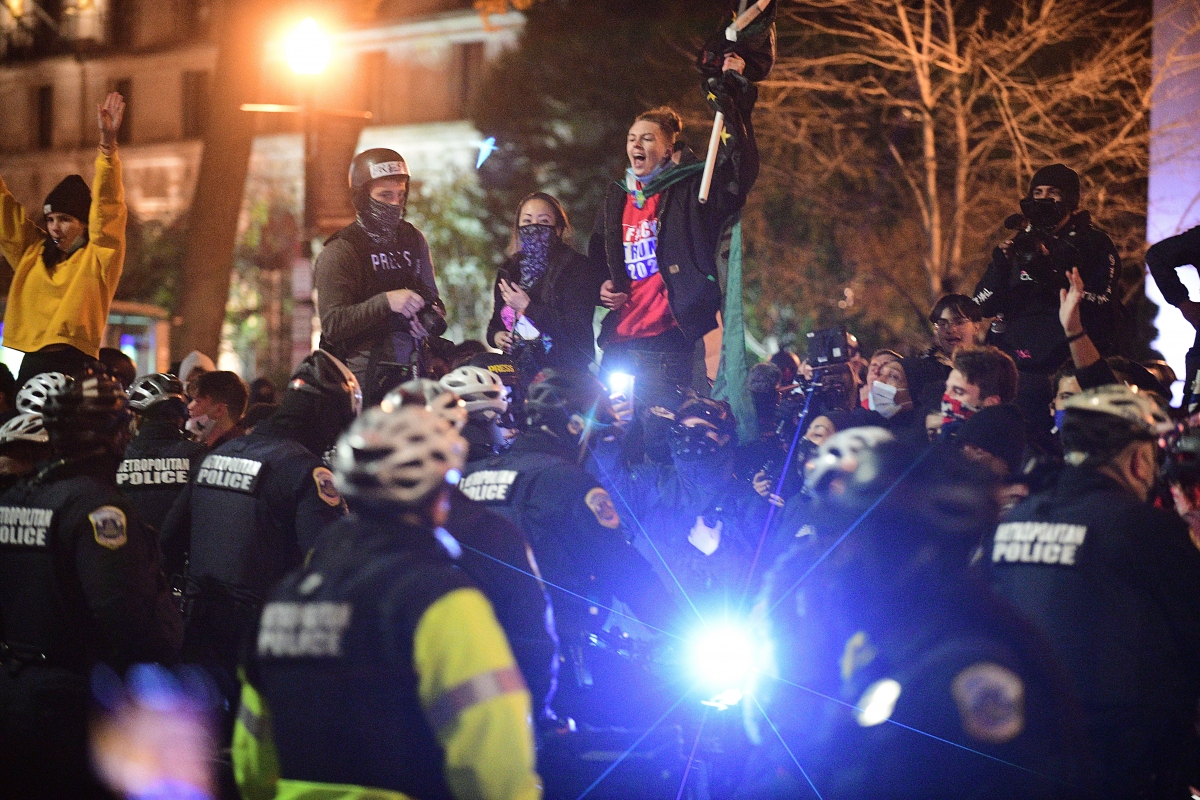
WASHINGTON – D.C. police said Sunday that nearly two dozen people were arrested, including several on gun charges, as thousands of people converged downtown Saturday for a pro-Trump march and rally. One person was stabbed and four police officers were injured.
Demonstrators confront D.C. police at Black Lives Matter Plaza in Washington, D.C., on Nov. 14, 2020. MUST CREDIT: Photo for The Washington Post by Astrid Riecken
For the better part of the day, police managed to keep supporters of President Donald Trump and his opponents apart, save for minor skirmishes during a “Stop the Steal” rally.
Organizers of the event falsely claim that the election won by President-elect Joe Biden was stolen.
Tensions grew as the main march moved from Freedom Plaza to outside the U.S. Supreme Court, and as the final speeches ended, clashes turned into roving street fights that left police struggling to keep up.
Shortly before 8 p.m., members of the extremist group the Proud Boys and other Trump supporters moved through downtown in the area of 12th and F streets NW. At the same time, a group of counterprotesters moved north on 10th Street.
It was not clear whether the groups, which were blocks apart, were initially aware of each other’s location. Police said they were monitoring both as they neared a collision course.
The groups met head-on at H Street near 11th Street. Police in riot gear rushed toward the fray but not quickly enough to stave off a brawl involving dozens, including the Proud Boys, that left participants bloodied and one man stabbed three times in the back and seriously wounded.
“I came here to fight,” a Trump supporter yelled moments before the clash began.
The day’s outcome appeared inevitable despite attempts by hundreds of police dealing with unrest throughout downtown.
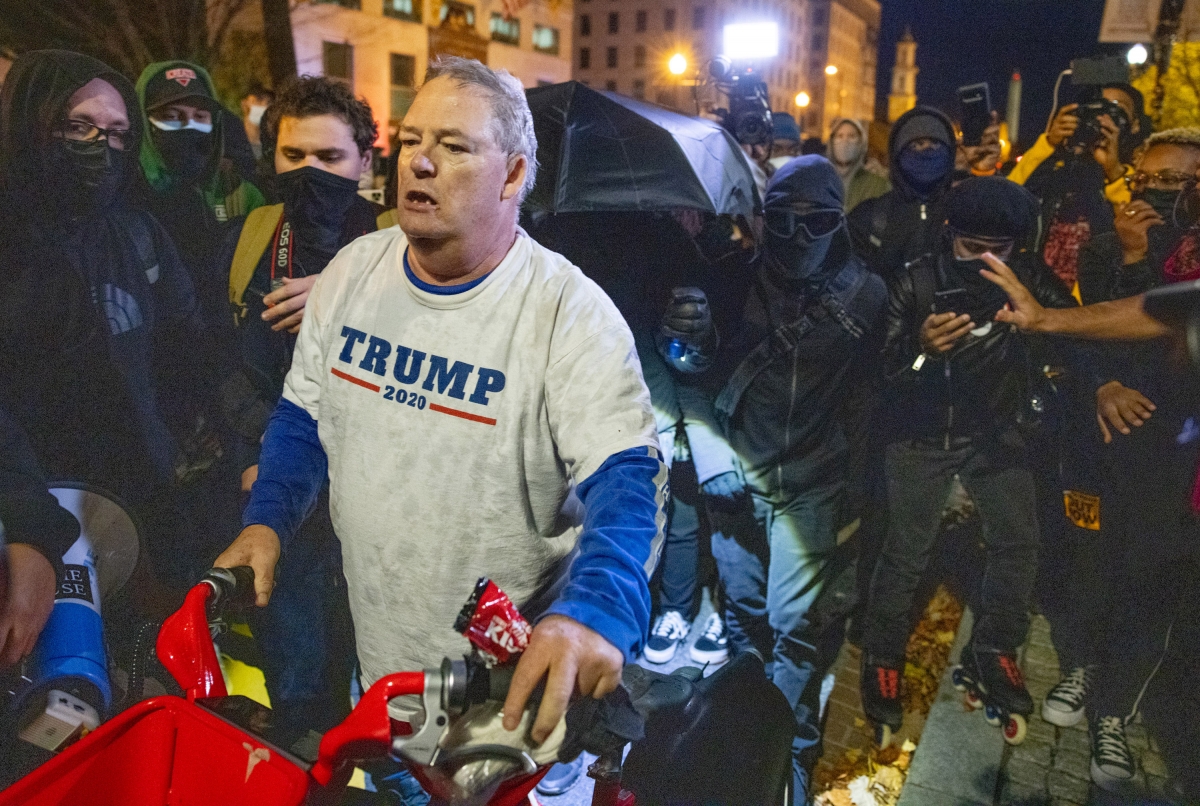
Protesters force a Trump supporter out of Black Lives Matter Plaza in Washington, D.C., on Nov. 14, 2020. MUST CREDIT: Photo for The Washington Post by Evelyn Hockstein
D.C. Police Chief Peter Newsham said people from both sides – and from outside and inside the region – came “intent on clashing,” and “the police department was put directly in the middle of it.”
Newsham said as opposing groups faced off, “police officers ran and placed themselves between them,” which he said he believed “prevented a much worse outcome.”
“We did our damnedest” to prevent violence, Newsham said. “We were doing the best we could to keep them separated.”
In all, police arrested 21 people, including one juvenile, on charges that include assault, disorderly conduct and inciting violence. Eight firearms were seized and five people were arrested on gun charges, including two Newsham said were linked to a Georgia-based militia group.
Newsham said police found three additional firearms and ammunition in a room linked to the two: Joshua Skillman, 28, and Samantha Falk, 33, both of Georgia. The name of the group was not available.
The others arrested on gun charges were identified as Jason Fisher, 41, of Virginia; Braxton McDonald, 28, of New Jersey; and Kenneth Deberry, 39, of Washington, D.C.
Of the adults arrested, nine are from Washington, three are from Maryland, two are from New York, two are from Georgia and one each are from Virginia, New Jersey, and South Carolina. The residence of one of those arrested was unknown.
Four officers were injured, one seriously when a chemical was sprayed into an eye.
D.C. Mayor Muriel Bowser, D, declined to comment Sunday. A spokeswoman said Bowser planned to address the news media and discuss the events on Monday.
On Sunday morning, Black Lives Matter Plaza near the White House had returned to relative quiet, though some volatility remained when a group of women started tearing down signs condemning racism, honoring Black people killed by police and denouncing Trump.
The women, who declined to give their names, clawed at the posters and tore them to the ground. A few people who arrived earlier to protect the wall, including 57-year-old software engineer Mike Manos, tried to guard the posters with their bodies.
“You have the right to put it up, we have the right to tear it down!” one woman shouted.
Everett Turner, 62, a mason from Washington, said he was on a bike ride before he stopped near the White House. “It’s sad,” Turner said. “Just get ready for the new president and move on.”
A few moments later, Turner got into a screaming match with a woman wearing a “Make America Great Again” hat.
“Go back to Europe or somewhere!” Turner, who is Black, shouted.
“Your ancestors sold you!” the White woman screamed back.
Police officers moved between the groups and admonished the women tearing down the posters to stop, though they did not physically intervene. Newsham said officers try to avoid getting involved in the destruction of signs, worried that their intervention could escalate tensions, and that it might not be illegal to remove signs placed on public property.
However, by Sunday evening, police had cordoned off a section of the plaza that had been vandalized, in what appeared to be an effort to prevent more destruction.
Trump – who in September refused to denounce the Proud Boys and instead urged them to “stand back and stand by” – appeared to relish the mayhem. In one tweet, Trump wrote, “Antifa SCUM ran for the hills today when they tried attacking the people at the Trump rally, because these people aggressively fought back.”
The outgoing president also tweeted for D.C. police to “Get going – do your job and don’t hold back!!!” in arresting counterprotesters. He accused Bowser of “not doing her job!” as he linked to a video of an older man dressed in pro-Trump regalia being hit in the face from behind and falling to the pavement, bleeding and unconscious.
But the video showed only part of the incident. A longer video posted online shows the man pushing a counterdemonstrator to the ground, stomping on his head and shaking his fist at people. Police said they arrested four people at that scene, including one charged in the assault. Newsham said the incident remains under investigation and could lead to charges filed against the older man.
Black Lives Matter DC, in turn, blamed Trump supporters for instigating the violence, and alleged in a tweet that “MPD has been protecting the Proud Boys and white nationalists all night,” and that police only put on riot gear and fired chemical irritants at city residents.
“They allowed white supremacists to spend the day in our City doing whatever they want while not wearing Masks,” the group said.
Another anti-Trump group, All Out DC, took to Twitter to complain that not enough of their supporters turned out, and said, “The people who stayed home today enabled fascist violence.”
No arrest was made in the stabbing, which injured a man who police said provided them with home addresses in the District and in Maryland. The incident occurred near 10th Street and New York Avenue NW during a brawl that had erupted nearby. A police report says the victim did not cooperate with investigators.
Police said that among the arrests were people – one from New York, the other from the District – who are charged with beating a person with a flagpole after that person tried to steal a sign. Another person was charged with throwing a firework at several people.
The individuals with firearms-related charges could make initial appearances in D.C. Superior Court on Monday.
Newsham said that “the majority of people left after the sun went down,” which was around the time the events at the Supreme Court had ended. There were still sporadic clashes that appeared isolated, some outside hotels where Trump supporters were staying.
Anticipating crowds and potential violence, police had blocked traffic from a wide swath of downtown, and as the formal event ended and people departed from the Supreme Court, police sealed off Black Lives Matter Plaza for a time to prevent rival groups from heading there.
One group of Trump supporters marched while tearing down Black Lives Matter signs from buildings, which police said they intervened to stop, as another group paraded a large blue and white banner with the slogan, “Trump law and order.”
By 12:30 a.m., there were few if any counterprotesters left, and the group with the Trump banner split. Many ducked into the Trump International Hotel, as a few people with the banner continued on into the now-quiet night.
By The Washington Post · Paulina Firozi, Hannah Knowles · NATIONAL, HEALTH, HEALTH-NEWS
Coronavirus cases reported in the United States passed 11 million on Sunday, as the nation shatters records for hospitalizations and daily new infections and as leaders turn to new, painful restrictions to stem the pandemic’s long-predicted surge.
The milestone came one week after the country hit 10 million cases, a testament to just how rapidly the virus is spreading – the first 1 million cases took more than three months. This new wave has increased covid-19 hospitalizations past the peaks seen in April and July, straining health-care systems and pushing some reluctant Republican governors to enact statewide mask mandates for the first time.
Other states are reenacting stay-at-home orders and store closures. Michigan Gov. Gretchen Whitmer, D, on Sunday announced sweeping new limits on gatherings for three-weeks – including a ban on indoor dining at restaurants and bars, and a halt to in-person classes at high schools and colleges. Washington Gov. Jay Inslee, D, also laid out a slew of new rules, which prohibit indoor social gatherings with people outside one’s household and indoor service at restaurants, bars and more.
“As hard as those first months were for our state, these next few are going to be even harder,” Whitmer said at a news conference, as health experts fear that winter weather driving people indoors will accelerate the crisis.
Inslee acknowledged that slowing the virus would come at a steep price for struggling businesses, even as the state works to distribute millions more in aid. He and Whitmer both appealed to the federal government to step in with more help. Congress remains deadlocked on a stimulus package, and President Donald Trump – still denying his election loss – largely has tuned out the pandemic’s surge; his refusal to concede is also stalling the transition to a new administration, including the formal transfer of information on the nation’s pandemic response.
Whitmer said that Trump has “an opportunity to meet the needs of the people of this country” and emphasized the importance of his final months in office. Inslee was already looking ahead to the administration of President-elect Joe Biden.
“All of us who feel, as I do, the pain of the small-business people ought to be pounding the doors of the Congress and the new president, who I’m glad we’re going to have, to really get this job done,” Inslee said.
Washington’s restrictions are not as tough as its stay-at-home order issued in March but extend into nearly every aspect of daily life. Wedding and funeral receptions are forbidden. Religious services and in-store retail are forced to operate at reduced capacity. Even outdoor social gatherings must be kept to a maximum of five people from outside one’s household.
Inslee and other leaders in the state emphasized the need to intervene early amid spiraling statistics, even as Washington posts some of the lowest numbers for new coronavirus infections in the country. The number of hospital patients with covid-19 recently rose about 40 percent in a week, officials said, and Seattle’s mayor said that nearly a fifth of the city’s cases have come just in the past two weeks.
Clint Wallace, an ICU nurse in Spokane, joined Inslee at Sunday’s news conference to plead with residents for their help. He called the ICU “as busy as I’ve seen it.”
“We are exhausted,” Wallace said of health-care workers around the state.
State and local officials nationwide are reinstating restrictions to fight the virus. New Mexico and Oregon on Friday ordered extensive new statewide shutdowns, while the Navajo Nation – devastated early on by the virus – reissued its stay-at-home order for at least three weeks. The Navajo Nation said cases threaten to swamp the health system on the southwestern reservation without immediate action.
North Dakota Gov. Doug Burgum, R, on Friday issued a statewide mask mandate and new capacity limits on businesses, less than a week after Utah Gov. Gary Herbert, R, announced a similar mask order in the face of overwhelmed hospitals warning that they might have to ration care.
“Our situation has changed, and we must change with it,” Burgum said in a late-night video message.
But state rules are just one piece of the puzzle, and some leaders are looking to Congress and the incoming president to take stronger action.
Ron Klain, Joe Biden’s incoming chief of staff, said Sunday it’s critical for the president-elect’s transition team to start working with Trump administration officials to ensure “nothing drops in this change of power” that could imperil the distribution of a potential coronavirus vaccine.
“Joe Biden is going to become president of the United States in the midst of an ongoing crisis. That has to be a seamless transition,” Klain said on NBC News’s “Meet the Press.”
The Trump White House is blocking the administration from formally cooperating with Biden, forcing the president-elect’s transition team to continue preparations with recently departed government officials and other experts. That means Biden’s team has not heard from Trump’s about vaccine development and other work to combat the pandemic.
A health expert on Biden’s covid-19 advisory board said there’s “a lot of information that needs to be transmitted. It can’t wait until the last minute.”
It is in the nation’s interest that the transition team get the threat assessments that the team knows about, understand the vaccine distribution plans, need to know where the stockpiles are, what the status is of masks and gloves,” said Atul Gawande, a surgeon at Brigham and Women’s Hospital and a professor at Harvard Medical School, on ABC News’s “This Week.”
Anthony Fauci, head of the National Institute of Allergy and Infectious Diseases, compared the process Sunday to “passing a baton in a race.”
“I’ve been through multiple transitions now, having served six presidents for 36 years, and it’s very clear that transition process that we go through . . . is really important in a smooth handing over of the information,” Fauci said on CNN’s “State of the Union.”
“Of course it would be better if we could start working with them,” he added when asked whether working with Biden’s team would serve the public interest.
On “Meet the Press,” Klain said there is “not that much Joe Biden can do right now to change things,” because he is not yet president.
“Right now we have a crisis that’s getting worse,” Klain said. “We had never had a day with 100,000 cases in a single day until last week. By next week, we may see 200,000 cases in a single day.”


 British Prime Minister Boris Johnson
  A visitor poses for a selfie photograph at the Badaling section of the Great Wall in Beijing on Oct. 1, 2020. MUST CREDIT: Bloomberg photo by Yan Cong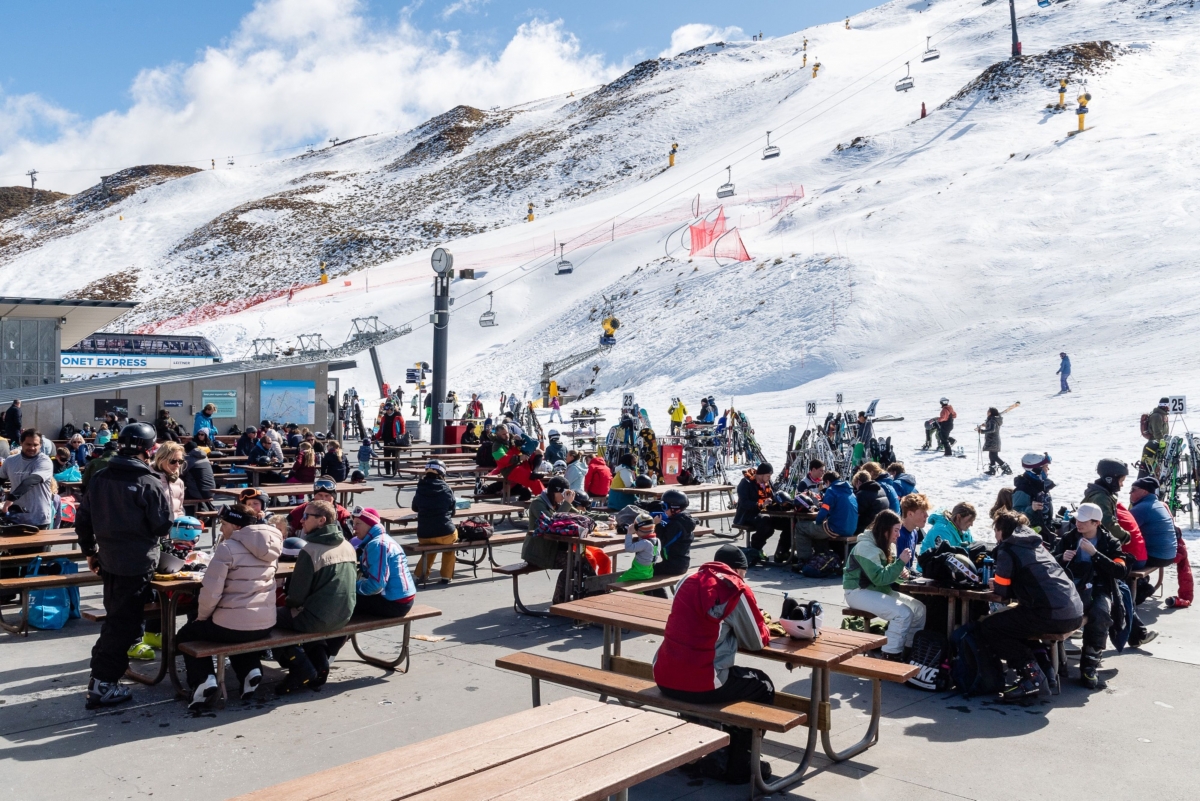
 Joe Biden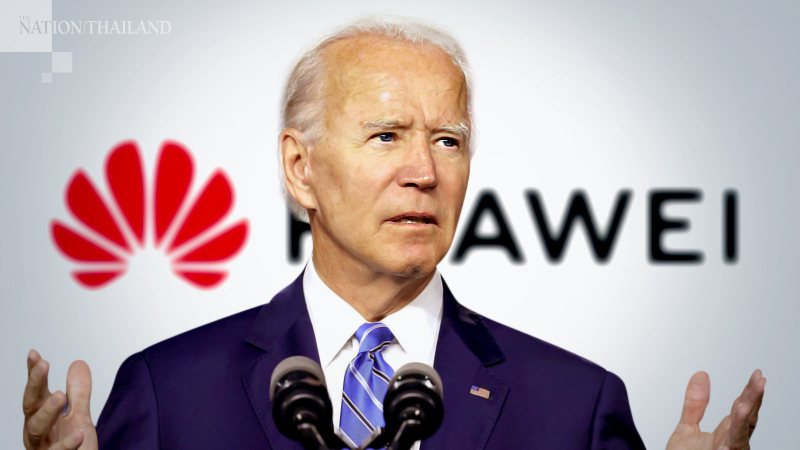
 Dominic Cummings waits with a box on a London street corner after departing from 10 Downing Street on Nov. 13, 2020. MUST CREDIT: Bloomberg photo by Hollie Adams.
  Supporters of President Donald Trump, including White supremacists and far-right extremists like Proud Boys, Oath Keepers, Nicholas Fuentes and Jack Prosobiec, rally at Freedom Plaza in Washington, D.C., on Nov. 14, 2020, to show their alliance in the president’s fight to deny his electoral defeat. MUST CREDIT: Photo for The Washington Post by Astrid Riecken
 Camilo Sandoval, far left, works in a makeshift war room in Vienna, Va., on Saturday. Sandoval is the federal government’s chief information security officer. MUST CREDIT: Washington Post photo by Marvin Joseph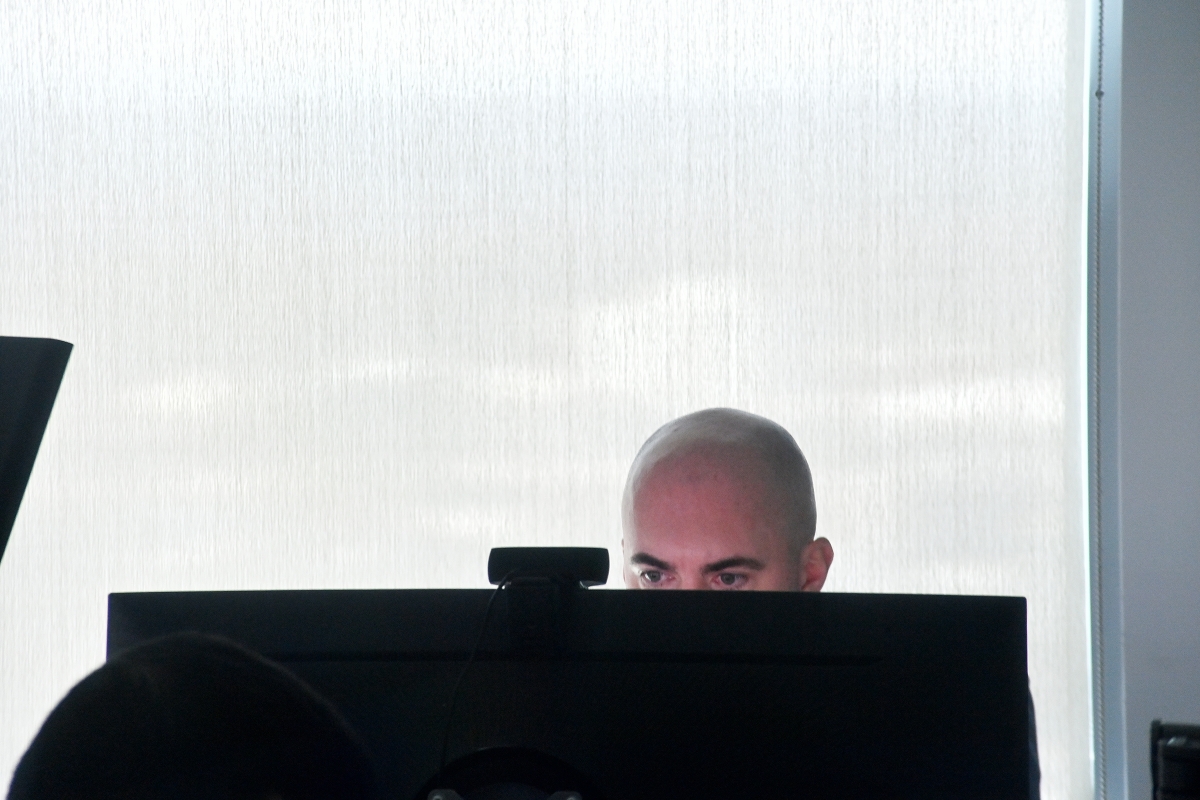
 Members of Proud Boys march at the Washington Monument on Nov. 14, 2020, in Washington, D.C. MUST CREDIT: Photo for The Washington Post by Evelyn Hockstein