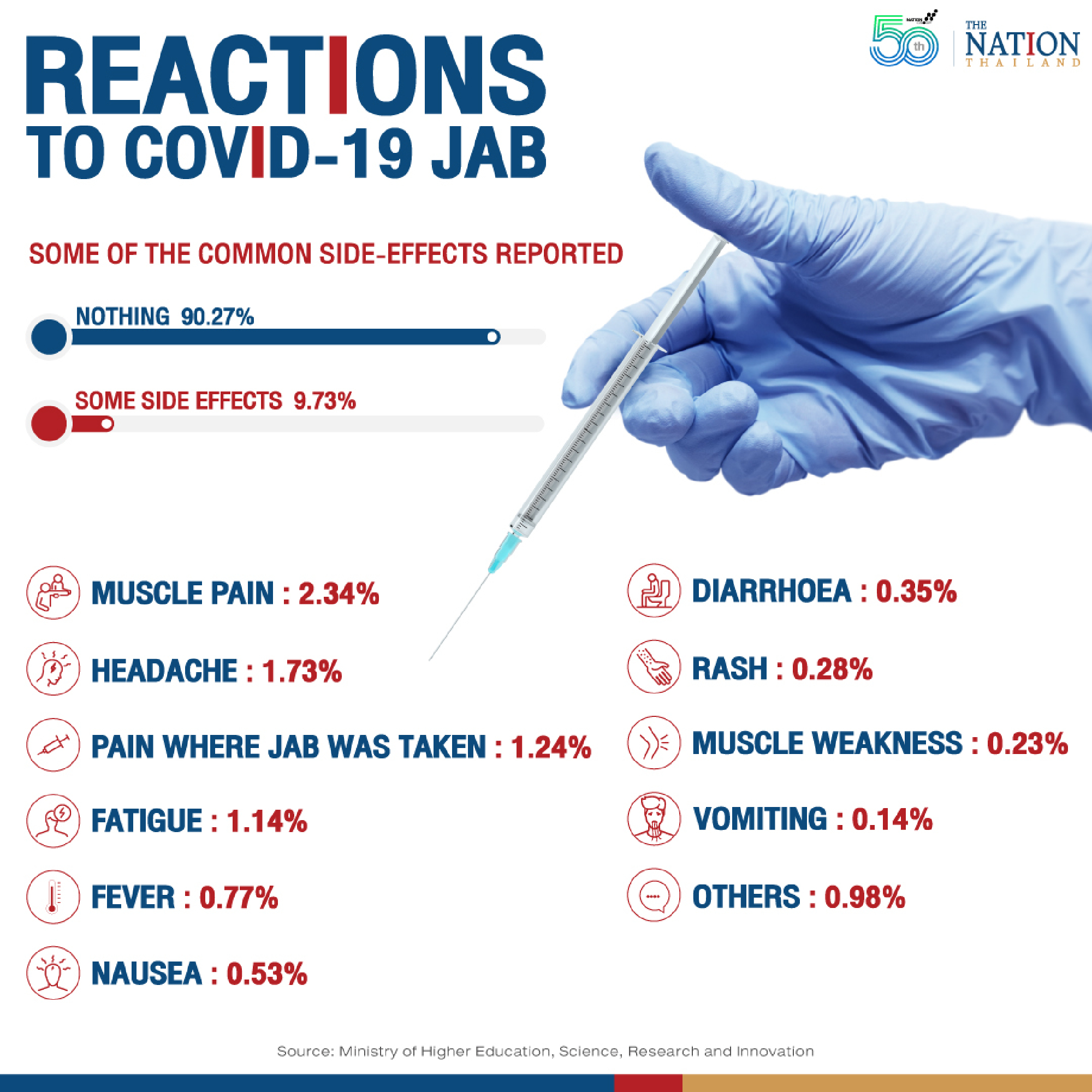
Most people (90.27 per cent) had no side effects after getting their Covid-19 jab, the National Research Council of Thailand and the Higher Education, Science, Research and Innovation Ministry reported on Friday.
Among those who have received a Covid-19 jab, only 9.73 per cent reported some side effects, the most common being muscle pain, headache and pain where the jab was taken.
Even though the vaccines being administered have been approved by the Food and Drug Administration, people are still advised to observe their symptoms and seek medical help if they worsen.
Assoc Prof Dr Panpit Suwangool, an infectious diseases specialist at Bangkok Hospital, is advising people to consume a lot of water to avoid blood clots and take paracetamol for fever or headache.
“People who develop a rash, high fever, dizziness, muscle weakness or pain in the chest should see a doctor immediately,” she said.
She also urged people to continue wearing facemasks, wash hands regularly and maintain social distancing. She added that people who have visited high-risk areas or come in contact with Covid-19 patients must go into self-isolation for 14 days.
“People who have been infected with Covid-19 should receive their jab three months later because there is no information on the duration of immunity after infection,” she added.
FDA advisers debate standards for a coronavirus vaccine for young children
WASHINGTON – With coronavirus vaccines available to adolescents and adults, regulators are now turning their attention to younger children and the level of proof needed before authorizing shots for children as young as six months.
On Thursday, many members of a panel that advises the Food and Drug Administration on vaccines argued that faster authorization should be an option because of uncertainties about virus variants and a potential fall surge in cases.
The discussion was not centered on a particular vaccine, and it unfolded as Pfizer-BioNTech and Moderna conduct trials of their vaccines in children.
The Pfizer-BioNTech vaccine is already authorized for adolescents as young as 12, and Moderna announced Thursday it had submitted an application to the FDA for authorization for adolescents. Executives from Pfizer and Moderna have said that data showing whether their vaccines are effective in younger children are expected by fall.
The timeline is welcome news to many families eager to go back to normal and gain confidence about in-person school. But the expert discussion included many points of disagreement and often strayed into currently unanswerable questions about the future, reflecting how the question about vaccines for children may become emotional and tricky in the fall. Because covid-19, the disease caused by the virus, rarely results in serious illness in young children, several of the advisers argued that a longer and more conventional review of the vaccine should take place.
But A. Oveta Fuller, associate professor of microbiology and immunology at the University of Michigan Medical School, said that as the country opens up, she fears that unvaccinated children who have been largely insulated from the virus would begin to bear the burden of disease.
“We haven’t seen it for the children because they have been isolated, or there are other mitigations,” Fuller said at the meeting of vaccine advisers. As mitigation measures are relaxed, she said, the virus could take root in unvaccinated populations. “I think we are in an emergency situation, and we will be going into winter.”
Children can suffer a rare inflammatory condition after infection, and about 300 children and adolescents are among the nearly 600,000 people in the United States who have died of covid-19.
The risk to children varies with age: Data presented at the meeting showed that children under age 5 were less likely to be infected or to have illness with symptoms compared with older children. But hospitalization rates – although low compared to adults – were similar.
The role that children play in transmission is still poorly understood, but Hannah Kirking, a medical epidemiologist at the respiratory viruses branch of the Centers for Disease Control and Prevention, presented unpublished data that suggests children of all ages play a role similar to adults in transmission and infection.
“I very strongly believe that we need a vaccine for adolescents and children, but I want to be sure that the risk of the vaccine is lower than the risk of hospitalization” from covid-19, said Cody Meissner, an infectious-diseases physician at Tufts Medical Center, noting that vaccines can carry risks and young children have a very low risk of being hospitalized. “As we generate herd immunity, this disease is disappearing, between the vaccine and natural immunity.”
The meeting included a review of evolving data on rare cases of inflammation of the heart muscle – known as myocarditis – that most often occur days after the second dose of the Moderna or Pfizer-BioNTech vaccine, predominantly in younger men. Public health officials have not drawn a link to the shot, but are investigating. Israeli health officials have said there is a probable link.
Tom Shimabukuro, a CDC official, presented slides showing that half of the 528 cases reported in a safety database occurred in people 12 to 24 years old, even though they represent only 9% of vaccine recipients. He also showed that the cases in younger age groups are occurring more frequently than would normally be expected.
Some experts said that untangling whether there is a link between the vaccines and the myocarditis cases is necessary before making a vaccine more widely available to children.
Coronavirus cases have been plummeting in the United States, and the summer is expected to bring further relief, with much of the eligible population vaccinated. But the fall and winter present an unknown, and many on the panel did not share Meissner’s confidence that the virus would not be a threat in autumn.
With the virus continuing to circulate globally and children returning to in-person school, many of the FDA advisers expressed concern that the virus would take hold among people who are not vaccinated – sickening some children and resulting in transmission to other vulnerable people. Others pointed out that children are routinely vaccinated for diseases far more rare than covid-19.
“We still vaccinate children in this country for polio, even though we have not had a case since the 1970s,” said Paul Offit, a vaccine expert at Children’s Hospital of Philadelphia. “The notion that we are not going to have to vaccinate children going forward, I think, is wrong.”
For full approval, the FDA would typically require six months of follow-up of 3,000 children ages 6 months to 12 years. But because of the health emergency, the agency has authorized coronavirus vaccines in other age groups based on two months of median follow-up of study participants. Granting emergency authorization would make it theoretically possible for children to have access to the vaccine as soon as this fall.
“I’d hate to not have the tool,” said Eric Rubin, an infectious-disease expert at the Harvard T.H. Chan School of Public Health. He said he feared what might happen when children return to school and people head back indoors, especially in swaths of the country with low rates of vaccination.
Doran Fink, an FDA vaccine expert, said increasing the size of pediatric vaccine trials would not necessarily flag rare events. Such reactions often are not detected until vaccines are used in millions of people.
Several experts recommended that infants and toddlers should be studied in slightly larger numbers given their especially low risk of covid-19 and because vaccine side effects that are manageable in adults, such as fever, could cause seizures.
Trials in children aim to figure out the protective dose – which may be lower – in progressively younger age groups. In the adult trials, researchers had to wait to see whether people who received the vaccine were less likely to fall ill than those who received a placebo. But the pediatric trials are immune bridging trials, designed to check whether children’s immune systems muster an equivalent immune response to people who were protected against illness in older age groups.
Pfizer announced this week that children between 5 and 11 years old will receive one-third the dose given to adults, with testing in that group starting this week. Children 6 months to 5 years old will receive a dose that is one-tenth of the adult dose, with studies likely to begin later in June. The Pfizer trial will include 4,500 children total in the United States, Finland, Poland and Spain. Two-thirds will receive the vaccine, and the rest will receive a placebo.
ADVERTISEMENT
Moderna’s 6,750-person trial began in March and follows a similar format, finding the right dose in three age clusters. The researchers start with a low dose and gradually increase it to a safe and tolerable level. Then, the researchers will test the safety and effectiveness of the vaccine in each age group.
Cancer patients should get inactivated Covid vaccine, says hospital director
A hospital director has advised cancer patients to choose inactivated Covid-19 vaccine to protect their weakened immune systems.
The only inactivated Covid-19 vaccine currently available in Thailand is the Sinovac brand.
Live attenuated vaccines elicit strong immune responses but are not suitable for people with a weakened immune system, said Dr Thanut Kuai-Charoenpanich, director of Chewamitra Hospital in Ubon Ratchathani.
Due to their lowered immunity, cancer patients, the elderly and those with congenital diseases are considered to be at high risk of developing severe symptoms when infected with Covid-19. They also take longer to rehabilitate than other Covid patients, Dr Thanut said.
These people need to get the Covid-19 vaccine to build immunity and reduce the risk of infection and severe symptoms, he added.
The American Cancer Society recommends that most patients with cancer or a history of cancer should get a Covid-19 vaccination but says factors to be considered include the type of vaccine, type of cancer, and treatment process.
Cancer patients who have completed treatment can be vaccinated immediately, Thanut said. However, cancer patients who are still being treated for the disease must consult their doctor to help determine the appropriate time for vaccination and also reduce the risk of side effects.





 10 มิถุนายน 2564 – 18:38 น.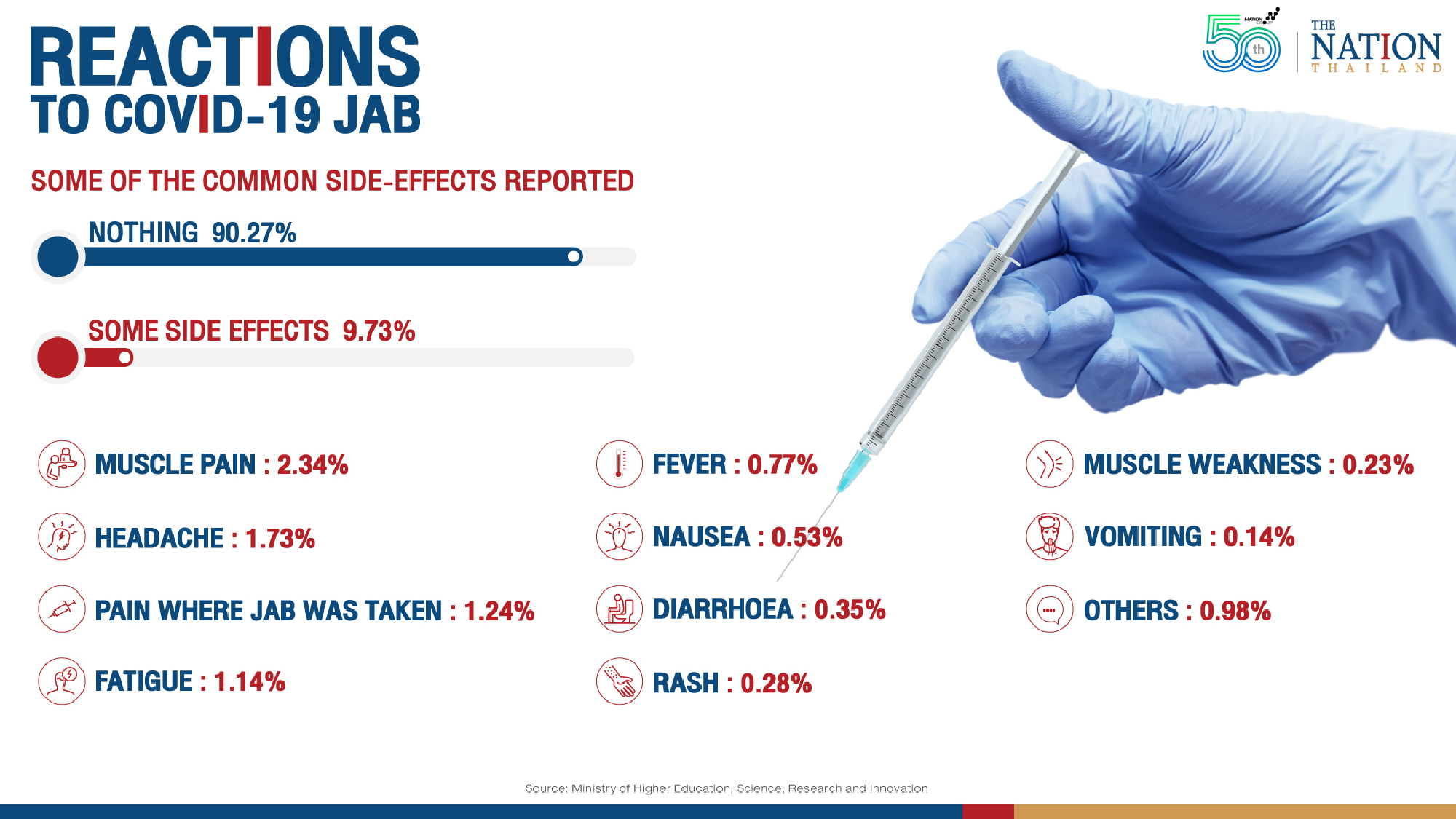
 Side effects to look out for after Covid-19 jab