Malaysia foils attempt to smuggle illegal immigrants across Thailand border
WEDNESDAY, OCTOBER 19, 2022
A human trafficking syndicate believed to be smuggling illegal immigrants from Thailand has been crippled by Malaysia’s immigration department with the arrest of a Cambodian man.
Department director-general Khairul Dzaimee Daud said the 47-year-old man was arrested while bringing five Myanmar nationals to Kuala Lumpur.
“They were detained following a special operation that was conducted at around 7pm on Sunday at the Shah Alam Bus Terminal.
“Our personnel from the Intelligence and Special Operations Division received information that an agent was bringing in five illegal immigrants.
“The three women and two men, aged between 18 and 44, were believed to have entered Malaysia from Thailand through a smugglers’ trail,” he said in a statement yesterday.
Khairul added that the six individuals were detained as soon as they came out of the bus terminal.
“Our checks showed that the Myanmar nationals did not have any documents and that they entered the country on Saturday through a non-gazetted road.
“The Cambodian man entered the country in July this year using a social visit pass,” he said, adding that the syndicate was believed to have started operations as soon as the borders reopened.
He also said checks revealed that an agent across the border would charge each illegal immigrant between 5,000 (40,000 baht) and 6,000 (48,000 baht) ringgit to make arrangements to send them across the border.
“The agent in Malaysia would then be paid 300 to 500 ringgit to smuggle them across the border.
“The six have been sent to the Immigration Detention Depot in Putrajaya while we investigate the case under the Anti-Trafficking in Persons and Anti-Smuggling of Migrants Act and Immigration Act,” he said.
A museum in Yokohama offers insights into history of Western confectionery in Japan
WEDNESDAY, OCTOBER 19, 2022
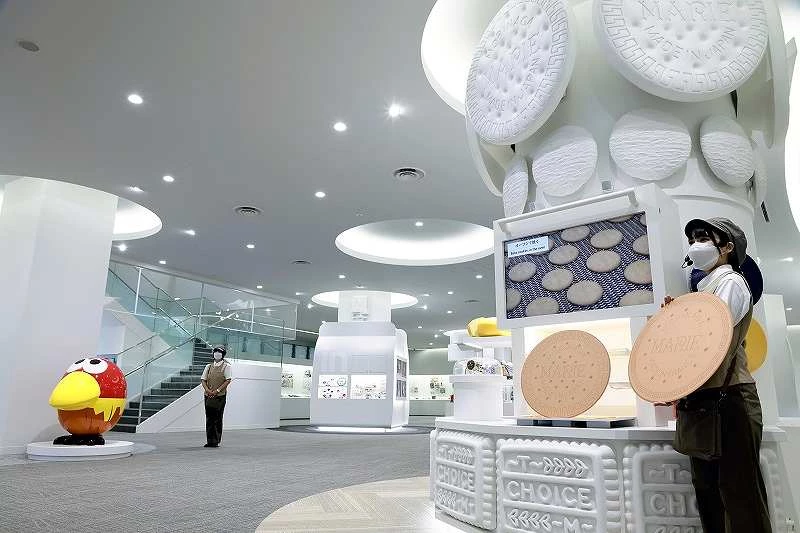
Chocolate bars, caramels, marshmallows — these Western confections are familiar today, but were a rarity for ordinary Japanese people during the Meiji era (1868-1912). Morinaga & Co, a company established at that time, manufactured and spread these products across the nation.
The Morinaga Angel Museum Morium in Tsurumi Ward, Yokohama, explains the history of the company as one of the pioneers in the industry, along with the manufacturing methods of some of their creations.
The founder, Taichiro Morinaga (1865-1937), first experienced Western confectionery when visiting the United States on unrelated business.
He received training at a confectionery factory there, and upon returning to Japan in 1899, set up his own factory with a floor area of only two tsubo (about 6.6 square metres) in Tokyo.
A section of the museum focuses on the company’s early years, with a small model of a travelling vending stall used to sell the confectioneries, which did not sell well in the beginning.
This section displays a package of milk caramel in 1914, an advertising poster, and a package of the first milk chocolate made in Japan. Museum staff provide explanations on the displays.
Another must-see display is the Omocha no Kanzume (a can of toys), a free novelty product that made its debut in the late 1960s as a giveaway for customers who bought Morinaga chocoball products. As it was featured in a TV commercial, it was coveted by many children, but only a small number of winners were able to get it.
Visitors to the museum can see many variations of Omocha no Kanzume that have changed over time.
But only the packages are on display.
“Even our president does not know what’s inside. It’s a treat only for people who get it,” company spokesperson Kazuyo Tamura said with a smile.
There is also a section of the museum explaining the manufacturing process, with videos to help explain.
The attractive crispy texture of the Choco Monaka Jumbo, an ice-cream product featuring thin chocolate sheets and monaka wafers, has always intrigued many people.
“The secret lies in our chocolate coating technique,” museum director Yoko Nakajima said. Visitors can learn about it from an explanatory video.
“I hope many people will learn about the special techniques and innovations that we have been developing and pursuing for many years,” Nakajima said.
The museum was built in 2019 to mark the 120th anniversary of the company and opened in January this year.
The emergence of the new super-wealthy global elite
WEDNESDAY, OCTOBER 19, 2022
It’s an age-old question: How much money do you need to be considered super-wealthy? A new landmark report on the rise of the centi-millionaire reveals that although a handful of the world’s billionaires, such as Elon Musk, Mark Zuckerberg, Jeff Bezos, Roman Abramovich and Bill Gates dominate the news headlines, their wealth cohort is outnumbered nearly 10-to-1 by a fast-growing global elite of highly influential super-wealthy movers and shakers who boast US$100 million or more in investible assets.
The first global study of the world’s 25,490 centi-millionaires pulls back the curtain on a growing and powerful class of super-rich tech titans, financiers, multinational CEOs, and heirs whose ranks have swelled amid a period of relative global prosperity and market gains — more than doubling in number over the past 20 years — and whose capital accumulation has been dramatically accelerated by the economically and socially disruptive effects of technology and the recent Covid pandemic.
The Centi-Millionaire Report released by international investment migration advisory firm Henley & Partners points out that in the late 1990s, US$ 30 million was considered the definition of ‘super wealthy’ but asset prices have risen significantly since then, making US$ 100 million the new benchmark.
The USA is home to an astonishing 38% (9,730) of global centi-millionaires, despite constituting only 4% of the world’s total population. The big emerging markets of China and India follow in 2nd and 3rd place, with 2,021 and 1,132 centi-millionaires, respectively.
They rank significantly higher than the main European markets, with the UK in 4th place (with 968 centi-millionaires) followed closely by Germany in 5th place (with 966). Switzerland (808), Japan (765), Canada (541), Australia (463), and finally Russia (435) make up the rest of the top 10 countries for centi-millionaires.
According to the report, there appears to be no set path to attaining centi-millionaire status but there are some notable generational differences. While a growing number of younger entrepreneurs who founded successful tech companies are newcomers to the club, Baby Boomers still tend to dominate the centi-millionaire circle despite many now cashing in their stock options and selling their businesses.
As Misha Glenny, financial journalist, author, and contributor to The Centi-Millionaire Report, points out, unsurprisingly, white males over the age of 55 from the US and Europe make up the majority of the cohort, but these demographics are shifting.
“At around 57%, the growth of centi-millionaires in Asia will be twice that of Europe and the US over the next decade. Concentrated primarily in China and India, the centi-millionaires in these countries are set to eclipse their European and American peers.”
The fastest growing market for centi-millionaires over the next decade is forecast to be Vietnam, with an astonishing 95% growth rate predicted for this emerging Asian manufacturing hub.
India is next in line with an anticipated 80% growth rate in individuals worth over US$ 100 million by 2032.
Mauritius has recently emerged as a hot spot for migrating centi-millionaires, with growth of 75% predicted for this business-friendly African island nation.
Three other countries on the continent make it into the top league of fastest growing centi-millionaire markets in the next decade — Rwanda (70%), Uganda (65%), and Kenya (55%) — with New Zealand (72%) and Australia (60%) also forecast to enjoy exceptional growth.
Commenting in the report, author, financial writer, and global investment expert Jeff Opdyke says a basic tenet of wealth preservation in the 21st century, regardless of wallet size, is diversifying away from the risk of having most or all of one’s assets exposed to a single currency, a single government, and a single legal, taxation, and financial system.
“In an era where currencies are burdened by the debts and economic weaknesses of the countries they represent, it doesn’t take much to undermine the status quo. Just look at the British pound. In the span of less than two months, it lost nearly 30% of its value relative to the dollar. That’s a major Western currency. The same can easily happen to the dollar.”
South Korea’s Kakao outage: What happens when a country relies on one app?
TUESDAY, OCTOBER 18, 2022
South Korean tech giant Kakao said most of its services have been restored following an extended outage that began Saturday. But as the country suffered a digital blackout for many hours, the dominance of this “super app” is being called into question.
Launched in 2010 as a messaging app, KakaoTalk grew in popularity exponentially over the years and branched out to other areas such as shopping and banking. Kakao also launched in-house apps that work along with KakaoTalk, such as the ride-hailing app Kakao T and GPS location service Kakao Map.
In a country of 51.8 million, KakaoTalk counted 45 million active users as of April this year, according to industry tracker WiseApp. It was also the most frequently used app in the country; South Koreans used the messenger app 72 times a day and 2,168 times a month on average.
While a Facebook or WhatsApp outage might have a similar impact in other countries, KakaoTalk’s tight grip on various aspects of life in South Korea means the consequences can be dire when it stops working.
How reliant is South Korea on KakaoTalk?
“I use Kakao T to hail a taxi. I use KakaoTalk to order Starbucks so I can use gift cards. I use Kakao Pay to order milk from E-mart regularly. Many people are in group chats on the app,” software engineer and technology journalist Lee Jun-haeng told The Korea Herald.
Lee’s tweet on how heavily reliant people are on the digital platform went viral over the weekend, racking up over 4,000 retweets.
“Hailing a taxi on the street has been almost impossible since most of them are ordered on Kakao T. But I enjoyed being able to do so over the weekend,” he said.
In addition to banking, mapping and ride-hailing, the app is also widely used for online identification verification.
When using digital government services or signing up for other apps, many people have grown reliant on Kakao’s in-app verification feature for its convenient interface.
Linked to official services
The Kakao-issued digital certificate is widely recognised by many entities in public services, banks and brokerages, including the Financial Supervisory Service and the National Pension Service.
Since early last year, people can use the app’s digital certificate when they settle their taxes. In January, the app’s certificate was used 9.79 million times for the annual year-end tax settlement service, becoming the most popular private authentication certificate provider in the country.
The app also took on a “quasi-governmental” role in the Covid-19 pandemic, according to tech critic Kim Good-hyun.
“Kakao apps play a quasi-governmental role in the country, in handling the Covid-19 pandemic or sending notifications from government offices for instance,” Kim said.
At the height of the pandemic, KakaoTalk teamed up with the Korea Disease Control and Prevention Agency to offer in-app features such as QR scanning and digital vaccine certificates. These features became essential in everyday life during the pandemic for a period, as they were required to enter big supermarkets and restaurants.
“In fear of facing criticism over the incompetence of its own system, the government let major tech firms take on the role on its behalf, driving more users to the apps as a result. It raises the potential issue of fair trade,” Kim said.
Super apps take over
The country’s mobile app landscape has faced criticism over the dominance of a handful of local super apps for not being friendly to foreigners who do not speak Korean and who are used to more global apps like Google Maps and Uber.
Kim also argues that peer pressure played a role in the app’s growth. As the app became a household name in Korea, not using KakaoTalk would be considered strange even.
“In cultures where people tend to go along with the majority, you see apps like WeChat, Line and KakaoTalk emerge, which unites a whole nation.
“The bright side is not having issues such as green bubbles and blue bubbles [when sending messages] in the US, for instance,” he said, referring to technical differences between Android and Apple users.
Tech firms are increasingly looking to develop super apps that people heavily rely on for strategic reasons while trying to cut down on staff who monitor the infrastructure, technology journalist Lee explained. Against this backdrop, he said greater efforts are needed to hold the companies accountable.
“We need a law which ensures that super apps that people heavily rely on in our everyday lives have a growing responsibility to guarantee safety,” he said.
Putin ‘wants to attend’ Bangkok Apec summit but it’s complicated: Don
TUESDAY, OCTOBER 18, 2022
Russian President Vladimir Putin has not confirmed whether he will attend the Asia-Pacific Economic Cooperation (Apec) summit in Bangkok next month, Foreign Minister Don Pramudwinai said on Tuesday.
“Putin wants to attend the meeting but he has to consider a lot of things, such as complicated travel arrangements,” Don said.
However, Don doubted other Apec leaders would be deterred from taking part in the summit if Putin does turn up.
Last Tuesday, he said no member country had said it would stay away from the Bangkok meet.
“I insist that every member of Apec will be in attendance, represented either by their leader or delegates,” Don said.
Foreign Minister Don Pramudwinai
He also confirmed that Crown Prince Mohammed bin Salman, the newly appointed prime minister of Saudi Arabia, is scheduled to attend the summit as a guest of Apec host Thailand.
Tensions between the United States, an Apec member, and Saudi Arabia flared last week after Washington accused Riyadh of pushing other members of the Opec cartel into cutting oil production by 2 million barrels per day. The move is expected to raise oil prices and increase revenue for Russia, an oil producer, softening the impact of sanctions imposed by the US and other countries over its invasion of Ukraine.
Tensions between Apec members spilled over at May’s meeting in Bangkok when the US and five other member countries staged a walkout protest over the invasion as Russia’s representative got up to speak. The May meeting also ended without the customary joint statement.
Thailand, which holds the Apec chair this year, will be looking to avoid a repeat of such scenes when world leaders arrive for the November 18-19 Apec summit at Queen Sirikit National Convention Centre in the heart of Bangkok.
Apart from Thai Prime Minister Prayut Chan-o-cha, the leader of the host nation, the following is a tentative list of Apec leaders or their representatives who are scheduled to attend the summit:
1. Russia – President Vladimir Putin
2. China – President Xi Jinping
3. Canada – Prime Minister Justin Trudeau
4. Indonesia – President Joko Widodo
5. South Korea – President Yoon Suk-yeol
6. Hong Kong – Chief Executive John Lee
7. Australia – Prime Minister Anthony Albanese
8. Chile – President Gabriel Boric
9. Brunei Darussalam – Sultan Hassanal Bolkiah
10. Malaysia – Prime Minister Ismail Sabri Yaakob
11. Mexico – Economy Minister Tatiana Clouthier
12. New Zealand – Prime Minister Jacinda Ardern
13. Papua New Guinea – Prime Minister James Marape
14. Peru – President Pedro Castillo
15. Phillippines – President Ferdinand “Bongbong” Marcos Jr
16. US – Vice President Kamala Harris
17. Saudi Arabia – Prime Minister Crown Prince Mohammed bin Salman (guest of the Thai government)
18. Singapore – Prime Minister Lee Hsien Loong
19. Representative of Taiwan President – Morris Chang
20. Vietnam – President Nguyễn Xuân Phúc
21. France – President Emmanuel Macron (guest of the Thai government)
22. Cambodia – Prime Minister Samdech Hun Sen (guest of the Thai government)
Thai SEC to host summit of international securities commissions
THURSDAY, OCTOBER 20, 2022
Thailand’s Securities and Exchange Commission (SEC) will host the 2023 annual meeting of the International Organisation of Securities Commissions (IOSCO), the SEC secretary-general said.
On Wednesday, secretary-general Ruenvadee Suwanmongkol and senior SEC officials took part in the handover ceremony for hosting the IOSCO summit during a meeting of the organisation’s Presidents Committee in Marrakesh, Morocco.
The committee is composed of presidents (chairs) of ordinary and associate members and meets once a year during the annual conference. It is chaired by the president of the ordinary member hosting the summit.
The 2023 IOSCO Annual Meeting will be held from June 13 to 15.
During the handover ceremony, Ruenvadee invited representatives of securities commissions from around the world to attend the Bangkok meeting.
They were also invited to stay on for the SEC Thailand Public Conference on June 16.
During the Presidents Committee meeting in Marrakesh, organisation members discussed the operations of the IOSCO Financial Stability Engagement Group to study and analyse financial stability of various nations so members could plan cooperation with respective central banks to maintain stability.
The meeting also discussed IOSCO operations related to digital assets.
The organisation thanked Thailand’s SEC for sending two officials to participate in its secondment policy meeting. The purpose of the secondment policy is to ensure there are appropriate human resources available at the IOSCO General Secretariat, located in Madrid.
The IOSCO is the international body that brings together the world’s securities regulators and is recognised as the global standard setter for the securities sector. The organisation develops, implements and promotes adherence to internationally recognised standards for securities regulation.
Baht strengthening may be limited in short term: market strategist
WEDNESDAY, OCTOBER 19, 2022
The baht opened at 38.09 to the US dollar on Wednesday, strengthening slightly from Tuesday’s close of 38.12.
The Thai currency will likely move between 37.90 and 38.15 against the greenback during the day, Krungthai market strategist Poon Panichpibool predicted.
He said the dollar’s strengthening might slow down as the market is in a risk-on state, but the baht is still being pressured by gold purchases and other currency transactions such as the Japanese yen.
Meanwhile, foreign investors off-loaded long-term bonds worth 5.8 billion baht in the past two days, so Poon expected any strengthening of the baht to be limited in the short term.
He did not expect the baht to exceed its support level of 37.80 to the dollar until there is a significant factor, such as the dollar weakening or foreign investors returning to buy more Thai assets.
Poon advised investors to use hedging tools such as options to manage risks in a highly volatile currency market.
The chairman of PTT’s board of directors, Thosaporn Sirisumphand, has stepped down due to political pressure, a source from Government House said on Tuesday.
The source made the remark after Thosaporn, who was also an independent director, sent in his resignation letter with effect from October 15, seven months after his appointment on April 8 this year.
The source said Thosaporn faced difficulties in his work as he stood against government officials who hold political power.
“Thosaporn had a severe conflict with the government working teams,” the source said, adding that he was pressured to resign from many positions that he holds.
The source added that Thosaporn plans to resign from all positions in the government. He is currently also the chief economic adviser to Prime Minister Prayut Chan-o-cha.
Thosaporn is considered an adviser trusted by Prayut. He had been appointed as National Economic and Social Development Council’s secretary-general instead of Porametee Vimolsiri, who became permanent secretary at the Social Development and Human Security Ministry.
A limited edition of 1 million commemorative coins for the 29th Asia-Pacific Economic Cooperation (Apec) Summit in Bangkok will be available to the public for purchase from November 1.
The move is aimed at enabling Thais to be aware of the importance of the Apec Summit and to seek their cooperation in warmly welcoming all delegates, Foreign Ministry spokesman Tanee Sangrat said on Wednesday.
He explained that the copper-nickel commemorative coin features His Majesty King Vajiralongkorn on the head of the coin and this year’s Apec logo on the back. Each coin is worth 20 baht.
The Treasury Department will allow people nationwide to purchase the commemorative coin from November 1, Tanee said.
“The Foreign Ministry will announce details about reserving the special coin soon,” he added.
The Apec Summit is scheduled to be held at Bangkok’s Queen Sirikit National Convention Centre on November 18 and 19.
Thai Foreign Ministry sets up ‘war room’ for smooth, successful Apec Summit
THURSDAY, OCTOBER 20, 2022
The Foreign Ministry has established a “war room” to ensure the Asia-Pacific Economic Cooperation (Apec) summit goes smoothly, ministry spokesman Tanee Sangrat said on Wednesday.
His statement came after Foreign Minister Don Pramudwinai presided over a meeting on Tuesday to follow up on preparations for the summit, which is scheduled to be held at Bangkok’s Queen Sirikit National Convention Centre on November 18 and 19.
Don and the ministry’s high-level officials discussed a number of issues, such as preparation for ceremonies, facilities, security, public health measures to contain the spread of Covid-19, and public relations, Tanee explained.
“Don stressed the importance of cooperation between related agencies at all levels,” the spokesman said.
He confirmed all Apec nations would attend the summit.
Thailand has already received written responses from six economies.
“Three countries have said their leaders would attend the summit, while two will send representatives to attend the meeting,” Tanee said, adding that Thailand is currently waiting for a response from four nations.
He said the complete list of Apec economies attending the summit will be announced during a meeting of the national committee for preparation of the summit on October 31, which will be chaired by Prime Minister Prayut Chan-o-cha.
Tanee said the ministry has already prepared measures to provide security to Apec delegates during the summit.
Apart from Prayut, the following is a tentative list of Apec leaders or their representatives who are scheduled to attend the summit:
1. Russia – President Vladimir Putin
2. China – President Xi Jinping
3. Canada – Prime Minister Justin Trudeau
4. Indonesia – President Joko Widodo
5. South Korea – President Yoon Suk-yeol
6. Hong Kong – Chief Executive John Lee
7. Australia – Prime Minister Anthony Albanese
8. Chile – President Gabriel Boric
9. Brunei – Sultan Hassanal Bolkiah
10. Malaysia – Prime Minister Ismail Sabri Yaakob
11. Mexico – Economy Minister Tatiana Clouthier
12. New Zealand – Prime Minister Jacinda Ardern
13. Papua New Guinea – Prime Minister James Marape
14. Peru – President Pedro Castillo
15. Philippines – President Ferdinand Marcos Jr
16. US – Vice President Kamala Harris
17. Saudi Arabia – Prime Minister Crown Prince Mohammed bin Salman (guest of the Thai government)





 Foreign Minister Don Pramudwinai


 The meeting also discussed IOSCO operations related to digital assets.


