The National Water Command Centre has warned people living on the banks of the Chao Phraya River in Bangkok to beware of rising water levels from Wednesday to next Monday.
The centre said on Monday that rising sea levels will increase the river’s level at Samut Prakan’s Chulachomklao Fort and nearby areas from 5pm to 8.30pm during this period.
In addition to this, there is rain in the upper and eastern parts of the river.
Meanwhile, water is flowing at the speed of 1,500 to 1,800 cubic metres per second through the Chao Phraya Dam and 400-500 cubic metres per second through the Rama VI Dam.
The centre expects the river’s level from Wednesday to next Monday to be around 1.9 to 2.2 metres higher than sea level. This increase is expected to affect riverside communities in Bangkok, Nonthaburi and Samut Prakan.
The centre has also called on related agencies to take the following steps:
Monitor the situation closely, inspect flood protection structures and provide updates to people living in risky areas
Prepare tools to help people and take action to ease the situation immediately
Monitor rising sea levels during this period and adjust the water-management plan for reservoirs, dams and floodgates.
Thailand International Cooperation Agency (TICA) under Ministry of Foreign Affairs will host the “2022 TICA Scholarships” event and launch a new website http://www.tica-scholarships.com on Saturday (August 27) from 13.30-15.00 hrs. (GMT+7).
The event will also be live streamed via this website.
The ministry said the new website is created as a useful source of information on scholarships and training awards offered by TICA, as well as on Thailand’s international development cooperation through human resource development cooperation by sharing its knowledge and experiences with other developing countries to support their sustainable development.
At the event, the current TICA scholarship awardees will share their experiences in Thailand. The participants will also enjoy enchanting Thai cultural performances and win special prizes from TICA.
TICA is offering participants the opportunity to register in advance for the conference through this link https://metag.pro/tica/.
For more information, please e-mail to aitc@mfa.go.th or tipp@mfa.go.th.
Nation Group CEO Shine Bunnag congratulated NationTV for winning two Mani Mekhala awards this year – one each in the “best news channel” and “best news show” categories.
The event, organised annually by the Association Reporter of Entertainment Thailand, was held on Saturday at Bangkok’s Show DC department store.
“As group CEO, I’m honoured and rejoice that NationTV has received these prestigious awards,” Shine said. “In its 52 years of operation, Nation Group has always been committed to its ideology of ethics and responsibility to society. We aim to present news impartially, monitor corruption and take care of national and public interests.
“These awards are like gifts and offer moral support to all employees of Nation Group to continue their duty for the sake of the country and society. Even though the path of true journalists will never be filled with rose petals and they will always have pressure from all sides,” he added.
The Mani Mekhala award ceremony has been held yearly since 1980 to encourage staff in the entertainment and mass media business to continue producing top-notch work.
NationTV, Thailand’s first 24-hour news channel, was launched 22 years ago and prides itself in providing high-quality, unbiased reports to the general public.
This year has also been promising for Nation Group business-wise, as the company recorded profits of 519.73 million baht in the first six months, compared with a loss of 99.87 million baht in the same period last year.
The Engineering Institute of Thailand has been told to check the shophouses at the top of Sukhumvit Soi 101/1 to find out why they are tilting at an alarming angle.
Photos of a row of the tilting shophouses were posted on Facebook on Sunday by Bangkokian Patai Padungtin sparking concern that the buildings could collapse at any time.
“Initial investigation showed no cracks in the buildings, though we believe there may be a problem with the foundation,” Bangkok Governor Chadchart Sittipunt said on Monday. “The city has therefore asked the institute, an impartial party, to find the cause, any structural weaknesses, whether the tilting of the buildings has stopped as well as estimate the danger to the public.”
The governor added that this is a serious issue as it involves the safety of residents and passers-by, while insisting that Bangkok officials will work with related parties to get to the bottom of this as soon as possible.
The governor admitted that he did not visit this neighbourhood often, and thanked people for alerting the city to the problem via social media and the Traffy Fondue application.
On Monday, he also tasked deputy governor Wissanu Subsomphon to personally notify the families living in the buildings about the investigation by engineers and ease their safety concerns.
Weerawit Triprasitthiphol, chief of Phra Khanong district’s civil engineering division, said the row of shophouses had been checked by the Thai Asset Management Corporation in 2017, which concluded that the tilting has stopped and posed no danger to surrounding buildings. Meanwhile, residents in the area have only ever lodged complaints about water drainage, never about the tilting, he said.
The second week of the Third Asia-Pacific Economic Cooperation (APEC) Senior Officials’ Meeting (SOM3) in Chiang Mai will be marked by many important APEC sub-fora discussions to promote free and open trade and investment in the Asia-Pacific region.
Aparticular focus is on driving sustainable economic recovery from the Covid-19 pandemic, which is one of the key priorities for APEC 2022, under the theme of “Open. Connect. Balance.” with the Bio-Circular-Green (BCG) Economy Model as the overarching thinking.
One of the most important agendas for trade and investment in SOM3 is to carry on the refreshed conversation on the Free Trade Area of the Asia Pacific (FTAAP) in the post-Covid-19 context. Building on the successful outcome of the APEC Ministers Responsible for Trade (MRT) Meeting in May 2022, the Committee of Trade and Investment (CTI) will convene a meeting on August 26-27 to discuss the development of FTAAP multi-year work plan, with a view to submitting it for endorsement at the APEC Ministerial Meeting in November. The FTAAP multi-year work plan will be an important achievement of APEC 2022. It will establish a long-term framework for APEC to continue advancing the FTAAP agenda, with an aim to promote free and open Asia-Pacific economy that offers trade and investment opportunities for all.
The CTI will also discuss FTAAP capacity building programmes, aimed at narrowing the gap between APEC member economies in different stages of development. CTI experts will plan a series of work programmes to exchange knowledge, best-practices and experiences among APEC members on important topics related to advancing regional economic integration, such as labour-related provisions in FTAs/RTAs, regulating solid waste trade for economic sustainability, promoting MSME engagement in e-commerce on regulatory procedures for low value shipments.
Knowledge and experiences sharing is a vital mechanism for APEC to carry out its role as an incubator of ideas conducive to sound economic policy options. In SOM3, many APEC sub-fora will organise workshops and dialogues for key stakeholders such as the business sector, academia and international organisations to discuss various topics instrumental to promoting sustainable and inclusive economic recovery. For example, last week, the APEC Investment Experts’ Group hosted a workshop on government strategies to attract green FDI and promote sustainable infrastructure. This week, the APEC Group of Services will organise a dialogue on women and services to promote inclusivity in this sector. It will also host a private-public dialogue on logistics services to exchange views on the challenges faced by firms operating in this sector, including express delivery, shipping, air transport and port operations. These workshops and dialogues allow an insight into first-hand experiences of private sector, which in turn enables APEC’s policymakers to respond to their real needs and address their challenges effectively.
Under the “Open” priority of APEC 2022, Thailand seeks to open the region to all trade and investment opportunities, where all businesses can benefit from a more open and conducive business environment. The FTAAP agenda and its multi-year work plan, which is the key deliverable under this priority, will contribute to advancing the APEC Putrajaya Vision 2040 for an open, dynamic, resilient and peaceful Asia-Pacific community.
The Public Health Ministry reported on Tuesday (August 23) that over the past 24 hours, 1,488 Covid-19 patients have been admitted to hospitals.
The death toll has risen by 26, while 2,394 patients have recovered and discharged from hospitals.
The number of cumulative cases in the country since January 1, 2022, stands at 2,413,764 with 10,383 deaths.
The country’s total caseload from Covid-19 stands at 4,637,199 – 4,587,221 of whom have recovered, 17,897 are still in hospitals and 32,081 have died.
Separately, another 1,365 people were given their first Covid-19 shot in the last 24 hours, 2,003 their second shot and 10,607 a booster, bringing the total number of Covid-19 vaccine doses administered nationwide to 142,481,893.
According to Worldometer, confirmed cases globally had risen to 601.81 million on Tuesday, 576.44 million of whom have recovered, 18.89 million are active cases (43,835 in severe condition) and 6.47 million have died (up by 1,244).
Thailand ranks 29th in the global list of most cases, which is topped by the US with 95.45 million, followed by India with 44.36 million, France with 34.36 million, Brazil with 34.29 million and Germany with 31.87 million.
Pets are becoming an important part of our lives, as not only do they offer unconditional love but also help us deal with our hectic lifestyles. For many, their pets are like their sons, daughters or beloved family members and are treated likewise.
Linda Pantanella Nilson, a pet lover turned entrepreneur, spotted this “oppawtunity” and launched MyFriend Your Pet’s app, an online app that caters to pets and pet owners’ needs by providing all kinds of information, ranging from tips on taking care of the pet to consultations and even throwing a party for your four-legged “son” or “daughter”.
“The pet industry continues to grow in Thailand. According to a recent survey, Thailand has the highest pet ownership ratio in Asia [after Indonesia] with 75 per cent of Thai families having one pet or more. Falling birth rates in Thailand and change of mindset in millennials are also creating a high demand for pets,” said Mathieu Hervillard Le Peillet, co-founder and chief executive officer of Thai Innovative Technologies Co, Ltd – creator of the MyFriend app.
Mathieu Hervillard Le Peillet
The Covid-19 pandemic also triggered a “loneliness epidemic”, with people becoming increasingly isolated while working from home or being quarantined as high-risk cases. Hence, demand for pets has risen as people need some company and moral support.
The bilingual (English/Thai) app offers pet parents an all-in-one service that allows them to voice their opinions, participate in discussions and share the latest trends. Pet parents can also “shop” for treats on the app and within this month, the app is expected to launch a pet-insurance scheme. Pet alerts and pet hotel bookings will be launched next month, and other exciting pet solutions will be launched before yearend. Call (02) 123 8744 or email info@myfriendapp.com, or download the app from the App Store and Google Play.
When food delivery platforms first emerged, they were hailed as an innovation that would bring convenience to our everyday lives. Suddenly, with just a few taps on their phone, epicures could have the world’s cuisine delivered to their doorsteps.
Small restaurant owners got access to a much wider pool of customers. People got jobs as delivery riders. Delivery start-ups were the darlings of the capital markets, receiving massive investment.
But after a decade of living with food-delivery apps, South Koreans are starting to question whether they have made us happier.
Kim Seung-june, 32, said doubts were roused by his recent experience.
Preparing for a housewarming party, he browsed the Baedal Minjok app for fried chicken and bossam, a Korean pork dish. The two dishes from two different restaurants had a combined price of 50,000 won (1,380 baht), but the delivery charges accounted for almost a quarter of that – 10,000 won.
“I ended up picking up the food from restaurants myself. I knew the delivery fee was soaring, but this was too much,” he said.
Surveys indicate Korean customers are losing their appetite for food delivery for this and other reasons.
A poll by the Seoul Institute in March found that 52 per cent of Seoul citizens who did not use delivery services in the first quarter of this year cited rising food and delivery costs.
The average cost for food delivery in Seoul in May rose about 12 per cent from March, said the National Council of Consumer Organisations. The cost of delivering a meal for a single person shot up by more than 40 per cent.
Restaurant owners are also complaining about the rise in fees they pay on orders received via delivery platforms.
“Delivery only makes small profits. Orders for a single serving generate hardly any profit margin,” said Kim Sung-hwan, who runs a small American-Chinese restaurant in Mapo-gu, Seoul. He said he would stop using delivery services if he had enough direct orders from customers.
Oh Eung-kyung, who opened a dessert cafe in Seongbuk district last November, said one-third of what customers pay via delivery apps goes to the platforms.
“During the first three months of opening, I only charged customers 2,000 won for each delivery. With that, the profits were not even enough to pay for the labour I put in,” she said. Oh added that she delivers coffee to locations close to her store to save costs.
What customers pay for delivery fees doesn’t cover the cost of hiring a rider. Restaurant owners usually shoulder part of the actual delivery costs in order to attract more customers, on top of paying commissions to the platform for each order placed through the app.
So are delivery platforms raking in profits after hiking fees and commissions? Not really.
Woowa Brothers, the operator of Baedal Minjok, posted 2 trillion won (53.7 billion baht) in revenue in 2021, nearly doubling its 2020 revenue as the prolonged Covid-19 pandemic pushed up demand for food deliveries. But its operating loss soared nearly sevenfold to 75.7 billion won over the same period.
Coupang Eats logged 3.5 billion in operating losses in 2021. Unlisted Yogiyo is not required to disclose earnings but its profit structure closely resembles that of its competitors.
The food delivery market has grown rapidly since the Covid-19 pandemic started. According to Statistics Korea, the food delivery market last year was worth 25.7 trillion won, 2.6 times bigger than in 2019.
Announcing its 2021 earnings in late March, Baedal Minjok said the loss resulted from outsourcing – mainly the expenses it paid to riders for delivery fees. It spent some 574 billion won on outsourcing last year, a huge jump from 181 billion won in 2020.
Increased competition among platforms has created a vicious circle.
The increase in delivery costs was driven by the introduction of single-meal delivery service by Baedal Minjok and Coupang Eats. Handling just one order at a time, riders could deliver individual orders more swiftly, compared to bundled deliveries which see them pick up multiple foods at once and deliver them to multiple locations.
The platforms scurried to recruit delivery agents needed for the new service by granting rewards and incentives, resulting in a huge increase in related costs.
So has the rise of food delivery apps made the lives of delivery workers better?
Pay and conditions have certainly improved, but even here there is still widespread dissatisfaction. Trade unions say that delivery workers are among the least protected workers in the economy. Working mostly on-demand as gig workers, riders are entitled to few if any of the work-related benefits ordinary workers get. Their plea for better protection has sparked debate in South Korea about the protection of workers in the gig economy.
Baedal Minjok and Coupang Eats, after a long tussle with delivery unionists over working conditions such as no insurance coverage for traffic accidents, have decided to hire full-time delivery workers. Unionists are now demanding an increase in the portion of the delivery fee that goes into riders’ pockets per order fulfilled.
The Korea Herald
Asia News Network
Asia News Network: The Nation (Thailand), The Korea Herald, The Straits Times (Singapore), China Daily, The Jakarta Post, The Star and Sin Chew Daily (Malaysia), The Statesman (India), Philippine Daily Inquirer, Yomiuri Shimbun and The Japan News, Gogo Mongolia, Dawn (Pakistan), The Island (Sri Lanka), Kuensel (Bhutan), Kathmandu Post (Nepal), Daily Star (Bangladesh), Eleven Media (Myanmar), The Phnom Penh Post and Rasmei Kampuchea (Cambodia), The Borneo Bulletin (Brunei), Vietnam News, and Vientiane Times (Laos).
An arm of Japanese rail firm JR East has created a fast-track way for wannabe campers in Tokyo to get a taste of the outdoors life.
JR East Urban Development Corp., which mainly manages land under elevated railway tracks, has established a pop-up camping site near JR Akihabara Station in the capital’s Taito Ward to help people experience the activity, which has grown in popularity amid the coronavirus pandemic.
At the site, which opened on Aug. 13 and is running until Aug. 24, staffers offer help and advice on such topics as setting up tents and packing them away. Visitors also can cook using gas burners and even stay overnight.
“We want people to enjoy both camping and walking around central Tokyo,” a staff member said.
Fees to use the site start from ¥2,000. According to the company, reservations to use the site have been almost fully booked.
The Japan News
Asia News Network
Asia News Network: The Nation (Thailand), The Korea Herald, The Straits Times (Singapore), China Daily, Jakarta Post, The Star and Sin Chew Daily (Malaysia), The Statesman (India), Philippine Daily Inquirer, Yomiuri Shimbun and The Japan News, Gogo Mongolia, Dawn (Pakistan), The Island (Sri Lanka), Kuensel (Bhutan), Kathmandu Post (Nepal), Daily Star (Bangladesh), Eleven Media (Myanmar), The Phnom Penh Post and Rasmei Kampuchea (Cambodia), The Borneo Bulletin (Brunei), Vietnam News, and Vientiane Times (Laos).
Police want the kid gloves to come off when dealing with negligent parents after data shows that failing to monitor their young children properly could have led to over 200 accidental deaths yearly.
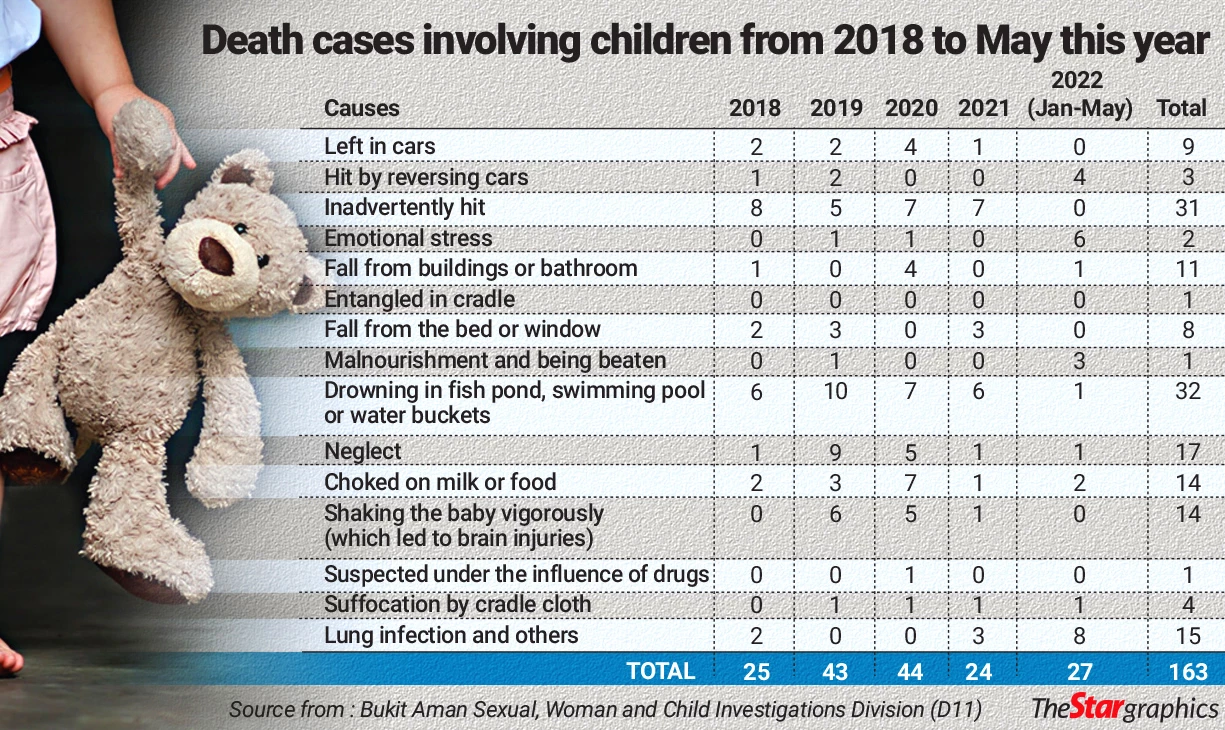
Cases of such parental neglect include allowing their underage children to drive, leaving them alone at home or inside vehicles, and neglecting to oversee their activities until these result in drowning during bathing, falling inside fish ponds or getting entangled in cradles.
Some even accidentally hit their children while reversing their cars.
Data shared by the Bukit Aman Sexual, Women and Child Investigations Division (D11) showed that there were 163 deaths involving children between 2018 and May this year that could partly have been due to the parents’ negligence. The numbers do not include those involving fatal accidents by unlicensed underage drivers.
D11 principal assistant director Asst Comm Siti Kamsiah Hassan said she believed that negligent parents should at least face some form of punishment.
“For me, punishment should be given at the bare minimum, at least, to serve as a lesson and to ensure that this does not recur,” she said.
ACP Siti Kamsiah told The Star that 38% of such cases were classified as “No Further Action” or NFA for various reasons, while 43% saw the legal guardian of the children involved being charged. The rest are still under investigation.
“The deputy public prosecutor (DPP) would have their reasons (not to pursue action). They would have to think of the implications, for example, if the father is the family’s breadwinner and having him sentenced to jail would only worsen the family situation,” she said.
To a question whether such “leeway” could be why cases of parental negligence continued to persist, ACP Siti Kamsiah disagreed, adding that she believed more awareness needed to be given to childcare.
“Parents sometimes take for granted that it is safe to leave their children at home but fail to look into other aspects, such as whether there is a grille (on the windows or balconies) or if the gap between the grille is too wide,” she said.
After seeing the promising effect in a case where a parent was held responsible for his child’s involvement in mat lajak activities, Bukit Aman Traffic Investigation and Enforcement Department principal assistant director (enforcement) Supt Dr Bakri Zainal Abidin hoped similar action would also be taken against those who allowed their children to drive without licences.
Police statistics showed that Malaysia recorded 8,484 accidents involving unlicensed teenage drivers and motorcyclists between 2018 and March this year. Of this total, 2,617 cases have resulted in either fatal accidents or serious injuries.
“There was a mosquito bike case (mat lajak) in Selangor where we decided to take action against the parent under the Child Act 2001. When the news broke, we could see that the number of cases in the state dropped by 50% because parents feared the jail sentence and the hefty fines.
“So, we want the DPP to impose stern punishment (on parents who allow their children to drive without licences) so that this can serve as a lesson to the community. Otherwise, we will face such menace (underage driving) forever,” he said.
So far, underage drivers and those who allow minors to drive their vehicles would only be issued with compounds.
Malaysian Institute of Road Safety Research chairman Assoc Prof Dr Wong Shaw Voon said imposing punishment on parents would show the government’s seriousness in handling the issue of unlicensed driving.
“We should start charging the parents.
“Of course, the judge may impose RM300 or RM2,000, but it will still send a powerful message.
“This will encourage parents to be careful and to take full charge of the vehicles that they possess,” he said, adding that some even allowed their children to use their vehicles to school.
He said parents should be given equal punishment in cases where their children caused harm to others due to underage driving.
“We have to ensure that if an underage child drives without a licence and someone gets killed (as a result), the parents should be given maximum sentences too.
“For example, Section 41 of the Road Transport Act states that one can be imprisoned. So, we need to look at our laws to ensure that parents too can be jailed; otherwise, they won’t be scared.
Aliza Shah
The Star
Asia News Network
Asia News Network: The Nation (Thailand), The Korea Herald, The Straits Times (Singapore), China Daily, Jakarta Post, The Star and Sin Chew Daily (Malaysia), The Statesman (India), Philippine Daily Inquirer, Yomiuri Shimbun and The Japan News, Gogo Mongolia, Dawn (Pakistan), The Island (Sri Lanka), Kuensel (Bhutan), Kathmandu Post (Nepal), Daily Star (Bangladesh), Eleven Media (Myanmar), The Phnom Penh Post and Rasmei Kampuchea (Cambodia), The Borneo Bulletin (Brunei), Vietnam News, and Vientiane Times (Laos).



 Mathieu Hervillard Le Peillet