Chairman of the State Administration Council (SAC) Senior General Min Aung Hlaing has dismissed the allegations that the Tatmadaw (military) burned down the homes of civilians in Myanmar.
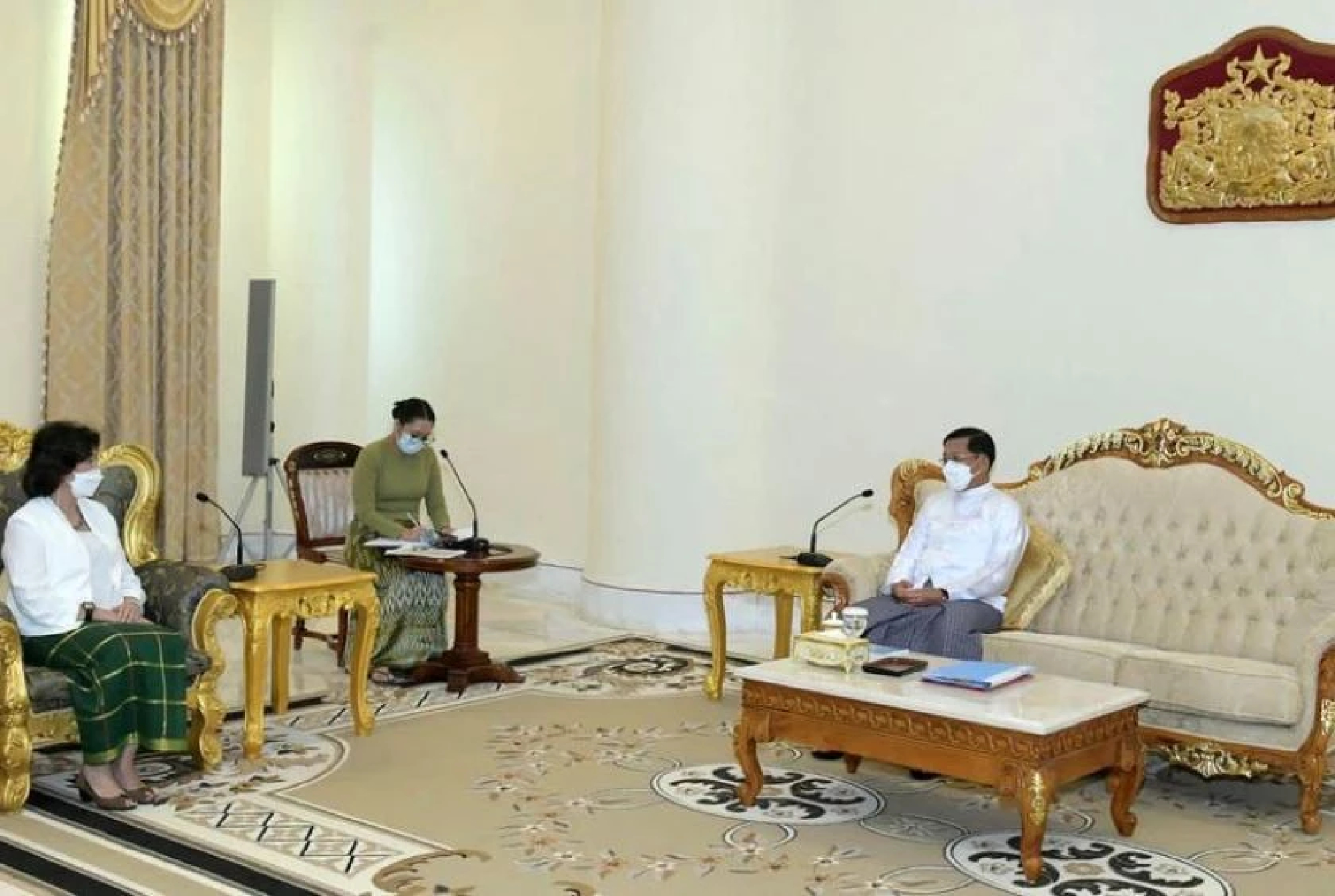
In meeting with the SAC chairman in Nay Pyi Taw on August 17, Noeleen Heyzer, Special Envoy of the United Nations Secretary-General on Myanmar, said she had no mandate to make any decision but to point out and discuss the development of Myanmar. The purpose of visiting Myanmar was to convey the message of the Secretary-General and make two specific requests: to halt the aerial bombing and to stop burning the villages and houses of the people, she added.
In response, Senior General Min Aung Hlaing gave a reply, which was included in a statement on their detailed discussions released by the SAC information team on August 19.
“We are just targeting the location of the insurgents who attack security forces and countering them. We will never initiate the attack if there is no attack on us. And there is no government and country in the world that accepts armed attacks. I categorically rejected the allegation of burning the villages and houses of the people. The Tatmadaw always protects the people of Myanmar. The Tatmadaw has been providing relief services to the people whenever they are hit by natural disasters,” the Senior General said in his reply.
As an example, he pointed out that with the permission of the government, the Nippon Foundation had provided assistance to refugees in Myanmar. And there are also other organizations which had provided assistance to them.
He further said: “It is common sense that we would never burn and destroy the houses of the people for whom we are responsible to protect. Therefore, I totally deny the alleged burning of villages.”
Eleven Media
Asia News Network
Asia News Network: The Nation (Thailand), The Korea Herald, The Straits Times (Singapore), China Daily, Jakarta Post, The Star and Sin Chew Daily (Malaysia), The Statesman (India), Philippine Daily Inquirer, Yomiuri Shimbun and The Japan News, Gogo Mongolia, Dawn (Pakistan), The Island (Sri Lanka), Kuensel (Bhutan), Kathmandu Post (Nepal), Daily Star (Bangladesh), Eleven Media (Myanmar), The Phnom Penh Post and Rasmei Kampuchea (Cambodia), The Borneo Bulletin (Brunei), Vietnam News, and Vientiane Times (Laos).
Singapore will decriminalize sex between men, the prime minister said on Sunday, adding that society in the city-state was becoming more accepting of gay people.
But he added the government had no intention of changing the city-state’s legal definition of marriage – that is, between a man and a woman.
“I believe this is the right thing to do, and something that most Singaporeans will now accept,” Prime Minister Lee Hsien Loong said in the annual national day rally speech, adding the government will repeal Section 377A of the penal code, a colonial-era law that criminalizes sex between men.
“Even as we repeal Section 377A, we will uphold and safeguard the institution of marriage… Under the law, only marriages between one man and one woman are recognized in Singapore,” Lee added.
Singapore residents on Monday welcomed Prime Minister Lee Hsien Loong’s plan to decriminalise sex between men, even though he had no plans to change the legal definition of marriage as being between a man and a woman.
“Very outdated law. I mean, repealing it sounds like it makes a lot of sense right now,” said Lim, a 48-year-old local resident who only provided his surname. Another resident said the legal adjustment would be a “timely” move and a “well-struck balance”.
Lee’s announcement was also welcomed by LGBTQ groups who said in a joint statement they were “relieved”. But they also expressed concern that ruling out same-sex marriage would help to perpetuate discrimination.
It was unclear when exactly Section 377A of Singapore’s penal code, a colonial-era law that criminalises sex between men, would be repealed. Under the law, offenders can be jailed for up to two years, but it is not currently actively enforced.
Security forces have ended a siege by al Qaeda-linked militants at a hotel in Somalia’s capital in which more than 20 people were killed and dozens injured, authorities said on Sunday.
Dozens of people who had been taken hostage in the stand-off at the Hayat Hotel in Mogadishu were freed.
Elite armed forces battled the militants for 30 hours from Friday evening after the attackers blasted and shot their way into the hotel, which is popular with lawmakers and other government officials.
“We have confirmed so far 21 dead people and 117 others injured,” Ali Haji, the minister for health, told national broadcaster SNTV.
Three attackers were shot dead during the military operation to end the siege, said Hassan, a police captain who only gave one name.
A fourth one was shot dead in the area on Sunday morning as he attempted to melt into the civilian population, Hassan said, adding that the exact number of attackers was still unclear.
The al Qaeda-linked al Shabaab group, which has been fighting to topple the government in the Horn of Africa country for more than a decade, claimed responsibility for the attack.
Friday’s attack at the Hayat was the first major incident since President Hassan Sheikh Mohamud took office in May.
The attackers shot and killed civilians who fled towards the wall of the hotel compound and its blown-up gate after they struck, said a police captain who gave only the name Ahmed, adding that they killed 10 security personnel with firearms and grenades.
The daughter of an ultra-nationalist Russian ideologue who advocates Russia absorbing Ukraine was killed in a suspected car bomb attack outside Moscow on Saturday evening, Russian state investigators said on Sunday.
Darya Dugina, daughter of prominent ideologue Alexander Dugin, was killed after a suspected explosive device detonated on the Toyota Land Cruiser she was travelling in, investigators from the Moscow region said in a statement.
Russia’s TASS state news agency quoted Andrei Krasnov, someone who knew Dugina, as saying the vehicle belonged to her father and that he was probably the intended target.
Father and daughter had been attending a festival outside Moscow and Dugin had decided to switch cars at the last minute, Russian government newspaper Rossiiskaya Gazeta reported.
TV footage accompanying the statement showed investigators collecting debris and fragments from the spot where the explosion happened.
Investigators, who described Darya Dugina as a journalist and political expert, said they had opened a murder case and would be carrying out forensic examinations to try to determine exactly what had happened.
They said they were considering “all versions” when it came to working out who was responsible for the crime.
Alexander Dugin, Darya’s father, has long advocated the unification of Russian-speaking and other territories in a vast new Russian empire.
He wants that empire to include Ukraine where Russian forces are currently carrying out what Moscow calls a “special military operation” to demilitarize Ukraine.
The influence of Dugin, who is on a U.S. sanctions list, over Russian President Vladimir Putin has been a subject of speculation, with some Russian watchers asserting that his sway is significant and others calling it minimal.
Darya Dugina, who also went by the surname Platonova and was reported by Russian state media to be 30 years old, broadly supported her father’s ideas and appeared on state TV in her own right to offer support for Russia’s actions in Ukraine.
In a statement in March, the U.S. Treasury said Dugina, the chief editor of the United World International website, which has suggested Ukraine would “perish” if admitted to the NATO military alliance, had been put on a U.S. sanctions list.
*This content was produced in Russia where the law restricts coverage of the Russian military operations in Ukraine.
How will the metaverse build an immersive “mirror” of our real world of shops, products, companies and venues? And how can businesses in Thailand and elsewhere gain access to this lucrative virtual world, dubbed “the next internet”?
Answers to these questions were provided by Anothai Wettayakorn at “Metaverse Expo Thailand” on Sunday.
“The metaverse has already happened, and it is expanding,” said Anothai, regional director for US-based Dell Technologies.
Bloomberg Intelligence estimates that the fast-growing metaverse market will be worth US$783.3 billion (28 trillion baht) by 2024. Not surprisingly, businesses ranging from large corporations to SMEs are looking for a slice of this market, and the Thai private sector is no exception.
Anothai said cloud technology will be key to the metaverse strategies of companies transitioning to the “next internet”.
He explained that the metaverse is currently a patchwork of separate immersive pockets that will eventually be stitched together to form a seamless virtual platform.
Development of this virtual world requires huge computing power to drive real-time immersive experiences – which is where cloud technology comes in.
But also helping to build the metaverse is Dell’s Digital Twin technology, Anothai said.
Digital Twin tech enables individuals, companies and organisations to duplicate real-world items and processes in the digital world.
He added that businesses can use cloud and Digital Twin technology to provide customers with immersive experiences in everything from work and education to shopping, health and leisure.
These metaverse experiences would drive the digital economy and boost global gross domestic product, he predicted.
“In the future, many organisations will focus on doing ‘anything from anywhere’,” he said.
“The question isn’t when the change will happen, but how to prepare organisations to deal with changes,” he added.
The three-day “Metaverse Expo Thailand”, organised by Nation Group, wrapped up on Sunday.
Thai developers must join hands to compete in the global metaverse market, five experts told the “Thailand Metaverse Expo 2022” in Bangkok on Sunday.
Nattasate Trithipcharoenchai, CEO of Jenosize Digital Group, said no one could be successful in their own isolated metaverse so his company created T-Verse to connect virtual business, education, and government sectors and boost Thailand’s competitiveness.
In a talk titled “Get Ready for Your Own ’Verse”, he said that if every metaverse sector joined hands, users would benefit from a seamless, immersive experience while developers could compete on the global stage.
He added that the challenge was not how to create the metaverse, but how to make it a success. And success depended on creating everyday accessibility for people. Currently, to enter metaverse worlds, users need relatively expensive gadgets like virtual-reality (VR) headsets.
Nattasate also highlighted security concerns, explaining that users would need to feel safe when they create their second identity in the metaverse.
Content was also an issue as users will want engaging activities while spending time in the virtual world.
He went on to explain the core metaverse concept of “Digital Twins”, citing the example of a user who buys a costume for their 3D avatar that is identical to their real-world outfit. He also described the metaverse as communities where users could meet and hang out with friends
Finally, he said commerce would be a crucial aspect since the metaverse will not be sustainable without money or profits.
Jinthita Chanthasuwannasin, a Jakaverse development team executive, boasted Jakaverse will be the biggest gaming metaverse, with more than 1,000 immersive games.
Jakaverse is also focusing on e-commerce, with Thai brands already buying up land in its virtual world. Singha Corporation has purchased 100 blocks of land while the Mall Group plans to build malls in the Jakaverse.
She also mentioned that her company will be one of the first Thai developers to make its metaverse compatible with VR glasses.
Jakaphan Prachuabmoh, a member of the Jakaverse development team, said that Generation Alpha children (born 2010-2020) are already in metaverses like Roblox or Fortnite but they are not decentralised metaverses.
He said these kids will teach their parents how to access the metaverse just as children now teach baby boomers to use Line or Facebook.
Meanwhile, in building a metaverse, developers must create enjoyable experiences that differ from the real world to give users a break from their busy everyday lives, he added. The metaverse’s selling point must also be clear.
The purchasing of land was another important aspect of the metaverse. Just as in the real world, different metaverses will have different strengths and the price of virtual will become more expensive in the future.
Jakaphan also mentioned that metaverse devices and infrastructure will gradually become smaller and easier to use.
He added that big companies such as Facebook and Microsoft are already developing metaverse gadgets so other companies should hurry if they want to jump into the market.
Pongwud Praipaisankij, CEO of Multiverse Expert, said his company does not have its own platform but is creating metaverses and their functions for customers.
Multiverse Expert is also developing GameFi (Game + Finance) applications with several game engines. Two games will feature on Thailand’s Bitkub Chain ecosystem.
He echoed the importance of accessibility, noting that Web 3.0 virtual technology required users to undergo several processes before entry. He said accessibility would be a decider of whether people choose to enter the metaverse or not.
Use cases were also important as almost every “verse” in Thailand launched by first selling land and buildings and opening them but is now deciding what to do with them.
He also sees differences in Europe and Asia. Metaverses in Europe focus mainly on decentralised finance while metaverses in Asia (mostly South Korea) tend to start with a single function and later seek collaboration with other metaverses, he said.
Pongwud added that standards and standardisation were also important. He mentioned that every verse he had created used the same technology, so they could be connected easily.
He said that the Metaverse Association of Thailand has been founded to set a standard for metaverses in Thailand so they could compete against counterparts in places like Europe, where they already share technologies.
Pongwud said that users would be bored if they stay in a single metaverse for a long time and will want to visit other verses just as people travel to foreign countries.
He also recommended that developers stop hyping the metaverse and start focusing more on business models and what people will gain.
He summarised his point as: “Ignorance will be expensive.”
Worawisut Pinyoyang, co-founder of Learnity, said his company is using immersive Web 3.0 technology to build a digital academy and infrastructure to tackle education problems.
He said that educational technology is solving issues such as credit transfers and forgery of certificates and reports.
He also agreed there needs to be a central organisation so Thai developers can join hands and expand to the international market.
As a decentralised applications developer, Worawisut said that Thai developers’ mindset is focused too narrowly on serving the Thai market while foreign developers are a step ahead and thinking about the global market.
He added that the public should focus on metaverse fundamentals rather than being scared away by temporary phenomena such as the crypto crash.
He concluded that the metaverse would be the first opportunity for Thai developers to compete equally with foreign developers.
The three-day “Thailand Metaverse Expo 2022”, sponsored by The Nation, wrapped up on Sunday.
The SKiVERSE team from Chulalongkorn University won Thailand’s first Sports Metaverse Challenge tournament, bagging prize money of 100,000 baht on Sunday.
Ten teams joined the tournament on Friday at CentralWorld in the Sports Metaverse Challenge #1, part of the “Thailand Metaverse Expo 2022” held by Nation Group. Four teams were chosen to compete in the final round on Sunday.
The team SKiVERSE chose skiing to present the metaverse system that helps athletes to practise in a virtual snowy terrain.
The team’s program can be developed for practical use in Thailand which does not have snow, although Thai skiers competed in the 2022 Winter Olympics in February.
SKiVERSE’s members Lalipat Sirirat, Kanchaporn Kietkhajornrit and Raewadee Lamlertsuk said they would build on this success and further develop their program.
Meanwhile, the BS team came second with their immersive Muay Thai program, receiving 30,000 baht in prize money.
The AS2P came third with a virtual table tennis game, winning 25,000 baht, while the Dragon Boat team were fourth with their dragon boat racing program, and received 20,000 baht.
The judges congratulated all teams for helping pave the way for the first Sport Metaverse Challenge, a tournament designed to find ideas to improve athletes’ potential through the metaverse.
The Nation will continue to support the teams of e-sports developers with networking and other aid as they help lay the foundations for Thailand’s metaverse.
Danupha “Milli” Khanatheerakul, the first Thai rapper to perform in Coachella, was brimming with joy when she was able to perform on an international stage for a second time.
On stage at the “Head in the Clouds” festival in Los Angeles, Milli kept the audience rapt by peppering her numbers with aerobics and children’s games like skipping rope.
However, the rapper burst into tears and began bowing to the audience when she heard her name being shouted out by the crowd.
“It was very hard. I just want to tell you that I was honoured that I came here, I was very happy when everyone sang and danced after me,” she said.
She also thanked her fans for the opportunity to perform in California for a second time after Coachella in April, promising that she will never forget this experience.
Milli, 19, is following in the footsteps of Lalisa “Lisa” Manoban, who became the first Thai to perform at the festival with her group Blackpink in 2019.
She launched her music career in 2019 after joining the second season of Workpoint TV’s “The Rapper”.
A talented rapper in both Thai and English, Milli also dances and composes her own songs.
The “Head in the Clouds” festival is heading to Jakarta and Manila in December.
A senior virologist has ruled out the possibility of the Covid-19 and monkeypox viruses combining, after a case emerged in Italy of a patient being infected with monkeypox and Covid-19, in addition to having HIV.
In a Facebook post on Sunday, Dr Anan Jongkaewwattana, director of Veterinary Health Innovation and Management Research Group at the National Centre for Genetic Engineering and Biotechnology, explained that Covid-19’s genetic material is ribonucleic acid while monkeypox’s genetic material is deoxyribonucleic acid (DNA), hence the two cannot merge.
Anan also cited a research titled “First case of monkeypox virus, SARS-CoV-2 and HIV co-infection”, published in the Journal of Infection https://bit.ly/3AANsaO on Friday.
The research said that the patient was an Italian 36-year-old male who had spent five days in Spain from June 16 to 20 before returning to Italy. He reportedly also had engaged in unprotected sexual activities with men while travelling.
The patient received two doses of Pfizer vaccine at the end of 2021 and got infected with Covid-19 at the beginning of 2022, which was likely the BA.1 subvariant.
Nine days after returning, he developed fever, sore throat, fatigue, headache and swollen lymph nodes.
After three days, a rash started to develop on his left arm and he also tested positive for Covid-19 on the same day.
After three more days, he was admitted to the hospital with pustules on his arms, torso, palms, fingers, legs and hips.
He was detected with the monkeypox virus, the BA 5.1 subvariant of Covid-19, and HIV-1 (with a viral load of 234,000 copies per millilitre of blood) on the following day.
Researchers speculated that he may not have known that he had HIV, and might have been infected recently because his CD4 lymphocyte count was unaltered with 812 cells/μL (normal value within 410-1590 cells/μL).
The patient stayed in the hospital for six days and still tested positive for Covid-19 and monkeypox, but almost all symptoms were resolved except for pustules on his skin hence the patient was discharged to be in home isolation.
His antigen test result for Covid-19 was negative after two days in home isolation. Six days later (eight days in home isolation), he took another test for the monkeypox virus and the result was still positive while crusts had healed almost completely, leaving small scars.
There was no information on whether monkeypox from him could have spread to other people within 29 days.
Researchers deduced that the patient was infected with monkeypox first and caught Covid-19 during the monkeypox’s incubation period.
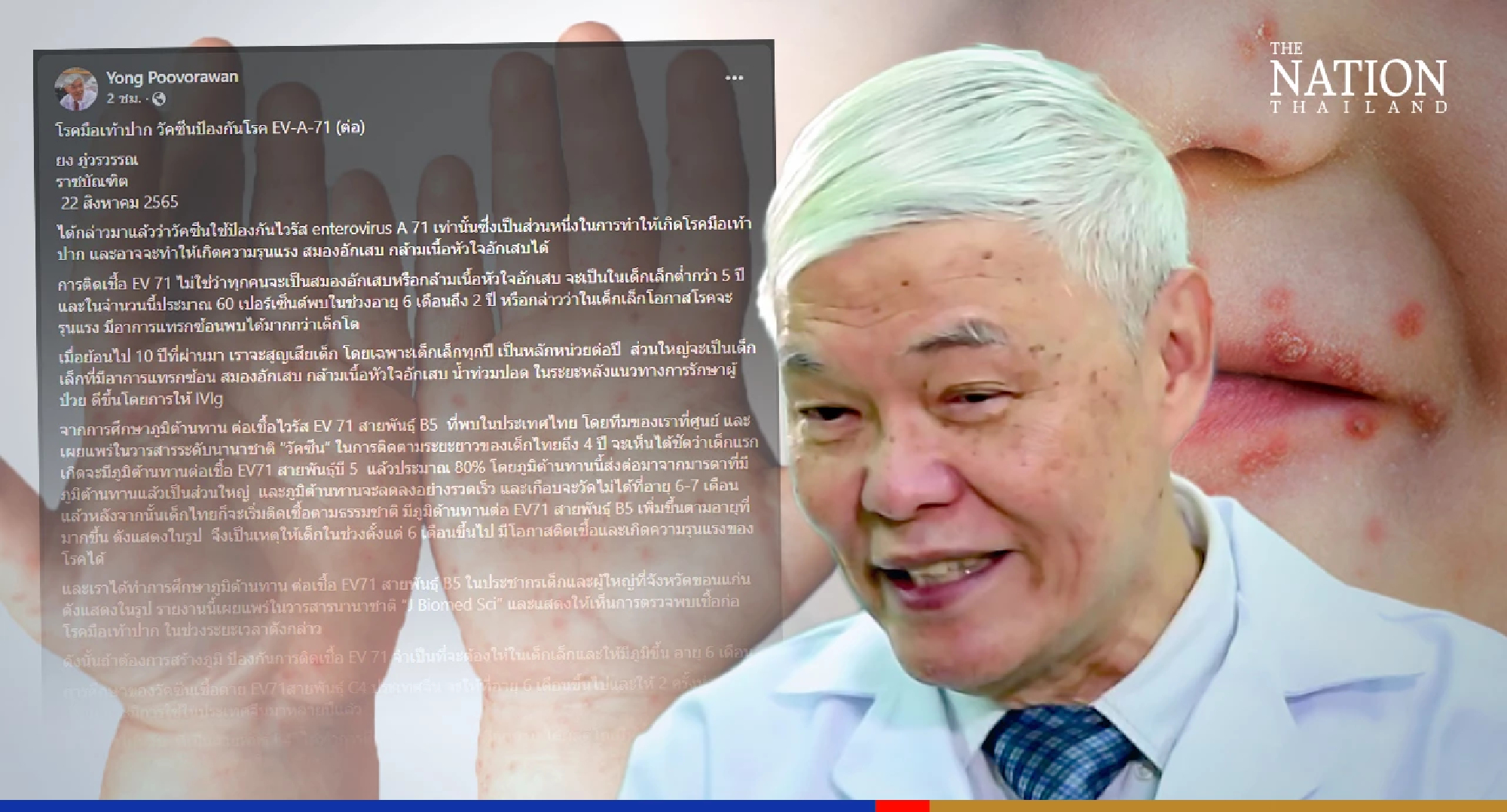
Infants aged between six months and two years can be at risk of complications from Enterovirus A71 (EV-A71) infections, a top virologist warned on Monday.
In a Facebook post, Dr Yong Poovorawan explained that apart from causing hand, foot and mouth disease, EV-A71 can also cause encephalitis and myocarditis (inflammation of the heart muscle).
He said these two conditions caused by EV-A71 have mostly been found in infants aged six months to two years.
“We have lost many children to these complications over the past 10 years,” he said, adding that treatment has improved thanks to Intravenous Immunoglobulin therapy.
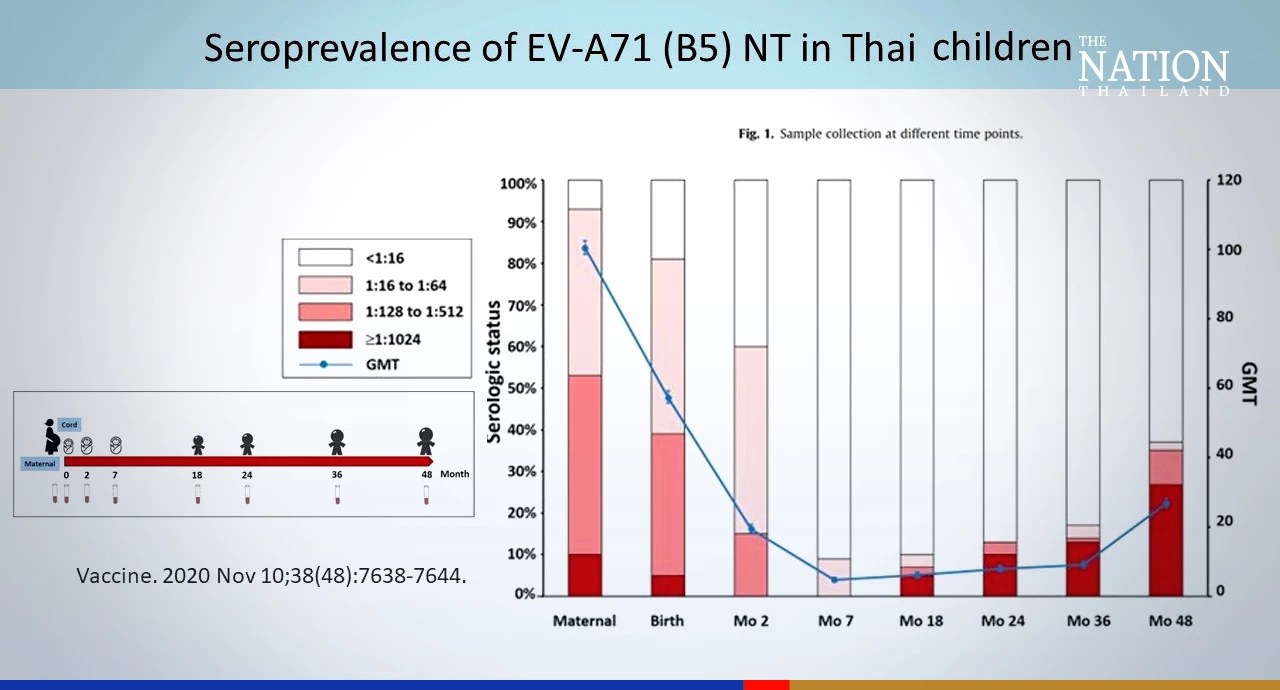
A study on infants’ immunity against the EV-A71 B5 subvariant, which has been found in Thailand, learned that children have 80 per cent immunity against the virus until they are six months old.
“This is why infants aged six months and above are most at risk,” he said, adding that infants should be vaccinated against the virus.
He added that China was already administering the two-dose vaccine against EV-A71 C4 subvariant to children aged six months or above at a month-long interval.
He also said that an initial trial of the Taiwan-produced EV-A71 vaccine against the B4 variant has been successful in both Taiwan and Vietnam. However, he said, the vaccine has not been registered yet because it is under a third clinical trial.








 Meanwhile, the BS team came second with their immersive Muay Thai program, receiving 30,000 baht in prize money.